ECU MERCEDES-BENZ E-CLASS COUPE 2009 User Guide
[x] Cancel search | Manufacturer: MERCEDES-BENZ, Model Year: 2009, Model line: E-CLASS COUPE, Model: MERCEDES-BENZ E-CLASS COUPE 2009Pages: 313, PDF Size: 7.76 MB
Page 51 of 313
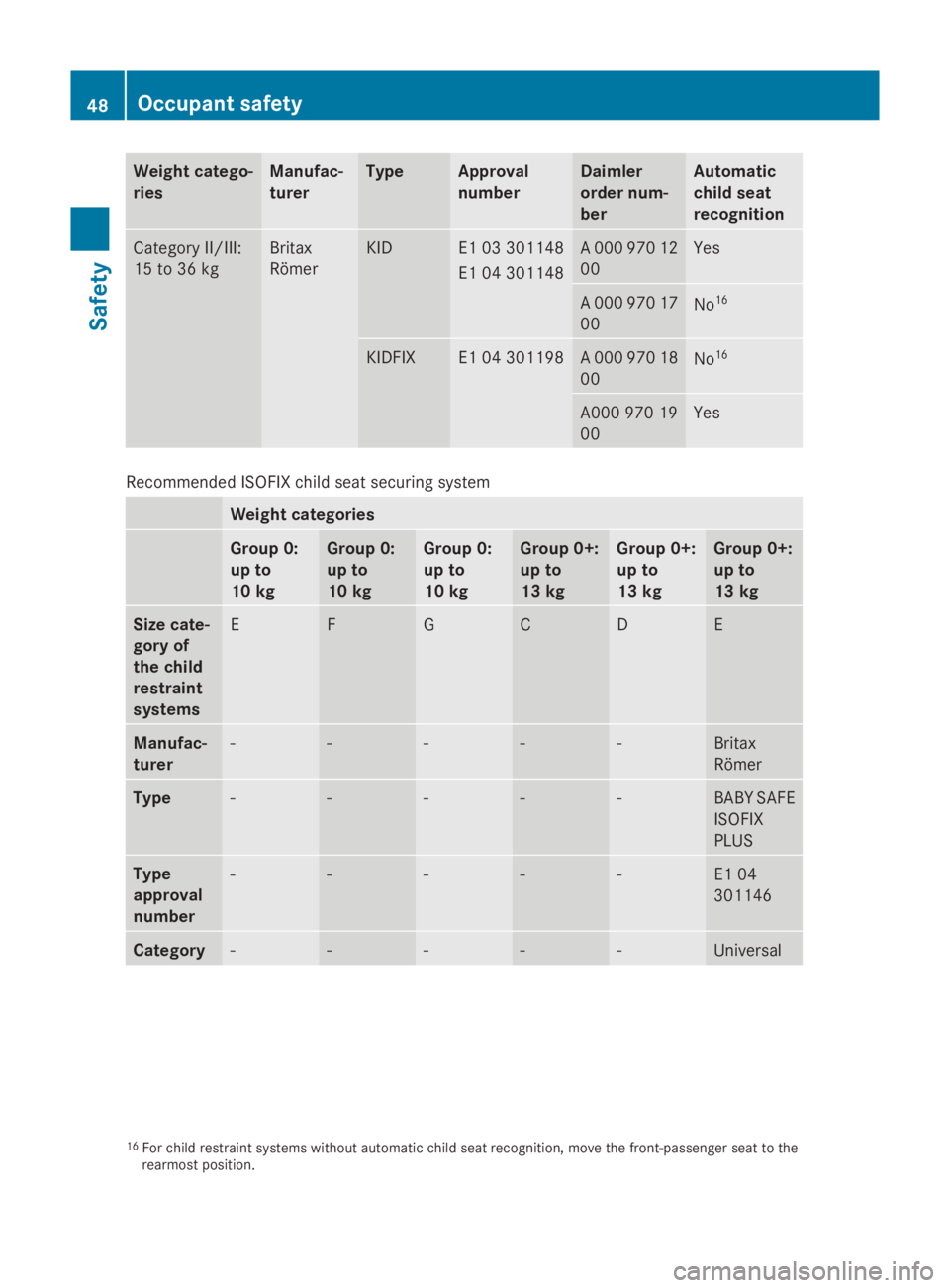
Weight catego-
ries Manufac-
turer Type Approval
number Daimler
order num-
ber Automatic
chil
dseat
recognition Category II/III:
15 to 36 kg Britax
Römer KID E1 03 301148
E1 04 301148 A0
00 970 12
00 Yes
A0
00 970 17
00 No
16 KIDFIX E1 04 301198 A0
00 970 18
00 No
16 A000 970 19
00 Yes
Recommended ISOFIX child seats
ecuring systemWeight categories
Group 0:
up to
10 kg Group 0:
up to
10 kg Group 0:
up to
10 kg Group 0+:
up to
13 kg Group 0+:
up to
13 kg Group 0+:
up to
13 kg
Size cate-
gory of
the child
restraint
systems
E F G C D E
Manufac-
turer
- - - - - Britax
Römer
Type
- - - - - BABY SAFE
ISOFIX
PLUS
Type
approval
number
- - - - - E1 04
301146
Category
- - - - - Universal
16
For child restraint systems without automatic child seat recognition, move the front-passenger seat to the
rearmost position. 48
Occupant safetySafety
207_AKB; 2; 3, en-GB
mkalafa,
Version: 2.11.8.1 2009-07-23T10:23:49+02:00-Seite 48
Page 52 of 313
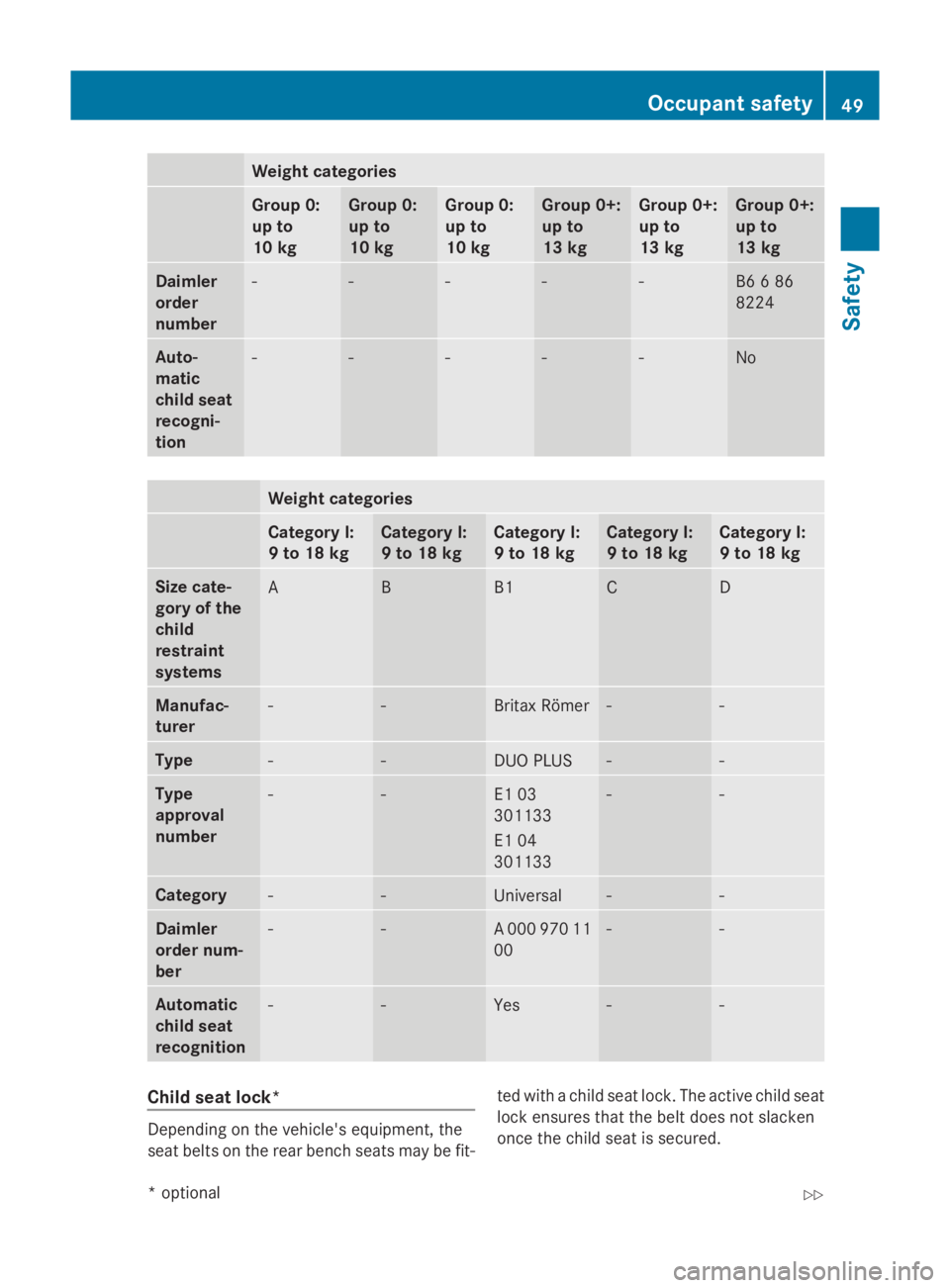
Weight categories
Group 0:
up to
10 kg Group 0:
up to
10 kg Group 0:
up to
10 kg Group 0+:
up to
13 kg Group 0+:
up to
13 kg Group 0+:
up to
13 kg
Daimler
order
number
- - - - - B6
686
8224 Auto-
matic
chil
dseat
recogni-
tion - - - - - No
Weight categories
Category I:
9to18kg Category I:
9to18kg Category I:
9to18kg Category I:
9to18kg Category I:
9to18kg
Size cate-
gory of the
child
restraint
systems
A B B1 C D
Manufac-
turer
- - Britax Römer - -
Type
- - DUO PLUS - -
Type
approval
number
- - E1 03
301133
E1 04
301133 - -
Category
- - Universal - -
Daimler
order num-
ber
- - A0
00 970 11
00 - -
Automatic
chil
dseat
recognition - - Yes - -
Chil
dseat lock* Depending on the vehicle's equipment, the
seatb
elts on the rear bench seats may be fit- ted with
achild seatl ock. The active child seat
lock ensure sthat the beltd oes not slacken
once the child seatiss ecured. Occupant safety
49Safety
*optional
207_AKB; 2; 3, en-GB
mkalafa,
Version: 2.11.8.1 2009-07-23T10:23:49+02:00-Seite 49 Z
Page 53 of 313
X
When installingt he childseat:
R comply with the manufacturer's installa-
tion instructions.
R pullt he belts moothlyfrom the inertia
reel.
R engag ethe seatb eltt ongue in the belt
buckle.
X Pullt he belto ut completely and let the iner-
tia reel retract it again.
Ar atcheting noise is audible whent he belt
is reeled back in. The child seatl ock is acti-
vated.
X When removin gthe chil dseat:
R comply with the manufacturer's installa-
tion instructions.
R press the release button of the belta nd
guide the beltt ongue to the belto utlet.
The child seatl ock is deactivated.
ISOFIXc hilds eat securing system in
the rear compartment ISOFIX is
astandardise dsecuring system for
speciallyd esigned child restraint systems on
the rear seats. Securing rings for two child
restraint system sare fitted on the left and
right of the rear seats.
Mercedes-Benz recommends the use of ISO-
FIX child restraint system slisted on
(Y page4 8) together with the insertio nguides
included. Fitting the ISOFIX child restraint
system is eased by using the insertio nguides. G
Risk of injury
Ac hild restraint system secure dbythe ISOFIX
child seat securing system does not provide
sufficient protection for children weighing
more than 22 kg. For this reason, do not
secure children weighing more than 22 kg in
ac hild restraint system secure dbythe ISOFIX
child seat securing system. If the child weighs
more than 22 kg, secure the child restraint
system using alap-shoulder belt. G
Risk of injury
The child restraint system cannot perform its
protective function if it is not correctly fitted
to as uitable vehicl eseat. The child cannot be
restrained in the event of an accident, heavy
braking or sudden changes of direction. The
child coul dbeseriousl yoreven fatally injured.
For this reason, when fitting achild restraint
system, observe the manufacturer's installa-
tion instructions and the correct use of the
child restraint system.
For reasons of safety ,only use child restraint
systems with the ISOFIX child seat securing
system on the rear seats.
We recommend the use of ISOFIX child
restraint system swhich have been approved
for Mercedes-Benz vehicles.
An incorrectly fitted child restraint system
coul dcome loos eand seriousl yoreven fatally
injure the child or other vehicl eoccupants.
When fitting the child restraint system ,always
make sure that it is engaged correctly in the
securing rings on both sides. G
Risk of injury
Please note that if child restraint systems, or
their retaining systems, are damaged or sub-
jected to aloa dinana ccident, they may not
be abl etoprovide their protective function.
This coul dresult in serious or even fatal inju-
ries to the secure dchild in the event of an
accident, heavy braking or asudden change
in direction.
For this reason, have child restraint systems
and their anchorages which have been dam-
age dors ubjected to aloa dinana ccident
checked immediatel yataqualified specialist
workshop. 50
Occupant safetySafety
207_AKB; 2; 3, en-GB
mkalafa,
Version: 2.11.8.1 2009-07-23T10:23:49+02:00-Seite 50
Page 54 of 313
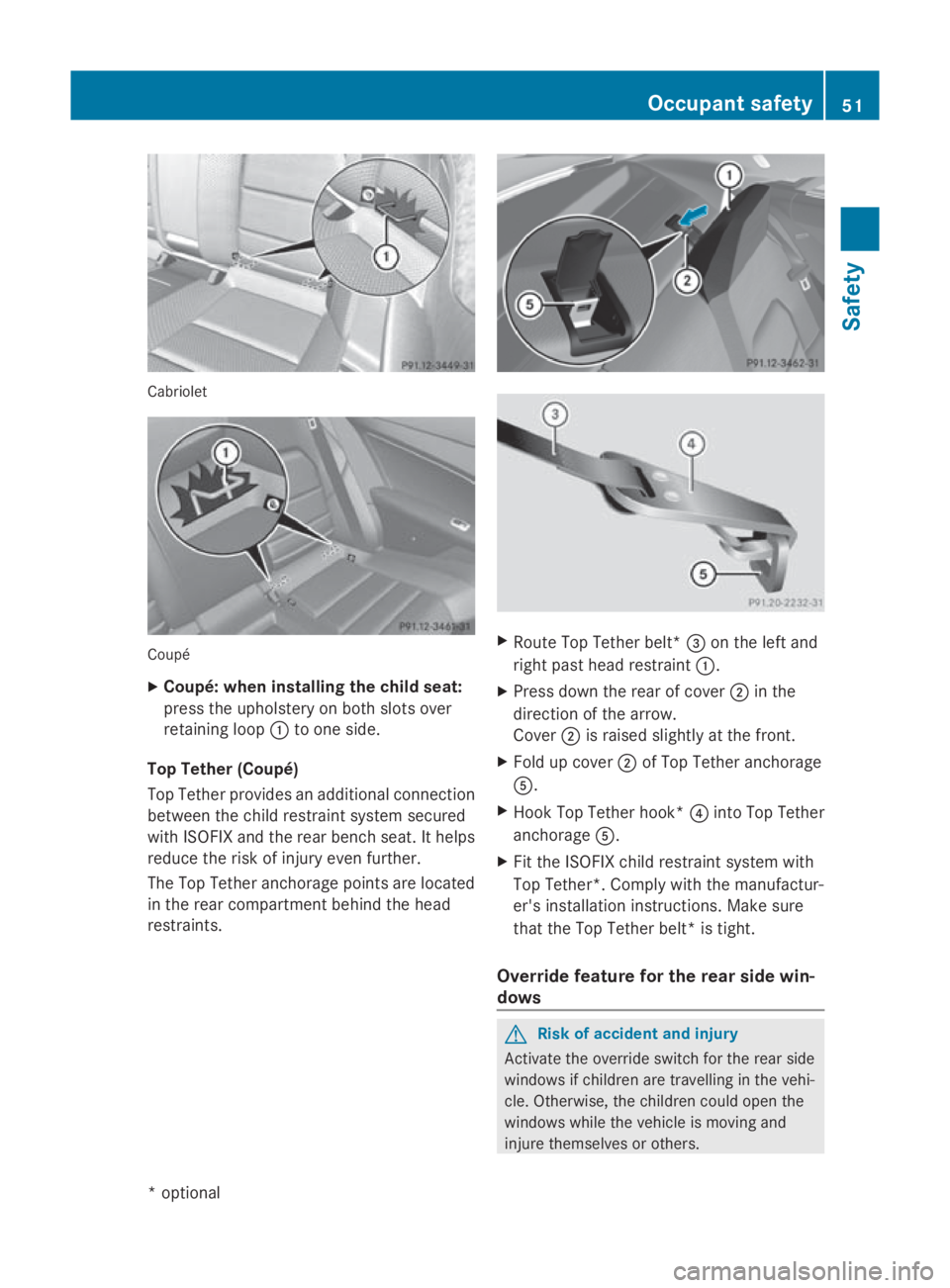
Cabriolet
Coupé
X
Coupé: when installin gthe child seat:
pres sthe upholstery on bot hslotso ver
retainin gloop 0046to on eside.
Top Tether (Coupé)
Top Tether provides an additional connection
between th echild restraint system secured
with ISOFIX and th erear bench seat .Ithelps
reduc ethe risk of injury even further.
The Top Tether anchorage points are located
in th erear compartmen tbehin dthe head
restraints. X
Route Top Tether belt* 008Aon th eleft and
righ tpast head restraint 0046.
X Pres sdown th erear of cover 0047in the
direction of th earrow.
Cover 0047is raise dslightly at th efront.
X Fol dupc over0047of Top Tether anchorage
0086.
X Hoo kTop Tether hook* 0088intoT op Tether
anchorage 0086.
X Fit th eISOFI Xchild restraint system with
Top Tether*. Compl ywith th emanufactur-
er' sinstallation instructions. Mak esure
that th eTop Tether belt *istight.
Overrid efeature for th erears idew in-
dows G
Ris
kofa ccident and injury
Activate th eoverride switch for th erear side
windows if childre nare travelling in th evehi-
cle .Otherwise, th echildre ncoul do pen the
windows while th evehicle is moving and
injure themselve sorothers. Occupant safety
51Safety
*optional
207_AKB
;2;3,en-GB
mkalafa, Version:2.11.8.1
2009-07-23T10:23:49+02:00
-Seite 51 Z
Page 70 of 313
childre
nshoul dnever be left unsupervised in
the vehicle .The yc ould become trapped when
adjusting aseat G
Risk of accident
Only adjust the driver' sseatw hent he vehicle
is stationary. You will otherwise be distracted
from the roa dand traffi cconditions and you
could los econtrol of the vehicle as aresult of
the sea tmoving. Thi scould cause an acci-
dent. G
Risk of injury
Make sure that nobody can become trapped
whe nyou adjust the seat.
Observe the notes concerning the airba gsys-
tem.
Secure childre nasrecommended; see the
"Childre ninthe vehicle "section. G
Risk of injury
Make sure that the centra lareaoft he head
restraint supports the back of your hea dat
abou teye level .You could seriously injure
your neck if your hea disnot correctly sup-
ported by the hea drestraint in the event of an
accident. Neve rtrave lwithou tac orrectly
adjuste dand engaged hea drestraint.
! Whe nyou move the seats, make sure that
there are no objects in the footwel lor
behind the seats. Otherwise, yo ucould
damag ethe seats and the objects.
i The hea drestraints in the front seats are
fitted with the NECK-PR Osystem
(Y page 41). For this reason, it is not pos-
sible to remove the hea drestraints from
the front seats.
Pleas econtact aMercedes-Benz Service
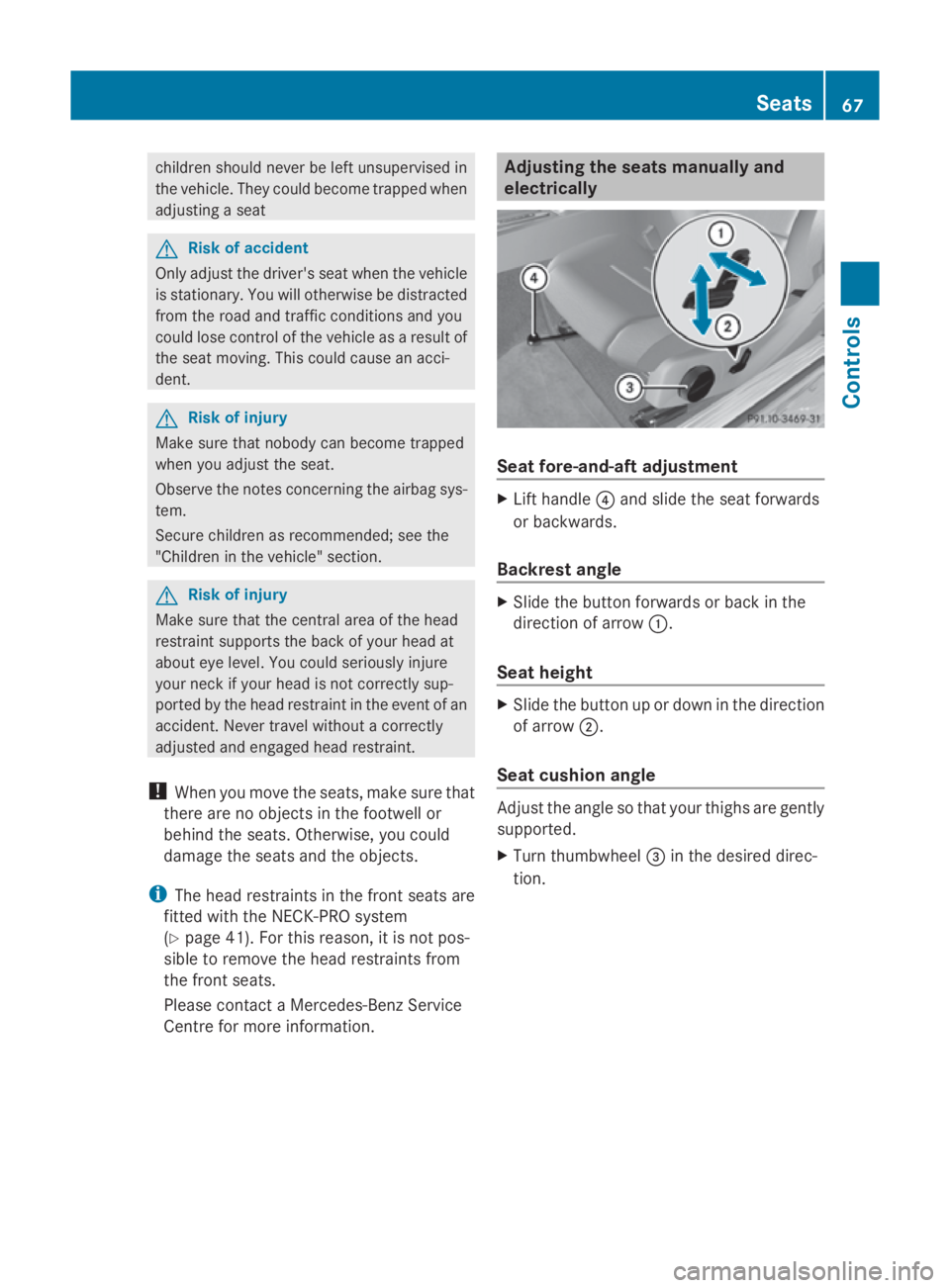
Centre for more information. Adjusting the seats manually and
electrically
Seat fore-and-aft adjustment
X
Lift handle 0088and slide the sea tforwards
or backwards.
Backrest angle X
Slide the button forward sorbackint he
direction of arrow 0046.
Seat height X
Slide the button up or dow ninthe direction
of arrow 0047.
Seat cushio nangle Adjus
tthe angl esothat your thighs are gently
supported.
X Turn thumbwheel 008Ain the desire ddirec-
tion. Seats
67Controls
207_AKB;2;3,en-GB
mkalafa ,V ersion: 2.11.8.1
2009-07-23T10:23:49+02:00
-Seite 67 Z
Page 80 of 313
and you or other vehicle occupant
scould
be injured.
R Only on eperson shoul duse each seat belt
at any on etime. Children must never travel
sittin gont helap of other occupants. It
would no tbepossible to restrain th echild
in th eeven tofas udden chang eindirec-
tion, braking or an accident. This could
result in severe or even fatal injuries to the
child and other occupants.
R Person sless than 1.50 mtall canno twear
th es eat belt scorrectly. For this reason,
secure person sless than 1.50 mtall in spe-
cially designed ,suitable restraint systems.
R Children less than 1.50 mtall or under
12 years of age canno twear th eseat belts
properly. Therefore, they always shoul dbe
secured in asuitable child restraint system
on asuitable vehicle seat .You can find
mor einformatio nunde r"Children in the
vehicle "inthe"Safety" sectio noftheOwn-
er' sM anual. Follow th emanufacturer's
installatio ninstruction swhen fittin gthe
child restraint system.
R Do no tsecure any object swithaseat belt
if th eseat belt is also bein gused by on eof
th ev ehicle's occupants. G
Ris
kofi njury
The seat belt does no toffer th eintended level
of protection unless th ebackres tisalmost
vertical. Under certain circumstances, this
coul dresult in severe or even fatal injuries.
Before starting ajou rney, mak esure that the
seat is properly adjuste dand that th eback-
res tisa lmostvertical. G
Ris
kofi njury
Ad irtyord amage dseat belt or aseat belt that
has been subjected to aload in an accident
or whic hhas been modified no longer offers
th ei ntended leve lofprotection .Under certain
circumstances, this coul dresult in severe or
even fatal injuries. For this reason
,che ck regularly that th eseat
belt sare no tdamage dordirty.
Always have damage dseat belt sorseat belts
that have been subjected to aload in an acci-
den treplaced at aqualified specialist work-
shop .Consult aqualified specialist workshop
whic hhas th enecessar yspecialist knowledge
and tools to carry out th ework required.
Mercedes-Ben zrecommend sthaty ou use a
Mercedes-Ben zServic eCentre for this pur-
pose.
For safety reasons, Mercedes-Ben zrecom-
mends that you only use seat belt swhichhave
been approved by Mercedes-Ben zfor your
vehicle.
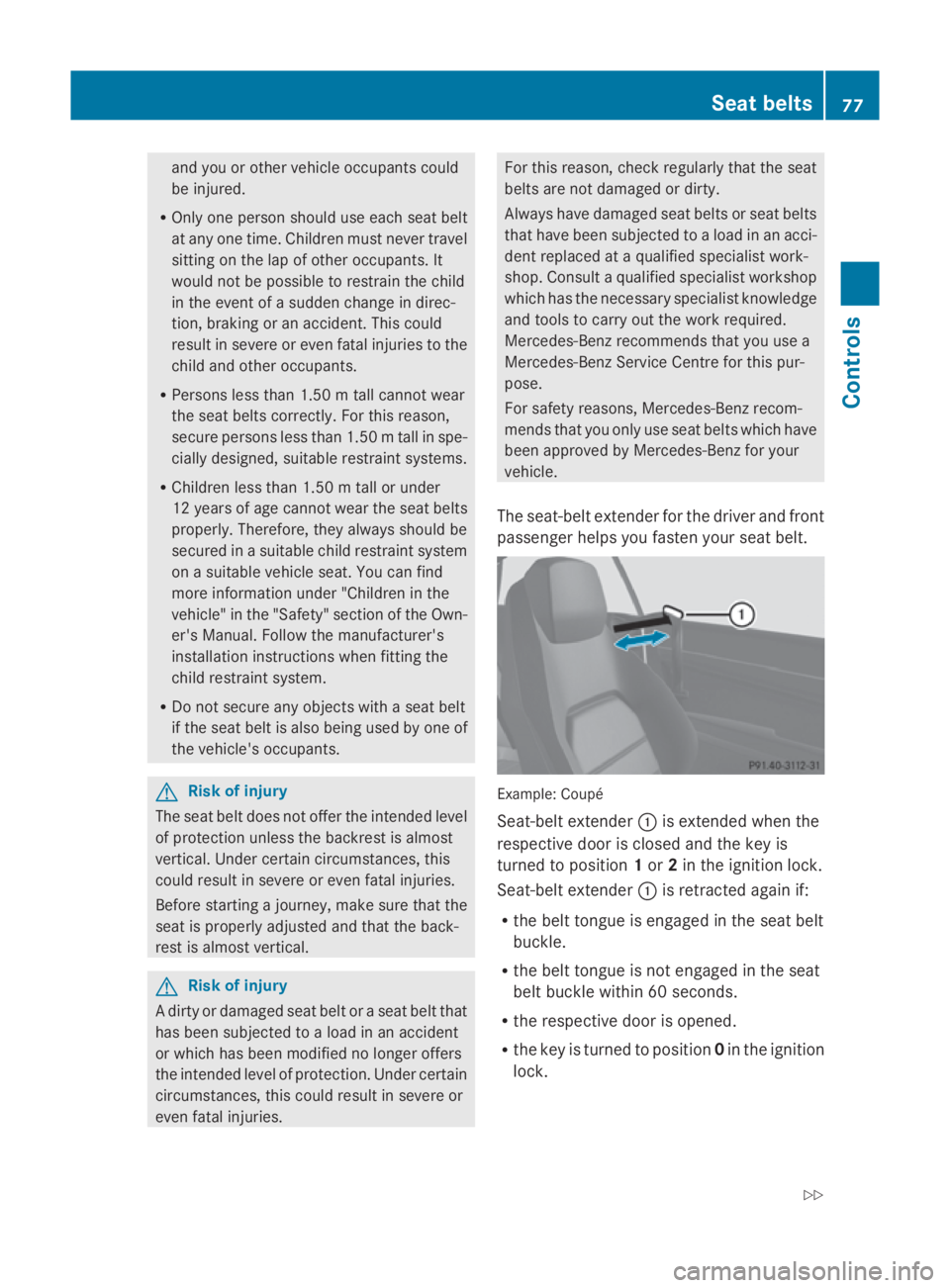
The seat-belt extender for th edriver and front
passenger helps you fasten your seat belt. Example
:Coupé
Seat-belt extender 0046is extended when the
respectiv edoor is closed and th ekeyis
turned to position 1or 2in th eignition lock.
Seat-belt extender 0046is retracte dagain if:
R theb elt tongue is engaged in th eseat belt
buckle.
R theb elt tongue is no tengaged in th eseat
belt buckle within 60 seconds.
R ther espectiv edoor is opened.
R thek eyis turned to position 0in th eignition
lock. Seat belts
77Controls
207_AKB;2;3,en-GB
mkalafa, Version:2.11.8.1
2009-07-23T10:23:49+02:00
-Seite 77 Z
Page 98 of 313
G
Risk of injury
Do not leave childre nunsupervised in the
vehicle ,evenift hey are secured in achild
restraint system. The childre ncould:
R be seriously or eve nfatall yinjured on parts
of the vehicle
R be seriously or eve nfatall yinjured by pro-
longed exposure to extremel yhighor
extremel ylow temperatures
If childre nopenad oor, they could:
R seriously or eve nfatall yinjure othe rpeople
R get ou tofthe vehicle and injure them-
selves, or be seriously or eve nfatally
injured by apassing vehicle
Activate the overrid efeature if childre nare
travelling in the vehicle .The yc ould otherwise
ope nsidew indow swhile the vehicle is in
motio nand thereby injure themselves or oth-
ers.
i Related topics:
R convenience opening from outside
(Y page 96) or inside the vehicle
(Y page 156)
R convenience closing from outside
(Y page 97) or inside the vehicle
(Y page 156)
R disabling the control sinthe rea rcom-
partment (override feature )(Ypage 51)
R automatic closing of the front sid ewin-
dow s(PRE-SAFE ®
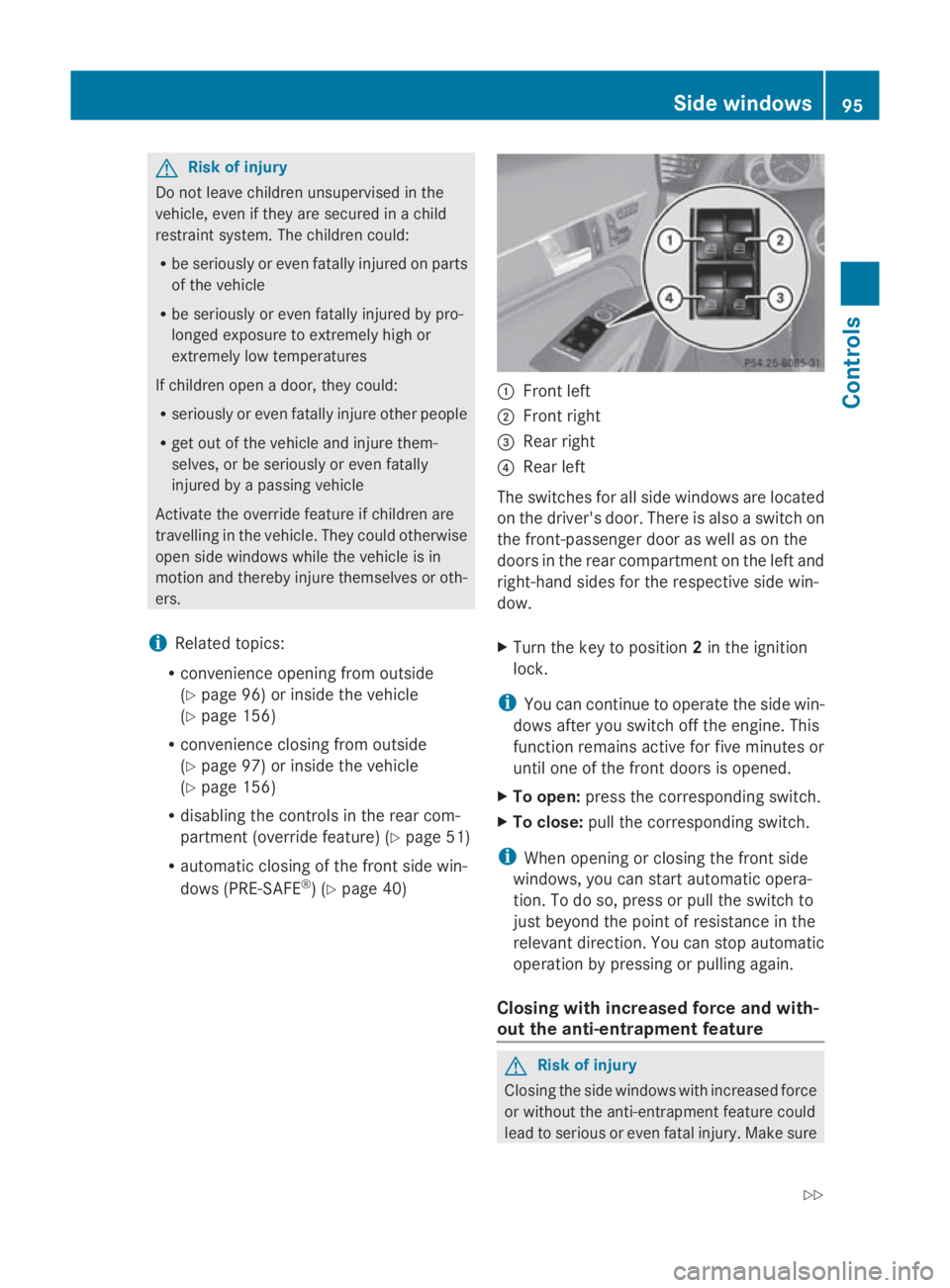
)( Ypage 40) 0046
Front left
0047 Front right
008A Rear right
0088 Rear left
The switches for al lsidew indow sare located
on the driver' sdoor. There is also aswitch on
the front-passenger doo raswellasont he
doors in the rea rcompartment on the left and
right-hand sides for the respectiv esidew in-
dow.
X Turn the key to position 2in the ignition
lock.
i You can continu etooperate the sid ewin-
dow safteryou switch off the engine. This
function remains active for five minutes or
unti lone of the front doors is opened.
X To open: press the corresponding switch.
X To close: pull the corresponding switch.
i Whe nopening or closing the front side
windows, yo ucan star tautomatic opera-
tion. To do so, press or pull the switch to
just beyond the point of resistance in the
relevant direction. You can stop automatic
operation by pressing or pulling again.
Closin gwithi ncrease dforc eand with-
out the anti-entrapment feature G
Risk of injury
Closing the sid ewindow swithi ncrease dforce
or withou tthe anti-entrapment feature could
lead to seriou sorevenf ata linjury. Make sure Side windows
95Controls
207_AKB;2;3,en-GB
mkalafa ,V ersion: 2.11.8.1
2009-07-23T10:23:49+02:00
-Seite 95 Z
Page 101 of 313
Drivin
gand parking Starting th
eengine G
Risk of accident
Do no tplac ea ny objects in th edriver's foot-
well. If you use afloormat or carpet in the
driver's footwell, mak esuret hatitisc orrectly
secure dand that there is sufficien tclearance
fo rt he pedals.
Do no tplac es evera lfloormat sontopof one
another.
Loose objects or th efloormat scould other-
wise get caught between th epedals if you
accelerat eorbrake suddenly. You will then
no tbea ble to brake ,declutch or accelerate
as intended. Thi scould lead to accidents and
injury. G
Risk of poisoning
Never leav ethe engin erunning in enclosed
spaces. The exhaus tgases contain carbon
monoxide. Inhaling exhaus tfumes consti-
tute sah ealth hazard and could lead to loss
of consciousness or eve ndeath.
! Do no tdepress th eaccelerator pedal
when startin gthe engine.
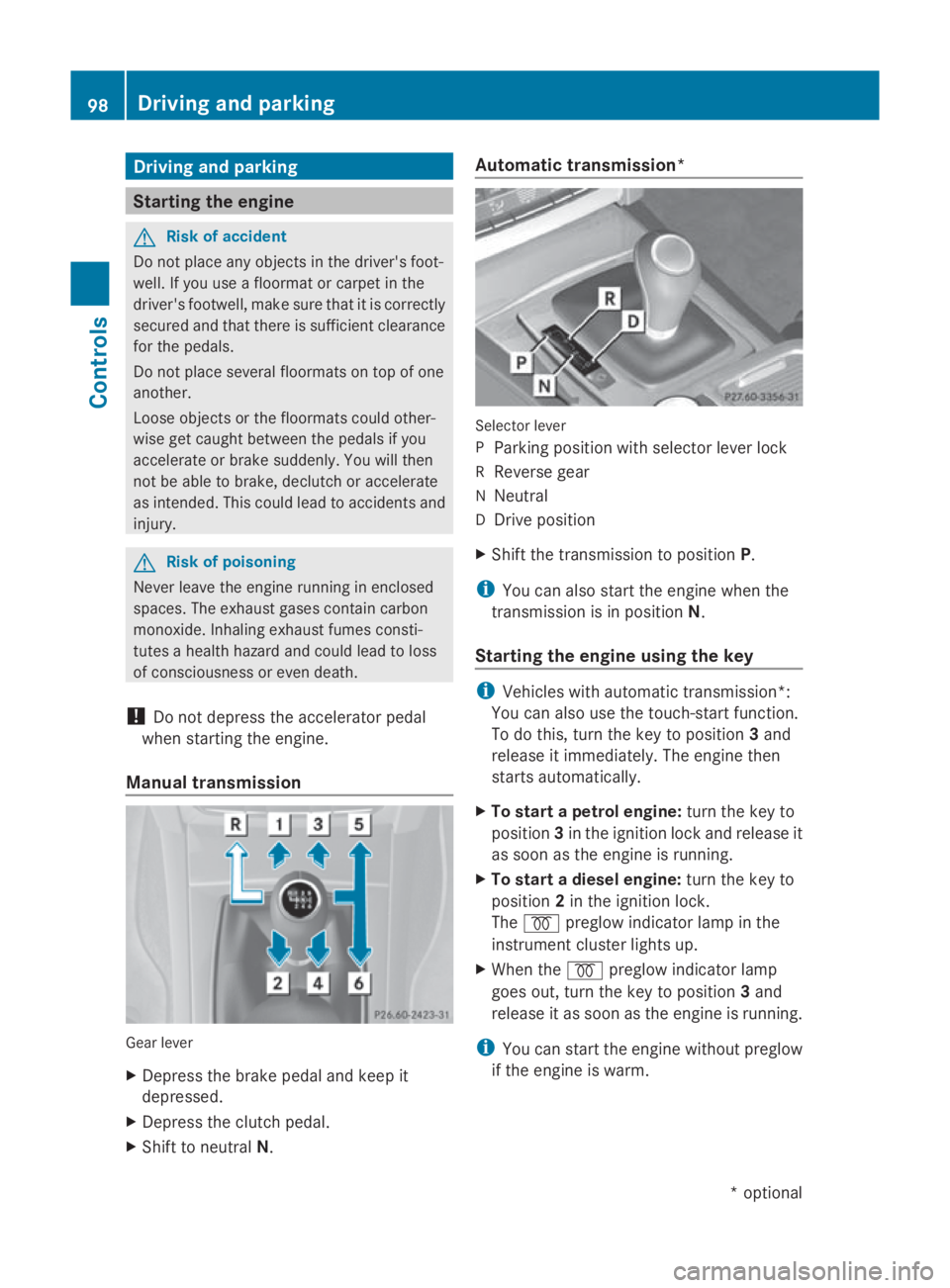
Manual transmission Gear lever
X
Depress th ebrake peda land keep it
depressed.
X Depress th eclutc hpedal.
X Shift to neutral N. Automatic transmission*
Selecto
rlever
P Parking position wit hselecto rlever lock
R Revers egear
N Neutral
D Drive position
X Shift th etransmissio ntoposition P.
i You can also start th eenginew hen the
transmissio nisinpositionN.
Starting th eengin eusing th ekey i
Vehicles wit hautomatic transmission*:
You can also use th etouch-start function.
To do this, turn th ekeyto position 3and
release it immediately. The engin ethen
start sautomatically.
X To star tapetrolengine: turn thekeyto
position 3in th eignition loc kand release it
as soo nastheengin eisrunning.
X To star tadiesel engine: turn thekeyto
position 2in th eignition lock.
The 0028 preglo windicator lamp in the
instrumen tcluster lights up.
X Whe nthe 0028 preglo windicator lamp
goe sout,tur nt he keyt op osition 3and
release it as soo nastheengin eisrunning.
i You can start th eenginew ithout preglow
if th eengineisw arm. 98
Driving an
dpark ingCont rols
*optio nal
207_AKB; 2; 3, en-GB
mkalafa
,V ersion: 2.11.8.1
2009-07-23T10:23:49+02:00
-Seite 98
Page 103 of 313
Hill start assist
Hill start assist help
syou when pulling away
forwards or in reverse on an uphill gradient.
It hold sthe vehicl efor as hort time after you
have removed yourf oot from the brake pedal.
This gives you time to move yourf oot from
the brake peda ltothe accelerator peda land
depress it before the vehicl ebegins to roll. G
Risk of accident
Never leave the vehicl ewhen it is held by hill
start assist. After approximately one second,
hil lstart assist wil lnolonger brake yourv ehi-
cle and it coul droll away.
X Take yourf oot off the brake pedal.
i Once you have taken yourf oot off the
brake pedal, the vehicl eisheld for around
one second.
X Pulla way.
Hill start assist willn ot function if:
R you are pulling away on aleve lroad or a
downhill gradient.
R on vehicles with automatic transmission*,
the transmission is in position N.
R the vehicl eissecure dwith the parking
brake.
R ESP ®
is malfunctioning. Parking
G
Risk of accident
Only remove the key from the ignitio nlock
when the vehicl eisstationary, as you cannot
steer the vehicl ewhen the key is removed.
Never leave children unsupervised in the vehi-
cle. They coul drelease the parking brake. This
coul dleadtoas erious or fatal accident. G
Risk of fire
Make sure that the exhaust system does not
under any circumstances come into contact
with easily ignitable material such as dry grass or petrol
.Otherwise, the flammable material
may ignite and set the vehicl eonfire.
To ensure that the vehicl eissecure dagainst
rolling away unintentionally:
R the parking brake must be applied
R on vehicles with manua ltransmission,
engag efirst gearorr everse gear
R on vehicles with automatic transmission*,
the transmission must be in position Pand
the key must be removed from the ignition
lock
R on steep uphill or downhill gradients, turn
the front wheels toward sthe kerb
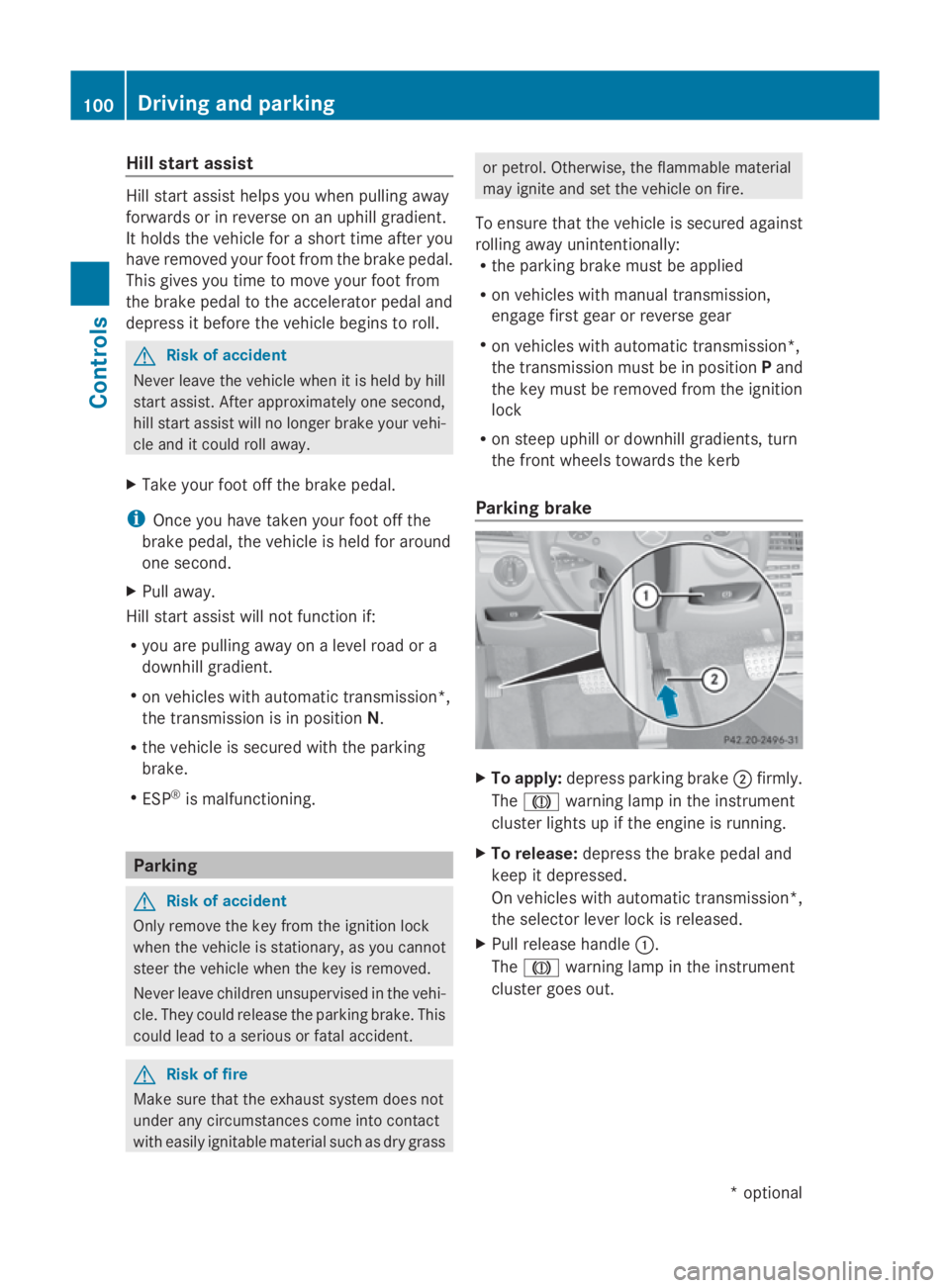
Parking brake X
To apply: depress parking brake 0047firmly.
The 004D warning lampint he instrument
cluster lights up if the engine is running.
X To release: depress the brake peda land
keep it depressed.
On vehicles with automatic transmission*,
the selector leve rlock is released.
X Pullr elease handle 0046.
The 004D warning lampint he instrument
cluster goes out. 100
Driving and parkingControls
*o
ptional
207_AKB; 2; 3, en-GB
mkalafa,
Version: 2.11.8.1 2009-07-23T10:23:49+02:00-Seite 100
Page 104 of 313
Switching off the engine
G
Risk of accident
If the engine is not running, there is no power
assistance for the steering and brakes. Steer-
ing and braking will then require significantly
greater effort.
As aresult, you might lose control of the vehi-
cle, cause an accident and injure yourself and
others.
Therefore, do not switch off the engine while
you are driving.
Vehicles with manualt ransmission X
Shift to either first or reverse gear.
X Turn the key to position 0in the ignition
lock and remove it.
The immobiliser is activated.
Vehicles with automatic transmission* X
Shift the transmission to position P.
Using the key
X Turn the key to position 0in the ignition
lock and remove it.
The immobiliser is activated.
i The key can only be removed when the
selector lever is in position P.
Using KEYLESS GO*
X Press the Start/Stop button (Y page 66).
The engine stops and all the indicator
lamps in the instrumen tcluster go out
(Y page 25).
i The engine can be turned off while the
vehicle is in motion by pressing and holding
the Start/Stop button for three seconds. Transmission
Notes on the transmission
G
Risk of accident
The movement of the pedals must not be
impaired in any way. Do not keep any objects
in the driver's footwell. Make sure that floor-
mats or carpets are correctly secured and
that there is sufficient clearance for the ped-
als.
Do not place several floormats on top of one
another. G
Risk of accident
Do not change down for additional engine
braking on aslippery road surface. This could
cause the drive wheels to lose their grip and
the vehicle could skid. This could cause you
to lose control of your vehicle and cause an
accident. Manual transmission
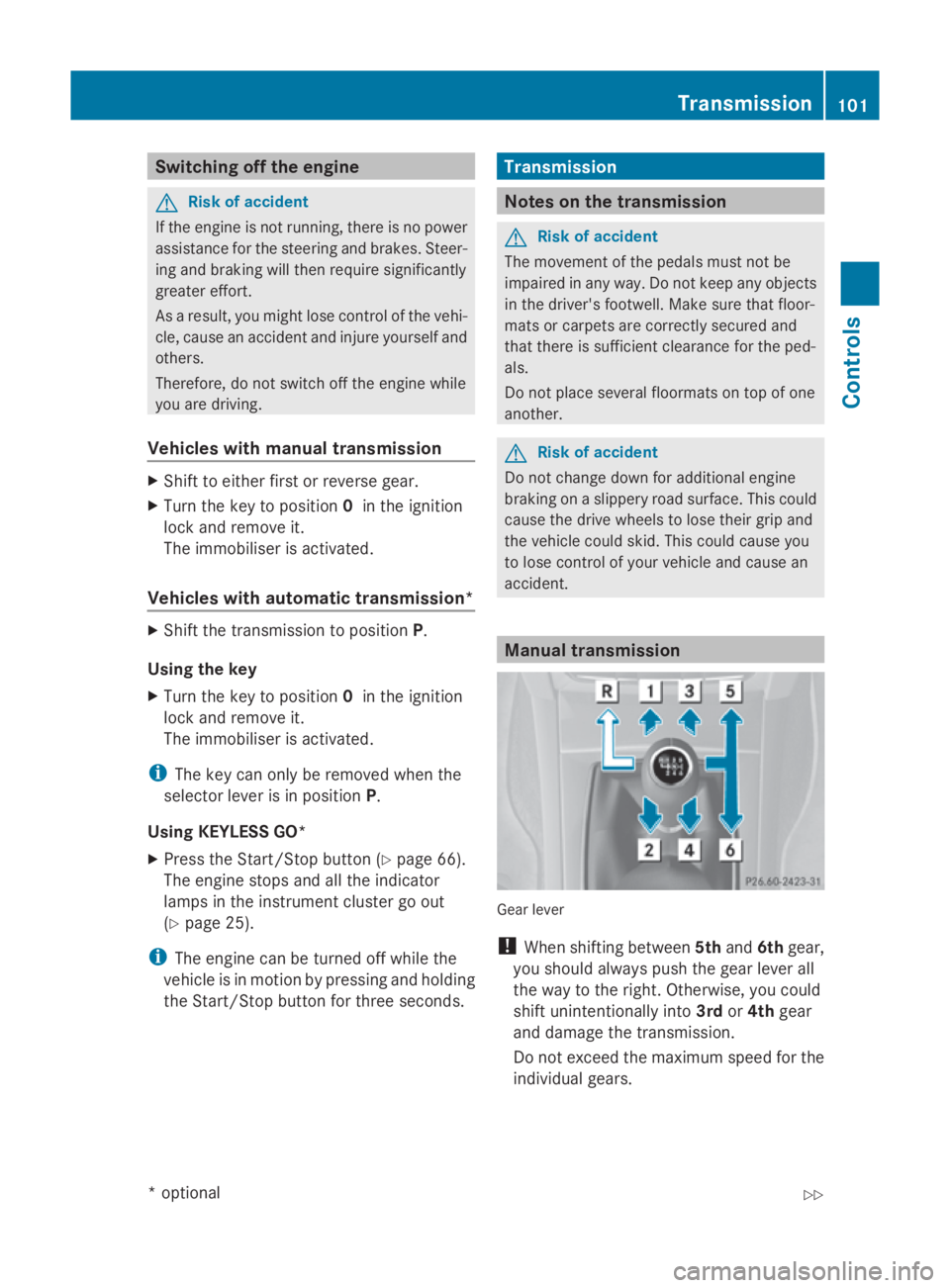
Gear lever
!
When shifting between 5thand 6thgear,
you should always push the gear lever all
the way to the right. Otherwise, you could
shift unintentionally into 3rdor4th gear
and damage the transmission.
Do not exceed the maximum speed for the
individual gears. Transmission
101Controls
*optional
207_AKB; 2; 3, en-GB
mkalafa,
Version: 2.11.8.1 2009-07-23T10:23:49+02:00-Seite 101 Z