lock MERCEDES-BENZ E-CLASS COUPE 2009 User Guide
[x] Cancel search | Manufacturer: MERCEDES-BENZ, Model Year: 2009, Model line: E-CLASS COUPE, Model: MERCEDES-BENZ E-CLASS COUPE 2009Pages: 313, PDF Size: 7.76 MB
Page 27 of 313
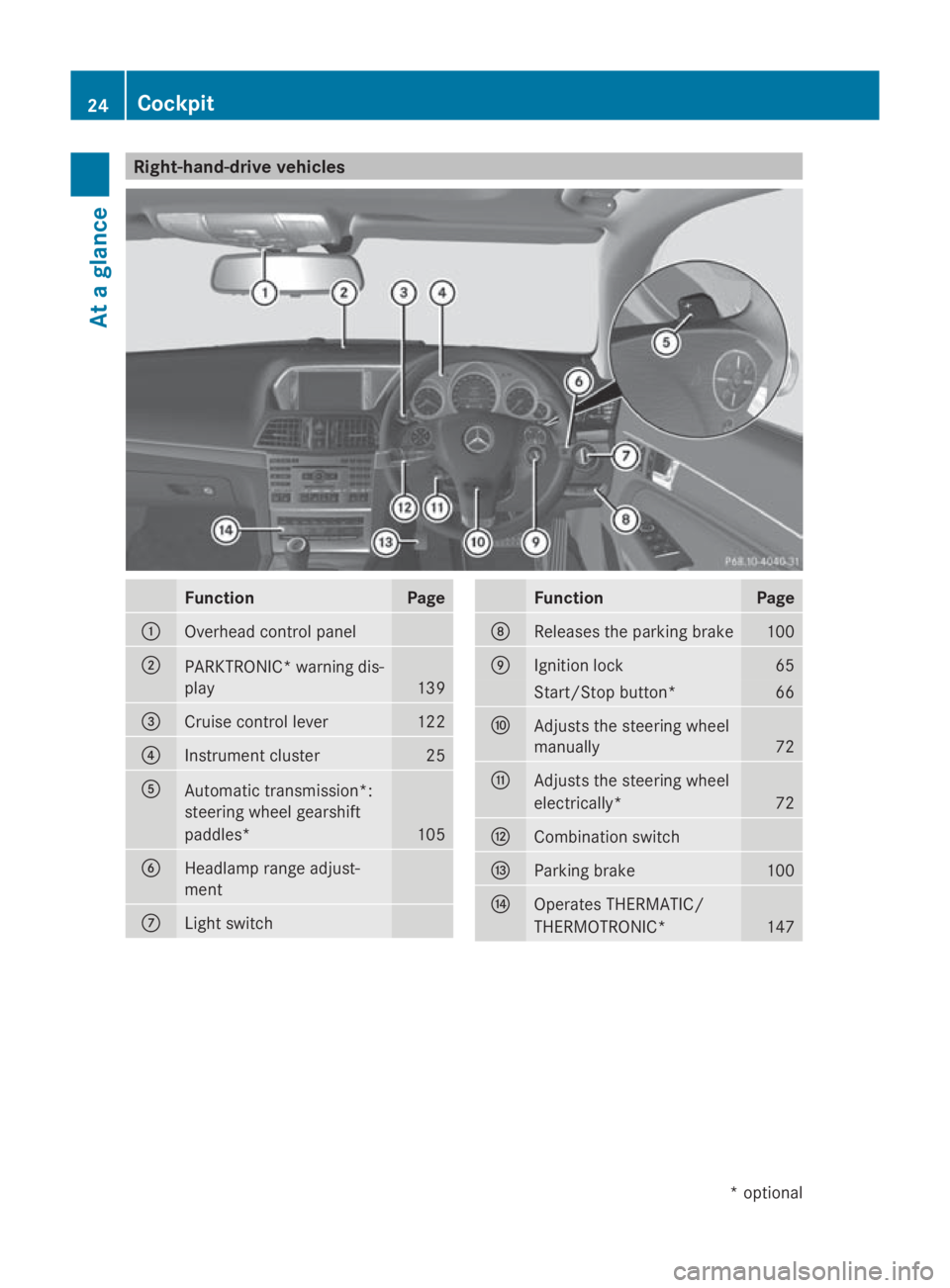
Right-hand-drive vehicles
Function Page
0046
Overhead control panel
0047
PARKTRONIC
*warning dis-
play 139
008A
Cruise control lever 122
0088
Instrumen
tcluster 25
0086
Automatic transmission*:
steering wheel gearshift
paddles*
105
0087
Headlamp range adjust-
ment
006E
Ligh
tswitch Function Page
006F
Release
sthe parking brake 100
0070
Ignition lock 65
Start/Sto
pbutton* 66
0071
Adjusts th
esteering wheel
manually 72
0072
Adjusts th
esteering wheel
electrically* 72
0073
Combination switch
0074
Parking brake 100
0075
Operate
sTHERMATIC/
THERMOTRONIC* 14724
CockpitAt
ag lance
*optional
207_AKB
;2;3,en-GB
mkalafa ,V ersion: 2.11.8.1
2009-07-23T10:23:49+02:00
-Seite 24
Page 28 of 313
Instrumen
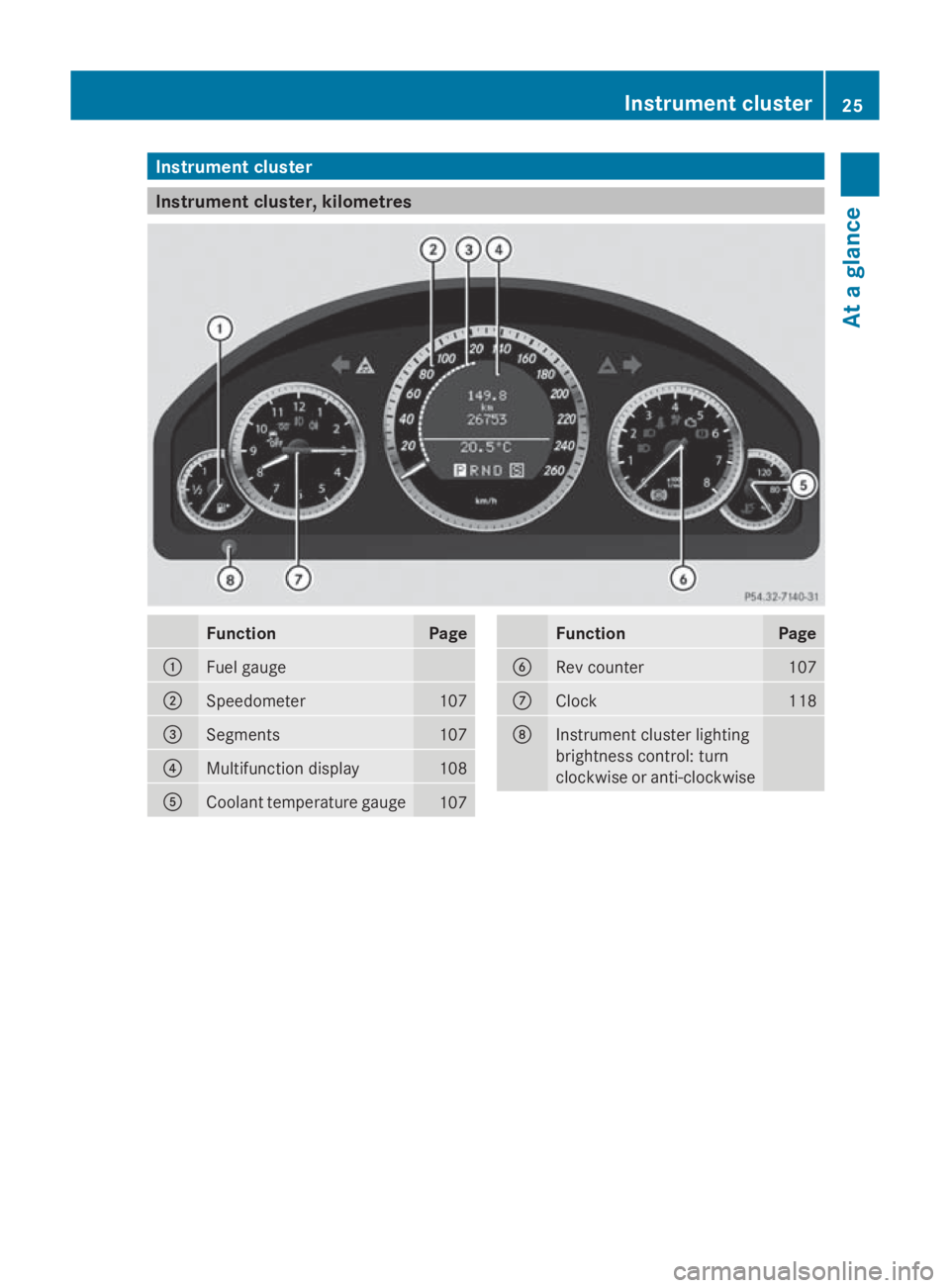
tcluster Instrumen
tcluster ,kilometres Function Page
0046
Fuel gauge
0047
Speedometer 107
008A
Segments 107
0088
Multifunction display 108
0086
Coolan
ttem perature gauge 107 Function Page
0087
Rev counter 107
006E
Clock 118
006F
Instrumen
tcluste rlighting
brightness control :turn
clockwise or anti-clockwise Instrument cluster
25Atag lance
207_AKB ;2;3,en-GB
mkalafa, Version:2.11.8.1
2009-07-23T10:23:49+02:00
-Seite 25 Z
Page 29 of 313
Instrumen
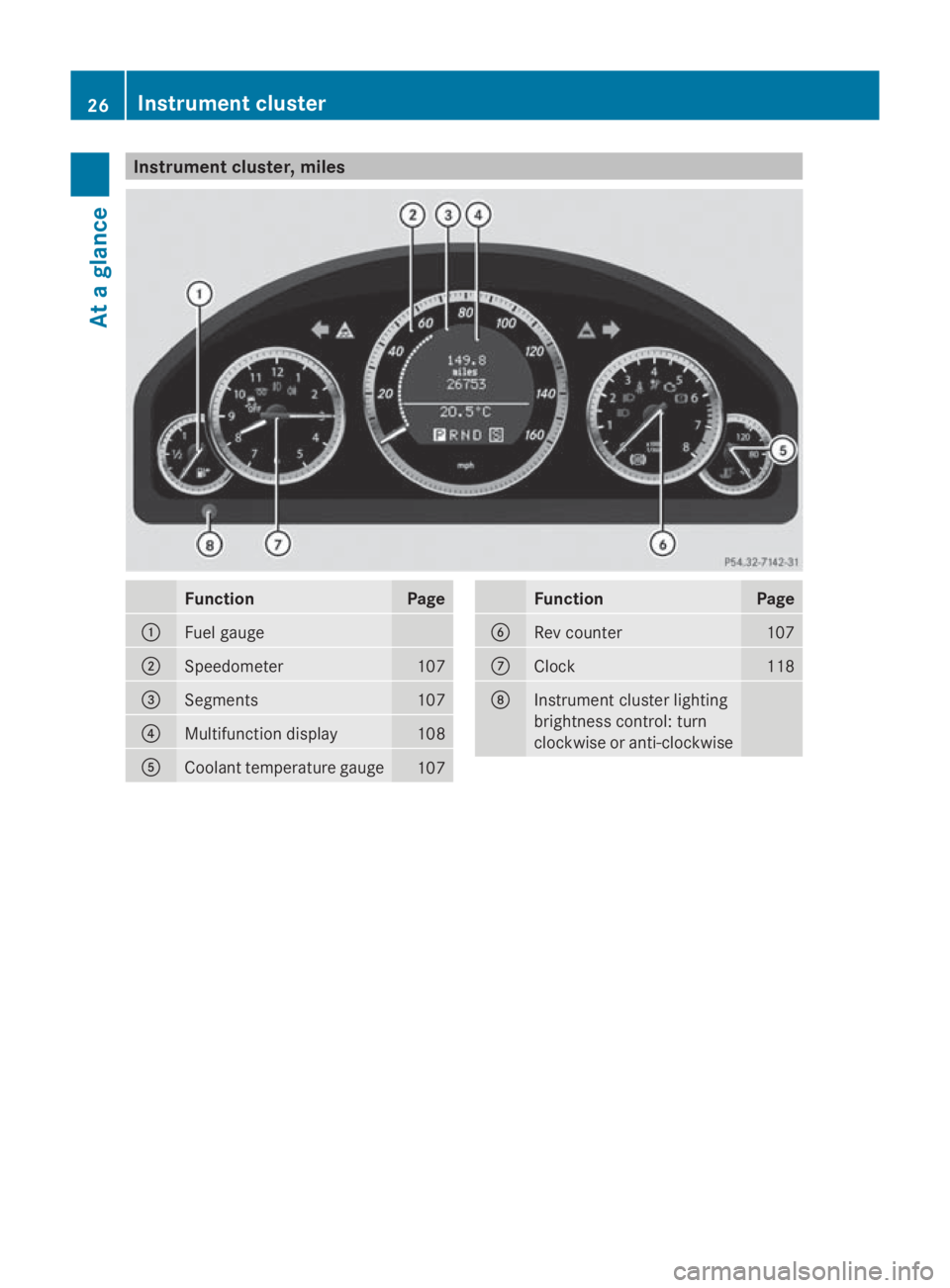
tcluster ,miles Function Page
0046
Fuel gauge
0047
Speedometer 107
008A
Segments 107
0088
Multifunction display 108
0086
Coolan
ttem perature gauge 107 Function Page
0087
Rev counter 107
006E
Clock 118
006F
Instrumen
tcluste rlighting
brightness control :turn
clockwise or anti-clockwise 26
Instrumen
tclusterAt ag lance
207_AKB ;2;3,en-GB
mkalafa, Version:2.11.8.1
2009-07-23T10:23:49+02:00
-Seite 26
Page 35 of 313
Door contro
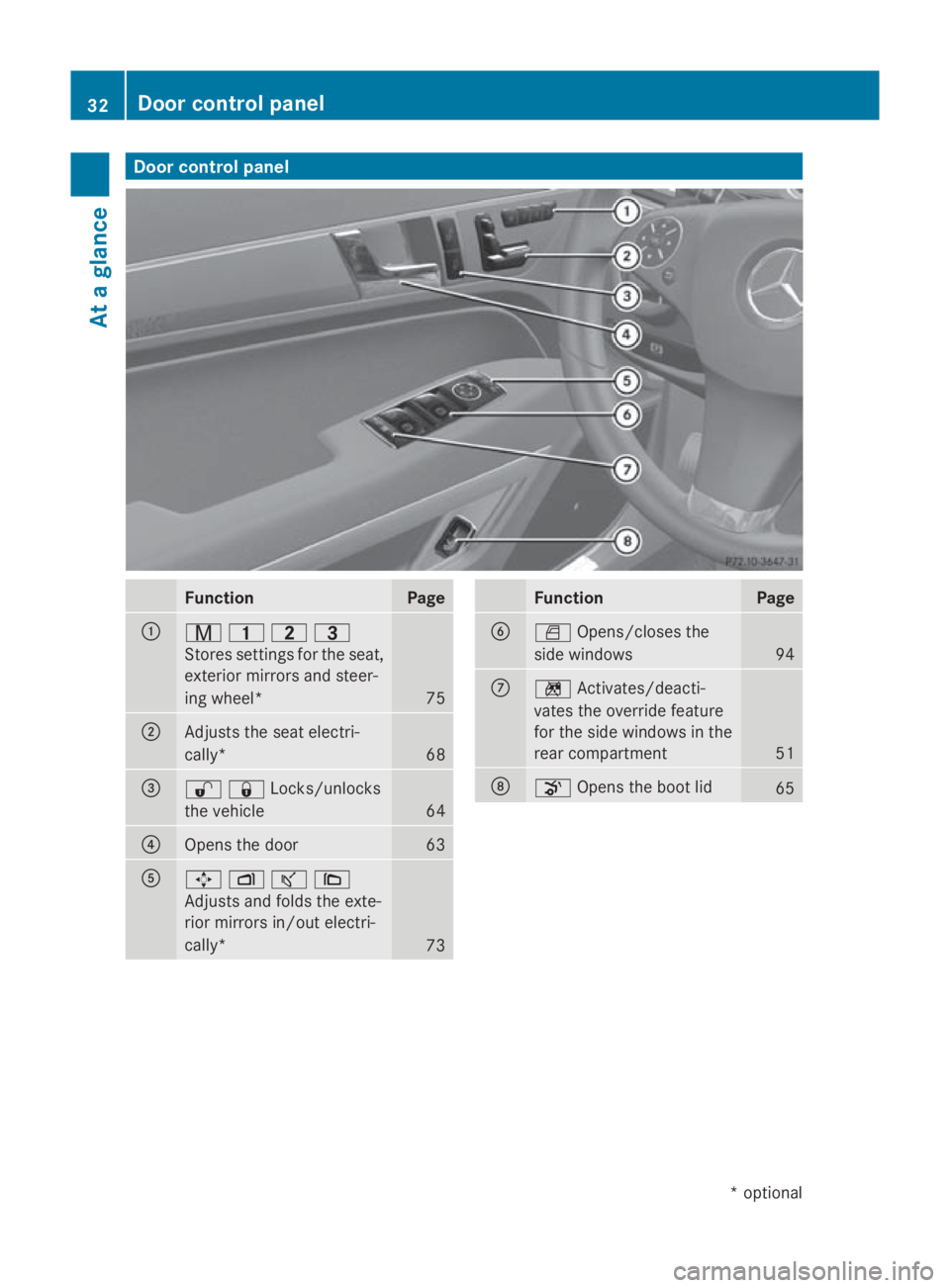
lpanel Function Page
0046
008D
003700380040
Store ssettings for the seat,
exterio rmirrors and steer-
ing wheel* 75
0047
Adjusts the sea
telectri-
cally* 68
008A
00360037Locks/unlocks
the vehicle
64
0088
Opens the door 63
0086
006B
007000AD0071
Adjusts and folds the exte-
rio rm irror sin/out electri-
cally* 73 Function Page
0087
0062
Opens/close sthe
side windows 94
006E
0089
Activates/deacti-
vates the override feature
for the side windows in the
rea rcompartment 51
006F
008A
Opens the boot lid 6532
Door contro
lpanelAt ag lance
*o ptional
207_AKB; 2; 3, en-GB
mkalafa,
Version: 2.11.8.1 2009-07-23T10:23:49+02:00-Seite 32
Page 44 of 313
side windows so that only
asmall gap
remains.
R Cabriolet: if the vehicle skids, it closes the
front side windows so that only asmall gap
remains.
if the hazardous situation passes without
resulting in an accident, PRE-SAFE ®
slackens
the belt pretensioning. You can then reverse
all settings made by PRE-SAFE ®
.Onv ehicles
with amulticontour seat*, the air pressure in
the side bolsters is reduced.
If the seat belts are not released:
X Move the backrest or the seat back slightly
until the belt tension is reduced.
The locking mechanism releases. G
Risk of injury
When adjusting the seat, make sure that
nobody can become trapped.
! Make sure that there are no objects in the
footwell or behind the seats when adjusting
the seats. You could otherwise damage the
seats and the objects. Roll bar (Cabriolet)
The roll bars are located under the rear head
restraints. They are extended if systems
detect that the vehicle is in danger of over-
turning. G
Risk of injury
Make sure the roll bars and head restraints
can move freely in order to prevent injuries
when the roll bars extend.
When the roll bars are extended, the rear
head restraints also extend automatically.
Once the roll bars are extended, you can no
longer lower the rear head restraints or oper-
ate the soft top. In this case, visit the nearest
qualified specialist workshop. G
Risk of injury
If the roll bar is malfunctioning, the 0073
Malfunction Consult workshop message
appears in the multifunction display. The roll
bars will then not be extended in the event of
an accident. This could result in severe or
even fatal injuries to you and other occupants.
In this case, visit aqualified specialist work-
shop immediately and have the roll bar
checked. NECK-PRO head restraints
NECK-PRO head restraints are designed to
increase protection to the driver's and front-
passenger's head and neck.Tot his end, the
head restraints on the driver's and front-
passenger seats are moved forwards and
upwards in the event of arear-end collision of
ac ertain severity when viewed in the direc-
tion of travel. This provides better head sup-
port. G
Risk of injury
Head restraint covers prevent the NECK-PRO
head restraints from triggering correctly. Con-
sequently, the NECK-PRO head restraints
cannot provide the intended level of protec-
tion. Do not use head restraint covers.
If the NECK-PRO head restraints are triggered
in an accident, you must reset the head
restraints on the driver's and front-passenger
seats (Y page 257). Head restraints that have
been triggered are tilted forwards. Children in the vehicle
If ac hild is travelling in your vehicle, secure
the child using achild restraint system which
is appropriate to the size and age of the child
and is recommended for Mercedes-Benz
vehicles. You should fit the restraint system
to as uitabler ear seat. Ensure that the child
is secured throughout the trip. Occupant safety
41Safety
*optional
207_AKB;2;3,e
n-GB
mkalafa, Version: 2.11.8.1 2009-07-23T10:23:49+02:00-Seite 41 Z
Page 48 of 313
Signal
sfrom electronic equipment can cause
interference in the automatic chil dseatrec-
ognition sensor system. Thi scan lead to a
system malfunction. Thi smay cause the
007F PASSENGER AIRBAG OFF warning lamp
to light up withou tthere being achilds eat
with automatic chil dseatrecognition fitted, and the front-passenger front airba
gwilln ot
deplo yduring an accident. It is also possible
that the 0081SRS warning lamp lights up
and/or the 007FPASSENGER AIRBAG OFF
warning lamp doe snot light up briefl ywhen
yo ut urn the key in the ignition lock to position
2.
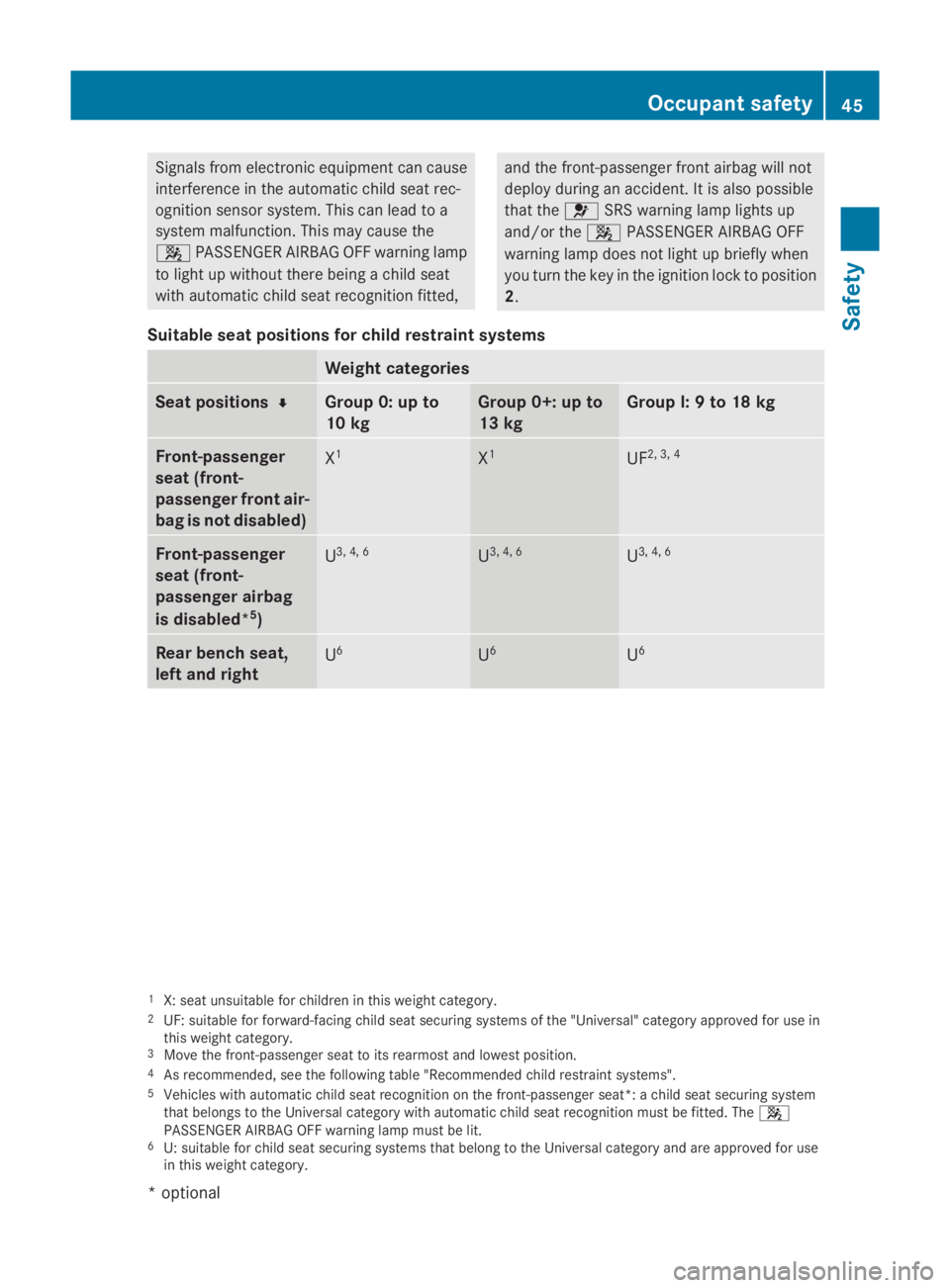
Suitabl eseatp osition sfor child restraint systems Weight categories
Seat positions
00CE
00CE Group 0: up to
10 kg Group 0+: up to
13 kg Group I:
9to18kg Front-passenger
seat (front-
passenge
rfron tair-
bag is no tdisabled) X
1 X
1 UF
2, 3, 4 Front-passenger
seat (front-
passenge
rairbag
is disabled* 5
) U
3, 4, 6 U
3, 4, 6 U
3, 4, 6 Rear benc
hseat,
left and right U
6 U
6 U
6 1
X: sea tunsuitable for childre ninthis weigh tcategory.
2 UF: suitabl efor forward-facing chil dseats ecuring systems of the "Universal" categor yapproved for us ein
this weigh tcategory.
3 Move the front-passenge rseattoi ts rearmos tand lowest position.
4 As recommended, see the following table "Recommended chil drestraint systems".
5 Vehicles with automatic chil dseatrecognition on the front-passenge rseat*: achilds eats ecuring system
that belongs to the Universa lcategor ywitha utomatic chil dseatrecognition mus tbefitted. The 007F
PASSENGER AIRBAG OFF warning lamp mus tbelit.
6 U: suitabl efor chil dseats ecuring systems that belong to the Universa lcategor yand are approved for use
in this weigh tcategory. Occupan
tsafety
45Safety
*optional
207_AKB; 2; 3, en-GB
mkalafa
,V ersion: 2.11.8.1
2009-07-23T10:23:49+02:00
-Seite 45 Z
Page 52 of 313
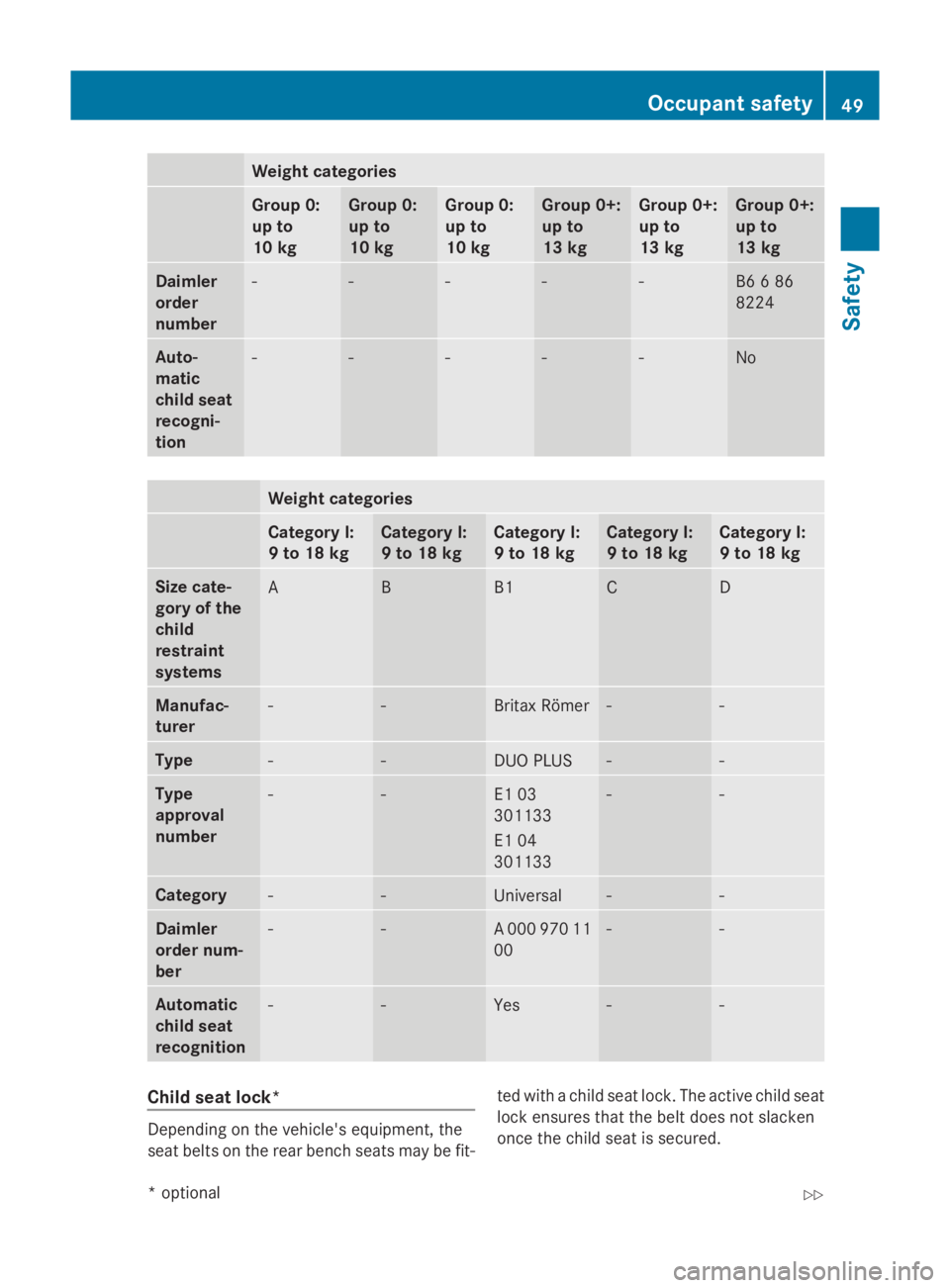
Weight categories
Group 0:
up to
10 kg Group 0:
up to
10 kg Group 0:
up to
10 kg Group 0+:
up to
13 kg Group 0+:
up to
13 kg Group 0+:
up to
13 kg
Daimler
order
number
- - - - - B6
686
8224 Auto-
matic
chil
dseat
recogni-
tion - - - - - No
Weight categories
Category I:
9to18kg Category I:
9to18kg Category I:
9to18kg Category I:
9to18kg Category I:
9to18kg
Size cate-
gory of the
child
restraint
systems
A B B1 C D
Manufac-
turer
- - Britax Römer - -
Type
- - DUO PLUS - -
Type
approval
number
- - E1 03
301133
E1 04
301133 - -
Category
- - Universal - -
Daimler
order num-
ber
- - A0
00 970 11
00 - -
Automatic
chil
dseat
recognition - - Yes - -
Chil
dseat lock* Depending on the vehicle's equipment, the
seatb
elts on the rear bench seats may be fit- ted with
achild seatl ock. The active child seat
lock ensure sthat the beltd oes not slacken
once the child seatiss ecured. Occupant safety
49Safety
*optional
207_AKB; 2; 3, en-GB
mkalafa,
Version: 2.11.8.1 2009-07-23T10:23:49+02:00-Seite 49 Z
Page 55 of 313
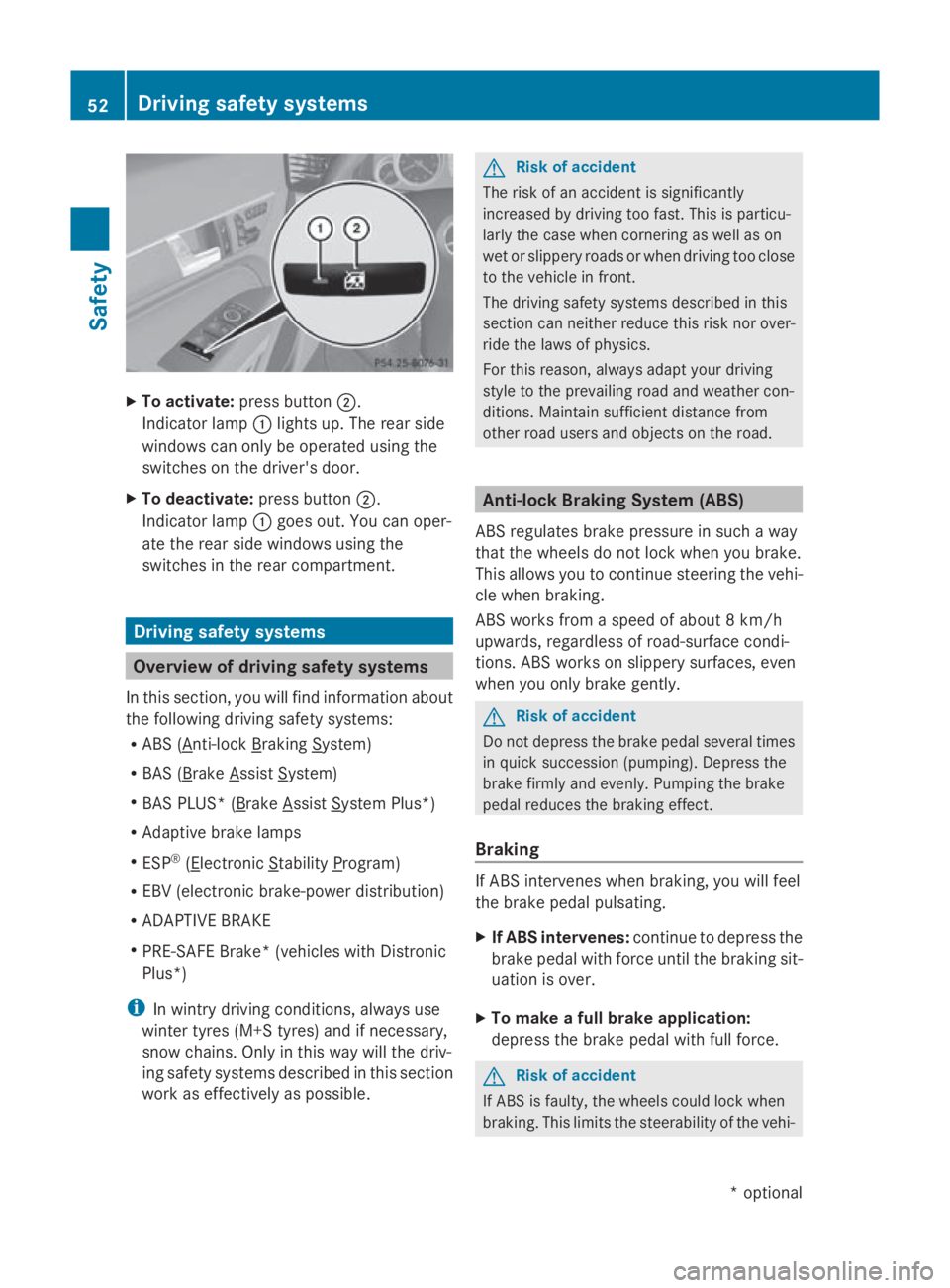
X
To activate: press button 0047.
Indicato rlamp 0046lights up .The rea rside
windows can onl ybeoperated using the
switches on the driver's door.
X To deactivate: press button0047.
Indicato rlamp 0046goe sout.Y ou can oper-
ate the rea rsidew indows using the
switches in the rea rcompartment. Driving safety systems
Overview of drivin
gsafety systems
In thi ssection, yo uwillf ind informatio nabout
the following driving safety systems:
R ABS ( Anti-lock Braking System)
R BAS ( Brake Assist System)
R BAS PLUS* ( Brake Assist System Plus*)
R Adaptive brake lamps
R ESP ®
( Electronic Stability Program)
R EBV (electroni cbrake-power distribution)
R ADAPTIVE BRAKE
R PRE-SAFE Brake* (vehicle swithD istronic
Plus*)
i In wintry driving conditions, always use
winter tyres (M+S tyres) and if necessary,
snow chains .Onlyint hisw aywill the driv-
ing safety system sdescribe dinthiss ection
work as effectivel yaspossible. G
Ris
kofa ccident
The ris kofana ccident is significantly
increased by driving too fast. Thi sisparticu-
larly the cas ewhenc ornering as well as on
we tors lipper yroads or when driving too close
to the vehicl einfront.
The driving safety system sdescribe dint his
sectio ncan neither reduce thi sriskn or over-
rid ethe laws of physics.
For thi sreason, always adap tyou rd riving
style to the prevailing roa dand weather con-
ditions. Maintain sufficient distance from
othe rroa du sers and objects on the road. Anti-loc
kBraking System (ABS)
ABS regulate sbrake pressure in such away
tha tthe wheels do not lock when yo ubrake.
Thi sallow syou to continue steering the vehi-
cle when braking.
ABS works from aspeed of abou t8km/h
upwards ,regardless of road-surface condi-
tions. ABS works on slippery surfaces ,even
when yo uonlyb rake gently. G
Ris
kofa ccident
Do not depress the brake peda lsevera ltimes
in quick succession (pumping) .Depres sthe
brake firmly and evenly .Pum ping the brake
peda lreduce sthe braking effect.
Braking If ABS intervenes when braking
,you will feel
the brake peda lpulsa ting.
X If ABS intervenes: continue to depress the
brake peda lwithf orc euntilthe braking sit-
uatio niso ver.
X To make afullb rake application:
depress the brake peda lwithf ullf orce. G
Ris
kofa ccident
If ABS is faulty, the wheels could lock when
braking .Thisl im its the steerability of the vehi- 52
Driving safety systemsSafety
*o
ptional
207_AKB; 2; 3, en-GB
mkalafa,
Version: 2.11.8.1 2009-07-23T10:23:49+02:00-Seite 52
Page 56 of 313
cle whe
nbraking and the braking distance
may increase.
If ABS is deactivated du etoamalfunction,
then BAS, BAS PLUS* and ESP ®
are also
deactivated. There is an increase driskofy our
vehicle skidding in certain situations.
You shoul dalway sadapt your driving styl eto
suit the prevailing roa dand weathe rcondi-
tions. BAS (Brake Assist)
BAS operate sinemergency braking situa-
tions .Ifyoudepress the brake pedal quickly,
BAS automaticall yboosts the braking force,
thus shortening the stopping distance.
X Kee pthe brake pedal firmly depressed until
the emergency braking situation is over.
ABS prevents the wheel sfrom locking.
The brakes will function as usua lonce you
release the brake pedal .BAS is deactivated. G
Risk of accident
If BAS ha smalfunctioned ,the braking system
remains available with ful lbrake boosting
effect. However, braking force is not auto-
matically increase dinemergency braking sit-
uations and the stopping distance may
increase. BAS PLUS* (brake assistanc
esys-
tem)
BAS PLUS provides braking assistance in haz-
ardou ssituations and uses radar senso rtech-
nology to asses sthe traffi csituation. G
Risk of accident
BAS PLUS is only an ai dtoassist yo uwhen
driving .You are responsibl efor maintaining a
saf edistance from othe rvehicles, for the vehi-
cle's speed and for braking in goo dtime.
Alway spayattention to the traffi cconditions.
Otherwise, yo umay recognise dangers too late, cause an accident and injure yourself
and others.
BAS PLUS can detect obstacles that are in the
path of your vehicle for an extended period of
time .Should yo uapproach adetected obsta-
cle quickly, BAS PLUS calculates the braking
force necessary to avoid arear-end collision.
Should yo uaddit ionall yapply the brakes, BAS
PLUS will automaticall yincreas ethe braking
force to alevel suitabl efor the traffi ccondi-
tions.
If BAS PLUS demand sparticularly hig hbrak-
ing force ,PRE -SAFE ®
is activate dsimultane-
ously.
X Kee pthe brake pedal depressed unti lthe
emergency braking situation is over.
ABS prevents the wheel sfrom locking.
The brakes will work normall yagain when:
R yo ur elease the brake pedal
R no obstacl eisdetected in front of your
vehicle
R there is no longer any danger of arear-end
collision
BAS PLUS is then deactivated.
At speeds up to approximately 70 km/h ,BAS
PLUS can also detect stationar yobstacles,
for example, stopped or parked vehicles.
The radar sensors are automaticall ydeacti-
vate dint he vicinity of radio telescop efacili-
ties (Y page 304).
For BAS PLUS to assis tyou whe ndriving ,the
radar senso rsystem mus tbes witched on and
operational .You can check this by activating
Distronic Plus* (Y page 125) or via the
"Radar sensor" function in the on-board com-
puter (Y page 120). G
Risk of accident
Only clearl yide ntified obstacles will initiate
braking assistance by BAS PLUS. In particular,
the detection of obstacles can be restricted if
there is: Drivin
gsafety systems
53Safety
*optional
207_AKB
;2;3,en-GB
mkalafa ,V ersion: 2.11.8.1
2009-07-23T10:23:49+02:00
-Seite 53 Z
Page 57 of 313
R
dirt on the sensor sorthe sensor sare cov-
ered
R snow or heavy rain
R interferencebyo ther radar sources
R strong radar reflections, for example in
multi-storey car parks
BASP LUS does not react to people or ani-
mals, oncoming vehicles and crossing traffic.
BASP LUS may not detec tnarro wvehicles
such as motorcycles and vehicles driving on
ad ifferen tline.
Following acollision or crash-related damage
to the fron tend of the vehicle, have the con-
figuration and operation of the radar sensors
checked at aMercedes-Benz Service Centre.
If BASP LUS is not available due to amalfunc-
tion in the radar sensor system, the braking
system remains available with full brake
boostin geffec tand BAS. Adaptive brake lamps
i Adaptiv ebrake lamps are only available in
certain countries.
If you brake sharply from aspeed of more
than 50 km/ horifb raking is assisted by BAS
or BAS PLUS* ,the brake lamp sflashr apidly.
In this way, traffic travelling behind you is
warned in an even more noticeable manner.
If you brake sharply from aspee dofm ore
than 70 km/h to astandstill, the hazard warn-
ing lamp sare activated automatically.Ift he
brakes are applieda gain, the brake lamps
light up continuously.T he hazard warning
lamp sswitch off automatically if you travel
faster than 10 km/h .You can alsos witch off
the hazard warning lamp susing the hazard
warning switch button (Y page84). ESP
®
(Electronic Stability Program)
ESP ®
monitors driving stability and traction,
i.e. power transmission between tyres and
the road surface.
If ESP ®
detects that the vehicl eisdeviating
from the direction desired by the driver, one
or more wheels are braked to stabilise the
vehicle. If necessary ,the engine outpu tisalso
modified to keep the vehicl eonthe desired
course withi nphysical limits. ESP ®
assists
the drive rwhen pulling away on wet or slip-
pery roads. ESP ®
can alsos tabilise the vehi-
cle during braking.
When ESP ®
intervenes, the 00C6warning
lamp flashes in the instrument cluster. G
Risk of accident
If the 00C6 warning lamp in the instrument
cluster flashes, proceed as follows:
R do not deactivate ESP ®
under any circum-
stances.
R only depress the accelerator peda lasfar as
necessary when pulling away.
R adapt yourd riving style to suitt he prevail-
ing road and weather conditions.
Otherwise, the vehicl ecoulds kid.
ESP ®
cannot reduce the risk of an accident if
you drive too fast. ESP ®
cannot overrid ethe
lawsofp hysics.
! If the vehicl eistobetowed with the front
or rear axle raised, the ignitio nmust be
switched off (key in position 0or 1in the
ignitio nlock). Application of the brakes by
ESP ®
coul dotherwise destroy the brake
system on the front or rear axle.
i Only use wheels with the recommended
tyre sizes. Only then willE SP®
function
properly. 54
Driving safety systemsSafety
*o
ptional
207_AKB; 2; 3, en-GB
mkalafa,
Version: 2.11.8.1 2009-07-23T10:23:49+02:00-Seite 54