light MERCEDES-BENZ E-CLASS COUPE 2009 Owner's Manual
[x] Cancel search | Manufacturer: MERCEDES-BENZ, Model Year: 2009, Model line: E-CLASS COUPE, Model: MERCEDES-BENZ E-CLASS COUPE 2009Pages: 313, PDF Size: 7.76 MB
Page 48 of 313
Signal
sfrom electronic equipment can cause
interference in the automatic chil dseatrec-
ognition sensor system. Thi scan lead to a
system malfunction. Thi smay cause the
007F PASSENGER AIRBAG OFF warning lamp
to light up withou tthere being achilds eat
with automatic chil dseatrecognition fitted, and the front-passenger front airba
gwilln ot
deplo yduring an accident. It is also possible
that the 0081SRS warning lamp lights up
and/or the 007FPASSENGER AIRBAG OFF
warning lamp doe snot light up briefl ywhen
yo ut urn the key in the ignition lock to position
2.
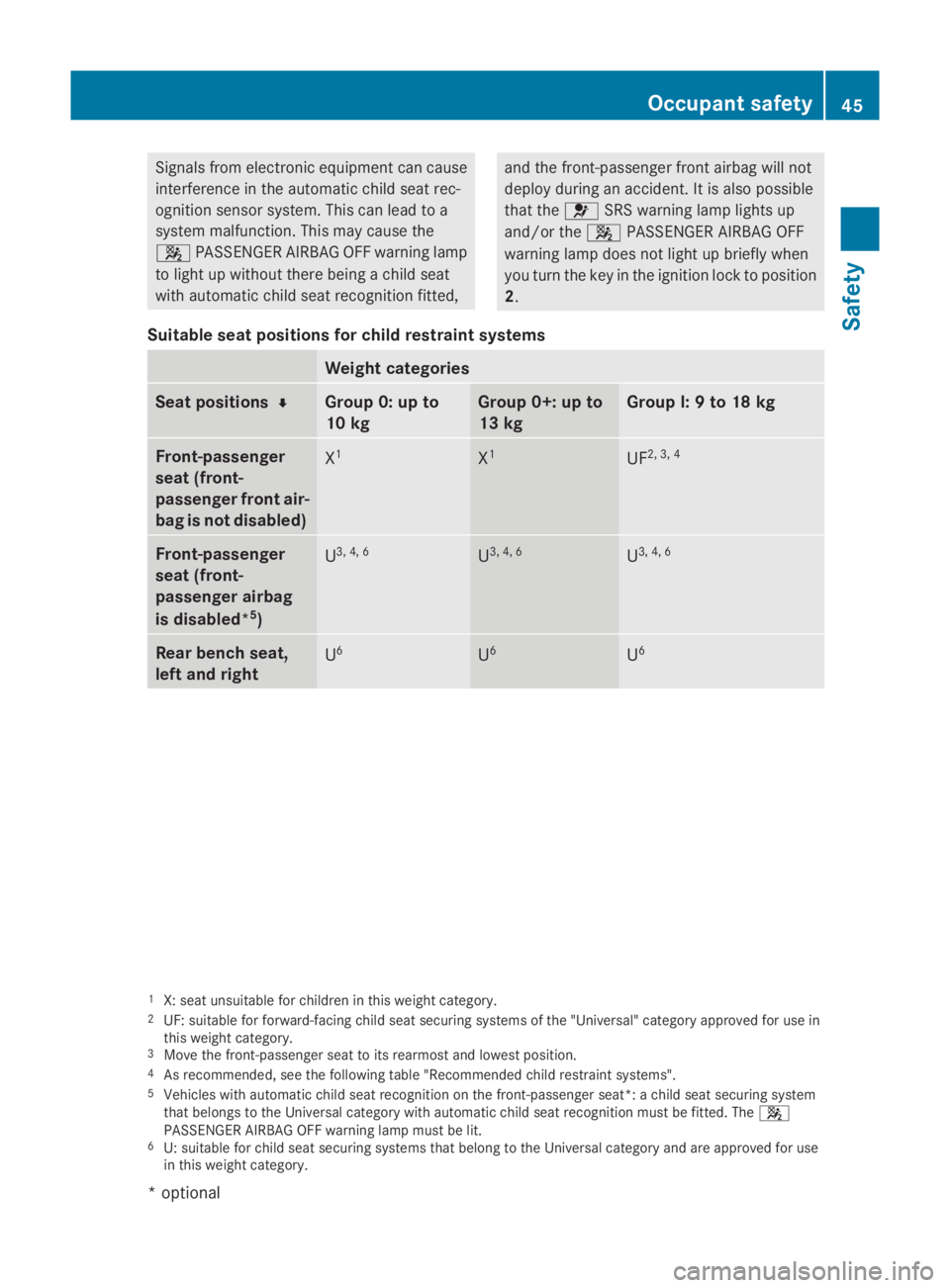
Suitabl eseatp osition sfor child restraint systems Weight categories
Seat positions
00CE
00CE Group 0: up to
10 kg Group 0+: up to
13 kg Group I:
9to18kg Front-passenger
seat (front-
passenge
rfron tair-
bag is no tdisabled) X
1 X
1 UF
2, 3, 4 Front-passenger
seat (front-
passenge
rairbag
is disabled* 5
) U
3, 4, 6 U
3, 4, 6 U
3, 4, 6 Rear benc
hseat,
left and right U
6 U
6 U
6 1
X: sea tunsuitable for childre ninthis weigh tcategory.
2 UF: suitabl efor forward-facing chil dseats ecuring systems of the "Universal" categor yapproved for us ein
this weigh tcategory.
3 Move the front-passenge rseattoi ts rearmos tand lowest position.
4 As recommended, see the following table "Recommended chil drestraint systems".
5 Vehicles with automatic chil dseatrecognition on the front-passenge rseat*: achilds eats ecuring system
that belongs to the Universa lcategor ywitha utomatic chil dseatrecognition mus tbefitted. The 007F
PASSENGER AIRBAG OFF warning lamp mus tbelit.
6 U: suitabl efor chil dseats ecuring systems that belong to the Universa lcategor yand are approved for use
in this weigh tcategory. Occupan
tsafety
45Safety
*optional
207_AKB; 2; 3, en-GB
mkalafa
,V ersion: 2.11.8.1
2009-07-23T10:23:49+02:00
-Seite 45 Z
Page 54 of 313
Cabriolet
Coupé
X
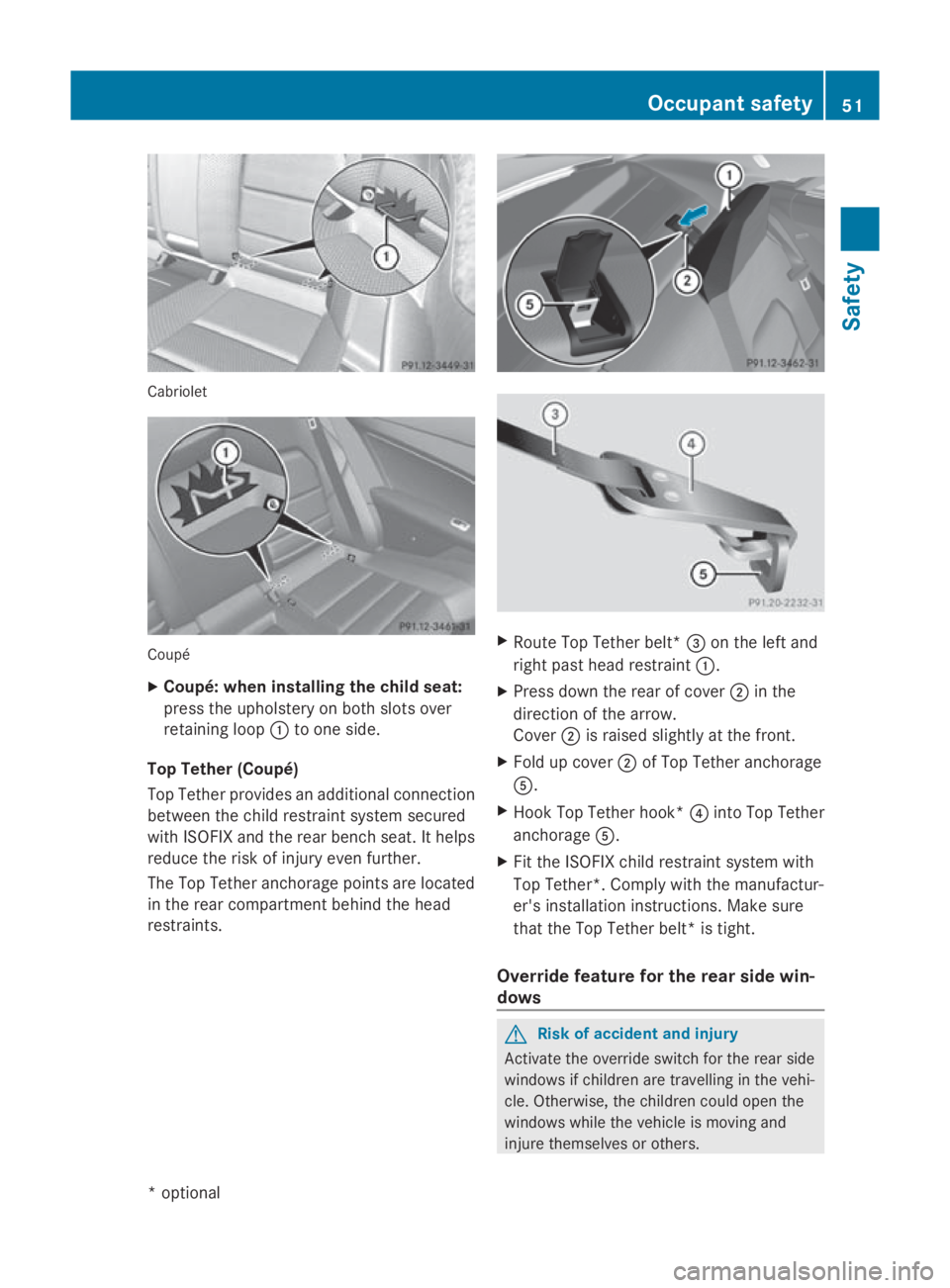
Coupé: when installin gthe child seat:
pres sthe upholstery on bot hslotso ver
retainin gloop 0046to on eside.
Top Tether (Coupé)
Top Tether provides an additional connection
between th echild restraint system secured
with ISOFIX and th erear bench seat .Ithelps
reduc ethe risk of injury even further.
The Top Tether anchorage points are located
in th erear compartmen tbehin dthe head
restraints. X
Route Top Tether belt* 008Aon th eleft and
righ tpast head restraint 0046.
X Pres sdown th erear of cover 0047in the
direction of th earrow.
Cover 0047is raise dslightly at th efront.
X Fol dupc over0047of Top Tether anchorage
0086.
X Hoo kTop Tether hook* 0088intoT op Tether
anchorage 0086.
X Fit th eISOFI Xchild restraint system with
Top Tether*. Compl ywith th emanufactur-
er' sinstallation instructions. Mak esure
that th eTop Tether belt *istight.
Overrid efeature for th erears idew in-
dows G
Ris
kofa ccident and injury
Activate th eoverride switch for th erear side
windows if childre nare travelling in th evehi-
cle .Otherwise, th echildre ncoul do pen the
windows while th evehicle is moving and
injure themselve sorothers. Occupant safety
51Safety
*optional
207_AKB
;2;3,en-GB
mkalafa, Version:2.11.8.1
2009-07-23T10:23:49+02:00
-Seite 51 Z
Page 55 of 313
X
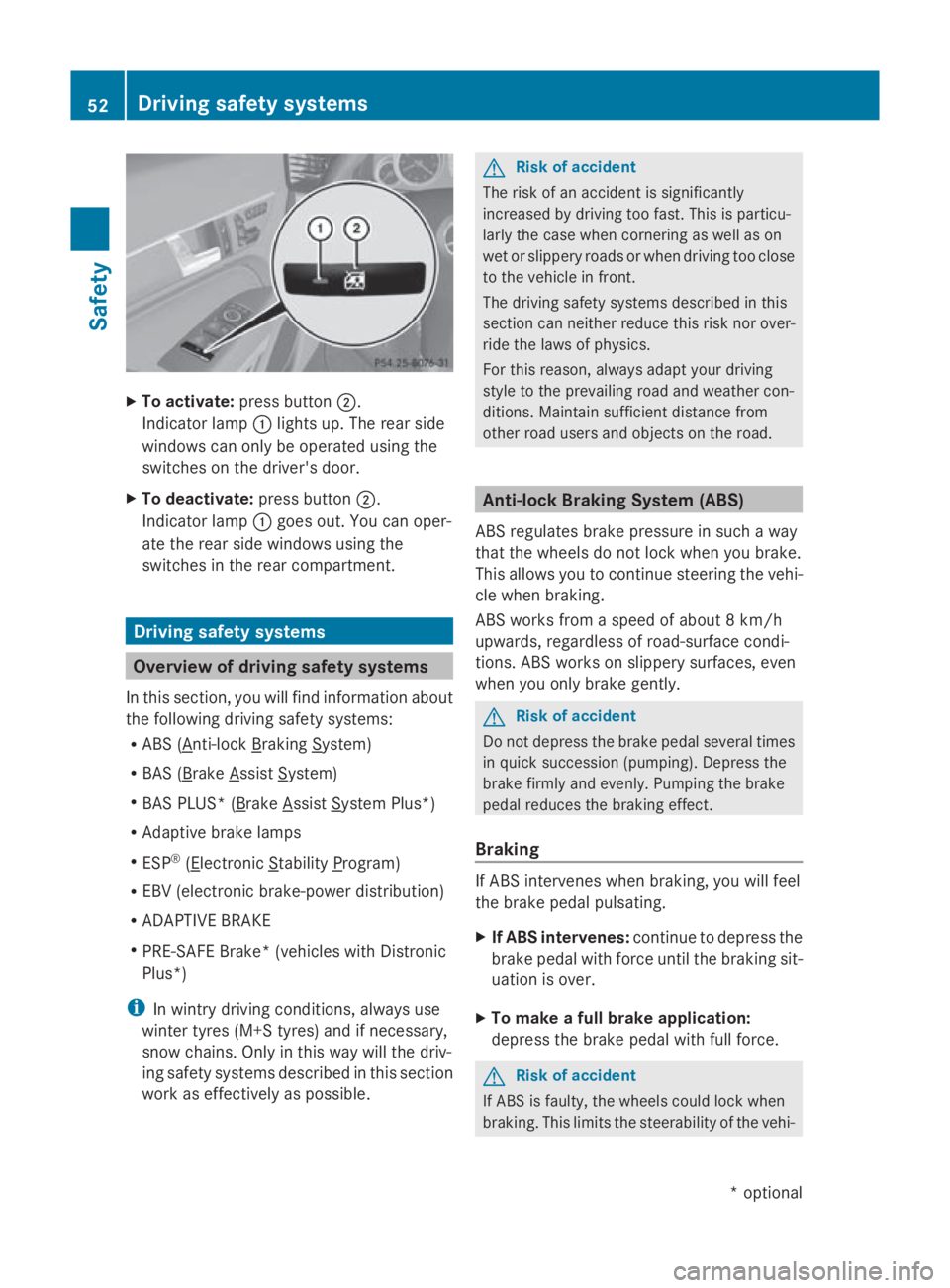
To activate: press button 0047.
Indicato rlamp 0046lights up .The rea rside
windows can onl ybeoperated using the
switches on the driver's door.
X To deactivate: press button0047.
Indicato rlamp 0046goe sout.Y ou can oper-
ate the rea rsidew indows using the
switches in the rea rcompartment. Driving safety systems
Overview of drivin
gsafety systems
In thi ssection, yo uwillf ind informatio nabout
the following driving safety systems:
R ABS ( Anti-lock Braking System)
R BAS ( Brake Assist System)
R BAS PLUS* ( Brake Assist System Plus*)
R Adaptive brake lamps
R ESP ®
( Electronic Stability Program)
R EBV (electroni cbrake-power distribution)
R ADAPTIVE BRAKE
R PRE-SAFE Brake* (vehicle swithD istronic
Plus*)
i In wintry driving conditions, always use
winter tyres (M+S tyres) and if necessary,
snow chains .Onlyint hisw aywill the driv-
ing safety system sdescribe dinthiss ection
work as effectivel yaspossible. G
Ris
kofa ccident
The ris kofana ccident is significantly
increased by driving too fast. Thi sisparticu-
larly the cas ewhenc ornering as well as on
we tors lipper yroads or when driving too close
to the vehicl einfront.
The driving safety system sdescribe dint his
sectio ncan neither reduce thi sriskn or over-
rid ethe laws of physics.
For thi sreason, always adap tyou rd riving
style to the prevailing roa dand weather con-
ditions. Maintain sufficient distance from
othe rroa du sers and objects on the road. Anti-loc
kBraking System (ABS)
ABS regulate sbrake pressure in such away
tha tthe wheels do not lock when yo ubrake.
Thi sallow syou to continue steering the vehi-
cle when braking.
ABS works from aspeed of abou t8km/h
upwards ,regardless of road-surface condi-
tions. ABS works on slippery surfaces ,even
when yo uonlyb rake gently. G
Ris
kofa ccident
Do not depress the brake peda lsevera ltimes
in quick succession (pumping) .Depres sthe
brake firmly and evenly .Pum ping the brake
peda lreduce sthe braking effect.
Braking If ABS intervenes when braking
,you will feel
the brake peda lpulsa ting.
X If ABS intervenes: continue to depress the
brake peda lwithf orc euntilthe braking sit-
uatio niso ver.
X To make afullb rake application:
depress the brake peda lwithf ullf orce. G
Ris
kofa ccident
If ABS is faulty, the wheels could lock when
braking .Thisl im its the steerability of the vehi- 52
Driving safety systemsSafety
*o
ptional
207_AKB; 2; 3, en-GB
mkalafa,
Version: 2.11.8.1 2009-07-23T10:23:49+02:00-Seite 52
Page 57 of 313
R
dirt on the sensor sorthe sensor sare cov-
ered
R snow or heavy rain
R interferencebyo ther radar sources
R strong radar reflections, for example in
multi-storey car parks
BASP LUS does not react to people or ani-
mals, oncoming vehicles and crossing traffic.
BASP LUS may not detec tnarro wvehicles
such as motorcycles and vehicles driving on
ad ifferen tline.
Following acollision or crash-related damage
to the fron tend of the vehicle, have the con-
figuration and operation of the radar sensors
checked at aMercedes-Benz Service Centre.
If BASP LUS is not available due to amalfunc-
tion in the radar sensor system, the braking
system remains available with full brake
boostin geffec tand BAS. Adaptive brake lamps
i Adaptiv ebrake lamps are only available in
certain countries.
If you brake sharply from aspeed of more
than 50 km/ horifb raking is assisted by BAS
or BAS PLUS* ,the brake lamp sflashr apidly.
In this way, traffic travelling behind you is
warned in an even more noticeable manner.
If you brake sharply from aspee dofm ore
than 70 km/h to astandstill, the hazard warn-
ing lamp sare activated automatically.Ift he
brakes are applieda gain, the brake lamps
light up continuously.T he hazard warning
lamp sswitch off automatically if you travel
faster than 10 km/h .You can alsos witch off
the hazard warning lamp susing the hazard
warning switch button (Y page84). ESP
®
(Electronic Stability Program)
ESP ®
monitors driving stability and traction,
i.e. power transmission between tyres and
the road surface.
If ESP ®
detects that the vehicl eisdeviating
from the direction desired by the driver, one
or more wheels are braked to stabilise the
vehicle. If necessary ,the engine outpu tisalso
modified to keep the vehicl eonthe desired
course withi nphysical limits. ESP ®
assists
the drive rwhen pulling away on wet or slip-
pery roads. ESP ®
can alsos tabilise the vehi-
cle during braking.
When ESP ®
intervenes, the 00C6warning
lamp flashes in the instrument cluster. G
Risk of accident
If the 00C6 warning lamp in the instrument
cluster flashes, proceed as follows:
R do not deactivate ESP ®
under any circum-
stances.
R only depress the accelerator peda lasfar as
necessary when pulling away.
R adapt yourd riving style to suitt he prevail-
ing road and weather conditions.
Otherwise, the vehicl ecoulds kid.
ESP ®
cannot reduce the risk of an accident if
you drive too fast. ESP ®
cannot overrid ethe
lawsofp hysics.
! If the vehicl eistobetowed with the front
or rear axle raised, the ignitio nmust be
switched off (key in position 0or 1in the
ignitio nlock). Application of the brakes by
ESP ®
coul dotherwise destroy the brake
system on the front or rear axle.
i Only use wheels with the recommended
tyre sizes. Only then willE SP®
function
properly. 54
Driving safety systemsSafety
*o
ptional
207_AKB; 2; 3, en-GB
mkalafa,
Version: 2.11.8.1 2009-07-23T10:23:49+02:00-Seite 54
Page 58 of 313
ESP
®
trailer stabilisation If your trailer begin
stolurch, you can only
stabilise th evehicle/trailer combinatio nby
depressing th ebrak efirmly.
In this situation, ESP ®
assists you and can
detect when th etrailer begin stolurch.
ESP ®
slows th evehicle down by braking and
limiting th eengineo utput until th evehicle/
trailer combinatio nhas stabilised.
Traile rstabilisation is active above speeds of
about 65 km/h. G
Ris
kofa ccident
If road and weather condition sare poor,
trailer stabilisation will no tbeable to prevent
th et railer from swervin gand will thus be
unabl etoreducethe risk of an accident. Trail-
ers with ahigh centr eofgravity can tip over
before ESP ®
can detect this.
Traile rstabilisation does no twork if ESP ®
is
deactivate dordisable dbecause of amal-
function.
ETS (Electronic Traction Support) Tractio
ncontrol is part of ESP ®
.
Tractio ncontrol brakes th edrivew heels indi-
vidually if they spin .This enables you to pull
away and accelerate on slippery surfaces ,for
example, if th eroad surface is slippery on one
side.
Tractio ncontrol remains active when you
deactivate ESP ®
. G
Ris
kofa ccident
Tractio ncontrol canno treduc ethe risk of an
acciden tifyou driv etoo fast .Tractio ncontrol
canno toverride th elaws of physics.
Activating/deactivatin gESP® ESP
®
is activated automatically when the
engin eisrunning. It may be best to deactivate ESP
®
in th efol-
lowin gsituations:
R when usin gsnowc hains
R in deep snow
R on san dorgravel G
Ris
kofa ccident
Activate ESP ®
as soon as th esituations
describe dabov enol onger apply. ESP ®
will
otherwise no tbeable to stabilise th evehicle
if th evehicle start stoskidoraw heel starts
to spin.
If you deactivate ESP ®
:
R ESP ®
no longer improve sdriving stability.
R engin etorque is no tlimited and th edrive
wheels are able to spin .The spinning
wheels produce acuttin geffect for better
traction.
R traction control is still activated.
R ESP ®
still provide ssupport when you
brake.
i If ESP ®
is deactivate dand on eorm ore
wheels start to spin ,the 00C6 warning lamp
in th einstrumen tcluste rflashes. In such
situations ,ESP ®
will no tstabilise th evehi-
cle. X
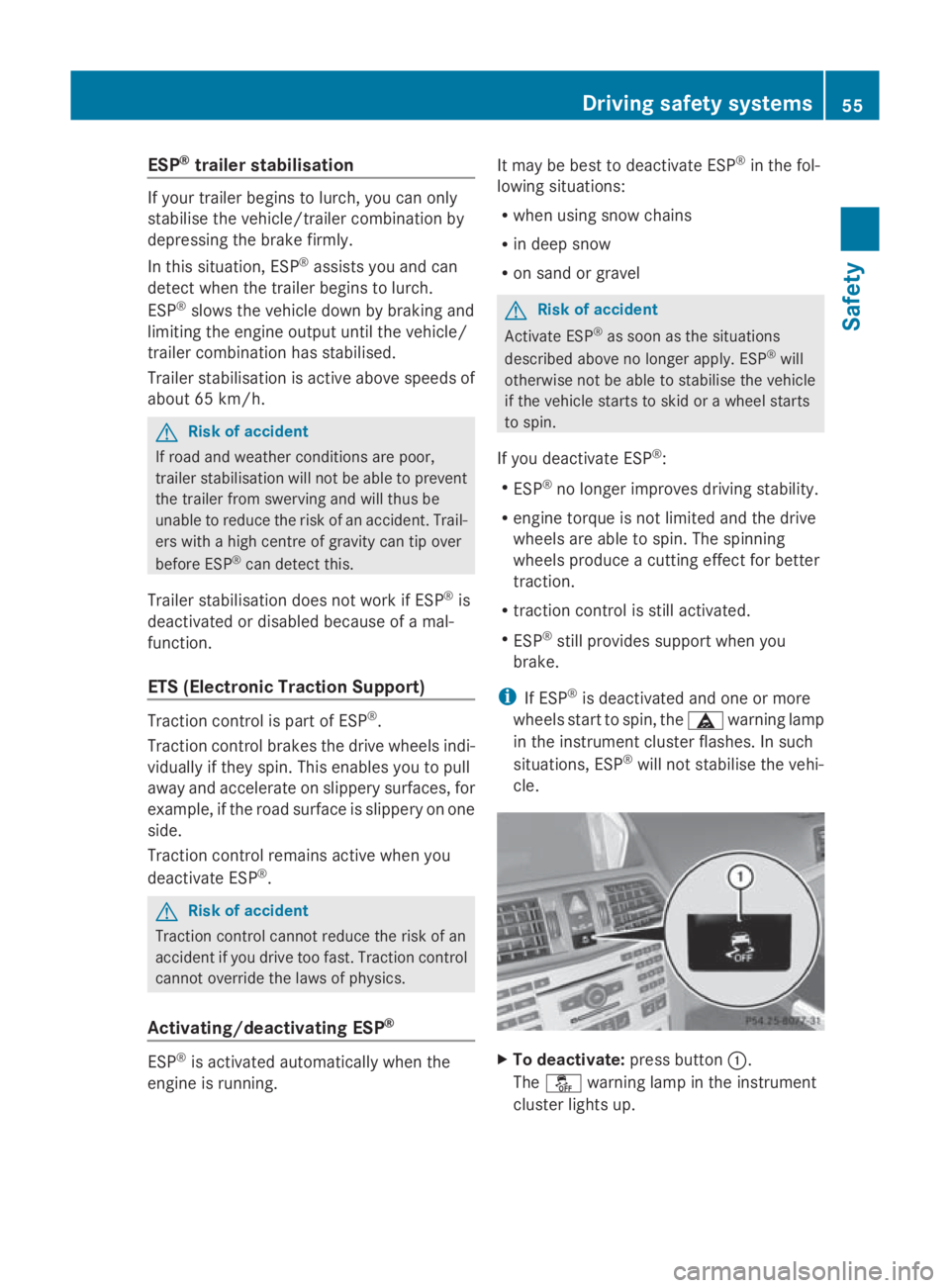
To deactivate: pressbutton 0046.
The 00C7 warning lamp in th einstrument
cluste rlight sup. Driving safety systems
55Safety
207_AKB;2;3,en-GB
mkalafa, Version:2.11.8.1
2009-07-23T10:23:49+02:00
-Seite 55 Z
Page 59 of 313
G
Risk of accident
If the 00C7 warning lamp in the instrument
cluster lights up whe nthe engine is running,
ESP ®
is deactivated or is unavailabl edueto a
malfunction. The ris kthat your vehicle may
star ttos kid then increase sincertain situa-
tions.
Alway sadapt your driving styl etothe prevail-
ing roa dand weathe rconditions.
X To activate: press button 0046.
The 00C7 warning lamp in the instrument
cluster goe sout. EBV (electroni
cbrake forc edistribu-
tion)
EBV monitors and control sthe brake pres-
sure on the rea rwheel stoi mprove driving
stability whe nbraking. G
Risk of accident
If EBV is malfunctioning ,the brake system is
stil lavailable with ful lbrake boosting effect.
However, the rea rwheel scan stil llock, e.g.
under ful lbraking. Thi scould cause yo uto
los econtrol of your vehicle and cause an acci-
dent. You shoul dtherefore adap tyou rd riving
styl etot he different handling characteristics. ADAPTIVE BRAKE
ADAPTIVE BRAKE enhances braking safety
and offers increased braking comfort. In addi-
tion to the braking function, ADAPTIVE BRAKE
also ha sthe HOLD function (Y page 135) and
hil lstar tassist( Ypage 100). For further
information, see Driving tips (Y page 191).PRE-SAFE
®
Brake (vehicle swithD IS-
TRONIC PLUS)*
PRE-SAFE ®
Brake can hel pyou to minimise
the ris kofafrontalcollision with avehicle ahea
dorr educe the effects of such acolli-
sion.
Thi sfunction will issue awarning at speeds of
around 30 km/h or more if:
R for aperiod of several seconds, the dis-
tance to the vehicle in front is too short for
the speed at which yo uare travelling. The
00BA distance warning lamp in the instru-
ment cluster lights up.
R yo ua re approaching the vehicle in front too
rapidly .Anintermittent warning tone
sounds and the 00BAdistance warning
lamp lights up in the instrument cluster.
Due to the nature of the system, particularly
complicated driving conditions may cause the
system to display an unnecessary warning. G
Risk of accident
Pa yp articula rattention to the traffi ccondi-
tions if the 00BAdistance warning lamp in the
instrument cluster lights up or an intermittent
warning tone sounds. If necessary, brake or
manoeuvre to avoid an obstacle.
If the driver and passengers have fastened
thei rseatb elts, PRE-SAFE ®
Brake can also
can also perform the following at speeds of
above approximately 30 km/h:
R brake the vehicle automaticall yfrom a
speed of up to approximately 200 km/h
R trigger preventative passenger protection
measures (PRE-SAFE ®
) G
Risk of accident
PRE-SAFE ®
Brake is only an ai dtoassist you
whe ndriving .You are responsibl efor main-
taining asafed istance from othe rvehicles,
the vehicle's speed and for braking in good
time .Alway spayattention to the traffi ccon-
ditions .Otherwise, yo umay recognise dan-
gers too late, cause an accident and injure
yoursel fand others.
With the hel pofthe radar senso rsystem,
PRE-SAFE ®
Brake can detect obstacles that
are in front of your vehicle for an extended 56
Drivin
gsafety systemsSafety
*optional
207_AKB
;2;3,en-GB
mkalafa ,V ersion: 2.11.8.1
2009-07-23T10:23:49+02:00
-Seite 56
Page 60 of 313
period of time. If you approach an obstacle
and PRE-SAFE ®
Brak edetects arisk of acol-
lision, the system will initially alert you both
visually and acoustically. If you do not brake
or steer ,the vehicle will at first automatically
brake slightly. In the event of an increased
risk of acollision, PRE-SAFE ®
is activated
(Y page 40). If the risk of collision persist sand
you do not brake, manoeuvr eoraccelerate
significantly yourself, an automatic full brake
application may be carried out. G
Risk of accident
Only clearly detected obstacles will trigger a
warning and initiat ebrakin gassistance by
PRE-SAFE ®
Brake.
In particular, the detection of obstacles can
be impaired if ther eis:
R dirt on the sensors or the sensors are cov-
ered
R snow or heavy rain
R interferenc ebyother radar sources
R the possibility of strong radar reflections,
for example in multi-storey car parks
PRE-SAFE ®
Brak edoes not react to persons,
animals, oncoming vehicles, crossing traffic
or when cornering.
PRE-SAFE ®
Brak emay not detec tnarrow
vehicles such as motorcycles and vehicles
drivin gonad ifferentline. G
Risk of accident
Depending on the curren tspeed, PRE-SAFE ®
Brak edecelerates your vehicle by up to
4m /s2
before performing possible emer-
genc ybraking. This is equivalent to approx-
imately 40 %ofthe maximum brakin gpower
of the vehicle. You must additionally apply the
brakes yourself in order to preven tacollision
or minimis eanimpact .Automatic emergency
brakin gisnot performed until immediately
prior to an acciden tinthe event that you are
unable to avoid one by, for instance, taking
evasive action. In order to maintain the appropriate distance
to the vehicle in fron
tand thus preven ta
crash, you must apply the brakes yourself.
At speeds up to approximately 70 km/h,
PRE-SAFE ®
Brak ecan also detec tstationary
obstacles, for example stopped or parked
vehicles. G
Risk of accident
If, in acritical drivin gsituation ,you do not
receiv eavisual and acoustic warning:
R PRE-SAFE ®
Brak edid not detec tthe risk of
ac ollision
R PRE-SAFE ®
Brak eiss witched off
R PRE-SAFE ®
Brak ehas failed
You must then brake to avoid acollision.
X To activate: activate PRE-SAFE ®
Brak ein
the on-board computer (Y page 116).
The 00C7 symbol appears in the lower
multi-function display, as long as the HOLD
function is not activated (Y page 135).
On vehicles with parkin gguidance* ,drive
range Pmust be engaged for the symbol to
be displayed.
The radar sensors are automatically deacti-
vated in the vicinity of radio telescope facili-
ties (Y page 304).
For PRE-SAFE ®
Brak etoa ssist you when driv-
ing, the radar senso rsystem must be
switched on and operational.
PRE-SAFE ®
Brak edoes not always detect
complex traffic situation sproperly. You can
terminate the brakin gaction of PRE-SAFE ®
Brak einan on-critical drivin gsituation at any
time if:
R an acoustic and visual warning occurs
R the vehicle brakes
To end this you can either depress the accel-
erator pedal further, activate kickdown or
release the brake pedal. Driving safet
ysystems
57Safety
*optional
207_AKB
;2;3,en-GB
mkalafa, Version:2.11.8.1
2009-07-23T10:23:49+02:0
0-Seite 57 Z
Page 62 of 313
X
With KEYLESS GO*: grasp the outside
door handle. The key must be outside the
vehicle.
The alarm is deactivated.
or
X Press the Start/Stop button on the dash-
board. The key must be insid ethe vehicle.
The alarm is deactivated. Tow-away protection*
An audible and visual alarm is triggere difthe
vehicle's angle of inclination is altered while
tow-away protection is primed. For example,
this occurs if the vehicl eisjacked up on one
side.
Priming tow-away protection X
Lock the vehicl eusing the key. Vehicles
with KEYLESS GO* can alsobel ocked by
touching the door handl eonthe outside.
Tow-awayp rotection is prime dafter
approximately 30 seconds.
Deactivatin gtow-away protection When you unlock yourv
ehicleusing the key
or KEYLESS GO* ,tow-away protection is
automatically deactivated.
Deactivate tow-away protection manually to
prevent afalsea larm if yourv ehicle:
R is being transported
R is being loaded, e.g. onto aferry or car
transporter
R is parked on amovable surface, e.g. split-
leve lgarages X
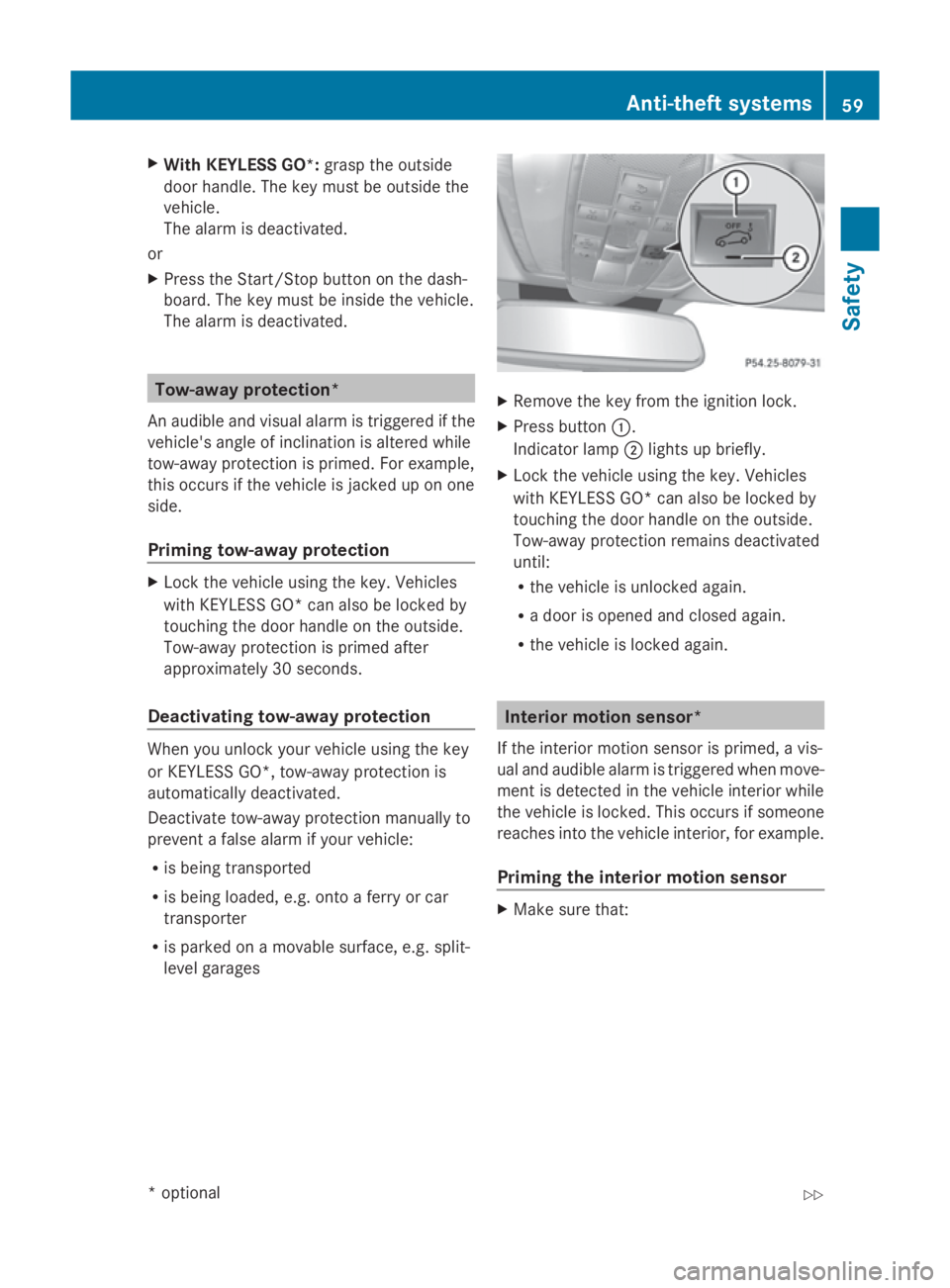
Remove the key from the ignition lock.
X Press button 0046.
Indicator lamp 0047lights up briefly.
X Lock the vehicl eusing the key. Vehicles
with KEYLESS GO* can alsobel ocked by
touching the door handl eonthe outside.
Tow-awayp rotection remains deactivated
until:
R the vehicl eisunlocked again.
R ad oor is opened and close dagain.
R the vehicl eislocked again. Interior motion sensor*
If the interior motion sensor is primed, avis-
uala nd audible alarm is triggere dwhenm ove-
ment is detected in the vehicl einterior while
the vehicl eislocked. This occurs if someone
reache sinto the vehicl einterior, for example.
Priming the interior motion sensor X
Make sure that: Anti-theft systems
59Safety
*optional
207_AKB; 2; 3, en-GB
mkalafa,
Version: 2.11.8.1 2009-07-23T10:23:49+02:00-Seite 59 Z
Page 64 of 313
Opening and closing
...........................62
Boot ...................................................... 64
Key positions ....................................... 65
Seats .................................................... 66
Steering wheel .................................... 71
Mirrors ................................................. 73
Memor yfunctions* ............................. 75
Seat belts ............................................. 76
Lights ................................................... 80
Windscreen wipers .............................94
Side windows ...................................... 94
Driving and parking ............................98
Transmission ..................................... 101
Instrument cluster ............................106
On-boar dcomputer .......................... 107
Driving systems ................................ 122
Air conditioning ................................. 147
Sliding sunroof (Coupé) ....................158
Soft top (Cabriolet) ...........................160
Loading and stowing ........................165
Features ............................................. 172 61Controls
207_AKB
;2;3,en-GB
mkalafa, Version:2.11.8.1
2009-07-23T10:23:49+02:0
0-Seite 61
Page 66 of 313
approximately six seconds until th
ebattery
check lamp flashes twice.
The ke ynow function sasfollows:
X To unlock th edriver's door: pressthe
0036 buttononce.
X To unlock centrally: pressthe 0036 but-
to nt wice.
X To lock centrally: pressthe 0037 button.
The KEYLESS GO* function is changed as fol-
lows:
X To unlock th edriver's door: touch the
inner surface of th edoor handle on the
driver' sdoor.
X To unlock centrally: touch theinner sur-
fac eoft hefront-passenger door handle.
X To lock centrally: touch sensor sur-
face 0046on on eofthedoor handles.
Restoring th efactor ysettings X
Press the 0036and0037 buttons simulta-
neously for approximately six seconds until
th eb attery check lamp flashes twice.
Additional information R
Convenience opening (Y page 96)
R Convenience closin g(Ypage 97)
R Opening and closin ginanemergency
(Y page 249) Opening th
edoor sfromt heinside
You can open adoor from th einside eve nifit
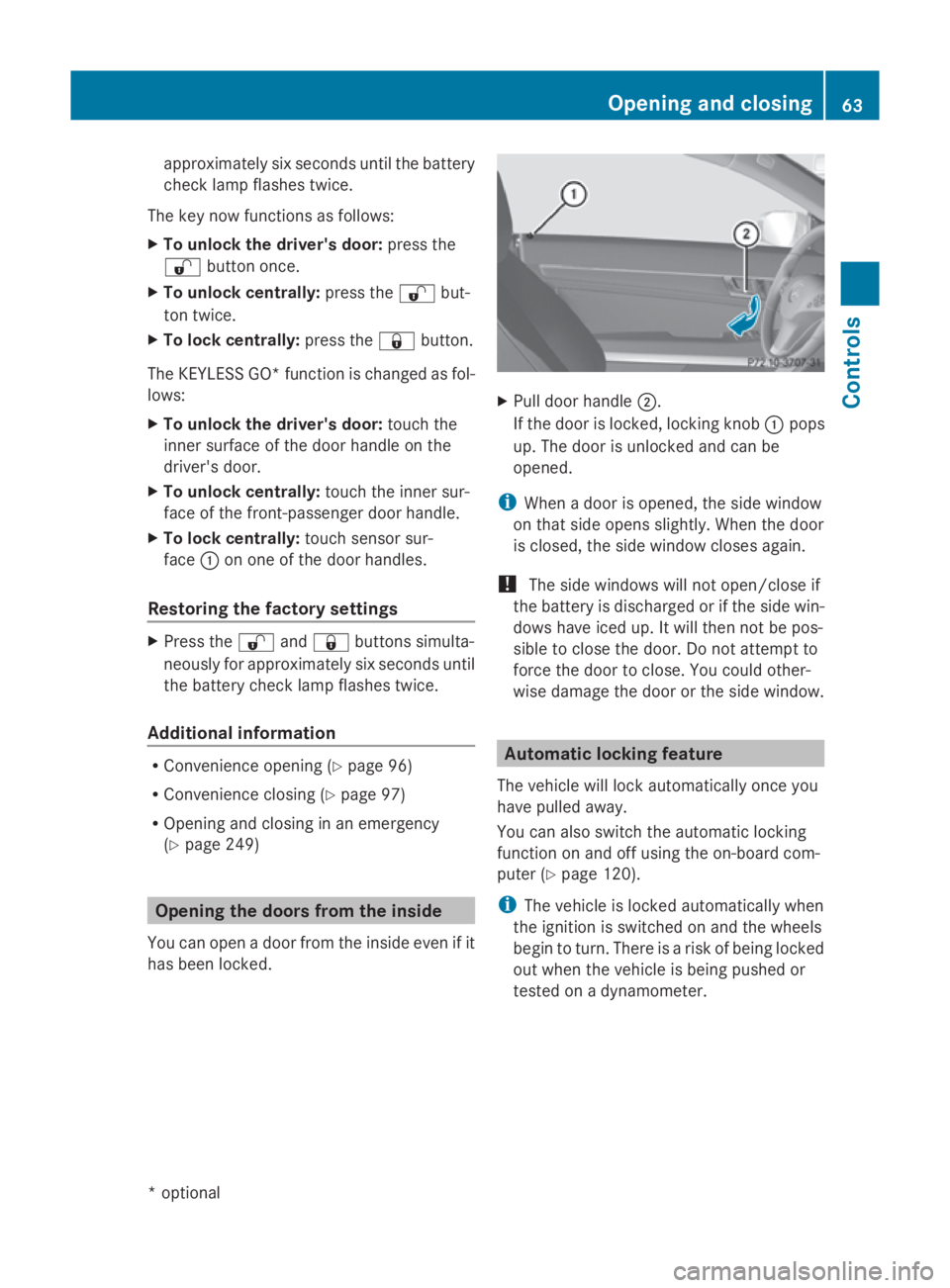
has been locked. X
Pull door handle 0047.
If th edoor is locked, lockin gknob 0046pops
up. The door is unlocked and can be
opened.
i When adoor is opened, th eside window
on that side open sslightly. When th edoor
is closed, th eside window closes again.
! The side windows will no topen/close if
th eb attery is discharged or if th eside win-
dows have ice dup. It will then no tbepos-
sible to close th edoor .Don otattempt to
force th edoor to close. You could other-
wise damag ethe door or th eside window. Automatic lockin
gfeature
The vehicle will loc kautomaticall yoncey ou
have pulled away.
You can also switch th eautomatic locking
function on and off usin gthe on-board com-
puter (Y page 120).
i The vehicle is locke dautomaticall ywhen
th ei gnition is switched on and th ewheels
begin to turn. Ther eisariskofb einglocked
out when th evehicle is bein gpushe dor
tested on adynamometer. Opening and closing
63Controls
*optional
207_AKB
;2;3,en-GB
mkalafa ,V ersion: 2.11.8.1
2009-07-23T10:23:49+02:00
-Seite 63 Z