airbag MERCEDES-BENZ E-CLASS COUPE 2012 User Guide
[x] Cancel search | Manufacturer: MERCEDES-BENZ, Model Year: 2012, Model line: E-CLASS COUPE, Model: MERCEDES-BENZ E-CLASS COUPE 2012Pages: 389, PDF Size: 9.32 MB
Page 47 of 389
G
WARNING
The airbag parts are hot after the airbag has
been deployed. Do not touch them as you
could burn yourself.
Have the airbags replaced at a qualified spe-
cialist workshop. Otherwise, occupants are
not protected by the airbags in the event of
another accident.
Airbag deployment slows downa nd restricts
the movement of the vehicle occupant.
If the airbags are deployed ,you will hear a
bang, and a small amount of powder may also
be released. Only in rare cases will the bang
affect your hearing. The powder that is
released generally does not constitute a
health hazard. The 6SRS warning lamp
lights up.
The airbag installation locations are identified
by the AIRBAG symbol.
Front airbags !
Do not place heavy objects on the front-
passenger seat. The system may then
detect that the seat is occupied and if there
is an accident, the restraint systems on the
front-passenger side could be deployed.
Have restraint systems that have been trig-
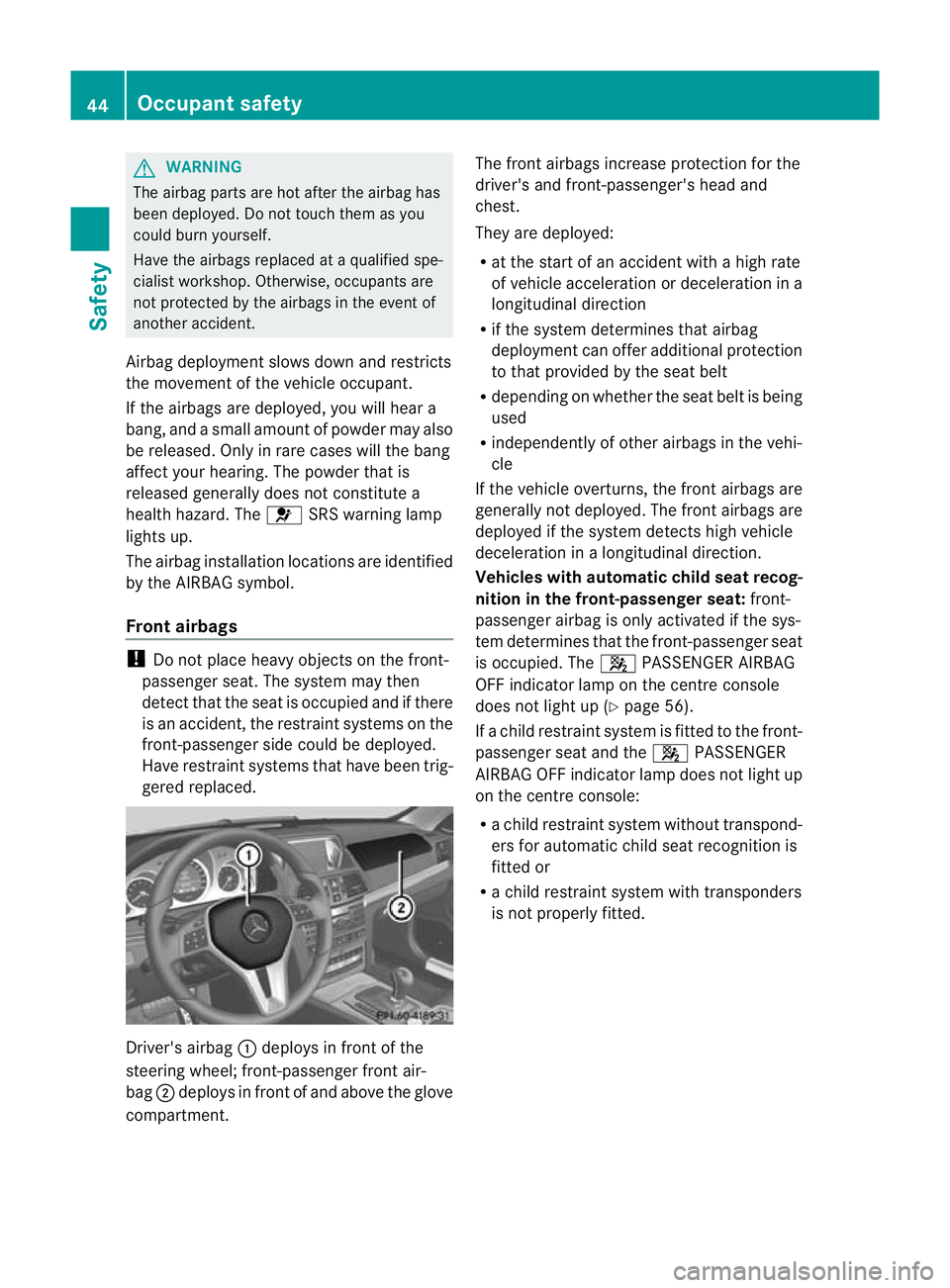
gered replaced. Driver's airbag
:deploys in front of the
steering wheel; front-passenger front air-
bag ;deploys in front of and above the glove
compartment. The front airbags increase protection for the
driver's and front-passenger's head and
chest.
They are deployed:
R
at the start of an accident with a high rate
of vehicle acceleration or deceleration in a
longitudinal direction
R if the system determines that airbag
deployment can offer additional protection
to that provided by the seat belt
R depending on whether the seat belt is being
used
R independently of other airbags in the vehi-
cle
If the vehicle overturns, the front airbags are
generally not deployed. The front airbags are
deployed if the system detects high vehicle
deceleration in a longitudinal direction.
Vehicles with automatic child seat recog-
nition in the front-passenger seat: front-
passenger airbag is only activated if the sys-
tem determines that the front-passenger seat
is occupied. The 4PASSENGER AIRBAG
OFF indicator lamp on the centre console
does not light up (Y page 56).
If a child restraint system is fitted to the front-
passenger seat and the 4PASSENGER
AIRBAG OFF indicator lamp does not light up
on the centre console:
R a child restraint system without transpond-
ers for automatic child seat recognition is
fitted or
R a child restraint system with transponders
is not properly fitted. 44
Occupant safetySafety
Page 48 of 389
Driver's kneebag
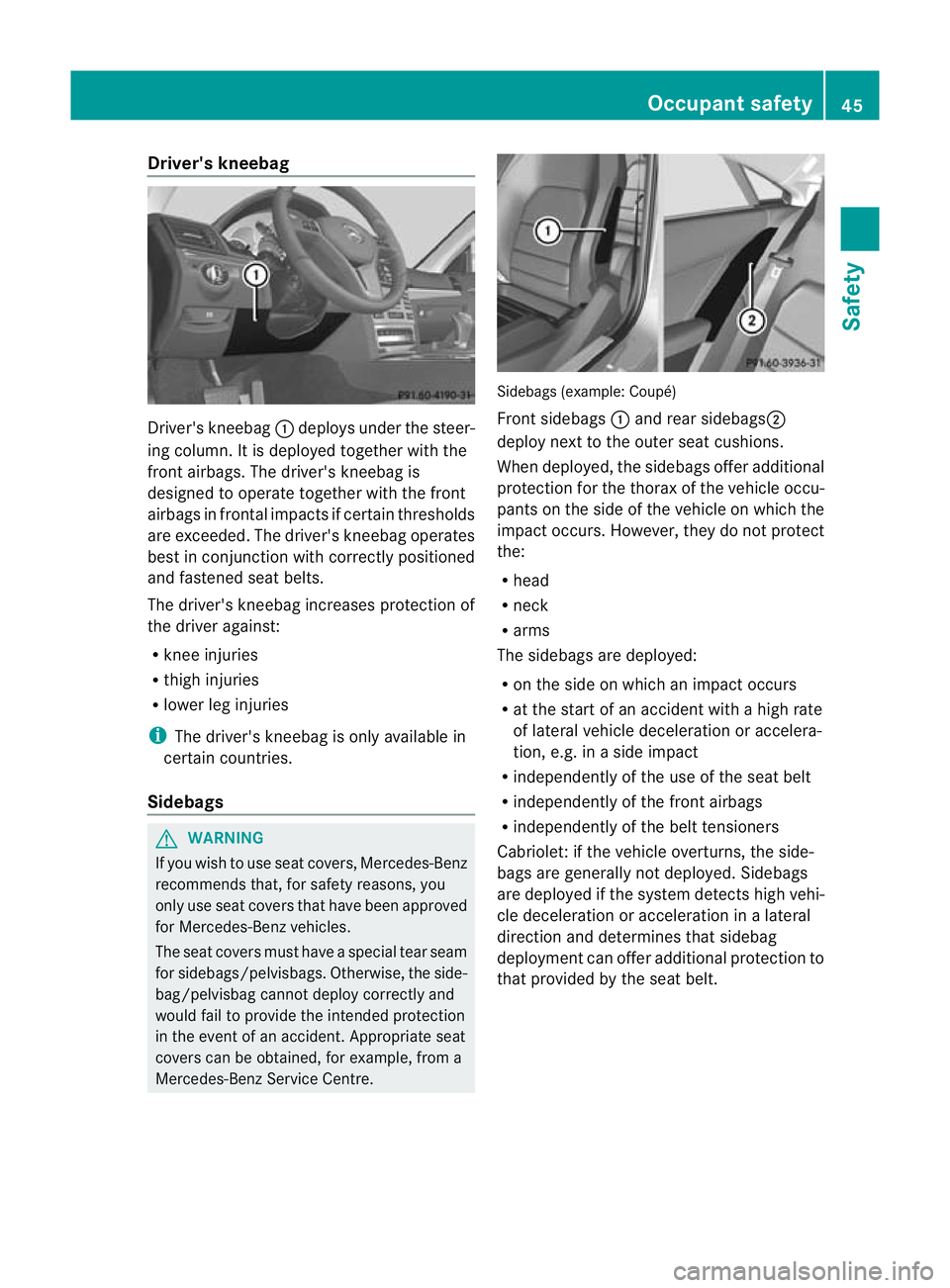
Driver's kneebag
:deploys under the steer-
ing column .Itis deployed together with the
front airbags. The driver's kneebag is
designed to operate together with the front
airbags in frontal impacts if certain thresholds
are exceeded. The driver's kneebag operates
best in conjunction with correctly positioned
and fastened seat belts.
The driver's kneebag increases protection of
the driver against:
R knee injuries
R thigh injuries
R lower leg injuries
i The driver's kneebag is only available in
certain countries.
Sidebags G
WARNING
If you wish to use seat covers, Mercedes-Benz
recommends that, for safety reasons, you
only use seat covers that have been approved
for Mercedes-Benz vehicles.
The seat covers must have a special tear seam
for sidebags/pelvisbags. Otherwise, the side-
bag/pelvisbag cannot deploy correctly and
would fail to provide the intended protection
in the event of an accident. Appropriate seat
covers can be obtained, for example, from a
Mercedes-Benz Service Centre. Sidebags (example: Coupé)
Front sidebags
:and rear sidebags ;
deploy next to the outer seat cushions.
When deployed, the sidebags offer additional
protection for the thorax of the vehicle occu-
pants on the side of the vehicle on which the
impact occurs. However, they do not protect
the:
R head
R neck
R arms
The sidebags are deployed:
R on the side on which an impact occurs
R at the start of an accident with a high rate
of lateral vehicle deceleration or accelera-
tion, e.g. in a side impact
R independently of the use of the seat belt
R independently of the front airbags
R independently of the belt tensioners
Cabriolet: if the vehicle overturns, the side-
bags are generally not deployed. Sidebags
are deployed if the system detects high vehi-
cle deceleration or acceleration in a lateral
direction and determines that sidebag
deployment can offer additional protection to
that provided by the seat belt. Occupant safety
45Safety Z
Page 49 of 389
Headbags
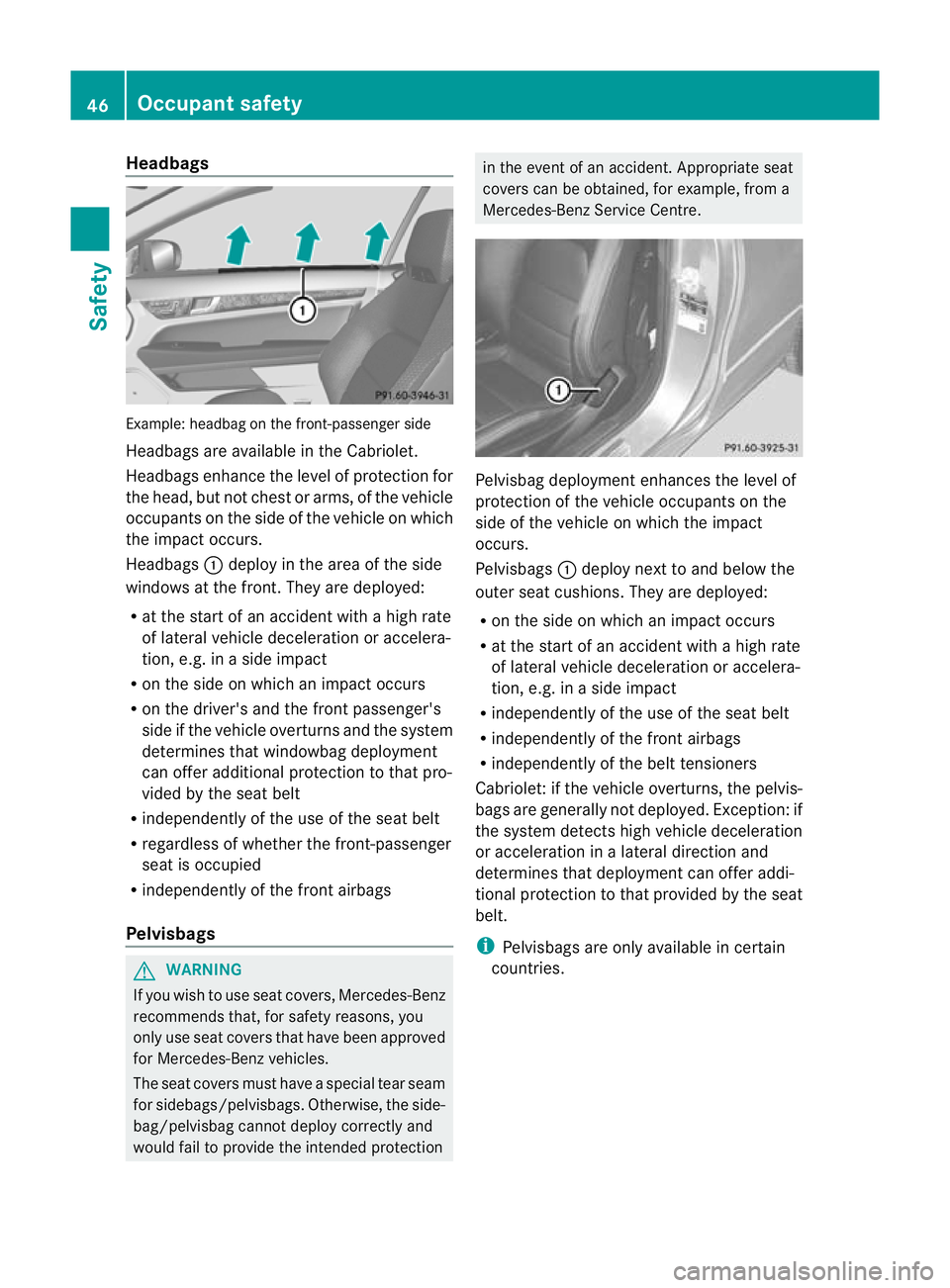
Example
:headbag on the front-passenger side
Headbags are available in the Cabriolet.
Headbags enhance the level of protection for
the head, but not chest or arms, of the vehicle
occupants on the side of the vehicle on which
the impact occurs.
Headbags :deploy in the area of the side
windows at the front. They are deployed:
R at the start of an accident with a high rate
of lateral vehicle deceleration or accelera-
tion, e.g. in a side impact
R on the side on which an impact occurs
R on the driver's and the front passenger's
side if the vehicle overturns and the system
determines that windowbag deployment
can offer additional protection to that pro-
vided by the seat belt
R independently of the use of the seat belt
R regardless of whether the front-passenger
seat is occupied
R independently of the fron tairbags
Pelvisbags G
WARNING
If you wish to use seat covers, Mercedes-Benz
recommends that, for safety reasons, you
only use seat covers that have been approved
for Mercedes-Ben zvehicles.
The seat covers must have a special tear seam
for sidebags/pelvisbags. Otherwise, the side-
bag/pelvisbag cannot deploy correctly and
would fail to provide the intended protection in the event of an accident. Appropriate seat
covers can be obtained, for example, from a
Mercedes-Benz Service Centre.
Pelvisbag deployment enhances the level of
protection of the vehicle occupants on the
side of the vehicle on which the impact
occurs.
Pelvisbags :deploy nextt o and below the
outer seat cushions. They are deployed:
R on the side on which an impact occurs
R at the start of an accident with a high rate
of lateral vehicle deceleration or accelera-
tion, e.g. in a side impact
R independently of the use of the seat belt
R independently of the front airbags
R independently of the belt tensioners
Cabriolet: if the vehicle overturns, the pelvis-
bags are generally not deployed. Exception :if
the syste mdetects high vehicle deceleration
or acceleration in a lateral direction and
determines that deployment can offer addi-
tional protection to that provided by the seat
belt.
i Pelvisbags are only available in certain
countries. 46
Occupant safetySafety
Page 50 of 389
Windowbags
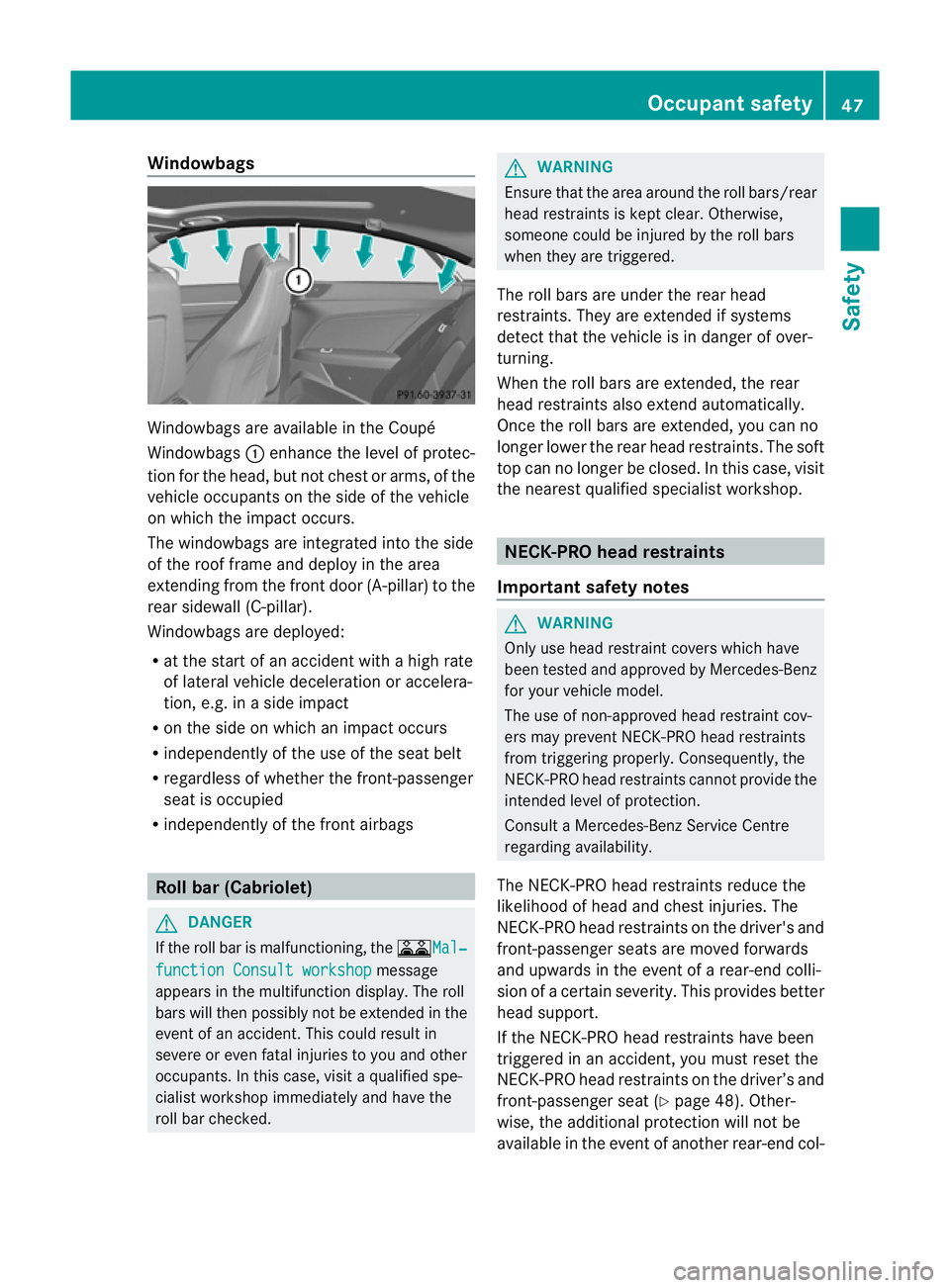
Windowbags are available in the Coupé
Windowbags :enhance the level of protec-
tion for the head, but not chest or arms, of the
vehicle occupants on the side of the vehicle
on which the impact occurs.
The windowbags are integrated into the side
of the roof frame and deploy in the area
extending from the front door (A-pillar) to the
rear sidewall (C-pillar).
Windowbags are deployed:
R at the start of an accident with a high rate
of lateral vehicle deceleration or accelera-
tion, e.g. in a side impact
R on the side on which an impact occurs
R independently of the use of the sea tbelt
R regardless of whether the front-passenger
seat is occupied
R independently of the fron tairbags Roll bar (Cabriolet)
G
DANGER
If the roll bar is malfunctioning, the AMal‐function Consult workshop message
appears in the multifunction display. The roll
bars will the npossibly not be extended in the
event of an accident .This could result in
severe or even fatal injuries to you and other
occupants. In this case, visit a qualified spe-
cialist workshop immediately and have the
roll bar checked. G
WARNING
Ensure that the area around the roll bars/rear
head restraints is kept clear. Otherwise,
someone could be injured by the roll bars
when they are triggered.
The roll bars are under the rear head
restraints. They are extended if systems
detect that the vehicle is in danger of over-
turning.
When the roll bars are extended, the rear
head restraints also extend automatically.
Once the roll bars are extended, you can no
longer lower the rear head restraints. The soft
top can no longer be closed. In this case, visit
the nearest qualified specialist workshop. NECK-PRO head restraints
Important safety notes G
WARNING
Only use head restraint covers which have
been tested and approved by Mercedes-Benz
for your vehicle model.
The use of non-approved head restraint cov-
ers may prevent NECK-PRO head restraints
from triggering properly. Consequently, the
NECK-PRO head restraints cannot provide the
intended level of protection.
Consult a Mercedes-Benz Service Centre
regarding availability.
The NECK-PRO head restraints reduce the
likelihood of head and chest injuries. The
NECK-PRO head restraints on the driver's and
front-passenger seats are moved forwards
and upwards in the event of a rear-end colli-
sion of a certain severity. This provides better
head support.
If the NECK-PRO head restraints have been
triggered in an accident, you must reset the
NECK-PRO head restraints on the driver’s and
front-passenger seat (Y page 48). Other-
wise, the additional protection will not be
available in the event of another rear-end col- Occupant safety
47Safety Z
Page 56 of 389
Comply with safety regulation
swhen dispos-
ing of belt tensioners. Any Mercedes-Benz
Service Centre can provide details of these
regulations.
! If the front-passenger seat is not occu-
pied, do not engage the seat belt tongue in
the buckle on the front-passenger seat.
Otherwise, the belt tensioner could be trig-
gered in the event of an accident.
The seat belts are fitted with belt tensioners.
The belt tensioners tighten the seat belts in
an accident, pulling them close against the
body.
Belt tensioners do not correct incorrect seat
positions or incorrectly fastened seat belts.
Belt tensioners do not pull vehicle occupants
back towards the backrest.
If the seat belt is also fitted with a belt force
limiter and this is triggered, the force exerted
by the seat belt on the vehicle occupant is
reduced.
The belt force limiters for the front seats are
synchronised with the front airbags, which
take on a part of the deceleration force. This
results in the force exerted on the occupant
being distributed over a greater area.
The belt tensioners can only be activated
when:
R the ignition is switched on.
R the restraint systems are operational; see
"SRS warning lamp" (Y page 41).
R the belt tongue is engaged in the buckle on
each of the three-point seat belts in front.
R
The belt tensioners on the seats in the rear
compartmenta re triggered independently of
the lock status of the seat belts.
The beltt ensioners are triggered depending
on the type and severity of an accident:
R if, in the event of a head-on or rear-end col-
lision the vehicle decelerates or acceler- ates rapidly in a longitudinal direction dur-
ing the initial stages of the impact
R if, in the event of a side impact, on the side
opposite the impact the vehicle deceler-
ates or accelerates rapidly in a lateral direc-
tion
R Cabriolet: in certain situations if the vehicle
overturns and the system determines that
it can provide additional protection.
If the airbags are deployed, you will hear a
bang, and a small amount of powder may also
be released. Only in rare cases will the bang
affect your hearing. The powder that is
released generally does not constitute a
health hazard. The 6SRS warning lamp
lights up.
Automatic comfort-fit feature The fron
tseat belts have an automatic com-
fort-fit feature. The automatic comfort-fit fea-
ture reduces the retraction force of the seat
belts. This results in increased seat belt com-
fort. Children in the vehicle
Child restraint systems
Important safety notes G
WARNING
To reduce the risk of serious or even fatal
injury to the child in the event of a sudden
change in direction, braking or an accident:
R children less than 1.50 m tall and under
twelve years of age must always be secured
in special child restraint systems on a suit-
able vehicle seat. This is necessary
because the seat belts are not designed for
children.
R Do not drive with a child secured in a rear-
ward-facing child restraint system on the
front-passenger seat. Exception: if the vehi-
cle is equipped with automatic child seat
recognition on the front-passenger seat Children in the vehicle
53Safety
Z
Page 58 of 389
Child seat lock
G
WARNING
If you release the seat belt during the journey,
the child seat loc kwill be deactivated.
After being released, the seat belt cannot be
fastened again during the journey as the iner-
tia reel will draw in a fraction .The child
restraint system is no longer correctly
secured. There is an increased risk of injury
or even death.
Always keep the seat belt of the activated
child seat lock fastened during the journey.
The seat belts on the rear seats are equipped
with a child-seat lock. When enabled, the
child seat lock function ensures that the seat
belt does not slacken once the child restraint
system is secured.
Installing a child restraint system:
X Always comply with the manufacturer's
installation instructions.
X Pull the seat belt smoothly from the inertia
reel.
X Engage the seat belt tongue in the belt
buckle.
Activating the child seat lock:
X Pull the seat belt out fully and let the inertia
reel retract it again.
While the seat belt is retracting, you should
hear a ratcheting sound. The child seat lock
function is enabled.
X Push down on the child restraint system to
take up any slack.
Removing a child restraint system/deactivat-
ing the child seat lock:
X Always comply with the manufacturer's
installation instructions.
X Press the seat belt release button and
guide the belt tongue to the belt outlet.
The child seat lock function is deactivated. Child restraint system on the front-
passenger seat G
WARNING
If the front-passenger airbag is not disabled:
R a child secured in a child restraint system
on the front-passenger seat could be seri-
ously and even fatally injured by the front-
passenger airbag deploying. This is espe-
cially a risk if the child is in the immediate
vicinity of the front-passenger airbag when
it deploys.
R never secure a child on the front-passenger
seat in a rearward-facing child restraint sys-
tem. Only secure a rearward-facing child
restraint system on a suitable rear seat.
R always move the front-passenger seat to
the rearmost position if you secure a child
in a forward-facing child restraint system
on the front-passenger seat.
The front-passenger airbag is not disabled:
R on vehicles without automatic child seat
recognition on the front-passenger seat
R in vehicles with automatic child seat rec-
ognition in the front-passenger seat, if no
special child restraint system with trans-
ponders for automatic child seat recogni-
tion in the front-passenger seat has been
fitted
R on vehicles with automatic child seat rec-
ognition on the front-passenger seat, if the
PASSENGER AIRBAG OFF indicator lamp
4 is not lit.
To make you aware of this danger, a corre-
sponding warning sticker has been affixed on
the dashboard and on both sides of the sun
visor on the front-passenger side.
Information about recommended child
restraint systems is available at any
Mercedes-Benz Service Centre. Children in the vehicle
55Safety Z
Page 59 of 389
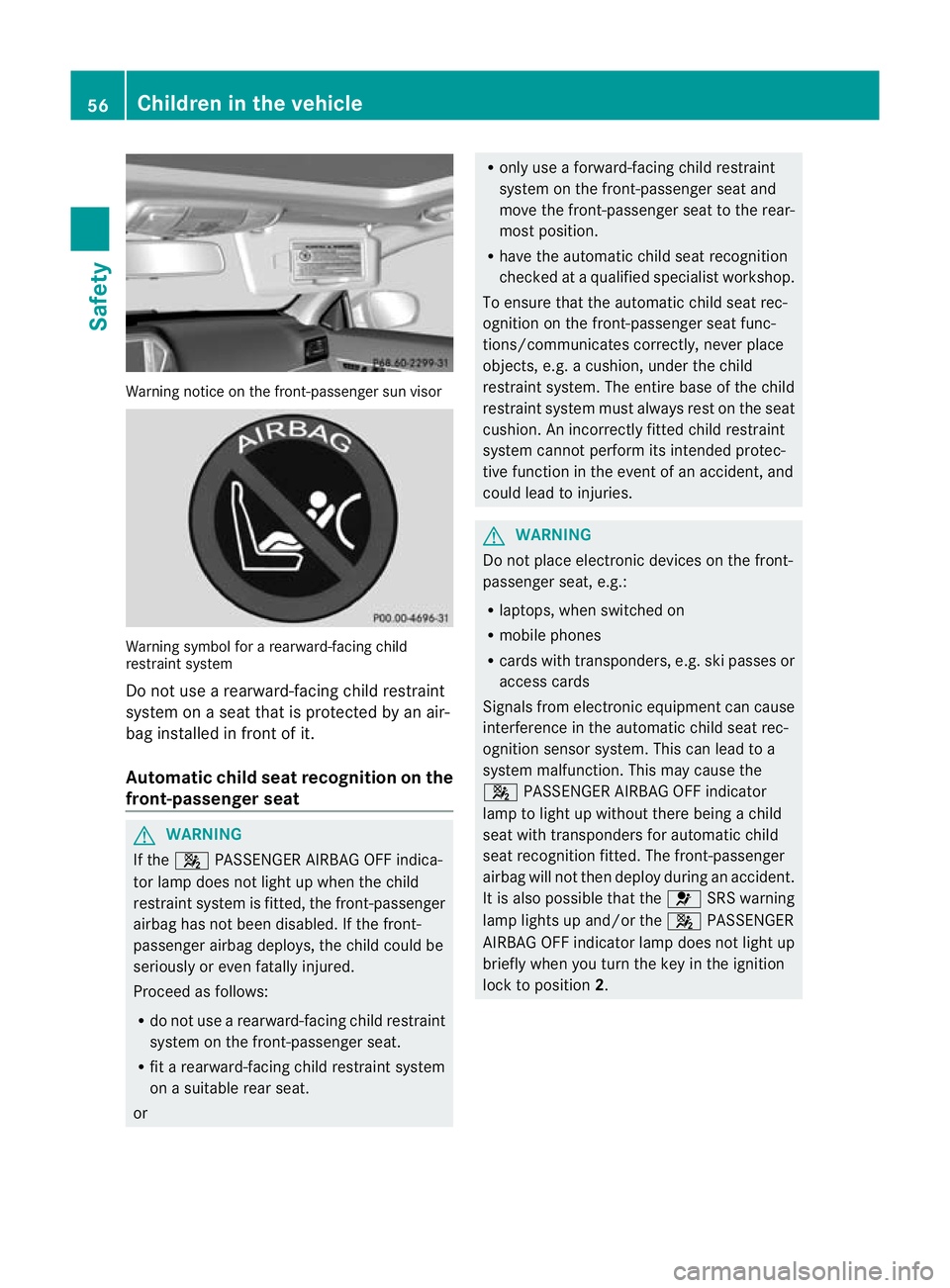
Warning notice on the front-passenger sun visor
Warning symbol for a rearward-facing child
restraint system
Do not use a rearward-facing child restraint
system on a seat that is protected by an air-
bag installed in fron tofit.
Automatic chil dseat recognition on the
front-passenger seat G
WARNING
If the 4 PASSENGER AIRBAG OFF indica-
to rlamp does no tlight up when the child
restraint system is fitted, the front-passenger
airbag has not been disabled. If the front-
passenger airbag deploys, the child could be
seriously or even fatally injured.
Proceed as follows:
R do not use a rearward-facing child restraint
system on the front-passenge rseat.
R fit a rearward-facing child restraint system
on a suitable rear seat.
or R
only use a forward-facing child restraint
system on the front-passenger seat and
move the front-passenger seat to the rear-
most position.
R have the automatic child seat recognition
checked at a qualified specialist workshop.
To ensure that the automatic child seat rec-
ognition on the front-passenger seat func-
tions/communicates correctly, never place
objects, e.g. a cushion, under the child
restraint system. The entire base of the child
restraint system must always rest on the seat
cushion. An incorrectly fitted child restraint
system cannot perform its intended protec-
tive function in the event of an accident, and
could lead to injuries. G
WARNING
Do not place electronic devices on the front-
passenger seat, e.g.:
R laptops, when switched on
R mobile phones
R cards with transponders, e.g. ski passes or
access cards
Signals from electronic equipment can cause
interference in the automatic child seat rec-
ognition sensor system. This can lead to a
system malfunction. This may cause the
4 PASSENGER AIRBAG OFF indicator
lamp to light up without there being a child
seat with transponders for automatic child
seat recognition fitted. The front-passenger
airbag will not then deploy during an accident.
It is also possible that the 6SRS warning
lamp lights up and/or the 4PASSENGER
AIRBAG OFF indicator lamp does not light up
briefly when you turn the key in the ignition
lock to position 2.56
Children in the vehicleSafety
Page 60 of 389
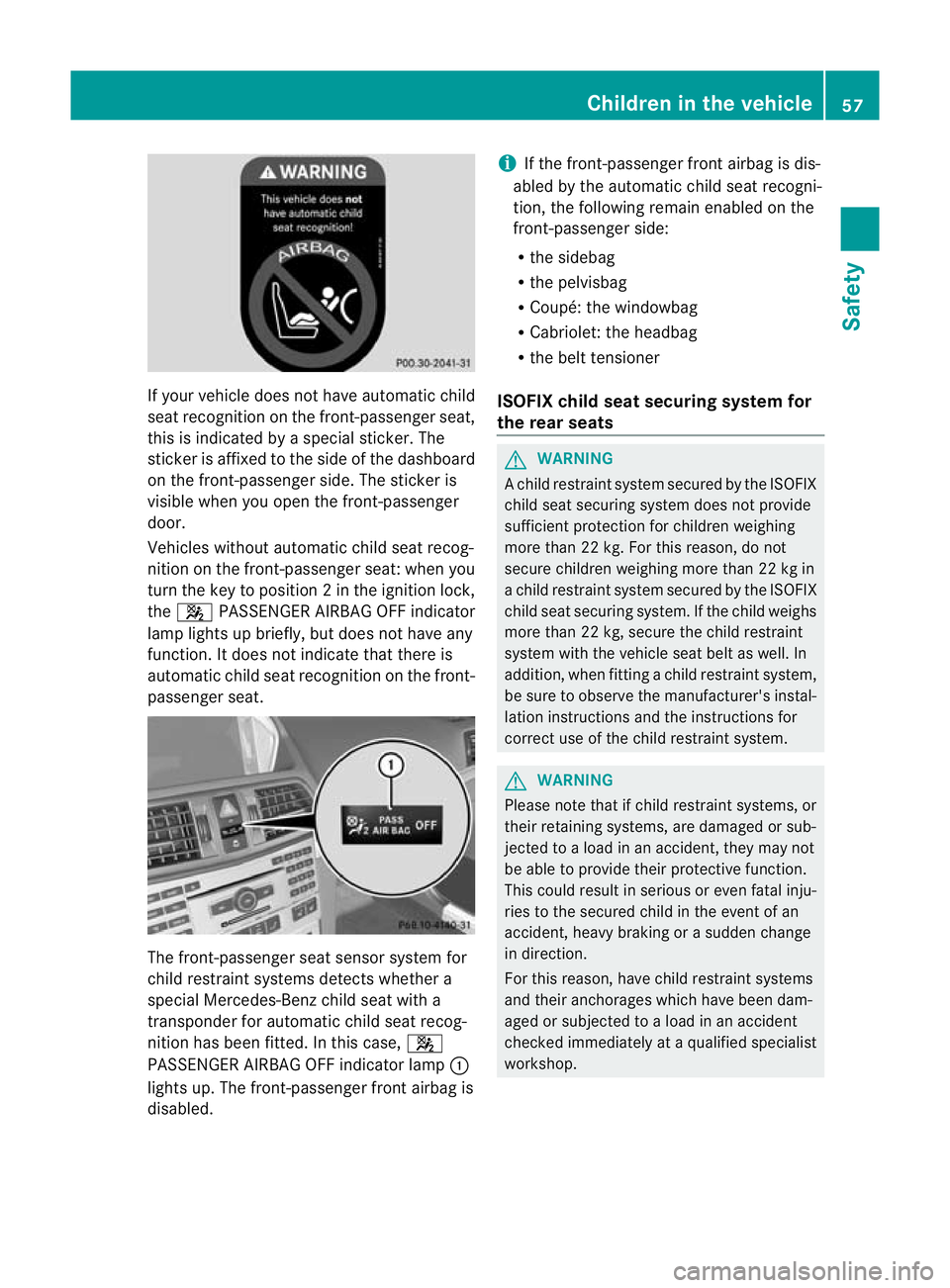
If yourv
ehicle does not have automatic child
seat recognition on the front-passenger seat,
this is indicated by a special sticker. The
sticker is affixed to the side of the dashboard
on the front-passenger side. The sticker is
visible when you open the front-passenger
door.
Vehicles without automatic child seat recog-
nition on the front-passenger seat: when you
turn the key to position 2inthe ignition lock,
the 4 PASSENGER AIRBAG OFF indicator
lamp lights up briefly, but does not have any
function. It does not indicate that there is
automatic child seat recognition on the front-
passenger seat. The front-passenger seat sensor system for
child restraint systems detects whether a
special Mercedes-Ben zchild seat with a
transponder for automatic child seat recog-
nition has been fitted. In this case, 4
PASSENGER AIRBAG OFF indicator lamp :
lights up. The front-passenger front airbag is
disabled. i
If the front-passenger front airbag is dis-
abled by the automatic child seat recogni-
tion, the following remain enabled on the
front-passenger side:
R the sidebag
R the pelvisbag
R Coupé:t he windowbag
R Cabriolet: the headbag
R the belt tensioner
ISOFIX child seat securing system for
the rear seats G
WARNING
Ac hild restraint system secured by the ISOFIX
child seat securing system does not provide
sufficient protection for children weighing
more than 22 kg. For this reason, do not
secure children weighing more than 22 kg in
a child restraint system secured by the ISOFIX
child seat securing system. If the child weighs
more than 22 kg, secure the child restraint
system with the vehicle seat belt as well. In
addition, when fitting a child restraint system,
be sure to observe the manufacturer's instal-
lation instructions and the instructions for
correct use of the child restraint system. G
WARNING
Please note that if child restraint systems, or
their retaining systems, are damaged or sub-
jected to a load in an accident, they may not
be able to provide their protective function.
This could result in serious or even fatal inju-
ries to the secured child in the event of an
accident, heavy braking or a sudden change
in direction.
For this reason, have child restraint systems
and their anchorages which have been dam-
aged or subjected to a load in an accident
checked immediately at a qualified specialist
workshop. Children in the vehicle
57Safety Z
Page 63 of 389
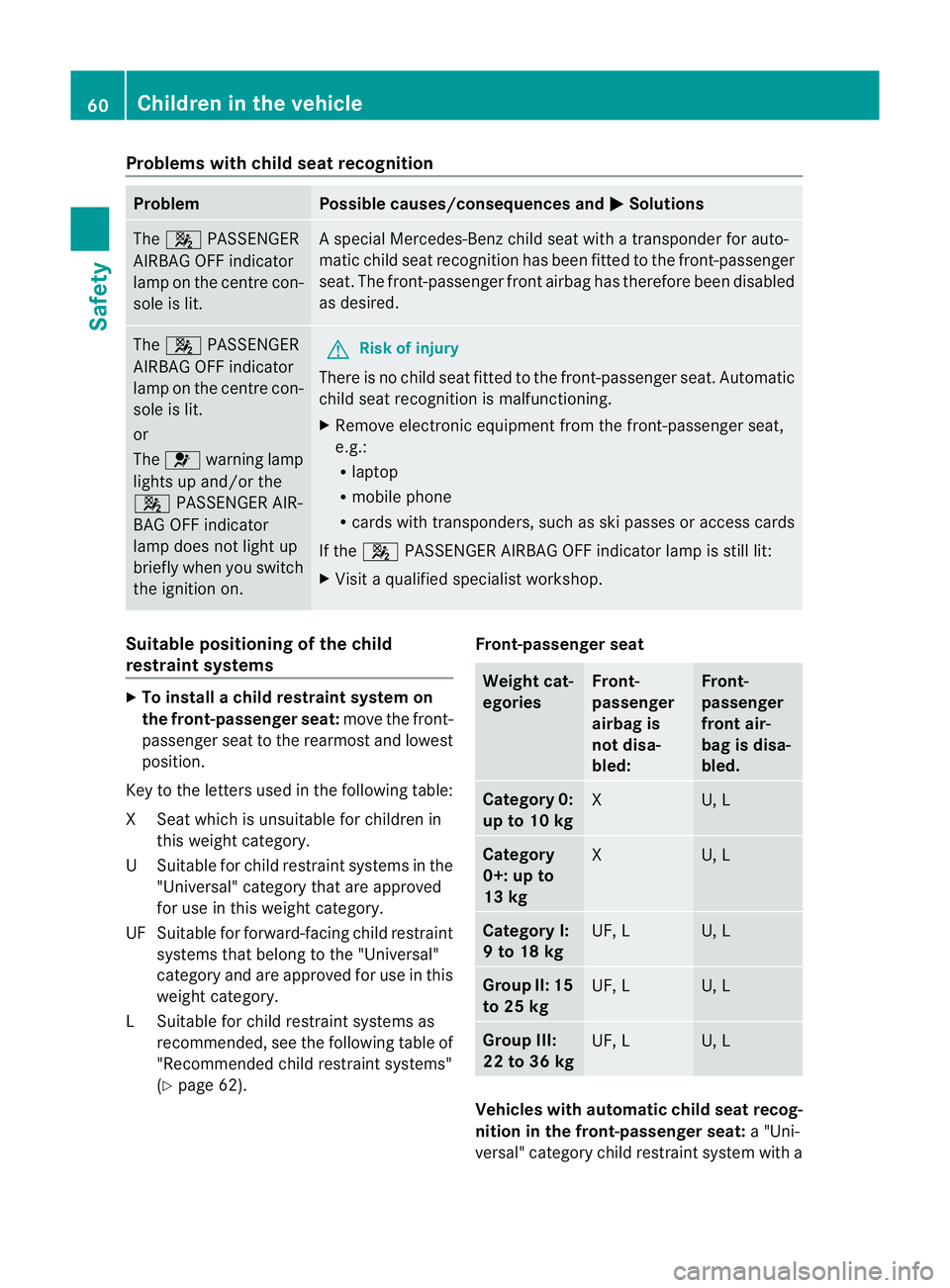
Problems with child seat recognition
Problem Possible causes/consequences and
M Solutions
The
4 PASSENGER
AIRBAG OFF indicator
lamp on the centre con-
sole is lit. As
pecial Mercedes-Benz child seat with a transponder for auto-
matic child seat recognition has been fitted to the front-passenger
seat. The front-passenger fron tairbag has therefore been disabled
as desired. The
4 PASSENGER
AIRBAG OFF indicator
lamp on the centre con-
sole is lit.
or
The 6 warning lamp
lights up and/or the
4 PASSENGER AIR-
BAG OFF indicator
lamp does not light up
briefly when you switch
the ignition on. G
Risk of injury
There is no child seat fitted to the front-passenger seat .Automatic
child seat recognition is malfunctioning.
X Remove electronic equipmen tfrom the front-passenge rseat,
e.g.:
R laptop
R mobile phone
R cards with transponders, such as ski passes or access cards
If the 4 PASSENGER AIRBAG OFF indicator lamp is still lit:
X Visit a qualified specialist workshop. Suitable positioning of the child
restraint systems
X
To install a child restraint system on
the front-passenger seat: move the front-
passenger seat to the rearmost and lowest
position.
Key to the letters used in the following table:
XS eat which is unsuitable for children in
this weight category.
US uitable for child restraint systems in the
"Universal" category that are approved
for use in this weigh tcategory.
UF Suitable for forward-facing child restraint systems that belong to th e"Universal"
category and are approved for use in this
weight category.
LS uitable for child restraint systems as
recommended, see the following table of
"Recommended child restraint systems"
(Y page 62). Front-passenger seat Weight cat-
egories Front-
passenger
airbag is
not disa-
bled: Front-
passenger
front air-
bag is disa-
bled.
Categor
y0:
up to 10 kg X U, L
Category
0+: up to
13 kg
X U, L
Category I:
9 to 18 kg UF, L U, L
Group II:1
5
to 25 kg UF, L U, L
Group III:
22 to 36 kg
UF, L U, L
Vehicles with automatic child seat recog-
nition in the front-passenger seat:
a "Uni-
versal" category child restraint system with a 60
Children in the vehicleSafety
Page 64 of 389
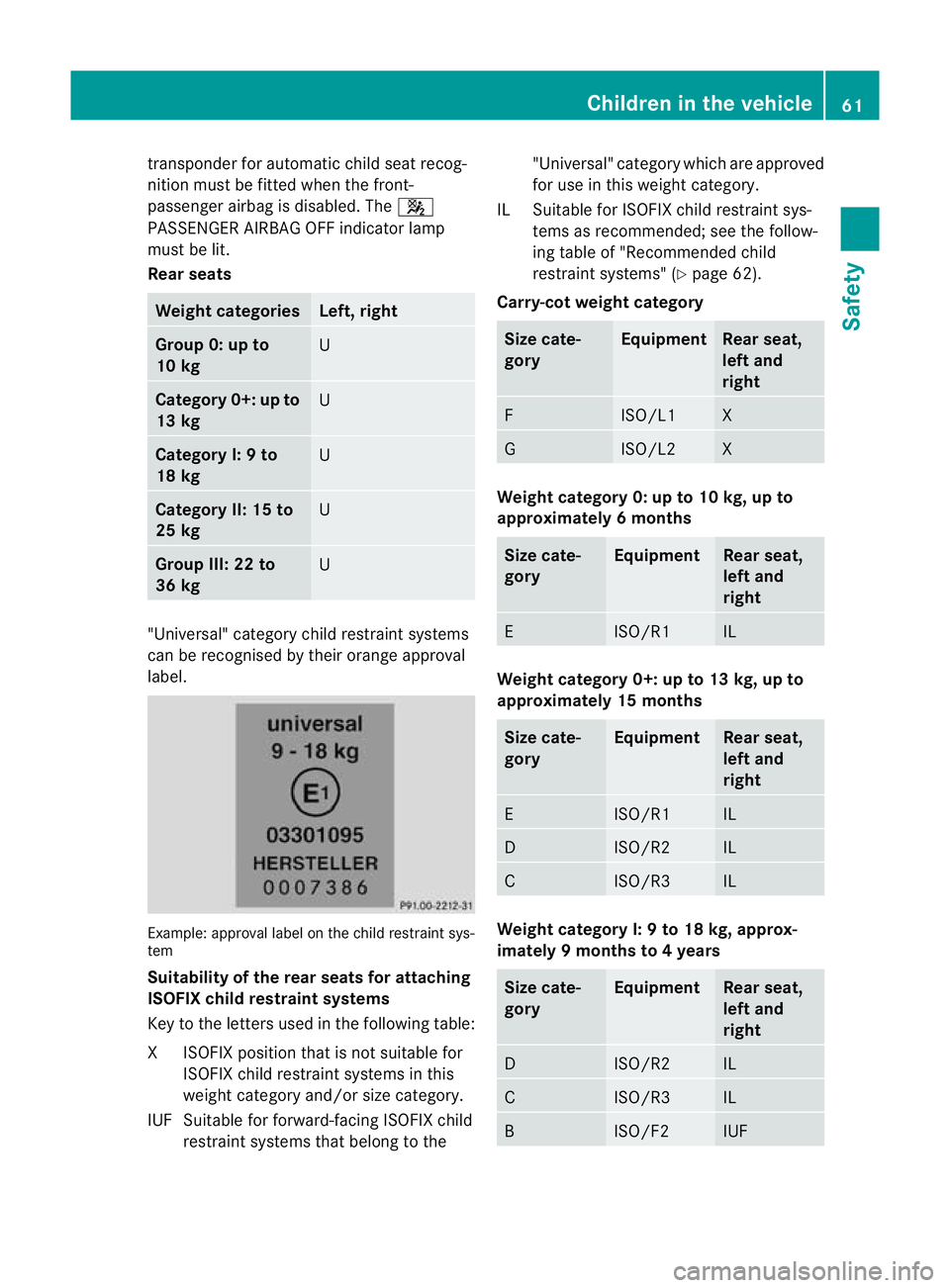
transponder for automatic child seat recog-
nition must be fitted when the front-
passenge
rairbag is disabled. The 4
PASSENGER AIRBAG OFF indicator lamp
must be lit.
Rear seats Weight categories Left, right
Group 0: up to
10 kg
U
Category 0+: up to
13 kg
U
Category I: 9 to
18 kg
U
Category II: 15 to
25 kg
U
Group III: 22 to
36 kg
U
"Universal" category child restraint systems
can be recognised by their orange approval
label. Example: approval label on the child restrain
tsys-
tem
Suitability of th erear seat sfor attaching
ISOFIX child restraint systems
Key to the letters used in the following table:
XI SOFIX position tha tis not suitable for
ISOFIX child restraint systems in this
weight category and/or size category.
IUF Suitable for forward-facing ISOFIX child restraint systems that belong to the "Universal" category which are approved
for use in this weight category.
IL Suitable for ISOFIX child restraint sys- tems as recommended; see the follow-
ing table of "Recommended child
restraint systems" (Y page 62).
Carry-cot weight category Size cate-
gory Equipment Rear seat,
left and
right
F ISO/L1 X
G ISO/L2 X
Weight category 0: up to 10 kg, up to
approximately 6 months
Size cate-
gory Equipment Rear seat,
left and
right
E ISO/R1 IL
Weight category 0+: up to 13 kg, up to
approximately 15 months
Size cate-
gory Equipment Rear seat,
left and
right
E ISO/R1 IL
D ISO/R2 IL
C ISO/R3 IL
Weight category I: 9 to 18 kg, approx-
imately 9 months to 4 years
Size cate-
gory Equipment Rear seat,
left and
right
D ISO/R2 IL
C ISO/R3 IL
B ISO/F2 IUFChildren in the vehicle
61Safety Z