tow MERCEDES-BENZ E-CLASS COUPE 2012 User Guide
[x] Cancel search | Manufacturer: MERCEDES-BENZ, Model Year: 2012, Model line: E-CLASS COUPE, Model: MERCEDES-BENZ E-CLASS COUPE 2012Pages: 389, PDF Size: 9.32 MB
Page 21 of 389
Surround lighting (on-board com-
puter)
.................................................. 244
Switching off the alarm (ATA) ............71 T
Tail lamps Display message ............................ 257
Tank
see Fuel tank
Technical data
Emergency spare wheel .................364
Information .................................... 368
Trailer loads ................................... 381
Tyres/wheels ................................. 350
Vehicle data ................................... 378
Telephone
Accepting acall............................. 238
Display message ............................ 273
Menu (on-board computer) ............238
Number from the phone book ....... .238
Redialling ....................................... 239
Rejecting/ending acall................. 238
Telephone compartment ................287
Temperature
Coolant .......................................... 230
Outside temperature ..................... .231
Setting (climate control) ................144
TEMPOMAT
Function/notes ............................. 182
Theft-deterrent system
ATA (Anti-Theft Alarm system) .........71
Immobiliser ...................................... 71
Through-loading ................................ 288
Through-loading feature ...................288
Time see Separate Owner' smanual
Tiredness Assist
see ATTENTION ASSIST
TIREFIT kit .......................................... 325
Top Tether ............................................ 58
Total distance recorder ....................233
Tow-away protection ..........................71
Towing Important safety notes ..................333
With the rear axle raised ................334Towing
atrailer
Activ eBlind Spot Assist .................217
Active Lane Keeping Assist ............220
Axle load, permissible ....................381
Bulb failure indicator for LED
lamps ............................................. 224
ESP ®
(Electronic Stability Pro-
gram) ............................................... 68
Towing away
Fitting the towing eye. ...................334
Removing the towing eye. ..............334
With both axles on the ground .......335
Tow-starting
Emergency engine starting ............335
Important safety notes ..................333
Removing the towing eye. ..............334
Trailer
Display message ............................ 272
Trailer coupling
see Towing atrailer
Trailer towing
7-pin connector ............................. 225
Blind Spot Assist ............................ 212
Cleaning the trailer tow hitch ......... 317
Coupling up atrailer ...................... 223
Decoupling atrailer ....................... 223
Driving tips .................................... 221
Folding in the ball coupling ............223
Folding out the ball coupling ..........222
Important safety notes ..................220
Lights displa ymessage .................. 256
Mounting dimensions ....................380
Parking Guidance ........................... 206
Parktroni c...................................... 202
Power supply ................................. 224
Shift range ..................................... 169
Trailer loads ................................... 381
Transmission
see Automatic transmission
see Manual transmission
Transporting the vehicle ..................335
Trim pieces (cleaning instructions) .318
Trip computer (on-board com-
puter) ................................................. .233
Trip meter Calling up ....................................... 233
Resetting (on-board computer) ......234 18
Index
Page 22 of 389
Turn signal
see Turn signals
Turn signals
Changing bulb s(front) ................... 135
Switching on/off ........................... 126
TV
Operating (on-board computer) .....237
see Separate operating instructions
Two-way radio
Frequencies ................................... 369
Installatio n..................................... 369
Transmission output (maximum) .... 369
Type identification plate
see Vehicle identification plate
Tyre pressure
Display message ............................ 269
Not reached (TIREFIT) ....................327
Reached (TIREFIT) ..........................327
Recommended ............................... 343
Tyre pressure loss warning
Important safety notes ..................344
Restarting ...................................... 345
Tyres
Changing awheel .......................... 346
Checking ........................................ 341
Direction of rotatio n...................... 346
Display message ............................ 269
Important safety notes ..................340
MOExtended tyres .........................342
Replacing ....................................... 346
Service life ..................................... 341
Storing ........................................... 346
Tyr esize (data) .............................. 350
Tyr etread ...................................... 341
see Flat tyre U
Unladen weight ................................. 378
Unlocking Emergency unlocking .......................84
From inside the vehicle (central
unlocking button) ............................. 83 V
Vanity mirror (in sun visor) ..............293
Variable SPEEDTRONIC see SPEEDTRONIC
Vehicle
Correct use ...................................... 24
Data acquisition ............................... 24
Display message ............................ 270
Electronics ..................................... 369
Equipment ....................................... 22
Implied warranty .............................. 24
Individua lsettings .......................... 242
Leaving parked up .........................179
Locking (in an emergency) ...............84
Locking (key )................................... 77
Lowering ........................................ 350
Pulling away ................................... 161
Raising ........................................... 348
Registration ..................................... 24
Securing from rolling away ............347
Towing away .................................. 333
Tow-starting ................................... 333
Transporting .................................. 335
Unlocking (in an emergency) ...........84
Unlocking (key )................................ 77
Vehicle data ................................... 378
Vehicle data ....................................... 378
Vehicle dimensions ...........................378
Vehicle emergency locking ................84
Vehicle identification number see VIN
Vehicle identification plate ..............371
Vehicle tool kit .................................. 323
Vehicle weights ................................. 378
Video Operating the DVD ......................... 237
VIN ...................................................... 371 W
Warning and indicator lamps ABS ................................................ 277
Brakes ........................................... 277
Distance warning signa l................. 283
ESP ®
.............................................. 278
ESP ®
OFF ....................................... 279
Fuel tank ........................................ 281 Index
19
Page 37 of 389
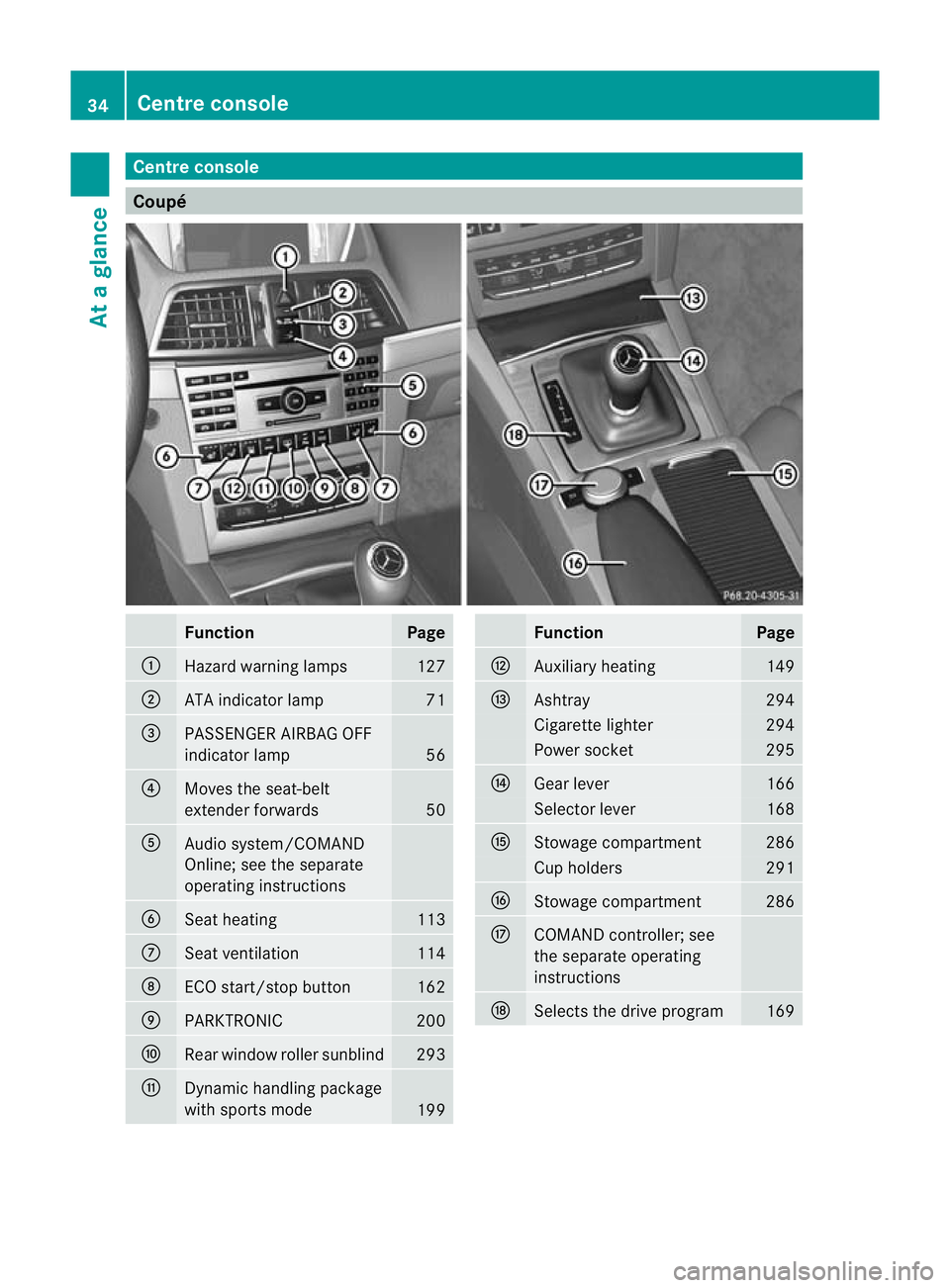
Centre console
Coupé
Function Page
:
Hazard warning lamps 127
;
ATA indicator lamp 71
=
PASSENGER AIRBAG OFF
indicator lamp
56
?
Moves the seat-belt
extender forwards
50
A
Audio system/COMAND
Online; see the separate
operating instructions
B
Seat heating 113
C
Seat ventilation 114
D
ECO start/stop button 162
E
PARKTRONIC 200
F
Rear window roller sunblind 293
G
Dynamic handling package
with sports mode
199 Function Page
H
Auxiliary heating 149
I
Ashtray 294
Cigarette lighter 294
Power socket 295
J
Gear lever 166
Selector lever 168
K
Stowage compartment 286
Cup holders 291
L
Stowage compartment 286
M
COMAND controller; see
the separate operating
instructions N
Selects the drive program 16934
Centre consoleAt a glance
Page 38 of 389
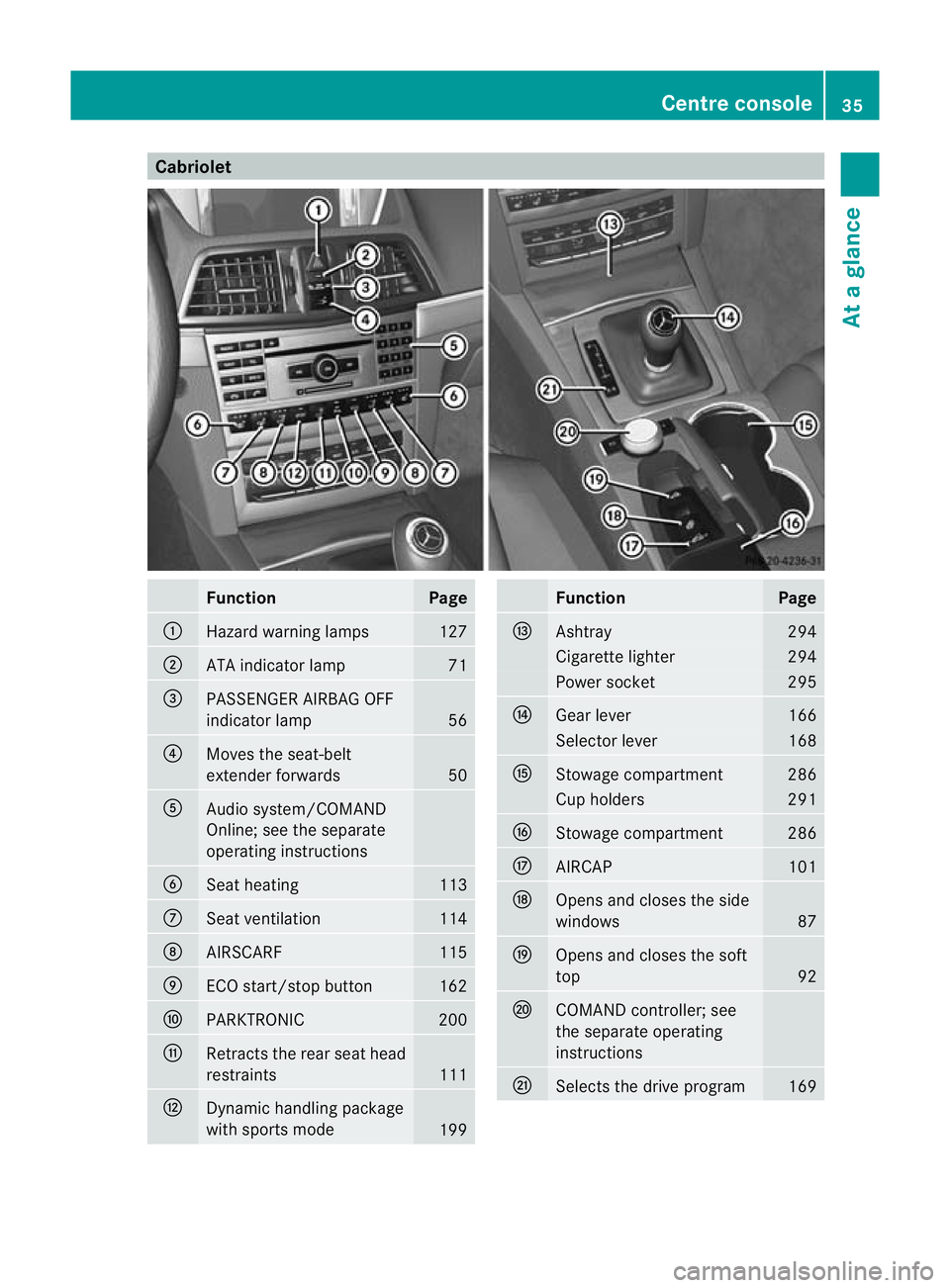
Cabriolet
Function Page
:
Hazard warning lamps 127
;
ATA indicator lamp 71
=
PASSENGER AIRBAG OFF
indicator lamp
56
?
Moves the seat-belt
extender forwards
50
A
Audio system/COMAND
Online; see the separate
operating instructions
B
Seat heating 113
C
Seat ventilation 114
D
AIRSCARF 115
E
ECO start/stop button 162
F
PARKTRONIC 200
G
Retracts the rear seat head
restraints
111
H
Dynamic handling package
with sports mode
199 Function Page
I
Ashtray 294
Cigarette lighter 294
Power socket 295
J
Gear lever 166
Selector lever 168
K
Stowage compartment 286
Cup holders 291
L
Stowage compartment 286
M
AIRCAP 101
N
Opens and closes the side
windows
87
O
Opens and closes the soft
top
92
P
COMAND controller; see
the separate operating
instructions
Q
Selects the drive program 169Centre console
35At a glance
Page 39 of 389
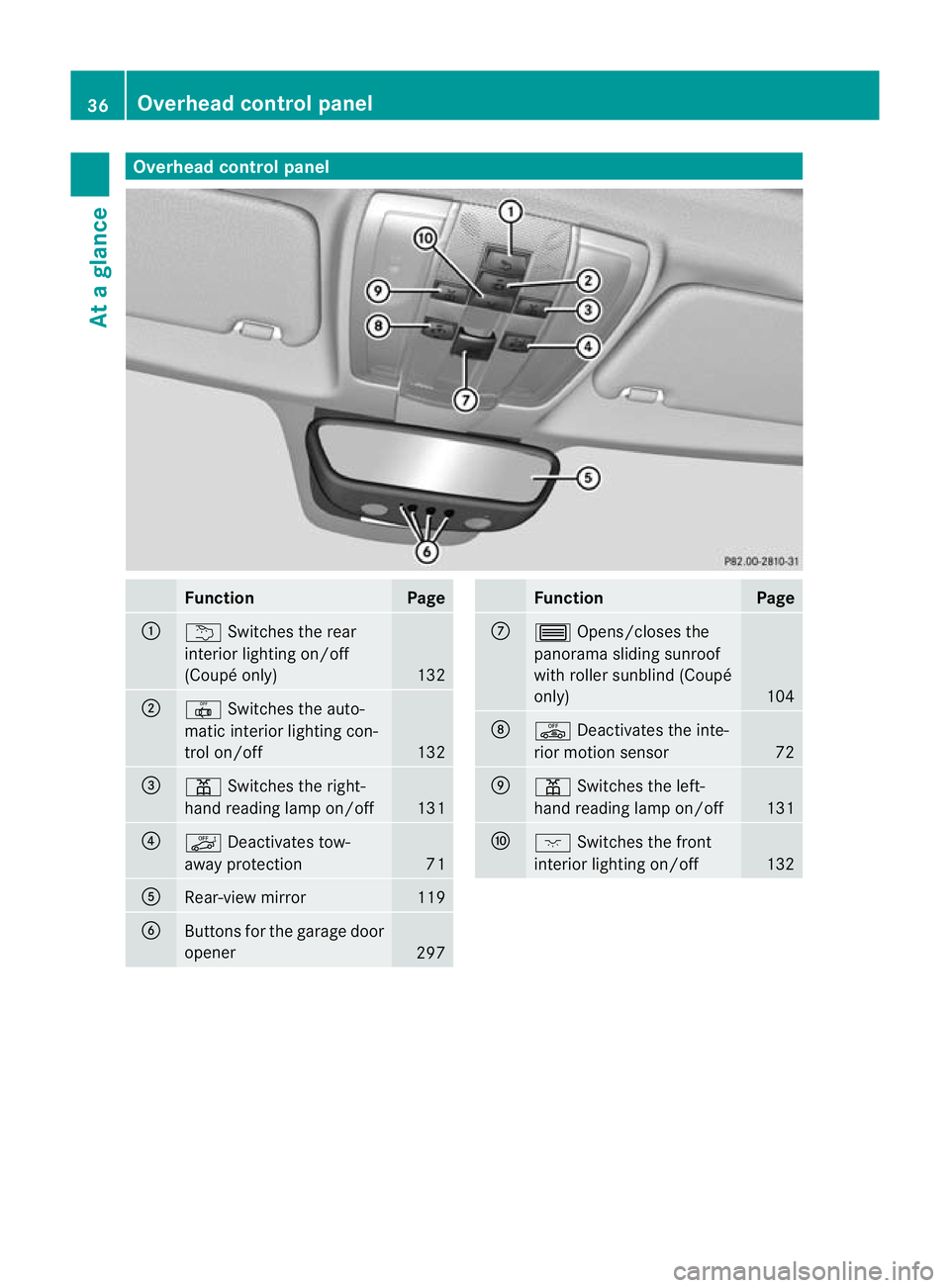
Overhea
dcontrol panel Function Page
:
u
Switches the rear
interio rlighting on/off
(Coupé only) 132
;
|
Switches the auto-
matic interior lighting con-
trol on/off 132
=
p
Switches the right-
hand reading lamp on/off 131
?
ë
Deactivates tow-
away protection 71
A
Rear-view mirror 119
B
Buttons for the garage door
opener
297 Function Page
C
3
Opens/closes the
panorama sliding sunroof
with roller sunblind (Coupé
only) 104
D
ê
Deactivates the inte-
rior motion sensor 72
E
p
Switches the left-
hand reading lamp on/off 131
F
c
Switches the front
interior lighting on/off 13236
Overhead control panelAt a glance
Page 44 of 389
To ensure that the restraint systems can
deliver their full potential protection, make
sure that:
R the seat and head restraint are adjusted
properly (Y page 108).
R the seat belt has been fastened properly
(Y page 49).
R the airbags can inflate unrestricted if
deployed (Y page 42).
R the steering wheel is adjusted properly
(Y page 115).
R the restraint systems have not been modi-
fied.
An airbag increases the protection of vehicle
occupants wearing a seat belt. However, air-
bags are only an additional restraint system
which complements, but does not replace,
the seat belt. All vehicle occupants must wear
their seat belt correctly at all times, even if
the vehicle is equipped with airbags. The air-
bags are not deployed in all types of acci-
dents .For example, if the protective capacity
of correctly fastened seat belts is not
increased by deploying the airbags, the air-
bags will not deploy.
Airbag deployment only provides increased
protection if the seat belt is worn correctly.
First, the seat belt helps to keep the vehicle
occupant in the best position in relation to the
airbag. Second, in a head-on collision, for
example, the seat belt prevents the vehicle
occupant from being propelled towards the
point of impact. SRS (Supplemental Restraint System)
Introduction SRS consists of:
R
the 6 SRS warning lamp
R airbags
R the airbag control unit with crash sensors
R belt tensioners
R belt force limiters SRS reduces the risk of occupants coming
into contact with the vehicle's interior in the
event of an accident. It can also reduce the
forces to which occupant
sare subjected dur-
ing an accident.
SRS warning lamp G
WARNING
If SRS is malfunctioning, individual systems
may be triggered unintentionally or might not
be triggered in the event of an accident with
a high rate of vehicle deceleration.
A malfunction has occurred if:
R the 6 SRS warning lamp does not light
up when the ignitio nis switched on.
R the engine is running and the 6SRS
warning lamp does not go out after a few
seconds.
R the engine is running and the 6SRS
warning lamp lights up again.
In this case, have SRS checked immediately
at a qualified specialist workshop.
SRS functions are checked regularly when
you switch on the ignition and when the
engine is running. Therefore, malfunctions
can be detected in good time.
The 6 SRS warning lamp in the instrument
cluster lights up when the ignition is switched
on. It goes out no later than a few seconds
after the engine is started.
Triggering of belt tensioners, belt force
limiters and airbags During the first stage of a collision, the airbag
control unit evaluates important physical
data relating to vehicle deceleration or accel-
eration, such as:
R
duration
R direction
R magnitude
Based on the evaluation of this data, the air-
bag control unit pre-emptively triggers the
belt tensioners in the first stage. Occupant safety
41Safety Z
Page 56 of 389
Comply with safety regulation
swhen dispos-
ing of belt tensioners. Any Mercedes-Benz
Service Centre can provide details of these
regulations.
! If the front-passenger seat is not occu-
pied, do not engage the seat belt tongue in
the buckle on the front-passenger seat.
Otherwise, the belt tensioner could be trig-
gered in the event of an accident.
The seat belts are fitted with belt tensioners.
The belt tensioners tighten the seat belts in
an accident, pulling them close against the
body.
Belt tensioners do not correct incorrect seat
positions or incorrectly fastened seat belts.
Belt tensioners do not pull vehicle occupants
back towards the backrest.
If the seat belt is also fitted with a belt force
limiter and this is triggered, the force exerted
by the seat belt on the vehicle occupant is
reduced.
The belt force limiters for the front seats are
synchronised with the front airbags, which
take on a part of the deceleration force. This
results in the force exerted on the occupant
being distributed over a greater area.
The belt tensioners can only be activated
when:
R the ignition is switched on.
R the restraint systems are operational; see
"SRS warning lamp" (Y page 41).
R the belt tongue is engaged in the buckle on
each of the three-point seat belts in front.
R
The belt tensioners on the seats in the rear
compartmenta re triggered independently of
the lock status of the seat belts.
The beltt ensioners are triggered depending
on the type and severity of an accident:
R if, in the event of a head-on or rear-end col-
lision the vehicle decelerates or acceler- ates rapidly in a longitudinal direction dur-
ing the initial stages of the impact
R if, in the event of a side impact, on the side
opposite the impact the vehicle deceler-
ates or accelerates rapidly in a lateral direc-
tion
R Cabriolet: in certain situations if the vehicle
overturns and the system determines that
it can provide additional protection.
If the airbags are deployed, you will hear a
bang, and a small amount of powder may also
be released. Only in rare cases will the bang
affect your hearing. The powder that is
released generally does not constitute a
health hazard. The 6SRS warning lamp
lights up.
Automatic comfort-fit feature The fron
tseat belts have an automatic com-
fort-fit feature. The automatic comfort-fit fea-
ture reduces the retraction force of the seat
belts. This results in increased seat belt com-
fort. Children in the vehicle
Child restraint systems
Important safety notes G
WARNING
To reduce the risk of serious or even fatal
injury to the child in the event of a sudden
change in direction, braking or an accident:
R children less than 1.50 m tall and under
twelve years of age must always be secured
in special child restraint systems on a suit-
able vehicle seat. This is necessary
because the seat belts are not designed for
children.
R Do not drive with a child secured in a rear-
ward-facing child restraint system on the
front-passenger seat. Exception: if the vehi-
cle is equipped with automatic child seat
recognition on the front-passenger seat Children in the vehicle
53Safety
Z
Page 70 of 389
cialist workshop. This also applies to colli-
sions at slow speeds where there is no visible
damage to the front of the vehicle. Adaptive brake lamps
If you brake sharply from a speed of more
than 50 km/h or if braking is assisted by BAS
or BAS PLUS, the brake lamps flash rapidly.
In this way, traffic travelling behind you is
warned in an even more noticeable manner.
If you brake sharply from a speed of more
than 70 km/h to a standstill, the hazard warn-
ing lamps are activated automatically. If the
brakes are applied again, the brake lamps
light up continuously .The hazard warning
lamps switch off automatically if you travel
faster than 10 km/h .You can also switch off
the hazard warning lamps using the hazard
warning button (Y page 127). ESP
®
(Electronic Stability Program)
Important safety notes i
Observe the "Important safety notes" sec-
tion (Y page 64). G
WARNING
If ESP ®
is malfunctioning, ESP ®
is unable to
stabilise the vehicle. In addition, other driving
safety systems are switched off. This increa-
ses the risk of skidding and an accident.
Drive on carefully. Have ESP ®
checked at a
qualified specialist workshop.
Vehicles without 4MATIC: observe the notes
on ESP ®
if the vehicle is being towed with the
rear axle raised (Y page 334).
ESP ®
is deactivated if the åwarning lamp
in the instrument cluster lights up continu-
ously when the engine is running.
If the ÷ warning lamp and the åwarn-
ing lamp are lit continuously, ESP ®
is not
available due to a malfunction. Observe the information on warning lamps
(Y
page 278) and display messages which
may be shown in the instrument cluster
(Y page 250).
If ESP ®
detects that the vehicle is deviating
from the direction desired by the driver, one
or more wheels are braked to stabilise the
vehicle. The engine output is also modified to
keep the vehicle on the desired course within
physical limits. ESP ®
assists the driver when
pulling away on wet or slippery roads. ESP ®
can also stabilise the vehicle during braking.
If ESP ®
intervenes, the ÷ESP®
warning
lamp flashes in the instrument cluster.
If ESP ®
intervenes:
X Do not deactivate ESP ®
under any circum-
stances.
X When pulling away, only depress the accel-
erator pedal as far as is necessary.
X Adapt your driving style to suit the prevail-
ing road and weather conditions.
i Only use wheels with the recommended
tyre sizes. Only then will ESP ®
function
properly.
4ETS (Electronic Traction System) Traction control is part of ESP
®
.
Traction control brakes the drive wheels indi-
vidually if they spin. This enables you to pull
away and accelerate on slippery surfaces, for
example if the road surface is slippery on one
side. In addition, more drive torque is trans-
ferred to the wheel or wheels with traction.
Traction control remains active if you deacti-
vate ESP ®
.
Deactivating/activating ESP ® G
WARNING
If you deactivate ESP ®
, ESP ®
no longer sta-
bilises the vehicle. There is an increased risk
of skidding and an accident. Driving safety systems
67Safety
Z
Page 74 of 389
For information on switching off the radar
senso rsystem using the on-board computer,
see (Y page 245).
Following damage to the fron tend of the vehi-
cle, have the configuratio nand operatio nof
the rada rsensors checked at a qualified spe-
cialist workshop. This also applies to colli-
sions at slow speeds where there is no visible
damage to the fron tofthe vehicle. Anti-theft systems
Immobiliser
X To activate with the key: remove the key
from the ignition lock.
X To activate with KEYLESS-GO: switch the
ignition off and open the driver's door.
X To deactivate: switch on the ignition.
The immobiliser prevents your vehicle from
being started without the correct key.
When leaving the vehicle, always take the key
with you and lock the vehicle. Anyone can
start the engine if a valid key has been left
inside the vehicle.
i The immobiliser is always deactivated
when you start the engine. ATA (Anti-Theft Alarm system) X
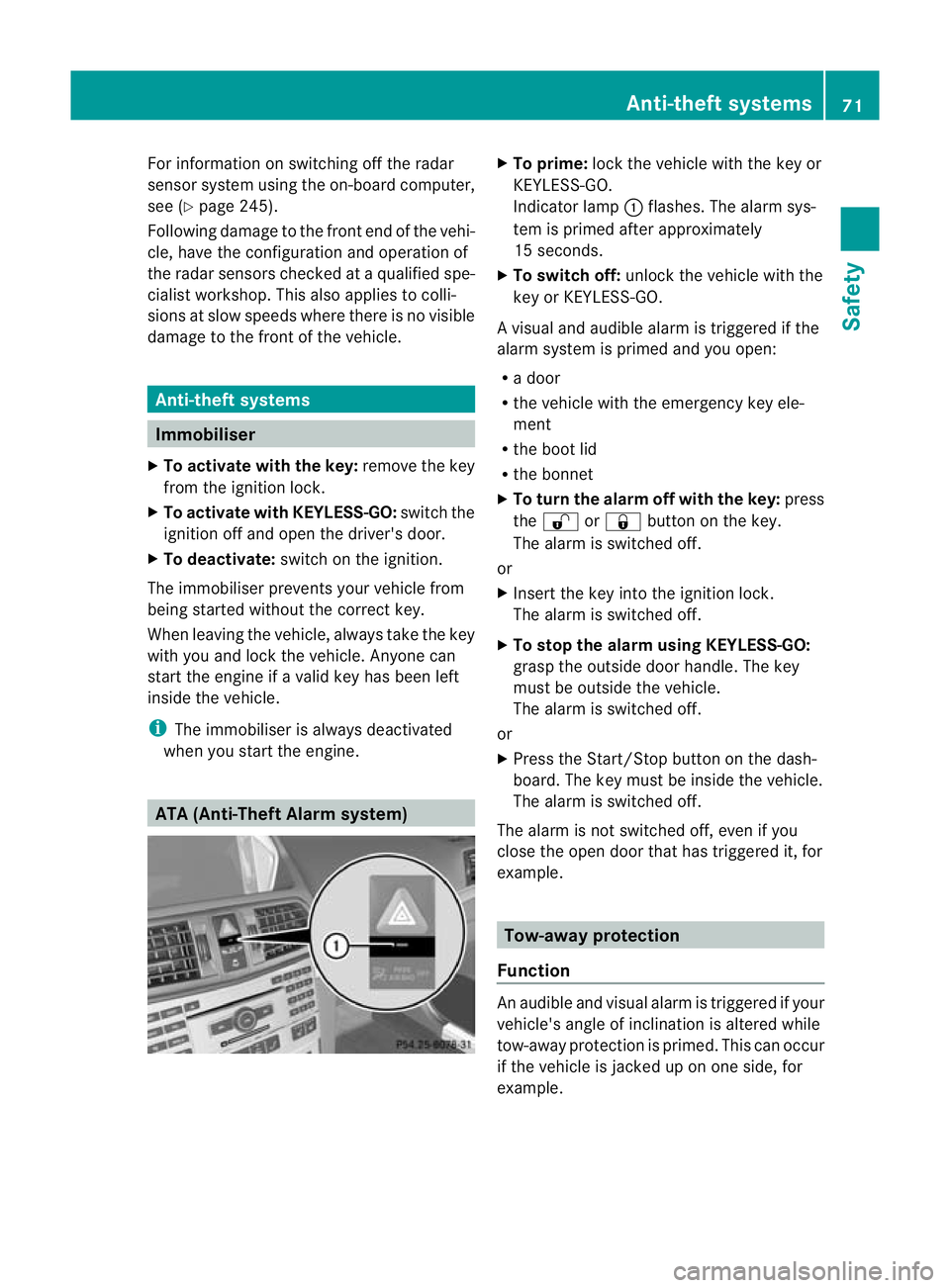
To prime: lock the vehicle with the key or
KEYLESS-GO.
Indicator lamp :flashes. The alarm sys-
tem is primed after approximately
15 seconds.
X To switch off: unlock the vehicle with the
key or KEYLESS-GO.
Av isual and audible alarm is triggered if the
alarm system is primed and you open:
R a door
R the vehicle with the emergency key ele-
ment
R the boot lid
R the bonnet
X To turn th ealarm off with th ekey: press
the % or& button on the key.
The alarm is switched off.
or
X Insert the key into the ignition lock.
The alarm is switched off.
X To stop the alarm using KEYLESS-GO:
grasp the outside door handle. The key
must be outside the vehicle.
The alarm is switched off.
or
X Press the Start/Stop button on the dash-
board. The key must be inside the vehicle.
The alarm is switched off.
The alarm is not switched off, even if you
close the open door that has triggered it, for
example. Tow-away protection
Function An audible and visual alarm is triggered if your
vehicle's angle of inclination is altered while
tow-away protection is primed. This can occur
if the vehicle is jacked up on one side, for
example. Anti-theft systems
71Safety Z
Page 75 of 389
Activating
X
Make sure that:
R
the doors are closed.
R the boot lid is closed.
Only then is the tow-away protection
primed.
X Lock the vehicle with the key or KEYLESS-
GO.
Tow-away protection is primed after
approximately 30 seconds.
To deactivate X
To switch off: unlockthe vehicle with the
key or KEYLESS-GO.
Tow-away protection is switched off auto-
matically.
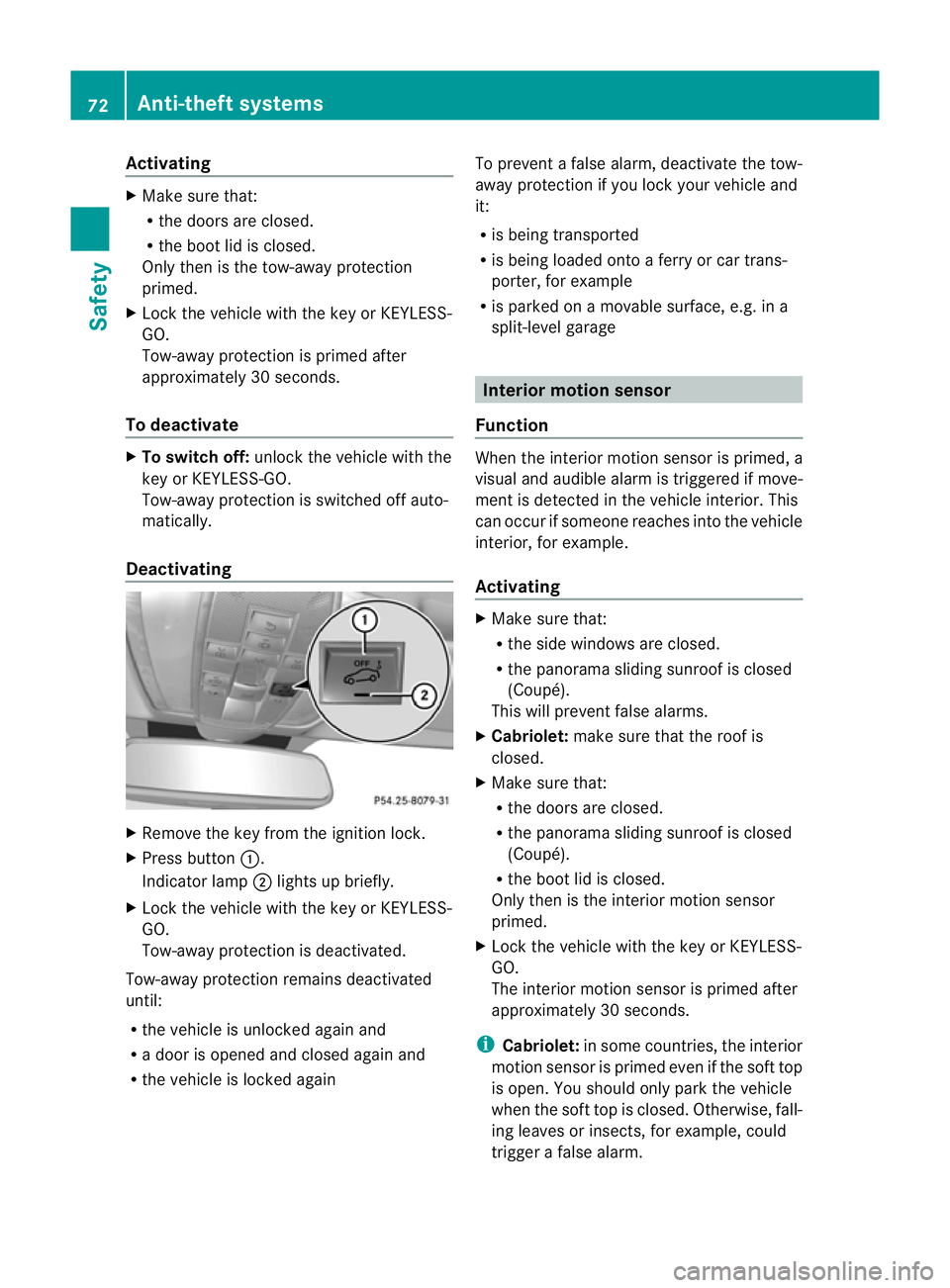
Deactivating X
Remove the key from the ignition lock.
X Press button :.
Indicator lamp ;lights up briefly.
X Lock the vehicle with the key or KEYLESS-
GO.
Tow-away protection is deactivated.
Tow-away protection remains deactivated
until:
R the vehicle is unlocked again and
R a door is opened and closed again and
R the vehicle is locked again To prevent a false alarm, deactivate the tow-
away protection if you lock your vehicle and
it:
R
is being transported
R is being loaded onto a ferry or car trans-
porter, for example
R is parked on a movable surface, e.g. in a
split-level garage Interior motion sensor
Function When the interior motion sensor is primed, a
visual and audible alarm is triggered if move-
ment is detected in the vehicle interior. This
can occur if someone reaches into the vehicle
interior, for example.
Activating
X
Make sure that:
R
the side windows are closed.
R the panorama sliding sunroof is closed
(Coupé).
This will prevent false alarms.
X Cabriolet: make sure that the roof is
closed.
X Make sure that:
R
the doors are closed.
R the panorama sliding sunroof is closed
(Coupé).
R the boot lid is closed.
Only then is the interior motion sensor
primed.
X Lock the vehicle with the key or KEYLESS-
GO.
The interior motion sensor is primed after
approximately 30 seconds.
i Cabriolet: in some countries, the interior
motion sensor is primed even if the soft top
is open. You should only park the vehicle
when the soft top is closed. Otherwise, fall-
ing leaves or insects, for example, could
trigger a false alarm. 72
Anti-theft systemsSafety