belt MERCEDES-BENZ E-CLASS COUPE 2012 Owners Manual
[x] Cancel search | Manufacturer: MERCEDES-BENZ, Model Year: 2012, Model line: E-CLASS COUPE, Model: MERCEDES-BENZ E-CLASS COUPE 2012Pages: 389, PDF Size: 9.32 MB
Page 8 of 389
Resetting the service interval dis-
play ................................................ 311
Service message ............................ 311
Special service requirements ........
.311
ATA (Anti-Theft Alarm system)
Activating/deactivating ...................71
Function .......................................... .71
Interior motion sensor .....................72
Switching off the alarm ....................71
Tow-away protection ........................ 71
ATTENTIO NASSIST
Activating/deactivating .................241
Display message ............................ 262
Function/notes ............................. 208
Authorised workshop
see Qualified specialist workshop
AUTO lights
Display message ............................ 258
see Lights
Automatic engine start (ECO start/
stop function) .................................... 164
Automatic engine switch-off (ECO
start/stop function) ..........................163
Automatic headlamp mode ..............123
Automatic transmission Accelerator pedal position .............169
Automatic drive program ...............170
Changing gea r............................... 168
Display message ............................ 270
Driving tips .................................... 169
Emergency running mode ..............173
Kickdow n....................................... 169
Manual drive program ....................171
Overview ........................................ 167
Problem (fault) ............................... 173
Progra mselecto rbutton ................ 169
Pulling away ................................... 161
Releasing the parking lock man-
ually ............................................... 173
Selector leve r................................ 168
Shift range s................................... 170
Starting the engine ........................160
Steering wheel gearshift paddle s... 170
Trailer towing ................................. 169
Transmissio nposition display ........168
Transmission positions ..................168
Automatic transmission emer-
gency running mode .........................173Auxiliary heating
Activating/deactivating .................149
Activating/deactivating (on the
centre console ).............................. 150
Display message ............................ 272
Important safety notes ..................149
Problem (display message) ............153
Remote control .............................. 150
Setting ........................................... 246
Setting the departur etime ............ .151
Auxiliary ventilation
Activating/deactivating .................149
Activating/deactivating (on the
centre console ).............................. 150
Problem (display message) ............153
Remote control .............................. 150
Axle load, permissible (traile rtow-
ing) ...................................................... 381 B
Bag hook ............................................ 290
Ball coupling Folding in ....................................... 223
Folding out ..................................... 222
BAS (Brake Assist System) .................65
BAS PLUS (Brake Assist System
PLUS) .................................................... 65
Battery (key) Checking .......................................... 79
Important safety notes ....................79
Replacing ......................................... 79
Battery (vehicle)
Charging ........................................ 330
Display message ............................ 261
Important safety notes ..................328
Jump starting ................................. 331
Belt
see Seat belt
Belt force limiters (activation) ...........41
Belt tensioner Activation ......................................... 41
Function .......................................... .52
Blind Spo tAssist
Activating/deactivating .................241
Display message ............................ 264 Index
5
Page 18 of 389
Senso
rrang e................................. 200
Trailer towing ................................. 202
Warning displa y............................. 201
PASSENGE RAIRBAG OFF warning
lamp ...................................................... 56
Petrol .................................................. 372
Plastic trim (cleaning instructions) .318
Power windows see Side windows
PRE-SAFE ®
(preventive occupant
safety system) Display message ............................ 253
Operation ........................................ .48
PRE-SAFE ®
Brake
Activating/deactivating .................240
Display message ............................ 253
Function/notes ................................ 69
Warning lamp ................................. 283
Product information ............................21
Program selector button ..................169
Protection of the environment General notes .................................. 21
Pulling away
Automatic transmission .................161
Manual transmission ..................... .161 Q
Qualifie dspecialis tworkshop ...........23 R
Radar sensors Overview ........................................ 382
Radar sensor system
Activating/deactivating .................245
Display message ............................ 263
Radiator cover ................................... 308
Radio Selecting astation ......................... 236
see separate operating instructions
Rain closing feature
Panorama sliding sunroo f.............. 104
Reading lamp ..................................... 131
Rear compartment Setting the airv ents...................... 154
Setting the temperature ................144Rear-compartment seat belt sta-
tus indicator
........................................ 52
Rear foglamp Display message ............................ 258
Switching on/off ........................... 125
Rear seat
Display message ............................ 271
Rear-view mirror
Anti-dazzle mode (automatic) ........119
Dipping (manual) ........................... 117
Rear window blind ............................293
Rear window heating Problem (fault) ............................... 147
Switching on/off ........................... 147
Refuelling
Fuel gauge ............................... 30, 229
Important safety notes ..................173
Refuelling proces s......................... 174
see Fuel
Releasing the parking loc kman-
ually (automatic transmission) ........173
Remote control Auxiliary heating/ventilation .......... 150
Changing the batteries (auxiliary
heating) ......................................... 151
Garage door opener .......................297
Programming (garage door
opener) .......................................... 297
Replacing the battery (auxiliary
heating remote control) .................... 151
Reserve (fuel tank) see Fuel
Reserve fuel
Display message ............................ 261
Warning lamp ................................. 281
Residual heat (climate control) ........148
Restraint system see SRS (Supplemental Restraint
System)
Rev counter ........................................ 231
Reverse gear Engaging (automatic transmis-
sion) ............................................... 168
Engaging (manual transmission) ....167 Index
15
Page 19 of 389
Reversing camera
Cleaning instructions .....................317
Function/notes ............................. 206
Switching on/off ........................... 207
Reversing lamp (display message) ..258
Roll bar Display message ............................ 254
Operation ........................................ .47
Rolle rsunblind
Panorama sliding sunroo f.............. 104
Rea rwindow .................................. 293
Roof
Overview .......................................... 92
see Soft top
Roof lining and carpets (cleaning
instructions) ...................................... 319
Roof load (maximum) ........................378 S
Safety Childre ninthe vehicle ..................... 53
Child restraint systems ....................53
Safety system
see Driving safety system
Seat
Seat backres tdisplay message .....271
Seat belt
Adjusting the driver's and front-
passenger sea tbelt ......................... 51
Automatic comfort-fit feature ..........53
Belt force limiter .............................. 52
Belt tensioner .................................. 52
Cleaning ......................................... 319
Display message ............................ 254
Fastening ......................................... 50
Important safety guidelines .............49
Rea rseat belt status indicator .........52
Releasing ......................................... 51
Switching belt adjustment on/off
(on-board computer) ......................247
Warning lamp ................................. 276
Warning lamp (function) ................... 52
Seats
Adjusting (electrically). ..................110
Adjusting (manually and electri-
cally) .............................................. 110Adjusting the 4-way lumba
rsup-
por t................................................ 113
Adjusting the head restraint ..........111
Cleaning the cover .........................318
Correct driver's sea tposition ........108
Folding the backrests forward/
back ............................................... 112
Important safety notes ..................109
Overview ........................................ 109
Seat heating problem ....................114
Seat ventilation problem ................115
Storing settings (memory func-
tion) ............................................... 120
Switching AIRSCARF on/off ..........115
Switching sea theating on/off .......113
Switching the sea tventilation on/
off .................................................. 114
Selector lever
Cleaning ......................................... 318
Sensors (cleaning instructions) .......317
Service see ASSYST PLUS
Service Centre
see Qualified specialist workshop
Service menu (on-board computer) .241
Service products Brake fluid ..................................... 376
Coolant (engine) ............................ 376
Engine oil ....................................... 375
Fuel ................................................ 372
Important safety notes ..................371
Washer fluid .................................. .377
Settings
Factory (on-board computer) .........248
On-board computer .......................242
Setting the air distribution ...............145
Setting the airflow ............................146
Short journeys (diesel particle fil-
ter) ...................................................... 180
Sidebag ................................................ 45
Side lamps Switching on/off ........................... 125
Side windows
Convenience closing ........................90
Convenience opening ......................90
Important safety notes ....................87
Opening/closing .............................. 88
Opening/closing all (Cabriolet) ........88 16
Index
Page 35 of 389
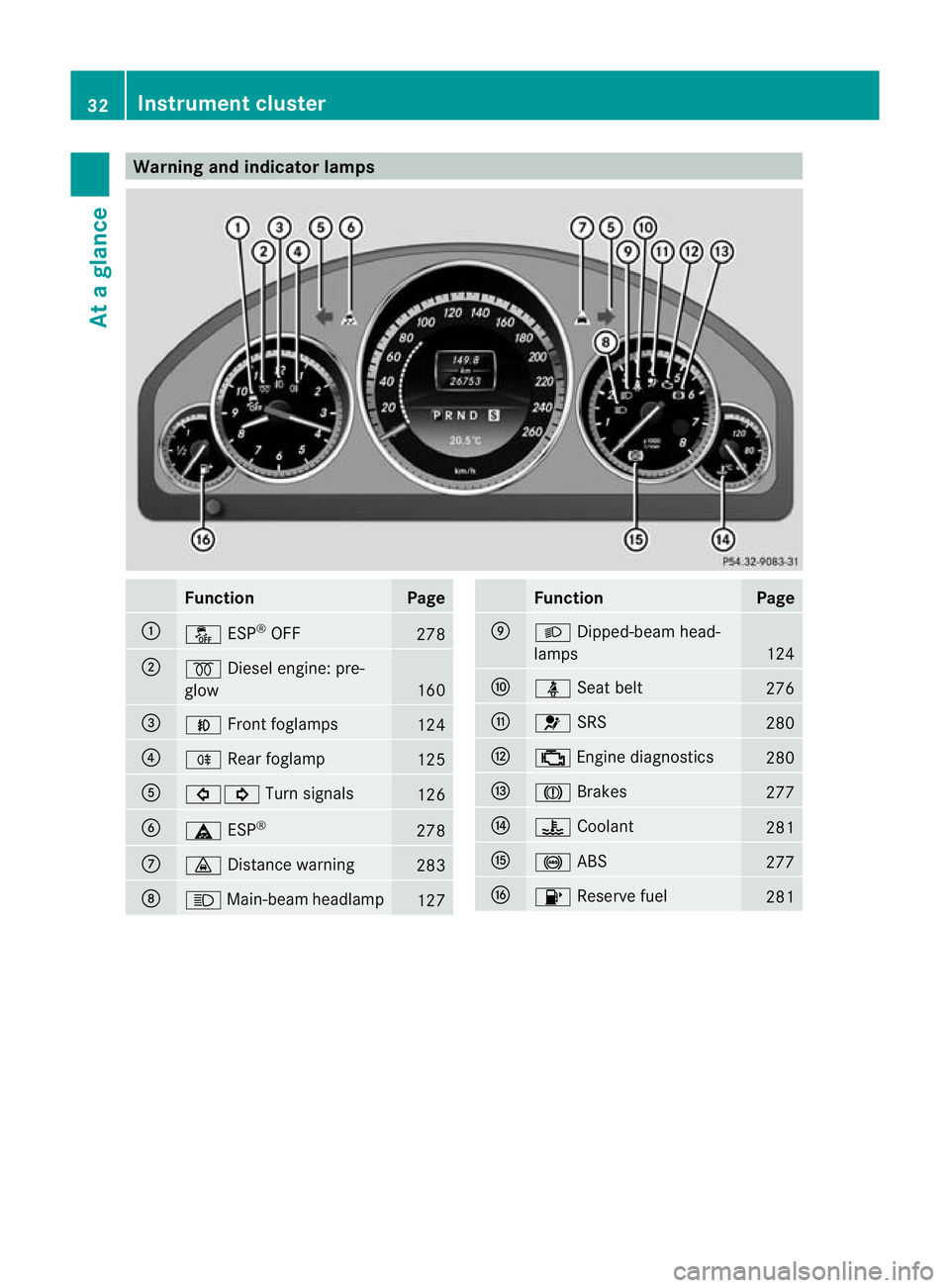
Warning and indicator lamps
Function Page
:
å
ESP®
OFF 278
;
%
Diesel engine: pre-
glow 160
=
N
Front foglamps 124
?
R
Rearfoglamp 125
A
#!
Turn signals 126
B
ä
ESP® 278
C
·
Distance warning 283
D
K
Main-beam headlamp 127 Function Page
E
L
Dipped-beam head-
lamps 124
F
ü
Seat belt 276
G
6
SRS 280
H
;
Engine diagnostics 280
I
J
Brakes 277
J
?
Coolant 281
K
!
ABS 277
L
8
Reserve fuel 28132
Instrument clusterAt a glance
Page 37 of 389
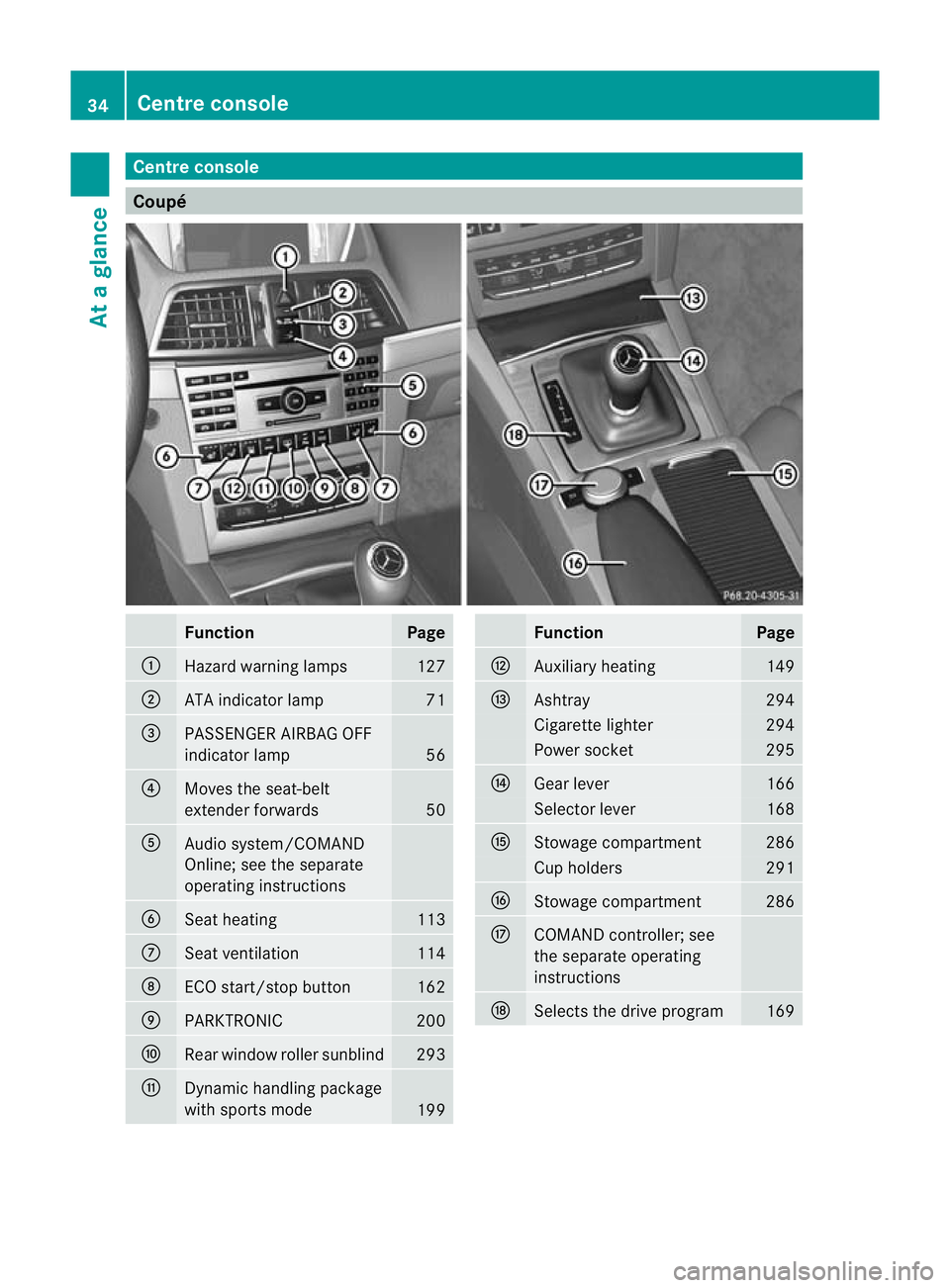
Centre console
Coupé
Function Page
:
Hazard warning lamps 127
;
ATA indicator lamp 71
=
PASSENGER AIRBAG OFF
indicator lamp
56
?
Moves the seat-belt
extender forwards
50
A
Audio system/COMAND
Online; see the separate
operating instructions
B
Seat heating 113
C
Seat ventilation 114
D
ECO start/stop button 162
E
PARKTRONIC 200
F
Rear window roller sunblind 293
G
Dynamic handling package
with sports mode
199 Function Page
H
Auxiliary heating 149
I
Ashtray 294
Cigarette lighter 294
Power socket 295
J
Gear lever 166
Selector lever 168
K
Stowage compartment 286
Cup holders 291
L
Stowage compartment 286
M
COMAND controller; see
the separate operating
instructions N
Selects the drive program 16934
Centre consoleAt a glance
Page 38 of 389
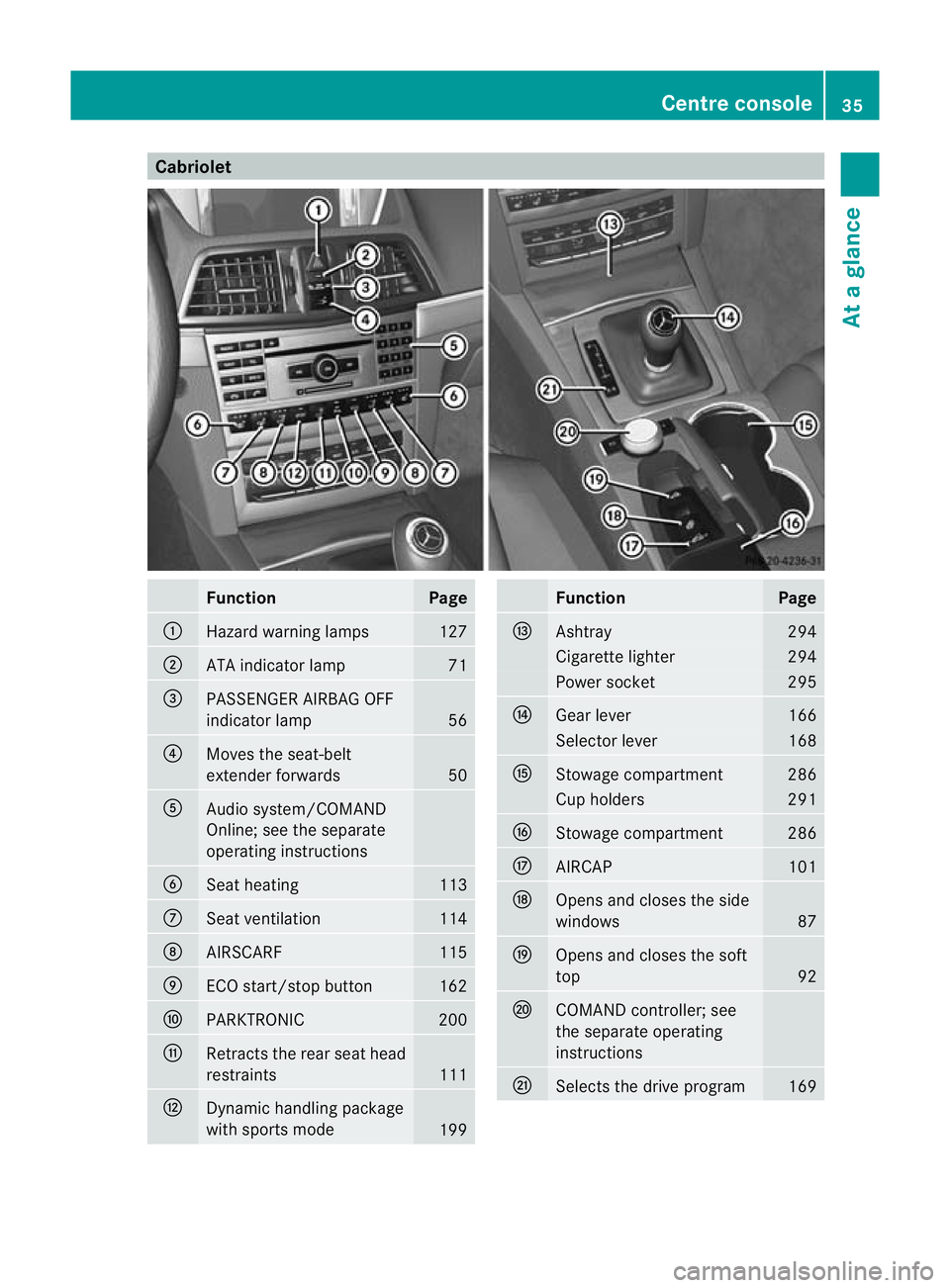
Cabriolet
Function Page
:
Hazard warning lamps 127
;
ATA indicator lamp 71
=
PASSENGER AIRBAG OFF
indicator lamp
56
?
Moves the seat-belt
extender forwards
50
A
Audio system/COMAND
Online; see the separate
operating instructions
B
Seat heating 113
C
Seat ventilation 114
D
AIRSCARF 115
E
ECO start/stop button 162
F
PARKTRONIC 200
G
Retracts the rear seat head
restraints
111
H
Dynamic handling package
with sports mode
199 Function Page
I
Ashtray 294
Cigarette lighter 294
Power socket 295
J
Gear lever 166
Selector lever 168
K
Stowage compartment 286
Cup holders 291
L
Stowage compartment 286
M
AIRCAP 101
N
Opens and closes the side
windows
87
O
Opens and closes the soft
top
92
P
COMAND controller; see
the separate operating
instructions
Q
Selects the drive program 169Centre console
35At a glance
Page 43 of 389
Useful information
i This Owner's Manual describes all mod-
els, series and optional equipment for your
vehicle that were available at the time of
going to press. National variations are pos-
sible. Note that your vehicle may not be
equipped with all of the functions descri-
bed. This is also the case for systems and
functions relevant to safety.
i Read the information on qualified special-
ist workshops: (Y page 23). Panic alarm
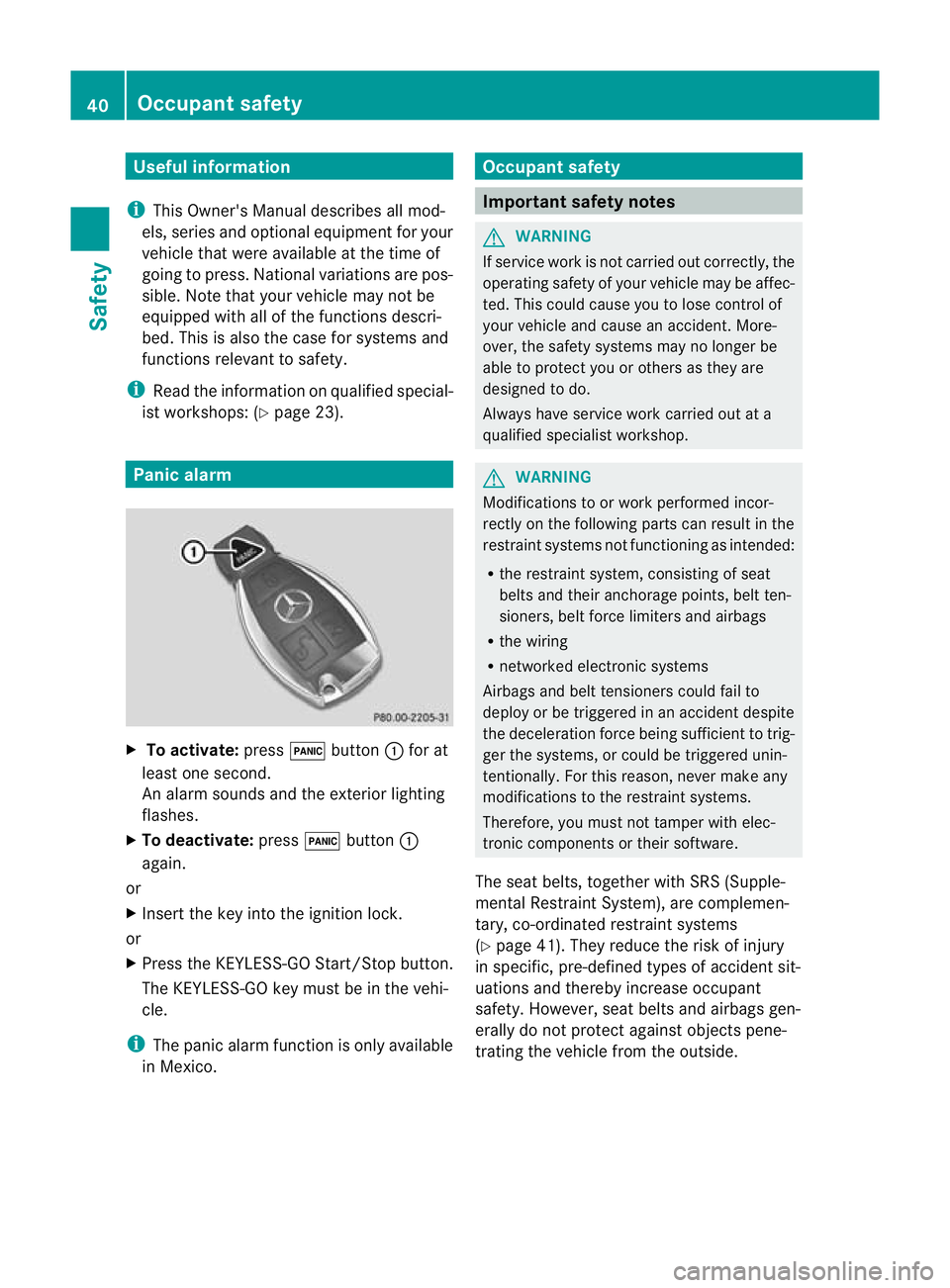
X
To activate: press!button :for at
least one second.
An alarm sounds and the exterior lighting
flashes.
X To deactivate: press!button :
again.
or
X Insert the key into the ignition lock.
or
X Press the KEYLESS-GO Start/Stop button.
The KEYLESS-GO key must be in the vehi-
cle.
i The panic alarm function is only available
in Mexico. Occupant safety
Important safety notes
G
WARNING
If service work is not carried out correctly, the
operating safety of your vehicle may be affec-
ted. This could cause you to lose control of
your vehicle and cause an accident. More-
over, the safety system smay no longer be
able to protect you or others as they are
designed to do.
Always have service work carried out at a
qualified specialist workshop. G
WARNING
Modifications to or work performed incor-
rectly on the following parts can result in the
restraint systems no tfunctioning as intended:
R the restraint system, consisting of seat
belts and their anchorage points, belt ten-
sioners, belt force limiters and airbags
R the wiring
R networked electronic systems
Airbags and belt tensioners could fail to
deploy or be triggered in an acciden tdespite
the deceleration force being sufficien tto trig-
ger the systems, or could be triggered unin-
tentionally. For this reason, never make any
modifications to the restraint systems.
Therefore, you must not tamper with elec-
tronic components or their software.
The seat belts, together with SRS (Supple-
mental Restraint System), are complemen-
tary, co-ordinated restraint systems
(Y page 41). They reduce the risk of injury
in specific, pre-defined types of accident sit-
uations and thereby increase occupant
safety. However, seat belts and airbags gen-
erally do not protect against objects pene-
trating the vehicle from the outside. 40
Occupant safetySafety
Page 44 of 389
To ensure that the restraint systems can
deliver their full potential protection, make
sure that:
R the seat and head restraint are adjusted
properly (Y page 108).
R the seat belt has been fastened properly
(Y page 49).
R the airbags can inflate unrestricted if
deployed (Y page 42).
R the steering wheel is adjusted properly
(Y page 115).
R the restraint systems have not been modi-
fied.
An airbag increases the protection of vehicle
occupants wearing a seat belt. However, air-
bags are only an additional restraint system
which complements, but does not replace,
the seat belt. All vehicle occupants must wear
their seat belt correctly at all times, even if
the vehicle is equipped with airbags. The air-
bags are not deployed in all types of acci-
dents .For example, if the protective capacity
of correctly fastened seat belts is not
increased by deploying the airbags, the air-
bags will not deploy.
Airbag deployment only provides increased
protection if the seat belt is worn correctly.
First, the seat belt helps to keep the vehicle
occupant in the best position in relation to the
airbag. Second, in a head-on collision, for
example, the seat belt prevents the vehicle
occupant from being propelled towards the
point of impact. SRS (Supplemental Restraint System)
Introduction SRS consists of:
R
the 6 SRS warning lamp
R airbags
R the airbag control unit with crash sensors
R belt tensioners
R belt force limiters SRS reduces the risk of occupants coming
into contact with the vehicle's interior in the
event of an accident. It can also reduce the
forces to which occupant
sare subjected dur-
ing an accident.
SRS warning lamp G
WARNING
If SRS is malfunctioning, individual systems
may be triggered unintentionally or might not
be triggered in the event of an accident with
a high rate of vehicle deceleration.
A malfunction has occurred if:
R the 6 SRS warning lamp does not light
up when the ignitio nis switched on.
R the engine is running and the 6SRS
warning lamp does not go out after a few
seconds.
R the engine is running and the 6SRS
warning lamp lights up again.
In this case, have SRS checked immediately
at a qualified specialist workshop.
SRS functions are checked regularly when
you switch on the ignition and when the
engine is running. Therefore, malfunctions
can be detected in good time.
The 6 SRS warning lamp in the instrument
cluster lights up when the ignition is switched
on. It goes out no later than a few seconds
after the engine is started.
Triggering of belt tensioners, belt force
limiters and airbags During the first stage of a collision, the airbag
control unit evaluates important physical
data relating to vehicle deceleration or accel-
eration, such as:
R
duration
R direction
R magnitude
Based on the evaluation of this data, the air-
bag control unit pre-emptively triggers the
belt tensioners in the first stage. Occupant safety
41Safety Z
Page 45 of 389
If there is an even higherr
ate of vehicle decel-
eration or acceleratio ninalongitudinal direc-
tion, the front airbags are also deployed.
Your vehicle has adaptive, two-stage front air-
bags. The airbag control unit evaluates vehi-
cle deceleration or acceleration in the event
of a collision. In the firs tdeployment stage,
the fron tairbag is filled with enough propel-
lant gas to reduce the risk of injuries. The
front airbag is fully deployed if a second
deploymen tthreshold is reached within a few
milliseconds.
The belt tensioner and airbag triggering
thresholds are variable and are adapted to the
rate of deceleration or acceleration of the
vehicle. This process is pre-emptive in nature.
The triggering process must take place in
good time at the start of the collision.
The rate of vehicle deceleration or accelera-
tion and the direction of the force are essen-
tially determined by:
R the distribution of forces during the colli-
sion
R the collision angle
R the deformation characteristics of the vehi-
cle
R the characteristics of the object with which
the vehicle has collided
Factors which can only be seen and measured
after a collision has occurred do not play a
decisive role in the deployment of an airbag,
nor do they provide an indication of airbag
deployment.
The vehicle may be deformed significantly,
e.g. the bonnet or the wing, without an airbag
being deployed. This is the case if only parts
which are relatively easily deformed are affec-
ted and the rate of deceleration is not high.
Conversely, airbags may be deployed even
though the vehicle suffers only minor defor-
mation. This is the case if, for example, very
rigid vehicle parts such as longitudinal body
members are hit, and sufficient deceleration
occurs as a result. i
The belt tensioners can only be triggered
if the seat belt tongues are correctly
engaged in the seat belt buckles.
i Not all airbags are deployed in an acci-
dent. The different airbag systems work
independently of each other.
How the airbag system works is deter-
mined by the severity of the accident detec-
ted, especially the vehicle deceleration or
acceleration, and the apparent type of acci-
dent:
R head-on collision
R side impact
R rear impact
R Cabriolet: overturn Airbags
Important safety notes G
WARNING
Airbags provide additional protection; they
are not, however, a substitute for seat belts.
Observe the following notes to reduce the risk
of serious or even fatal injury caused by airbag
deployment:
R all vehicle occupants –inparticular, preg-
nant women – must wear their seat belt
correctly at all times and lean back against
the backrest, which should be positioned
as close to the vertical as possible. The
head restraint must support the back of the
head at about eye level.
R always secure childre nless than
1.50mt all or unde r12years of age in suit-
able child restraint systems.
R all vehicle occupants must select a seat
position that is as far away from the airbag
as possible. The driver's seat position must
allow the vehicle to be driven safely. The
driver's chest should be as far away from
the centre of the driver's airbag cover as
possible. 42
Occupant safetySafety
Page 47 of 389
G
WARNING
The airbag parts are hot after the airbag has
been deployed. Do not touch them as you
could burn yourself.
Have the airbags replaced at a qualified spe-
cialist workshop. Otherwise, occupants are
not protected by the airbags in the event of
another accident.
Airbag deployment slows downa nd restricts
the movement of the vehicle occupant.
If the airbags are deployed ,you will hear a
bang, and a small amount of powder may also
be released. Only in rare cases will the bang
affect your hearing. The powder that is
released generally does not constitute a
health hazard. The 6SRS warning lamp
lights up.
The airbag installation locations are identified
by the AIRBAG symbol.
Front airbags !
Do not place heavy objects on the front-
passenger seat. The system may then
detect that the seat is occupied and if there
is an accident, the restraint systems on the
front-passenger side could be deployed.
Have restraint systems that have been trig-
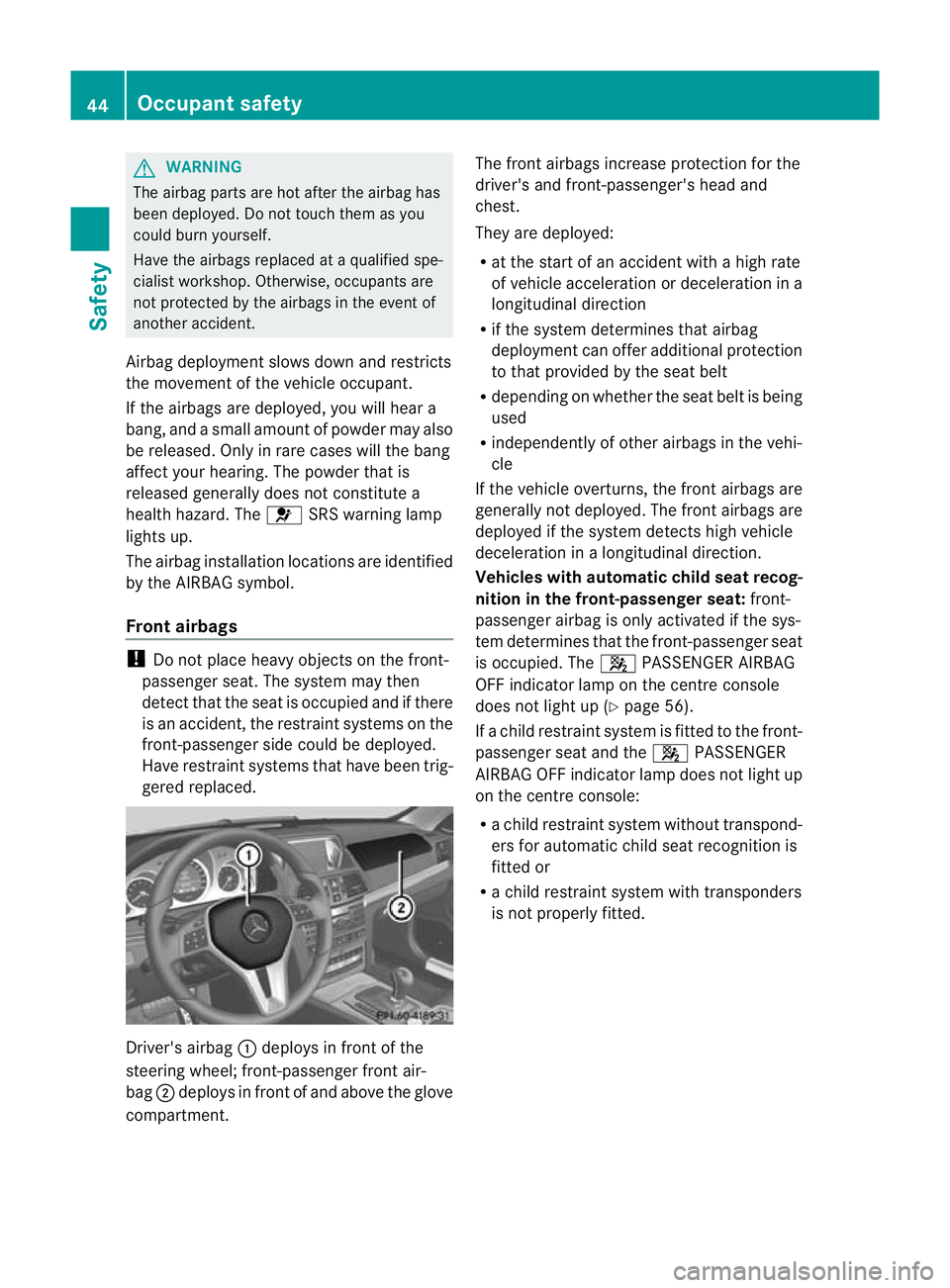
gered replaced. Driver's airbag
:deploys in front of the
steering wheel; front-passenger front air-
bag ;deploys in front of and above the glove
compartment. The front airbags increase protection for the
driver's and front-passenger's head and
chest.
They are deployed:
R
at the start of an accident with a high rate
of vehicle acceleration or deceleration in a
longitudinal direction
R if the system determines that airbag
deployment can offer additional protection
to that provided by the seat belt
R depending on whether the seat belt is being
used
R independently of other airbags in the vehi-
cle
If the vehicle overturns, the front airbags are
generally not deployed. The front airbags are
deployed if the system detects high vehicle
deceleration in a longitudinal direction.
Vehicles with automatic child seat recog-
nition in the front-passenger seat: front-
passenger airbag is only activated if the sys-
tem determines that the front-passenger seat
is occupied. The 4PASSENGER AIRBAG
OFF indicator lamp on the centre console
does not light up (Y page 56).
If a child restraint system is fitted to the front-
passenger seat and the 4PASSENGER
AIRBAG OFF indicator lamp does not light up
on the centre console:
R a child restraint system without transpond-
ers for automatic child seat recognition is
fitted or
R a child restraint system with transponders
is not properly fitted. 44
Occupant safetySafety