child seat MERCEDES-BENZ E-CLASS ESTATE 2015 Service Manual
[x] Cancel search | Manufacturer: MERCEDES-BENZ, Model Year: 2015, Model line: E-CLASS ESTATE, Model: MERCEDES-BENZ E-CLASS ESTATE 2015Pages: 497, PDF Size: 16.23 MB
Page 352 of 497
X
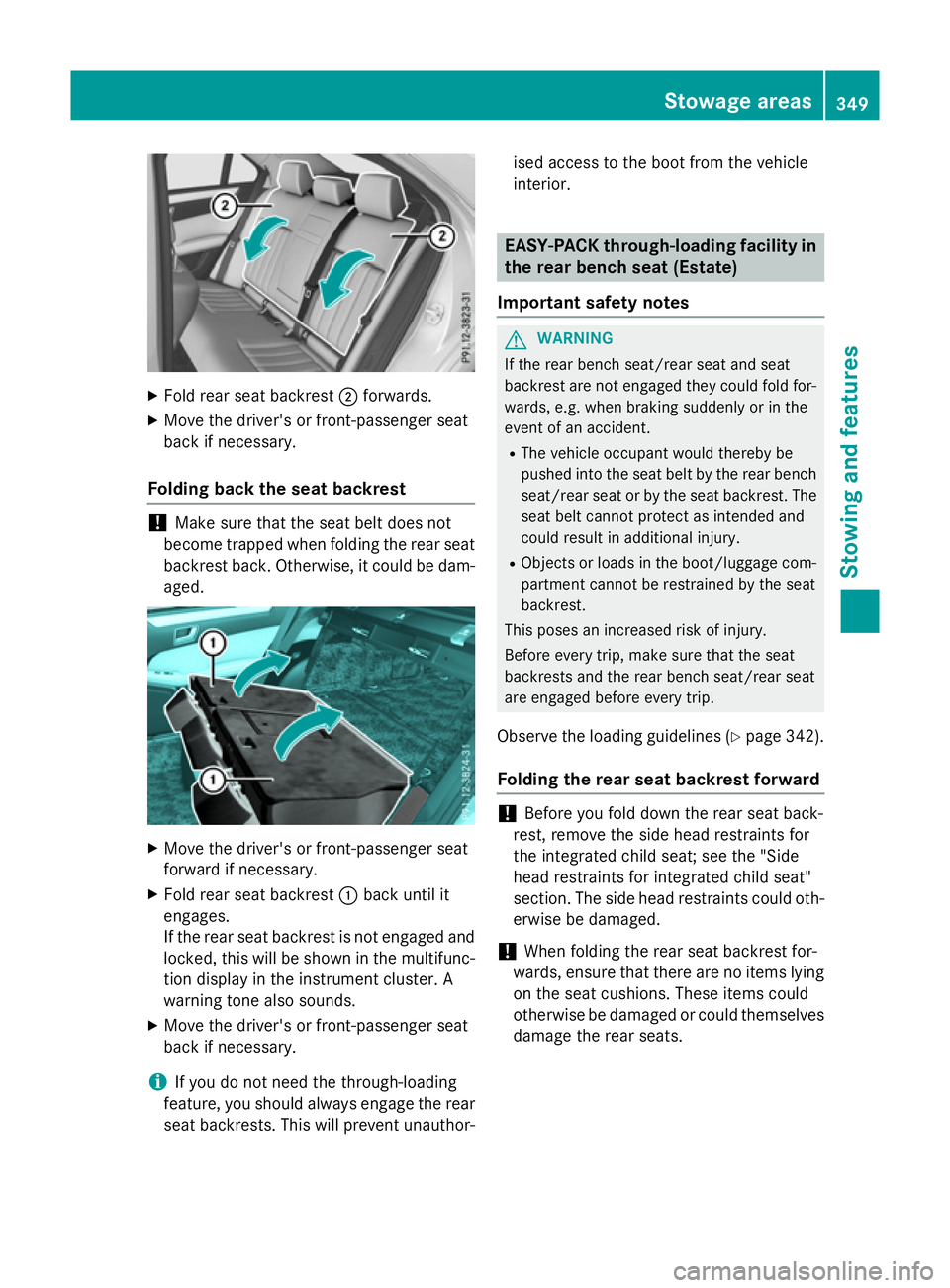
Fold rea rseatb ackrest ;forwards.
X Move the driver' sorfront-passenger seat
back if necessary.
Folding bac kthe seat backrest !
Make sure that the sea
tbeltd oesn ot
become trapped whe nfolding the rea rseat
backrest back. Otherwise, it could be dam- aged. X
Move the driver' sorfront-passenger seat
forward if necessary.
X Fold rea rseatb ackrest :back unti lit
engages.
If the rea rsea tb ackrest is not engaged and
locked, this will be shown in the multifunc-
tion display in the instrument cluster. A
warning tone also sounds.
X Move the driver' sorfront-passenger seat
back if necessary.
i If yo
udon ot need the through-loading
feature ,you shoul dalway sengage the rear
sea tbackrests. Thi swillp revent unauthor- ise
da ccess to the boo tfrom the vehicle
interior. EASY-PACK through-loadin
gfacility in
the rear benc hseat(Es tate)
Important safety notes G
WARNING
If the rea rbench seat/rea rseata nd seat
backrest are not engaged they could fol dfor-
wards, e.g. whe nbraking suddenl yorinthe
event of an accident.
R The vehicle occupant would thereby be
pushe dinto the sea tbeltb ythe rea rbench
seat/rea rseatorb ythe sea tbackrest. The
sea tbeltc annot protect as intended and
could result in additiona linjury.
R Objects or loads in the boot/luggage com-
partment cannot be restrained by the seat
backrest.
Thi sp oses an increase driskofi njury.
Befor eevery trip ,make sur ethat the seat
backrests and the rea rbench seat/rea rseat
are engaged before every trip.
Observe the loading guidelines (Y page 342).
Folding the rear seat backres tforward !
Befor
eyou foldd ownthe rea rseatb ack-
rest, remove the sid eheadr estraints for
the integrate dchilds eat; see the "Side
hea drestraints for integrate dchilds eat"
section. The sid eheadr estraints could oth-
erwise be damaged.
! Whe
nfolding the rea rseatb ackrest for-
wards, ensure that there are no item slying
on the sea tcushions .These item scould
otherwise be damaged or could themselves
damag ethe rea rseats. Stowage areas
349Stowingand features Z
Page 405 of 497
lead to function restrictions applying to
safety-relevant systems, e.g the lighting sys-
tem ,the AB S(anti-loc kbraking system) or the
ESP ®
(Electronic Stability Program). The oper-
atin gsafet yofy our vehicle may be restricted.
You could lose control of the vehicle, for
example:
R when braking
R in the even tofabrupt steerin gmanoeuvres
and/or when the vehicle's speed is not
adapted to the road conditions
There is arisk of an accident.
In the even tofashortcircuit or asimilar inci-
dent ,contac taqualified specialist workshop
immediately. Do not drive any further. Always have work on the battery carried out at a
qualified specialist workshop.
Further information about AB S(Ypage 77)
and ESP ®
(Y page 83). G
WARNING
Electrostatic build-up can lead to the creation of sparks, which could ignit ethe highly explo-
sive gases of abattery. There is arisk of an
explosion.
Before handlin gthe battery, touc hthe vehicle
body to remove any existin gelectrostatic
build-up.
The highly flammable gas mixture is created
while the battery is charging and when jump-
starting.
Always make sure that neither you nor the
battery is electrostatically charged. Electro-
static charge is created, for example:
R by wearing synthetic fibre clothing
R due to friction betwee nclothing and the
seat
R when you pull or push the battery across
carpe torother synthetic materials
R when you rub the battery with acloth G
WARNING
Durin gthe charging process, abattery produ-
ces hydroge ngas. If ashor tcircuit occurs or spark
sare created, the hydroge ngas can
ignite. There is arisk of an explosion.
R Make sure that the positive terminal of a
connected battery does not com eintoc on-
tac twith vehicle parts.
R Never place metal object sortools on abat-
tery.
R It is importan tthat you observe the descri-
bed order of the battery terminals when
connectin gand disconnecting abattery.
R When jump-starting, make sure that the
battery poles with identical polarit yare
connected.
R It is particularly importan ttoobserve the
described order when connectin gand dis-
connectin gthe jump leads.
R Never connec tordisconnect the battery
terminals while the engin eisrunning. G
WARNING
Batter yacid is caustic. There is arisk of injury.
Avoid contac twith the skin ,eyes or clothing.
Do not breathe in any battery gases. Do not
lean over the battery. Keep the batteries out
of the reach of children. Immediately rinse off
battery acid thoroughly with plent yofclean
water and seek medical attention at once. H
Environmental note Batteries contain pollutants.
It is illegal to dispose of them
with the household rubbish.
They must be collected sep-
arately and dispose dofinan
environmentally responsible
recyclin gsystem. Dispose of batteries in an
environmentally responsible
manner. Take discharged
batteries to
aqualified spe-
cialist workshop or to acol-
lection point for used batter-
ies.
! Have the battery checked regularly at a
qualified specialist workshop. 402
Battery (vehicle)Breakdown assistance