engine oil MERCEDES-BENZ E-CLASS SALOON 2009 User Guide
[x] Cancel search | Manufacturer: MERCEDES-BENZ, Model Year: 2009, Model line: E-CLASS SALOON, Model: MERCEDES-BENZ E-CLASS SALOON 2009Pages: 373, PDF Size: 12.37 MB
Page 224 of 373
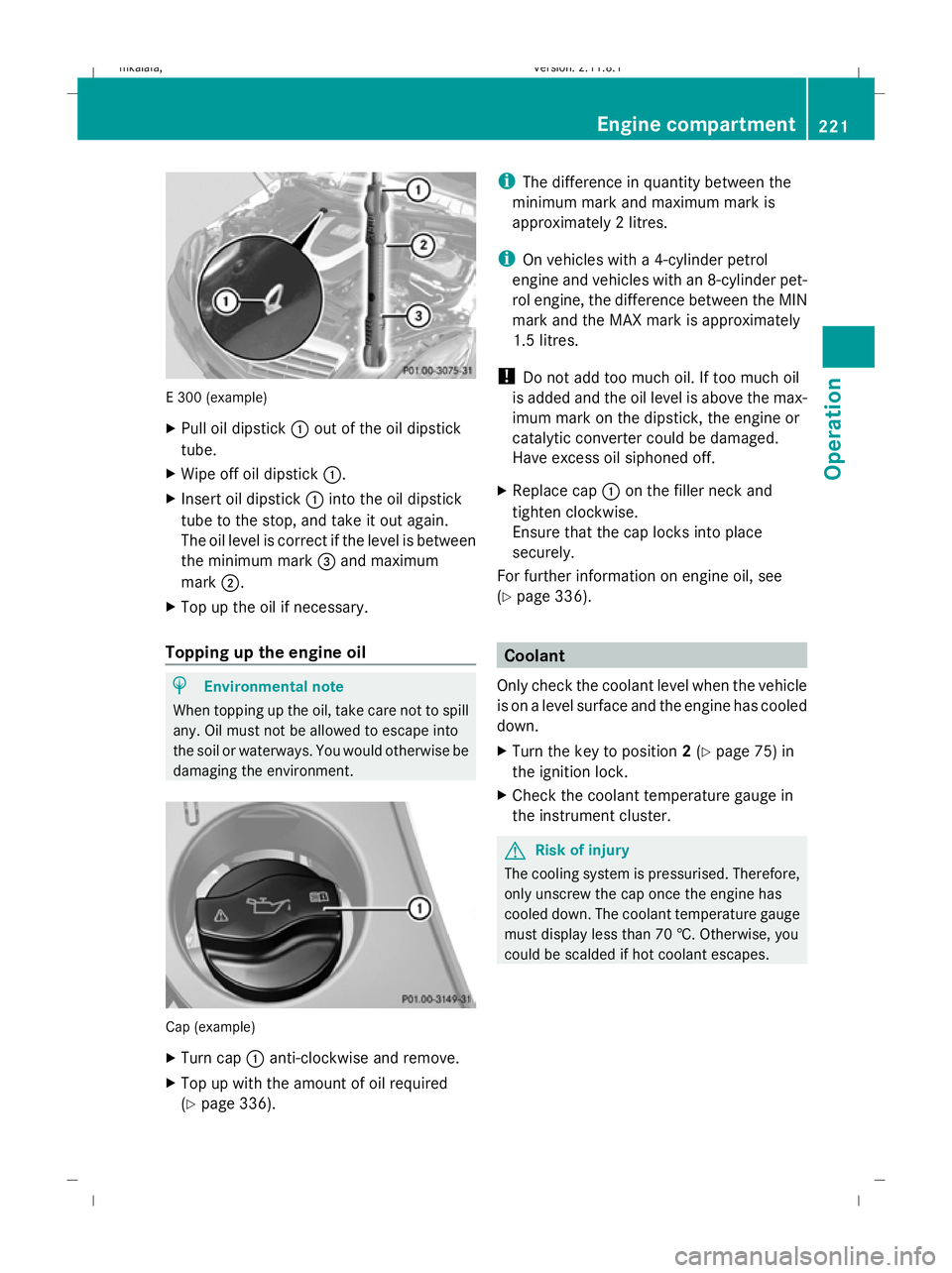
E 300 (example)
X
Pull oil dipstick :out of the oil dipstick
tube.
X Wipe off oil dipstick :.
X Insert oil dipstick :into the oil dipstick
tube to the stop, and take it out again.
The oil level is correct if the level is between
the minimum mark =and maximum
mark ;.
X Top up the oil if necessary.
Topping up the engine oil H
Environmental note
When topping up the oil, take care not to spill
any. Oil must not be allowed to escape into
the soil or waterways. You would otherwise be
damaging the environment. Cap (example)
X
Turn cap :anti-clockwise and remove.
X Top up with the amount of oil required
(Y page 336). i
The difference in quantity between the
minimum mark and maximum mark is
approximately 2 litres.
i On vehicles with a 4-cylinder petrol
engine and vehicles with an 8-cylinder pet-
rol engine, the difference between the MIN
mark and the MAX mark is approximately
1.5 litres.
! Do not add too much oil. If too much oil
is added and the oil level is above the max-
imum mark on the dipstick, the engine or
catalytic converter could be damaged.
Have excess oil siphoned off.
X Replace cap :on the filler neck and
tighten clockwise.
Ensure that the cap locks into place
securely.
For further information on engine oil, see
(Y page 336). Coolant
Only check the coolant level when the vehicle
is on a level surface and the engine has cooled
down.
X Turn the key to position 2(Y page 75) in
the ignition lock.
X Check the coolant temperature gauge in
the instrument cluster. G
Risk of injury
The cooling system is pressurised. Therefore,
only unscrew the cap once the engine has
cooled down. The coolant temperature gauge
must display less than 70 †. Otherwise, you
could be scalded if hot coolant escapes. Engine compartment
221Operation
212_AKB; 2; 4, en-GB
mkalafa, Version: 2.11.8.1 2009-05-05T14:17:16+02:00 - Seite 221 Z
Dateiname: 6515346702_buchblock.pdf; erzeugt am 07. May 2009 14:16:56; WK
Page 277 of 373
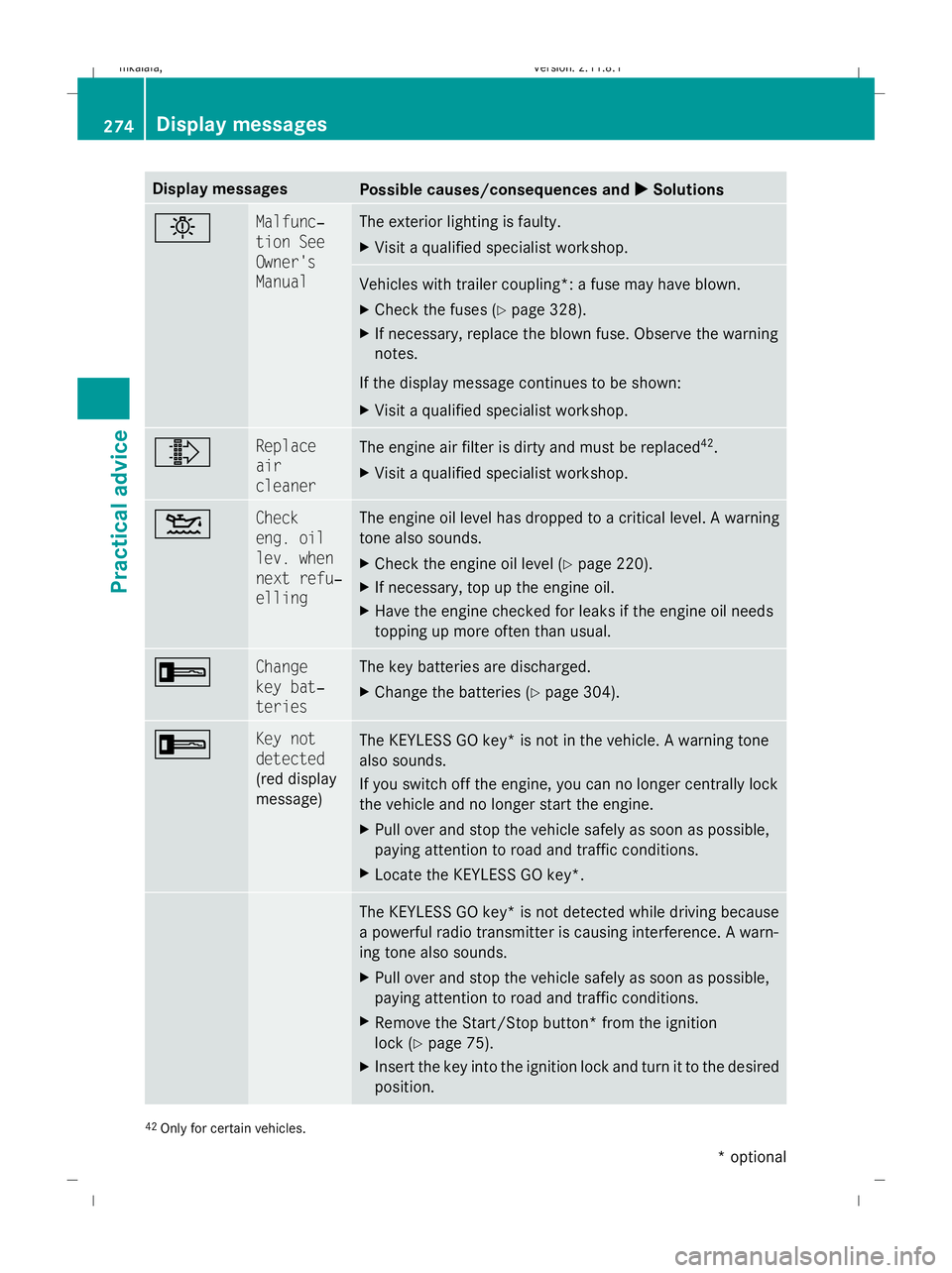
Display messages
Possible causes/consequences and
X
X Solutions b Malfunc‐
tion See
Owner's
Manual The exterior lighting is faulty.
X
Visit a qualified specialist workshop. Vehicles with trailer coupling*: a fuse may have blown.
X
Check the fuses (Y page 328).
X If necessary, replace the blown fuse. Observe the warning
notes.
If the display message continues to be shown:
X Visit a qualified specialist workshop. ¸ Replace
air
cleaner
The engine air filter is dirty and must be replaced
42
.
X Visit a qualified specialist workshop. 4 Check
eng. oil
lev. when
next refu‐
elling The engine oil level has dropped to a critical level. A warning
tone also sounds.
X
Check the engine oil level ( Ypage 220).
X If necessary, top up the engine oil.
X Have the engine checked for leaks if the engine oil needs
topping up more often than usual. + Change
key bat‐
teries The key batteries are discharged.
X
Change the batteries ( Ypage 304). + Key not
detected
(red display
message)
The KEYLESS GO key* is not in the vehicle. A warning tone
also sounds.
If you switch off the engine, you can no longer centrally lock
the vehicle and no longer start the engine.
X
Pull over and stop the vehicle safely as soon as possible,
paying attention to road and traffic conditions.
X Locate the KEYLESS GO key*. The KEYLESS GO key* is not detected while driving because
a powerful radio transmitter is causing interference. A warn-
ing tone also sounds.
X
Pull over and stop the vehicle safely as soon as possible,
paying attention to road and traffic conditions.
X Remove the Start/Stop button* from the ignition
lock (Y page 75).
X Insert the key into the ignition lock and turn it to the desired
position. 42
Only for certain vehicles. 274
Display
messagesPractical advice
* optional
212_AKB; 2; 4, en-GB
mkalafa
,V ersion: 2.11.8.1
2009-05-05T14:17:16+02:00 - Seite 274
Dateiname: 6515346702_buchblock.pdf; erzeugt am 07. May 2009 14:17:11; WK
Page 296 of 373
Automatic transmission*
Problem
Possible causes/consequences and
X
X Solutions The transmission has
problems shifting gear. The transmission is losing oil.
X
Have the transmission checked at a qualified specialist work-
shop immediately. The acceleration ability
is deteriorating.
The transmission no
longer changes gear. The transmission is in emergency mode.
It is only possible to shift into
secondgear and reverse gear.
X Stop the vehicle.
X Move the transmission to position P.
X Turn the key in the ignition to position 0(Y page 75) or press
the Start/Stop button* repeatedly until all indicator lamps in
the instrument cluster go out.
X Wait at least 10 seconds before restarting the engine.
X Move the transmission to position Dor R.
If D is selected, the transmission shifts into secondgear; ifRis
selected, the transmission shifts into reverse gear.
X Have the transmission checked at a qualified specialist work-
shop immediately. PARKTRONIC*
Problem
Possible causes/consequences and
X
X Solutions Only the red segments
in the PARKTRONIC
warning display are lit.
You also hear a warning
tone for approximately
two seconds.
PARKTRONIC is deacti-
vated after approx-
imately 20 seconds and
the indicator lamp in
the PARKTRONIC but-
ton lights up. PARKTRONIC has malfunctioned and has switched itself off.
X
If problems persist, have PARKTRONIC checked at a qualified
specialist workshop. Only the red segments
in the PARKTRONIC
warning display are lit.
PARKTRONIC is deacti-
vated after approx-
imately 20 seconds. The PARKTRONIC sensors are dirty or there is interference.
X
Clean the PARKTRONIC sensors (Y page 243).
X Switch the ignition back on. Troubleshooting
293Practical advice
* optional
212_AKB; 2; 4, en-GB
mkalafa,
Version: 2.11.8.1 2009-05-05T14:17:16+02:00 - Seite 293 Z
Dateiname: 6515346702_buchblock.pdf; erzeugt am 07. May 2009 14:17:13; WK
Page 336 of 373
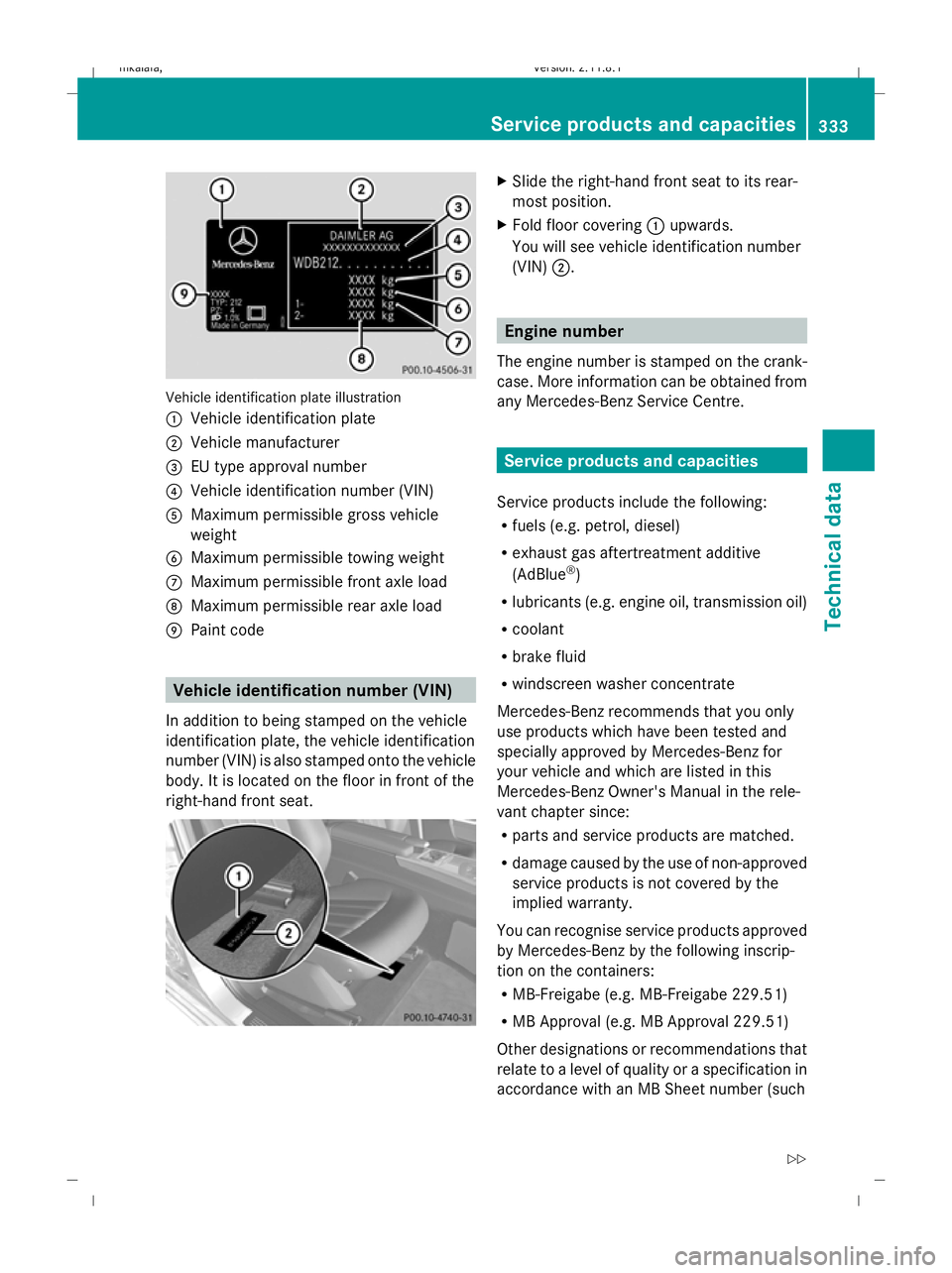
Vehicle identification plate illustration
:
Vehicle identification plate
; Vehicle manufacturer
= EU type approval number
? Vehicle identification number (VIN)
A Maximum permissible gross vehicle
weight
B Maximum permissible towing weight
C Maximum permissible front axle load
D Maximum permissible rear axle load
E Paint code Vehicle identification number (VIN)
In addition to being stamped on the vehicle
identification plate, the vehicle identification
number (VIN) is also stamped onto the vehicle
body. It is located on the floor in front of the
right-hand front seat. X
Slide the right-hand front seat to its rear-
most position.
X Fold floor covering :upwards.
You will see vehicle identification number
(VIN) ;. Engine number
The engine number is stamped on the crank-
case. More information can be obtained from
any Mercedes-Benz Service Centre. Service products and capacities
Service products include the following:
R fuels (e.g. petrol, diesel)
R exhaust gas aftertreatment additive
(AdBlue ®
)
R lubricants (e.g. engine oil, transmission oil)
R coolant
R brake fluid
R windscreen washer concentrate
Mercedes-Benz recommends that you only
use products which have been tested and
specially approved by Mercedes-Benz for
your vehicle and which are listed in this
Mercedes-Benz Owner's Manual in the rele-
vant chapter since:
R parts and service products are matched.
R damage caused by the use of non-approved
service products is not covered by the
implied warranty.
You can recognise service products approved
by Mercedes-Benz by the following inscrip-
tion on the containers:
R MB-Freigabe (e.g. MB-Freigabe 229.51)
R MB Approval (e.g. MB Approval 229.51)
Other designations or recommendations that
relate to a level of quality or a specification in
accordance with an MB Sheet number (such Service products and capacities
333Technical data
212_AKB; 2; 4, en-GB
mkalafa, Version: 2.11.8.1 2009-05-05T14:17:16+02:00 - Seite 333 Z
Dateiname: 6515346702_buchblock.pdf; erzeugt am 07. May 2009 14:17:32; WK
Page 338 of 373
R
at very low temperatures
R in urban traffic
R on short trips
R when towing a trailer
R in mountainous terrain
i Only for certain countries: the respective
current consumption and emission values
of your vehicle can be found in the COC
papers (EC CERTIFICATE OF CONFORM-
ITY). These documents are supplied when
the vehicle is delivered.
The consumption figures for vehicles falling
under the EURO4 standard have been
determined in accordance with EU Direc-
tive 80 /1268 /EEC while figures for vehi-
cles falling under the EURO5 standard have
been determined in accordance with Reg-
ulation (EC) No. 715 / 2007, in each case
based on the currently applicable version.
The values do not refer to a specific vehicle.
Deviations from these values may occur
under normal operating conditions.
! Do not use any special additives, as they
can cause malfunctions and engine dam-
age. Damage resulting from the use of such
additives is not covered by the Mercedes-
Benz implied warranty. H
Environmental note
CO 2(carbon dioxide) is the gas which scien-
tists believe to be principally responsible for
global warming (the greenhouse effect). Your
vehicle's CO 2emissions are directly related to
fuel consumption and therefore depend on:
R efficient use of the fuel by the engine
R driving style
R other non-technical factors, such as envi-
ronmental influences or road conditions
You can minimise your vehicle's CO 2emis-
sions by driving carefully and having it serv-
iced regularly. AdBlue
®
i For BlueTEC vehicles only.
AdBlue ®
is a non-flammable, non-toxic, col-
ourless and odourless water-soluble fluid.
! Only use AdBlue ®
compliant with ISO
22241. The use of special additives is not
permitted.
! Surfaces, such as carpets or paintwork,
which come into contact with AdBlue ®
while refilling should be rinsed immediately
with plenty of water. Immediately after
spilling, remove AdBlue ®
using a damp
cloth and cold water. If AdBlue ®
has
already crystallised, use a sponge and hot
water to clean it off. AdBlue ®
residues crys-
tallise after a certain period of time and soil
the affected surfaces.
High outside temperatures If AdBlue
®
is heated to above 50 † for an
extended period of time, e.g. as a result of
direct sunlight on the AdBlue ®
tank,
AdBlue ®
may decompose. Ammonia vapours
develop as a result. G
Risk of injury
Ammonia vapours may escape if the
AdBlue ®
tank cap is opened at high tempera-
tures. Ammonia vapours have a pungent
odour and are particularly irritating to the
skin, to mucous membranes and to the eyes.
You may experience a burning sensation in
your eyes, nose and throat, as well as cough-
ing and watering of the eyes.
Do not inhale ammonia vapours.
Low outside temperatures AdBlue
®
freezes at a temperature of approx-
imately –11 †. The vehicle is equipped with
an AdBlue ®
preheating system at the factory.
Winter operation is therefore also guaranteed
at temperatures below –11 †. Service products and capacities
335Technical data
212_AKB; 2; 4, en-GB
mkalafa,V ersion: 2.11.8.1
2009-05-05T14:17:16+02:00 - Seite 335 Z
Dateiname: 6515346702_buchblock.pdf; erzeugt am 07. May 2009 14:17:32; WK
Page 339 of 373
Special additives
!
Only use AdBlue ®
compliant with ISO
22241. Do not add any special additives to
AdBlue ®
and do not dilute it with water.
Doing so can destroy the BlueTEC ®
exhaust
gas aftertreatment system.
Damage resulting from the use of such
additives or from water is not covered by
the Mercedes-Benz implied warranty.
Purity The purity of AdBlue
®
is particularly important
for avoiding malfunctions in the exhaust gas
aftertreatment system.
If AdBlue ®
is pumped out of the AdBlue ®
tank,
e.g. during repair work, it must not be
returned to the tank again as the purity of the
fluid can no longer be guaranteed.
! Impurities in AdBlue ®
(e. g. due to other
service products, cleaning agents or dust)
result in increased emission values, system
malfunctions, catalytic converter damage
or engine damage. Vehicle model Total capacity of
the AdBlue ®
tank E 350 BlueTEC 24.5 l
Engine oil
Only Mercedes-Benz approved engine oils
may be used in Mercedes-Benz engines.
A list of the engine oils tested and approved
in accordance with the Mercedes-Benz Spec-
ifications for Service Products can be called
up by visiting http://bevo.daimler.com and
entering the MB Sheet number. Further infor-
mation on tested and approved engine oils
can be obtained from any Mercedes-Benz
Service Centre. Engine oils which have been
approved by Mercedes-Benz have the MB
Sheet number indicated on the oil container
under the "MB approval" notice. The table
shows which MB Sheet number applies to
which engine: E 200 CGI BlueEFFI-
CIENCY
E 250 CGI BlueEFFI- CIENCY E 300
47
E 350 47
E 350 4MATIC
E 350 CGI BlueEFFI- CIENCY
E 500
E 500 4MATIC E 63 AMG
48 MB Sheet number
229.3, 229.5,
229.51 229.3, 229.5 mm 229.5
47
Only for certain countries.
48 Restriction: only SAE 0W-40 engine oils may be used. 336
Service products and capacitiesTechnical data
212_AKB; 2; 4, en-GB
mkalafa,
Version: 2.11.8.1 2009-05-05T14:17:16+02:00 - Seite 336
Dateiname: 6515346702_buchblock.pdf; erzeugt am 07. May 2009 14:17:32; WK
Page 340 of 373
E 200 CDI BlueEFFICIENCY
E 220 CDI BlueEFFICIENCY
E 220 CDI BlueEFFICIENCY (Belgium) E 250 CDI BlueEFFICIENCY
E 350 CDI BlueEFFICIENCY
E 350 CDI 4MATIC BlueEFFICIENCY E 350 BlueTEC MB Sheet number
Vehicles with a diesel par-
ticle filter
228.51, 229.31, 229.51
i
In the event that the:
R engine oil brand
R grade (MB Sheet number)
R SAE classification (viscosity)
is not available, you can use another min-
eral or synthetic engine oil which has been
approved by Mercedes-Benz. You must
then have an oil change carried out at the
earliest possible opportunity.
Mixing oils reduces the benefits of high-
grade engine oil.
! Do not use lubricant additives, as they can
lead to increased wear and damage to
mechanical assemblies. The use of lubri-
cant additives will result in a restriction of
your warranty. Engine oil viscosity
Viscosity describes the flow characteristics
of a fluid. If an engine oil has a high viscosity,
this means it is thick; a low viscosity means
that it is thin.
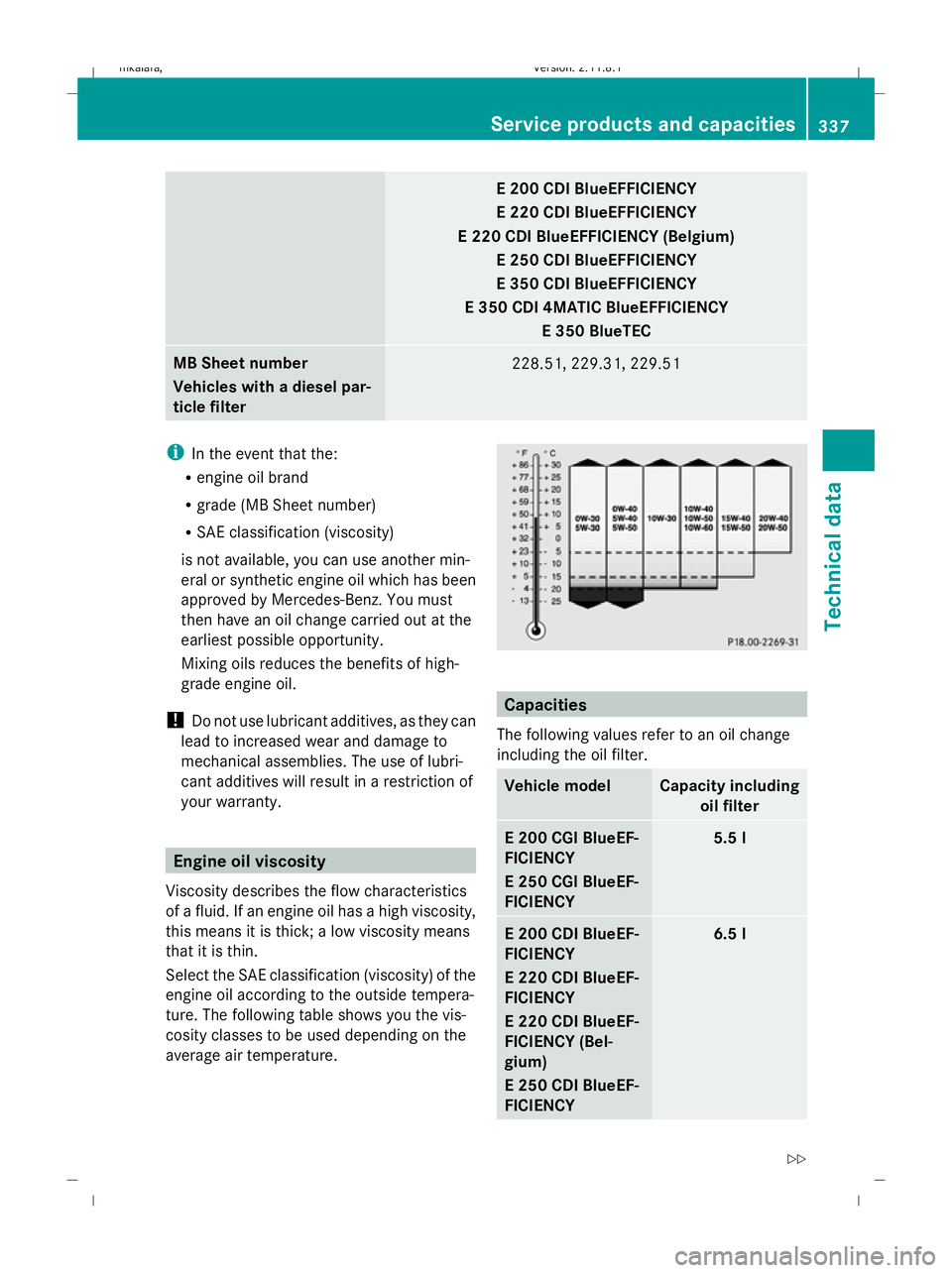
Select the SAE classification (viscosity) of the
engine oil according to the outside tempera-
ture. The following table shows you the vis-
cosity classes to be used depending on the
average air temperature. Capacities
The following values refer to an oil change
including the oil filter. Vehicle model Capacity including
oil filter E 200 CGI BlueEF-
FICIENCY
E 250 CGI BlueEF-
FICIENCY 5.5 l
E 200 CDI BlueEF-
FICIENCY
E 220 CDI BlueEF-
FICIENCY
E 220 CDI BlueEF-
FICIENCY (Bel-
gium)
E 250 CDI BlueEF-
FICIENCY 6.5 lService products and capacities
337Technical data
212_AKB; 2; 4, en-GB
mkalafa, Version: 2.11.8.1 2009-05-05T14:17:16+02:00 - Seite 337 Z
Dateiname: 6515346702_buchblock.pdf; erzeugt am 07. May 2009 14:17:32; WK
Page 341 of 373
Vehicle model Capacity including
oil filter E 350 4MATIC 7.0 l
E 300
49
E 350 49
E 350 CGI BlueEF-
FICIENCY
E 350 CDI BlueEF-
FICIENCY
E 350 BlueTEC 8.0 l
E 63 AMG
8.0 l (8.8 l
50
) E 500
E 500 4MATIC 8.5 l
Coolant
The coolant is a mixture of water and anti-
freeze/corrosion inhibitor. It performs the
following tasks:
R anti-corrosion protection
R antifreeze protection
R raising the boiling point
i When the vehicle is first delivered, it is
topped up with a coolant that will ensure
adequate antifreeze and corrosion protec-
tion.
! Only top up with coolant that has been
premixed with the desired antifreeze pro-
tection. You could otherwise damage the
engine.
Further information on coolants and on fill-
ing can be found in the Mercedes-Benz
Specifications for Service Products, Sheet
310.1, or at any Mercedes-Benz Service
Centre. !
Always use a suitable coolant mixture,
even in countries where high temperatures
prevail.
Otherwise, the cooling system will not be
sufficiently protected from corrosion, and
the boiling point will be too low.
If antifreeze/corrosion inhibitor is present in
the correct concentration, the boiling point of
the coolant will be around 130 †.
The antifreeze/corrosion inhibitor concentra-
tion in the cooling system should:
R be at least 50%. This will protect the cooling
system against freezing down to around
-37 †.
R not exceed 55% (antifreeze protection
down to -45 †); otherwise, heat will not be
effectively dissipated.
If the vehicle has lost coolant, top it up with
equal amounts of water and antifreeze/cor-
rosion inhibitor. Mercedes-Benz recom-
mends an antifreeze/corrosion inhibitor
which has been approved for Mercedes-Benz.
! The cooling system contains a supply
which must be renewed after 15 years, or
after 250, 000 km at the latest.
The warranty is only valid if you top up with
an antifreeze/corrosion inhibitor which
has been approved by Mercedes-Benz and
if the recommended mixture ratio is
observed. Brake fluid
Over a period of time, the brake fluid absorbs
moisture from the air; this lowers its boiling
point. G
Risk of accident
If the boiling point of the brake fluid is too low,
vapour pockets may form in the brake system
when the brakes are applied hard (e.g. when
49 Only for certain countries.
50 Capacity including oil filter and external oil cooler. 338
Service products and capacitiesTechnical data
212_AKB; 2; 4, en-GB
mkalafa
,V ersion: 2.11.8.1
2009-05-05T14:17:16+02:00 - Seite 338
Dateiname: 6515346702_buchblock.pdf; erzeugt am 07. May 2009 14:17:33; WK