window MERCEDES-BENZ E-CLASS SALOON 2009 User Guide
[x] Cancel search | Manufacturer: MERCEDES-BENZ, Model Year: 2009, Model line: E-CLASS SALOON, Model: MERCEDES-BENZ E-CLASS SALOON 2009Pages: 373, PDF Size: 12.37 MB
Page 37 of 373
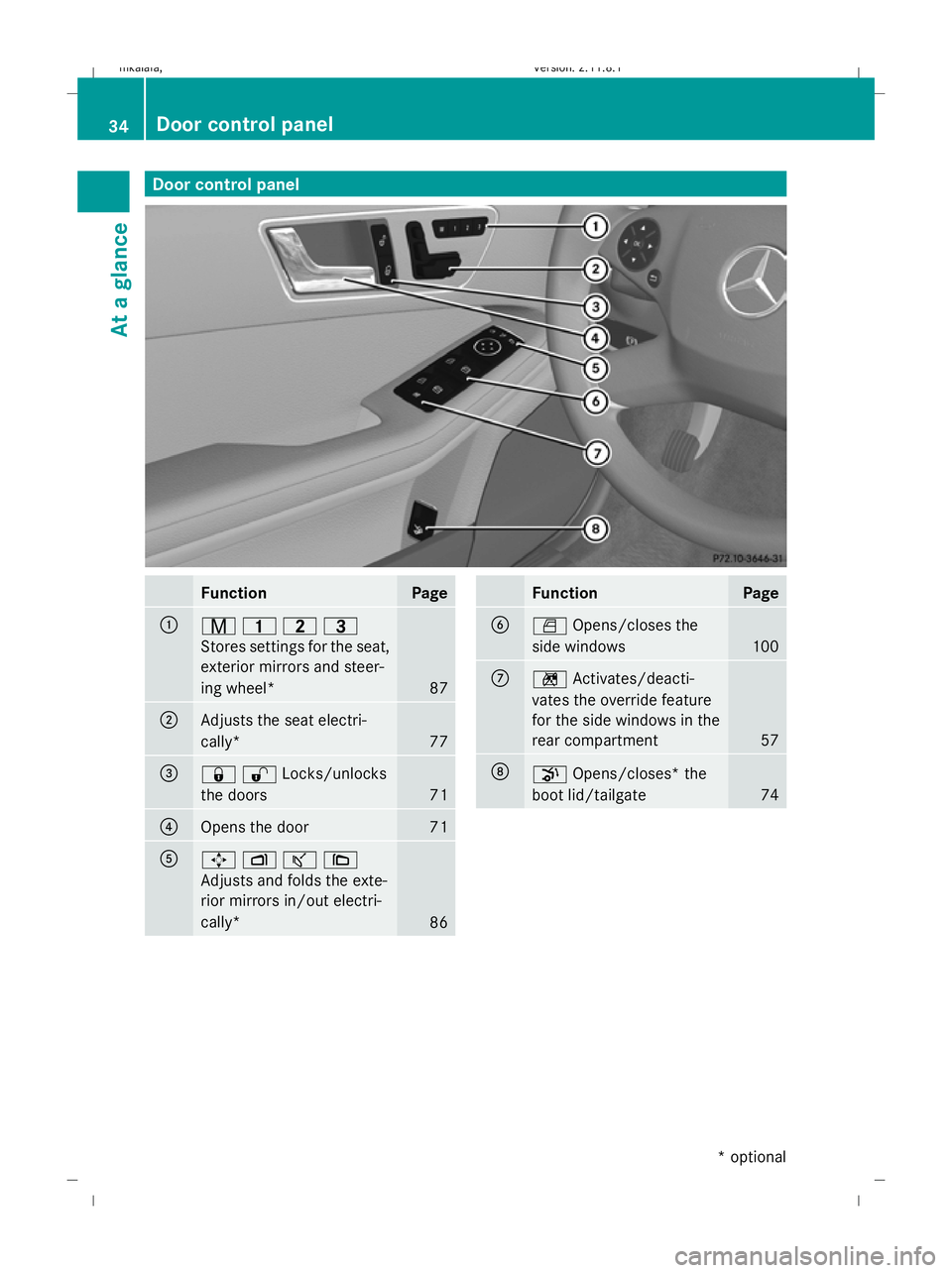
Door control panel
Function Page
:
r
45=
Stores settings for the seat,
exterior mirrors and steer-
ing wheel* 87
;
Adjusts the seat electri-
cally*
77
=
&%Locks/unlocks
the doors
71
?
Opens the door 71
A
7
Zª\
Adjusts and folds the exte-
rior mirrors in/out electri-
cally* 86 Function Page
B
W
Opens/closes the
side windows 100
C
n
Activates/deacti-
vates the override feature
for the side windows in the
rear compartment 57
D
p
Opens/closes* the
boot lid/tailgate 7434
Door control panelAt a glance
* optional
212_AKB; 2; 4, en-GB
mkalafa,
Version: 2.11.8.1 2009-05-05T14:17:16+02:00 - Seite 34
Dateiname: 6515346702_buchblock.pdf; erzeugt am 07. May 2009 14:15:35; WK
Page 42 of 373
G
Risk of injury
If the seat belt tensioners have been trig-
gered, they provide no additional protection
in the event of another accident. Therefore,
have belt tensioners which have been trig-
gered replaced at a qualified specialist work-
shop.
Comply with safety regulations when dispos-
ing of belt tensioners. Any Mercedes-Benz
Service Centre can provide details of these
regulations.
Airbags Airbag deployment slows down and restricts
the movement of the vehicle occupant.
If the airbags are deployed, you will hear a
bang and a small amount of powder may also
be released. Only in rare cases will the bang
affect your hearing. The powder that escapes
does not generally constitute a health hazard.
The SRS warning lamp 6lights up.
The AIRBAG identification indicates the loca-
tion of the airbags. G
Risk of injury
Airbags provide additional protection; they
are not, however, a substitute for seat belts.
Observe the following notes to reduce the risk
of serious or even fatal injury if an airbag is
deployed:
R all vehicle occupants ― in particular, preg-
nant women ― must wear their seat belt
correctly at all times and lean back against
the backrest, which should be positioned
as close to the vertical as possible. The
head restraint must support the back of the
head at about eye level.
R always secure children less than 1.50 m tall
or under 12 years of age in suitable child
restraint systems.
R all vehicle occupants must select a seat
position that is as far away from the airbag
as possible. The driver's seat position must
allow the vehicle to be driven safely. The driver's chest should be as far away from
the middle of the driver's front airbag cover
as possible.
R move the front-passenger seat as far back
as possible, especially if a child is secured
in a child restraint system on the seat.
R vehicle occupants – in particular, children
– must not lean their head into the area of
the window in which the sidebag/head air-
bag is deployed.
R rearward-facing child restraint systems
must not be fitted to the front-passenger
seat unless the front-passenger front air-
bag has been disabled. The front-passenger
front airbag of a vehicle fitted with auto-
matic child seat recognition* is only disa-
bled when a child restraint system with
automatic child seat recognition is fitted to
the front-passenger seat. The 4
PASSENGER AIRBAG OFF warning lamp
must be continuously lit.
If the front-passenger seat of your vehicle
does not have automatic child seat recog-
nition*, or your rearward-facing child
restraint system does not have automatic
child seat recognition, children must be
secured in a child restraint system on a
suitable seat in the rear. If you secure a
forward-facing child restraint system to the
front-passenger seat, you must move the
front-passenger seat as far back as possi-
ble.
R make sure there are no heavy or sharp-
edged objects in pockets of clothing.
R do not lean forwards, e.g. over the cover of
the driver's/front-passenger front airbag,
particularly when the vehicle is in motion.
R do not put your feet on the dashboard.
R only hold the steering wheel by the rim. This
allows the airbag to deploy fully. You could
be injured if the airbag is deployed and you
are holding the inside of the steering wheel. Occupant safety
39Safety
* optional
212_AKB; 2; 4, en-GB
mkalafa
,V ersion: 2.11.8.1
2009-05-05T14:17:16+02:00 - Seite 39 Z
Dateiname: 6515346702_buchblock.pdf; erzeugt am 07. May 2009 14:15:36; WK
Page 43 of 373
R
do not lean on the doors from inside the
vehicle.
R make sure that there are no people, ani-
mals or objects between the vehicle occu-
pants and the area of deployment of the
airbag.
R do not place any objects between the seat
backrest and the door.
R do not hang any hard objects, for example,
coat hangers, on the grab handles or coat
hooks.
R do not attach accessories, e.g. cup holders,
to the doors.
It is not possible to rule out a risk of injuries
caused by an airbag due to the high speed at
which the airbag is required to deploy. G
Risk of injury
The airbag's functionality can only be guaran-
teed if the following parts are not covered and
no badges or stickers are attached to them:
R padded steering wheel boss
R knee airbag cover below the steering col-
umn
R front-passenger front airbag cover
R outer side of front seats
R side panel next to the rear seat backrest G
Risk of injury
When an airbag deploys, a small amount of
powder is released. The powder may cause
short-term breathing difficulties to persons
suffering from asthma or other pulmonary
conditions.
In order to prevent potential breathing diffi-
culties, you should leave the vehicle as soon
as it is safe to do so. You can also open the
window to allow fresh air to enter the interior.
The powder generally does not constitute a
health hazard and does not indicate that there
is a fire in the vehicle. G
Risk of injury
The airbag parts are hot after the airbag has
been deployed. Do not touch them; other-
wise, you may burn yourself.
Have the airbags checked at a qualified spe-
cialist workshop. Otherwise, occupants are
not protected by the airbags in the event of
another accident.
Front airbags
The front airbags are designed to increase
protection for the driver's and front passeng-
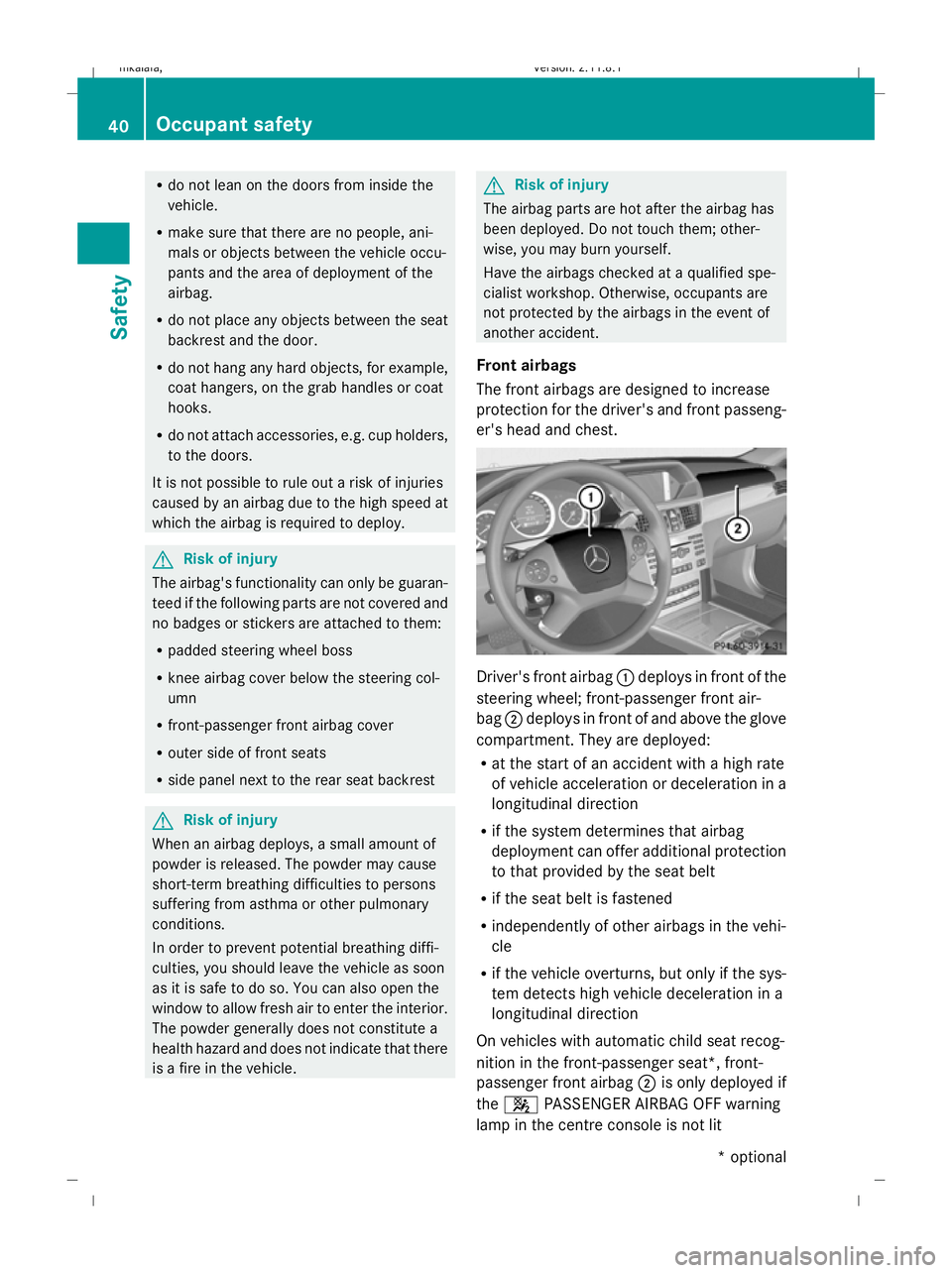
er's head and chest. Driver's front airbag
:deploys in front of the
steering wheel; front-passenger front air-
bag ;deploys in front of and above the glove
compartment. They are deployed:
R at the start of an accident with a high rate
of vehicle acceleration or deceleration in a
longitudinal direction
R if the system determines that airbag
deployment can offer additional protection
to that provided by the seat belt
R if the seat belt is fastened
R independently of other airbags in the vehi-
cle
R if the vehicle overturns, but only if the sys-
tem detects high vehicle deceleration in a
longitudinal direction
On vehicles with automatic child seat recog-
nition in the front-passenger seat*, front-
passenger front airbag ;is only deployed if
the 4 PASSENGER AIRBAG OFF warning
lamp in the centre console is not lit 40
Occupant safetySafety
* optional
212_AKB; 2; 4, en-GB
mkalafa,
Version: 2.11.8.1 2009-05-05T14:17:16+02:00 - Seite 40
Dateiname: 6515346702_buchblock.pdf; erzeugt am 07. May 2009 14:15:36; WK
Page 45 of 373
in the event of an accident. Appropriate seat
covers can be obtained from a Mercedes-
Benz Service Centre.
The purpose of pelvisbag deployment is to
enhance the level of protection of the vehicle
occupants on the side of the vehicle on which
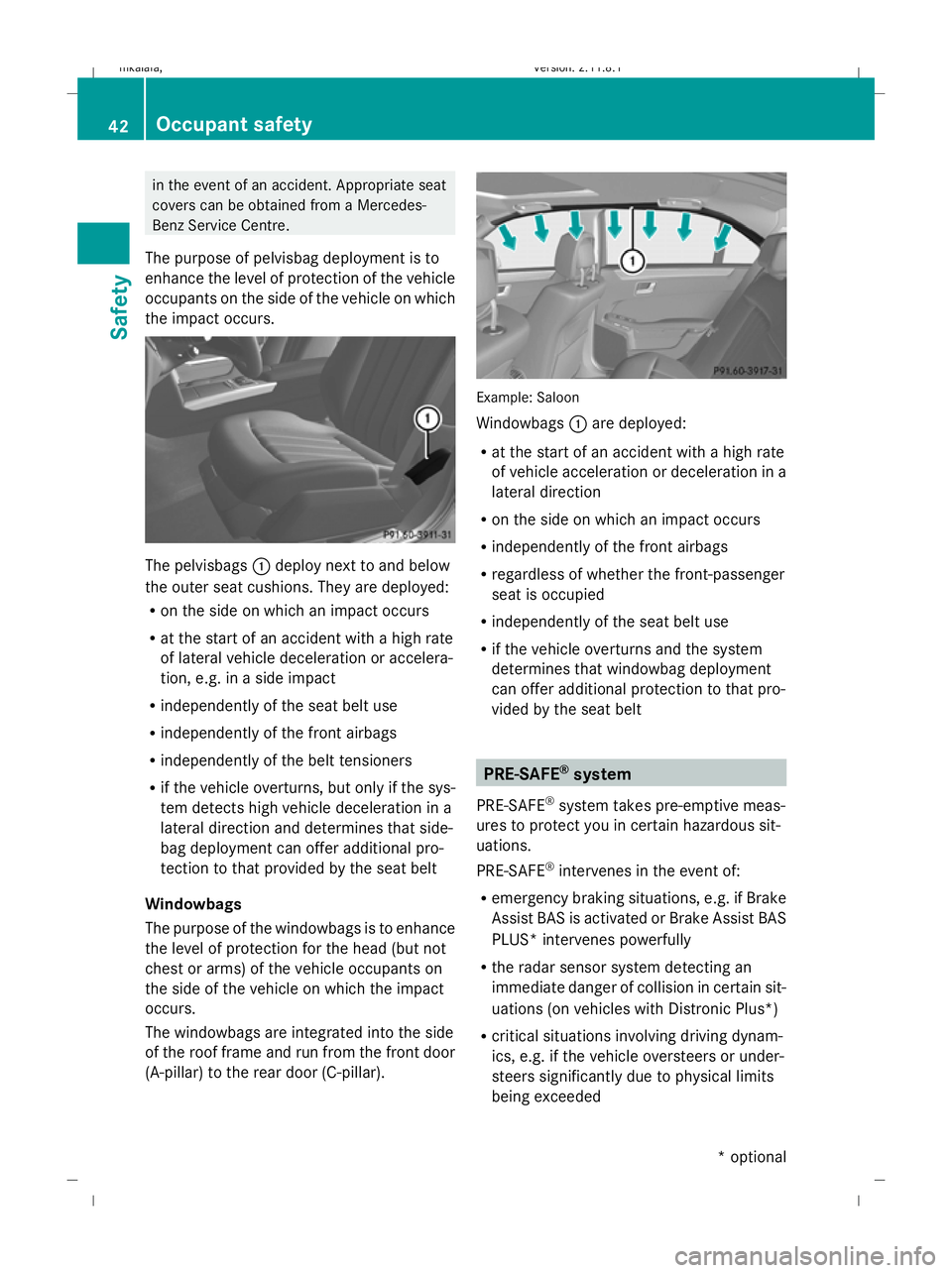
the impact occurs. The pelvisbags
:deploy next to and below
the outer seat cushions. They are deployed:
R on the side on which an impact occurs
R at the start of an accident with a high rate
of lateral vehicle deceleration or accelera-
tion, e.g. in a side impact
R independently of the seat belt use
R independently of the front airbags
R independently of the belt tensioners
R if the vehicle overturns, but only if the sys-
tem detects high vehicle deceleration in a
lateral direction and determines that side-
bag deployment can offer additional pro-
tection to that provided by the seat belt
Windowbags
The purpose of the windowbags is to enhance
the level of protection for the head (but not
chest or arms) of the vehicle occupants on
the side of the vehicle on which the impact
occurs.
The windowbags are integrated into the side
of the roof frame and run from the front door
(A-pillar) to the rear door (C-pillar). Example: Saloon
Windowbags
:are deployed:
R at the start of an accident with a high rate
of vehicle acceleration or deceleration in a
lateral direction
R on the side on which an impact occurs
R independently of the front airbags
R regardless of whether the front-passenger
seat is occupied
R independently of the seat belt use
R if the vehicle overturns and the system
determines that windowbag deployment
can offer additional protection to that pro-
vided by the seat belt PRE-SAFE
®
system
PRE-SAFE ®
system takes pre-emptive meas-
ures to protect you in certain hazardous sit-
uations.
PRE-SAFE ®
intervenes in the event of:
R emergency braking situations, e.g. if Brake
Assist BAS is activated or Brake Assist BAS
PLUS* intervenes powerfully
R the radar sensor system detecting an
immediate danger of collision in certain sit-
uations (on vehicles with Distronic Plus*)
R critical situations involving driving dynam-
ics, e.g. if the vehicle oversteers or under-
steers significantly due to physical limits
being exceeded 42
Occupant safetySafety
* optional
212_AKB; 2; 4, en-GB
mkalafa,
Version: 2.11.8.1
2009-05-05T14:17:16+02:00 - Seite 42
Dateiname: 6515346702_buchblock.pdf; erzeugt am 07. May 2009 14:15:38; WK
Page 46 of 373
PRE-SAFE
®
may take the following measures
in these situations:
R it tensions the front seat belts.
R on vehicles with memory functions*: it
adjusts the front-passenger seat if this is in
an unfavourable position.
R on vehicles with multicontour seat* or
active multicontour seat*: it increases the
air pressure in the seat side cushions and
the backrest side cushions.
R if the vehicle skids, it closes the sliding/
tilting sunroof* or panorama sliding sun-
roof* and the side windows so that only a
small gap remains.
if the hazardous situation passes without
resulting in an accident, PRE-SAFE ®
slackens
the belt pretensioning. You can then reverse
all settings made by PRE-SAFE ®
. On vehicles
with a multi-contour seat* or an active multi-
contour seat*, the air pressure in the side
bolsters is then reduced again.
If the seat belts are not released:
X Move the backrest or the seat back slightly
until the belt tension is reduced.
The locking mechanism releases. G
Risk of injury
When adjusting the seat, make sure that
nobody can become trapped.
! Make sure that there are no objects in the
footwell or behind the seats when adjusting
the seats. You could otherwise damage the
seats and the objects. NECK-PRO head restraints
NECK-PRO head restraints are designed to
increase protection to the driver's and front-
passenger's head and neck. To this end, the
head restraints on the driver's and front-
passenger seats are moved forwards and
upwards in the event of a rear-end collision of
a certain severity when viewed in the direc- tion of travel. This provides better head sup-
port. G
Risk of injury
Head restraint covers prevent the NECK-PRO
head restraints from triggering correctly. Con-
sequently, the NECK-PRO head restraints
cannot provide the intended level of protec-
tion. Do not use head restraint covers.
If the NECK-PRO head restraints are triggered
in an accident, you must reset the head
restraints on the driver's and front-passenger
seats (Y page 303). Head restraints that have
been triggered are tilted forwards. Children in the vehicle
If a child is travelling in your vehicle, secure
the child using a child restraint system which
is appropriate to the size and age of the child
and is recommended for Mercedes-Benz
vehicles. You should fit the restraint system
to a suitable rear seat. You can also secure
the child on the integrated child seat*
(Y page 53). Ensure that the child is secured
throughout the trip.
You can obtain information about the correct
child restraint system from any Mercedes-
Benz Service Centre.
i It is advisable to use Mercedes-Benz care
products to clean child restraint systems.
Information about this can be obtained
from any Mercedes-Benz Service Centre. G
Risk of injury
Do not leave children unsupervised in the
vehicle, even if they are secured in a child
restraint system. Children could injure them-
selves on parts of the vehicle. They could also
be seriously or even fatally injured by pro-
longed exposure to extreme heat or cold.
Do not expose the child restraint system to
direct sunlight. Parts of the child restraint sys-
tem could heat up and the child could burn
herself/himself on them. Occupant safety
43Safety
* optional
212_AKB; 2; 4, en-GB
mkalafa,
Version: 2.11.8.1 2009-05-05T14:17:16+02:00 - Seite 43 Z
Dateiname: 6515346702_buchblock.pdf; erzeugt am 07. May 2009 14:15:38; WK
Page 49 of 373
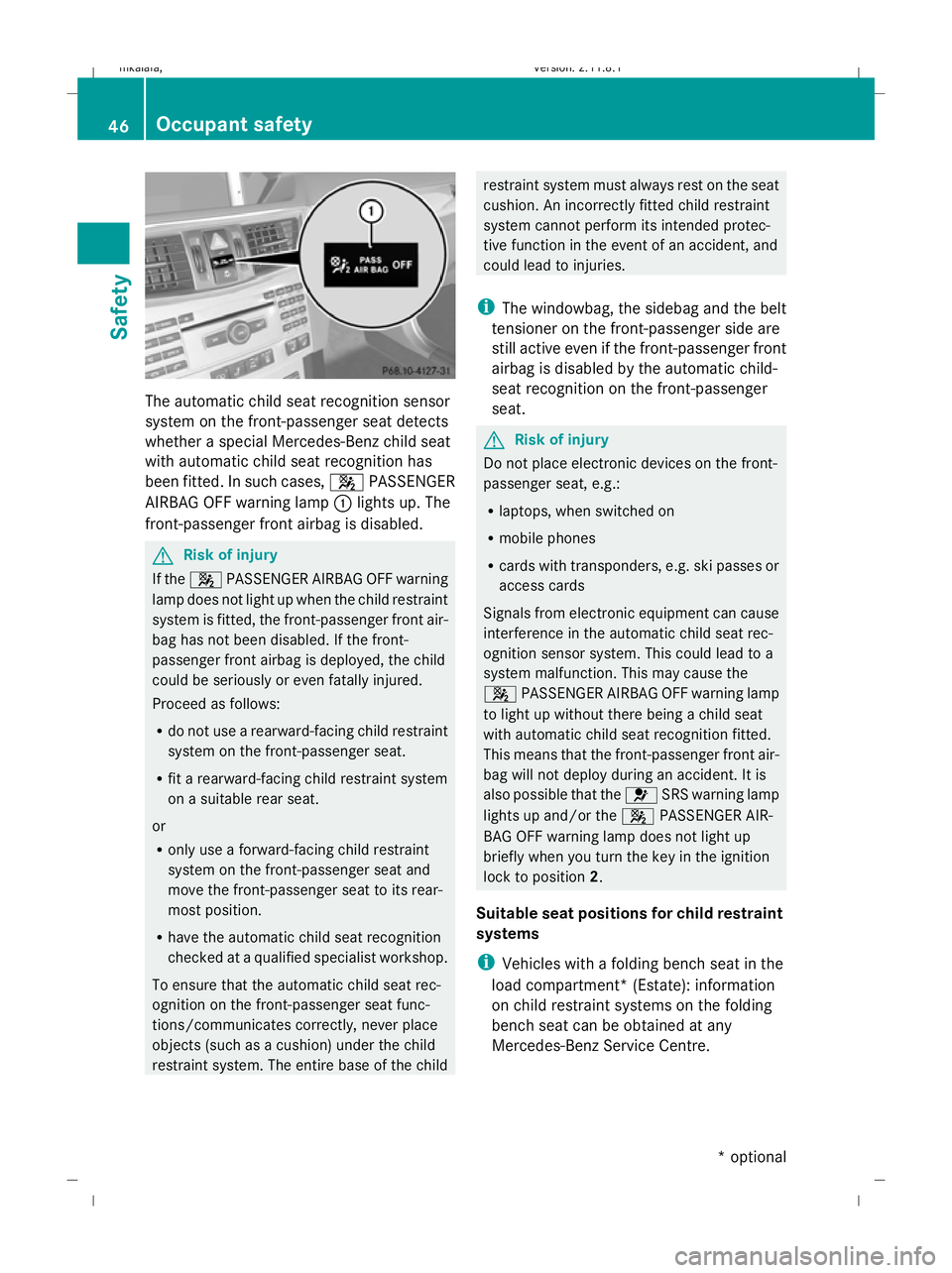
The automatic child seat recognition sensor
system on the front-passenger seat detects
whether a special Mercedes-Benz child seat
with automatic child seat recognition has
been fitted. In such cases, 4PASSENGER
AIRBAG OFF warning lamp :lights up. The
front-passenger front airbag is disabled. G
Risk of injury
If the 4 PASSENGER AIRBAG OFF warning
lamp does not light up when the child restraint
system is fitted, the front-passenger front air-
bag has not been disabled. If the front-
passenger front airbag is deployed, the child
could be seriously or even fatally injured.
Proceed as follows:
R do not use a rearward-facing child restraint
system on the front-passenger seat.
R fit a rearward-facing child restraint system
on a suitable rear seat.
or
R only use a forward-facing child restraint
system on the front-passenger seat and
move the front-passenger seat to its rear-
most position.
R have the automatic child seat recognition
checked at a qualified specialist workshop.
To ensure that the automatic child seat rec-
ognition on the front-passenger seat func-
tions/communicates correctly, never place
objects (such as a cushion) under the child
restraint system. The entire base of the child restraint system must always rest on the seat
cushion. An incorrectly fitted child restraint
system cannot perform its intended protec-
tive function in the event of an accident, and
could lead to injuries.
i The windowbag, the sidebag and the belt
tensioner on the front-passenger side are
still active even if the front-passenger front
airbag is disabled by the automatic child-
seat recognition on the front-passenger
seat. G
Risk of injury
Do not place electronic devices on the front-
passenger seat, e.g.:
R laptops, when switched on
R mobile phones
R cards with transponders, e.g. ski passes or
access cards
Signals from electronic equipment can cause
interference in the automatic child seat rec-
ognition sensor system. This could lead to a
system malfunction. This may cause the
4 PASSENGER AIRBAG OFF warning lamp
to light up without there being a child seat
with automatic child seat recognition fitted.
This means that the front-passenger front air-
bag will not deploy during an accident. It is
also possible that the 6SRS warning lamp
lights up and/or the 4PASSENGER AIR-
BAG OFF warning lamp does not light up
briefly when you turn the key in the ignition
lock to position 2.
Suitable seat positions for child restraint
systems
i Vehicles with a folding bench seat in the
load compartment* (Estate): information
on child restraint systems on the folding
bench seat can be obtained at any
Mercedes-Benz Service Centre. 46
Occupant safetySafety
* optional
212_AKB; 2; 4, en-GB
mkalafa,
Version: 2.11.8.1 2009-05-05T14:17:16+02:00 - Seite 46
Dateiname: 6515346702_buchblock.pdf; erzeugt am 07. May 2009 14:15:39; WK
Page 60 of 373
X
Guide the seat belt through seat belt guide
A on the door side on side head restraint
B.
X Secure the child using the seat belt
(Y page 53).
Removing the side head restraints
X Take the seat belt out of seat belt guide
A.
X Move head restraint ;upwards.
X Press left or right release button ?and pull
side head restraint Bforward to remove
it.
Left-hand and right-hand lock verification
indicators :fold out briefly.
X Adjust head restraints ;(Ypage 79).
Storing the padded table and the side
head restraint G
Risk of injury
If the padded table and the side head
restraints are not secured in the vehicle as
specified, they may come loose. In the event
of an accident, sudden braking or abrupt
change in direction, they could injure vehicle
occupants or cause damage to the vehicle.
Secure the padded table in the vehicle as
specified.
On vehicles with TIREFIT kit, the side head
restraints can be stored in the stowage com-
partment under the boot/luggage compart-
ment floor (Y page 204)/(Y page 204).
Child-proof locks If children are travelling in the vehicle, you can
activate the child-proof locks for the rear
doors.
Child-proof locks for the rear doors
The child-proof locks on the rear doors enable
you to secure each door individually. A locked
door cannot be opened from the inside. The
door can be opened from the outside if the
vehicle is unlocked. G
Risk of accident and injury
Activate the child-proof locks for the rear
doors and the override switch for the rear
windows if children are travelling in the vehi-
cle. Otherwise, the children could open doors
or windows while the vehicle is in motion and
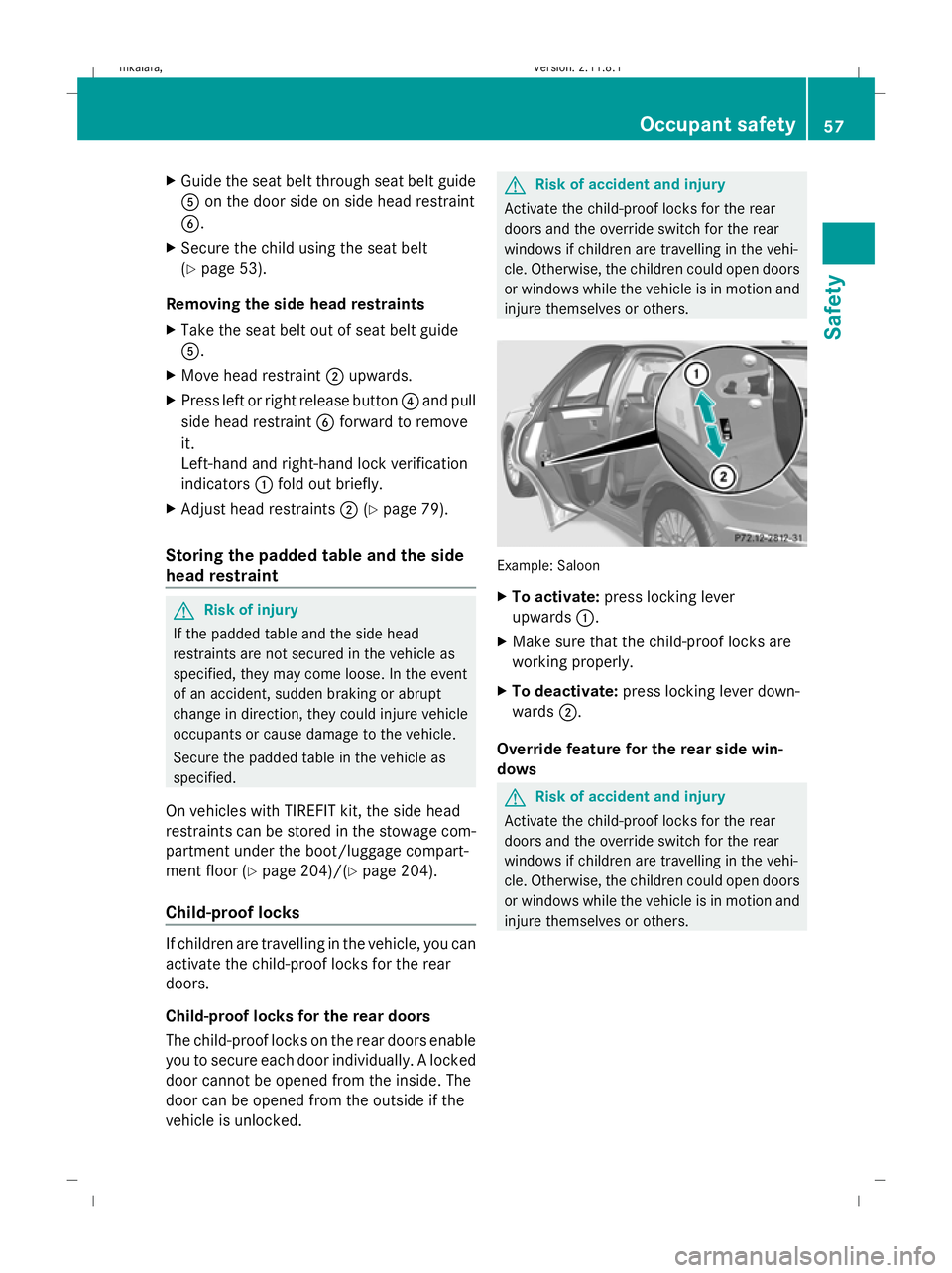
injure themselves or others. Example: Saloon
X
To activate: press locking lever
upwards :.
X Make sure that the child-proof locks are
working properly.
X To deactivate: press locking lever down-
wards ;.
Override feature for the rear side win-
dows G
Risk of accident and injury
Activate the child-proof locks for the rear
doors and the override switch for the rear
windows if children are travelling in the vehi-
cle. Otherwise, the children could open doors
or windows while the vehicle is in motion and
injure themselves or others. Occupant safety
57Safety
212_AKB; 2; 4, en-GB
mkalafa,V ersion: 2.11.8.1
2009-05-05T14:17:16+02:00 - Seite 57 Z
Dateiname: 6515346702_buchblock.pdf; erzeugt am 07. May 2009 14:15:42; WK
Page 61 of 373
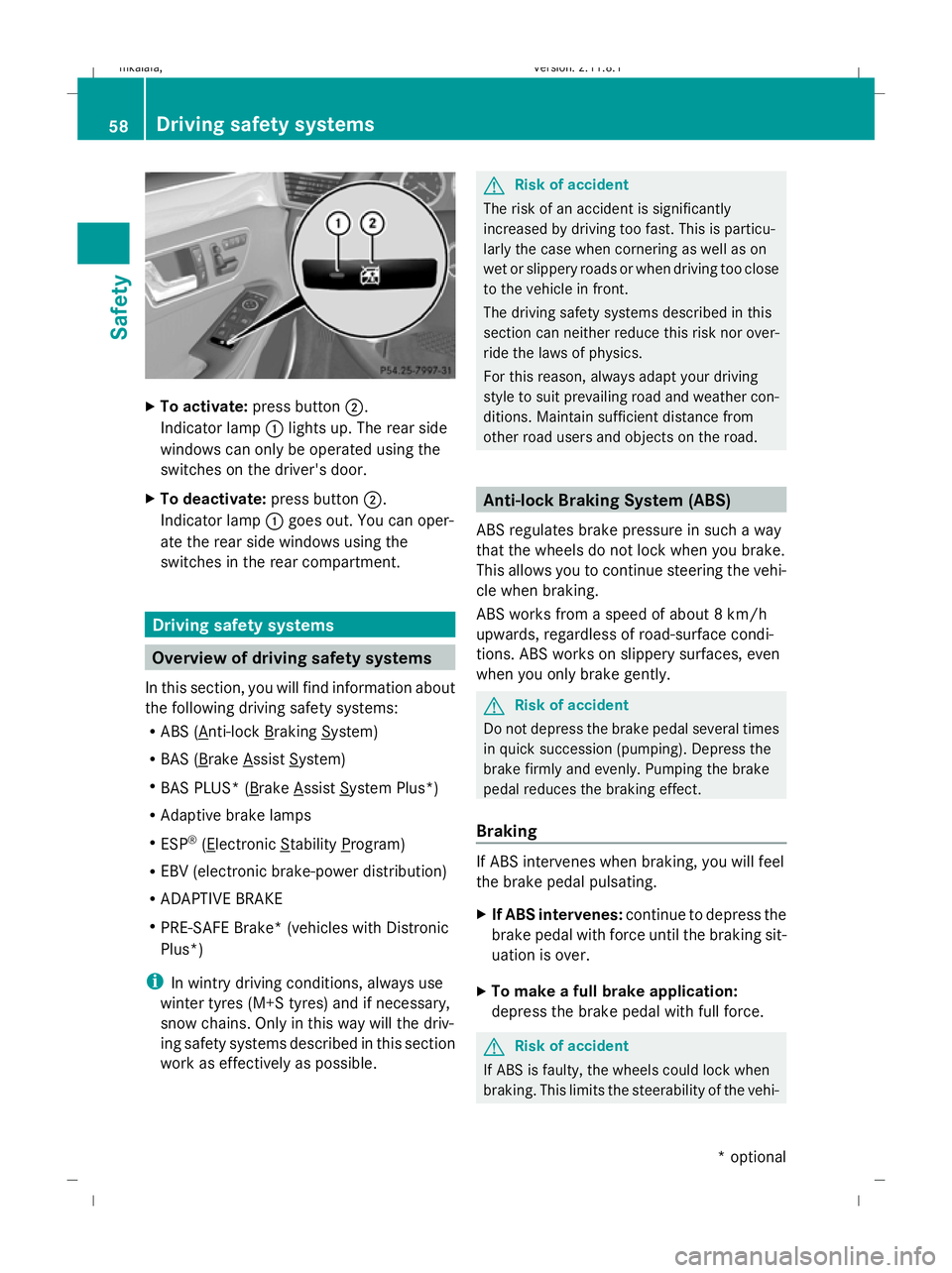
X
To activate: press button ;.
Indicator lamp :lights up. The rear side
windows can only be operated using the
switches on the driver's door.
X To deactivate: press button;.
Indicator lamp :goes out. You can oper-
ate the rear side windows using the
switches in the rear compartment. Driving safety systems
Overview of driving safety systems
In this section, you will find information about
the following driving safety systems:
R ABS ( Anti-lock Braking System)
R BAS ( Brake Assist System)
R BAS PLUS* ( Brake Assist System Plus*)
R Adaptive brake lamps
R ESP ®
( Electronic Stability Program)
R EBV (electronic brake-power distribution)
R ADAPTIVE BRAKE
R PRE-SAFE Brake* (vehicles with Distronic
Plus*)
i In wintry driving conditions, always use
winter tyres (M+S tyres) and if necessary,
snow chains. Only in this way will the driv-
ing safety systems described in this section
work as effectively as possible. G
Risk of accident
The risk of an accident is significantly
increased by driving too fast. This is particu-
larly the case when cornering as well as on
wet or slippery roads or when driving too close
to the vehicle in front.
The driving safety systems described in this
section can neither reduce this risk nor over-
ride the laws of physics.
For this reason, always adapt your driving
style to suit prevailing road and weather con-
ditions. Maintain sufficient distance from
other road users and objects on the road. Anti-lock Braking System (ABS)
ABS regulates brake pressure in such a way
that the wheels do not lock when you brake.
This allows you to continue steering the vehi-
cle when braking.
ABS works from a speed of about 8 km/h
upwards, regardless of road-surface condi-
tions. ABS works on slippery surfaces, even
when you only brake gently. G
Risk of accident
Do not depress the brake pedal several times
in quick succession (pumping). Depress the
brake firmly and evenly. Pumping the brake
pedal reduces the braking effect.
Braking If ABS intervenes when braking, you will feel
the brake pedal pulsating.
X
If ABS intervenes: continue to depress the
brake pedal with force until the braking sit-
uation is over.
X To make a full brake application:
depress the brake pedal with full force. G
Risk of accident
If ABS is faulty, the wheels could lock when
braking. This limits the steerability of the vehi- 58
Driving safety systemsSafety
* optional
212_AKB; 2; 4, en-GB
mkalafa,
Version: 2.11.8.1 2009-05-05T14:17:16+02:00 - Seite 58
Dateiname: 6515346702_buchblock.pdf; erzeugt am 07. May 2009 14:15:42; WK
Page 70 of 373
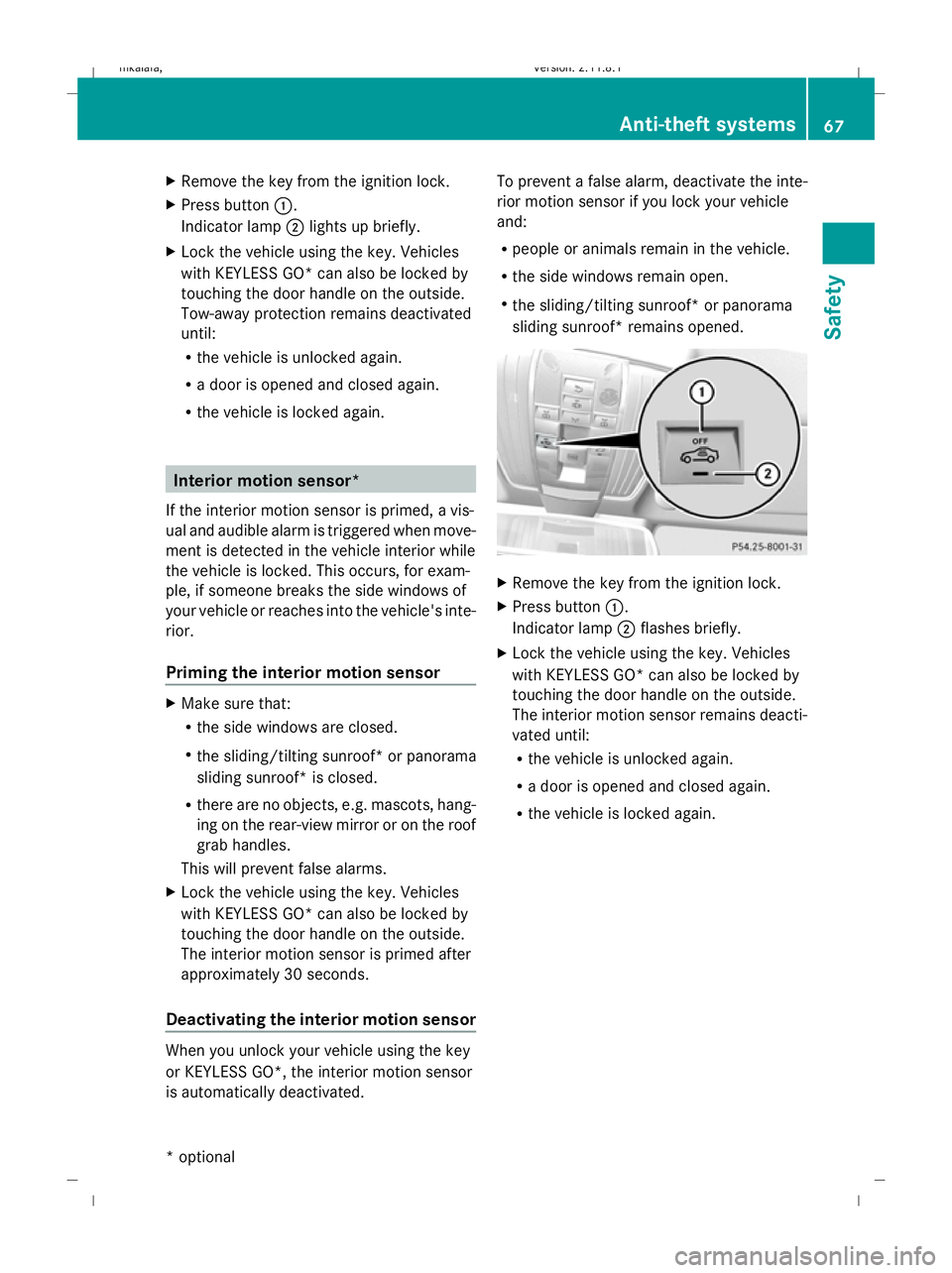
X
Remove the key from the ignition lock.
X Press button :.
Indicator lamp ;lights up briefly.
X Lock the vehicle using the key. Vehicles
with KEYLESS GO* can also be locked by
touching the door handle on the outside.
Tow-away protection remains deactivated
until:
R
the vehicle is unlocked again.
R a door is opened and closed again.
R the vehicle is locked again. Interior motion sensor*
If the interior motion sensor is primed, a vis-
ual and audible alarm is triggered when move-
ment is detected in the vehicle interior while
the vehicle is locked. This occurs, for exam-
ple, if someone breaks the side windows of
your vehicle or reaches into the vehicle's inte-
rior.
Priming the interior motion sensor X
Make sure that:
R
the side windows are closed.
R the sliding/tilting sunroof* or panorama
sliding sunroof* is closed.
R there are no objects, e.g. mascots, hang-
ing on the rear-view mirror or on the roof
grab handles.
This will prevent false alarms.
X Lock the vehicle using the key. Vehicles
with KEYLESS GO* can also be locked by
touching the door handle on the outside.
The interior motion sensor is primed after
approximately 30 seconds.
Deactivating the interior motion sensor When you unlock your vehicle using the key
or KEYLESS GO*, the interior motion sensor
is automatically deactivated. To prevent a false alarm, deactivate the inte-
rior motion sensor if you lock your vehicle
and:
R
people or animals remain in the vehicle.
R the side windows remain open.
R the sliding/tilting sunroof* or panorama
sliding sunroof* remains opened. X
Remove the key from the ignition lock.
X Press button :.
Indicator lamp ;flashes briefly.
X Lock the vehicle using the key. Vehicles
with KEYLESS GO* can also be locked by
touching the door handle on the outside.
The interior motion sensor remains deacti-
vated until:
R the vehicle is unlocked again.
R a door is opened and closed again.
R the vehicle is locked again. Anti-theft systems
67Safety
* optional
212_AKB; 2; 4, en-GB
mkalafa,
Version: 2.11.8.1 2009-05-05T14:17:16+02:00 - Seite 67 Z
Dateiname: 6515346702_buchblock.pdf; erzeugt am 07. May 2009 14:15:45; WK
Page 72 of 373
Opening and closing
...........................70
Boot/luggage compartment ..............72
Key positions ....................................... 75
Seats .................................................... 76
Steering wheel .................................... 84
Mirrors ................................................. 86
Memory functions* .............................87
Seat belts ............................................. 89
Lights ................................................... 93
Windscreen wipers .............................99
Side windows .................................... 100
Driving and parking ..........................103
Transmission ..................................... 110
Instrument cluster ............................117
On-board computer ..........................118
Driving systems ................................ 137
Air conditioning ................................. 171
Sliding sunroof .................................. 184
Loading and stowing ........................187
Features ............................................. 207 69Controls
212_AKB; 2; 4, en-GB
mkalafa,
Version: 2.11.8.1 2009-05-05T14:17:16+02:00 - Seite 69
Dateiname: 6515346702_buchblock.pdf; erzeugt am 07. May 2009 14:15:46; WK