belt MERCEDES-BENZ E-CLASS SALOON 2015 User Guide
[x] Cancel search | Manufacturer: MERCEDES-BENZ, Model Year: 2015, Model line: E-CLASS SALOON, Model: MERCEDES-BENZ E-CLASS SALOON 2015Pages: 497, PDF Size: 16.23 MB
Page 50 of 497
tional restraint system. The seat belt cannot
perform its intende dprotective functio nifitis
not fastened correctly. Also, an improperly
fastened seat belt can cause additional inju-
rie sint he event of an accident, sudden brak-
ing or abrupt change sofdirection. There is an
increase driskofi njury ,possibl yevenf atal.
Secure persons less tha n1.50 mtall in asuit-
able restraint system.
If ac hild younger than twelve years old and
unde r1.50m in heigh tistravellin ginthe
vehicle:
R always secure th echild in achild restraint
system suitable for this Mercedes-Benz
vehicle .The child restraint system must be
appropriat etotheage, weight and siz eof
th ec hild.
R always observ ethe instruction sand safety
note son" Children in th evehicle "inthis
Owner' sManual (Y page 58)inaddition
to th echild restraint system manufactur-
er' sinstallation instructions G
WARNING
Seat belt scanno tprotect as intended, if:
R they are damaged, have been modified ,are
extremely dirty, bleached or dyed
R thes eat belt buckle is damage dor
extremely dirty
R modifications have been made to th ebelt
tensioners ,belt anchorages or inertia reels
Seat belt smay sustain non-visible damage in
an accident, e.g .due to glass splinters. Modi-
fied or damage dseat belt scan tear or fail, for
example in th eeven tofana ccident. Modified
seat belt tensioners may be deployed unin-
tentionally or fail to be deployed when
required. Ther eisanincreased risk of injury,
possibly even fatal.
Never modify safety belts, seat belt tension-
ers ,seat belt anchorages and inertia reels.
Ensure that seat belt sare no tdamage dor
worn and are clean. Afte ranaccident, have
th es eat belt schecked immediately at aquali-
fied specialist workshop. Mercedes-Ben
zrecommend sthaty ou only
use seat belt swhichh ave been approved
specifically for your vehicle by Mercedes-
Benz. Otherwise your vehicle's general oper-
atin gpermit coul dbeinvalidated.
Correct seat belt use Observ
ethe safety note sontheseat belt
(Y page 46).
All vehicle occupant smust be wearin gthe
seat belt correctly before beginnin gthe jour-
ney. Als omakes ure that all vehicle occu-
pant sare always wearin gthe seat belt cor-
rectly while th evehicle is in motion.
When fastening th eseat belt ,always make
sure that:
R thes eat belt tongue is only inserted to the
belt buckle belongin gtothats eat.
R thes eat belt is tight across your body.
Avoid wearin gbulkyclothing ,e.g.aw inter
coat.
R thes eat belt is no ttwisted.
Only then can forces whic hoccur be dis-
tributed across th esurface of th eseat belt.
R thes houlder sectio nofthebelt is always
routed across th ecentr eofy our shoulder.
The shoulder sectio noftheseat belt should
no ttou ch your nec knorbe routed under
your arm. If possible, adjus tthe seat belt to
th ea ppropriat eheight.
R thel ap belt passe sacross your lap as
tightly and as low down as possible.
The lap must always be routed across your hip joint sand never across your abdomen.
This applies particularly to pregnant
women. If necessary, pres sthe lap belt
down int oyour hip joint sand pull tight with
th es houlder sectio nofthebelt.
R thes eat belt is no trouted across sharp,
pointe dorfragile objects.
If you have suc hitems locate donorinyour
clothing ,e.g.p ens, keys or spectacles,
store these in asuitable place.
R only on eperson is usin gaseat belt. Occupant safety
47Safety Z
Page 51 of 497
Infants and childre
nmust never travel sit-
ting on the lap of avehicle occupant. In the
event of an accident, they could be crushed betwee nthe vehicle occupant and seat
belt.
R objects are never secured with aseat belt if
the seat belt is also being used by one of the vehicle's occupants.
Seat belts are only intended to secure and
restrain vehicle occupants. Alwayso bserve
the "Loading guidelines" for securing objects,
luggage or loads (Y page 342).
Fastening and adjusting the seat belts Observe the safety notes on the seat belt
(Y page 46) and the notes on correct use of
seat belts (Y page 47).
If ap assenger is wearing the centre rear seat
belt, also observe the information on the seat belt for the centre rear seat (Y page 48).X
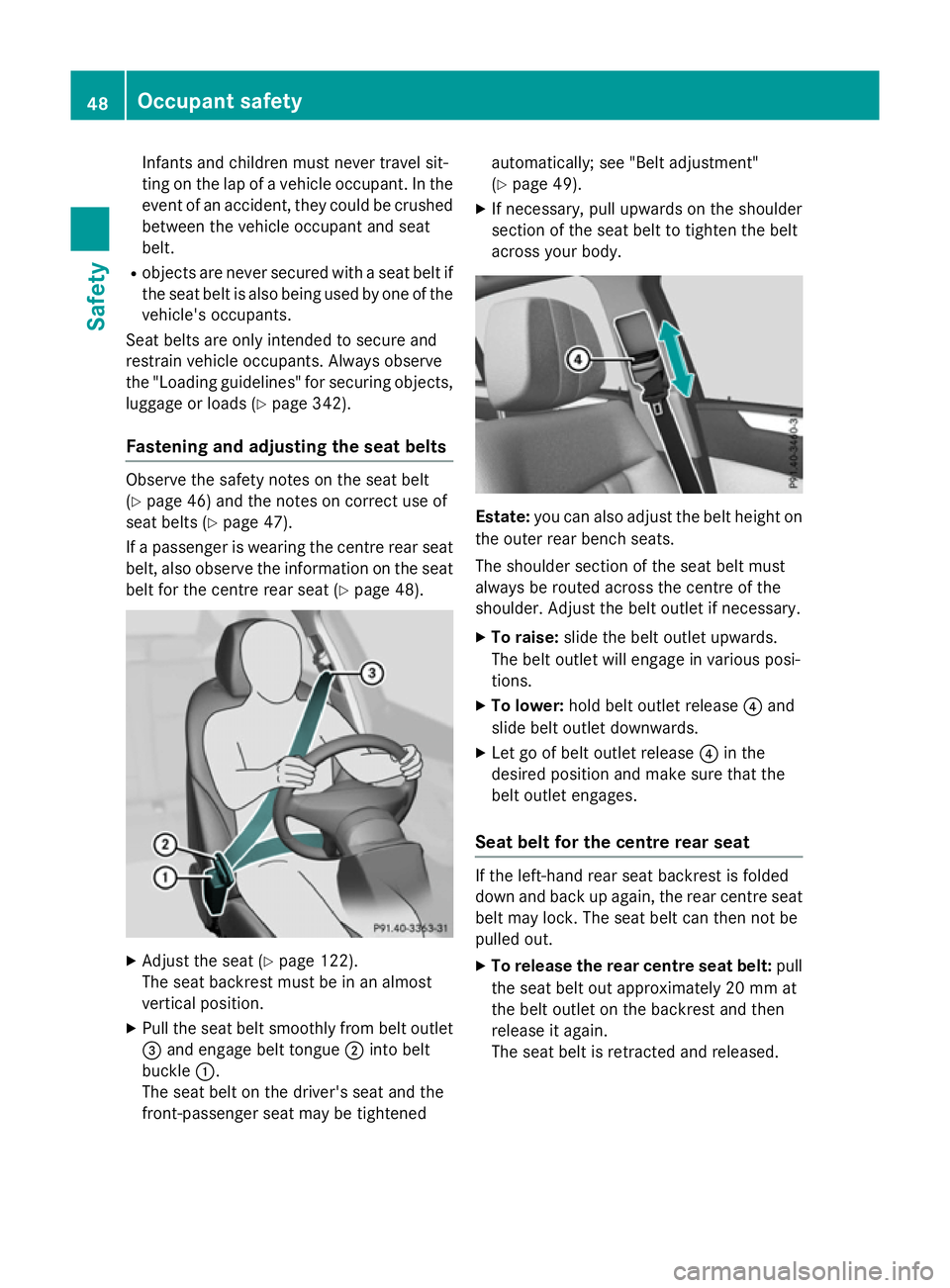
Adjust the seat (Y page 122).
The seat backrest must be in an almost
vertical position.
X Pullt he seat belt smoothly from belt outlet
= and engage belt tongue ;into belt
buckle :.
The seat belt on the driver's seat and the
front-passenger seat may be tightened automatically; see "Belt adjustment"
(Y
page 49).
X If necessary ,pullu pwards on the shoulder
section of the seat belt to tighten the belt
across yourb ody. Estate:
you can also adjustt he belt heighton
the outer rear bench seats.
The shoulder section of the seat belt must
alwaysber outed across the centre of the
shoulder. Adjust the belt outlet if necessary.
X To raise: slidethe belt outlet upwards.
The belt outlet wille ngage in variousposi-
tions.
X To lower: hold belt outlet release ?and
slideb elt outlet downwards.
X Let go of belt outlet release ?in the
desire dpositio nand make sure that the
belt outlet engages.
Seat beltf or the centre rear seat If the left-hand rear seat backrest is folded
down and back up again, the rear centre seat
belt may lock. The seat belt can then not be
pulled out.
X To release the rear centre seat belt: pull
the seat belt out approximately 20 mm at
the belt outlet on the backrest and then
release it again.
The seat belt is retracted and released. 48
Occupant safetySafety
Page 52 of 497
Releasin
gthe seat belts !
Make sure that the sea
tbelti sf ully rolled
up .O therwise, the sea tbeltorb eltt ongue
will be trapped in the doo rorinthe seat
mechanism. Thi scould damag ethe door,
the doo rtrim panel and the sea tbelt. Dam-
aged sea tbelts can no longer fulfil their
protectiv efunction and mus tbereplaced.
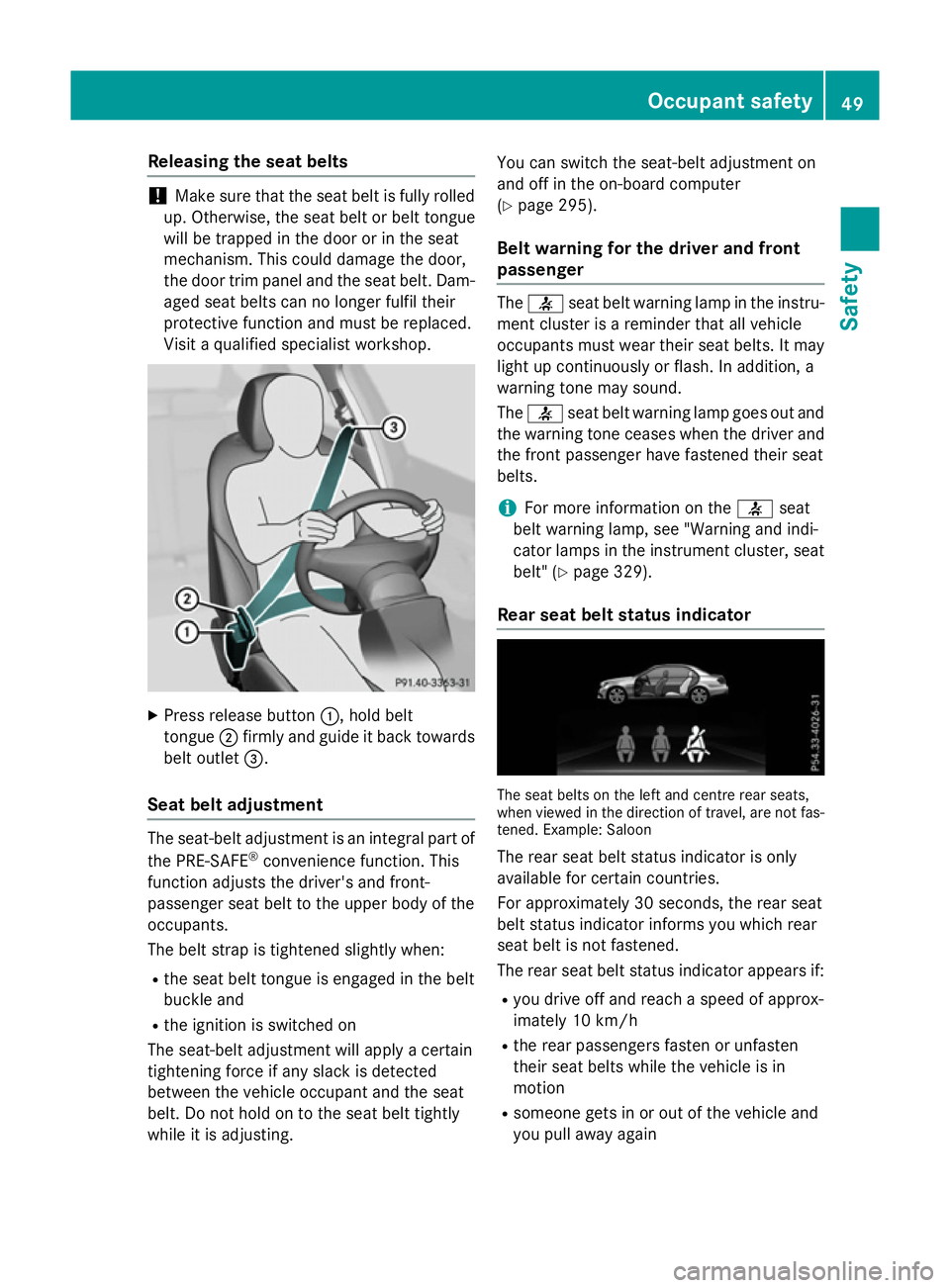
Visit aquali fied specialist workshop. X
Press release button :,holdb elt
tongue ;firmly and guid eitbackt owards
bel toutlet =.
Seat belt adjustment The seat-bel
tadjustment is an integral part of
the PRE-SAFE ®
convenience function. This
function adjusts the driver' sand front-
passenger sea tbelttot he upper bod yofthe
occupants.
The bel tstra pist ightened slightl ywhen:
R the sea tbeltt ongu eise ngaged in the belt
buckle and
R the ignition is switche don
The seat-bel tadjustment will appl yacertain
tightening force if any slack is detected
between the vehicl eoccupant and the seat
belt. Do not hol dontothe seatbeltt ightly
whil eitisa djusting. Yo
uc an switch the seat-bel tadjustment on
and off in the on-board computer
(Y page 295).
Bel twarnin gfor the drive rand front
passenger The
7 seatbeltw arning lamp in the instru-
ment cluster is areminder that al lvehicle
occupants mus twearthei rseatb elts. It may
light up continuously or flash. In addition, a
warning tone may sound.
The 7 seatbeltw arning lamp goe soutand
the warning tone ceases when the driver and
the front passenger have fastened thei rseat
belts.
i For more information on the
7seat
bel tw arning lamp, see "Warning and indi-
cato rlam ps in the instrument cluster, seat
belt" (Y page 329).
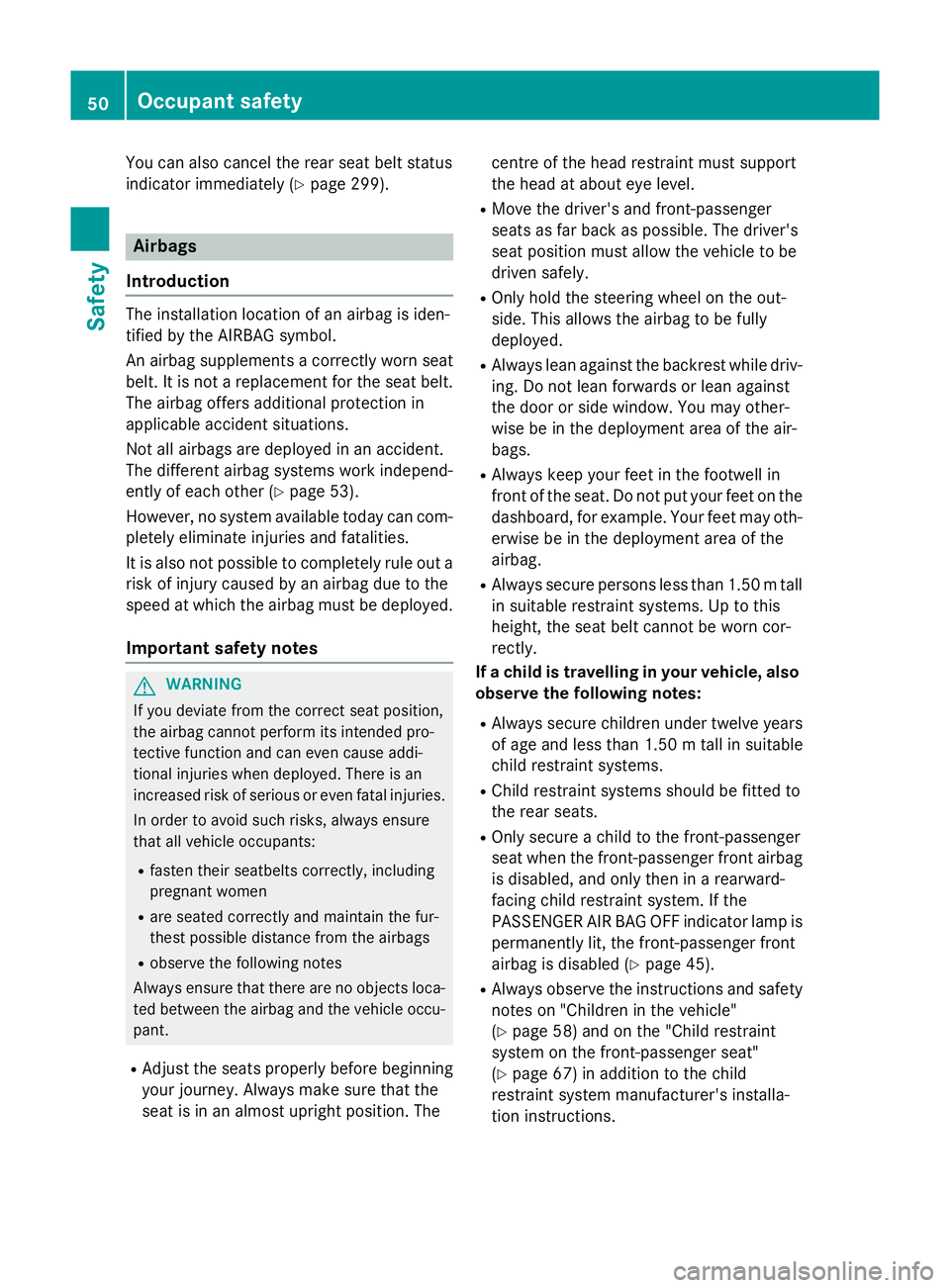
Rear seat belt status indicator The sea
tbelts on the left and centre rea rseats,
when viewe dinthe direction of travel ,are not fas-
tened .Example :Saloon
The rea rseatb elts tatu sindicator is only
available for certain countries.
For approximately 30 seconds ,the rea rseat
bel tstatu sindicator informs yo uwhich rear
sea tbelti sn ot fastened.
The rea rseatb elts tatu sindicator appears if:
R yo ud rive off and reach aspeed of approx-
imately 10 km/h
R the rea rpassenger sfasten or unfasten
thei rseatb elts whil ethe vehicl eisin
motion
R someone gets in or ou tofthe vehicl eand
yo up ulla wa ya gain Occupan
tsafety
49Safety Z
Page 53 of 497
You can also cancel the rear seat belt status
indicator immediately (Y page 299).Airbags
Introduction The installation location of an airbag is iden-
tified by the AIRBA Gsymbol.
An airbag supplements acorrectly worn seat
belt. It is not areplacemen tfor the seat belt.
The airbag offers additional protection in
applicable accident situations.
Not all airbags are deployed in an accident.
The differen tairbag systems work independ-
ently of each other (Y page 53).
However, no system available today can com- pletely eliminate injuries and fatalities.
It is also not possible to completely rule out a
risk of injury caused by an airbag due to the
speed at which the airbag must be deployed.
Important safet ynotes G
WARNING
If you deviat efromt he correc tseat position,
the airbag cannot perform its intended pro-
tectiv efunction and can even cause addi-
tional injuries when deployed. There is an
increased risk of serious or even fatal injuries.
In order to avoid such risks, always ensure
that all vehicle occupants:
R fasten their seatbelts correctly, including
pregnant women
R are seate dcorrectly and maintain the fur-
thest possible distanc efromt he airbags
R observe the followin gnotes
Always ensure that there are no object sloca-
ted betwee nthe airbag and the vehicle occu-
pant.
R Adjust the seats properly befor ebeginning
your journey. Always make sure that the
seat is in an almost upright position. The centr
eofthe head restraint must support
the head at about eye level.
R Move the driver's and front-passenger
seats as far back as possible. The driver's
seat position must allow the vehicle to be
drive nsafely.
R Only hold the steerin gwheel on the out-
side. This allows the airbag to be fully
deployed.
R Always lean against the backrest while driv-
ing. Do not lean forwards or lean against
the door or side window. You may other-
wise be in the deploymen tarea of the air-
bags.
R Always keep your feet in the footwell in
front of the seat. Do not put your feet on the
dashboard ,for example. Your feet may oth-
erwise be in the deploymen tarea of the
airbag.
R Always secur epersons less than 1.50 mtall
in suitable restraint systems .Uptothis
height ,the seat belt canno tbeworn cor-
rectly.
If ac hild is travelling in you rvehicle, also
observe th efollowing notes:
R Always secure childre nunde rtwelve years
of age and less than 1.50 mtall in suitable
child restraint systems.
R Child restraint systems should be fitte dto
th er ear seats.
R Only secure achild to th efront-pa ssenger
seat when th efront-pa ssenger fron tairbag
is disabled, and only then in arearward-
facing child restraint system. If the
PASSENGER AI RBAG OFFindicator lamp is
permanently lit ,the front-passenger front
airbag is disabled (Y page 45).
R Always observ ethe instruction sand safety
note son" Children in th evehicle"
(Y page 58) and on th e"Child restraint
system on th efront-pa ssenger seat"
(Y page 67 )inaddition to th echild
restraint system manufacturer' sinstalla-
tio ninstructions. 50
Occupant safetySafety
Page 56 of 497
When deployed, the windowbag enhances the
level of protection for the head. However, it
does not protec tthe chest or arms.
In the event of aside impact, the windowbag
is deployed on the side on which the impact
occurs.
If the system determines that they can offer
additional protection to that provided by the
seat belt, awindowbag may be deployed in
other accident situation s(Ypage 53). Deployment of belt tensioners and air-
bags
Important safety notes G
WARNING
After the airbag deploys, the airbag parts are
hot. There is arisk of injury.
Do not touch the airbag parts. Have a
deployed airbag replaced at aqualified spe-
cialist workshop as soon as possible. G
WARNING
Pyrotechnic seat belt tensioners that have
been deployed are no longer operational and
are unable to perform their intended protec-
tive function. This poses an increased risk of
injury or even fatal injury.
Therefore, have pyrotechnic belt tensioners
which have been triggered immediately
replaced at aqualified specialist workshop.
Mercedes-Benz recommends that you have
the vehicle towed to aqualified specialist
workshop after an accident .Take this into
account ,particularly if aseat belt tensioner
was triggered or an airbag was deployed.
An electric motor is used by PRE-SAFE ®
to
trigger the tightening of the seat belt in haz-
ardous situations. This procedure is reversi-
ble.
If the belt tensioners are triggered or an air-
bag is deployed, you will hear abang, and a
small amount of powder may also be released. The
6restraint system warning
lamp lights up.
Only in rare cases will the bang affect your
hearing. In general, the powder released is
not hazardous to health but may cause short- term breathin gdifficulties to persons suffer-
ing from asthma or other pulmonary condi-
tions. Provided it is safe to do so, you should
leave the vehicle immediately or open the
window in order to preven tbreathin gdifficul-
ties.
Operation During the first stage of
acollision, the
restraint system control unit evaluates impor-
tant physical data relating to vehicle deceler- ation or acceleration, such as:
R duration
R direction
R intensity
Based on the evaluation of this data, the
restraint system control unit trigger sthe seat
belt tensioners in the event of ahead-on or
rear collision.
As eat belt tensioner can only be triggered if:
R the ignition is switched on
R the componentsoft he restraint system are
operational; see "Restraint system warning lamp" (Y page 45)
R the belt tongue has engaged in the belt
buckle of the respective fron tseat
The seat belt tensioners in the rear compart-
ment are triggered independently of the lock
status of the seat belts.
If the restraint system control unit detect sa
high severit yofanaccident,incertain head-
on collisions, additional componentsoft he
restraint system are deployed independently
of each another:
R Fron tairbags and driver's kneebag
R Windowbag, if the system determines that
deployment can offer additional protection
to that provided by the seat belt Occupant safety
53Safety Z
Page 57 of 497
Depending on the perso
ninthe front-
passenge rsea t, the front-passenge rfront air-
ba gise ithe rd isable dorenabled .The front-
passenge rfront airba gcan onl ybedeployed
in an accident if the PASSENGER AIR BAG OFF indicator lamp is off .Obser ve the information
on the PASSENGER AIR BAG OFF indicator
lamp (Y page 45).
Your vehicl ehastwo-stage front airbags. In
the first deployment stage ,the front airba gis
fille dwithp ropellant ga storeduce the risk of
injuries .The front airba gisfullydeployed if
the second deployment stage is activated
withi nafew milliseconds.
Th ea ctivatio nthreshold for the seat belt ten-
sioners and airbags is determine dbased on
the evaluation of the vehicle' srateofd ecel-
eratio noracceleratio natvarious points in the
vehicle. This proces sispre-emptiv einnature.
Th et riggering/deployment proces sshould
take place in good tim eatthe start of the
collision.
Th er ateofv ehicledeceleratio noraccelera-
tio na nd the directio nofthe force ar eessen-
tiall ydetermine dby:
R the distributio nofforces during the colli-
sion
R the collision angle
R the deformatio ncharacteristics of the vehi-
cle
R the characteristics of the object with which
the vehicl ehascollided
Factors which can onl ybeseena nd measured
after acollision ha soccurre ddonot play a
decisiv eroleint he deployment of an airbag,
nor do the yprovide an indicatio nofairbag
deployment.
Th ev ehicl emaybe deformed significantly
without an airba gbeing deployed .Thisist he
cas eifo nlyp arts which ar erelativel yeasily
deformed ar eaffecte dand the rate of decel-
eratio nisn ot high .Conversely ,anairba gm ay
be deployed eve nthoug hthe vehicl esuffers
onl ym inor deformation. This is the cas eif, for
example, ver yrigid vehicl eparts such as lon- gitudina
lbod ym embers ar ehit,a nd sufficient
deceleratio noccurs as aresult.
If the restraint syste mcontro lunitd etects a
side impact or if the vehicl eoverturns, the
applicabl ecomponents of the restraint sys-
tem ar eactivated independentl yofeach
other depending on the apparent typ eofacci-
dent.
R Sidebag sand pelvisba gonthe side on
which an impact occurs, independent from the seat belt tensioner and seat belt usage
Vehicle switht he automatic child seat rec-
ognition on the front-passenge rseat: the
sideba gand pelvisba gonthe front-
passenge rside( front) deploy under the fol-
lowing conditions:
- an occupant is detecte donthe front-
passenge rseator
- the belt tongue is engaged in the belt
buckle of the front-passenge rseat
R Windowbag on the side on which an impact
occurs, independent of seat belt usag eand
regardles sofwhether the front-passenger
seat is occupied
R Sea tbeltt ensioners ,ifthe syste mdeter-
mines tha tdeployme nt can offer additional
protection for the vehicl eoccupants in this
situation
R Windowbag sonthe driver's and front-
passenge rsideinc ertainsituations if the
vehicl eoverturns and if the syste mdeter-
mines tha tdeployme nt can offer additional
protection to tha tprovide dbythe seat belt
i Not al
lairbags ar edeployed in an acci-
dent. Th edifferent airba gsystems work
independentl yofeacho ther.
How the airba gsystemw orks is deter-
mined by the severity of the accident detec- ted ,especially the vehicl edeceleratio nor
acceleration, and the apparent typ eofacci-
dent:
R frontal collision
R side impact
R overturn 54
Occupant safetySafety
Page 59 of 497
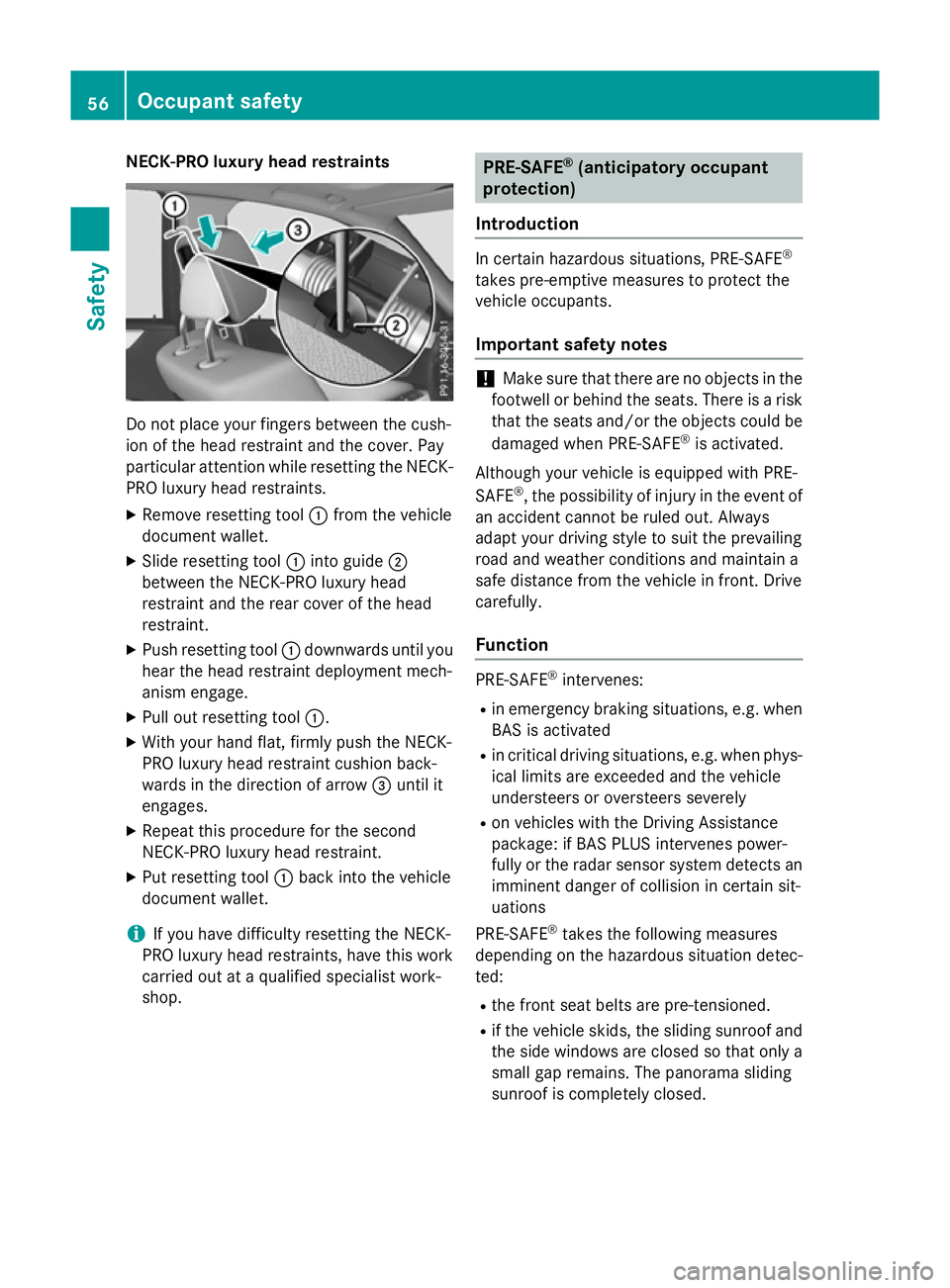
NECK-PRO luxury head restraints
Do not place your fingers between the cush-
io noft he head restraint and the cover. Pay
particular attentio nwhile resetting the NECK-
PR Ol uxuryh eadr estraints.
X Remov eresetting tool :fromt he vehicle
document wallet.
X Slide resetting tool :into guide ;
between the NECK-PR Oluxuryh ead
restraint and the rea rcove roft he head
restraint.
X Push resetting tool :downwards unti lyou
hear the head restraint deployment mech-
anism engage.
X Pull ou tresetting tool :.
X With your hand flat, firml ypusht he NECK-
PR Ol uxuryh eadr estraint cushion back-
wards in the direction of arrow =unti lit
engages.
X Repeat thi sprocedur efor the second
NECK-PR Oluxuryh eadr estraint.
X Pu tresetting tool :back into the vehicle
document wallet.
i If yo
uhaved ifficulty resetting the NECK-
PR Ol uxuryh eadr estraints ,havet hisw ork
carried ou tataqualified specialis twork-
shop. PRE-SAFE
®
(anticipatory occupant
protection)
Introduction In certain hazardous situations, PRE-SAFE
®
take spre-emptive measures to protect the
vehicl eoccupants.
Important safety notes !
Make sure tha
tthere ar enoobjects in the
footwell or behind the seats .The re is arisk
tha tthe seats and/or the objects could be
damage dwhenP RE-SAFE ®
is activated.
Although your vehicl eisequippe dwithP RE-
SAFE ®
,t he possibility of injury in the event of
an accident cannot be rule dout.A lways
adap tyou rd rivin gstyle to suit the prevailing
roa dand weather conditions and maintain a
safe distance fro mthe vehicl einfront. Drive
carefully.
Function PRE-SAFE
®
intervenes:
R in emergency braking situations, e.g .when
BAS is activated
R in critica ldrivin gsituations, e.g .whenp hys-
ica llimit sareexceeded and the vehicle
understeers or oversteers severely
R on vehicles with the Driving Assistance
package: if BAS PLU Sintervenes power-
full yort he rada rsen sor syste mdetects an
imminent dange rofcollision in certain sit-
uations
PRE-SAFE ®
take sthe following measures
depending on the hazardous situatio ndetec-
ted:
R the front seat belts ar epre-tensioned.
R if the vehicl eskids ,the sliding sunroo fand
the side windows ar eclose dsot hato nlya
small ga premains. Th epanorama sliding
sunroo fiscompletel yclosed. 56
Occupant safetySafety
Page 60 of 497
R
vehicles with the memory function: the
front-passenge rseat is adjusted if it is in an
unfavourable position.
R vehicles with amulticontour seat or active
multicontour seat: the air pressure in the
side bolsters of the backrest is increased.
If the hazardous situation passes without
resulting in an accident, PRE-SAFE ®
slackens
the beltp re-tensioning. On vehicles with mul-
ticontour seats/active multicontour seats,
the air pressure in the side bolsters is reduced
again. All settings made by PRE-SAFE ®
can
then be reversed.
If the seat beltp re-tensioning is not reduced:
X Move the seat backrest or seat back
slightly when the vehicl eisstationary.
Seat beltp re-tensioning is reduced and the
locking mechanism is released.
The seat-belt adjustment is an integral part of
the PRE-SAFE ®
convenience function. Infor-
mation about the convenience function can
be found under "Bel tadjustment"
(Y page4 9). PRE-SAFE
®
PLUS( anticipatory occu-
pant protectio nPLUS)
Introduction PRE-SAFE
®
PLUS is only available in vehicles
with the Driving Assistance package.
Using the rada rsensor system, PRE-SAFE ®
PLUS is abletod etect thatahead-on or rear-
end collision is imminent. In certain hazard-
ous situations, PRE-SAFE ®
PLUS takes pre-
emptive measures to protect the vehicle
occupants.
Important safety notes The intervention of PRE-SAFE
®
PLUS cannot
prevent an imminent collision.
The drive risnot warned before the interven-
tion of PRE-SAFE ®
PLUS. PRE-SAFE
®
PLUS does not intervene:
R if the vehicl eisreversing
R when the vehicl eistowing atrailer and
there is arisk of arear-end collision
PRE-SAFE ®
PLUS does not perform braking
actions while the vehicl eisinmotion or when
Parking Guidance is active.
Function PRE-SAFE
®
PLUS intervenes in certain situa-
tions if the rada rsensor system detects an
imminent head-on or rear-end collision.
PRE-SAFE ®
PLUS takes the following meas-
ures depending on the hazardous situation
detected:
R If the rada rsensor system detects that a
head-on collision is imminent, the seat
belts are pre-tensioned.
R If the rada rsensor system detects that a
rear-end collision is imminent:
- the rear hazard warning lamp sare acti-
vated and flas hatahigher frequency.
- the brake pressure is increase difthe
drive rappliest he brakes when the vehi-
cle is stationary.
- the seat belts are pre-tensioned.
The PRE-SAFE ®
PLUS braking application is
cancelled:
R if the accelerator peda lisdepressed when
ag earise ngaged
R if the risk of acollision passes or is no lon-
ger detected
R if DISTRONIC PLUS indicates an intention
to pulla way
If the hazardous situation passes without
resulting in an accident, the original settings
are restored. Occupant safety
57Safety Z
Page 61 of 497
Automati
cmeasures after an acci-
dent
Immediately after an accident, th efollowing
measures are implemented, depending on
th et ypea nd severity of th eimpact:
R theh azard warning lamp sare activated
R thee mergenc ylighting is activated
R thev ehicl edoor sare unlocked
R thef ront side windows are lowered
R vehicles wit hamemory function :the elec-
trically adjustable steering whee lisraised
R thee ngineiss witched off and th efuel sup-
ply is cut off
R vehicles wit hthe Mercedes-Benz emer-
gency call system: automatic emergency
call
R vehicles wit hthe hybrid driv esystem: the
hybrid system and th ehigh-voltage electri-
cal system are deactivated Children in th
evehicle Important safety notes
Acciden tstatistics sho wthatc hildren
secured in th erear seat sare safer than chil-
dre nsecured in th efront seats. Fo rthisr ea-
son ,Mercedes-Benz strongly advises that you
instal lachild restrain tsystem on arear seat.
Children are generally bette rprotected there.
If ac hild younger than twelve years old and
under 1.50 minh eight is travellin ginthe
vehicle:
R always secure th echild in achild restraint
system suitable for Mercedes-Benz vehi-
cles. The child restrain tsystem mus tbe
appropriat etotheage, weigh tand siz eof
th ec hild
R be sur etoobservethe instruction sand
safet ynotes in this section in addition to
th ec hild restrain tsystem manufacturer's
installation instructions
Do no tfitar earward-facing child restraint
system on th ecentre rear seat. G
WARNING
If you leav echildren unattended in th evehi-
cle ,the ym ay be able to set th evehicl ein
motion if, for example, they:
R release th eparking brake
R shif tthe automatic transmission out of park
position Por shif tmanual transmission into
neutral
R start th eengine
In addition ,the ym ay operate vehicl eequip-
men tand become trapped .There is ariskof
an acciden tand injury.
When leaving th evehicle, always tak ethe key
wit hyou and loc kthe vehicle. Never leave
children unattended in th evehicle. G
WARNING
If person s(particularly children )are exposed
to heat or cold for aprolonged period, there is
ar iskofs erious or eve nfatal injuries. Never
leav eperson s(particularly children )unatten-
ded in th evehicle. G
WARNING
If th echild restrain tsystem is placed in direct
sunlight, th epartsc ould become ver yhot.
Children could be suffer burn sbytouching
these parts, in particular on th emetallic parts
of th echild restrain tsystem. There is ariskof
injury.
If you and your child leav ethe vehicle, always
mak esuret hatthe child restrain tsystem is
no tind irectsunlight. Cove ritwithab lanket,
for example. If th echild restrain tsystem has
been exposed to direc tsunlight, leav eitto
cool down before securin gthe child in it.
Never leav echildren unattended in th evehi-
cle.
Always ensur etha tall vehicl eoccupant shave
their seat belt sfastene dcorrectly and are sit-
ting properly. Particular attention mus tbe
paid to children.
Observ ethe safet ynotes on th eseat belt
(Y page 46) and th enotes on how to use the
seat belt properly (Y page 47).58
Childre
ninthevehicleSafety
Page 62 of 497
Child restraint system
Do no tfitar earward-facing child restraint
system on th ecentr erear seat.
Be sure to observ ethe correct use of th echild
restraint system (Y page 70).
For safety reasons, Mercedes-Ben zrecom-
mends that you only use achild restraint sys-
te mr ecommended by Mercedes-Benz
(Y page 74). G
WARNING
If th echild restraint system is incorrectly fit-
te dont heseat positio nsuitable for this pur-
pose ,itcanno tperform its intended protec-
tiv ef unction .Intheevent of an accident,
shar pbraking or asudde nchang eind irection,
th ec hild may no tbeheld securely. Ther eisan
increased ris kofserious or eve nfatal injuries.
Observ ethe manufacturer' sinstallation
instruction sand th ecorrec tuse for th echild
restraint system. Mak esure that th eentire
surface of th echild restraint system is resting
on th eseat surface. Never plac eobjects
unde rorb ehindthe child restraint system,
e.g .cushions. Only use child restraint sys-
tems wit hthe original cover designe dfor
them. Only replace damaged covers wit hgen-
uine covers. G
WARNING
If th echild restraint system is fitte dincor-
rectly or is no tsecured, it can com eloos ein
th ee vent of an accident, heav ybraking or a
sudde nchang eind irection .The child
restraint system coul dbethrown about ,strik-
ing vehicle occupants .Ther eisani ncreased
ris kofi njury, possibly eve nfatal.
Always fit child restraint systems properly,
eve nift heya re no tbein gu sed. Mak esure
that you observ ethe child restraint system
manufacturer' sinstallatio ninstructions.
You will fin dfurther informatio nonstowing
objects, luggage and loads securely under
"Loading guidelines" (Y page 342). G
WARNING
Child restraint systems or their securin gsys-
tems that have been damaged or subjected to al oad in an acciden tcanno tperform their
intended protective function .Intheevent of
an accident, shar pbraking or asudden
chang eindirection ,the child may no tbeheld
securely. Ther eisanincreased ris kofserious
or eve nfatal injuries.
Immediately replace child restraint systems
that have been damaged or subjected to a
load in an accident. Hav ethe child restraint
securin gsystems checked in aqualified spe-
cialist worksho pbefore fittin gachild restraint
system again.
Securin gsystems for child restraint systems
include:
R thes eat belt system
R theI SOFI Xsecurin grings
R Top Tether anchorage points
If it is absolutely necessary to carry achild on
th ec o-driver's seat ,besure to observ ethe
note son" Child restraint systems on th eco-
driver' sseat "(Ypage 67). Information
about deactivatin gthe co-driver's fron tairbag
can also be foun dthere.
Observ ethe warning labels in th evehicle inte-
rior and on th echild restraint system.
i It is advisable to use Mercedes-Ben
zcare
product stoclean child restraint systems
recommended by Mercedes-Benz. You can obtain informatio nfroma ny Mercedes-
Ben zServic eCentre. ISOFIX child seat securing system
G
WARNING
ISOFIX child restraint systems do no toffer
sufficient protective effect for childre nwhose
weigh tisgreate rtha n2 2k gw ho are secured
usin gthe safety belt integrate dinthechild
restraint system. The child could, for example, no tber estraine dcorrectly in th eevent of an Children in th
evehicle
59Safety
Z