air condition MERCEDES-BENZ E-CLASS WAGON 2018 User Guide
[x] Cancel search | Manufacturer: MERCEDES-BENZ, Model Year: 2018, Model line: E-CLASS WAGON, Model: MERCEDES-BENZ E-CLASS WAGON 2018Pages: 506, PDF Size: 6.73 MB
Page 168 of 506
Drivingand drivin gsaf ety sy stems
Driving sy stems and your responsibility
Yo ur vehicle is equipped with driving sy stems
which assist youin drivin g, parking and maneu‐
ve ring theve hicle. The driving sy stems are aids
and do not relie ve you of your responsibility. Pay
attention tothe tra ffic conditions at all times
and inter vene when necessary . Beaware of the
limitations rega rding the safe use of these sys‐
te ms.
Fu nction of thera dar senso rs
Some driving and driving safe ty systems use
ra dar sensors tomonitor the area in front of,
behind or next totheve hicle (depending on the
ve hicle's equipment).
Depending on theve hicle's equipment, thera dar
sensors are integrated behind the bumpers
and/or behind thera diator grill. Keep these
parts free of dirt, ice and slush (
→page 336).
The sensors must not be co vered, forex ample
by bicycle rack s, overhanging loads or radar-
re flecting sticke rs.Fo llowing an impact and in th
eeve nt of associated damage , which may not
be visible, tothe bumpers or radiator grille, ha ve
th e function of thera dar sensors checked at a
qu alified specialist workshop. The driver assis‐
ta nce sy stem may no longer workproperly.
Overview of driving sy stems and driving
saf ety sy stems
In this section, you will find information about
th efo llowing driving sy stems and driving saf ety
sy stems:
R360° Camera (→page 196)
RABS ( Anti-lock BrakingSystem)
(→page 166)
RAc tive Dis tance Assist DISTRONIC
(→pa ge 177)
RAIR BODY CONTROL(→page 187)
RAc tive Brake Assi st(→page 170)
RAc tive Lane Keeping Assist (→page 211)
RAT TENTION ASSIST (→page 205)
RBA S (Bra keAssist System) (→page 167)
RDY NA MIC BODY CONTROL (→page 187)
REBD ( Electronic Brakeforc eDistribution)
(→page 170)
RESP®(E lectronic Sta bility Program)
(→page 167)
RHOLD function (→page 186)
RSTEER CONTROL (→page 170)
RAc tive Steering Assist (→page 183)
RAc tive Parking Assist (→page 199)
RParking Assist PARKTRONI C (→page19 0)
RRe ar view camera (→page 194)
RCruise control (→page 175)
RBlind Spot Assist andActive Blind Spot Assi st
(→page 208)
RTr af fic Sign Assist (→page 206)
Functions of ABS (anti-lock braking sy stem)
ABS regulates the brake pressure in critical driv‐
ing situations:
RDuring braking, e.g. at maximum full-s top
braking or insuf ficient traction of the tires,
th e wheels are pr evented from blocking.
16 6
Driving and pa rking
Page 169 of 506
RVehicle steerability while braking is ensured.
If ABS inter venes when braking, youwill feel a
pulsing in the brake pedal. The pulsating brake
pedal can be an indication of hazardous road
conditions and can ser veas a reminder totake
ex tra care while driving.
Sy stem limitations
RABS is active from speeds of appr ox. 5 mph
(8 km/h).
RABS may be impaired or may not function if a
malfunction has occur red and theye l‐
low ! ABSwarning lamp lights up contin‐
uously in the instrument clus ter af terth e
engine is star ted.
Fu nction of BAS (Brake Assist Sy stem)
&
WARNING Risk of an accident caused by
a malfunction in BAS (Brake Assist Sys‐
te m)
If BA S is malfunctioning, the braking dis tance
in an emergency braking situation is
increased.
#Depre ssthe brake pedal with full forc e
in emer gency braking situations. ABS
pr eve nts the wheels from locking.
BA S suppo rts yo ur eme rgency braking situation
with additional brake forc e.
If yo u depress the brake pedal quickl y,BA S is
acti vated:
RBA S au tomatical lyboosts the brake pres‐
sure.
RBA S can short enthe braking dis tance.
RABS pr events the wheels from locking.
The brakes will function as usual once you
re lease the brake pedal. BAS is deactivated.
Functions of ESP®(Electronic Stability Pro‐
gr am)
&
WARNING Risk of skidding if ESP®is
malfunctioning
If ESP
®is malfunctioning, ESP®cannot car ry
out vehicle stabilization. In addition, other
driving saf etysy stems are switched off.
#Drive on carefull y.
#Have ESP®checked at a qualified spe‐
cialist workshop.
&
WARNING Risk of skidding if ESP®is
deactivated
If yo u deactivate ESP
®, ESP®cannot car ry
out vehicle stabilization.
#ESP®should only be deactivated in the
fo llowing situations.
ESP®monitors and impr oves driving stability and
traction, particular ly inthefo llowing situations:
RWhen pulling away on wet or slippe ryroads.
Driving and parking 16
7
Page 180 of 506
taking on the left in left-hand tra ffic on free ways
and high-speed major roads.
If yo u act ivate the turn signal indicator tochange
lanes, theve hicle will accelerate more briskly to
th e set speed under thefo llowing conditions:
RAc tive Dis tance Assist DISTRONIC is acti va‐
te d.
RIfth e driving speed is higher than 45 mph
(70 km/h).
RIf th e driven speed drops below thestored
speed.
RThe sy stem cannot detect a vehicle in there l‐
ev ant area of theov ertak ing lane.
Ve hicles with Driving Assistance Package
and Traf fic Sign Assis t:Ac tive Dis tance Assist
DISTRONIC also has theAc tive Speed Limit
Assi stfunction. This function can be configure d
in the multimedia sy stem. If a change in the
speed limit is de tected and Active Dis tance
Assist DISTRONIC is acti vated, Ac tive Dis tance
Assist DISTRONIC assumes this new speed.
The driven speed is adap ted when theve hicle is
le ve l with the tra ffic signs. The speed limit dis‐ play in
the Instrument Display is alw ays update d
when theve hicle is le vel with the tra ffic sign.
If Ac tive Dis tance Assist DISTRONIC has been
put into passive modebypressing the accelera‐
to r pedal, only speed limits which are higher
th an the set speed ar e adop
ted.
Pullin
g th e cruise control le ver will set the dis‐
pla yed speed limit as the speed, pr ovided that:
RAc tive Speed Limit Assi sthas been activated
in the multimedia sy stem and
RAc tive Dis tance Assist DISTRONIC has been
acti vated
If no speed limit is display ed whenthe le ver is
operated, the speed set bythe driver is adop ted.
Drive prog ram
The DYNA MIC SELECT switch allo wsyouto
ch ange the driving style of Active Dis tance
Assist DISTRONIC. Depending on which drive
prog ram is selected, the driving characteristics
can be geared towa rds fuel econom y,comfort or
dynamic per form ance (
→page 150). Sy
stem limitations
Ve hicles with the Driving Assistance Pack‐
age: Active Dis tance Assist DISTRONIC is acti ve
in the 0 mph(0 km/h) to130mp h(210 km/h)
speed range.
The sy stem may be impaired or may not function
in thefo llowing ins tances, forex ample:
RIn snow ,ra in, fog, heavy spr ay, if there is
gl are, in direct sunlight or in greatlyvarying
ambient light.
RThe windshield in the area of the camera is
dirty, fogged up, damaged or co vered.
RIfth era dar sensors are dirty or co vered.
ROn slippery roads, braking or accelerating
can cause the drive wheels tolose traction
and theve hicle could then skid.
RIn parking garage s,tollst ations or on roads
with steep uphill or downhill gradients.
Do not use Active Dis tance Assist DISTRONIC in
th ese situations.
17 8
Driving and pa rking
Page 182 of 506
çsymbol is displa yed cyclically when the
ve hicle is ready topull away.
Ve hicles with Active Speed Limit Assi st:If a
speed limit is au tomatical lyadop ted, this is
shown as thestored speed with theê sym‐
bol.
Operating Active Di stance Assist DI STRO NIC
&
WARNING Risk of accident if de tection
function of Active Dis tance Assist
DISTRONIC is impaire d
Ac tive Dis tance Assist DISTRONIC does not
re act:
RTo people or animals.
RTostationary obstacles on thero ad, e.g.
st opped or par kedve hicles (vehicles with‐
out the Driving Assis tance Package).
RTo stationary obstacles on thero ad, e.g.
st opped or par kedve hicles, if conditions
are not suf ficient toenable de tection
(vehicles wi th the Driving Assis tance
Pa ckage).
RTo oncoming vehicles and crossing traf‐
fi c.
Ac tive Dis tance Assist DISTRONIC can nei‐
th er give warnings nor inter vene in such sit‐
uations.
#Alw ays carefully obser vethe traf fic con‐
ditions and be ready tobrake at all
times.
& WARNING Risk of accident due tolimi‐
te d de tectability of road users and traf fic
situations
Ac tive Dis tance Assist DISTRONIC cannot
al wa ys clear lyidentify other road users and
complex traf fic situations.
In these conditions, Active Dis tance Assist
DISTRONIC may:
RGi ve an unnecessary warning and then
brake theve hicle.
RNeither give a warning nor inter vene.
RAc celerate or brake unexpectedly.
#Continue driving wi thcare and be ready
to brake, particular lyifAc tive Dis tance
Assist DISTRONIC warnsyo u.
&
WARNING Risk of accident from acceler‐
ation or braking byActive Dis tance
Assist DISTRONIC
Ac tive Dis tance Assist DISTRONIC may accel‐
erate or brake in thefo llowing cases, for
ex ample:
RIfth eve hicle pulls away using Active Dis‐
ta nce Assist DISTRONIC.
RIfth estored speed is called up and is
considerably faster or slo werth an the
cur rently driven speed.
RIfAc tive Dis tance Assist DISTRONIC no
longer de tects a vehicle in front or does
not react toreleva nt objects.
#Alw ays carefully obser vethe traf fic con‐
ditions and be ready tobrake at all
times.
18 0
Driving and pa rking
Page 186 of 506
RIfth e lane markings change quickl y,e.g.
lanes branch off, cross one ano ther or
mer ge.
RThe road is nar row and winding.
RIfth ere are highly variable shade conditions
on thero ad.
RIfth ere are obs tacles such as object mar kers
on the lane or projecting out into the lane.
The sy stem does not pr ovide assis tance in the
fo llowing conditions:
ROn very sharp bends.
RWhen towing a trailer.
RIfyo u act ively change lane without switch ing
on the turn signal indicator.
RIfyo uswit chon the turn signal indicator and
th e conditions for activating Active Lane
Change Assi stare not fulfilled.
Ac tivating Active Steering Assist
Requ irements:
RESP®must be activated, but not inter vening.
RAc tive Dis tance Assist DISTRONIC must be
activated.
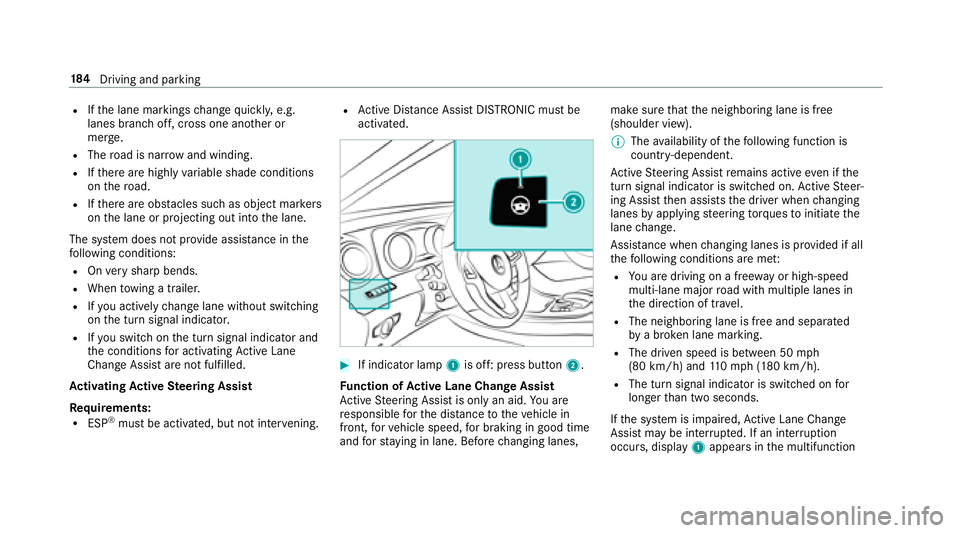
#If indicator lamp 1is off: press button 2.
Fu nction of Active Lane Change Assi st
Ac tive Steering Assist is only an aid. You are
re sponsible forth e dis tance totheve hicle in
front, forve hicle speed, for braking in good time
and forst ay ing in lane. Before changing lanes, make sure
that the neighboring lane is free
(shoulder view).
% The availability of thefo llowing function is
countr y-dependent.
Ac tive Steering Assist remains active even if the
turn signal indica tor is switched on. Active Steer‐
ing Assist then assists the driver when changing
lanes byapplying steering torques toinitiate the
lane change.
Assis tance when changing lanes is pr ovided if all
th efo llowing conditions are me t:
RYou are driving on a free wayor high-speed
multi-lan emajo rro ad with multiple lanes in
th e direction of tr avel.
RThe neighboring lane is free and separated
bya broken lane marking.
RThe driven speed is between 50 mph
(80 km/h) and 110mp h(1 80 km/h).
RThe turn signal indicator is switched on for
longer than two seconds.
If th e sy stem is impaired, Active Lane Change
Assi stmay be inter rupte d. If an inter ruption
occurs, display 1appears in the multifunction
18 4
Driving and pa rking
Page 189 of 506
The HOLD function is deactivated inthefo llow‐
ing situations:
RWhen Active Dis tance Assist DISTRONIC is
acti vated.
RThe transmission is switched toposition j.
RWhentheve hicle is secured with the electric
parking brake.
In thefo llowing situations, theve hicle is held by
th e transmission position jorby the electric
parking brake:
RWhen the seat belt is unfas tened and the
driver's door is opened.
RWhen the engine is switched off.
RWhen there is a malfunction in the sy stem or
if th e po wer supply is insufficient.
DY NA MIC BODY CONT ROL
DYNA MIC BODY CONTROL has thefo llowing
ch aracteristics:
RVa riable damping characteristics
RContinual adjustment of the damping forc es
The damping characteristics adapt tothe cur rent
operating and driving situation.
The da mping is tuned individually for each wheel
and is af fected bythefo llowing factors:
RThe road sur face conditions
RVe hicle load
RThe drive program selected
The drive program can be adjus ted using the
DY NA MIC SELECT switch.
AIR BODY CONT ROL
AIR BODY CONT ROL function
AIR BODY CONTROL is an air suspension sy stem
with variable damping for impr oved driving com‐
fo rt. The all-round le vel control sy stem ensures
th e best possible suspension and const ant
ground clearance, even with a laden vehicle.
When driving at speed, theve hicle is lo wered
automatically toimpr ovedriving saf etyand to re
duce fuel consum ption. The option of manually
adjusting theve hicle le vel is also available.
AIR BODY CONTROL comprises:
RAir suspension with variable spring rate
RAu tomatic le vel control sy stem
RSpeed-dependent lo wering toreduce fuel
consum ption
RManual le vel adjustment
RADS PLUS (Adaptive Damping Sy stem with
const ant damping forc e adjustment)
RDY NA MIC SELECT switch and le vel button
Driving and parking 18
7
Page 209 of 506
Warning when the maximum permissible
speed is exceeded
The sy stem can warnyouif yo u unin tentional ly
exc eed the maximum permissible speed. Todo
th is, you can specify inthe multimedia sy stem
by how much the maximum permissible speed
can be exceeded before a warning is issued. You
can specify whe ther thewa rning is tobe just a
visual warning or an acoustic one as well.
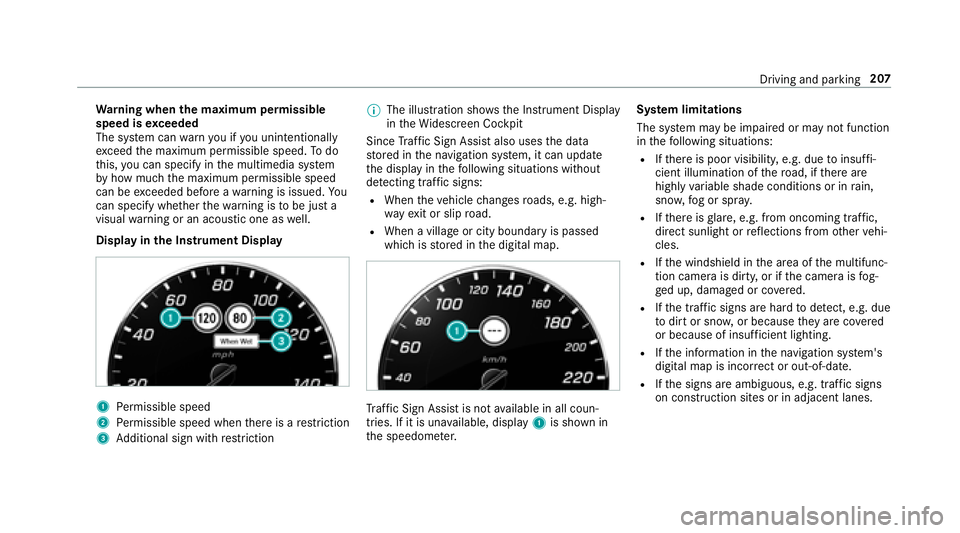
Display in the Instrument Display
1Pe rm issible speed
2Perm issible speed when there is a restriction
3Ad ditional sign with restriction %
The illu stra tion sho wsthe Instrument Display
in theWi descreen Cockpit
Since Traf fic Sign Assist also usesthe data
st ored in the navigation sy stem, it can update
th e display in thefo llowing situations without
de tecting traf fic signs:
RWhen theve hicle changes roads, e.g. high‐
wa yex it or slip road.
RWhen a village or city boundary is passed
which is stored in the digital map.
Traf fic Sign Assist is notavailable in all coun‐
tries. If it is una vailable, display 1is shown in
th e speedome ter. Sy
stem limitations
The sy stem may be impaired or may not function
in thefo llowing situations:
RIf th ere is poor visibility, e.g. due toinsuf fi‐
cient illumination of thero ad, if there are
highly variable shade conditions or in rain,
sno w,fog or spr ay.
RIfth ere is glare, e.g. from oncoming traf fic,
dire ct sunlight or reflections from other vehi‐
cles.
RIf th e windshield in the area of the multifunc‐
tion camera is dirty, or if the camera is fog‐
ge d up, damaged or co vered.
RIfth e tra ffic signs are hard todetect, e.g. due
to dirt or sno w,or because they are co vered
or because of insuf ficient lighting.
RIf th e information in the navigation sy stem's
digital map is incor rect or out-of-date .
RIfth e signs are ambiguous, e.g. traf fic signs
on construction sites or in adjacent lanes.
Driving and park ing207
Page 214 of 506
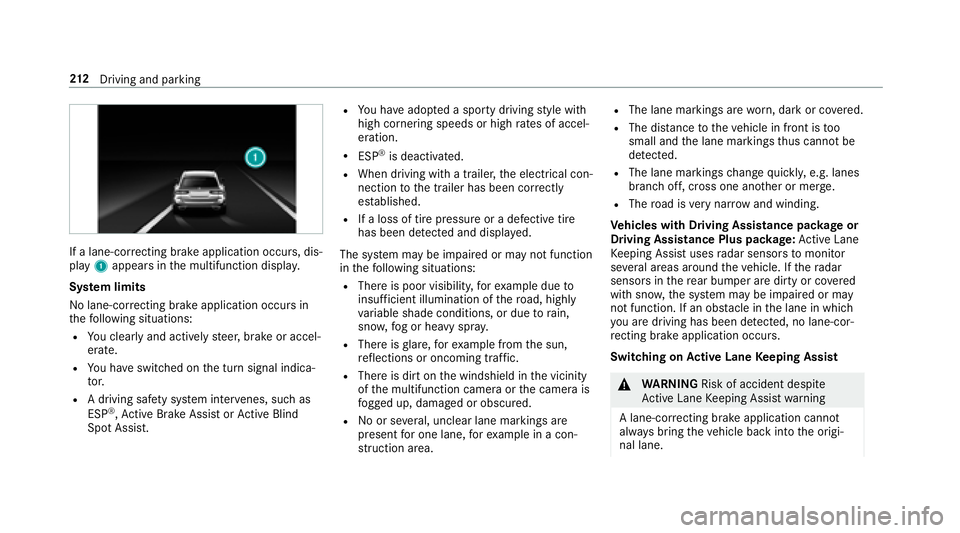
If a lane-correcting brake application occurs , dis‐
play 1appears in the multifunction displa y.
Sy stem limits
No lane-cor recting brake application occurs in
th efo llowing situations:
RYo u clear lyand actively steer, brake or accel‐
erate.
RYo u ha veswitched on the turn signal indica‐
to r.
RA driving safe ty system inter venes, such as
ESP®, Ac tive Brake Assi stor Active Blind
Spot Assi st.
RYo u ha veadop ted a sporty driving style with
high cornering speeds or high rates of accel‐
eration.
RESP®is deactivated.
RWhen driving with a trailer, the electrical con‐
nection tothe trailer has been cor rectly
es tablished.
RIf a loss of tire pressure or a defective tire
has been de tected and displ ayed.
The sy stem may be impaired or may not function
in thefo llowing situations:
RThere is poor visibility, forex ample due to
insuf ficient illumination of thero ad, highly
va riable shade conditions, or due torain,
sno w,fog or heavy spr ay.
RThere is glare, forex ample from the sun,
re flections or oncoming tra ffic.
RThere is dirt on the windshield in the vicinity
of the multifunction camera or the camera is
fo gged up, damaged or obscured.
RNo or se veral, unclear lane markings are
present for one lane, forex ample in a c on‐
st ru ction area.
RThe lane markings are worn, dark or co vered.
RThe dis tance totheve hicle in front is too
small and the lane markings thus cannot be
de tected.
RThe lane markings change quickl y,e.g. lanes
branch off, cross one ano ther or mer ge.
RThe road is very nar row and winding.
Ve hicles with Driving Assistance pac kage or
Driving Assistance Plus pa ckage: Active Lane
Ke eping Assist uses radar sensors tomonitor
se veral areas around theve hicle. If thera dar
sensors in there ar bumper are dirty or co vered
with snow ,th e sy stem may be impaired or may
not function. If an obs tacle in the lane in which
yo u are driving has been de tected, no lane-cor‐
re cting brake application occurs .
Switching on Active Lane Keeping Assist
&
WARNING Risk of accident despite
Ac tive Lane Keeping Assist warning
A lane-cor recting brake application cannot
al wa ys bring theve hicle back into the origi‐
nal lane.
21 2
Driving and pa rking
Page 328 of 506
ASSYST PLUS serv ice interval display
Fu nction of the ASS YST PLUS serv ice interval
displ ay
The ASS YST PLUS service inter val display in the
Instrument Display pr ovides information on the
re maining time or dis tance be fore the next
service due date.
Yo u can hidethis service message using the
back button on the left-hand side of thesteering
wheel.
Yo u can obtain fur ther information concerning
th e servicing of your vehicle from a qualified
specialist workshop, e.g. an authorized
Mercedes-Benz Center.
Displaying the service due da te
On-board computer:
,6HUYLFH.$66<67 3/86
The next service due date is displa yed.
#To exitth e displa y:Press the back button
on the left-hand side of thesteering wheel. Make sure
toobser vethefo llowing fur ther rela‐
te d subjec t:
ROperating the on-board computer
(→page 216).
Car rying out service workatregular inter‐
va ls
* NO
TEPremature wearthro ugh failure to
obser veservice due dates
Service workwhich is not car ried out at the
ri ght time or incomple tely can lead to
inc reased wear and damage totheve hicle.
#Alw ays obser vethe prescribed service
inter vals.
#Alw ays ha vethe prescribed service
wo rkcar ried out at a qualified specialist
wo rkshop.
Special service requ irements
The prescribed service inter val is based on nor‐
mal operation of theve hicle. Service workwill need
tobe per form ed more of ten if theve hicle
is operated under arduous conditions or
increased loads, forex ample:
Rregular city driving with frequent intermedi‐
ate stops.
Rif th eve hicle is primarily used totrave l short
dis tances.
Rfor frequent operation in mountainous terrain
or on poor road sur faces.
Rif th e engine is of ten le ftidling for long peri‐
ods.
Rin particula rly dusty condition sand/o rif air -
re circulation mode is frequently used.
In these or similar operating conditions, ha vethe
interior air filter, engine air filter, engine oil, oil
fi lter etc. changed more frequent ly.Th etire s
must be checked more frequently if theve hicle
is operated under increased loads. Further infor‐
mation can be obtained at a qualified specialist
wo rkshop.
326
Maintenance and care
Page 364 of 506
RThe tires maywearexc essively and/or
une venly, which may greatlyimpair tire
traction.
RThe driving characteristics, as well as
st eering and braking, may be greatly
impaired.
#Comply with there commended tire
pressure and check the tire pressure of
all tires including the spare wheel regu‐
larly:
Rat least once a month
Rwhen the load changes
Rbefore embarking on a longe r journey
Rif operating conditionschange, e.g. off-
ro ad driving
#Ad just the tire pressure as necessar y.
Driving withtire pressure that is too high or too
low can:
RSho rten the service life of the tires.
RCause increased tire damage.
RAd versely af fect handling characteristics and
th us dr iving saf ety, e.g. due to hydroplaning.
&
WARNING Risk of an accident due to
insuf ficient tire pressure
Ti re s with pressure that is too low can over‐
heat and bur stas a result.
In addition, they also suf fer from excessive
and/or ir regular wear, which can significantly
impair the braking properties and the han‐
dling characteristics.
#Av oid excessively low tire pressures in
all the tires, including the spare wheel.
Tire pressure which is too low can cause:
RTire defects as a result of overheating
RImpaired handling characteristics
RIrre gular wear
RIncreased fuel consum ption
&
WARNING Risk of accident from exces‐
sive tire pressure
Ti re s with excessively high pressure can
burs t because they are damaged more easily
by highw ayfill, pot holes etc.
In addition, they also suf fer from ir regular
we ar, which can significantly impair the brak‐
ing properties and the handling characteris‐
tics.
#Av oid excessively high tire pressures in
all the tires, including the spare wheel.
Excessively high tire pressure can result in:
RIncreased braking dis tance
RImpaired handling characteristics
RIrre gular wear
RImpaired driving com fort
RSusceptibility todamage
362
Wheels and tires