engine MERCEDES-BENZ G-Class 2012 W463 Manual Online
[x] Cancel search | Manufacturer: MERCEDES-BENZ, Model Year: 2012, Model line: G-Class, Model: MERCEDES-BENZ G-Class 2012 W463Pages: 284, PDF Size: 9.4 MB
Page 228 of 284
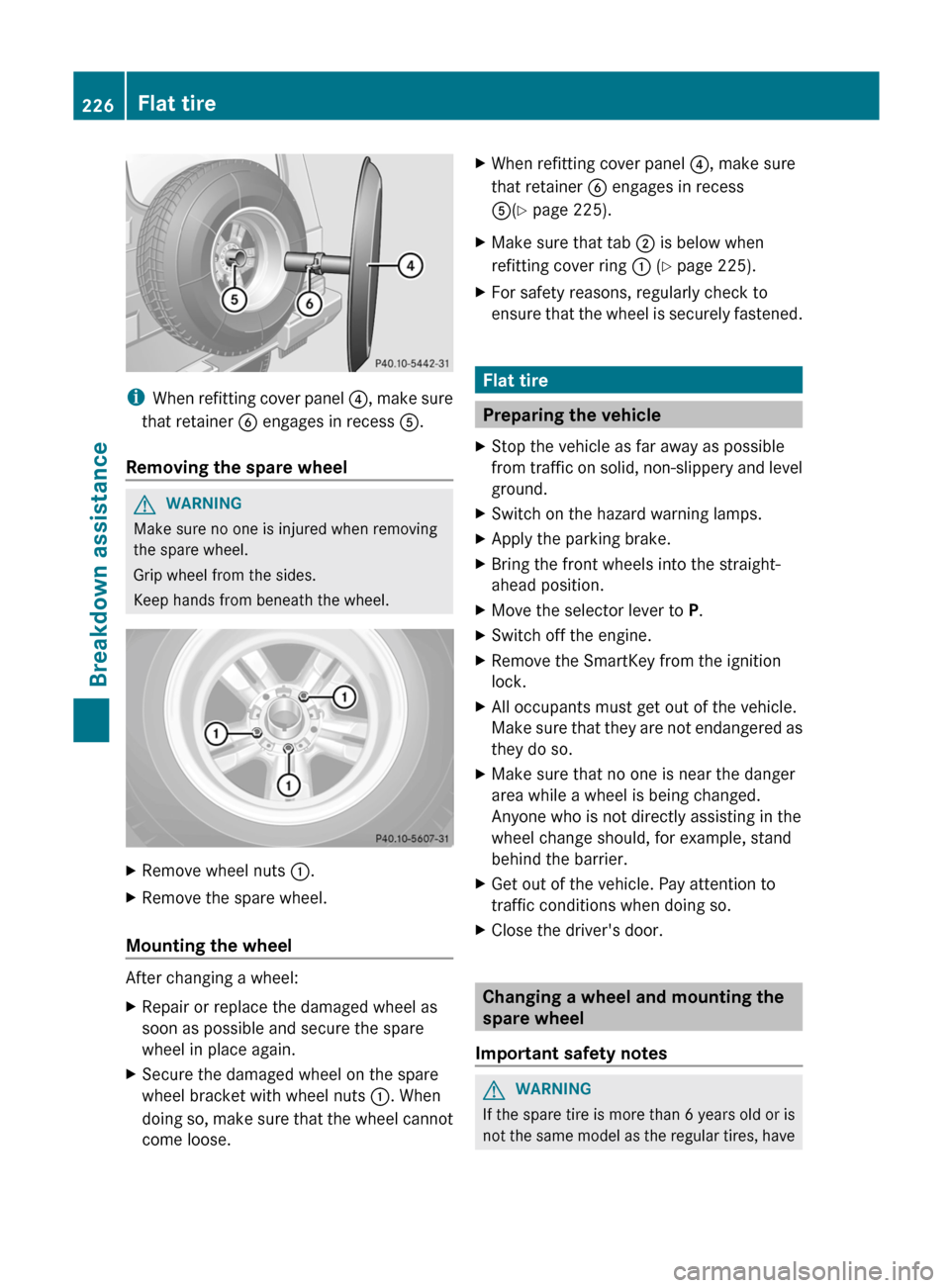
i
When refitting
cover panel ?, make sure
that retainer B engages in recess A.
Removing the spare wheel G
WARNING
Make sure no one is injured when removing
the spare wheel.
Grip wheel from the sides.
Keep hands from beneath the wheel. X
Remove wheel nuts :.
X Remove the spare wheel.
Mounting the wheel After changing a wheel:
X
Repair or replace the damaged wheel as
soon as possible and secure the spare
wheel in place again.
X Secure the damaged wheel on the spare
wheel bracket with wheel nuts :. When
doing so,
make sure that the wheel cannot
come loose. X
When refitting cover panel ?, make sure
that retainer B engages in recess
A(Y page 225).
X Make sure that tab ; is below when
refitting cover ring : (Y page 225).
X For safety reasons, regularly check to
ensure that
the wheel is securely fastened. Flat tire
Preparing the vehicle
X Stop the vehicle as far away as possible
from traffic
on solid, non-slippery and level
ground.
X Switch on the hazard warning lamps.
X Apply the parking brake.
X Bring the front wheels into the straight-
ahead position.
X Move the selector lever to P.
X Switch off the engine.
X Remove the SmartKey from the ignition
lock.
X All occupants must get out of the vehicle.
Make sure
that they are not endangered as
they do so.
X Make sure that no one is near the danger
area while a wheel is being changed.
Anyone who is not directly assisting in the
wheel change should, for example, stand
behind the barrier.
X Get out of the vehicle. Pay attention to
traffic conditions when doing so.
X Close the driver's door. Changing a wheel and mounting the
spare wheel
Important safety notes G
WARNING
If the spare tire is more than 6 years old or is
not the
same model as the regular tires, have226
Flat tire
Breakdown assistance
Page 230 of 284
surfaces, such as tiled floors, you should use
a
non-slip
underlay, for example a rubber mat.
Do not use wooden blocks or similar objects
to support the jack. Otherwise the jack may
not be able to achieve its load-bearing
capacity if it is not at its full height.
Never start the engine when the vehicle is
raised.
Also observe the notes on the jack. X
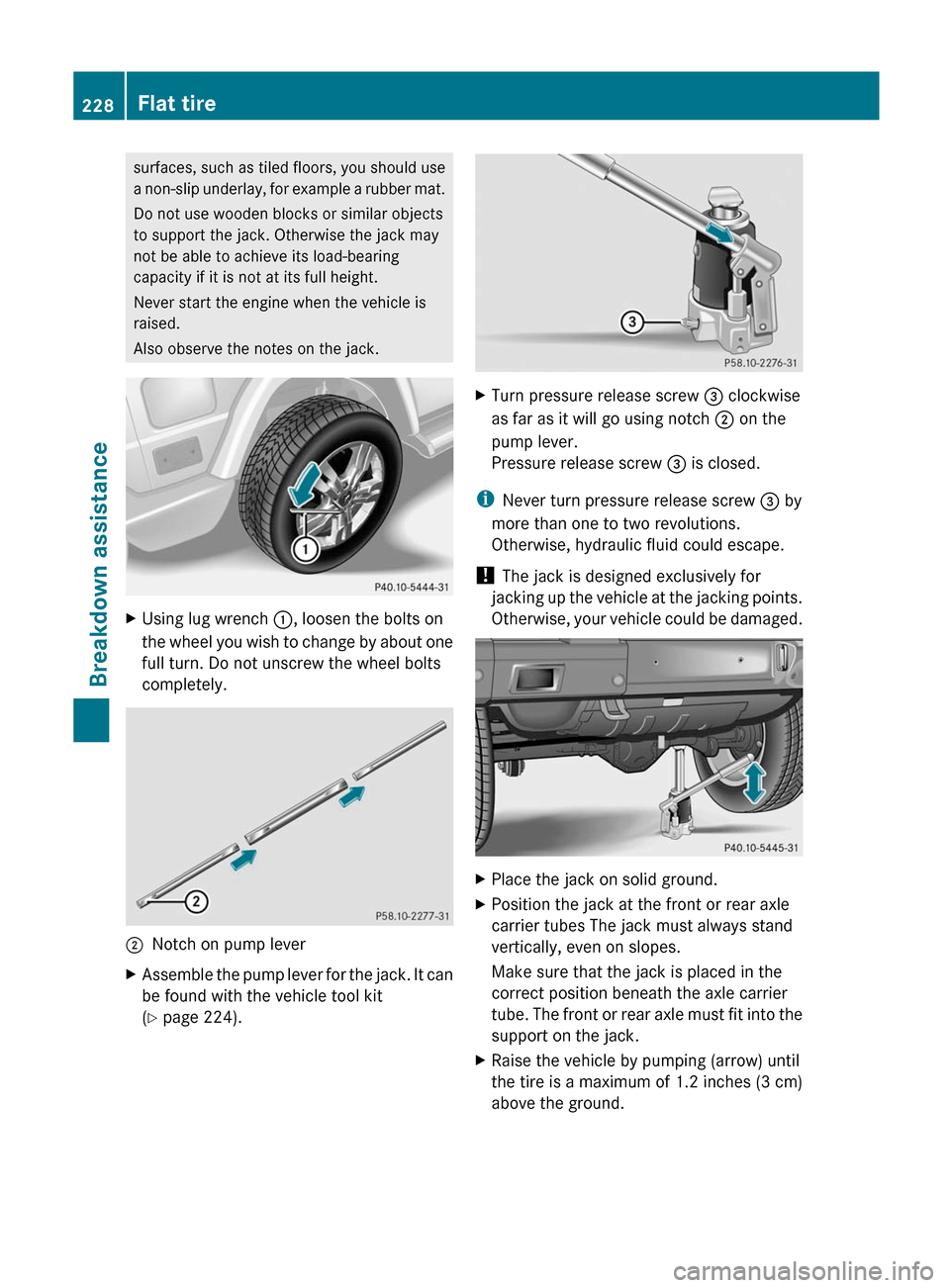
Using lug wrench
:, loosen the bolts on
the wheel
you wish to change by about one
full turn. Do not unscrew the wheel bolts
completely. ;
Notch on pump lever
X Assemble
the pump lever for the jack. It can
be found with the vehicle tool kit
(Y page 224). X
Turn pressure release screw = clockwise
as far as it will go using notch ; on the
pump lever.
Pressure release screw = is closed.
i Never turn pressure release screw = by
more than one to two revolutions.
Otherwise, hydraulic fluid could escape.
! The jack is designed exclusively for
jacking up
the vehicle at the jacking points.
Otherwise, your vehicle could be damaged. X
Place the jack on solid ground.
X Position the jack at the front or rear axle
carrier tubes The jack must always stand
vertically, even on slopes.
Make sure that the jack is placed in the
correct position beneath the axle carrier
tube. The
front or rear axle must fit into the
support on the jack.
X Raise the vehicle by pumping (arrow) until
the tire is a maximum of 1.2 inches (3 cm)
above the ground.228
Flat tire
Breakdown assistance
Page 233 of 284
G
WARNING
Do not place any metal objects on the battery
as this could result in a short circuit.
Use leak-proof
batteries only to avoid the risk
of acid burns in the event of an accident.
Take care that you do not become statically
charged, e.g. by wearing synthetic clothing or
rubbing against textiles. For this reason, you
also should not pull or push the battery over
carpets or other synthetic materials.
Never touch the battery first. First, touch the
outside body of the vehicle in order to release
any possible electrostatic charges.
Do not rub the battery with rags or cloths. The
battery could explode if touched due to
electrostatic charge or due to spark
formation.
! Switch off the engine and remove the
SmartKey before you loosen or disconnect
the terminal clamps. You may otherwise
destroy electronic components such as the
alternator.
! Like other batteries, the vehicle battery
may discharge over time if you do not use
the vehicle. In this case, have the battery
disconnected at a qualified specialist
workshop. You can also charge the battery
with a charger recommended by Mercedes-
Benz. Contact a qualified specialist
workshop for further information.
The battery and the cover of the positive
terminal clamp must be installed securely
during operation.
i Remove the SmartKey if you park the
vehicle and do not require any electrical
consumers. The vehicle will then use very
little energy, thus conserving battery
power.
Mercedes-Benz recommends that you do not
carry out work on batteries yourself, e.g.
removing or charging. Have this work
performed at a qualified specialist workshop. i
If the power supply has been interrupted,
e.g. if the battery has been reconnected,
you must carry out the following tasks:
R reset the head restraints on the front
seats (
Y page 78). Charging the battery
G
WARNING
Never charge a battery still installed in the
vehicle unless
a battery charger unit approved
by Mercedes-Benz is being used. Gases may
escape during charging and cause explosions
that may result in paint damage, corrosion or
personal injury.
A battery charger unit specially adapted for
Mercedes-Benz vehicles and tested and
approved by Mercedes-Benz is available as an
accessory. It permits the charging of the
battery in its installed position. Contact an
authorized Mercedes-Benz Center for further
information and availability.
Charge the battery in accordance with the
separate instructions for the battery charger. G
WARNING
There is a risk of acid burns during the
charging process due to the gases which
escape from
the battery. Do not lean over the
battery during the charging process. G
WARNING
Battery
acid is caustic. Avoid contact with the
skin, eyes or clothing.
! Only charge the installed battery with a
battery charger
which has been tested and
approved by Mercedes-Benz. These battery
chargers allow the battery to be charged
while still installed.
! Only use battery chargers with a
maximum charging voltage of 14.8 V.
! Only charge the battery using the jump-
starting connection point. Battery
231
Breakdown assistance Z
Page 234 of 284
The jump-starting connection point is in the
engine compartment
(
Y page 233).
X Open the hood (Y page 210).
X Connect the battery charger to the positive
terminal and
earth point in the same order
as when connecting the donor battery in
the jump-starting procedure
(Y page 233).
X Read the battery charger's operating
instructions before charging the battery.232
Battery
Breakdown assistance
Page 235 of 284
Jump-starting
G
WARNING
Failure to follow these directions will cause damage to the electronic components, and can lead
to a battery explosion and severe injury or death.
Never lean over batteries while connecting or jump starting. You might get injured.
Battery fluid contains sulfuric acid. Do not allow this fluid to come in contact with eyes, skin or
clothing. In case it does, immediately flush affected area with water, and seek medical help if
necessary.
A battery will also produce hydrogen gas, which is flammable and explosive. Keep flames or
sparks away from battery, avoid improper connection of jumper cables, smoking, etc.
Attempting to jump start a frozen battery can result in it exploding, causing personal injury.
Read all instructions before proceeding.
! Avoid repeated and lengthy starting attempts. Otherwise, non-combusted fuel may
damage the catalytic converter and create a risk of fire.
Do not use a rapid charging device to start the vehicle.
Make sure the jumper cables are not damaged.
Make sure the jumper cables are not touching any other metal objects when they are
connected to the battery.
If your vehicle's battery is discharged, the engine can be jump-started from another vehicle
or from a second battery using jumper cables.
Observe the following points:
X The battery is not accessible in all vehicles. If the other vehicle's battery is not accessible,
jump-start the vehicle using a second battery or a jump-starting device.
X You may only jump-start the vehicle when the engine and catalytic converter are cold.
X Do not start the engine if the battery is frozen. Let the battery thaw first.
X Jump-starting may only be performed from batteries with a nominal voltage of 12 V.
X Only use jumper cables which have a sufficient cross-section and insulated terminal clamps.
X Make sure that the jumper cables cannot come into contact with parts, such as the pulley
or the fan. These parts move when the engine is started and while it is running.
X If the battery is fully discharged, leave the battery that is being used to jump-start connected
for a few minutes before attempting to start. This charges the empty battery a little.
i Jumper cables and further information about jump-starting can be obtained from any
authorized Mercedes-Benz Center, for example.
X Make sure that the two vehicles do not touch.
X Apply the parking brake.
X Move the selector lever to P.
X Switch off all electrical consumers (e.g. radio, blower, etc.).
X Open the hood (Y page 210). Jump-starting
233
Breakdown assistance Z
Page 236 of 284
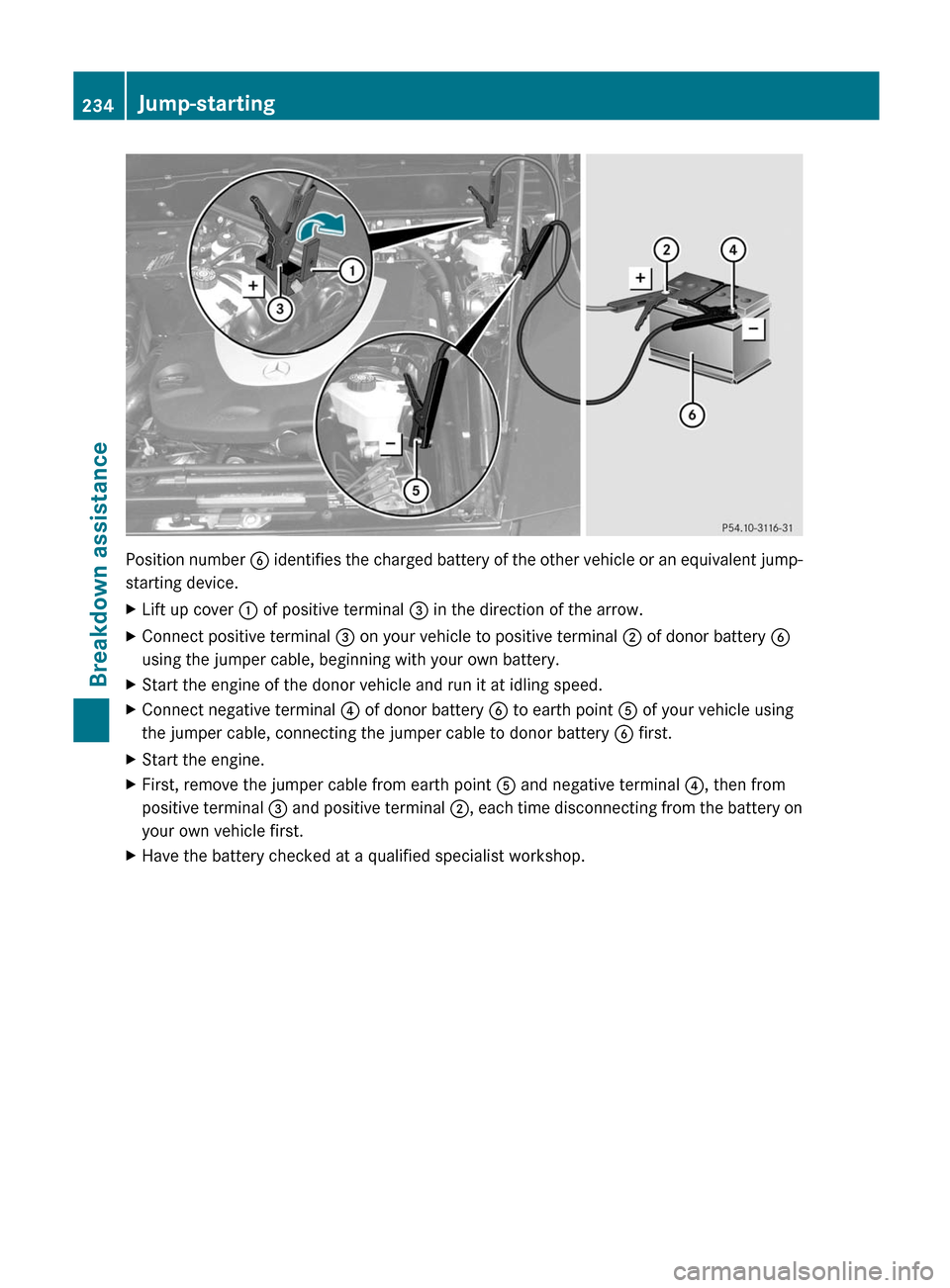
Position number
B identifies the charged battery of the other vehicle or an equivalent jump-
starting device.
X Lift up cover : of positive terminal = in the direction of the arrow.
X Connect positive terminal = on your vehicle to positive terminal ; of donor battery B
using the jumper cable, beginning with your own battery.
X Start the engine of the donor vehicle and run it at idling speed.
X Connect negative terminal ? of donor battery B to earth point A of your vehicle using
the jumper cable, connecting the jumper cable to donor battery B first.
X Start the engine.
X First, remove the jumper cable from earth point A and negative terminal ?, then from
positive terminal
=
and positive terminal ;, each time disconnecting from the battery on
your own vehicle first.
X Have the battery checked at a qualified specialist workshop.234
Jump-starting
Breakdown assistance
Page 237 of 284
Towing and tow-starting
Important safety notes
G
WARNING
If circumstances require towing the vehicle
with all
wheels on the ground, always tow with
a tow bar if:
R the engine will not run
R there is a malfunction in the brake system
R there is a malfunction in the power supply
or the vehicle's electrical system
This is necessary to adequately control the
towed vehicle.
Prior to towing the vehicle with all wheels on
the ground, make sure the SmartKey is in
starter switch position 2.
If the SmartKey is left in starter switch
position 0 for an extended period of time, it
can no longer be turned in the switch. In this
case, the steering is locked. To unlock,
remove SmartKey from starter switch and
reinsert.
It is better to have the vehicle transported
than to have it towed.
! You may only tow the vehicle a maximum
distance of 30 miles (50 km). A towing
speed of 30 mph (50 km/h) must not be
exceeded.
For towing distances over 30 miles
(50 km), the vehicle must loaded onto a
transporter.
! Only secure the tow cable or tow bar to
the towing eyes. You could otherwise
damage the vehicle.
! Do not tow with sling-type equipment.
This could damage the vehicle.
! Do not use the towing eyes for recovery
purposes as this could damage the vehicle.
If in doubt, recover the vehicle with a crane.
! When towing, pull away slowly and
smoothly. If the tractive power is too high,
the vehicles could be damaged. !
Your vehicles is equipped with an
automatic transmission. Therefore, you
must not
have the vehicle tow-started. The
transmission may otherwise be damaged.
If the transfer case can be shifted into neutral
N, you can tow the vehicle.
If the transfer case cannot be shifted into
neutral N, you can tow the vehicle with one
axle raised. Please bear the following in mind:
R remove the propeller shaft between the
transfer case and the rolling axle.
R turn the SmartKey to position 1 in the
ignition lock.
The battery must be connected and charged.
Otherwise, you:
R cannot turn the SmartKey to position 2 in
the ignition lock
R cannot shift the automatic transmission to
position N
i Deactivate the automatic locking feature
(Y page 161) You could otherwise be
locked out when pushing or towing the
vehicle. Towing eyes
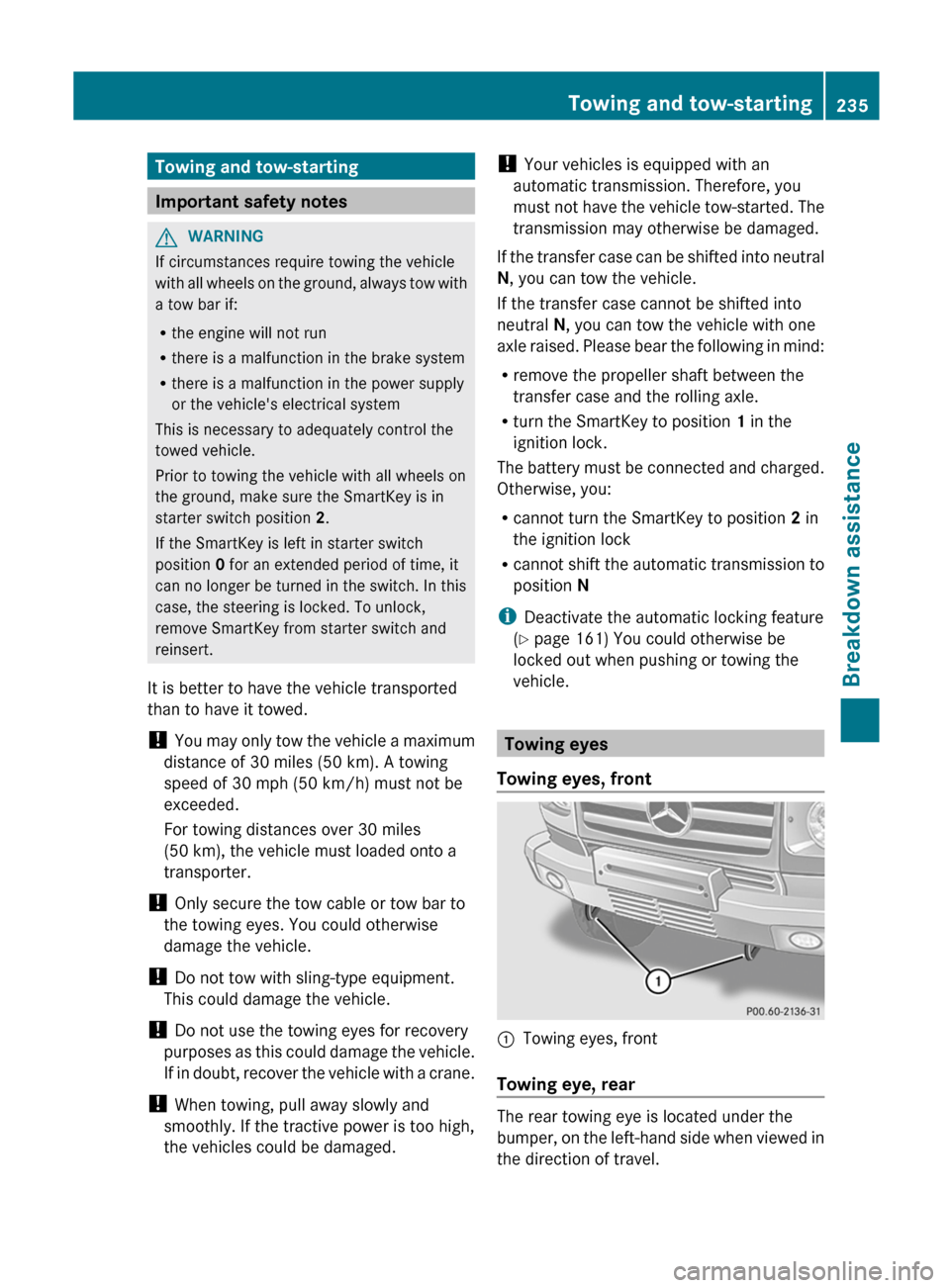
Towing eyes, front :
Towing eyes, front
Towing eye, rear The rear towing eye is located under the
bumper,
on
the left-hand side when viewed in
the direction of travel. Towing and tow-starting
235
Breakdown assistance Z
Page 238 of 284
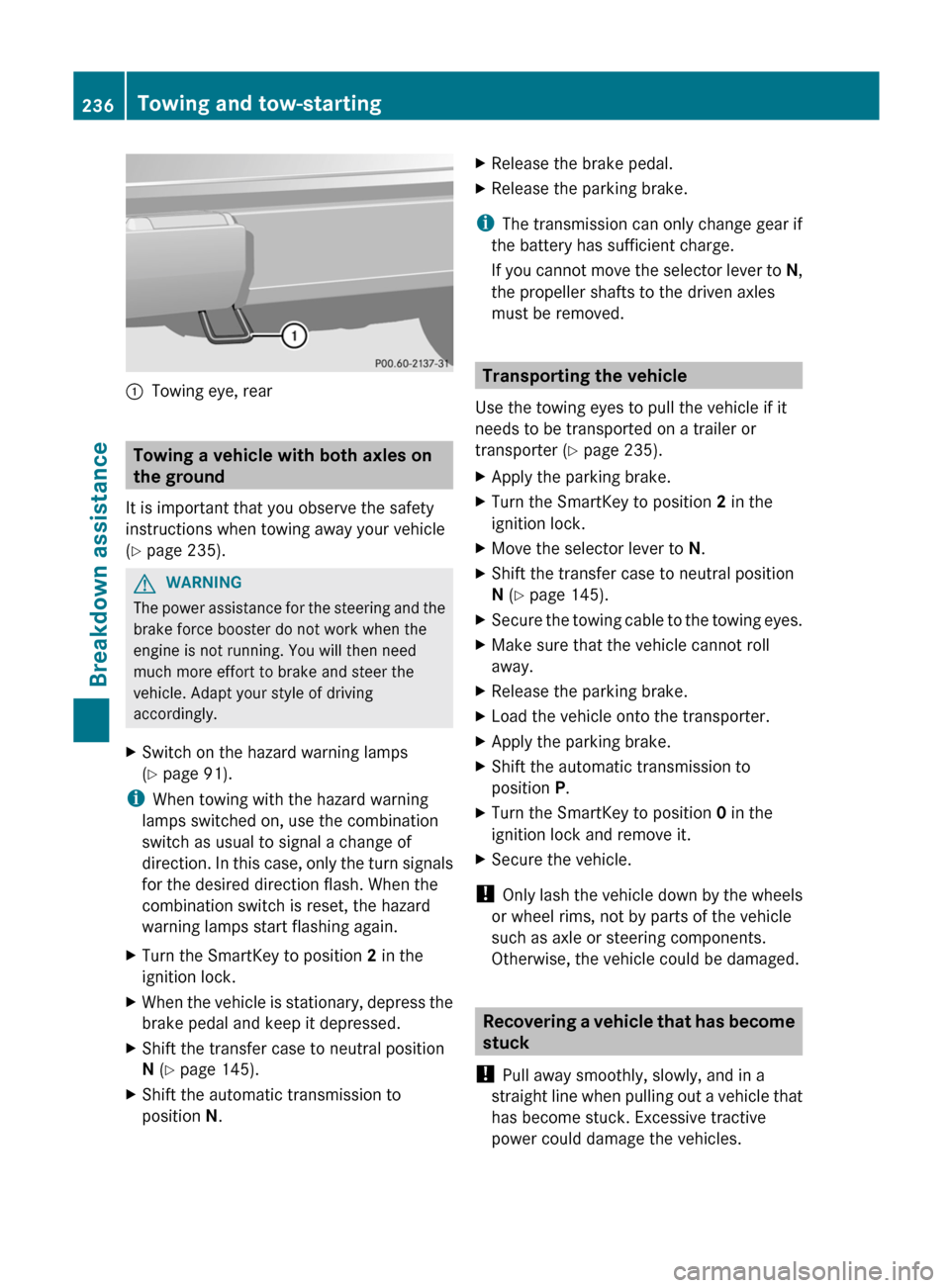
:
Towing eye, rear Towing a vehicle with both axles on
the ground
It is important that you observe the safety
instructions when towing away your vehicle
(Y page 235). G
WARNING
The power assistance for the steering and the
brake force booster do not work when the
engine is not running. You will then need
much more effort to brake and steer the
vehicle. Adapt your style of driving
accordingly.
X Switch on the hazard warning lamps
(Y page 91).
i When towing with the hazard warning
lamps switched on, use the combination
switch as usual to signal a change of
direction. In
this case, only the turn signals
for the desired direction flash. When the
combination switch is reset, the hazard
warning lamps start flashing again.
X Turn the SmartKey to position 2 in the
ignition lock.
X When the vehicle is stationary, depress the
brake pedal and keep it depressed.
X Shift the transfer case to neutral position
N (Y page 145).
X Shift the automatic transmission to
position N. X
Release the brake pedal.
X Release the parking brake.
i The transmission can only change gear if
the battery has sufficient charge.
If you
cannot move the selector lever to N,
the propeller shafts to the driven axles
must be removed. Transporting the vehicle
Use the towing eyes to pull the vehicle if it
needs to be transported on a trailer or
transporter ( Y page 235).
X Apply the parking brake.
X Turn the SmartKey to position 2 in the
ignition lock.
X Move the selector lever to N.
X Shift the transfer case to neutral position
N (Y page 145).
X Secure the towing cable to the towing eyes.
X Make sure that the vehicle cannot roll
away.
X Release the parking brake.
X Load the vehicle onto the transporter.
X Apply the parking brake.
X Shift the automatic transmission to
position P.
X Turn the SmartKey to position 0 in the
ignition lock and remove it.
X Secure the vehicle.
! Only lash
the vehicle down by the wheels
or wheel rims, not by parts of the vehicle
such as axle or steering components.
Otherwise, the vehicle could be damaged. Recovering a vehicle that has become
stuck
! Pull away smoothly, slowly, and in a
straight line
when pulling out a vehicle that
has become stuck. Excessive tractive
power could damage the vehicles. 236
Towing and tow-starting
Breakdown assistance
Page 239 of 284
If the drive wheels get trapped on loose or
muddy ground, recover the vehicle with the
utmost care, especially so if the vehicle is
laden.
Never attempt to recover a vehicle with a
trailer attached.
Pull out the vehicle backwards, if possible,
using the tracks it made when it became
stuck.
Towing in the event of malfunctions
General notes !
If you are removing the propeller shaft,
use M10 nuts as spacers on the M8 bolts
and secure them with M8 nuts.
New self-locking nuts must be used when
the propeller shafts are refitted.
X Observe the safety notes as you do so
(Y page 235).
i Consult an authorized Mercedes-Benz
Center.
Engine damage, gear damage or
electrical malfunctions X
Move the selector lever to N(Y page 120).
X Shift the transfer case to neutral position
N (Y page 145).
In the event of damage to the transfer
case Have the propeller shafts between the axles
and the transfer case removed.
Have the vehicle towed with the front axle
raised.
In
the
event of damage to the front axle Have the propeller shaft between the rear
axle and the transfer case removed.
Have the vehicle towed with the front axle
raised. In the event of damage to the rear axle Have the propeller shaft between the front
axle and the transfer case removed.
Have the vehicle towed with the rear axle
raised and with wheel rollers under the front
axle.
Fuses
Important safety notes
G
WARNING
Only use fuses that have been approved for
Mercedes-Benz vehicles and that have the
correct fuse rating for the systems
concerned. Do
not attempt to repair or bridge
faulty fuses. Using fuses that have not been
approved or attempting to repair or bridge
faulty fuses could cause the fuse to be
overloaded and result in a fire. Have the cause
traced and rectified at a qualified specialist
workshop.
! Only use fuses that have been approved
for Mercedes-Benz vehicles and which
have the correct fuse rating for the system
concerned. Otherwise, components or
systems could be damaged.
The fuses in your vehicle serve to close down
faulty circuits. If a fuse blows, all the
components on the circuit and their functions
stop operating.
Blown fuses must be replaced with fuses of
the same rating, which you can recognize by
the color and value. The fuse ratings are listed
in the fuse allocation chart.
i If a fuse has blown, contact a breakdown
service or an authorized Mercedes-Benz
Center.
If a newly inserted fuse also blows, have the
cause traced and rectified at a qualified
specialist workshop, e.g. an authorized
Mercedes-Benz Center. Fuses
237
Breakdown assistance Z
Page 272 of 284
Useful information
i This Operator's Manual describes all
models and all standard and optional
equipment of your vehicle available at the
time of publication of the Operator's
Manual. Country-specific differences are
possible. Please
note that your vehicle may
not be equipped with all features
described. This also applies to safety-
related systems and functions.
i Please read the information on qualified
specialist workshops (Y page 20). Genuine Mercedes-Benz parts
All Mercedes-Benz
Centers maintain a supply
of genuine Mercedes-Benz parts for
necessary service and repair work. In
addition, strategically located parts delivery
centers provide quick and reliable parts
service.
More than 300,000 different genuine
Mercedes-Benz parts are available for
Mercedes-Benz models.
Genuine Mercedes-Benz parts are subject to
strict quality control. Each part has been
specially developed, manufactured or
selected for Mercedes-Benz vehicles and
fine-tuned for them.
Only genuine Mercedes-Benz parts should
therefore be used.
! The use of non-approved parts could
impair the vehicle's safety. For this reason,
Mercedes-Benz recommends genuine
Mercedes-Benz parts and approved
conversion parts and accessories for your
vehicle model. H
Environmental note
Daimler
AG also supplies reconditioned major
assemblies and parts which are of the same
quality as
new parts. They are covered by the
same Limited Warranty entitlements as new
parts. Always specify the vehicle identification
number (VIN) (
Y page 271) and the engine
number (
Y page 272) when ordering genuine
Mercedes-Benz parts. Warranty
The Service and Warranty Information
booklet contains detailed information about
the warranties covering your vehicle.
Your authorized Mercedes-Benz Center will
exchange or repair any defective parts
originally installed in the vehicle in
accordance with the terms of the following
warranties:
R New Vehicle Limited Warranty
R Emission System Warranty
R Emission Performance Warranty
R California, Connecticut, Maine,
Massachusetts, New York, Pennsylvania,
Rhode Island and Vermont Emission
Control System Warranty
R State warranty enforcement laws (Lemon
Laws)
Replacement parts and accessories are
covered by the Mercedes-Benz Parts and
Accessories warranties. You can obtain
information about this from any authorized
Mercedes-Benz Center.
i Should you lose your Service and
Warranty Information booklet, have an
authorized Mercedes-Benz Center arrange
for a replacement. It will be mailed to you. 270
Warranty
Technical data