check engine MERCEDES-BENZ G-Class 2017 W463 User Guide
[x] Cancel search | Manufacturer: MERCEDES-BENZ, Model Year: 2017, Model line: G-Class, Model: MERCEDES-BENZ G-Class 2017 W463Pages: 286, PDF Size: 4.91 MB
Page 96 of 286
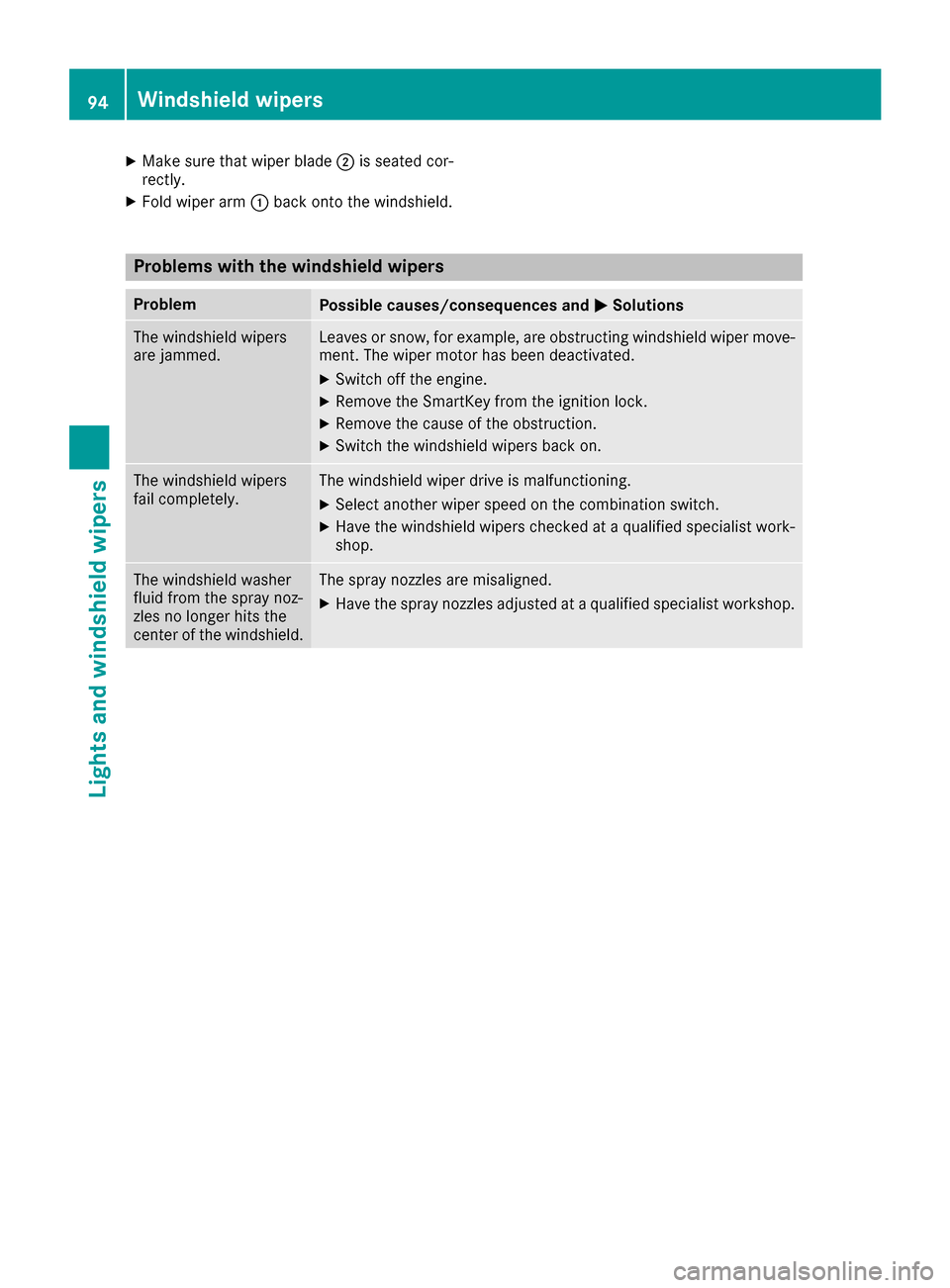
XMake sure that wiper blade;is seated cor-
rectly.
XFold wiper arm :back onto the windshield.
Problems with the windshield wipers
ProblemPossible causes/consequences and MSolutions
The windshield wipers
are jammed.Leaves or snow, for example, are obstructingw indshield wiper move-
ment. The wiper motor has been deactivated.
XSwitch off the engine.
XRemove the SmartKey from the ignition lock.
XRemove the cause of the obstruction.
XSwitch the windshield wipers back on.
The windshield wipers
fail completely.The windshield wiper drive is malfunctioning.
XSelect another wiper speed on the combination switch.
XHave the windshield wipers checked at aqualified specialist work-
shop.
The windshield washer
fluid from the spray noz-
zles no longer hits the
center of the windshield.The spray nozzles are misaligned.
XHave the spray nozzles adjusted at aqualified specialist workshop.
94Windshield wipers
Lights and windshield wipers
Page 99 of 286
ROnly use the "Windshield defrosting" function
briefly until the windshieldisclear again.
ROnly use air-recirculation mode briefly, e.g. if
there are unpleasant outside odors or when in
at unnel. The windows could otherwise fog up,
since no fresh air is drawn into the vehicle in
air-recirculation mode.
ECO start/stop function
During automatic engine switch-off, the climate
control system only operates at areduced capa-
city. If you require the full climate control output,
you can switch off the ECO start/stop function
by pressing the ECO button (
Ypage 106).
Operating the climate control system
Activates/deactivates climate con-
trol
General notes
When the climate control is switched off, the air
supply and air circulation are also switched off. The windows could fog up. Therefore, switch off
climate control only briefly.
Activate climate control primarily using the
à button (
Ypage 98).
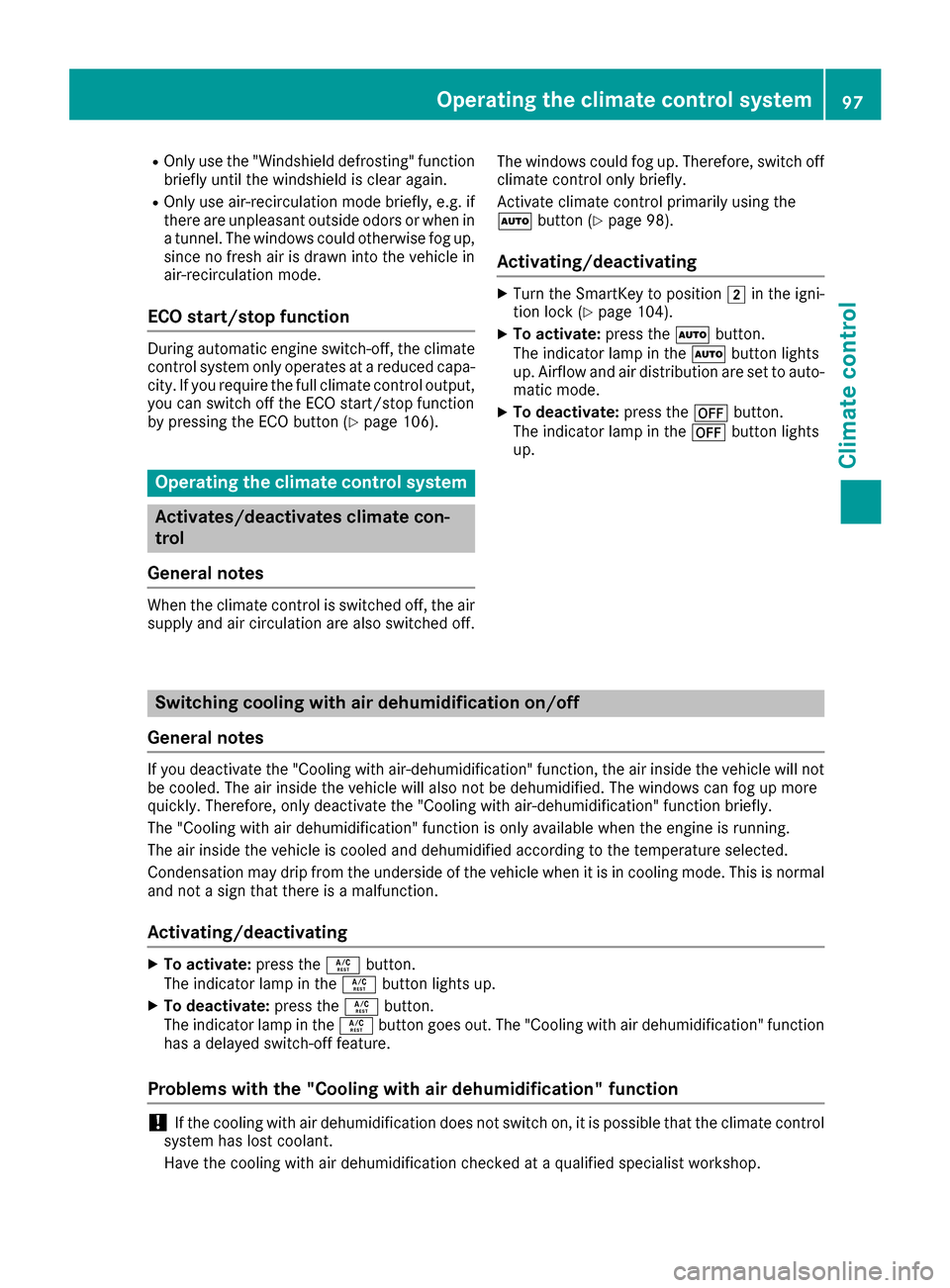
Activating/deactivating
XTurn the SmartKey to position 2in the igni-
tion lock (Ypage 104).
XTo activate: press theÃbutton.
The indicator lamp in the Ãbutton lights
up. Airflow and air distribution are set to auto-
matic mode.
XTo deactivate: press the^button.
The indicator lamp in the ^button lights
up.
Switchingc ooling with air dehumidification on/off
General notes
If you deactivate the "Cooling with air-dehumidification" function, the air inside the vehicle will not
be cooled. The air inside the vehicle will also not be dehumidified. The windows can fog up more
quickly. Therefore, only deactivate the "Cooling with air-dehumidification" function briefly.
The "Cooling with air dehumidification" function is only available when the engine is running.
The air inside the vehicle is cooled and dehumidified according to the temperature selected.
Condensation may drip from the underside of the vehicle when it is in cooling mode. This is normal
and not asign that there is amalfunction.
Activating/deactivating
XTo activate: press theÁbutton.
The indicator lamp in the Ábutton lights up.
XTo deactivate: press theÁbutton.
The indicator lamp in the Ábutton goes out. The "Cooling with air dehumidification" function
has adelayed switch-off feature.
Problems with the "Cooling with air dehumidification" function
!If the cooling with air dehumidification does not switch on, it is possible that the climate control
system has lost coolant.
Have the cooling with air dehumidification checked at aqualified specialist workshop.
Operating the climatec ontrol system97
Climatecontrol
Page 106 of 286
Do not switch off the ignition whiledriving.
GWARNING
If the parkin gbrake hasn ot been fully
released when driving, the parkin gbrake can:
Roverheat and cause afire
Rlose its hol dfunction.
There is ariskoff irea nd an accident. Release
the parkin gbrake full ybefor ed rivin goff.
!Warm up the engine quickly. Do not us ethe
engine's full performance unti lithasreached
operating temperature.
Onlys hift the automatic transmission to the
desired drive positio nwhent he vehicl eissta-
tionary.
Where possible, avoi dspinning the drive
wheels when pulling away on slippery roads.
Yo uc ould otherwis edamag ethe drive train.
!Avoi dhighe ngine speeds when the engine
is cold. The engine's servic elifec ould other-
wise be significantl yshortened. Do not use
the engine's full performance unti lithas
reachedo perating temperature.
!Mercedes-AMG vehicles: at lowengine oil
temperatures belo w68‡ (+20† ),the max-
imu me ngine spee disrestricted in order to
protect the engine .Toprotect the engine and
maintain smooth engine operation, avoi ddriv-
ing at full throttle when the engine is cold.
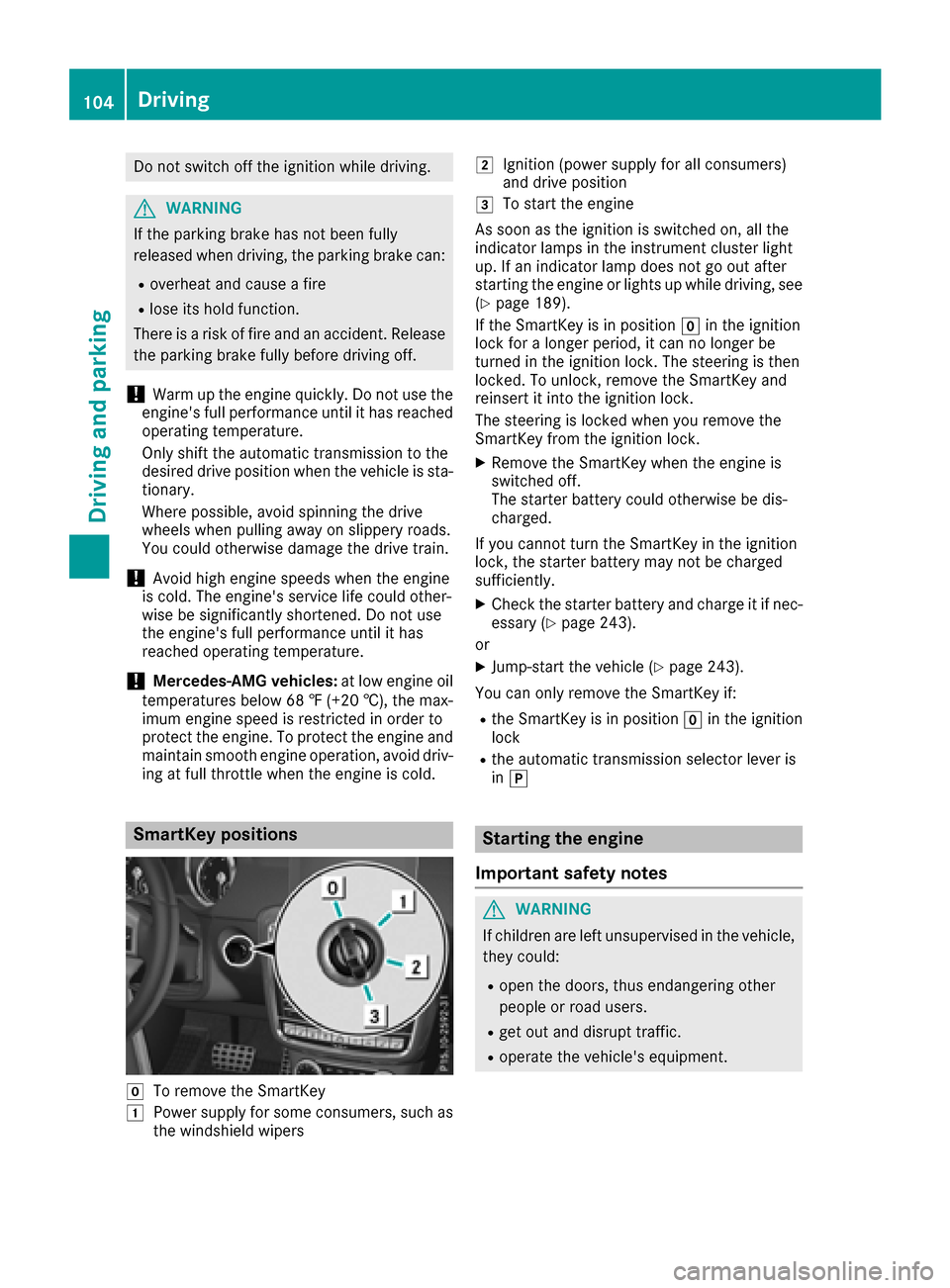
SmartKey positions
gTo remove the SmartKey
1Powe rsuppl yfor som econsumers ,suc ha s
the windshiel dwiper s
2Ignitio n(powe rsuppl yfor al lconsumers)
and drive position
3To start the engine
As soo nasthe ignition is switched on, al lthe
indicator lamps in the instrument cluster light
up .Ifani ndicator lamp does not go ou tafter
startin gthe engine or lights up whil edriving, see
(
Ypage 189).
If the SmartKeyisinp osition gin the ignition
lock for alon gerp eriod, it can no longe rbe
turned in the ignition lock. The steerin gisthen
locked .Tounlock, remove the SmartKeya nd
reinsert it into the ignition lock.
The steerin gislocked when yo uremove the
SmartKeyf romthe ignition lock.
XRemov ethe SmartKeyw hent he engine is
switched off.
The starter battery could otherwis ebedis-
charged.
If yo ucanno tturnt he SmartKeyint he ignition
lock, the starter battery mayn ot be charged
sufficiently.
XCheck the starter battery and charge it if nec-
essar y(Ypage 243).
or
XJump-star tthe vehicl e(Ypage 243).
Yo uc an onl yremove the SmartKeyi f:
Rthe SmartKeyisinpositiongin the ignition
lock
Rthe automatic transmission selecto rlev er is
in j
Starting the engine
Important safety notes
GWARNING
If children ar eleftu nsupervised in the vehicle,
theyc ould:
Ropen the doors ,thuse ndangering other
people or roa dusers.
Rgeto utand disrupt traffic.
Roperate the vehicle's equipment.
104Driving
Driving an dparking
Page 107 of 286
Additionally, children could set the vehiclein
motion if, for example, they:
Rrelease the parking brake.
Rshifting the automatic transmission outo f
park position P
RStartthe engine.
There is ariskofana ccident and injury.
Whe nleavi ng the vehicle, always take the
SmartKeyw ithy ou and lock the vehicle. Never
leav echildren or animals unattended in the
vehicle. Alway skeept he SmartKeyo utof
reach of children.
GWARNING
Combustion engine semitp oiso nousexhaust
gases such as carbo nmonoxide. Inhaling
thes eexhaus tgases lead stopoisoning. There
is ar iskoff atalinjury.T herefore neve rleave
the engine running in enclose dspaces with-
outs ufficient ventilation.
GWARNING
Flammabl ematerial sintroduced through
environmental influence or by animals can
ignite if in contact with the exhaus tsystem or
parts of the engine thath eatu p.There is arisk
of fire.
Carry outr egular checks to make sure that
ther eareno flammabl eforeig nmaterial sin
the engine compartment or in the exhaust
system.
!Do not depress the accelerator when start-
ing the engine.
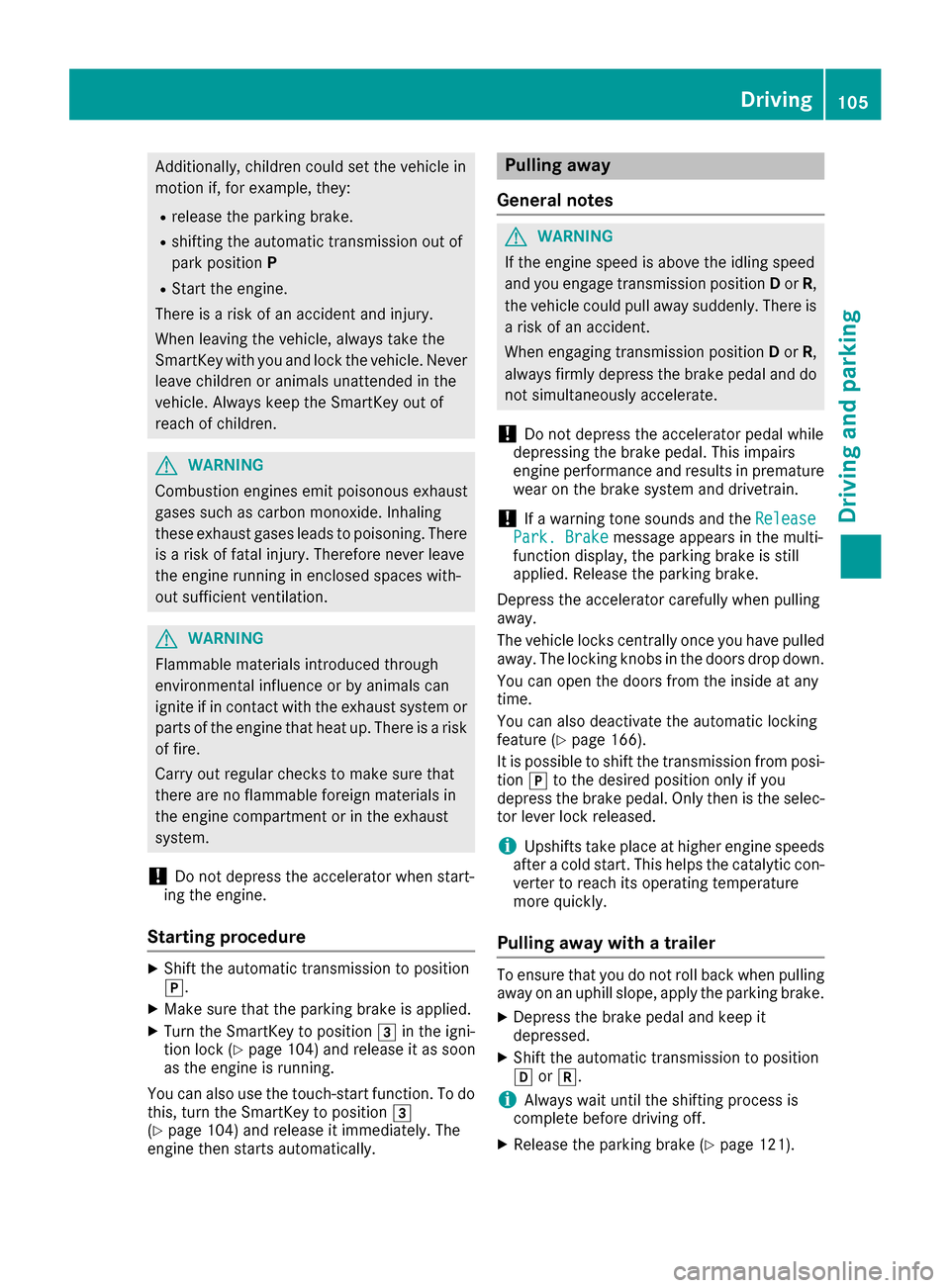
Starting procedure
XShift the automatic transmission to position
j.
XMake sure thatt he parking brake is applied.
XTurn the SmartKeytop osition3in the igni-
tio nlock(Ypage 104) and release it as soon
as the engine is running.
Yo uc an also us ethe touch-start function. To do
this, turn the SmartKeytop osition3
(
Ypage 104 )and release it immediately. The
engine then starts automatically.
Pulling away
General notes
GWARNING
If the engine speed is above the idling speed
and yo uengag etransmission position Dor R,
the vehicl ecould pull away suddenly. There is
ar iskofana ccident.
Whe nengaging transmission position Dor R,
always firmly depress the brake peda land do
not simultaneously accelerate.
!Do not depress the accelerator peda lwhile
depressing the brake pedal. Thi simpairs
engine performance and results in premature
wear on the brake system and drivetrain.
!If aw arning tone sounds and the ReleasePark. Brakemessage appearsinthe multi-
functio ndisplay ,the parking brake is still
applied. Releas ethe parking brake.
Depres sthe accelerator carefull ywhenp ulling
away.
The vehicl eloc ks centrall yonce yo uhavep ulle d
away .The locking knobsint he doors dropdown.
Yo uc an open the doors from the insid eatany
time.
Yo uc an also deactivate the automatic locking
feature (
Ypage 166).
It is possibl etoshift the transmission from posi-
tion jto the desired positio nonlyify ou
depress the brake pedal. Onlyt hen is the selec-
tor lever lock released.
iUpshifts take place at highe rengine speeds
afte rac olds tart. Thi shelps the catalytic con-
verter to reach its operating temperature
more quickly.
Pulling away with atrailer
To ensure thaty oudo not rollb ackw henp ulling
away on an uphill slope, appl ythe parking brake.
XDepres sthe brake peda land kee pit
depressed.
XShift the automatic transmission to position
h ork.
iAlway swaitu ntilthe shifting proces sis
complete before driving off.
XReleas ethe parking brake (Ypage 121).
Driving105
Driving an dparking
Z
Page 111 of 286
ProblemPossible causes/consequences andMSolutions
The coolant temperature
gage showsavalue
above A
display message may
also appear in the multi-
function display and a
warning tone may sound.The coolant level is too low. The coolant is too hot and the engine is no
longer being cooled sufficiently.
XStop as soon as possible and allow the engine and the coolant to
cool down.
XCheck the coolant level (Ypage 229). Observe the warning notes
as you do so and add coolant if necessary.
If the coolant level is correct,t he radiator fan may be faulty. The cool-
ant is too hot and the engine is no longer being cooled sufficiently.
XAt coolant temperatures below drive to the nearest
qualified specialist workshop.
XAvoid heavy loads on the engin easyou do so, e.g. driving in moun-
tainou sterrai nand stop-and-go traffic.
Adjustabl edamping
General notes
With adjustabl edamping you can choose
between two different suspensions ettings.
Suspensions ettings
COMFcomfortable suspensions etting
Sportsports suspensionsetting
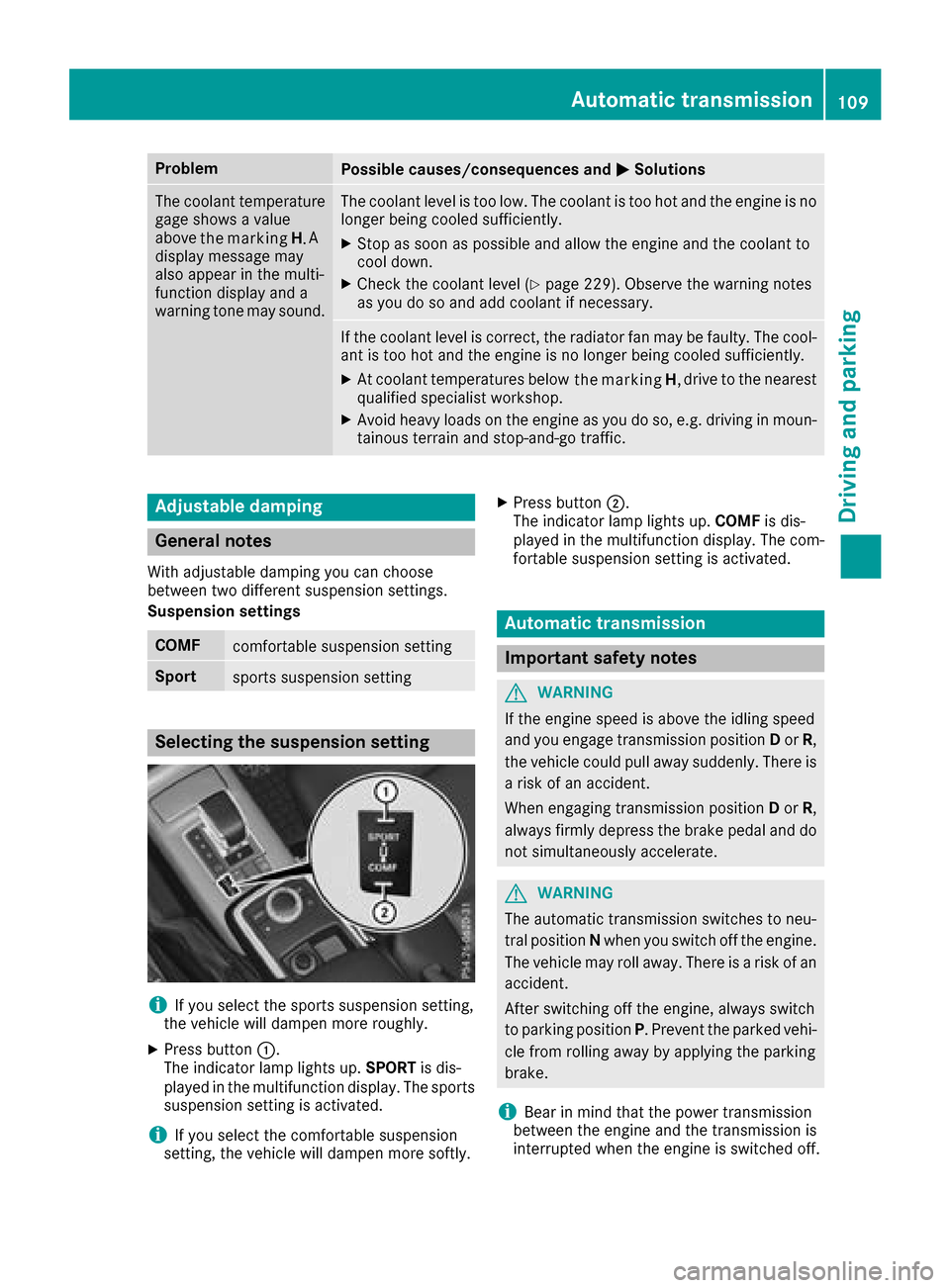
Selecting the suspension setting
iIf you select the sports suspensions etting,
the vehicle wil ldampen more roughly.
XPress button :.
The indicator lamp lights up. SPORTis dis-
played in the multifunction display. The sports
suspensions etting is activated.
iIf you select the comfortable suspension
setting, the vehicle wil ldampen more softly.
XPress button ;.
The indicator lamp lights up. COMFis dis-
played in the multifunction display. The com-
fortabl esuspensions etting is activated.
Automatic transmission
Important safety notes
GWARNING
If the engine speedisa bove the idling speed
and you engag etransmission position Dor R,
the vehicle coul dpulla wa ysuddenly.T here is
ar isk of an accident.
When engaging transmission position Dor R,
always firmlyd epress the brake pedal and do
not simultaneousl yaccelerate.
GWARNING
The automatic transmission switches to neu-
tral position Nwhe nyou switch off the engine.
The vehicle may roll away .There is arisk of an
accident.
After switching off the engine, always switch
to parking position P.Prevent the parke dvehi-
cle from rolling away by applying the parking
brake.
iBear in mind that the power transmission
between the engine and the transmission is
interrupted whe nthe engine is switched off.
Automatic transmission109
Driving and parking
Z
the marking
H
.
the markingH,
Page 112 of 286
For this reason, shift the automatic transmis-
sio ntoP whe nthe engine is switched off and
the vehicle is at astandstill. Appl ythe parking
brake to prevent the vehicle from rolling
away.
Selector lever
Overviewoft ransmissionp ositions
!If the engine speed is too hig horifthe vehi-
cle is rolling, do not shift the transmission
directly from Dto R,f rom Rto Dor directly to
P.
Do not opent he driver's doorw hile the vehi-
cle is in motion. At low speeds in transmission
position Dor R,p arkp osition Pis otherwise
engaged automatically.
The transmission could be damaged.
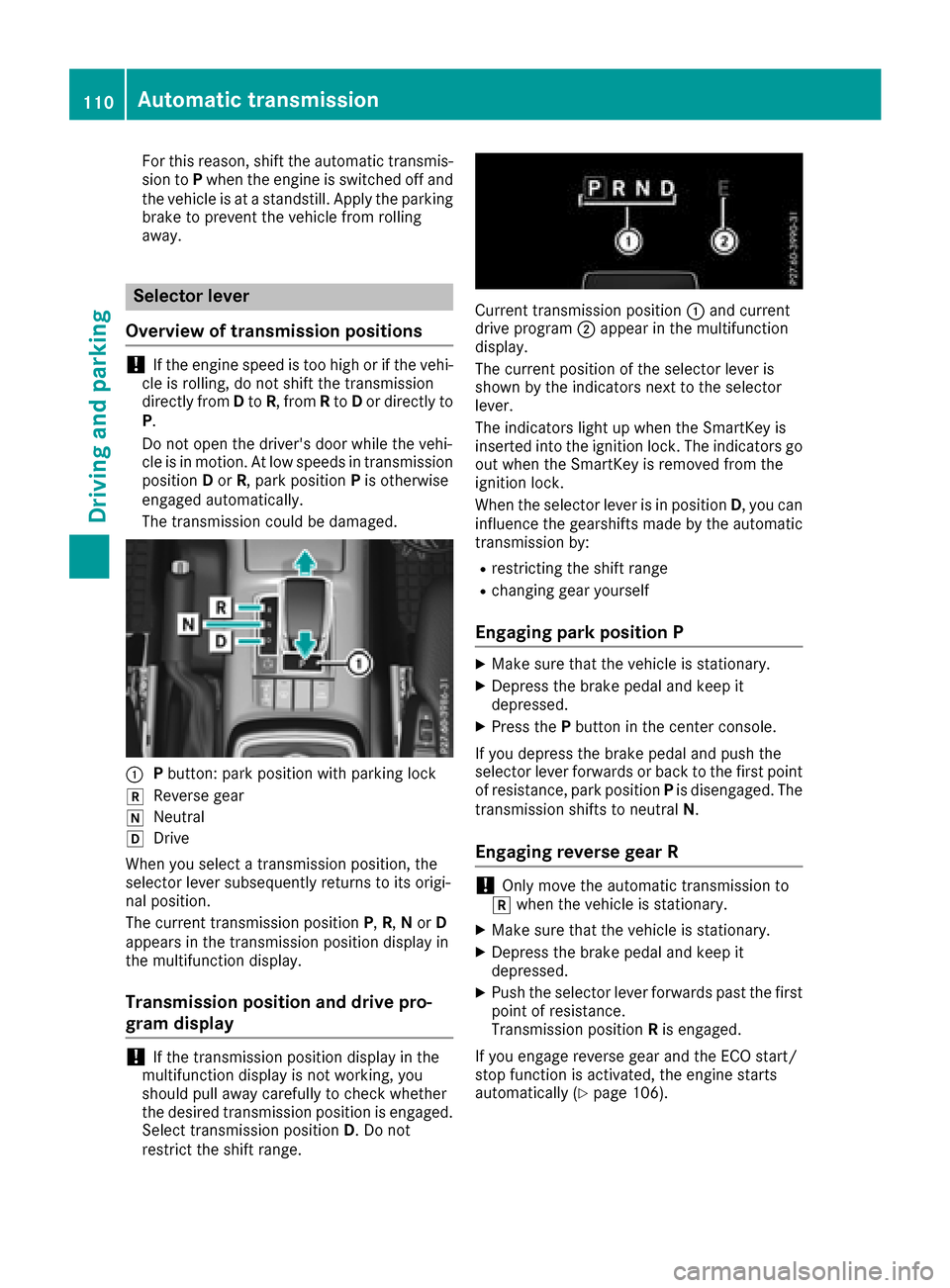
:P button: park positio nwithp arking lock
kReverse gear
iNeutral
hDrive
Wheny ouselect atransmission position, the
selector lever subsequently returns to its origi-
nal position.
The current transmission position P,R, Nor D
appears in the transmission positio ndispla yin
the multifunction display.
Transmissionp ositionand drive pro-
gram display
!If the transmission positio ndispla yint he
multifunction displa yisnot working, you
should pull away carefully to check whether
the desire dtransmission positio nisengaged.
Select transmission position D.Don ot
restrict the shift range.
Current transmission position :and current
drive program ;appea rinthe multifunction
display.
The current positio nofthe selector lever is
shownb ythe indicators next to the selector
lever.
The indicators light up whe nthe SmartKe yis
inserted into the ignition lock. The indicators go
outw hent he SmartKe yisremoved from the
ignition lock.
Whent he selector lever is in position D,y ou can
influence the gearshifts mad ebythe automatic
transmission by:
Rrestricting the shift range
Rchanging geary ourself
Engaging park positionP
XMake sur ethat the vehicle is stationary.
XDepress the brake pedal and keep it
depressed.
XPresst hePbutton in the center console.
If yo udepress the brake pedal and push the
selector lever forward sorbacktot he firs tpoint
of resistance ,parkp osition Pis disengaged.T he
transmission shifts to neutral N.
Engaging reverse gear R
!Only move the automatic transmission to
k whe nthe vehicle is stationary.
XMake sur ethat the vehicle is stationary.
XDepress the brake pedal and keep it
depressed.
XPush the selector lever forward spastthe first
point of resistance.
Transmissio nposition Ris engaged.
If yo uengage reverse geara nd the ECO start/
stop function is activated, the engine starts
automaticall y(
Ypage 106).
110Automatic transmission
Drivingand parking
Page 119 of 286
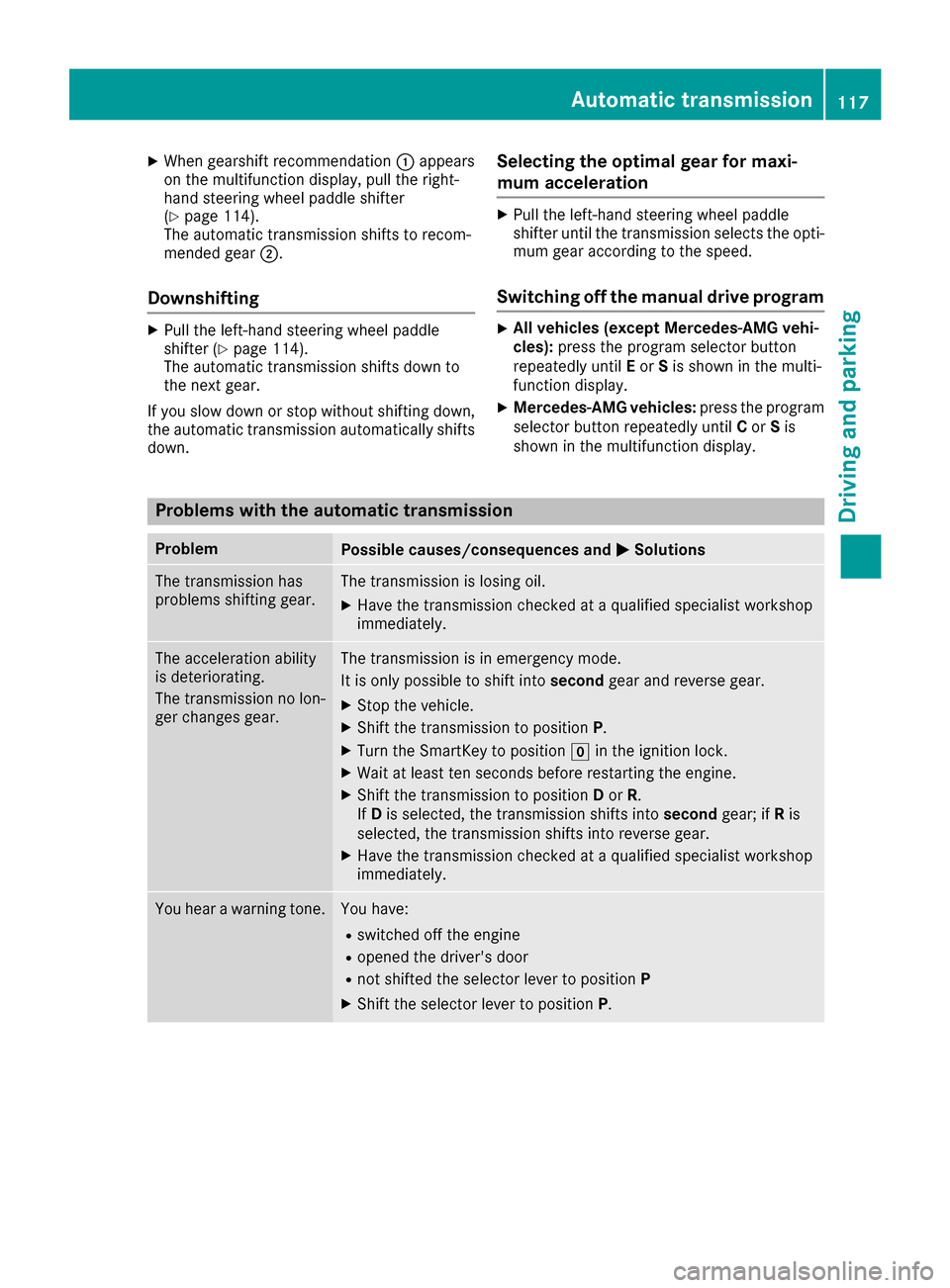
XWhen gearshift recommendation:appears
on the multifunction display, pull the right-
hand steerin gwheel paddle shifter
(
Ypage 114).
The automatic transmission shifts to recom-
mended gear ;.
Downshifting
XPull the left-hand steerin gwheel paddle
shifter (Ypage 114).
The automatic transmission shifts down to
the next gear.
If you slow down or stop without shiftin gdown,
the automatic transmission automatically shifts
down.
Selecting the optimal gear for maxi-
mum acceleration
XPull the left-hand steerin gwheel paddle
shifter until the transmission selects the opti-
mum gear accordingtot he speed.
Switching off the manual drive program
XAll vehicles (except Mercedes ‑AMG vehi-
cles): press the program selector button
repeatedly until Eor Sis shown in the multi-
function display.
XMercedes‑AMG vehicles: press the program
selector button repeatedly until Cor Sis
shown in the multifunction display.
Problems with the automatic transmission
ProblemPossible causes/consequences and MSolutions
The transmission has
problems shiftinggear.The transmission is losing oil.
XHave the transmission checked at aqualified specialist workshop
immediately.
The acceleration ability
is deteriorating.
The transmission no lon-
ger changes gear.The transmission is in emergency mode.
It is only possible to shift into secondgear and reverse gear.
XStop the vehicle.
XShift the transmission to position P.
XTurn the SmartKey to positiongin the ignition lock.
XWait at least ten seconds before restarting the engine.
XShift the transmission to position Dor R.
If D is selected, the transmission shifts into secondgear; ifRis
selected, the transmission shifts into reverse gear.
XHave the transmission checked at aqualified specialist workshop
immediately.
You hear awarning tone.You have:
Rswitched off the engine
Ropened the driver's door
Rnot shifted the selector lever to position P
XShift the selector lever to positionP.
Automatic transmission117
Driving and parking
Z
Page 121 of 286
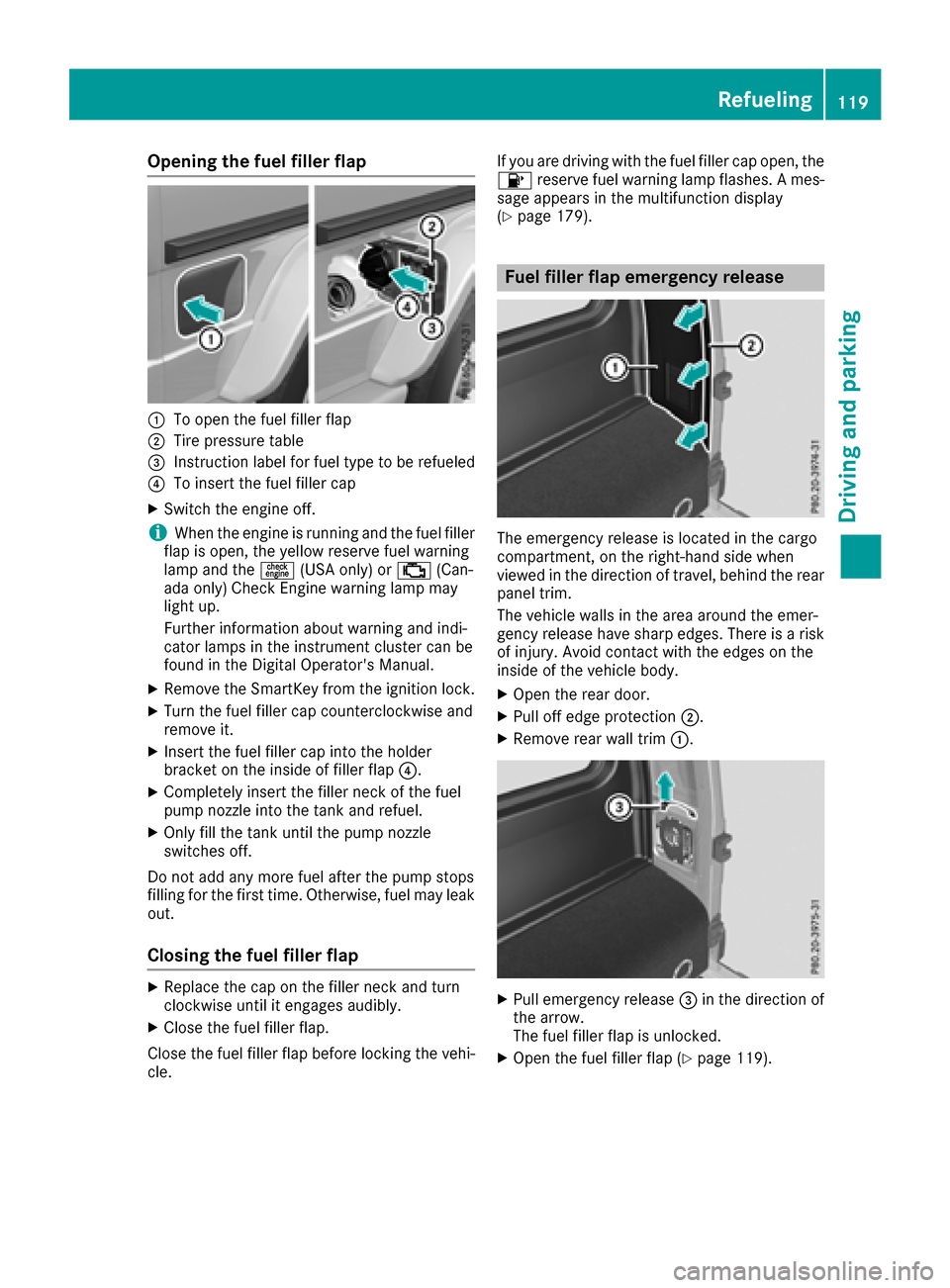
Opening the fuel filler flap
:To open the fuel filler flap
;Tire pressure table
=Instruction label for fuel type to be refueled
?To insert the fuel filler cap
XSwitchthe engine off.
iWhen the engine is running and the fuel filler
flap is open, the yellow reserve fuel warning
lamp and the =(USA only) or ;(Can-
ada only) Check Engine warning lamp may
light up.
Further information about warning and indi-
cator lamps in the instrument cluster can be
found in the Digital Operator's Manual.
XRemove the SmartKey from the ignition lock.
XTurn the fuel filler cap counterclockwise and
remove it.
XInser tthe fuel filler cap into the holder
bracket on the inside of filler flap ?.
XCompletely insert the filler neck of the fuel
pump nozzle into the tank and refuel.
XOnly fill the tank until the pump nozzle
switches off.
Do not add any more fuel after the pump stops
filling for the first time. Otherwise, fuel may leak
out.
Closing the fuel filler flap
XReplace the cap on the filler neck and turn
clockwise until it engages audibly.
XClose the fuel filler flap.
Close the fuel filler flap before lockin gthe vehi-
cle. If you are driving with the fuel filler cap open, the
8
reservef uel warning lamp flashes. Ames-
sage appears in the multifunction display
(
Ypage 179).
Fuel filler flap emergency release
The emergency release is located in the cargo
compartment ,onthe right-hand side when
viewed in the direction of travel, behind the rear
panel trim.
The vehicle walls in the area around the emer-
genc yrelease have sharp edges. There is arisk
of injury. Avoid contact with the edges on the
inside of the vehicle body.
XOpen the rear door.
XPull off edge protection ;.
XRemove rear wall trim:.
XPull emergency release =in the direction of
the arrow.
The fuel filler flap is unlocked.
XOpen the fuel filler flap (Ypage 119).
Refueling119
Driving and parking
Z
Page 126 of 286
Heavy and light loads
GWARNING
If you rest you rfoot on the brake pedalw hile
driving, the braking system can overheat. This increases the stopping distance and can even
caus ethe braking system to fail .There is a
risk of an accident.
Never use the brake pedalasaf ootrest. Never
depress the brake pedala nd the accelerator
pedalatt he same time.
!Depressing the brake pedalc onstantly
results in excessive and premature weart o
the brake pads.
If the brakes have been subjected to aheavy
load, do not stop the vehiclei mmediately. Drive
on for ashort while. This allows the airflow to
cool the brakes more quickly.
Wet roads
If driving in heavy rain for aprolonged period of
time without braking, there may be adelayed
reactio nfrom the brakes when braking for the
first time. This may als ooccur after the vehicle
has been washed.
You have to depress the brake pedalm ore
firmly.M aintainagreater distance from the
vehicleinf ront.
After driving on awet road or having the vehicle
washed, brake firmly while paying attention to
the traffic conditions. This wil lwarmupt he
brake discs, thereby drying them more quickly
and protecting them against corrosion.
Limited braking performance on salt-
treated roads
If you drive on salted roads, alayer of sal tresi-
due may form on the brake discs and brake
pads. This can result in asignificantly longer
braking distance.
RIn order to prevent any sal tbuild-up, apply the
brakes occasionall ywhile paying attention to
the traffic conditions.
RCarefully depress the brake pedala nd the
beginning and end of ajourney.
RMaintain agreater distance to the vehicle
ahead.
Servicing the brakes
!The brake flui dlevelm ay be too low,i f:
Rif the red brake warning lamp lights up in
the instrument cluste rand
Ryou hearaw arning tone while the engine is
running
Observe additiona lwarning messages in the
multifunction display.
The brake flui dlevelm ay be too low due to
brake pad wearorl eaking brake lines.
Have the brake system checked immediately. Consult aqualified specialist workshopt o
arrange this.
!If the brake warning lamp lights up in the
instrument cluste rand you hearaw arning
tone even though the parking brake has been
released ,the brake flui dlevelm ay be too low.
Observe additionalw arning messages in the
multifunction display.
The brake flui dlevelm ay be too low due to
brake pad wearorl eaking brake lines.
Have the brake system checked immediately.
This work should be carrie dout at aqualified
specialist workshop.
!Af unction or performance test should only
be carrie dout on a2-axle dynamometer. If
you wis htooperate the vehicleons uch a
dynamometer, please consul taqualified spe-
cialist workshopina dvance. You couldoth-
erwise damage the drive train or the brake
system.
!The ESP®system operates automatically.I f
the parking brake is tested on abrake dyna-
mometer (for amaximu moften seconds),t he
engine and the ignitio nmust be switched off.
Braking triggereda utomatically by ESP
®may
otherwise caus esevere damage to the brake
system.
All checks and maintenance work on the brake
system must be carrie dout at aqualified spe-
cialist workshop.
Have brake pad sinstalled and brake fluid
replaced at aqualified specialist workshop.
If the brake system has only been subject to
moderate loads, you shoul
d test the functional-
ity of you rbrakes at regular intervals.
Informatio nonBAS (Brake Assist) (
Ypage5 8).
124Driving tips
Driving and parking
Page 130 of 286
Familiarize yourself with the characteristics of
your vehicle and the gearshift operation before
driving through difficult terrain.
The following driving systems are specially
adapted to off-roadd riving:
R4ETS (Ypage 59)
ROff-roadABS (Ypage 58)
RTransfer case (Ypage 145)
RDifferentia llocks (Ypage 120)
Observe the following notes:
RStop the vehicle before yo udrive off-roada nd,
if necessary ,shift the transfe rcase to the off-
roadd riving position LOW RANGE
(
Ypage 146).
REngag ethe differential locks if necessary
(Ypage 148).
iABS, 4ETS, ESP®and BAS are deactivated
while the differential locks are engaged.T his
allow sthe front wheels to lock briefly, so that
these can dig into aloose surface .However,
please note that locke dwheels skid and can
no longer steer.
RCheck that items of luggage and loads are
stowed safely and are well secured
(
Ypage 209).
RTo avoid damaging the vehicle, make sure
there is always sufficient ground clearance.
RAlway skeep the engine running and in gear
whe ndriving on adownhil lgradient.
RAlway skeep the engine running and in gear
whe ndriving downani ncline.
RDrive slowlyand evenly, if necessary at a
walking pace.
REnsure that the wheels are in contact with the
ground at al ltimes.
RDrive with extreme care on unfamilia roff-road
routes where visibility is poor. For safety rea-
sons, get ou
tofthe vehicle firs tand survey
the off-roadr oute.
RCheck the depth of water before fording rivers
and streams.
RWatch outfor obstacles.
RAlwayskeep the doors, reard oor, sidewin-
dowsa nd the sliding sunroof closed while the
vehicle is in motion.
RSwitch off cruise control.
RDo not deviate from marke droutes.
RAdap tyou rspeed to the terrain. The rougher,
steeper or more ruts on the terrain, the slower
your speed should be.
RDo not jump with the vehicle. as this will inter-
rup tthe vehicle' spropulsion.
RAvoid hig hengine speeds .Drive at appropri-
ate engine speeds (maximu m3,000 rpm).
RDo not shift the automatic transmission to
position N.
RAlwayscheck the vehicle for damag eafteroff-
roadd riving.
Do not use the HOLD function whe ndriving off-
road, on steep uphil lordownhil lgradients or on
slippery or loose surfaces. The HOLD function
cannot holdt he vehicle on such surfaces.
You can obtain further information aboutr etro-
fitting specia lall-terrain tires from aquali fied
specialist workshop.
Checklist before driving off-road
!If the engine oil warning lamp lights up while
the vehicle is in motion, stop the vehicle in a
saf ep lace as soona spossible. Check the
engine oil level. The engine oil warning lamp
warning mus tnot be ignored.C ontinuing the
journey while the symbol is displaye dcould
lea dtoe ngine damage.
XEngin eoillevel: check the engine oil level
and ad doil if necessary.
Whend riving on steep gradients, the engine
oil level mus tbes ufficiently hig htoensure a
correct oil supply in the vehicle.
XTire-changing too lkit: check that the jack is
working and make sur eyou hav ethe lug
wrench, arobust tow cable and afolding
spade in the vehicle.
XWheels and tires: check the tire treadd epth
and tire pressure.
XCheck for damag eand remove any foreign
objects, e.g. small stones,f rom the wheels/
tires.
XReplace any missing valve caps.
XReplace dente dordamaged wheels .Also
check the spare wheel.
XRims: dentedorbent rims can result in aloss
of tire pressure and damag ethe tire bead.
Befored riving off-road, check the wheels and
replace them if necessary.
128Drivin gtips
Drivin gand parking