engine MERCEDES-BENZ G-Class 2017 W463 Workshop Manual
[x] Cancel search | Manufacturer: MERCEDES-BENZ, Model Year: 2017, Model line: G-Class, Model: MERCEDES-BENZ G-Class 2017 W463Pages: 286, PDF Size: 4.91 MB
Page 118 of 286
Shift recommendation
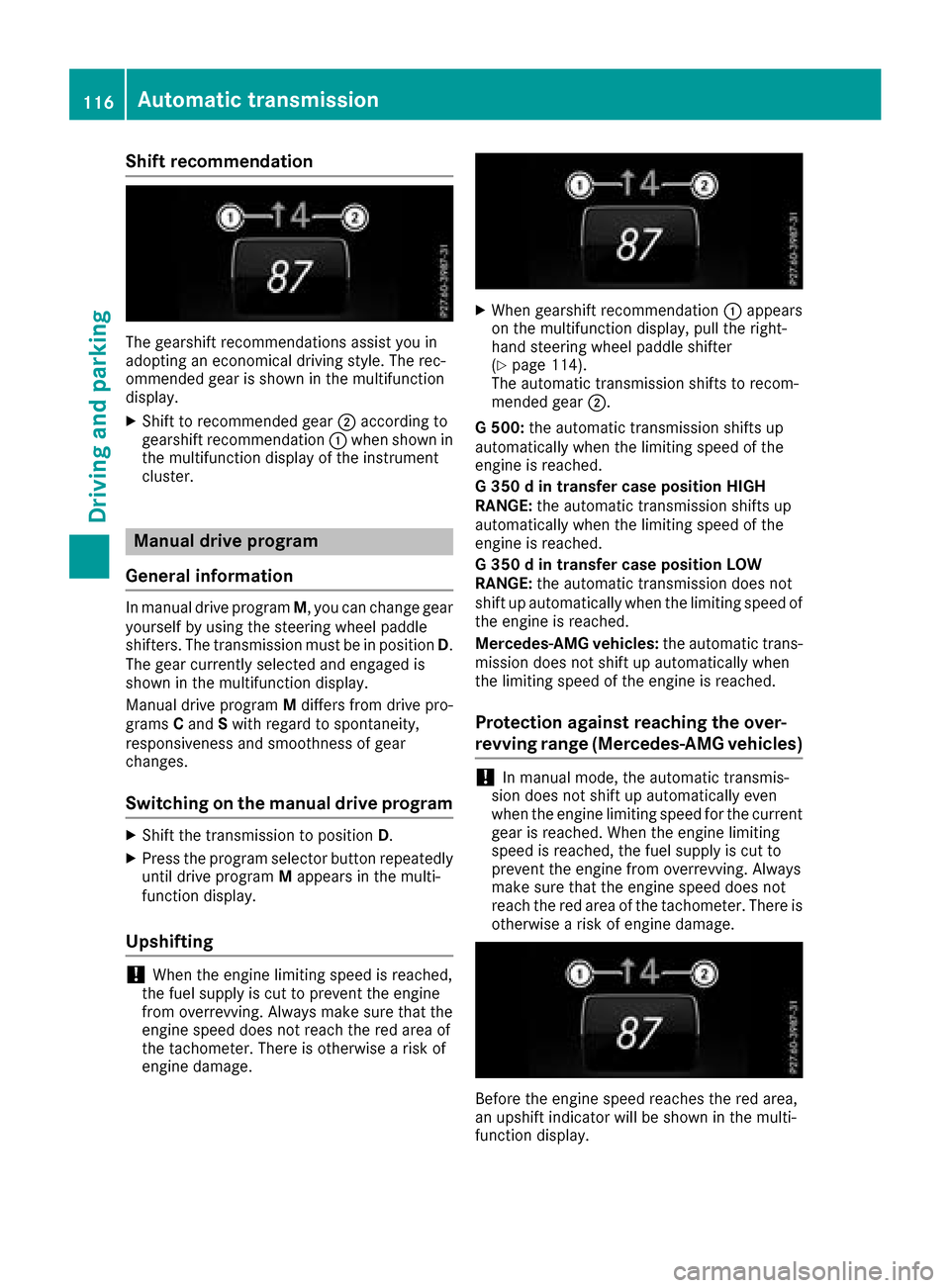
The gearshift recommendations assist you in
adopting an economical driving style. The rec-
ommended gear is shown in the multifunction
display.
XShift to recommended gear;according to
gearshift recommendation :when shown in
the multifunction display of the instrument
cluster.
Manual drive program
General information
In manual drive program M,you can change gear
yourself by using the steering wheel paddle
shifters. The transmission must be in position D.
The gear currently selected and engaged is
shown in the multifunction display.
Manual drive program Mdiffers from drive pro-
grams Cand Swith regard to spontaneity,
responsiveness and smoothness of gear
changes.
Switching on the manuald rive program
XShift the transmission to position D.
XPress the program selector button repeatedly
until drive program Mappears in the multi-
function display.
Upshifting
!When the engine limiting speed is reached,
the fuel supply is cut to prevent the engine
from overrevving. Always make sure that the
engine speed does not reach the red area of
the tachometer. There is otherwise arisk of
engine damage.
XWhen gearshift recommendation :appears
on the multifunction display,p ull the right-
hand steering wheel paddle shifter
(
Ypage 114).
The automatic transmission shifts to recom-
mended gear ;.
G5 00: the automatic transmission shifts up
automatically when the limiting speed of the
engine is reached.
G3 50dint ransfer case position HIGH
RANGE: the automatic transmission shifts up
automatically when the limiting speed of the
engine is reached.
G3 50dint ransfer case position LOW
RANGE: the automatic transmission does not
shift up automatically when the limiting speed of
the engine is reached.
Mercedes-AMG vehicles: the automatic trans-
mission does not shift up automatically when
the limiting speed of the engine is reached.
Protection against reaching the over-
revving range (Mercedes-AMG vehicles)
!In manual mode, the automatic transmis-
sion does not shift up automatically even
when the engine limiting speed for the current
gear is reached. When the engine limiting
speed is reached, the fuel supply is cut to
prevent the engine from overrevving. Always
make sure that the engine speed does not
reach the red area of the tachometer. There is
otherwise arisk of engine damage.
Before the engine speed reaches the red area,
an upshift indicator will be shown in the multi-
function display.
116Automatic transmission
Driving and parking
Page 119 of 286
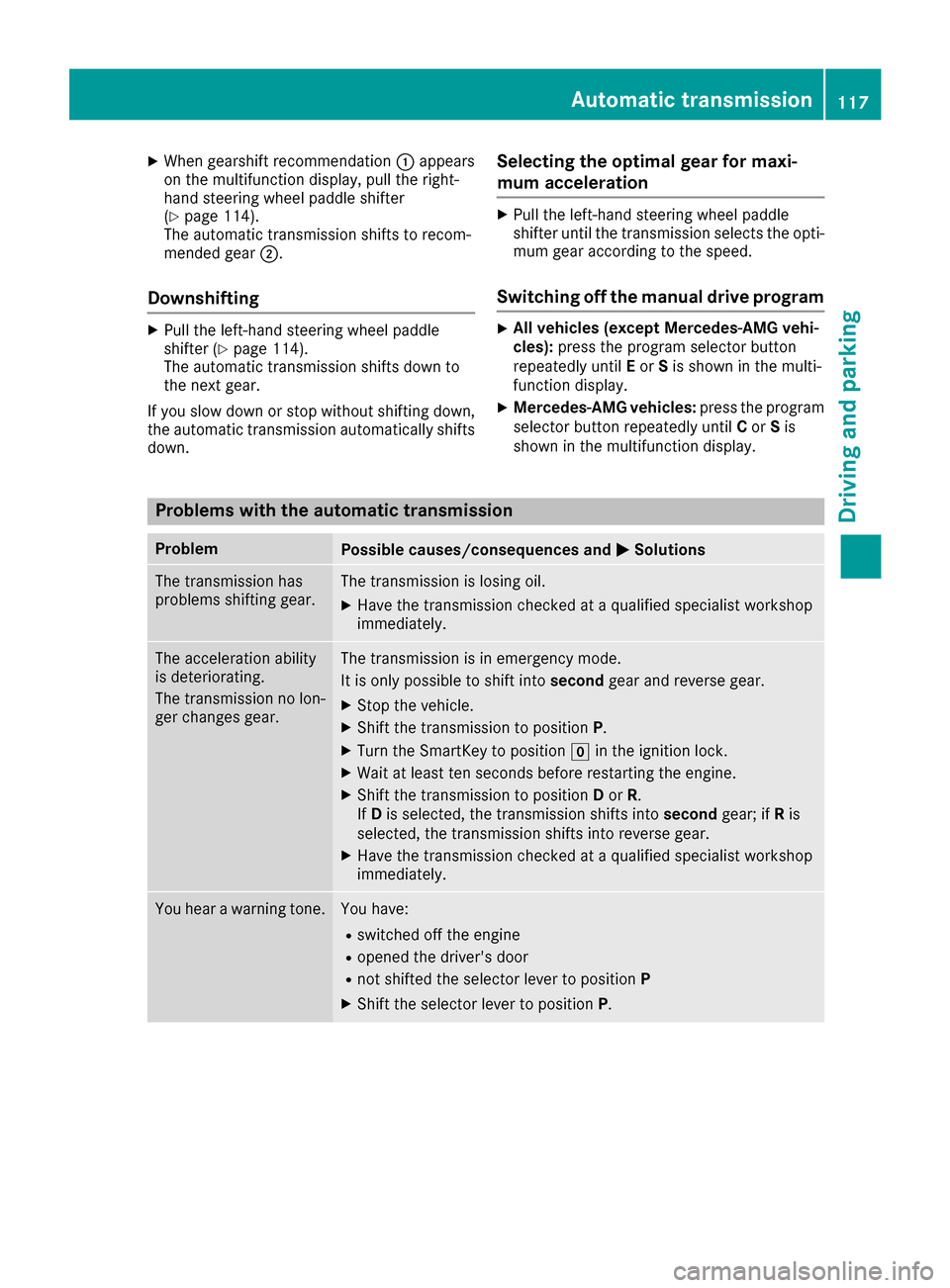
XWhen gearshift recommendation:appears
on the multifunction display, pull the right-
hand steerin gwheel paddle shifter
(
Ypage 114).
The automatic transmission shifts to recom-
mended gear ;.
Downshifting
XPull the left-hand steerin gwheel paddle
shifter (Ypage 114).
The automatic transmission shifts down to
the next gear.
If you slow down or stop without shiftin gdown,
the automatic transmission automatically shifts
down.
Selecting the optimal gear for maxi-
mum acceleration
XPull the left-hand steerin gwheel paddle
shifter until the transmission selects the opti-
mum gear accordingtot he speed.
Switching off the manual drive program
XAll vehicles (except Mercedes ‑AMG vehi-
cles): press the program selector button
repeatedly until Eor Sis shown in the multi-
function display.
XMercedes‑AMG vehicles: press the program
selector button repeatedly until Cor Sis
shown in the multifunction display.
Problems with the automatic transmission
ProblemPossible causes/consequences and MSolutions
The transmission has
problems shiftinggear.The transmission is losing oil.
XHave the transmission checked at aqualified specialist workshop
immediately.
The acceleration ability
is deteriorating.
The transmission no lon-
ger changes gear.The transmission is in emergency mode.
It is only possible to shift into secondgear and reverse gear.
XStop the vehicle.
XShift the transmission to position P.
XTurn the SmartKey to positiongin the ignition lock.
XWait at least ten seconds before restarting the engine.
XShift the transmission to position Dor R.
If D is selected, the transmission shifts into secondgear; ifRis
selected, the transmission shifts into reverse gear.
XHave the transmission checked at aqualified specialist workshop
immediately.
You hear awarning tone.You have:
Rswitched off the engine
Ropened the driver's door
Rnot shifted the selector lever to position P
XShift the selector lever to positionP.
Automatic transmission117
Driving and parking
Z
Page 120 of 286
Refueling
Important safety notes
GWARNING
Fue lish ighly flammable. If yo uhandlef uel
incorrectly, there is ariskoff ire and explo-
sion.
Yo um usta void fire ,ope nf lames ,creating
sparks and smoking. Switch off the engine
and ,ifa pplicable, the auxiliary heating before
refueling.
GWARNING
Fue lisp oisonous and hazardoustoh ealth.
There is ariskofi njury.
Yo um ustm ake sure that fue ldoe sn ot come
into contact with your skin, eyes or clothing
and that it is not swallowed. Do not inhale fuel
vapors. Keepf uelawa yfrom children.
If yo uoro thers come into contact with fuel,
observe the following:
RWash away fue lfrom skin immediately
using soapa nd water.
RIf fuelcomesi nto contact with your eyes,
immediately rins ethem thoroughly with
clean water. Seek medica lassistance with-
outd elay.
RIf fuelisswallowed, seekm edicalassis-
tance withoutd elay.Don ot induce vomit-
ing.
RImmediately change outofc lothing which
hasc ome into contact with fuel.
GWARNING
Electrostatic buildu pcan create sparks and
ignite fue lvapors. There is ariskoff ire and
explosion.
Alway stouch the vehicl ebodyb efore opening
the fue lfille rflaport ouching the fue lpum p
nozzle .Any existing electrostati cbuildup is
thereby discharged.
Do not get into the vehicl eagain during the refu-
eling process .otherwise electrostati ccharge
could buil dupagain.
!Do not us ediese ltor efuel vehicles with a
gasoline engine. Do not switch on the ignition
if yo uaccidentall yrefuel with the wrong fuel.
Otherwise, the fue lwille nter the fue lsys tem.
Even small amounts of the wrong fue lcould
resul tind amagetot he fue lsystem and the
engine. Notify aquali fied specialist workshop
and have the fue ltank and fue llin es drained
completely.
!Overfilling the fue ltank could damag ethe
fue lsystem.
!Take care not to spill any fue lonpainted
surfaces. Yo ucould otherwise damag ethe
paintwork.
!Use afilter when adding fue lfrom afue lcan.
The fue llin es and/or the fue linjection system
could otherwise be blocked by particles from
the fue lcan.
If yo uoverfil lthe fue ltank, fue lcould spray out
when the fue lpum pnozzle is removed.
If yo uoverfil lthe fue ltank, pressure may build
up in the fue ltank. Thisc ould ca
use fue
ltospray
outw hent he fue lpum pnozzle is removed.
There is ariskofi njury. The fue ltank is ful lwhen
the fue lpum pnozzle firs tswitches off. End the
refueling process.
For further information on fue land fue lquali ty
(
Ypage 276).
Refueling
General information
Paya ttention to the important safety notes
(Ypage 118).
If yo uunlock/lock the vehicl efrom the outside,
the fue lfille rflapa lsou nlocks/locks.
The position of the fue lfille rcap is displayed in
the instrument cluster 8.The arrow next to
the filling pump indicates the sid eofthe vehicle.
118Refueling
Driving and parking
Page 121 of 286
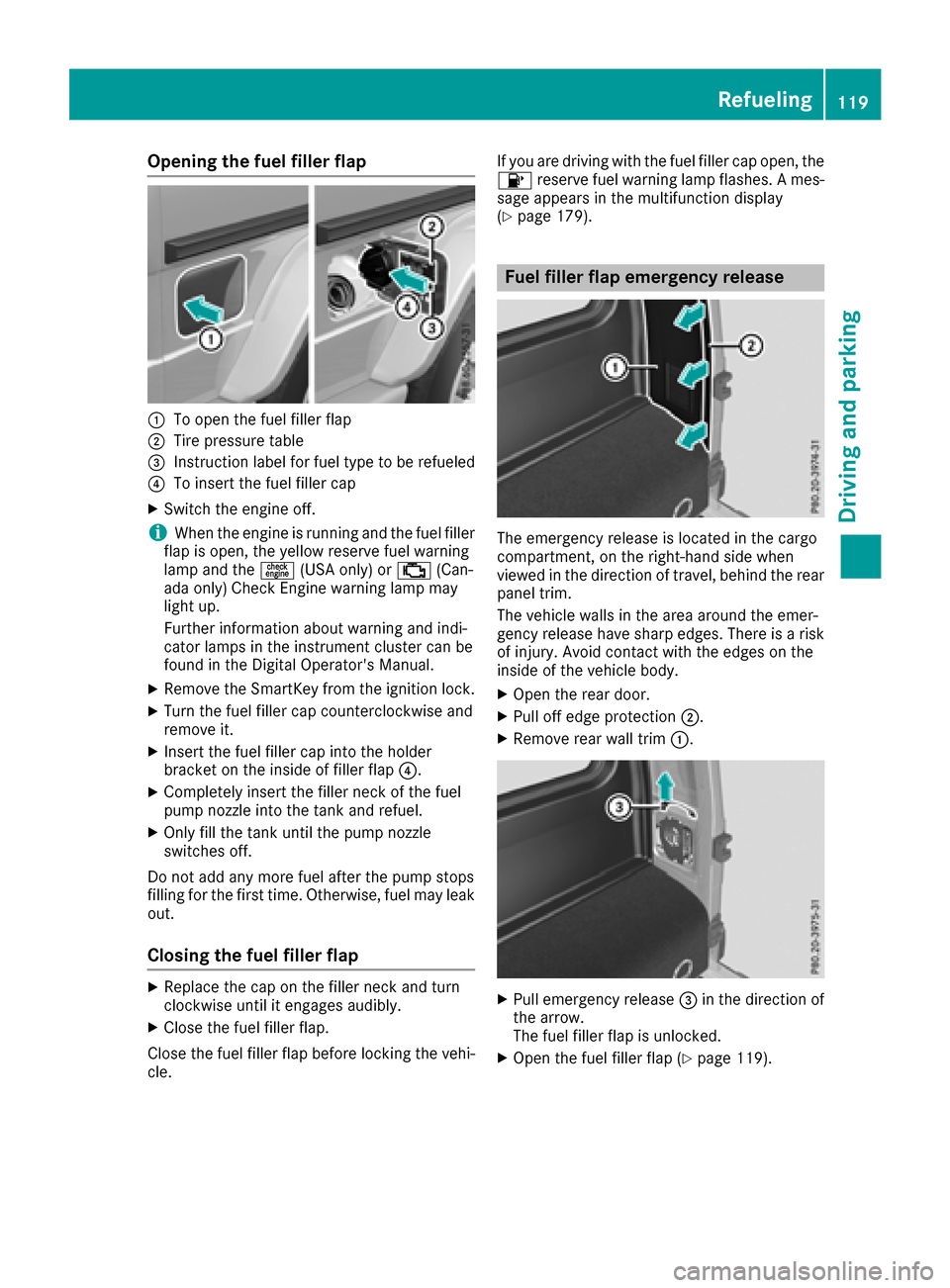
Opening the fuel filler flap
:To open the fuel filler flap
;Tire pressure table
=Instruction label for fuel type to be refueled
?To insert the fuel filler cap
XSwitchthe engine off.
iWhen the engine is running and the fuel filler
flap is open, the yellow reserve fuel warning
lamp and the =(USA only) or ;(Can-
ada only) Check Engine warning lamp may
light up.
Further information about warning and indi-
cator lamps in the instrument cluster can be
found in the Digital Operator's Manual.
XRemove the SmartKey from the ignition lock.
XTurn the fuel filler cap counterclockwise and
remove it.
XInser tthe fuel filler cap into the holder
bracket on the inside of filler flap ?.
XCompletely insert the filler neck of the fuel
pump nozzle into the tank and refuel.
XOnly fill the tank until the pump nozzle
switches off.
Do not add any more fuel after the pump stops
filling for the first time. Otherwise, fuel may leak
out.
Closing the fuel filler flap
XReplace the cap on the filler neck and turn
clockwise until it engages audibly.
XClose the fuel filler flap.
Close the fuel filler flap before lockin gthe vehi-
cle. If you are driving with the fuel filler cap open, the
8
reservef uel warning lamp flashes. Ames-
sage appears in the multifunction display
(
Ypage 179).
Fuel filler flap emergency release
The emergency release is located in the cargo
compartment ,onthe right-hand side when
viewed in the direction of travel, behind the rear
panel trim.
The vehicle walls in the area around the emer-
genc yrelease have sharp edges. There is arisk
of injury. Avoid contact with the edges on the
inside of the vehicle body.
XOpen the rear door.
XPull off edge protection ;.
XRemove rear wall trim:.
XPull emergency release =in the direction of
the arrow.
The fuel filler flap is unlocked.
XOpen the fuel filler flap (Ypage 119).
Refueling119
Driving and parking
Z
Page 122 of 286
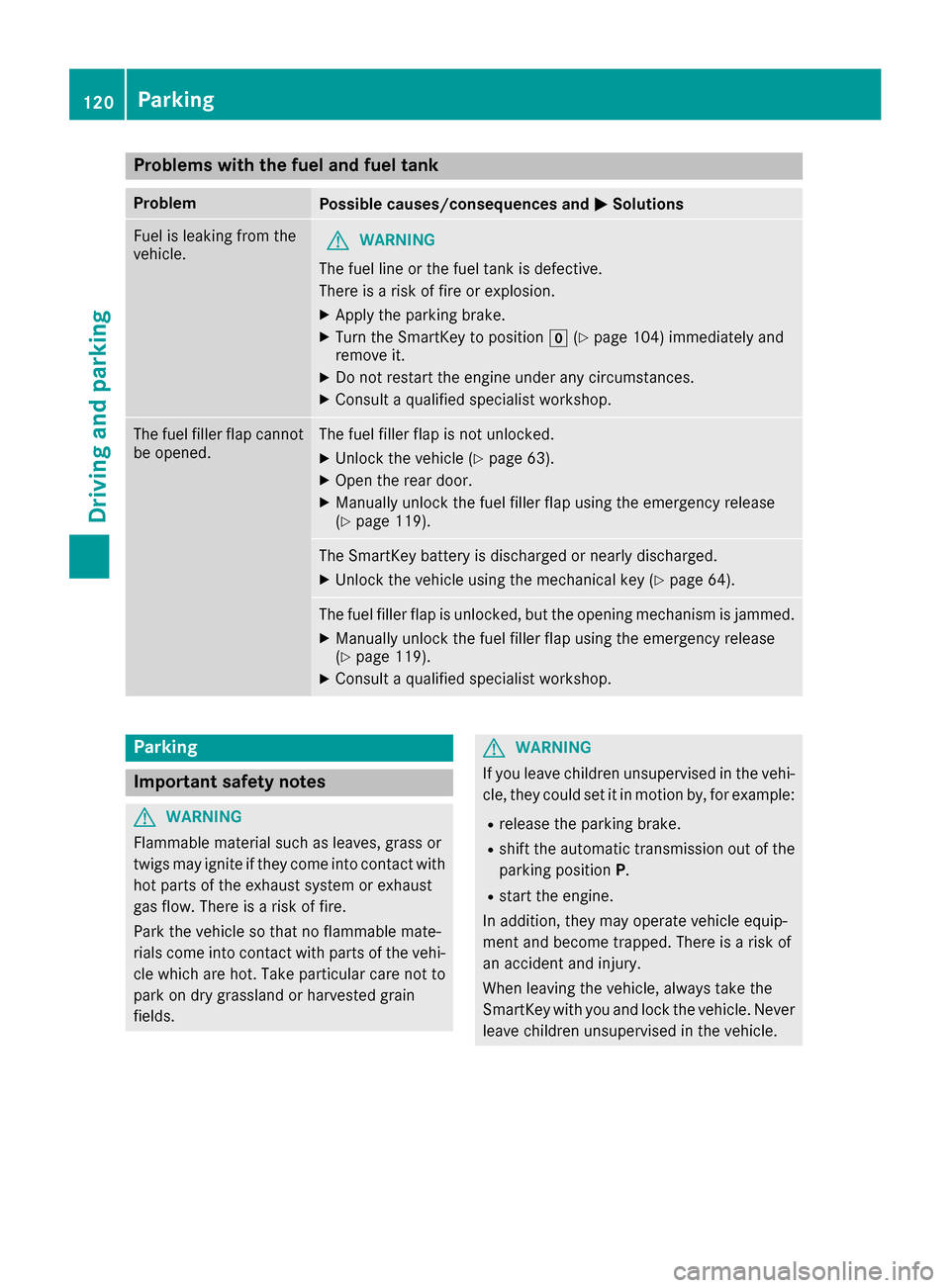
Problems with the fuel and fuel tank
ProblemPossible causes/consequences andMSolutions
Fuel is leaking from the
vehicle.GWARNING
The fuel line or the fuel tank is defective.
There is arisk of fire or explosion.
XApply the parking brake.
XTurn the SmartKey to position g(Ypage 104) immediately and
remove it.
XDo not restart the engine under any circumstances.
XConsult aqualified specialist workshop.
The fuel filler flap cannot
be opened.The fuel filler flap is not unlocked.
XUnlock the vehicle (Ypage 63).
XOpen the rear door.
XManually unlock the fuel filler flap using the emergency release
(Ypage 119).
The SmartKey battery is discharged or nearly discharged.
XUnlock the vehicle using the mechanical key (Ypage 64).
The fuel filler flap is unlocked, but the opening mechanism is jammed.
XManually unlock the fuel filler flap using the emergency release
(Ypage 119).
XConsult aqualified specialist workshop.
Parking
Important safety notes
GWARNING
Flammable material such as leaves, grass or
twigs may ignite if they come into contact with
hot parts of the exhaust system or exhaust
gas flow. There is arisk of fire.
Park the vehicle so that no flammable mate-
rials come into contact with parts of the vehi-
cle which are hot. Take particular care not to
park on dry grassland or harvested grain
fields.
GWARNING
If you leave children unsupervised in the vehi-
cle, they could set it in motion by, for example:
Rrelease the parking brake.
Rshift the automatic transmission out of the
parking position P.
Rstart the engine.
In addition, they may operate vehicle equip-
ment and become trapped. There is arisk of
an accident and injury.
When leaving the vehicle, always take the
SmartKey with you and lock the vehicle. Never
leave children unsupervised in the vehicle.
120Parking
Driving and parking
Page 123 of 286
To ensure that the vehicle is safeguarded
against rolling away unintentionally:
Rthe parking brake must be applied.
Rthe transmission must be in positionPand the
SmartKey must be removed from the ignition
lock
Rthe transfer case must not be in the neutral
position
Rthe front wheels must be turned towards the
curb on steep uphill or downhill gradients
Rthe empty vehicle must be secured at the
front axle with awheel chock or similar
object ,for example, on uphill or downhill gra-
dients
Ral aden vehicle must also be secured at the
rear axle with awheel chock or similar object,
for example, on uphill or downhill gradients
Switching off the engine
GWARNING
The automatic transmission switches to neu-
tral position Nwhen you switch off the engine.
The vehicle may roll away.T here isarisk of an
accident.
After switching off the engine, alwayss witch
to parking position P.Prevent the parked vehi-
cle from rolling away by applying the parking
brake.
XShift the automatic transmission to position
P.
XTurn the SmartKey to position 0in the ignition
lock and remove it.
The immobilizer is activated.
XApply the parking brake firmly.
XTurn the steerin gwheel until the steering
wheel lock engages.
If you switch the engine off with the transmis-
sion in position Ror D,t he automatic transmis-
sion shifts to Nautomatically.
If you then open the driver's door or the front-
passenger door or remove the SmartKey from
the ignition ,the automatic transmission shifts
to Pautomatically.
If you switch off the engine while the transmis-
sion is in position N,t he automatic transmission
remains in Neven if adoor is opened. The auto-
matic transmission only automatically shifts into neutral
Nwhen you switch off the engine
using the SmartKey.
Parking brake
GWARNING
If you must brake the vehicle with the parking brake, the braking distance is considerably
longer and the wheels could lock. There is an
increased danger of skidding and accidents.
Only use the parking brake to brake the vehi-
cle when the service brake is faulty. Do not
apply the parking brake too firmly. If the
wheels lock, release the parking brake until
the wheels begin turnin gagain.
GWARNING
If you leave children unsupervised in the vehi-
cle, they could set it in motion by, for example:
Rrelease the parking brake.
Rshift the automatic transmission out of the
parking position P.
Rstart the engine.
In addition, they may operate vehicle equip-
ment and become trapped. There is arisk of
an accident and injury.
When leaving the vehicle, alwayst ake the
SmartKey with you and lock the vehicle. Never
leave children unsupervised in the vehicle.
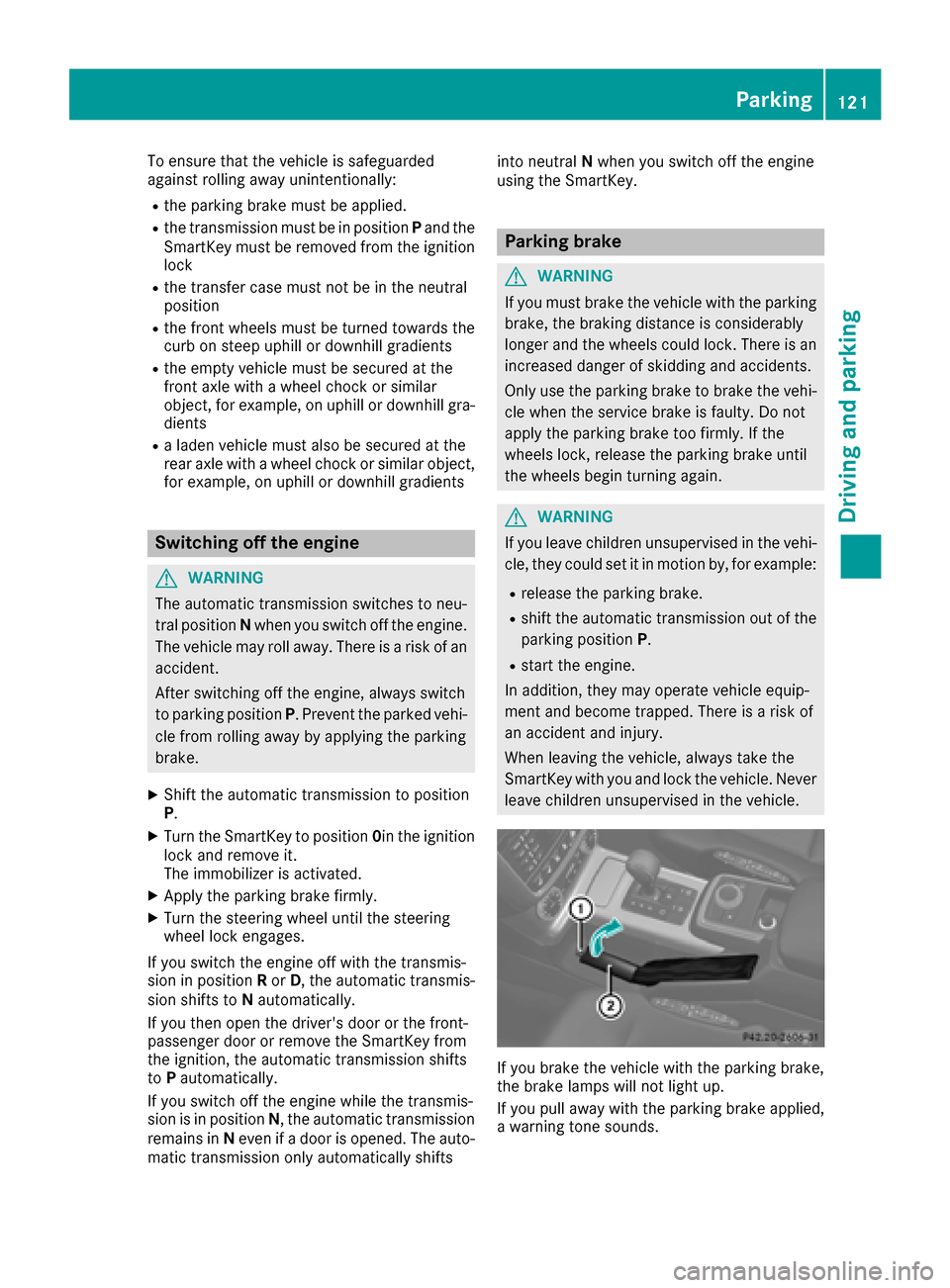
If you brake the vehicle with the parking brake,
the brake lamps will not light up.
If you pull away with the parking brake applied,
aw arning ton esounds.
Parking121
Driving and parking
Z
Page 125 of 286
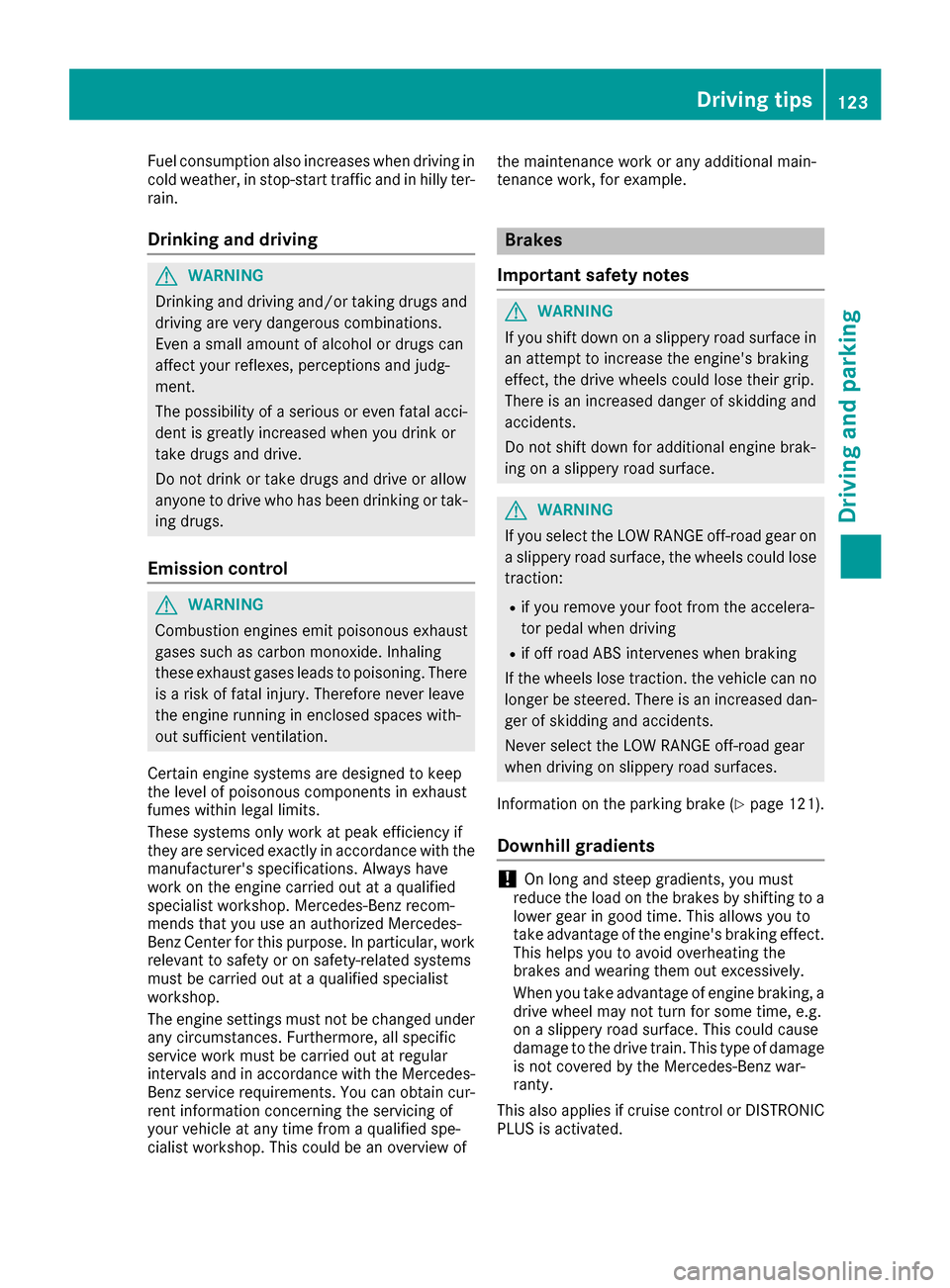
Fuelconsumptio nalsoi ncreases whe ndriving in
cold weather, in stop-start traffi cand in hilly ter-
rain.
Drinking and driving
GWARNING
Drinking and driving and/o rtaking drugs and
driving are very dangerous combinations.
Even asmall amount of alcoholord rugs can
affect your reflexes,p erceptions and judg-
ment.
The possibility of aseriousore ven fatalacci-
dent is greatly increased whe nyou drink or
take drugs and drive.
Do not drink or take drugs and drive or allow
anyone to drive who has bee ndrinking or tak-
ing drugs.
Emissionc ontrol
GWARNING
Combustio nengines emitp oisonousexhaust
gases such as carbon monoxide. Inhaling
these exhaust gases leads to poisoning. There
is ar isk of fata linjury. Therefore never leave
the engine running in enclosed spaces with-
outs ufficient ventilation.
Certai nengine systems are designe dtokeep
the level of poisonousc omponents in exhaust
fume swithin legal limits.
These systems only wor katpeakefficiency if
they are serviced exactl yinaccordance with the
manufacturer's specifications. Alway shave
wor kont he engine carried outata qualified
specialist workshop.M ercedes-Benz recom-
mends that yo uuse an authorized Mercedes-
Benz Center for this purpose. In particular, work
relevant to safety or on safety-related systems
mus tbec arried outata qualified specialist
workshop.
The engine setting smustn ot be changed under
any circumstances. Furthermore,a llspecific
service wor kmustb ec arried outatr egular
intervals and in accordance with the Mercedes-
Benz service requirements. You can obtain cur-
rent information concerning the servicing of
your vehicle at any time from aquali fied spe-
cialist workshop.T hiscould be an overvie wof the maintenance wor
korany additional main-
tenance work, for example.
Brakes
Important safety notes
GWARNING
If yo ushift downonaslippery roads urface in
an attemp ttoincrease the engine's braking
effect, the drive wheels could los etheirg rip.
There is an increased danger of skidding and
accidents.
Do not shift downf or additional engine brak-
ing on aslippery roads urface.
GWARNING
If yo uselect the LOW RANG Eoff-roadg earon
as lippery roads urface,the wheels could lose
traction:
Rif yo uremove your foot from the accelera-
tor pedal whe ndriving
Rif off roadA BS intervenes whe nbraking
If the wheels los etraction. the vehicle can no
longer be steered. There is an increased dan-
ger of skidding and accidents.
Nevers elect the LOW RANG Eoff-roadg ear
whe ndriving on slippery roads urfaces.
Information on the parking brake (
Ypage 121).
Downhillg radients
!On long and steep gradients, yo umust
reduce the loa donthe brakes by shifting to a
lower gearing oodtime. Thisa llow syou to
take advantage of the engine's braking effect.
Thish elps yo utoavoid overheating the
brakes and wearing them oute xcessively.
Wheny outake advantage of engine braking, a
drive wheel may not turn for some time, e.g.
on aslippery roads urface.Thisc ould cause
damag etothe drive train. Thist ypeofd amage
is not covered by the Mercedes-Benz war-
ranty.
Thisa lsoa pplies if cruise control or DISTRONIC
PLUS is activated.
Drivin gtips123
Drivin gand parking
Z
Page 126 of 286
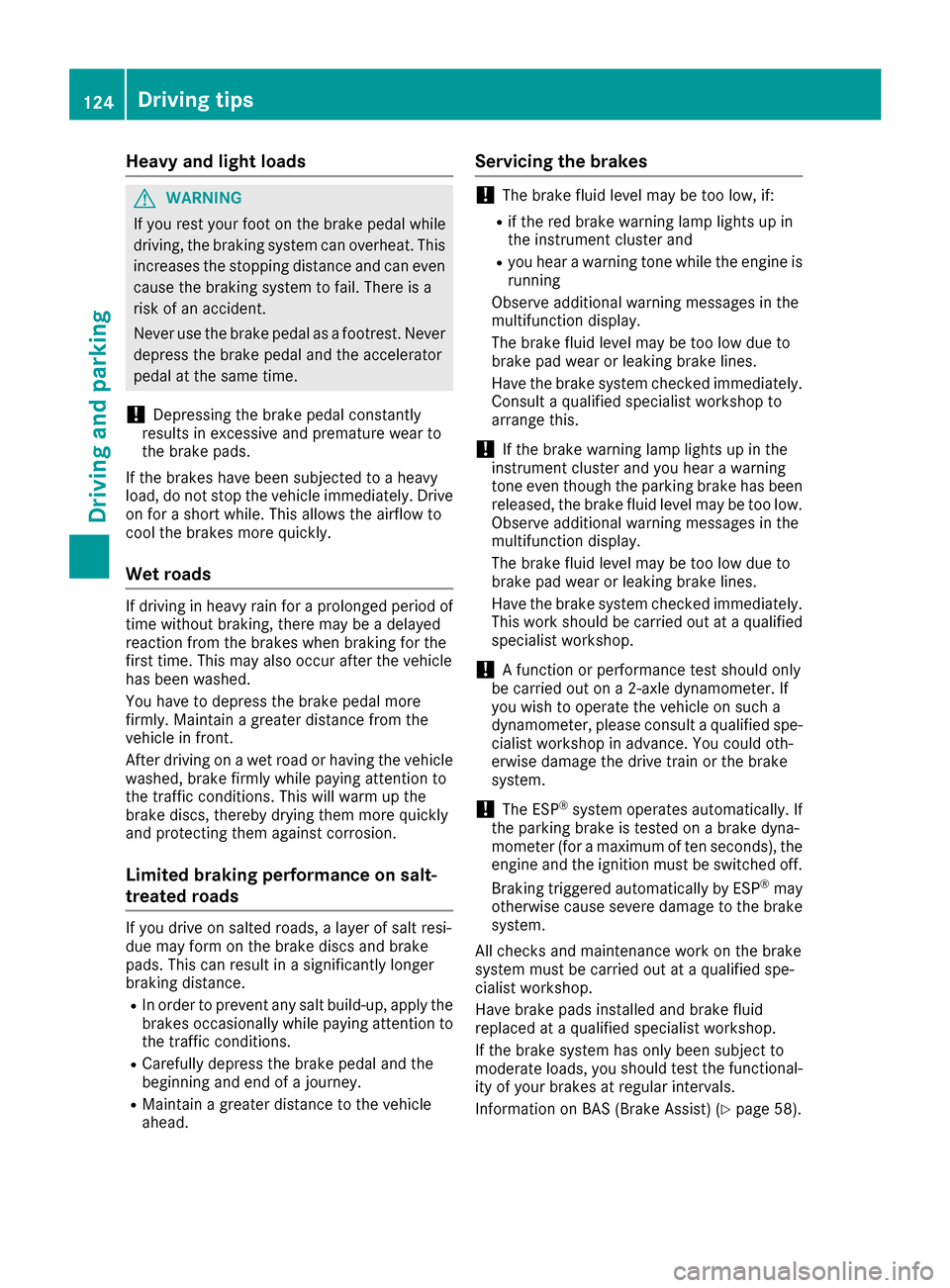
Heavy and light loads
GWARNING
If you rest you rfoot on the brake pedalw hile
driving, the braking system can overheat. This increases the stopping distance and can even
caus ethe braking system to fail .There is a
risk of an accident.
Never use the brake pedalasaf ootrest. Never
depress the brake pedala nd the accelerator
pedalatt he same time.
!Depressing the brake pedalc onstantly
results in excessive and premature weart o
the brake pads.
If the brakes have been subjected to aheavy
load, do not stop the vehiclei mmediately. Drive
on for ashort while. This allows the airflow to
cool the brakes more quickly.
Wet roads
If driving in heavy rain for aprolonged period of
time without braking, there may be adelayed
reactio nfrom the brakes when braking for the
first time. This may als ooccur after the vehicle
has been washed.
You have to depress the brake pedalm ore
firmly.M aintainagreater distance from the
vehicleinf ront.
After driving on awet road or having the vehicle
washed, brake firmly while paying attention to
the traffic conditions. This wil lwarmupt he
brake discs, thereby drying them more quickly
and protecting them against corrosion.
Limited braking performance on salt-
treated roads
If you drive on salted roads, alayer of sal tresi-
due may form on the brake discs and brake
pads. This can result in asignificantly longer
braking distance.
RIn order to prevent any sal tbuild-up, apply the
brakes occasionall ywhile paying attention to
the traffic conditions.
RCarefully depress the brake pedala nd the
beginning and end of ajourney.
RMaintain agreater distance to the vehicle
ahead.
Servicing the brakes
!The brake flui dlevelm ay be too low,i f:
Rif the red brake warning lamp lights up in
the instrument cluste rand
Ryou hearaw arning tone while the engine is
running
Observe additiona lwarning messages in the
multifunction display.
The brake flui dlevelm ay be too low due to
brake pad wearorl eaking brake lines.
Have the brake system checked immediately. Consult aqualified specialist workshopt o
arrange this.
!If the brake warning lamp lights up in the
instrument cluste rand you hearaw arning
tone even though the parking brake has been
released ,the brake flui dlevelm ay be too low.
Observe additionalw arning messages in the
multifunction display.
The brake flui dlevelm ay be too low due to
brake pad wearorl eaking brake lines.
Have the brake system checked immediately.
This work should be carrie dout at aqualified
specialist workshop.
!Af unction or performance test should only
be carrie dout on a2-axle dynamometer. If
you wis htooperate the vehicleons uch a
dynamometer, please consul taqualified spe-
cialist workshopina dvance. You couldoth-
erwise damage the drive train or the brake
system.
!The ESP®system operates automatically.I f
the parking brake is tested on abrake dyna-
mometer (for amaximu moften seconds),t he
engine and the ignitio nmust be switched off.
Braking triggereda utomatically by ESP
®may
otherwise caus esevere damage to the brake
system.
All checks and maintenance work on the brake
system must be carrie dout at aqualified spe-
cialist workshop.
Have brake pad sinstalled and brake fluid
replaced at aqualified specialist workshop.
If the brake system has only been subject to
moderate loads, you shoul
d test the functional-
ity of you rbrakes at regular intervals.
Informatio nonBAS (Brake Assist) (
Ypage5 8).
124Driving tips
Driving and parking
Page 128 of 286
erwise, water may enter the vehicle interior or
the engine compartment.This can damage
the electronic component sinthe engine or
the automatic transmission. Water can also
be drawn in by the engine' sair suction nozzles
and this can cause engine damage.
If you have to drive on stretches of road on which
water has collected, please bear in mind that:
Rin the case of standin gwater, the water level
must be no higher than the lower edge of the
vehicle body
Ryou should drive no faster than walking pace
Off-road fording
!Under no circumstances should you accel-
erate before entering the water. The bow
wave could cause water to enter and damage
the engine and other assemblies.
!Do not open any of the vehicle's doors while
fording. Otherwise, water could get into the
vehicle interior and damage the vehicle's
electronics and interior equipment.
iYou may only drive through fresh water.
RObserve the safety notes (Ypage 127) and
general notes (Ypage 127) on driving off-
road.
REstablish how deep the water is and the char-
acteristics of the body of water before ford-
ing.
RSwitc hoff automatic climate control
RShift the transfer case to the off-road driving
position LOW RANGE (Ypage 145).
REngage the differential locks if necessary
(Ypage 148).
RAvoid high engine speeds.
REnter and exit the water at aflat place and at
as teady walking pace.
RDrive slowly and at an even speed through the
water.
REnsure that abow wave does not form as you
drive.
RDo not stop and do not switch off the engine.
Water offers ahigh degree of resistance, and
the ground is slippery and in some cases
unstable. Therefore, it is difficult and danger-
ous to pull away in water.
RClean any mud from the tire tread after ford-
ing.
RApply the brakes to dry them after fording. Always observe the fordingd
epth values
(
Ypage 283).
Winter driving
GWARNING
If you shift down on aslippery road surface in
an attempt to increase the engine' sbraking
effect, the drive wheels could lose their grip.
There is an increased danger of skidding and
accidents.
Do not shift down for additional engine brak-
ing on aslippery road surface.
GWARNING
If you select the LOW RANGE off-road gear on
as lippery road surface, the wheels could lose
traction:
Rif you remove your foot from the accelera-
tor pedal when driving
Rif off road ABS intervenes when braking
If the wheels lose traction .the vehicle can no
longer be steered. There is an increased dan-
ger of skidding and accidents.
Never select the LOW RANGE off-road gear
when driving on slippery road surfaces.
Have your vehicle winter-proofed at aqualified
specialist workshop at the onset of winter.
Drive particularly carefully on slippery road sur-
faces. Avoid sudden acceleration, steerin gand
braking maneuvers. Do not use cruise control or DISTRONIC PLUS.
If the vehicle threatens to skid or cannot be
stopped when moving at low speed:
XShift the automatic transmission to position
N .
The outside temperature indicator is not
designed to serve as an ice-warning device and is therefore unsuitable for that purpose.
Changes in the outside temperature are dis-
played after ashort delay.
Indicated temperatures just above the freezing
point do not guarantee that the road surface is
free of ice. The road may still be icy, especially in
wooded areas or on bridges. The vehicle could
skid if you fail to adapt your driving style. Always
126Driving tips
Driving and parking
Page 130 of 286
Familiarize yourself with the characteristics of
your vehicle and the gearshift operation before
driving through difficult terrain.
The following driving systems are specially
adapted to off-roadd riving:
R4ETS (Ypage 59)
ROff-roadABS (Ypage 58)
RTransfer case (Ypage 145)
RDifferentia llocks (Ypage 120)
Observe the following notes:
RStop the vehicle before yo udrive off-roada nd,
if necessary ,shift the transfe rcase to the off-
roadd riving position LOW RANGE
(
Ypage 146).
REngag ethe differential locks if necessary
(Ypage 148).
iABS, 4ETS, ESP®and BAS are deactivated
while the differential locks are engaged.T his
allow sthe front wheels to lock briefly, so that
these can dig into aloose surface .However,
please note that locke dwheels skid and can
no longer steer.
RCheck that items of luggage and loads are
stowed safely and are well secured
(
Ypage 209).
RTo avoid damaging the vehicle, make sure
there is always sufficient ground clearance.
RAlway skeep the engine running and in gear
whe ndriving on adownhil lgradient.
RAlway skeep the engine running and in gear
whe ndriving downani ncline.
RDrive slowlyand evenly, if necessary at a
walking pace.
REnsure that the wheels are in contact with the
ground at al ltimes.
RDrive with extreme care on unfamilia roff-road
routes where visibility is poor. For safety rea-
sons, get ou
tofthe vehicle firs tand survey
the off-roadr oute.
RCheck the depth of water before fording rivers
and streams.
RWatch outfor obstacles.
RAlwayskeep the doors, reard oor, sidewin-
dowsa nd the sliding sunroof closed while the
vehicle is in motion.
RSwitch off cruise control.
RDo not deviate from marke droutes.
RAdap tyou rspeed to the terrain. The rougher,
steeper or more ruts on the terrain, the slower
your speed should be.
RDo not jump with the vehicle. as this will inter-
rup tthe vehicle' spropulsion.
RAvoid hig hengine speeds .Drive at appropri-
ate engine speeds (maximu m3,000 rpm).
RDo not shift the automatic transmission to
position N.
RAlwayscheck the vehicle for damag eafteroff-
roadd riving.
Do not use the HOLD function whe ndriving off-
road, on steep uphil lordownhil lgradients or on
slippery or loose surfaces. The HOLD function
cannot holdt he vehicle on such surfaces.
You can obtain further information aboutr etro-
fitting specia lall-terrain tires from aquali fied
specialist workshop.
Checklist before driving off-road
!If the engine oil warning lamp lights up while
the vehicle is in motion, stop the vehicle in a
saf ep lace as soona spossible. Check the
engine oil level. The engine oil warning lamp
warning mus tnot be ignored.C ontinuing the
journey while the symbol is displaye dcould
lea dtoe ngine damage.
XEngin eoillevel: check the engine oil level
and ad doil if necessary.
Whend riving on steep gradients, the engine
oil level mus tbes ufficiently hig htoensure a
correct oil supply in the vehicle.
XTire-changing too lkit: check that the jack is
working and make sur eyou hav ethe lug
wrench, arobust tow cable and afolding
spade in the vehicle.
XWheels and tires: check the tire treadd epth
and tire pressure.
XCheck for damag eand remove any foreign
objects, e.g. small stones,f rom the wheels/
tires.
XReplace any missing valve caps.
XReplace dente dordamaged wheels .Also
check the spare wheel.
XRims: dentedorbent rims can result in aloss
of tire pressure and damag ethe tire bead.
Befored riving off-road, check the wheels and
replace them if necessary.
128Drivin gtips
Drivin gand parking