engine MERCEDES-BENZ G-CLASS SUV 2008 Workshop Manual
[x] Cancel search | Manufacturer: MERCEDES-BENZ, Model Year: 2008, Model line: G-CLASS SUV, Model: MERCEDES-BENZ G-CLASS SUV 2008Pages: 293, PDF Size: 4.49 MB
Page 162 of 293
Engine compartment
159Engine oil
Depending on driving style, the vehicle con-
sumes a maximum of 0.8 l oil per 1,000 km.
The oil consumption may be higher than this
when the vehicle is new or if you frequently
drive at high engine speeds. You can only
estimate the oil consumption after you have
driven a considerable distance.
You will find further information about engine
oil in the "Technical data" section
(Y page 279).
Checking the engine oil level To do so:
R
the vehicle should be parked on level
ground.
R the engine should be switched off for at
least five minutes if the engine was at nor-
mal operating temperature.
R the engine should be switched off for at
least 30 minutes if the engine was not at
operating temperature (i.e. if you only star-
ted the engine briefly). Via the on-board computer
i
Only possible on the G 55 AMG. On all
other models, a dipstick is used to check
the engine oil level (Y page 160).
X Make sure that the key is in position 2in
the ignition lock (Y page 59).
X Press konce on the multi-function
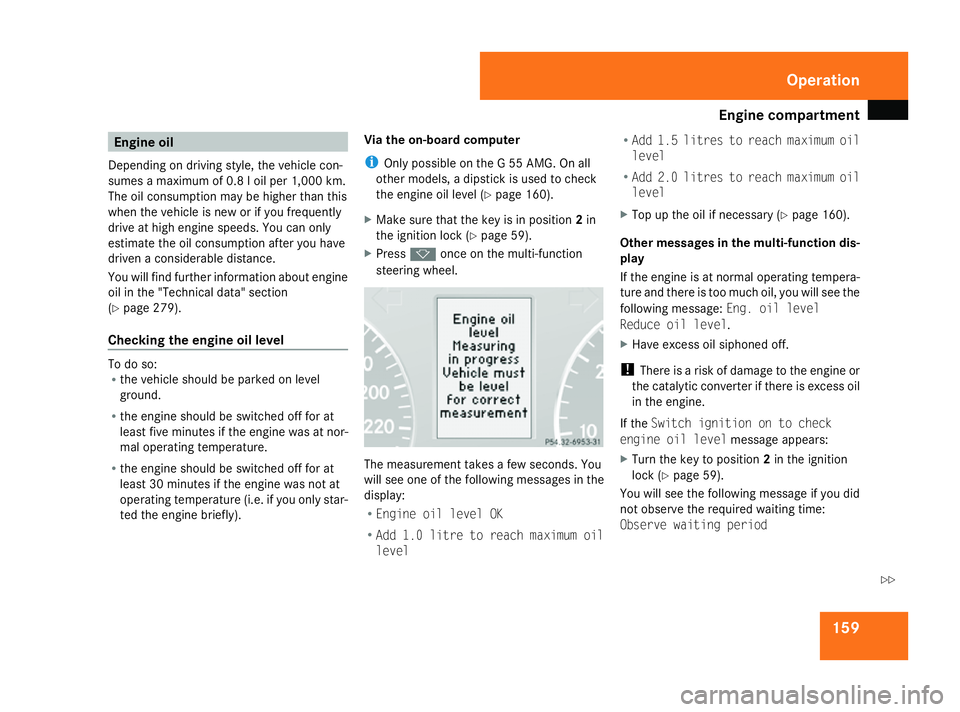
steering wheel. The measurement takes a few seconds. You
will see one of the following messages in the
display:
R
Engine oil level OK
R Add 1.0 litre to reach maximum oil
level R
Add 1.5 litres to reach maximum oil
level
R Add 2.0 litres to reach maximum oil
level
X Top up the oil if necessary ( Ypage 160).
Other messages in the multi-function dis-
play
If the engine is at normal operating tempera-
ture and there is too much oil, you will see the
following message: Eng. oil level
Reduce oil level.
X Have excess oil siphoned off.
! There is a risk of damage to the engine or
the catalytic converter if there is excess oil
in the engine.
If the Switch ignition on to check
engine oil level message appears:
X Turn the key to position 2in the ignition
lock (Y page 59).
You will see the following message if you did
not observe the required waiting time:
Observe waiting period Operation
463_AKB; 1; 8, en-GB
wobuchh,
Version: 2.10.6 2008-07-17T15:19:41+02:00 - Seite 159 ZDateiname: 6515_4091_02_buchblock.pdf; preflight
Page 163 of 293
Engine compartment
160
X
Repeat the measurement after about five
minutes if the engine is at normal operating
temperature.
X Repeat the measurement after about
30 minutes if the engine is not at normal
operating temperature (if the engine was
only started briefly).
If the engine is running, the Engine oil
level Not when engine on message
appears.
X Switch off the engine and wait for five
minutes if the engine is at normal operating
temperature, or for about 30 minutes if the
engine is not at normal operating temper-
ature (if the engine was only started
briefly), before measuring.
i If you wish to cancel the measurement,
press the korj button on the multi-
function steering wheel.
Using the oil dipstick
i Only possible on the G 320 CDI and
G 500. On the G 55 AMG, the oil level is
checked using the on-board computer
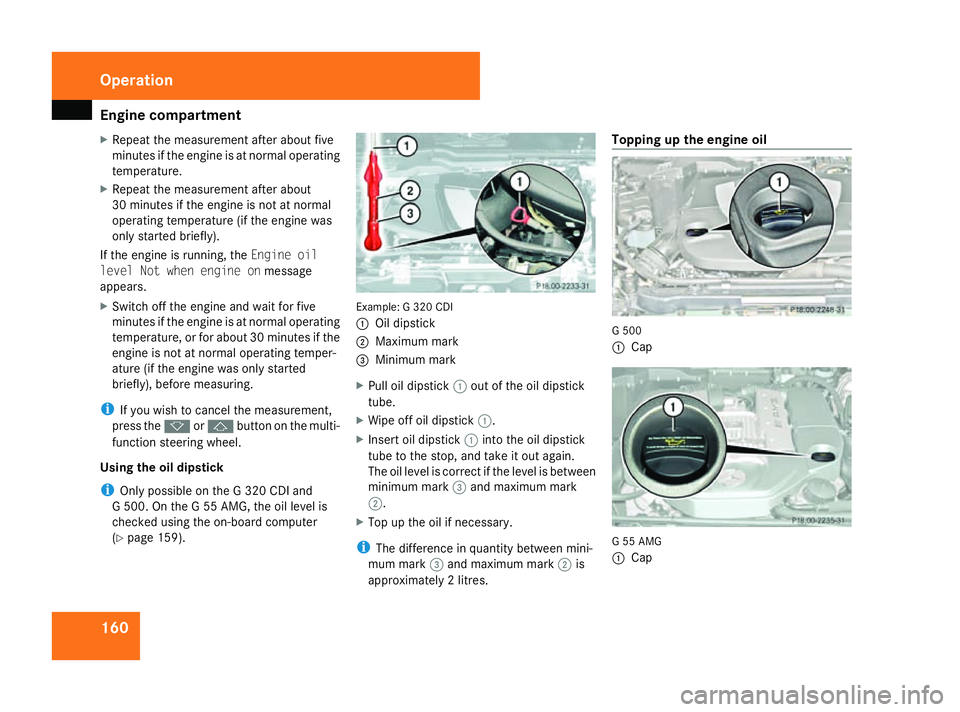
(Y page 159). Example: G 320 CDI
1
Oil dipstick
2 Maximum mark
3 Minimum mark
X Pull oil dipstick 1out of the oil dipstick
tube.
X Wipe off oil dipstick 1.
X Insert oil dipstick 1into the oil dipstick
tube to the stop, and take it out again.
The oil level is correct if the level is between
minimum mark 3and maximum mark
2.
X Top up the oil if necessary.
i The difference in quantity between mini-
mum mark 3and maximum mark 2is
approximately 2 litres. Topping up the engine oil
G 500
1
Cap G 55 AMG
1
Cap Operation
463_AKB; 1; 8, en-GB
wobuchh,
Version: 2.10.6 2008-07-17T15:19:41+02:00 - Seite 160Dateiname: 6515_4091_02_buchblock.pdf; preflight
Page 164 of 293
Engine compartment
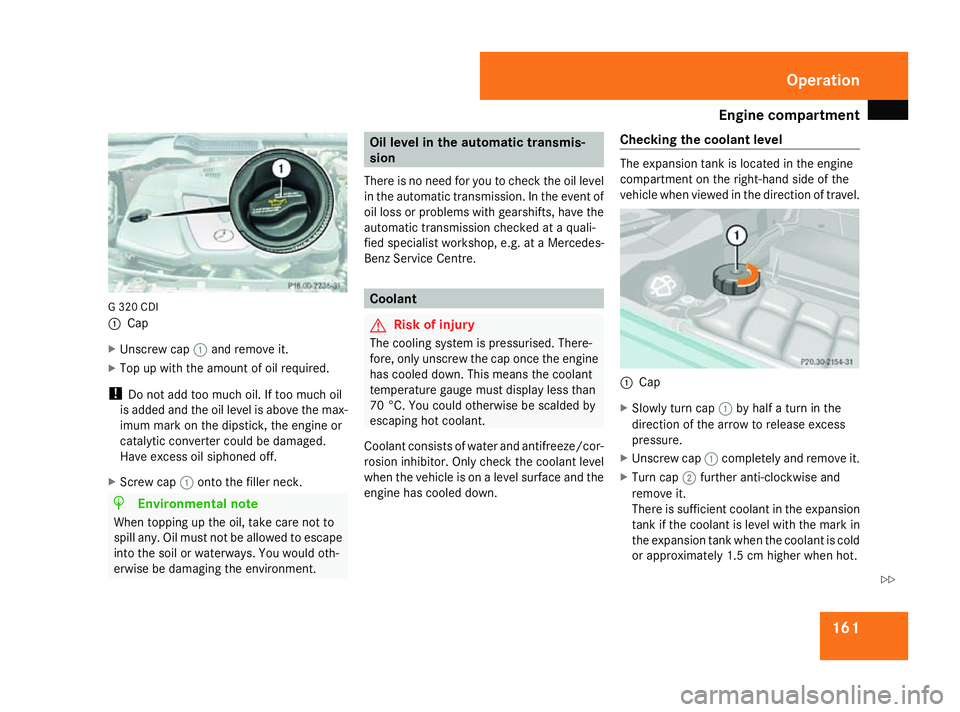
161G 320 CDI
1
Cap
X Unscrew cap 1and remove it.
X Top up with the amount of oil required.
! Do not add too much oil. If too much oil
is added and the oil level is above the max-
imum mark on the dipstick, the engine or
catalytic converter could be damaged.
Have excess oil siphoned off.
X Screw cap 1onto the filler neck. H
Environmental note
When topping up the oil, take care not to
spill any. Oil must not be allowed to escape
into the soil or waterways. You would oth-
erwise be damaging the environment. Oil level in the automatic transmis-
sion
There is no need for you to check the oil level
in the automatic transmission. In the event of
oil loss or problems with gearshifts, have the
automatic transmission checked at a quali-
fied specialist workshop, e.g. at a Mercedes-
Benz Service Centre. Coolant
G
Risk of injury
The cooling system is pressurised. There-
fore, only unscrew the cap once the engine
has cooled down. This means the coolant
temperature gauge must display less than
70 °C. You could otherwise be scalded by
escaping hot coolant.
Coolant consists of water and antifreeze/cor-
rosion inhibitor. Only check the coolant level
when the vehicle is on a level surface and the
engine has cooled down. Checking the coolant level The expansion tank is located in the engine
compartment on the right-hand side of the
vehicle when viewed in the direction of travel.
1
Cap
X Slowly turn cap 1by half a turn in the
direction of the arrow to release excess
pressure.
X Unscrew cap 1completely and remove it.
X Turn cap 2further anti-clockwise and
remove it.
There is sufficient coolant in the expansion
tank if the coolant is level with the mark in
the expansion tank when the coolant is cold
or approximately 1.5 cm higher when hot. Operation
463_AKB; 1; 8, en-GB
wobuchh,
Version: 2.10.6
2008-07-17T15:19:41+02:00 - Seite 161 ZDateiname: 6515_4091_02_buchblock.pdf; preflight
Page 165 of 293
Tyres and wheels
162
X
Top up the coolant if necessary.
X Replace cap 1and tighten all the way to
the stop.
You will find further information about coolant
in the "Technical data" section
(Y page 280). Windscreen washer system/head-
lamp cleaning system
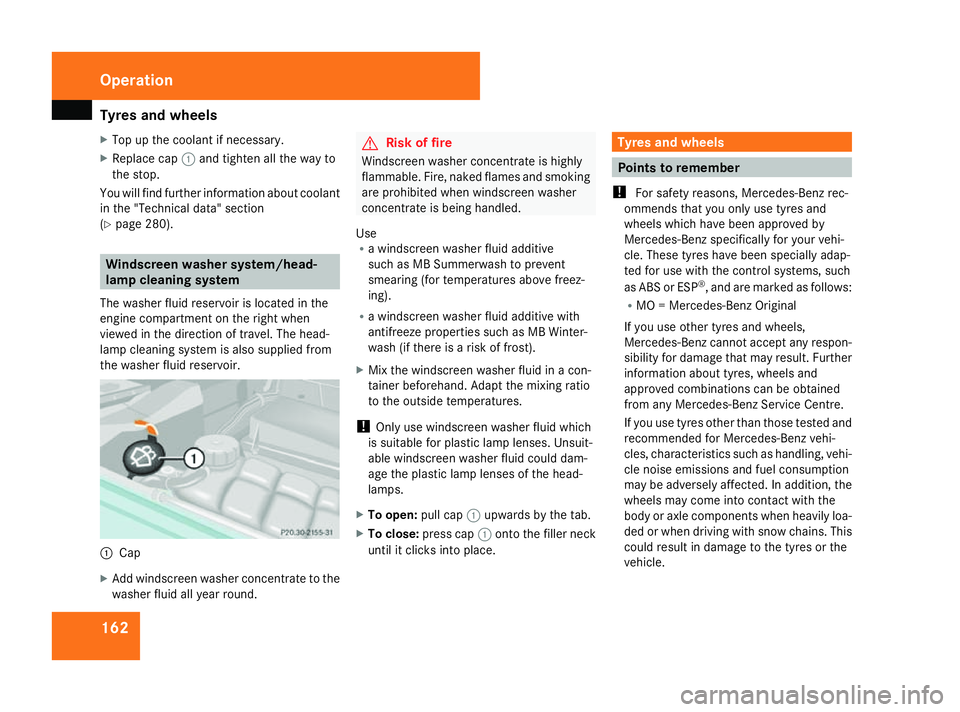
The washer fluid reservoir is located in the
engine compartment on the right when
viewed in the direction of travel. The head-
lamp cleaning system is also supplied from
the washer fluid reservoir. 1
Cap
X Add windscreen washer concentrate to the
washer fluid all year round. G
Risk of fire
Windscreen washer concentrate is highly
flammable. Fire, naked flames and smoking
are prohibited when windscreen washer
concentrate is being handled.
Use
R a windscreen washer fluid additive
such as MB Summerwash to prevent
smearing (for temperatures above freez-
ing).
R a windscreen washer fluid additive with
antifreeze properties such as MB Winter-
wash (if there is a risk of frost).
X Mix the windscreen washer fluid in a con-
tainer beforehand. Adapt the mixing ratio
to the outside temperatures.
! Only use windscreen washer fluid which
is suitable for plastic lamp lenses. Unsuit-
able windscreen washer fluid could dam-
age the plastic lamp lenses of the head-
lamps.
X To open: pull cap1upwards by the tab.
X To close: press cap 1onto the filler neck
until it clicks into place. Tyres and wheels
Points to remember
! For safety reasons, Mercedes-Benz rec-
ommends that you only use tyres and
wheels which have been approved by
Mercedes-Benz specifically for your vehi-
cle. These tyres have been specially adap-
ted for use with the control systems, such
as ABS or ESP ®
, and are marked as follows:
R MO = Mercedes-Benz Original
If you use other tyres and wheels,
Mercedes-Benz cannot accept any respon-
sibility for damage that may result. Further
information about tyres, wheels and
approved combinations can be obtained
from any Mercedes-Benz Service Centre.
If you use tyres other than those tested and
recommended for Mercedes-Benz vehi-
cles, characteristics such as handling, vehi-
cle noise emissions and fuel consumption
may be adversely affected. In addition, the
wheels may come into contact with the
body or axle components when heavily loa-
ded or when driving with snow chains. This
could result in damage to the tyres or the
vehicle. Operation
463_AKB; 1; 8, en-GB
wobuchh
, Version: 2.10.6 2008-07-17T15:19:41+02:00 - Seite 162Dateiname: 6515_4091_02_buchblock.pdf; preflight
Page 172 of 293
Driving
tips 169Snow chains
For safety reasons, Mercedes-Benz recom-
mends that you only use snow chains which
have been specially approved for your vehicle
by Mercedes-Benz, or are of a corresponding
standard of quality.
! Information about the use of snow chain-
compatible AMG winter tyres is applicable
for AMG tyres. Use of snow chains is only
permissible with these tyres.
If you intend to fit snow chains, please bear
the following points in mind:
R snow chains cannot be fitted to all wheel/
tyre combinations.
R fit the snow chains for maximum tractive
power and driving stability on all four
wheels. Comply with the manufacturer's
installation instructions.
Do not exceed the maximum permissible
speed of 50 km/h.
i You may wish to deactivate ESP ®
when
pulling away with snow chains fitted.
(Y page 49)This way you can allow the
wheels to spin in a controlled manner, ach-
ieving an increased driving force (cutting
action). Winter driving
G
Risk of accident
Do not shift down for additional engine
braking on a slippery road surface. This
could cause the drive wheels to lose their
grip and the vehicle could skid.
You should drive particularly carefully on slip-
pery road surfaces. Avoid sudden accelera-
tion, steering and braking manoeuvres.
If the vehicle threatens to skid or cannot be
stopped when moving at low speed:
X Shift the selector lever to N.
X Try to bring the vehicle under control by
using corrective steering. Driving tips
Pulling away on slippery surfaces
! If possible, do not let the drive wheels
spin. Otherwise, you could damage the
drive train.
X When necessary, engage the differential
locks (Y page 94). Rolling with the engine switched off
G
Risk of accident
Never switch the engine off while the vehi-
cle is in motion.
There is no power assistance for the steer-
ing and the service brake when the engine
is not running.
You will require considerably more effort to
steer and brake and, therefore, you could
lose control of the vehicle and cause an
accident. Operation
463_AKB; 1; 8, en-GB
wobuchh
,V ersion: 2.10.6
2008-07-17T15:19:41+02:00 - Seite 169 ZDateiname: 6515_4091_02_buchblock.pdf; preflight
Page 173 of 293
Driving
tips 170 Braking
G
Risk of accident
Do not change down for additional engine
braking on a slippery road surface. This
could cause the drive wheels to lose their
grip and the vehicle could skid. G
Risk of accident
Make sure that other road users are not
endangered by your braking.
Downhill gradients On long and steep downhill gradients, espe-
cially if the vehicle is laden or towing a trailer,
you must select shift range 1,2or 3in good
time.
i This also applies if you have activated
cruise control or Speedtronic.
This will use the braking effect of the engine,
so less braking will be required to maintain
the speed. This relieves the load on the brake
system and prevents the brakes from over-
heating and wearing too quickly. If you need
additional braking, depress the brake pedal
repeatedly rather than continuously. Heavy and light loads If the brakes have been subjected to a heavy
load, do not stop the vehicle immediately, but
drive on for a short while. This allows the air-
flow to cool the brakes more quickly.
G
Risk of accident
Never depress the brake pedal continu-
ously while the vehicle is in motion, e.g.
never cause the brakes to rub by applying
constant slight pedal pressure. This causes
the brake system to overheat, increases
the braking distance and can lead to the
brakes failing completely.
If the brakes have been used only moderately,
you should occasionally test their effective-
ness. To do this, brake more firmly from a
higher speed. This improves the grip of the
brakes.
Wet roads If driving in heavy rain for a prolonged period
of time without braking, there may be a
delayed reaction from the brakes when brak-
ing for the first time. You must brake harder.
Therefore, you must maintain a greater dis-
tance from the vehicle in front.Brake firmly after driving on a wet road. This
way the brake discs will become warm, drying
more quickly, which will protect them against
corrosion.
Limited braking performance on salted
roads G
Risk of accident
The layer of salt on the brake discs and the
brake pads/linings may cause a delay in
the braking effect, resulting in a signifi-
cantly longer braking distance, which could
lead to an accident.
To avoid this danger, you should:
R occasionally brake carefully, without put-
ting other road users at risk, when you
are driving on salted roads. This helps to
remove any salt that may have started to
build up on the brake discs and the brake
pads/linings.
R maintain a greater distance to the vehicle
ahead and drive with particular care.
R carefully apply the brakes at the end of a
trip and immediately after commencing a
new trip, so that salt residues are
removed from the brake disc. Operation
463_AKB; 1; 8, en-GB
wobuchh
,V ersion: 2.10.6
2008-07-17T15:19:41+02:00 - Seite 170 Dateiname: 6515_4091_02_buchblock.pdf; preflight
Page 175 of 293
Off-road driving
172 Driving on flooded roads
If you have to drive on stretches of road on
which water has collected, please bear in
mind that:
R the maximum permissible still water depth
is 50 cm
R you should drive no faster than at walking
pace
! Bear in mind that vehicles travelling in
front or in the opposite direction create
waves. This may cause the maximum per-
missible water depth to be exceeded.
You must observe these notes. Otherwise,
damage may occur to the engine, electrics
and transmission. Parking the vehicle after high engine
loading
! G 320 CDI: The vehicle's turbocharger
can become very hot at high engine load,
e.g. during:
R trailer towing
R longer motorway journeys at high speed
R longer journeys through mountainous
terrain
Let the engine run for approximately
another two minutes while the vehicle is
stationary before stopping the engine. This
way, the turbocharger can cool down more
effectively. Off-road driving
Points to remember
G
Risk of accident
Drive slowly in rough terrain with which you
are unfamiliar. This will allow you to detect
unexpected obstacles more easily and,
therefore, to reduce the risk of an accident.
Do not make U-turns on mountain roads.
Otherwise, the vehicle could tip over. If a
slope is too steep for the vehicle, drive back
in reverse gear.
Do not drive at an angle up steep inclines.
Otherwise, the vehicle could tip over. If you
drive up a steep incline at an angle and the
vehicle threatens to overturn, steer into the
line of fall immediately.
Never allow the vehicle to roll backwards.
The braking effect of the engine cannot be
utilised in neutral. If you only use the
service brake, you could lose control of the
vehicle. G
Risk of accident
Grains of sand, particles of dirt and other
abrasive materials can enter the brake sys-
tem. This can lead to excessive wear and
unpredictable braking efficiency. Operation
463_AKB; 1; 8, en-GB
wobuchh,
Version: 2.10.6 2008-07-17T15:19:41+02:00 - Seite 172Dateiname: 6515_4091_02_buchblock.pdf; preflight
Page 176 of 293
Off-road driving
173After the brakes have been exposed to dirty
conditions, have them checked and
cleaned at a qualified specialist workshop,
e.g. a Mercedes-Benz Service Centre. Oth-
erwise, there is a risk that braking power
may be insufficient in the event of an emer-
gency, or that braking efficiency may be
unpredictable.
Read this section before driving your vehicle
off-road. Practise by travelling over more gen-
tle off-road terrain first.
The following driving systems are specially
adapted to off-road driving:
R transfer case (Y page 92)
R differential locks (Y page 93)
R 4ETS (Y page 50) Off-road driving
G
Risk of accident
Damage to the vehicle creates the risk of
an accident for yourself and other road
users. If in doubt, have your vehicle
checked at a qualified specialist workshop
which has the necessary specialist knowl-
edge and tools to carry out the work
required. Mercedes-Benz recommends
that you use a Mercedes-Benz Service
Centre for this purpose. H
Environmental note
Protection of the environment is of primary
importance. Treat nature with respect.
Observe all prohibiting signs.
General information R
Stop your vehicle and, if necessary, shift
the transfer case to LOW(Ypage 92)
before driving off-road.
R Check that items of luggage and loads are
stowed safely and are well secured
(Y page 139).
R Engage the differential locks, if necessary
(Y page 93). i
When the differential locks are engaged,
ABS is deactivated. This allows the front
wheels to lock briefly, so that these can dig
into a loose surface. However, please note
that locked wheels skid and can no longer
steer.
R Always keep the engine running and in gear
when driving on a downhill gradient.
R Drive slowly and evenly, if necessary at a
walking pace.
R Ensure that the wheels are in contact with
the ground at all times.
R Drive with extreme care on unknown off-
road routes where visibility is poor. For
safety reasons, get out of the vehicle first
and survey the off-road route.
R Check the depth of water before fording
rivers and streams.
R Look out for obstacles such as rocks, holes,
tree stumps and furrows.
R Always keep the side windows and the slid-
ing /tilting sunroof* closed during the jour-
ney.
R Do not stray from marked routes or paths. Operation
* optional
463_AKB; 1; 8, en-GB
wobuchh,
Version: 2.10.6 2008-07-17T15:19:41+02:00 - Seite 173 ZDateiname: 6515_4091_02_buchblock.pdf; preflight
Page 177 of 293
Off-road driving
174
i
Information about retrofitting special all-
terrain tyres is available from any
Mercedes-Benz Service Centre.
Checklist before driving off-road X
Engine oil level: check the engine oil and
top it up if necessary.
Only then does the engine receive enough
oil when the vehicle is standing on a steep
incline.
X Vehicle toolkit: check that the jack is
working and make sure you have the wheel-
brace, a robust tow cable and a folding
spade in the vehicle.
X Wheels and tyres: check the tyre tread
depth and tyre pressure.
X Check for damage and remove any objects,
e.g. small stones, from the wheels/tyres.
X Replace any missing valve caps.
X Replace dented or damaged wheels.
Checklist after driving off-road Driving over rough terrain places greater
demands on your vehicle than driving on nor-
mal roads. After driving off-road, check the
vehicle. This allows you to detect damage
promptly and reduce the risk of an accident
to yourself and other road users. X
Shift the transfer case to HIGH
(Y page 93).
X Disengage the differential locks
(Y page 95).
X Clean the headlamps and rear lights and
check for damage.
X Clean the front and rear licence plates.
X Clean the wheels/tyres with a water jet and
remove any foreign objects.
X Clean the wheels, wheel arches and the
vehicle underside with a water jet; check
for foreign objects and damage.
X Check whether twigs or other parts of
plants have become trapped. These
increase the risk of fire and can damage
fuel pipes, brake hoses or the rubber bel-
lows of the axle joints and propeller shafts.
X After the trip, examine without fail the
entire undercarriage, wheels, tyres, brakes,
bodywork structure, steering, chassis and
exhaust system for damage.
X After driving for extended periods across
sand, mud, gravel, water or in similarly dirty
conditions, have the brake discs, wheels,
brake pads /linings and axle joints checked
and cleaned.
X If you detect strong vibrations after off-road
travel, check for foreign objects in the
wheels and drive train and remove them if necessary. Foreign objects can disturb the
balance and cause vibrations. Travelling uphill
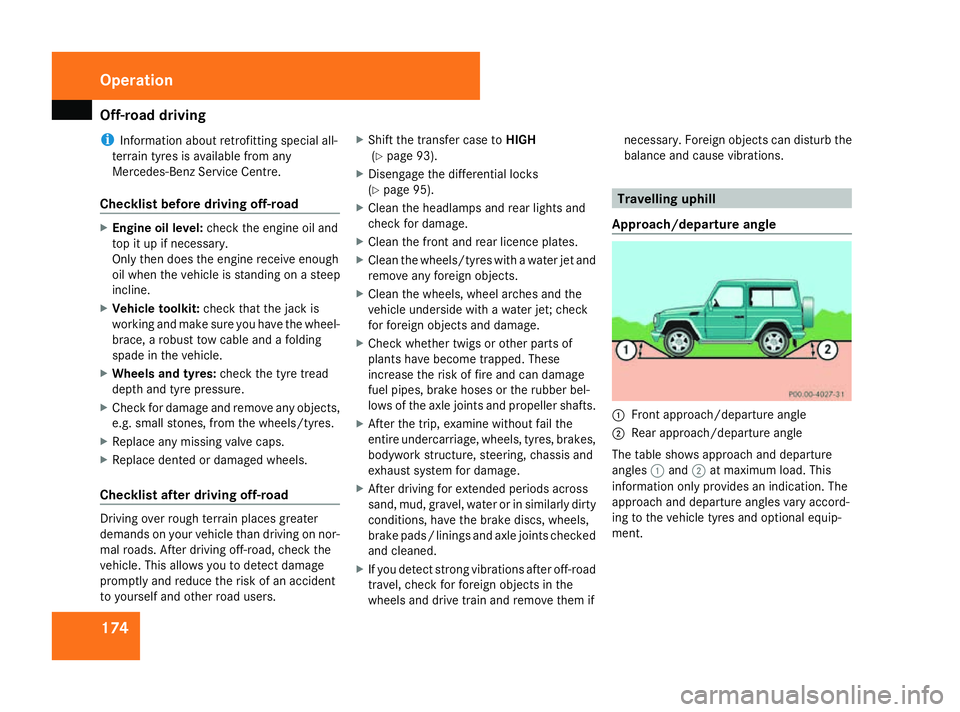
Approach/departure angle 1
Front approach/departure angle
2 Rear approach/departure angle
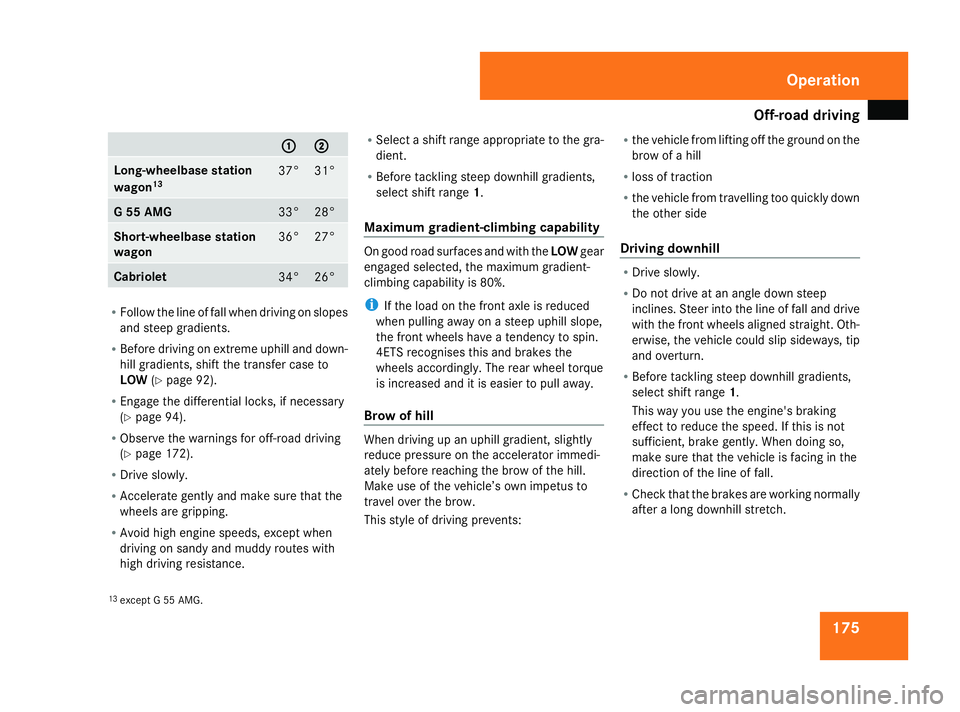
The table shows approach and departure
angles 1and 2at maximum load. This
information only provides an indication. The
approach and departure angles vary accord-
ing to the vehicle tyres and optional equip-
ment. Operation
463_AKB; 1; 8, en-GB
wobuchh,
Version: 2.10.6 2008-07-17T15:19:41+02:00 - Seite 174Dateiname: 6515_4091_02_buchblock.pdf; preflight
Page 178 of 293
Off-road driving
1751
1 2
2 Long-wheelbase station
wagon
13 37° 31°
G 55 AMG
33° 28°
Short-wheelbase station
wagon
36° 27°
Cabriolet
34° 26°
R
Follow the line of fall when driving on slopes
and steep gradients.
R Before driving on extreme uphill and down-
hill gradients, shift the transfer case to
LOW (Ypage 92).
R Engage the differential locks, if necessary
(Y page 94).
R Observe the warnings for off-road driving
(Y page 172).
R Drive slowly.
R Accelerate gently and make sure that the
wheels are gripping.
R Avoid high engine speeds, except when
driving on sandy and muddy routes with
high driving resistance. R
Select a shift range appropriate to the gra-
dient.
R Before tackling steep downhill gradients,
select shift range 1.
Maximum gradient-climbing capability On good road surfaces and with the
LOWgear
engaged selected, the maximum gradient-
climbing capability is 80%.
i If the load on the front axle is reduced
when pulling away on a steep uphill slope,
the front wheels have a tendency to spin.
4ETS recognises this and brakes the
wheels accordingly. The rear wheel torque
is increased and it is easier to pull away.
Brow of hill When driving up an uphill gradient, slightly
reduce pressure on the accelerator immedi-
ately before reaching the brow of the hill.
Make use of the vehicle’s own impetus to
travel over the brow.
This style of driving prevents:R
the vehicle from lifting off the ground on the
brow of a hill
R loss of traction
R the vehicle from travelling too quickly down
the other side
Driving downhill R
Drive slowly.
R Do not drive at an angle down steep
inclines. Steer into the line of fall and drive
with the front wheels aligned straight. Oth-
erwise, the vehicle could slip sideways, tip
and overturn.
R Before tackling steep downhill gradients,
select shift range 1.
This way you use the engine's braking
effect to reduce the speed. If this is not
sufficient, brake gently. When doing so,
make sure that the vehicle is facing in the
direction of the line of fall.
R Check that the brakes are working normally
after a long downhill stretch.
13 except G 55 AMG. Operation
463_AKB; 1; 8, en-GB
wobuchh,
Version: 2.10.6 2008-07-17T15:19:41+02:00 - Seite 175 ZDateiname: 6515_4091_02_buchblock.pdf; preflight