warning MERCEDES-BENZ G-CLASS SUV 2008 Repair Manual
[x] Cancel search | Manufacturer: MERCEDES-BENZ, Model Year: 2008, Model line: G-CLASS SUV, Model: MERCEDES-BENZ G-CLASS SUV 2008Pages: 293, PDF Size: 4.49 MB
Page 223 of 293
Troubleshooting
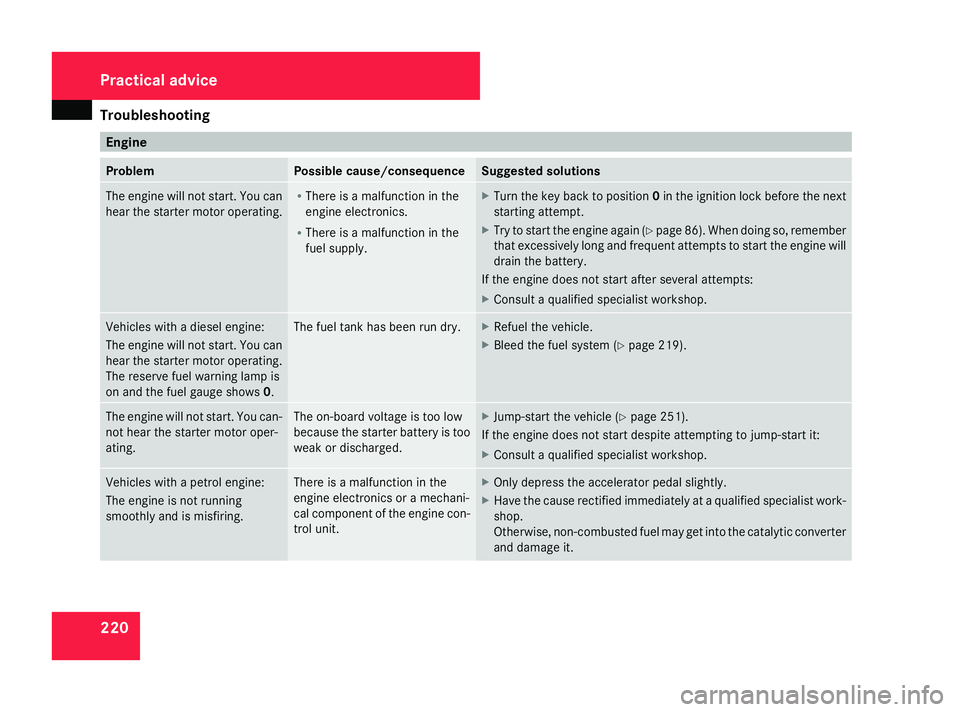
220 Engine
Problem Possible cause/consequence Suggested solutions
The engine will not start. You can
hear the starter motor operating. R
There is a malfunction in the
engine electronics.
R There is a malfunction in the
fuel supply. X
Turn the key back to position 0in the ignition lock before the next
starting attempt.
X Try to start the engine again (Y page 86). When doing so, remember
that excessively long and frequent attempts to start the engine will
drain the battery.
If the engine does not start after several attempts:
X Consult a qualified specialist workshop. Vehicles with a diesel engine:
The engine will not start. You can
hear the starter motor operating.
The reserve fuel warning lamp is
on and the fuel gauge shows 0. The fuel tank has been run dry. X
Refuel the vehicle.
X Bleed the fuel system (Y page 219).The engine will not start. You can-
not hear the starter motor oper-
ating. The on-board voltage is too low
because the starter battery is too
weak or discharged. X
Jump-start the vehicle (Y page 251).
If the engine does not start despite attempting to jump-start it:
X Consult a qualified specialist workshop. Vehicles with a petrol engine:
The engine is not running
smoothly and is misfiring. There is a malfunction in the
engine electronics or a mechani-
cal component of the engine con-
trol unit. X
Only depress the accelerator pedal slightly.
X Have the cause rectified immediately at a qualified specialist work-
shop.
Otherwise, non-combusted fuel may get into the catalytic converter
and damage it. Practical advice
463_AKB; 1; 8, en-GB
wobuchh,
Version: 2.10.6 2008-07-17T15:19:41+02:00 - Seite 220Dateiname: 6515_4091_02_buchblock.pdf; preflight
Page 224 of 293
Troubleshooting
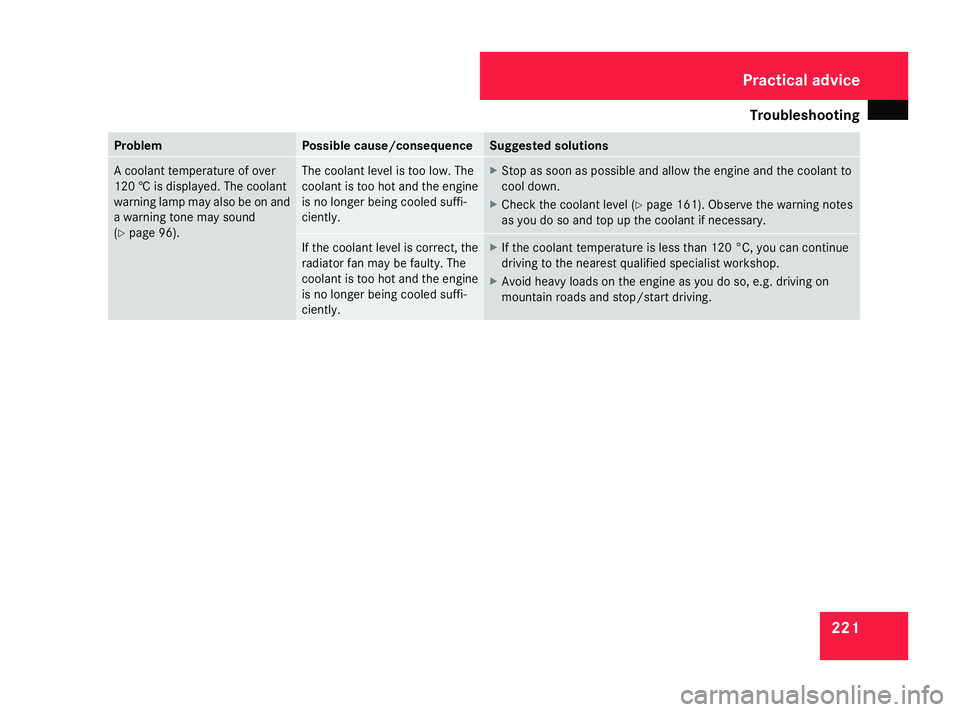
221Problem Possible cause/consequence Suggested solutions
A coolant temperature of over
120 † is displa
yed. The coolant
warning lamp may also be on and
a warning tone may sound
(Y page 96). The coolant level is too low. The
coolant is too hot and the engine
is no longer being cooled suffi-
ciently. X
Stop as soon as possible and allow the engine and the coolant to
cool down.
X Check the coolant level (Y page 161). Observe the warning notes
as you do so and top up the coolant if necessary. If the coolant level is correct, the
radiator fan may be faulty. The
coolant is too hot and the engine
is no longer being cooled suffi-
ciently. X
If the coolant temperature is less than 120 °C, you can continue
driving to the nearest qualified specialist workshop.
X Avoid heavy loads on the engine as you do so, e.g. driving on
mountain roads and stop/start driving. Practical advice
463_AKB; 1; 8, en-GB
wobuchh,
Version: 2.10.6 2008-07-17T15:19:41+02:00 - Seite 221 ZDateiname: 6515_4091_02_buchblock.pdf; preflight
Page 225 of 293
Troubleshooting
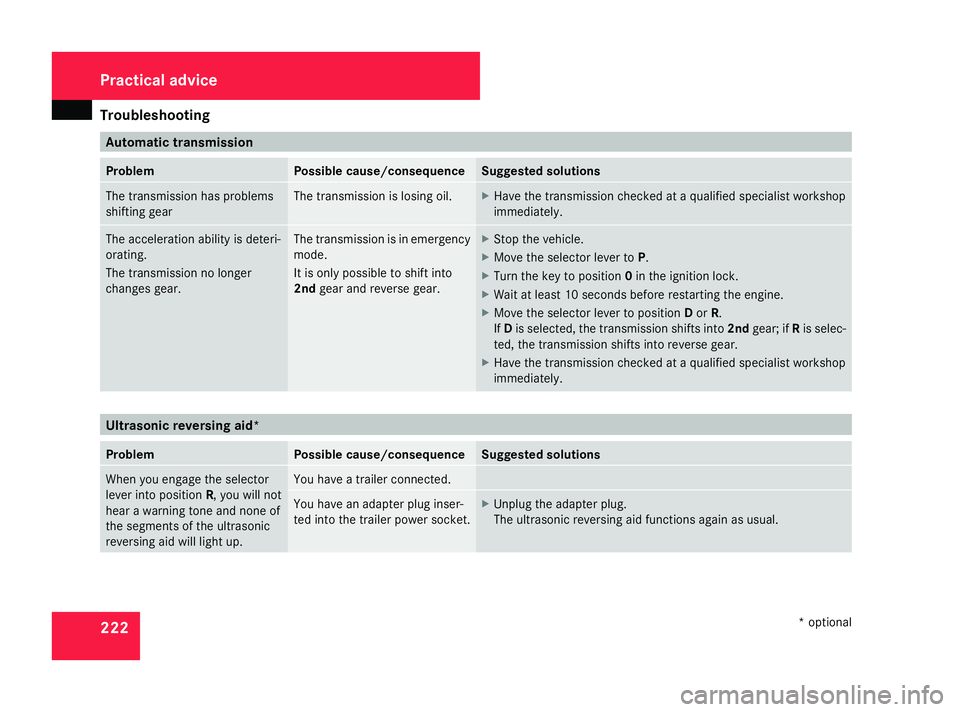
222 Automatic transmission
Problem Possible cause/consequence Suggested solutions
The transmission has problems
shifting gear The transmission is losing oil. X
Have the transmission checked at a qualified specialist workshop
immediatel y. The acceleration ability is deteri-
orating.
The transmission no longer
changes gear. The transmission is in emergency
mode.
It is only possible to shift into
2nd
gear and reverse gear. X
Stop the vehicle.
X Move the selector lever to P.
X Turn the key to position 0in the ignition lock.
X Wait at least 10 seconds before restarting the engine.
X Move the selector lever to position Dor R.
If D is selected, the transmission shifts into 2ndgear; if Ris selec-
ted, the transmission shifts into reverse gear.
X Have the transmission checked at a qualified specialist workshop
immediately. Ultrasonic reversing aid*
Problem Possible cause/consequence Suggested solutions
When you engage the selector
lever into position
R, you will not
hear a warning tone and none of
the segments of the ultrasonic
reversing aid will light up. You have a trailer connected.
You have an adapter plug inser-
ted into the trailer power socket. X
Unplug the adapter plug.
The ultrasonic reversing aid functions again as usual. Practical advice
* optional
463_AKB; 1; 8, en-GB
wobuchh,
Version: 2.10.6 2008-07-17T15:19:41+02:00 - Seite 222Dateiname: 6515_4091_02_buchblock.pdf; preflight
Page 226 of 293
Troubleshooting
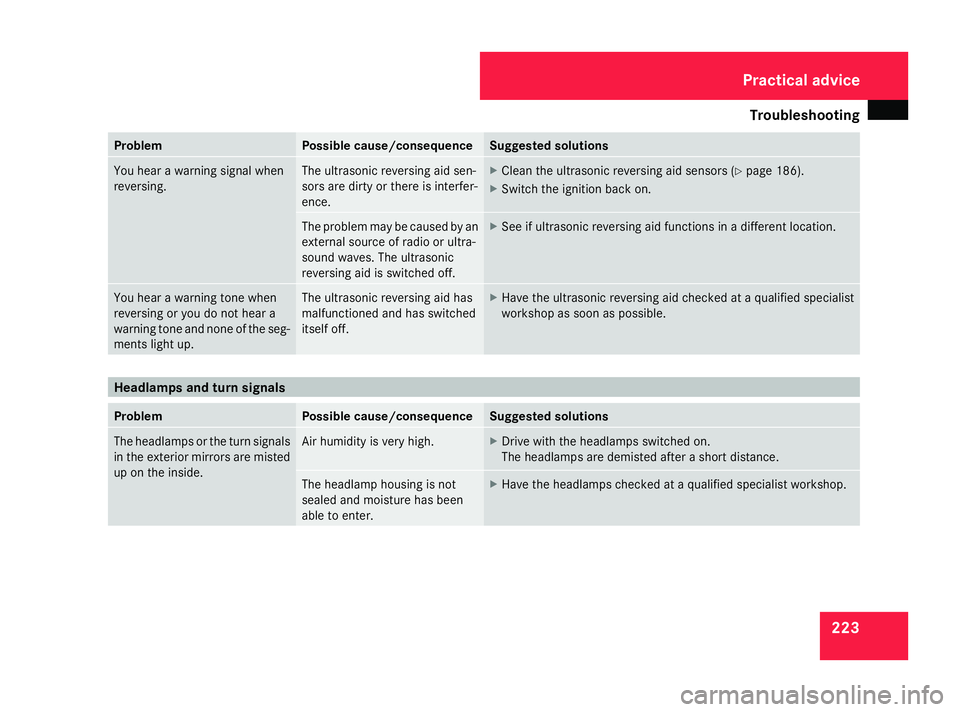
223Problem Possible cause/consequence Suggested solutions
You hear a warning signal when
reversing. The ultrasonic reversing aid sen-
sors are dirty or there is interfer-
ence. X
Clean the ultrasonic reversing aid sensors (Y page 186).
X Switch the ignition back on. The problem ma
y be caused by an
external source of radio or ultra-
sound waves. The ultrasonic
reversing aid is switched off. X
See if ultrasonic reversing aid functions in a different location. You hear a warning tone when
reversing or you do not hear a
warning tone and none of the seg-
ments light up. The ultrasonic reversing aid has
malfunctioned and has switched
itself off. X
Have the ultrasonic reversing aid checked at a qualified specialist
workshop as soon as possible. Headlamps and turn signals
Problem Possible cause/consequence Suggested solutions
The headlamps or the turn signals
in the exterior mirrors are misted
up on the inside. Air humidity is very high. X
Drive with the headlamps switched on.
The headlamps are demisted after a short distance. The headlamp housing is not
sealed and moisture has been
able to enter. X
Have the headlamps checked at a qualified specialist workshop. Practical advice
463_AKB; 1; 8, en-GB
wobuchh,
Version: 2.10.6 2008-07-17T15:19:41+02:00 - Seite 223 ZDateiname: 6515_4091_02_buchblock.pdf; preflight
Page 246 of 293
Flat tyre
243
X
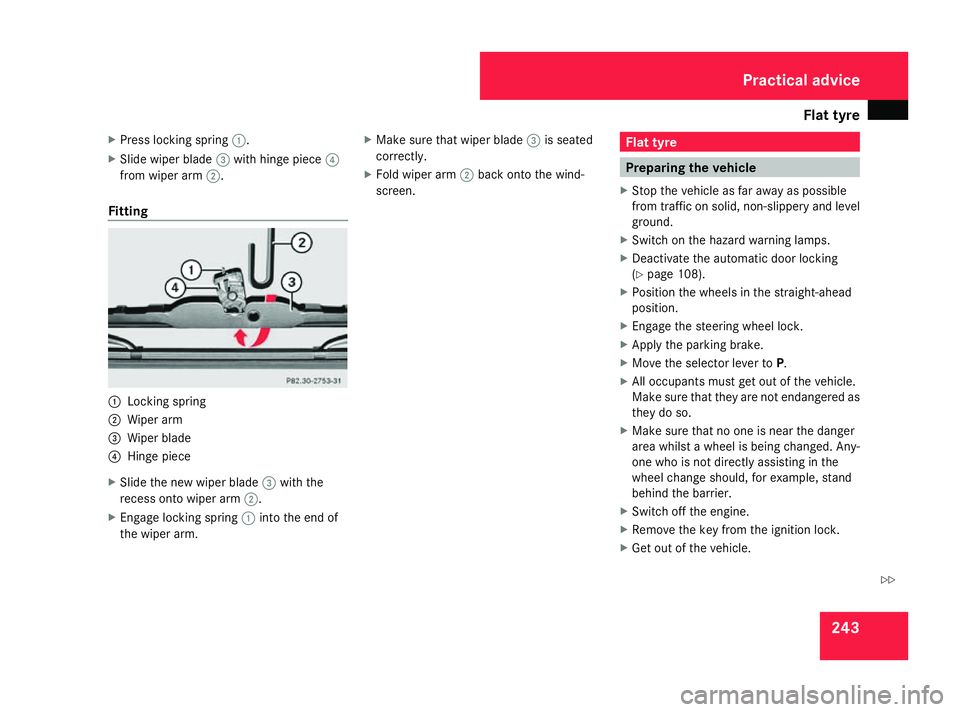
Press locking spring 1.
X Slide wiper blade 3with hinge piece 4
from wiper arm 2.
Fit ting 1
Locking spring
2 Wiper arm
3 Wiper blade
4 Hinge piece
X Slide the new wiper blade 3with the
recess onto wiper arm 2.
X Engage locking spring 1into the end of
the wiper arm. X
Make sure that wiper blade 3is seated
correctly.
X Fold wiper arm 2back onto the wind-
screen. Flat tyre
Preparing the vehicle
X Stop the vehicle as far away as possible
from traffic on solid, non-slippery and level
ground.
X Switch on the hazard warning lamps.
X Deactivate the automatic door locking
(Y page 108).
X Position the wheels in the straight-ahead
position.
X Engage the steering wheel lock.
X Apply the parking brake.
X Move the selector lever to P.
X All occupants must get out of the vehicle.
Make sure that they are not endangered as
they do so.
X Make sure that no one is near the danger
area whilst a wheel is being changed. Any-
one who is not directly assisting in the
wheel change should, for example, stand
behind the barrier.
X Switch off the engine.
X Remove the key from the ignition lock.
X Get out of the vehicle. Practical advice
463_AKB; 1; 8, en-GB
wobuchh
,V ersion: 2.10.6
2008-07-17T15:19:41+02:00 - Seite 243 ZDateiname: 6515_4091_02_buchblock.pdf; preflight
Page 247 of 293
Flat tyre
244
X
Close the driver’s door.
X Place the warning triangle ( Ypage 188) or
warning lamps at a suitable distance.
Observe legal requirements. Changing a wheel and fitting the spare
wheel G
Risk of accident
If the spare wheel is more than six years
old, or it does not correspond to the regular
wheel type: have the spare wheel replaced
by a new wheel at the nearest qualified spe-
cialist workshop, e.g. a Mercedes-Benz
Service Centre.
Never drive the vehicle with more than one
spare wheel fitted.
Vehicles with different tyre dimensions on
the front and rear axles: wheel and tyre size
of the spare wheel and normal wheel are
different. When using the spare wheel, the
handling characteristics are compromised.
Do not exceed the maximum speed of 80
km/h. G
Risk of accident
Vehicles with AMG equipment: when you fit
the spare wheel, make sure you observe the
following:
R the maximum speed of 80 km/h
R the prescribed tyre pressure
Preparing the vehicle X
Prepare the vehicle as described
(Y page 243).
X If a trailer is coupled, uncouple it.
X Remove the vehicle tool kit and the jack
(Y page 191).
X Remove the spare wheel from the spare
wheel bracket (Y page 192).
X Secure the vehicle to prevent it from rolling
away.
On level ground: place chocks or similar
items under the front and rear of the wheel
that is diagonally opposite the wheel you
wish to change.
X On downhill gradients: place chocks or
similar items under both wheels of the
other axle. Raising
the vehicle G
Risk of injury
The jack is designed only to raise the vehi-
cle for a short time while a wheel is being
changed.
The vehicle must be placed on stands if you
intend to work under it.
Make sure that the jack is placed on a firm,
non-slip, level surface. Do not use wooden
blocks or similar items as jacking supports.
Otherwise, the jack will not be able to ach-
ieve its load-bearing capacity due to the
restricted height.
Do not start the engine at any time while
the wheel is being changed.
Do not lie under the vehicle when it is being
supported by the jack. If you do not raise
the vehicle as described, it could slip off the
jack (e.g. when starting the engine, opening
or closing a door or the tailgate) and you
could be seriously injured. G
Risk of accident
If you fail to position the jack correctly, the
vehicle may: Practical advice
463_AKB; 1; 8, en-GB
wobuchh
,V ersion: 2.10.6
2008-07-17T15:19:41+02:00 - Seite 244 Dateiname: 6515_4091_02_buchblock.pdf; preflight