lock MERCEDES-BENZ G-CLASS SUV 2012 Owners Manual
[x] Cancel search | Manufacturer: MERCEDES-BENZ, Model Year: 2012, Model line: G-CLASS SUV, Model: MERCEDES-BENZ G-CLASS SUV 2012Pages: 357, PDF Size: 8.86 MB
Page 241 of 357
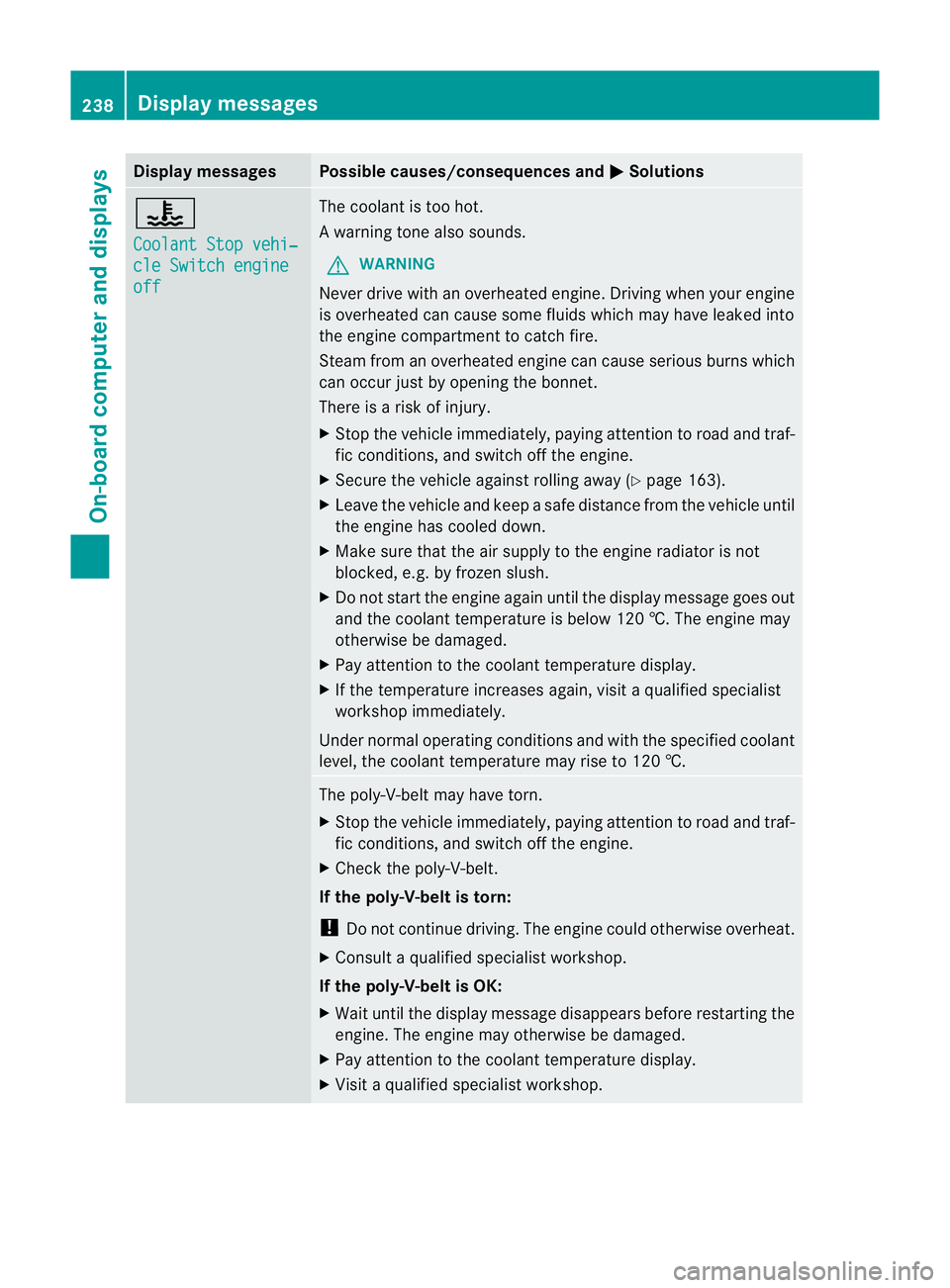
Display messages Possible causes/consequences and
M Solutions
?
Coolant Stop vehi‐
cle Switch engine
off The coolan
tis too hot.
Aw arning tone also sounds.
G WARNING
Never drive with an overheated engine. Driving when your engine
is overheated can cause som efluids which may have leaked into
the engine compartment to catch fire.
Steam fro manoverheated engine can cause serious burns which
can occur just by opening the bonnet.
There is a risk of injury.
X Stop the vehicle immediately, paying attention to road and traf-
fic conditions, and switch off the engine.
X Secure the vehicle against rolling away (Y page 163).
X Leave the vehicle and keep a safe distance from the vehicle until
the engine has cooled down.
X Make sure that the air supply to the engine radiator is not
blocked, e.g. by frozen slush.
X Do not start the engine again until the display message goes out
and the coolant temperature is below 120 †. The engine may
otherwise be damaged.
X Pay attention to the coolant temperature display.
X If the temperature increases again, visi taqualified specialist
workshop immediately.
Under normal operating conditions and with the specified coolant
level, the coolant temperature may rise to 120 †. The poly-V-belt may have torn.
X
Stop the vehicle immediately, paying attention to road and traf-
fic conditions, and switc hoff the engine.
X Check the poly-V-belt.
If the poly-V-belt is torn:
! Do not continue driving. The engine could otherwise overheat.
X Consult a qualified specialist workshop.
If the poly-V-belt is OK:
X Wai tuntil the display message disappears before restarting the
engine .The engine may otherwise be damaged.
X Pay attention to the coolant temperature display.
X Visit a qualified specialist workshop. 238
Display messagesOn-board computer and displays
Page 245 of 357
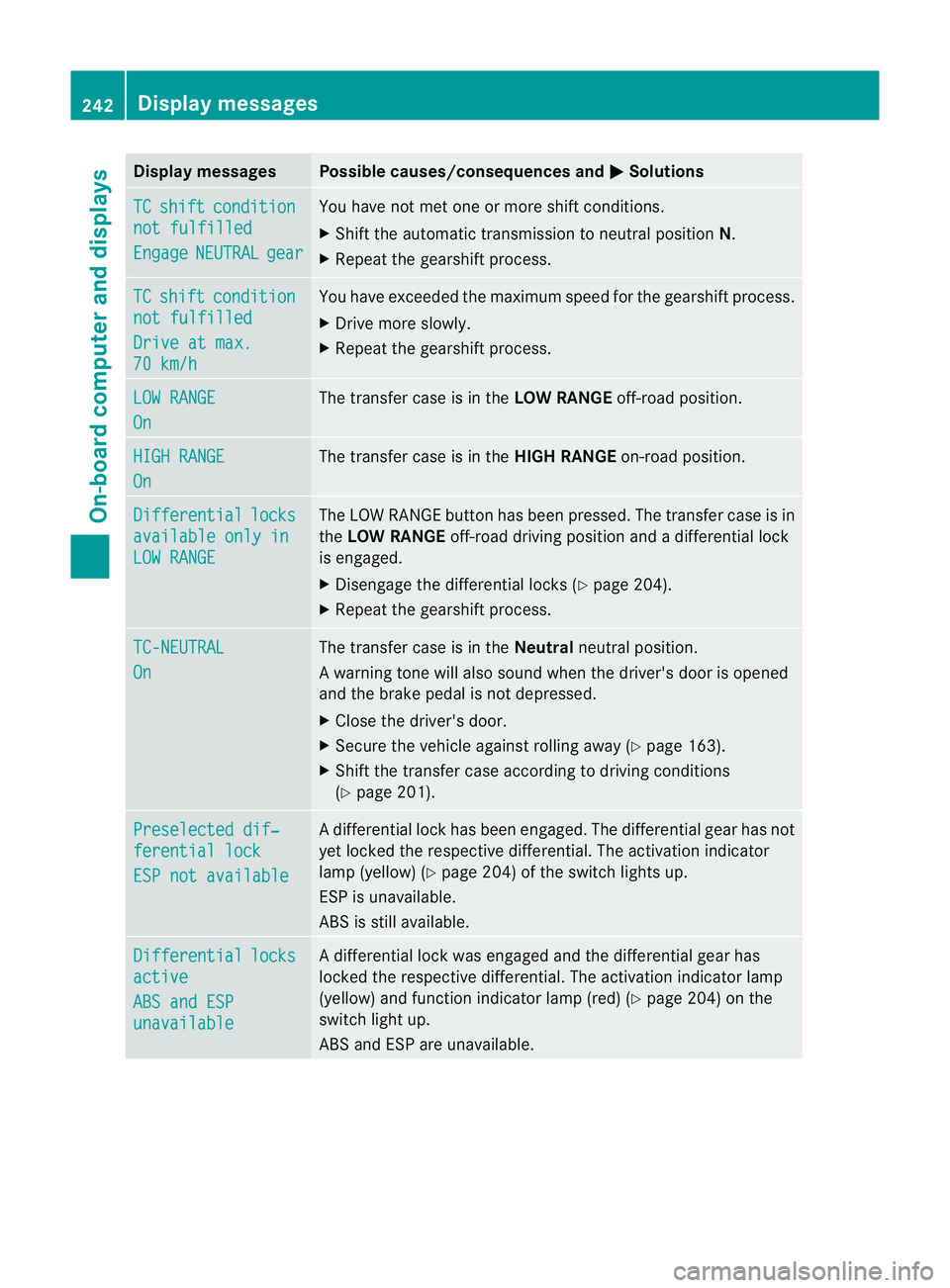
Display messages Possible causes/consequences and
M Solutions
TC shift condition
not fulfilled
Engage NEUTRAL gear You have not met one or more shift conditions.
X
Shift the automati ctransmission to neutral position N.
X Repeat the gearshift process. TC shift condition
not fulfilled
Drive at max.
70 km/h You have exceeded the maximu
mspeed for the gearshift process.
X Drive more slowly.
X Repeat the gearshift process. LOW RANGE
On The transfer case is in the
LOW RANGEoff-road position. HIGH RANGE
On The transfer case is in the
HIGH RANGEon-road position. Differential locks
available only in
LOW RANGE The LOW RANGE button has been pressed. The transfer case is in
the
LOW RANGE off-road driving position and a differential lock
is engaged.
X Disengage the differential locks (Y page 204).
X Repeat the gearshift process. TC-NEUTRAL
On The transfer case is in the
Neutralneutral position.
Aw arning tone will also sound when the driver's door is opened
and the brake pedal is no tdepressed.
X Close the driver's door.
X Secure the vehicle against rolling away (Y page 163).
X Shift the transfer case according to driving conditions
(Y page 201). Preselected dif‐
ferential lock
ESP not available Ad
ifferential lock has been engaged. The differential gear has not
yet locked the respective differential. The activation indicator
lamp (yellow) ( Ypage 204) of the switch lights up.
ESP is unavailable.
AB Sis still available. Differential locks
active
ABS and ESP
unavailable Ad
ifferential lock was engaged and the differential gear has
locked the respective differential. The activation indicator lamp
(yellow) and function indicator lamp (red) (Y page 204) on the
switch light up.
AB Sa nd ESP are unavailable. 242
Display messagesOn-board computer and displays
Page 252 of 357
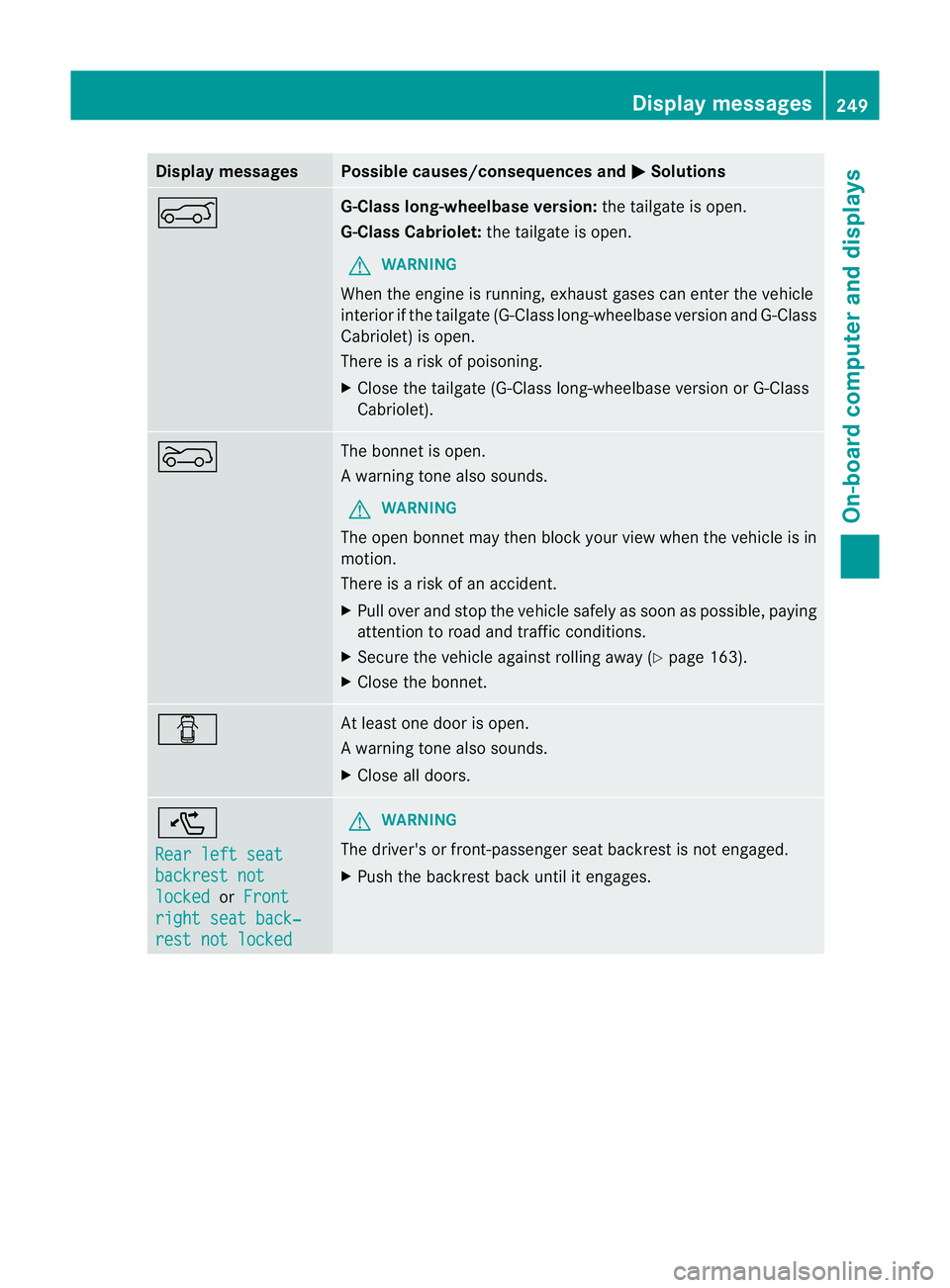
Display messages Possible causes/consequences and
M Solutions
A G-Class long-wheelbase version:
the tailgate is open.
G-Class Cabriolet: the tailgate is open.
G WARNING
Whe nthe engine is running, exhaust gases can enter the vehicle
interior if the tailgate (G-Class long-wheelbase version and G-Class
Cabriolet) is open.
There is a risk of poisoning.
X Close the tailgate (G-Class long-wheelbase version or G-Class
Cabriolet). ? The bonnet is open.
Aw
arning tone also sounds.
G WARNING
The open bonne tmay then bloc kyour view when the vehicle is in
motion.
There is a risk of an accident.
X Pull over and stop the vehicle safely as soon as possible, paying
attention to road and traffic conditions.
X Secure the vehicle against rolling away (Y page 163).
X Close the bonnet. C At least one door is open.
Aw arning tone also sounds.
X Close all doors. ^
Rear left seat
backrest not
locked or
Front right seat back‐
rest not locked G
WARNING
The driver's or front-passenger seat backres tis not engaged.
X Push the backrest back until it engages. Display messages
249On-board computer and displays Z
Page 254 of 357
Display messages Possible causes/consequences and
M Solutions
Telephone No
service Your vehicle is outside the network provider's transmitter/
receiver range.
X
Wait until the mobile phone operational readiness symbol
appears in the multifunction display. ¥
Top
up washer fluid The washer fluid level in th
ewasher fluid reservoir has dropped
below the minimum.
X Top up the washe rfluid (Y page 294). Key
Displa
ymessages Possible causes/consequences and
M Solutions
Â
Key does not
belong to vehicle You have put the wrong key in the ignitio
nlock.
X Use the correct key. Â
Replace key The key needs to be replaced.
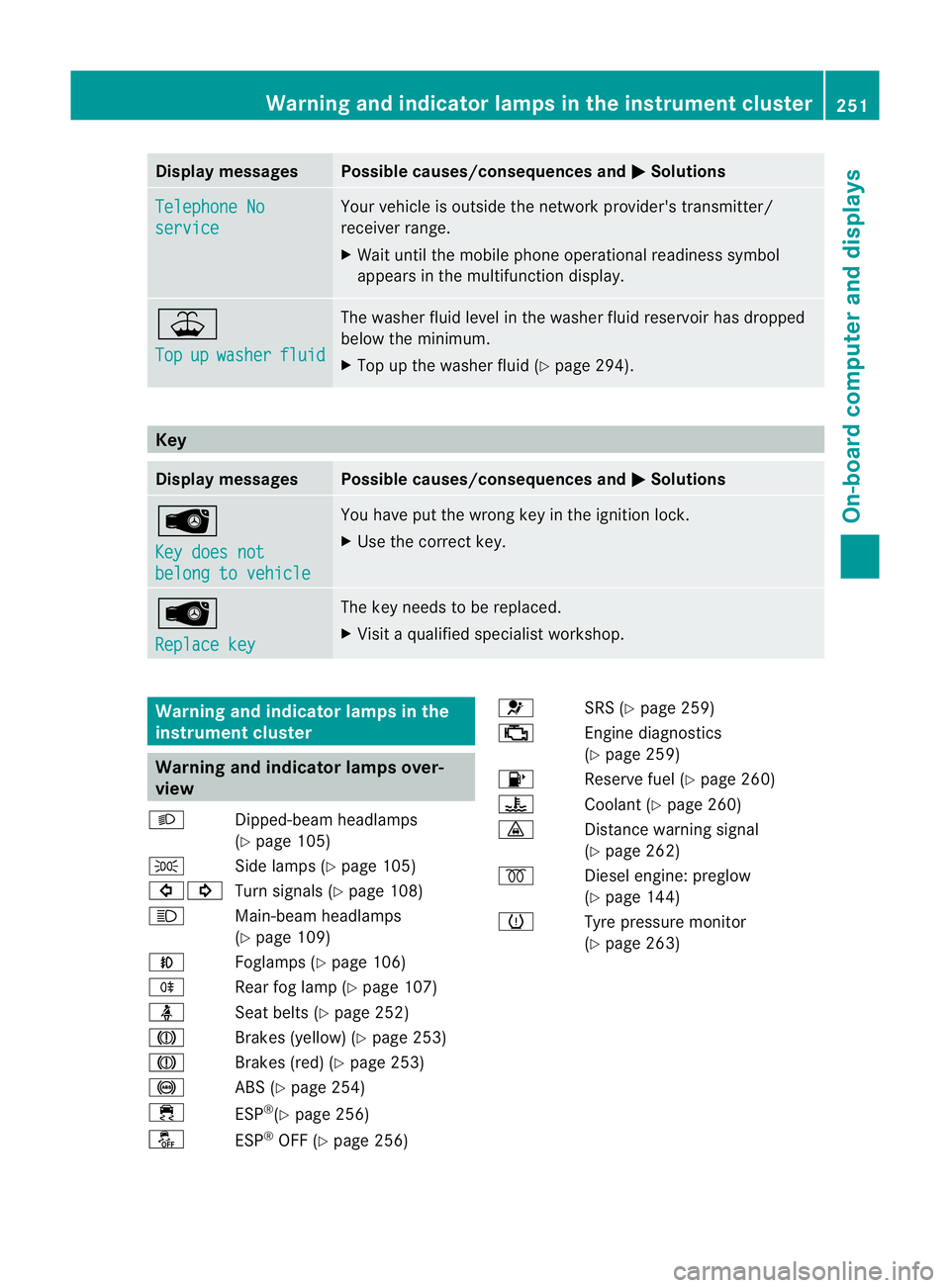
X Visit a qualified specialist workshop. Warning and indicator lamps in the
instrument cluster Warning and indicator lamps over-
view
L Dipped-beam headlamps
(Ypage 105)
T Side lamps (Y page 105)
#! Turn signals (Y page 108)
K Main-beam headlamps
(Ypage 109)
N Foglamps (Y page 106)
R Rear fog lamp (Y page 107)
ü Seat belts (Y page 252)
J Brakes (yellow) (Y page 253)
J Brakes (red) (Y page 253)
! ABS (Ypage 254)
÷ ESP®
(Y page 256)
å ESP®
OFF (Y page 256) 6
SRS (Ypage 259)
; Engine diagnostics
(Ypage 259)
8 Reserve fuel (Y page 260)
? Coolant (Ypage 260)
· Distance warning signal
(Ypage 262)
% Diesel engine: preglow
(Ypage 144)
h Tyre pressure monitor
(Ypage 263) Warning and indicator lamps in the instrument cluster
251On-board computer and displays Z
Page 257 of 357
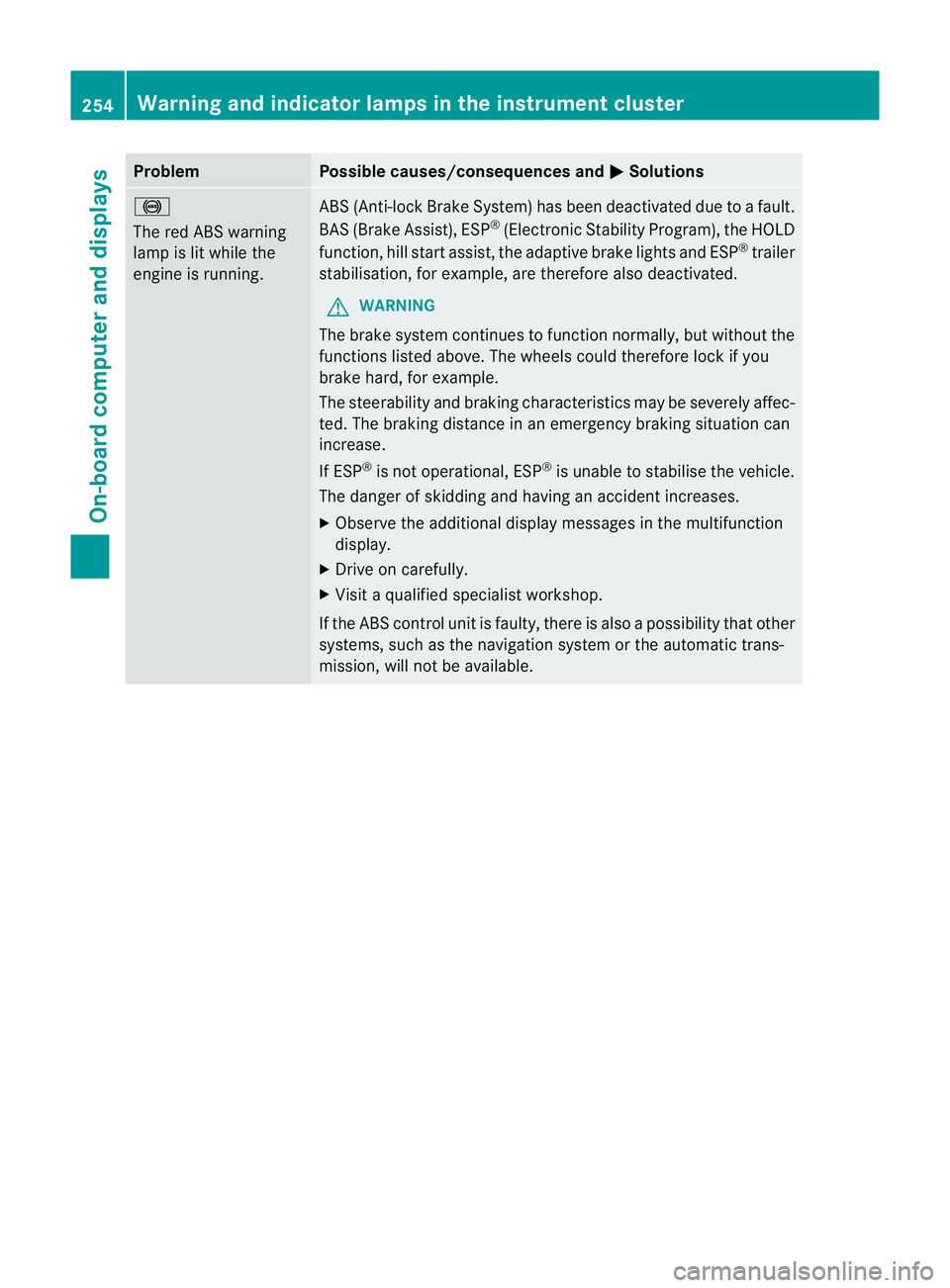
Problem Possible causes/consequences and
M Solutions
!
The red ABS warning
lamp is lit while the
engine is running.
ABS (Anti-lock Brake System) has been deactivated due to a fault.
BAS (Brake Assist), ESP
®
(Electronic Stability Program), the HOLD
function, hill start assist, the adaptive brake lights and ESP ®
trailer
stabilisation, for example, are therefore also deactivated.
G WARNING
The brake system continues to function normally, but without the
functions listed above. The wheels could therefore lock if you
brake hard, for example.
The steerability and braking characteristics may be severely affec-
ted. The braking distance in an emergency braking situation can
increase.
If ESP ®
is not operational, ESP ®
is unable to stabilise the vehicle.
The danger of skidding and having an accident increases.
X Observe the additional display messages in the multifunction
display.
X Drive on carefully.
X Visit a qualified specialist workshop.
If the ABS control unit is faulty, there is also a possibility that other
systems, such as the navigation system or the automatic trans-
mission, will not be available. 254
Warning and indicator lamps in the instrument clusterOn-board computer and displays
Page 258 of 357
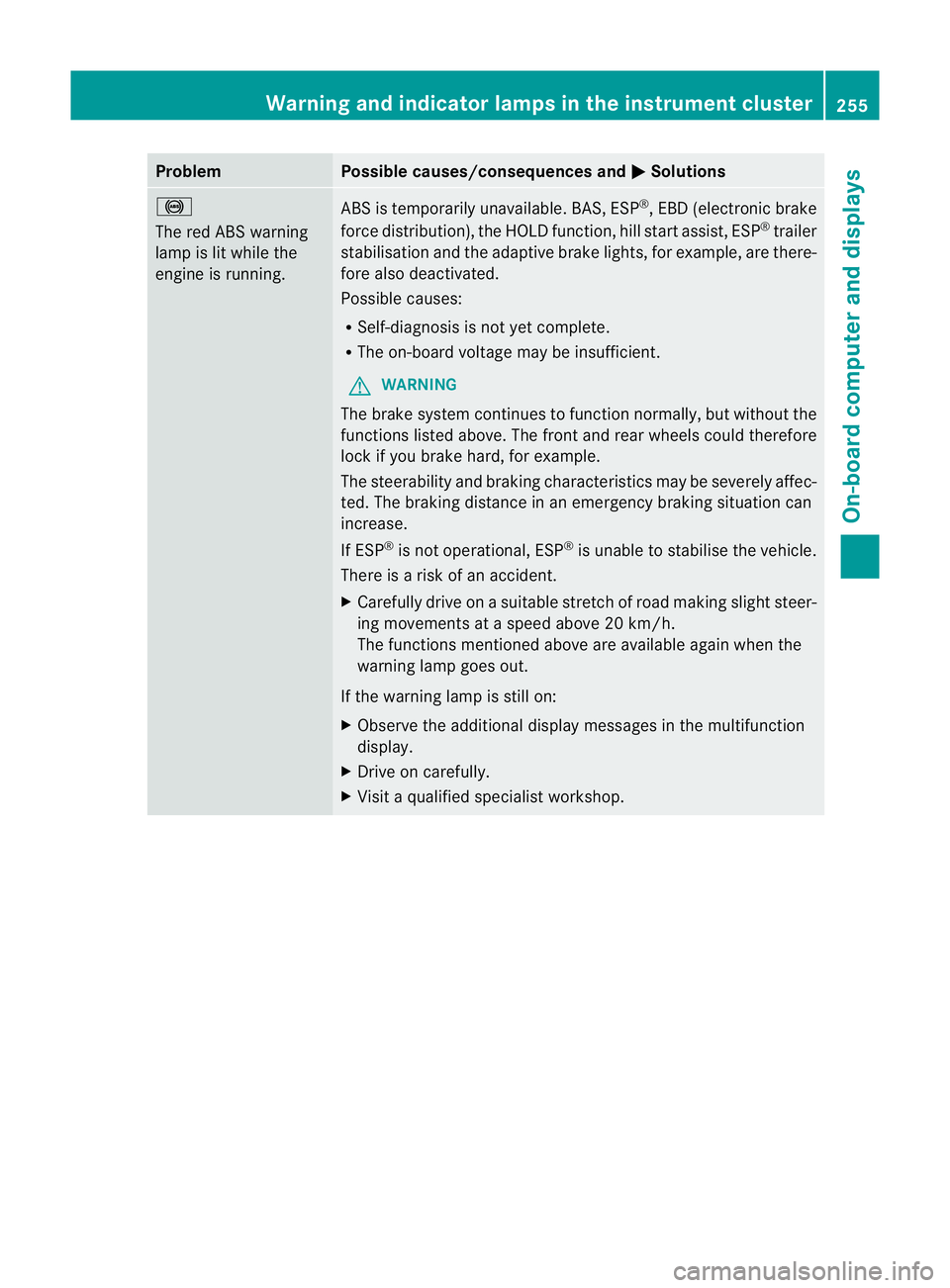
Problem Possible causes/consequences and
M Solutions
!
The red ABS warning
lamp is lit while the
engine is running.
ABS is temporarily unavailable. BAS, ESP
®
,E BD (electronic brake
force distribution), the HOLD function, hill star tassist, ESP ®
trailer
stabilisation and the adaptive brake lights, for example, are there-
fore also deactivated.
Possible causes:
R Self-diagnosis is not yet complete.
R The on-board voltage may be insufficient.
G WARNING
The brake system continues to function normally, but without the
functions listed above. The front and rear wheels could therefore
lock if you brake hard, for example.
The steerability and braking characteristics may be severely affec-
ted. The braking distance in an emergency braking situation can
increase.
If ESP ®
is not operational, ESP ®
is unable to stabilise the vehicle.
There is a risk of an accident.
X Carefully drive on a suitable stretch of road making slight steer-
ing movements at a speed above 20 km/h.
The functions mentioned above are available againw hen the
warning lamp goes out.
If the warning lamp is still on:
X Observe the additional display messages in the multifunction
display.
X Drive on carefully.
X Visit a qualified specialist workshop. Warning and indicator lamps in the instrument cluster
255On-board computer and displays Z
Page 259 of 357
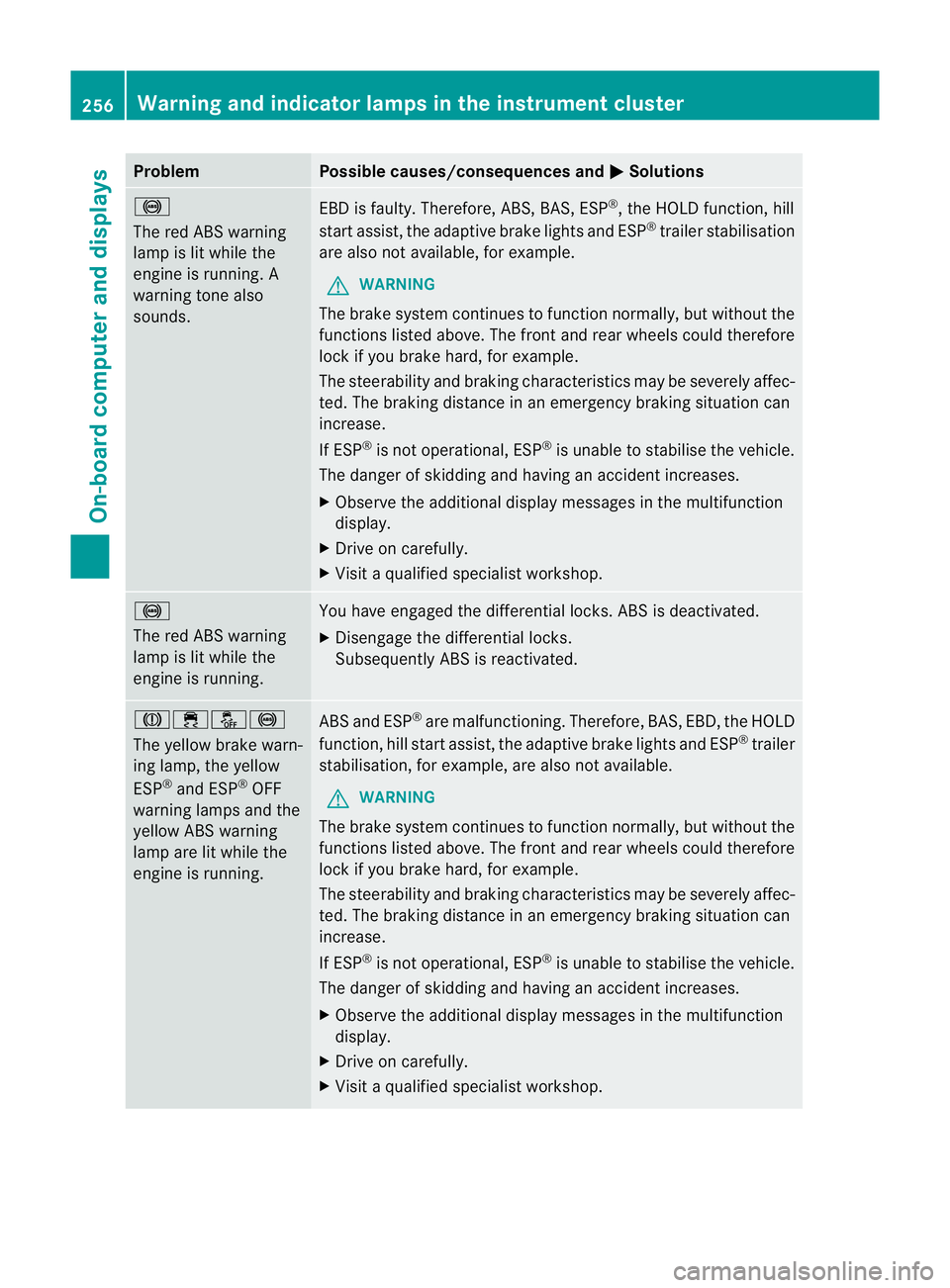
Problem Possible causes/consequences and
M Solutions
!
The red ABS warning
lamp is lit while the
engine is running. A
warning tone also
sounds.
EBD is faulty. Therefore, ABS, BAS, ESP
®
, the HOLD function, hill
start assist, the adaptive brake lights and ESP ®
trailer stabilisation
are also not available, for example.
G WARNING
The brake system continues to function normally, but without the
functions listed above. The front and rear wheels could therefore
lock if you brake hard, for example.
The steerability and braking characteristics may be severely affec-
ted. The braking distance in an emergency braking situation can
increase.
If ESP ®
is not operational, ESP ®
is unable to stabilise the vehicle.
The danger of skidding and having an accident increases.
X Observe the additional display messages in the multifunction
display.
X Drive on carefully.
X Visit a qualified specialist workshop. !
The red ABS warning
lamp is lit while the
engine is running.
You have engaged the differential locks. ABS is deactivated.
X
Disengage the differential locks.
Subsequently ABS is reactivated. J֌!
The yellow brake warn-
ing lamp, the yellow
ESP ®
and ESP ®
OFF
warning lamps and the
yellow ABS warning
lamp are lit while the
engine is running. ABS and ESP
®
are malfunctioning. Therefore, BAS, EBD, the HOLD
function, hill start assist, the adaptive brake lights and ESP ®
trailer
stabilisation, for example, are also not available.
G WARNING
The brake system continues to function normally, but without the
functions listed above. The front and rear wheels could therefore
lock if you brake hard, for example.
The steerability and braking characteristics may be severely affec-
ted. The braking distance in an emergency braking situation can
increase.
If ESP ®
is not operational, ESP ®
is unable to stabilise the vehicle.
The danger of skidding and having an accident increases.
X Observe the additional display messages in the multifunction
display.
X Drive on carefully.
X Visit a qualified specialist workshop. 256
Warning and indicator lamps in the instrument clusterOn-board computer and displays
Page 261 of 357
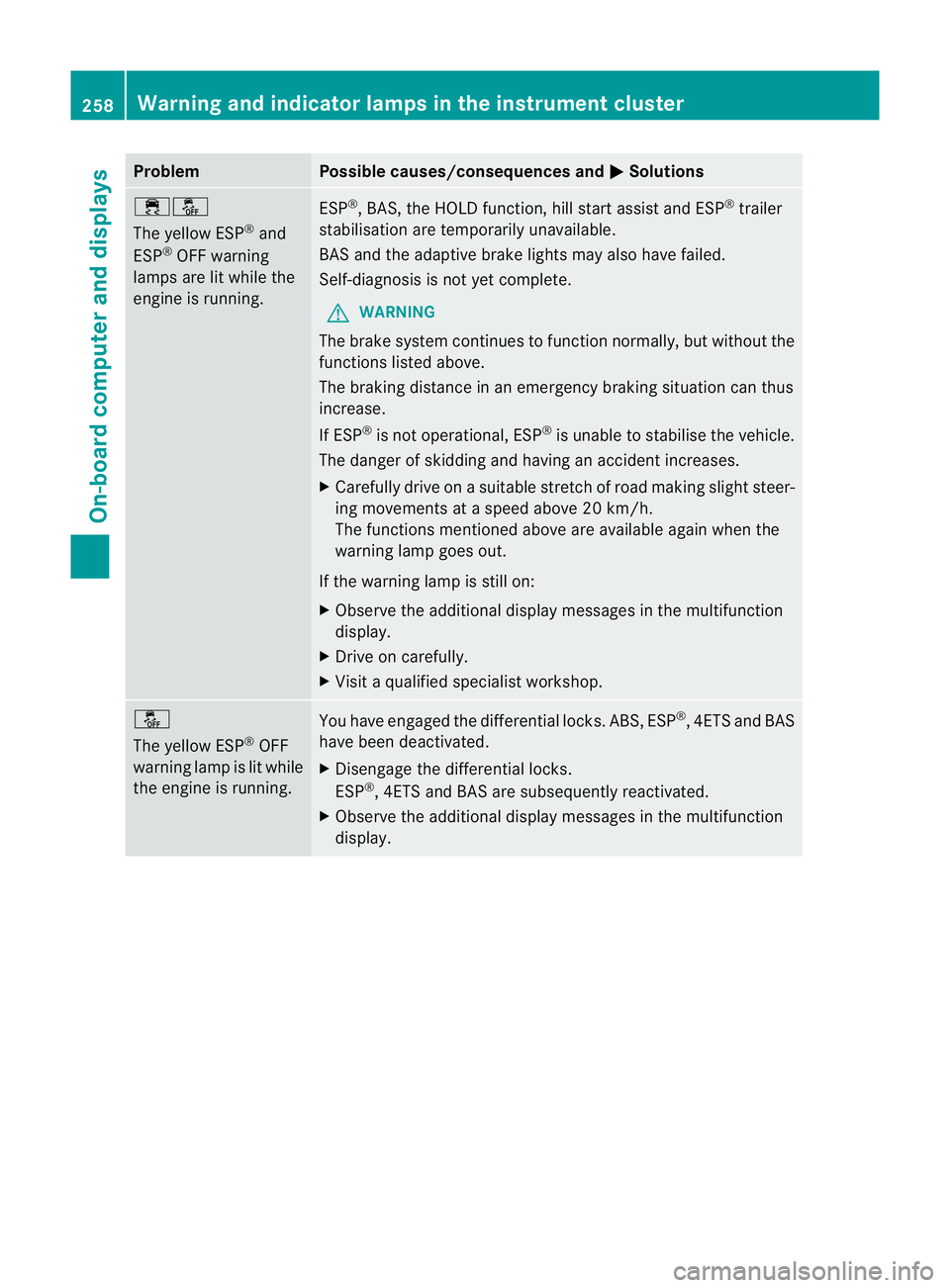
Problem Possible causes/consequences and
M Solutions
֌
The yellow ESP
®
and
ESP ®
OFF warning
lamps are lit while the
engine is running. ESP
®
, BAS, the HOLD function, hill start assist and ESP ®
trailer
stabilisation are temporarily unavailable.
BAS and the adaptive brake lights may also have failed.
Self-diagnosis is not yet complete.
G WARNING
The brake system continues to function normally, but without the
functions listed above.
The braking distance in an emergency braking situation can thus
increase.
If ESP ®
is not operational, ESP ®
is unable to stabilise the vehicle.
The danger of skidding and having an accident increases.
X Carefully drive on a suitable stretch of road making slight steer-
ing movements at a speed above 20 km/h.
The functions mentioned above are available again when the
warning lamp goes out.
If the warning lamp is still on:
X Observe the additional display messages in the multifunction
display.
X Drive on carefully.
X Visit a qualified specialist workshop. å
The yellow ESP
®
OFF
warning lamp is lit while
the engine is running. You have engaged the differential locks. ABS, ESP
®
,4 ETS and BAS
have been deactivated.
X Disengage the differential locks.
ESP ®
, 4ETS and BAS ar esubsequently reactivated.
X Observe the additional display messages in the multifunction
display. 258
Warning and indicator lamps in the instrument clusterOn-board computer and displays
Page 264 of 357
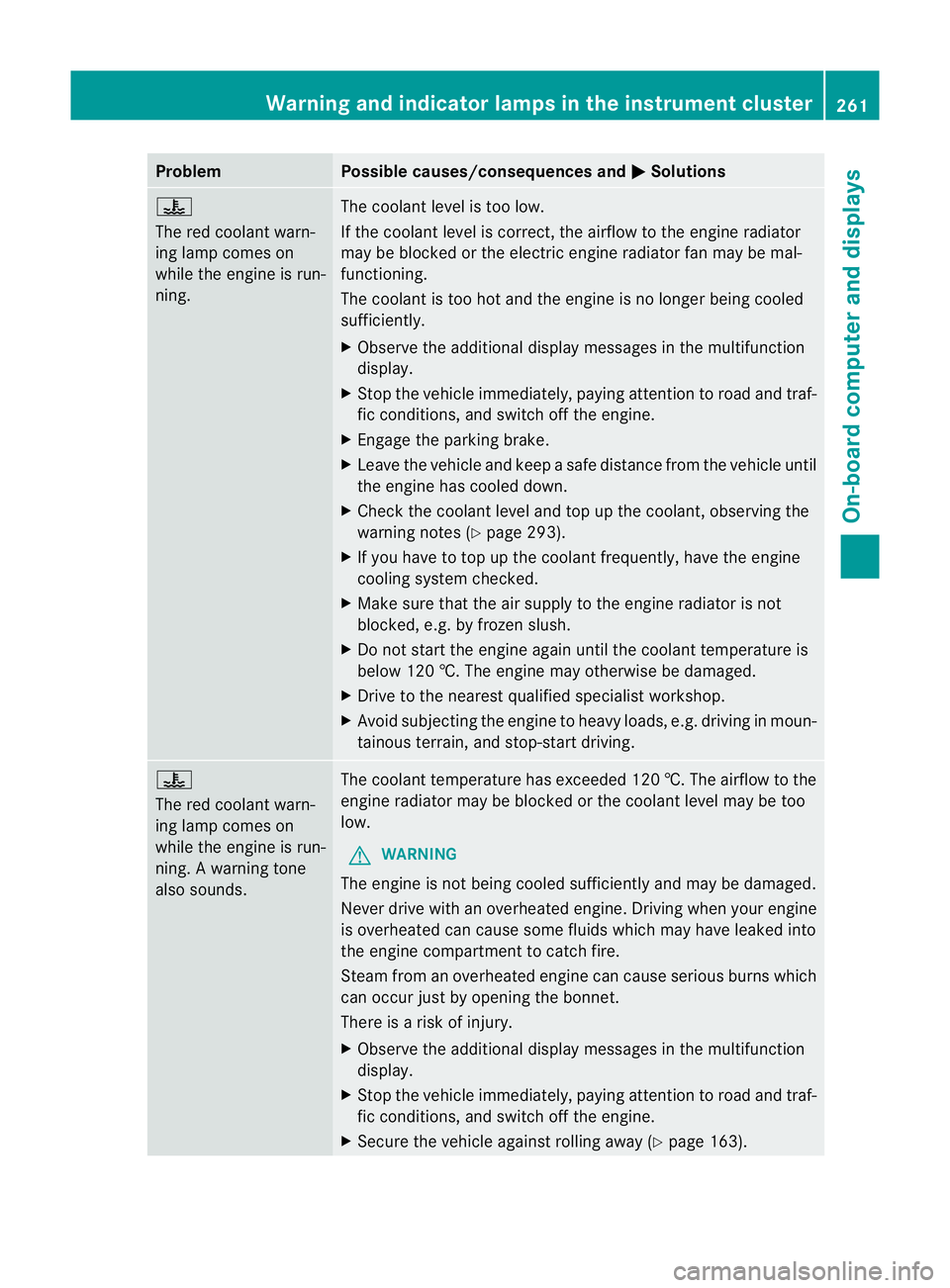
Problem Possible causes/consequences and
M Solutions
?
The red coolant warn-
ing lamp comes on
while the engine is run-
ning.
The coolant level is too low.
If the coolant level is correct, the airflow to the engine radiator
may be blocked or the electric engine radiator fan may be mal-
functioning.
The coolant is too hot and the engine is no longer being cooled
sufficiently.
X
Observe the additional display messages in the multifunction
display.
X Stop the vehicle immediately, paying attention to road and traf-
fic conditions, and switch off the engine.
X Engage the parking brake.
X Leave the vehicle and keep a safe distance from the vehicle until
the engine has cooled down.
X Check the coolant level and top up the coolant, observing the
warning notes (Y page 293).
X If you have to top up the coolant frequently, have the engine
cooling system checked.
X Make sure that the air supply to the engine radiator is not
blocked, e.g. by frozen slush.
X Do not start the engine again until the coolant temperature is
below 120 †. The engine may otherwise be damaged.
X Drive to the nearest qualified specialist workshop.
X Avoid subjecting the engine to heavy loads, e.g. driving in moun-
tainous terrain, and stop-start driving. ?
The red coolant warn-
ing lamp comes on
while the engine is run-
ning. A warning tone
also sounds.
The coolant temperature has exceeded 120 †. The airflow to the
engine radiator may be blocked or the coolant level may be too
low.
G WARNING
The engine is not being cooled sufficiently and may be damaged.
Never drive with an overheated engine. Driving when your engine
is overheated can cause some fluids which may have leaked into
the engine compartment to catch fire.
Steam from an overheated engine can cause serious burns which
can occur just by opening the bonnet.
There is a risk of injury.
X Observe the additional display messages in the multifunction
display.
X Stop the vehicle immediately, paying attention to road and traf-
fic conditions, and switch off the engine.
X Secure the vehicle against rolling away (Y page 163).Warning and indicator lamps in the instrument cluster
261On-board computer and displays Z
Page 265 of 357
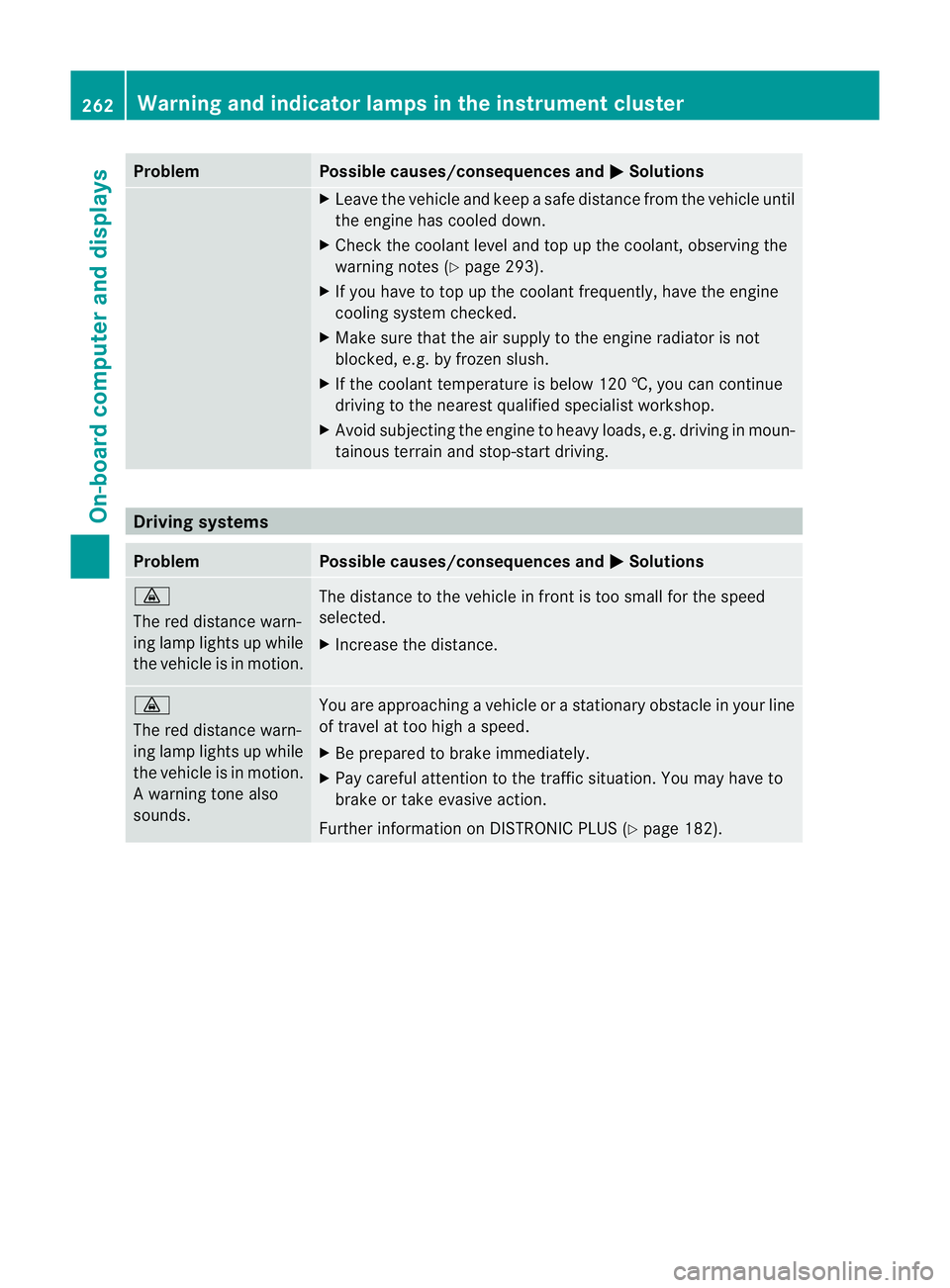
Problem Possible causes/consequences and
M Solutions
X
Leave the vehicle and keep a safe distance from the vehicle until
the engine has cooled down.
X Check the coolant level and top up the coolant, observing the
warning notes (Y page 293).
X If you have to top up the coolant frequently, have the engine
cooling system checked.
X Make sure that the air supply to the engine radiator is not
blocked, e.g. by frozen slush.
X If the coolant temperature is below 120 †, you can continue
driving to the nearest qualified specialist workshop.
X Avoid subjecting the engine to heavy loads, e.g. driving in moun-
tainous terrain and stop-start driving. Driving systems
Problem Possible causes/consequences and
M Solutions
·
The red distance warn-
ing lamp lights up while
the vehicle is in motion. The distance to the vehicle in front is too small for the speed
selected.
X
Increase the distance. ·
The red distance warn-
ing lamp lights up while
the vehicle is in motion.
Aw arning tone also
sounds. You are approaching a vehicle or a stationary obstacle in your line
of travel at too high a speed.
X
Be prepared to brake immediately.
X Pay careful attention to the traffic situation. You may have to
brake or take evasive action.
Further information on DISTRONIC PLUS (Y page 182).262
Warning and indicator lamps in the instrument clusterOn-board computer and displays