ABS MERCEDES-BENZ G-CLASS SUV 2012 Owner's Manual
[x] Cancel search | Manufacturer: MERCEDES-BENZ, Model Year: 2012, Model line: G-CLASS SUV, Model: MERCEDES-BENZ G-CLASS SUV 2012Pages: 357, PDF Size: 8.86 MB
Page 258 of 357
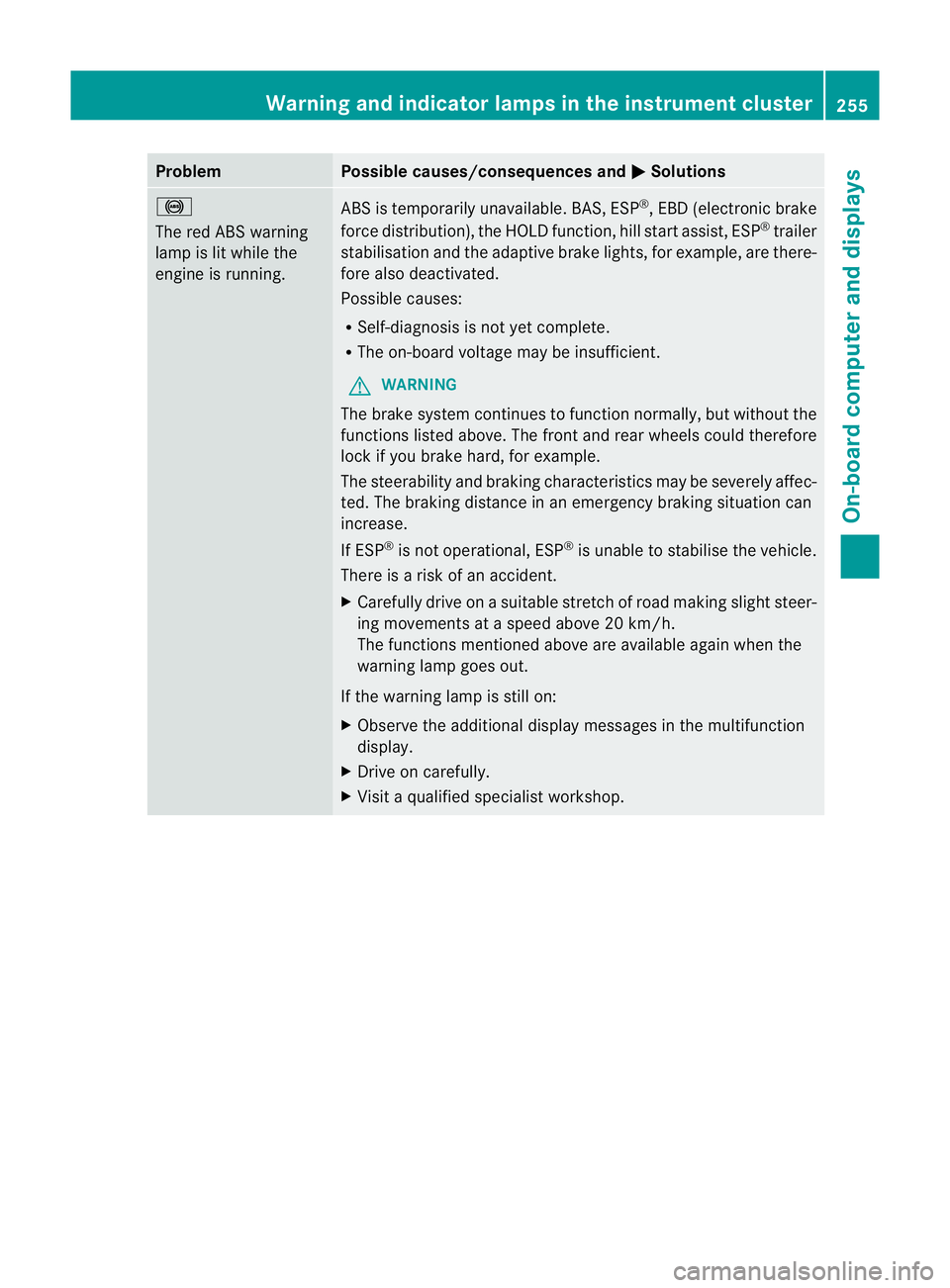
Problem Possible causes/consequences and
M Solutions
!
The red ABS warning
lamp is lit while the
engine is running.
ABS is temporarily unavailable. BAS, ESP
®
,E BD (electronic brake
force distribution), the HOLD function, hill star tassist, ESP ®
trailer
stabilisation and the adaptive brake lights, for example, are there-
fore also deactivated.
Possible causes:
R Self-diagnosis is not yet complete.
R The on-board voltage may be insufficient.
G WARNING
The brake system continues to function normally, but without the
functions listed above. The front and rear wheels could therefore
lock if you brake hard, for example.
The steerability and braking characteristics may be severely affec-
ted. The braking distance in an emergency braking situation can
increase.
If ESP ®
is not operational, ESP ®
is unable to stabilise the vehicle.
There is a risk of an accident.
X Carefully drive on a suitable stretch of road making slight steer-
ing movements at a speed above 20 km/h.
The functions mentioned above are available againw hen the
warning lamp goes out.
If the warning lamp is still on:
X Observe the additional display messages in the multifunction
display.
X Drive on carefully.
X Visit a qualified specialist workshop. Warning and indicator lamps in the instrument cluster
255On-board computer and displays Z
Page 259 of 357
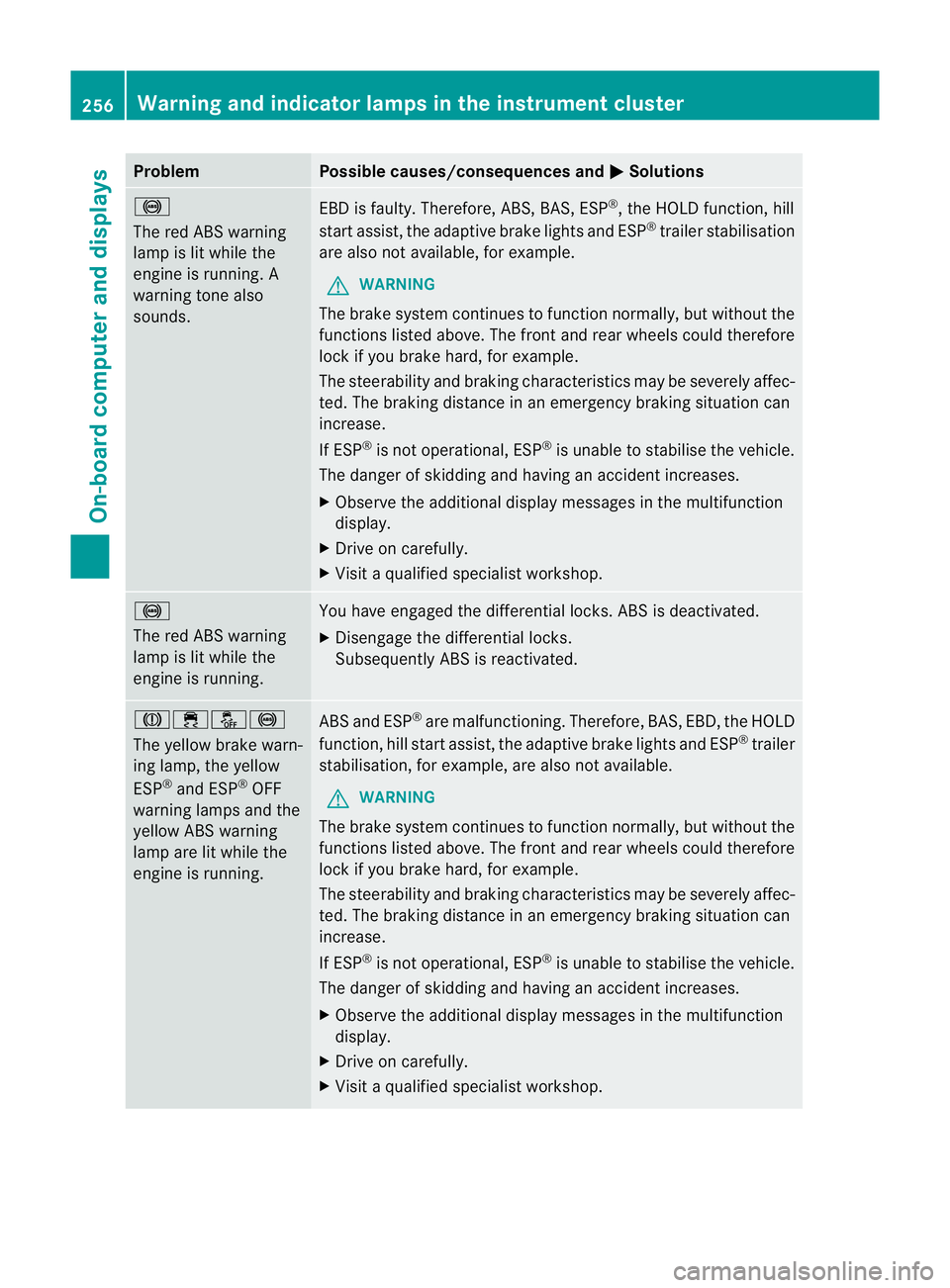
Problem Possible causes/consequences and
M Solutions
!
The red ABS warning
lamp is lit while the
engine is running. A
warning tone also
sounds.
EBD is faulty. Therefore, ABS, BAS, ESP
®
, the HOLD function, hill
start assist, the adaptive brake lights and ESP ®
trailer stabilisation
are also not available, for example.
G WARNING
The brake system continues to function normally, but without the
functions listed above. The front and rear wheels could therefore
lock if you brake hard, for example.
The steerability and braking characteristics may be severely affec-
ted. The braking distance in an emergency braking situation can
increase.
If ESP ®
is not operational, ESP ®
is unable to stabilise the vehicle.
The danger of skidding and having an accident increases.
X Observe the additional display messages in the multifunction
display.
X Drive on carefully.
X Visit a qualified specialist workshop. !
The red ABS warning
lamp is lit while the
engine is running.
You have engaged the differential locks. ABS is deactivated.
X
Disengage the differential locks.
Subsequently ABS is reactivated. J֌!
The yellow brake warn-
ing lamp, the yellow
ESP ®
and ESP ®
OFF
warning lamps and the
yellow ABS warning
lamp are lit while the
engine is running. ABS and ESP
®
are malfunctioning. Therefore, BAS, EBD, the HOLD
function, hill start assist, the adaptive brake lights and ESP ®
trailer
stabilisation, for example, are also not available.
G WARNING
The brake system continues to function normally, but without the
functions listed above. The front and rear wheels could therefore
lock if you brake hard, for example.
The steerability and braking characteristics may be severely affec-
ted. The braking distance in an emergency braking situation can
increase.
If ESP ®
is not operational, ESP ®
is unable to stabilise the vehicle.
The danger of skidding and having an accident increases.
X Observe the additional display messages in the multifunction
display.
X Drive on carefully.
X Visit a qualified specialist workshop. 256
Warning and indicator lamps in the instrument clusterOn-board computer and displays
Page 261 of 357
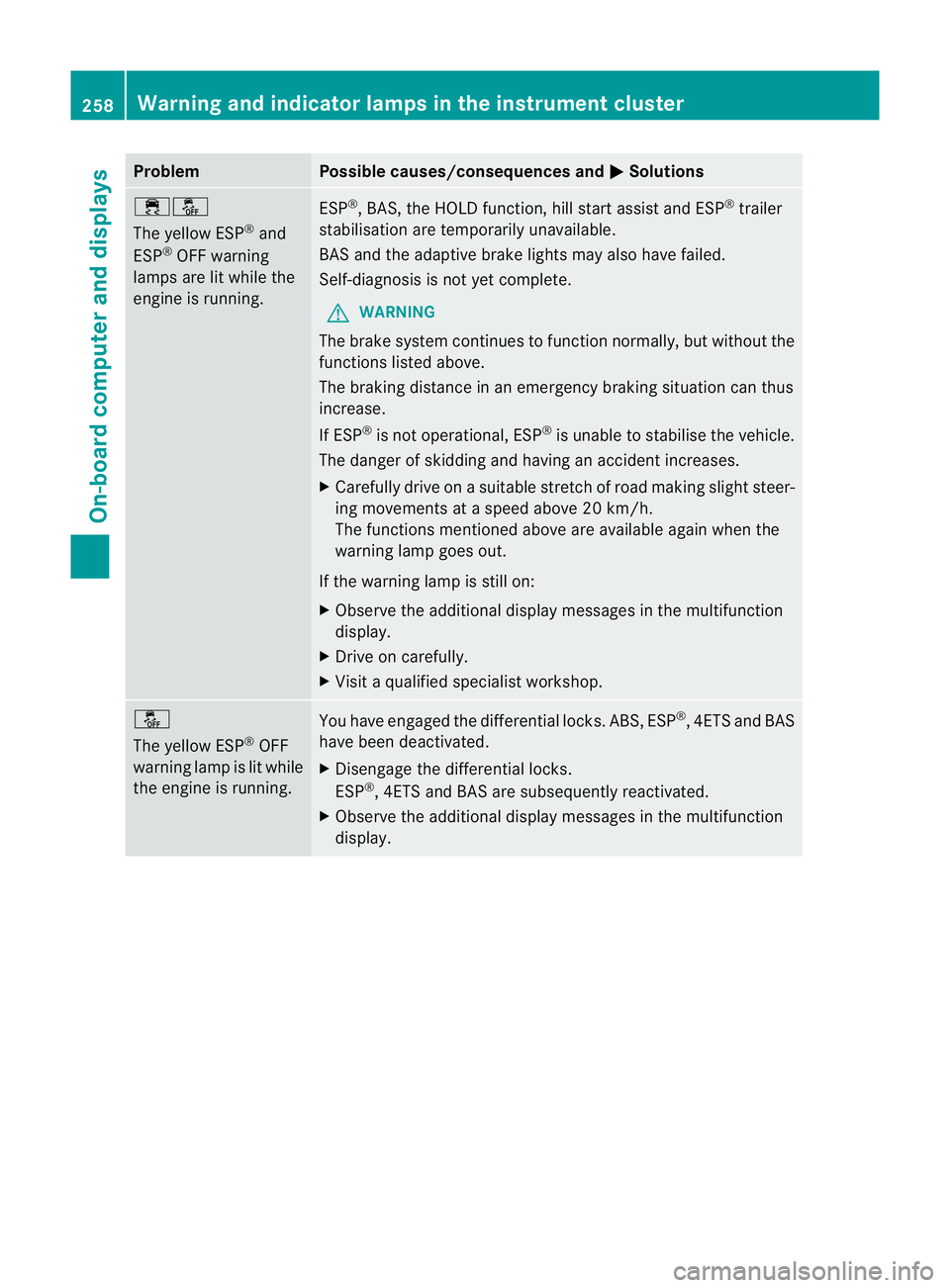
Problem Possible causes/consequences and
M Solutions
֌
The yellow ESP
®
and
ESP ®
OFF warning
lamps are lit while the
engine is running. ESP
®
, BAS, the HOLD function, hill start assist and ESP ®
trailer
stabilisation are temporarily unavailable.
BAS and the adaptive brake lights may also have failed.
Self-diagnosis is not yet complete.
G WARNING
The brake system continues to function normally, but without the
functions listed above.
The braking distance in an emergency braking situation can thus
increase.
If ESP ®
is not operational, ESP ®
is unable to stabilise the vehicle.
The danger of skidding and having an accident increases.
X Carefully drive on a suitable stretch of road making slight steer-
ing movements at a speed above 20 km/h.
The functions mentioned above are available again when the
warning lamp goes out.
If the warning lamp is still on:
X Observe the additional display messages in the multifunction
display.
X Drive on carefully.
X Visit a qualified specialist workshop. å
The yellow ESP
®
OFF
warning lamp is lit while
the engine is running. You have engaged the differential locks. ABS, ESP
®
,4 ETS and BAS
have been deactivated.
X Disengage the differential locks.
ESP ®
, 4ETS and BAS ar esubsequently reactivated.
X Observe the additional display messages in the multifunction
display. 258
Warning and indicator lamps in the instrument clusterOn-board computer and displays
Page 307 of 357
Useful information
i This Owner's Manual describes all mod-
els, series and optional equipment for your
vehicle that were available at the time of
going to press. Country-specific differen-
ces are possible. Note that your vehicle
may not be fitted with all features descri-
bed. This is also the case for systems and
functions relevant to safety.
i Read the information on qualified special-
ist workshops: (Y page 22). Where will I find...?
Warning triangle
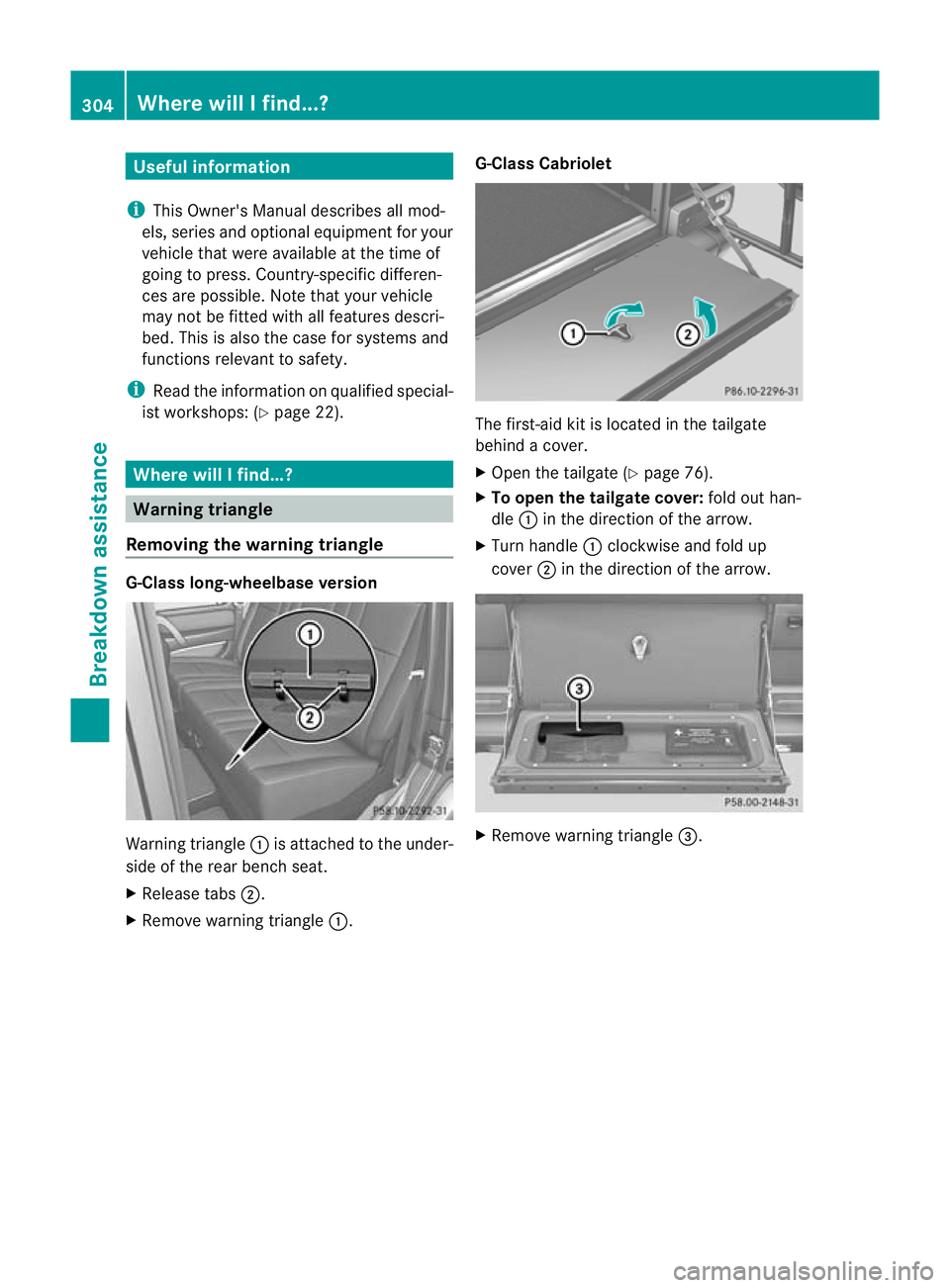
Removing the warning triangle G-Class long-wheelbase version
Warning triangle
:is attached to the under-
side of the rear bench seat.
X Release tabs ;.
X Remove warning triangle :.G-Class Cabriolet The first-aid kit is located in the tailgate
behind a cover.
X
Open the tailgate (Y page 76).
X To open the tailgate cover: fold out han-
dle :in the direction of the arrow.
X Turn handle :clockwise and fold up
cover ;in the direction of the arrow. X
Remove warning triangle =.304
Where will I find...?Breakdown assistance
Page 312 of 357
X
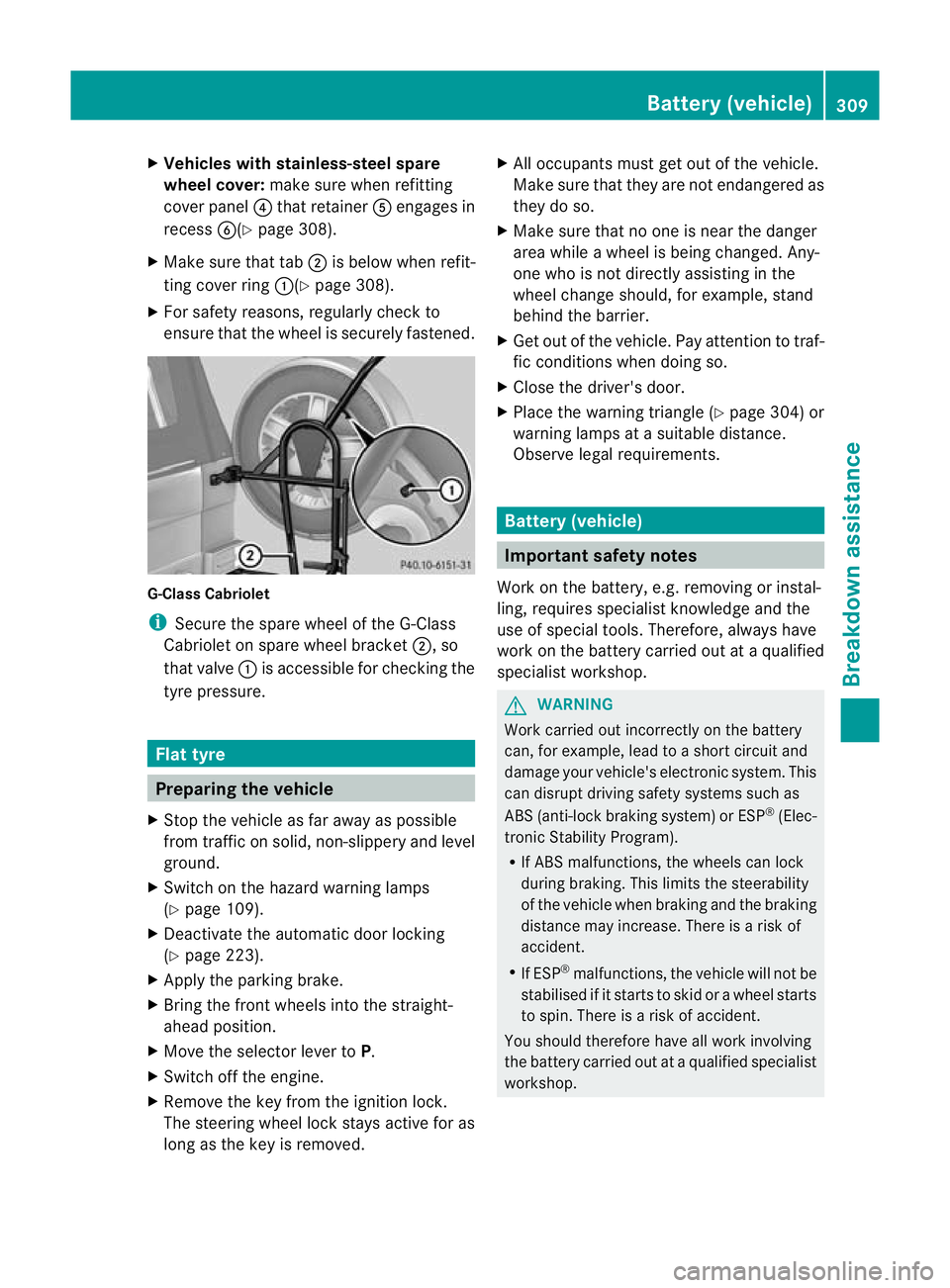
Vehicles with stainless-steel spare
wheel cover: make sure when refitting
cove rpanel ?that retainer Aengages in
recess B(Ypage 308).
X Make sure that tab ;is below when refit-
ting cover ring :(Ypage 308).
X For safety reasons, regularly check to
ensure that the wheel is securely fastened. G-Class Cabriolet
i
Secure the spare wheel of the G-Class
Cabriolet on spare wheel bracket ;, so
that valve :is accessible for checking the
tyre pressure. Flat tyre
Preparing the vehicle
X Stop the vehicle as far away as possible
from traffic on solid ,non-slippery and level
ground.
X Switch on the hazard warning lamps
(Y page 109).
X Deactivate the automatic door locking
(Y page 223).
X Apply the parking brake.
X Bring the front wheels into the straight-
ahead position.
X Move the selector lever to P.
X Switch off the engine.
X Remove the key from the ignition lock.
The steering wheel lock stays active for as
long as the key is removed. X
All occupants must get out of the vehicle.
Make sure that they are not endangered as
they do so.
X Make sure that no one is near the danger
area while a wheel is being changed. Any-
one who is not directly assisting in the
wheel change should, for example, stand
behind the barrier.
X Get out of the vehicle. Pay attention to traf-
fic conditions when doing so.
X Close the driver's door.
X Place the warning triangle (Y page 304) or
warning lamps at a suitable distance.
Observe legal requirements. Battery (vehicle)
Important safety notes
Work on the battery, e.g. removing or instal-
ling, requires specialist knowledge and the
use of special tools. Therefore, always have
work on the battery carried out at a qualified
specialist workshop. G
WARNING
Work carried out incorrectly on the battery
can, for example, lead to a short circuit and
damage your vehicle's electronic system. This
can disrupt driving safety systems such as
ABS (anti-lock braking system) or ESP ®
(Elec-
tronic Stability Program).
R If ABS malfunctions, the wheels can lock
during braking. This limits the steerability
of the vehicle when braking and the braking
distance may increase. There is a risk of
accident.
R If ESP ®
malfunctions, the vehicle will not be
stabilised if it starts to skid or a wheel starts
to spin. There is a risk of accident.
You should therefore have all work involving
the battery carried out at a qualified specialist
workshop. Battery (vehicle)
309Breakdown assistance Z
Page 313 of 357
G
WARNING
During the charging process, a battery produ-
ces hydrogen gas. If a short circuit occurs or
sparks are created, the hydrogen gas can
ignite. There is a risk of an explosion.
R Make sure that the positive terminal of a
connected battery does not come into con-
tact with vehicle parts.
R Never place metal objects or tools on a bat-
tery.
R It is important that you observe the descri-
bed order of the battery terminals when
connecting and disconnecting a battery.
R When jump-starting, make sure that the
battery poles with identical polarity are
connected.
R It is particularly important to observe the
described order when connecting and dis-
connecting the jump leads.
R Never connect or disconnect the battery
terminals while the engine is running. G
WARNING
Electrostatic build-up can lead to the creation
of sparks, which could ignite the highly explo-
sive gases of a battery .There is a risk of an
explosion.
Before handling the battery, touch the vehicle
body to remove any existing electrostatic
build-up. G
WARNING
Battery acid is caustic. There is a risk of injury.
Avoid contact with the skin, eyes or clothing.
Do not inhale any battery gases. Do not lean
over the battery. Keep children away from
batteries. Wash battery acid immediately with
water and seek medical attention.
! Have the battery checked regularly at a
qualified specialist workshop.
Observe the service intervals in the Service
Booklet or contact a qualified specialist
workshop for more information. !
Always have work on the battery carried
out at a qualified specialist workshop.
Should it, in exceptional circumstances, be
absolutely necessary to disconnectt he bat-
tery yourself, please observe the following:
R switch off the engine and remove the
key. Check that all the indicator lamps in
the instrumentc luster are off.Otherwise,
you may damage electroni ccomponents
such as the alternator, for example.
R first, disconnect the negative terminal
clamp, followed by the positive terminal
clamp. Never swap the terminal clamps.
The vehicle electronics may otherwise be
damaged.
R on vehicles with automatic transmission,
the transmission is locked in position P
after disconnecting the battery. The vehi-
cle is secured against rolling away.Y ou
can then no longer move the vehicle.
The battery and the cover of the positive
terminal clamp must be fitted securely dur-
ing operation.
! Have the battery checked and, if neces-
sary, replaced at a qualified specialist
workshop every two years or at least every
20,000 km. H
Environmental note Batteries contain pollutants.
It is illegal to dispose of them
with the household rubbish.
They must be collected sep-
arately and disposed of in an
environmentally responsible
recycling system. Dispose of batteries in an
environmentally responsible
manner
.Take discharged
batteries to a qualified spe-
cialis tworkshop or to a col-
lection point for used batter-
ies. 310
Battery (vehicle)Breakdown assistance
Page 327 of 357
Mercedes-Ben
zcannot accept responsibility
for this type of damage. M+S tyres
G
WARNING
M+S tyres with a tyre tread depth of less than
4mma re not suitable for use in winter as they
do not provide sufficient traction. There is a
risk of accident.
M+S tyres with a tread depth of less than
4 mm must be replaced. G
WARNING
The spare wheel and M+S tyres have different
tyre characteristics. Driving characteristics
can be severely impaired when you fit the
spare wheel. There is a risk of an accident.
You should therefore adapt yourd riving style
and drive carefully.H ave the spare wheel
replaced with a new wheel with an M+S tyre
at the nearest qualified specialist workshop.
At temperatures below +7 †, use winter tyres
or all-season tyres. Both types of tyre are
identified by the M+S marking.
Only winter tyres bearing the isnowflake
symbol in addition to the M+S marking pro-
vide the best possible grip in wintry road con-
ditions. Only these tyres will allow driving
safety systems such as ABS and ESP ®
to
function optimally in winter, as these tyres
have been designed specifically for driving on
snow.
Use M+S tyres of the same make and tread
on all wheels to maintain safe handling char-
acteristics.
Always observe the maximum permissible
speed specified for the M+S tyres you have
fitted.
If you fit M+S tyres that have a lower maxi-
mum permissible speed than that of the vehi-
cle, affix an appropriate warning sign in the
driver's field of vision .This can be obtained
at a qualified specialist workshop. Under these circumstances, you should also
restrict the maximum speed of the vehicle
using variable SPEEDTRONIC so that it does
not exceed the maximum permissible speed
for the M+S tyres(Y
page 178).
When you have fitted the M+S tyres:
X Check the tyre pressures (Y page 327).
X Restart the tyre pressure monitor
(Y page 328).
i You can obtain information about winter
tyres that have been approved by
Mercedes-Ben zespecially for your vehicle
at any Mercedes-Benz Service Centre.
i For further information about tyres, see
(Y page 333). Snow chains
! Information aboutt he use of snow chain
compatible AMG winter tyres is applicable
for AMG tyres. Use of snow chains is only
permissible with these tyres.
For safety reasons, Mercedes-Ben zrecom-
mends that you only use snow chains that
have been specially approved for your vehicle
by Mercedes-Benz, or that are of a corre-
sponding standard of quality.
R only use snow chains when the road sur-
face is completely snow-covered. Remove
the snow chains as soon as possible when
you come to road that is not snow-covered.
R local regulations may restrict the use of
snow chains. Observe the appropriate reg-
ulations if you wish to fit snow chains.
R Do not exceed the maximum permissible
speed of 50 km/h.
If you intend to fit snow chains, please bear
the following points in mind:
R snow chains cannot be fitted to all wheel/
tyre combinations (Y page 62).
R fit the snow chains on all four wheels for
maximum tractive power and driving sta-
bility. Observe the manufacturer's fitting
instructions. 324
Winter operationWheels and tyres
Page 336 of 357
X
Stow the jack and the vehicle tools in the
vehicle again.
X Check the tyre pressure of the newly fitted
wheel and adjus titifnecessary.
You will find a table of tyre pressures on the
inside of your vehicle's fuel filler flap. Wheel and tyre combinations
General notes
! For safety reasons, Mercedes-Benzr ec-
ommends that you only use tyres, wheels
and accessories which have been approved
by Mercedes-Benzs pecifically for your
vehicle. These tyres have been specially
adapted for use with the driving safety sys-
tems, such as ABS or ESP ®
.
Only use tyres, wheels or accessories tes-
ted and approved by Mercedes-Benz .Cer-
tain characteristics, e.g. handling, vehicle
noise emissions or fuel consumption, may
otherwise be adversely affected. In addi-
tion, when driving with aload, tyre dimen-
sion variations could cause the tyres to
come into contact with the bodywork and
axle components.T his could result in dam-
age to the tyres or the vehicle.
Mercedes-Ben zaccepts no liability for
damage resulting from the use of tyres,
wheels or accessories othe rthan those tes-
ted and approved.
Further information about wheels, tyres
and approved combinations can be
obtained from any Mercedes-Benz Service
Centre.
! Large wheels: the lower the section width
for a certain wheel size, the lower the ride
comfort is on poor road surfaces. Roll com-
fort and suspension comfort are reduced
and the risk of damage to the wheels and
tyres as a result of driving over obstacles
increases.
i You will find a table of tyre pressures on
the inside of your vehicle's fuel filler flap. For further information on tyre pressure,
see (Y
page 325). Check tyre pressures
regularly and only when the tyres are cold.
i Notes on the vehicle equipment –always
fit the vehicle:
R with tyres of the same size on a given axle
(left/right)
R fit the same type of tyres on your vehicle
at a given time (summer tyres, winter
tyres, all-weather tyres, All Terrain tyres)
The tyre and wheel combinations listed in the
tables below apply to the following models: V1 G 500
V2 G 350 BlueTEC
V3 G 63 AMG
G 65 AMG
i
Not all wheel/tyre combinations can be
mounted at the factory in all countries. Tyres
G3 50 BlueTEC Summer tyres
Tyres Light-alloy
wheels
265/60 R18 109 H
Tyre manufacturer
recommended by
Mercedes-Benz:
Bridgestone. 7.5
Jx18 H2 ET 63 i
You can obtai ninformation abou ttyres
and tyre dimensions that are no tlisted here
at any Mercedes-Benz Service Centre. Wheel and tyre combinations
333Wheels and tyres Z
Page 349 of 357
Petrol engines MB Approval
G5
00 229.3, 229.5
G 63 AMG
229.5
G 65 AMG
229.5
Diesel engines MB Approval
G3
50 BlueTEC 228.51,
229.31, 229.51
i
Restriction for AMG vehicles: only
engine oils SAE 0W-40 or SAE 5W-4 0may
be used.
i If the engine oils listed in the table are not
available, you may add the following engine
oils until the next oil change:
R Vehicles with apetrol engine: MB
Approval 229.1 229.3 or ACEA A3
R Vehicles with adiesel engine: MB
Approval 229.1, 229.3, 229.5 or
ACEA C3
Use only SAE 0W-40 or SAE 5W-40 engine
oils for AMG vehicles.
This may only be topped up once and the
quantity must not be greater than 1.0 l.
Capacities The following values refer to an oil change
including the oil filter.
The missing values for the following model
were not available at the time of going to
print:
R
G 63 AMG
R G 65 AMG Vehicle model Capacity including
oil filter G5
00 9.0 l
G3
50 BlueTEC 12.5 l Vehicle model Capacity including
oil filter G 63 AMG
G 65 AMG
Additives
!
Do not use any additives with the engine
oil. This could damage the engine.
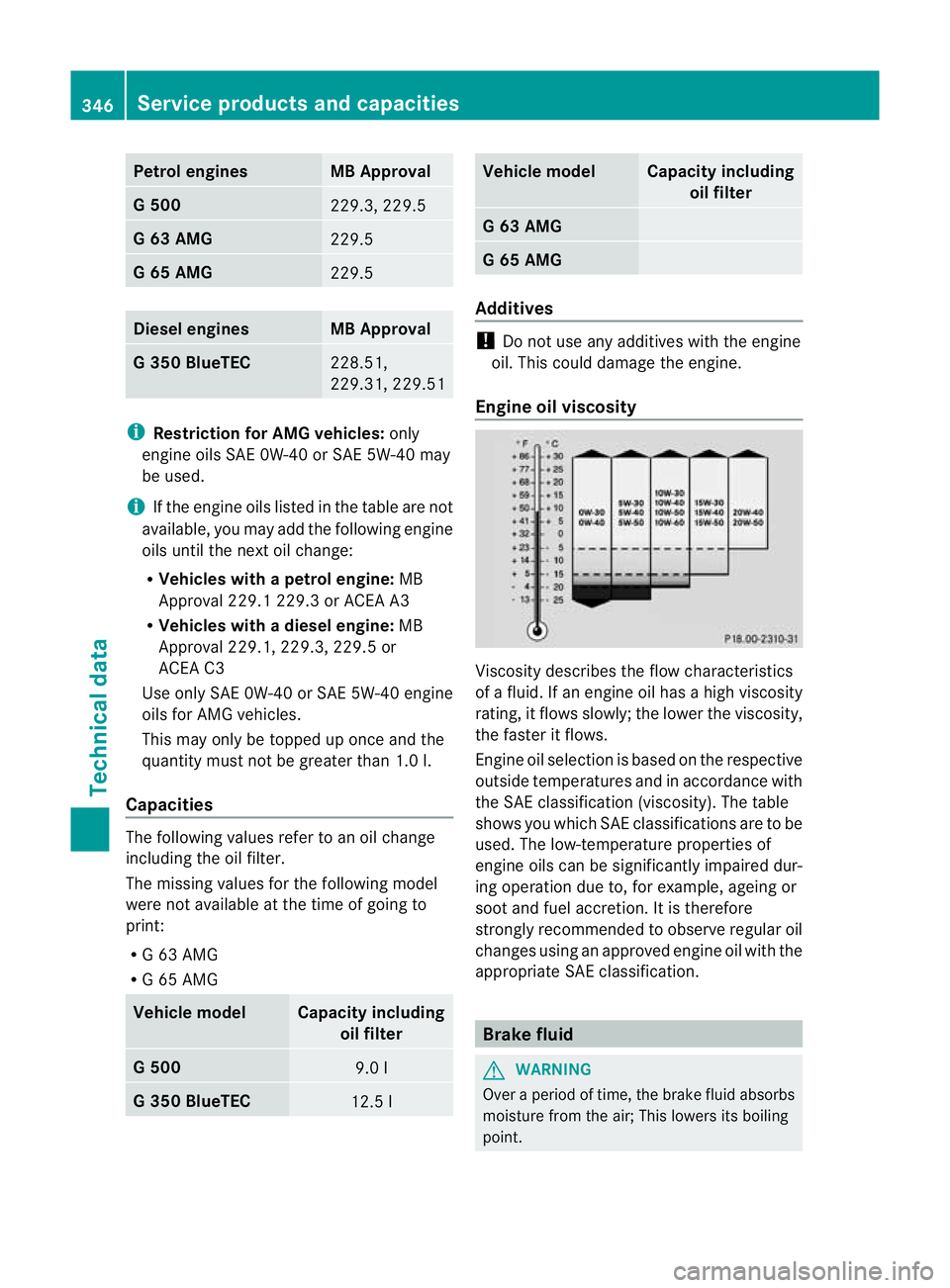
Engine oil viscosity Viscosity describes the flow characteristics
of a fluid. If an engine oil has a high viscosity
rating, it flows slowly; the lower the viscosity,
the faster it flows.
Engine oil selection is based on the respective
outside temperatures and in accordance with
the SAEc lassification (viscosity). The table
shows you which SA Eclassifications are to be
used. The low-temperature properties of
engine oils can be significantly impaired dur-
ing operation due to, for example, ageing or
soot and fuel accretion. It is therefore
strongly recommended to observe regular oil
changes using an approved engine oil with the
appropriate SA Eclassification. Brake fluid
G
WARNING
Over a period of time, the brake fluid absorbs
moisture fro mthe air; This lowers its boiling
point. 346
Service products and capacitiesTechnical data