light MERCEDES-BENZ G-CLASS SUV 2013 User Guide
[x] Cancel search | Manufacturer: MERCEDES-BENZ, Model Year: 2013, Model line: G-CLASS SUV, Model: MERCEDES-BENZ G-CLASS SUV 2013Pages: 364, PDF Size: 9.62 MB
Page 18 of 364
Supplemental Restraint System
see SRS (Supplemental Restraint
System)
Surround lighting (on-board
computer) .......................................... 219
Suspension tuning SETUP (on-board computer) .......... 222
SUV
(Sport Utility Vehicle) .......................22
Switching air-recirculation mode
on/off ................................................. 134
Switching off the alarm (ATA) ............65T
Tachometer ........................................ 210
Tailgate Opening dimensions ...................... 357
Tail lamps
Display message ............................ 233
see Lights
Tank content
Fuel gauge ..................................... 209
Technical data
Capacities ...................................... 350
Tires ............................................... 344
Tires/wheels ................................. 344
Trailer Loads .................................. 358
Vehicle data ................................... 357
Wheels ........................................... 344
TELEAID
Call priority .................................... 276
Downloading destinations
(COMAND) ..................................... 277
Downloading routes .......................279
Emergency call .............................. 274
Geo fencing ................................... 280
Important safety notes .................. 272
Locating a stolen vehicle ............... 278
MB info call button ........................ 276
Remote vehicle locking .................. 277
Roadside Assistance button .......... 275
Self-test ......................................... 273
Speed alert .................................... 279
System .......................................... 273
Triggering the vehicle alarm ........... 280 Vehicle remote malfunction
diagnosis
....................................... 278
Vehicle remote unlocking .............. 277
Telephone
Accepting a call ............................. 217
Display message ............................ 246
Menu (on-board computer) ............ 216
Number from the phone book ........ 217
Redialing
........................................ 217
Rejecting/ending a call ................. 217
Telephone compartment ..................263
Temperature Coolant .......................................... 209
Coolant (on-board computer) ......... 222
Engine oil (on-board computer) ...... 222
Outside temperature ...................... 210
Setting (climate control) ................ 131
Theft deterrent systems
ATA (Anti-Theft Alarm system) .........65
Immobilizer ...................................... 64
Tilt/sliding sunroof
see Sliding sunroof
Time
see Separate Operator's Manual
Timing (RACETIMER) .........................222
Tire pressure Calling up (on-board computer) ..... 325
Checking manually ........................325
Display message ............................ 242
Maximum ....................................... 324
Notes ............................................. 323
Recommended ............................... 322
Table (single tires) .........................322
Tire pressure monitor
Checking the tire pressure
electronically ................................. 327
Warning message .......................... 327
Tire pressure monitoring system
Function/notes ............................. 325
Restarting ...................................... 327
Warning lamp ................................. 259
Tires
Aspect ratio (definition) ................. 339
Average weight of the vehicle
occupants (definition) .................... 338
Bar (definition) ............................... 338
Changing a wheel .......................... 340
Characteristics .............................. 33716
Index
Page 19 of 364
Checking ........................................ 319
Definition of terms .........................
338
Direction of rotation ...................... 341
Display message
............................ 242
Distribution of the vehicle
occupants (definition) .................... 340
DOT, Tire Identification Number
(TIN) ............................................... 337
DOT (Department of
Transportation) (definition) ............ 338
GAWR (Gross Axle Weight Rating)
(definition) ..................................... 338
GTW (Gross Trailer Weight)
(definition) ..................................... 338
GVW (Gross Vehicle Weight)
(definition) ..................................... 338
GVWR (Gross Vehicle Weight
Rating) (definition) .........................339
Important safety notes .................. 318
Increased vehicle weight due to
optional equipment (definition) ...... 338
Kilopascal (kPa) (definition) ........... 339
Labeling (overview) ........................ 334
Load bearing index (definition) ...... 340
Load index ..................................... 336
Load index (definition) ...................339
Maximum loaded vehicle weight
(definition) ..................................... 339
Maximum load on a tire
(definition) ..................................... 339
Maximum permissible tire
pressure (definition) ....................... 339
Maximum tire load ......................... 337
Maximum tire load (definition) .......339
Optional equipment weight
(definition) ..................................... 340
PSI (pounds per square inch)
(definition) ..................................... 339
Replacing ....................................... 340
Service life ..................................... 320
Sidewall (definition) .......................340
Speed rating (definition) ................ 338
Storing ........................................... 341
Structure and characteristics
(definition) ..................................... 338
Technical data ............................... 344
Temperature .................................. 333TIN (Tire Identification Number)
(definition) .....................................
340
Tire bead (definition) ......................340
Tire pressure (definition) ................ 339
Tire pressures (recommended)
......338
Tire size (data) ............................... 344
Tire size designation, load-bearing
capacity, speed rating .................... 334
Tire tread ....................................... 319
Tire tread (definition) .....................339
Total load limit (definition) ............. 340
Traction ......................................... 333
Traction (definition) ....................... 340
Tread wear ..................................... 333
TWR (permissible trailer drawbar
noseweight) (definition) .................340
Uniform Tire Quality Grading
Standards ...................................... 332
Uniform Tire Quality Grading
Standards (definition) .................... 338
Unladen weight (definition) ............ 339
Wear indicator (definition) .............340
Wheel rim (definition) .................... 338
see Flat tire
Top Tether ............................................ 58
Towing Important safety guidelines ...........310
In the event of malfunctions ..........313
Towing a trailer
Axle load, permissible .................... 358
Driving tips .................................... 203
Lights display message .................. 231
Mounting dimensions .................... 358
Shift range ..................................... 149
Trailer loads ................................... 358
Trailer tow hitch ............................. 358
Towing away
With both axles on the ground ....... 312
Towing eye
Front .............................................. 311
Rear ............................................... 311
Tow-starting
Important safety notes .................. 310
Trailer
7-pin connector ............................. 206
Power supply ................................. 206
Trailer loads
Technical data ............................... 358 Index
17
Page 30 of 364
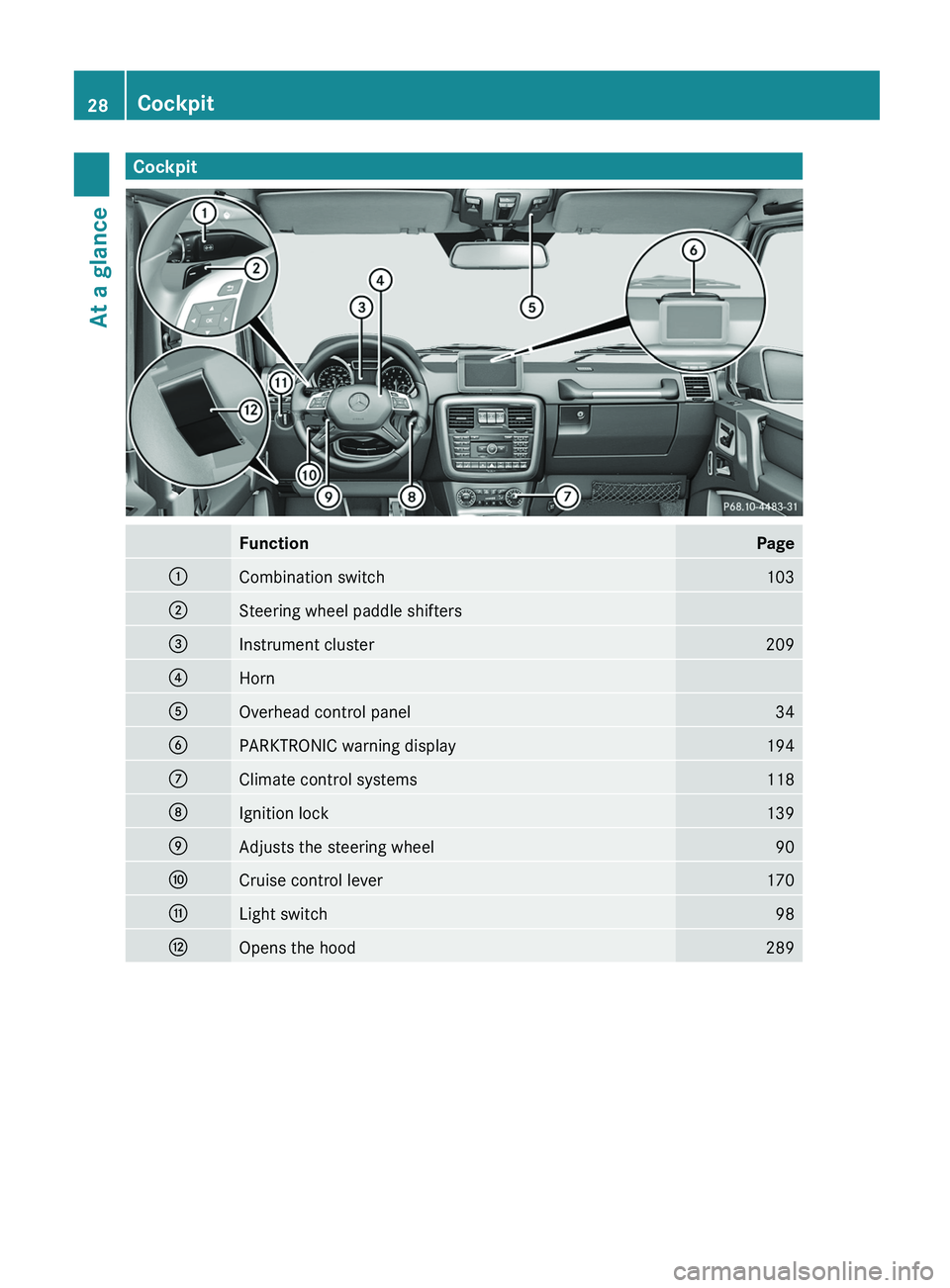
Cockpit
Function Page
0043
Combination switch 103
0044
Steering wheel paddle shifters
0087
Instrument cluster 209
0085
Horn
0083
Overhead control panel 34
0084
PARKTRONIC warning display 194
006B
Climate control systems 118
006C
Ignition lock 139
006D
Adjusts the steering wheel 90
006E
Cruise control lever 170
006F
Light switch 98
0070
Opens the hood 28928
CockpitAt a glance
Page 31 of 364
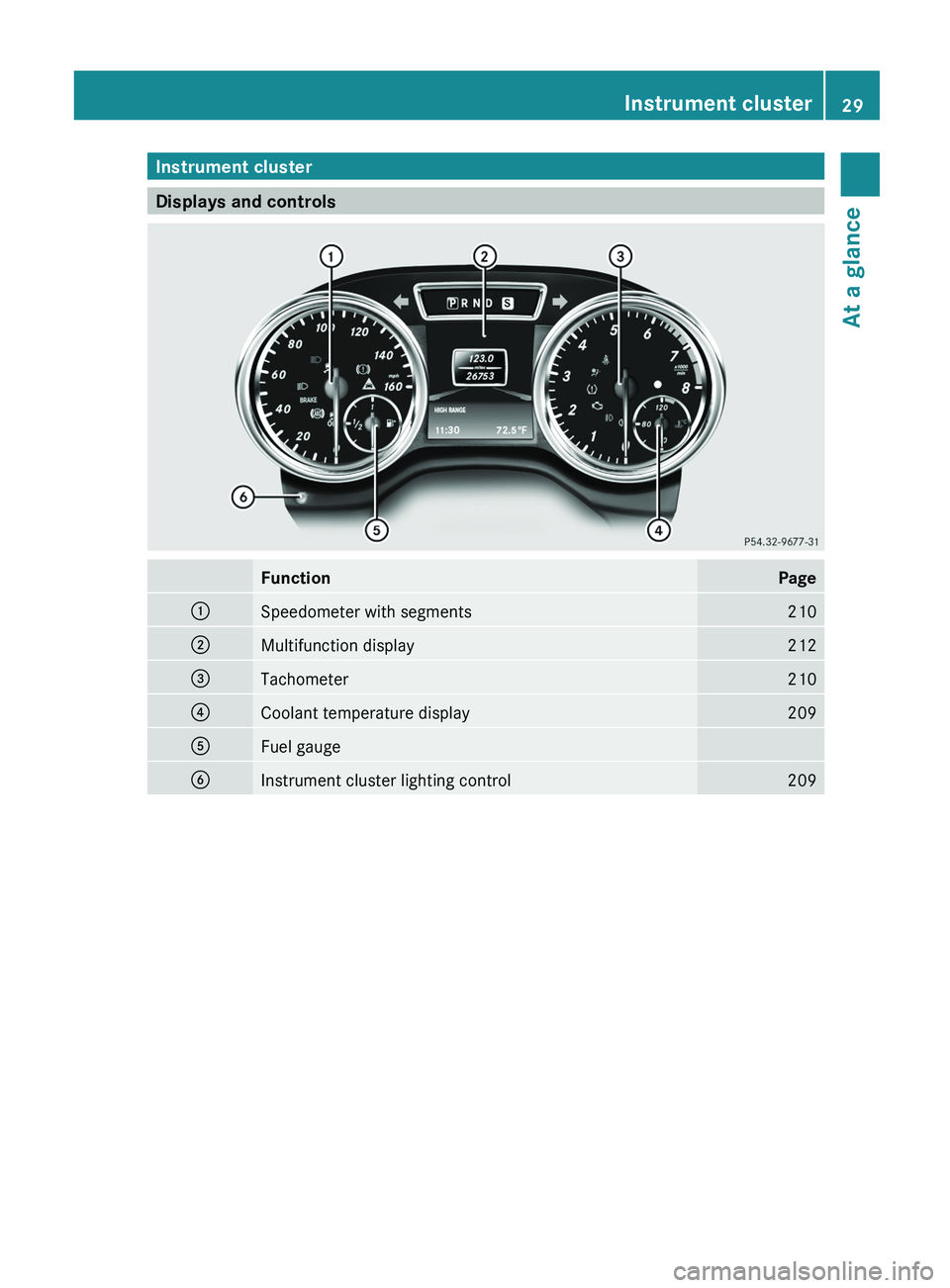
Instrument cluster
Displays and controls
Function Page
0043
Speedometer with segments 210
0044
Multifunction display 212
0087
Tachometer 210
0085
Coolant temperature display 209
0083
Fuel gauge
0084
Instrument cluster lighting control 209Instrument cluster
29At a glance
Page 35 of 364
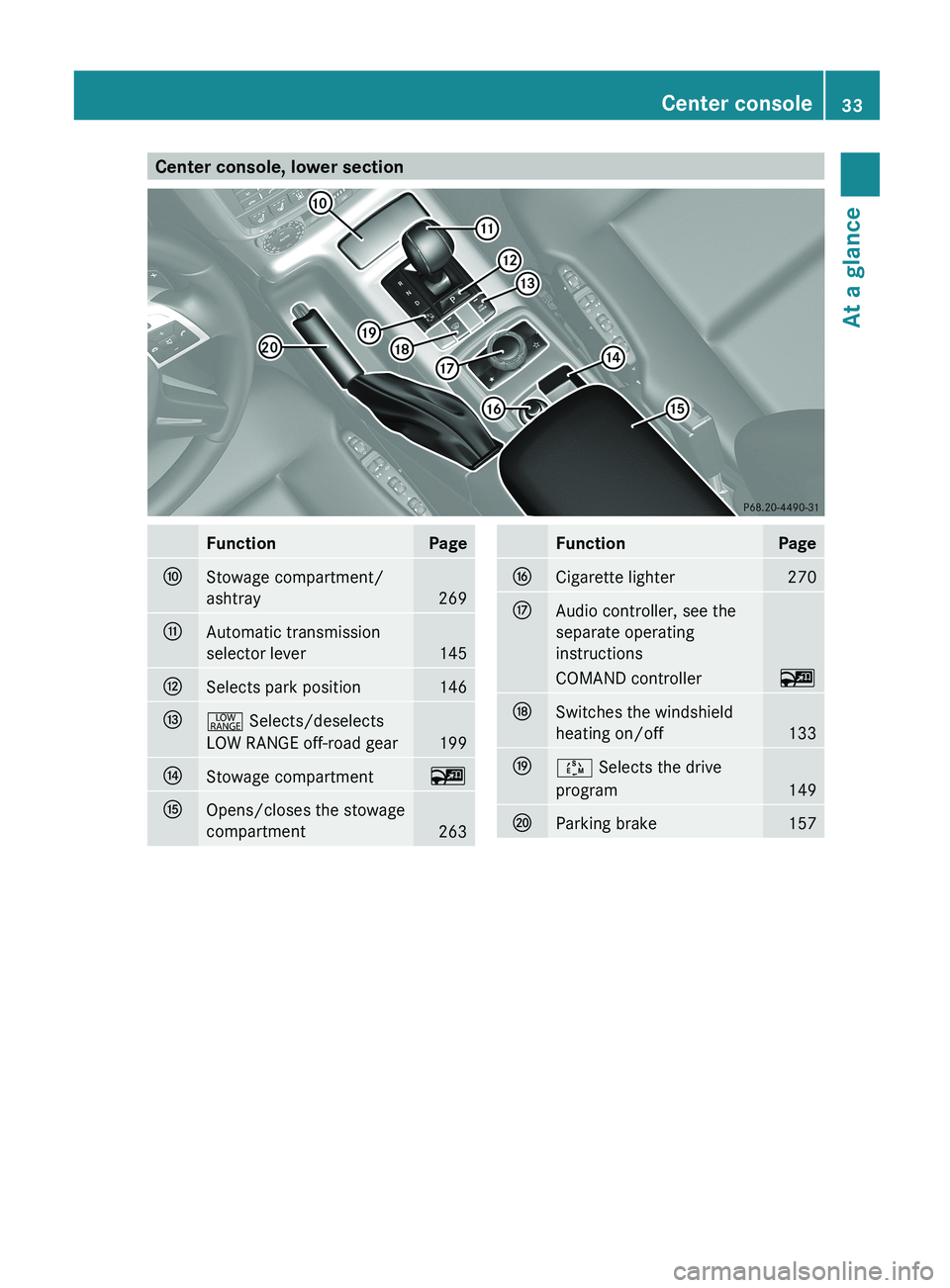
Center console, lower section
Function Page
006E
Stowage compartment/
ashtray
269
006F
Automatic transmission
selector lever
145
0070
Selects park position 146
0071
002E Selects/deselects
LOW RANGE off-road gear
199
0072
Stowage compartment 00FC
0073
Opens/closes the stowage
compartment
263 Function Page
0074
Cigarette lighter 270
0075
Audio controller, see the
separate operating
instructions
COMAND controller 00FC
0076
Switches the windshield
heating on/off
133
0077
00C8 Selects the drive
program
149
0078
Parking brake 157Center console
33At a glance
Page 36 of 364
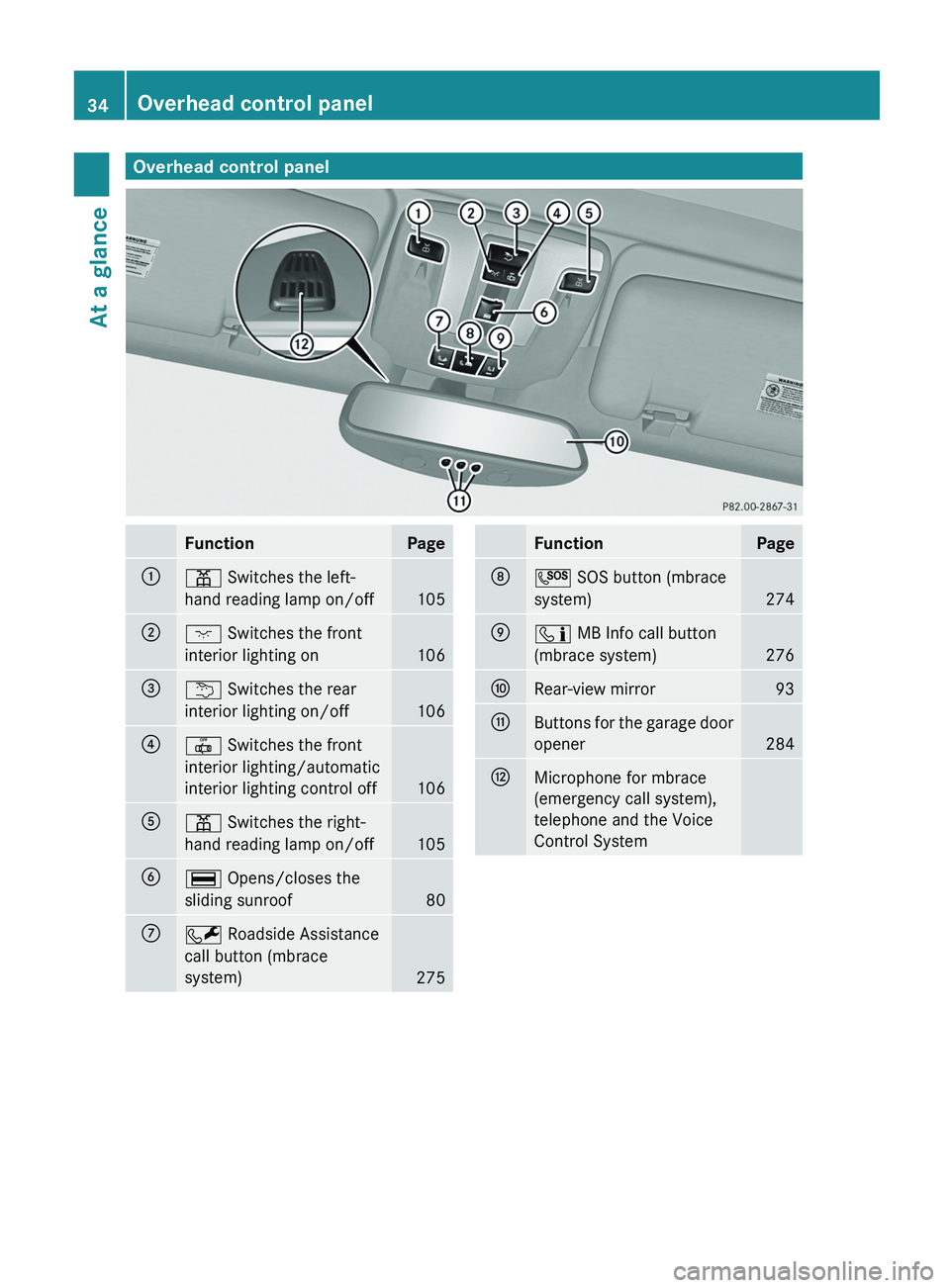
Overhead control panel
Function Page
0043
003D Switches the left-
hand reading lamp on/off
105
0044
004A Switches the front
interior lighting on
106
0087
0042 Switches the rear
interior lighting on/off
106
0085
0033 Switches the front
interior lighting/automatic
interior lighting control off
106
0083
003D Switches the right-
hand reading lamp on/off
105
0084
006A Opens/closes the
sliding sunroof
80
006B
0052 Roadside Assistance
call button (mbrace
system)
275 Function Page
006C
0053 SOS button (mbrace
system)
274
006D
00D9 MB Info call button
(mbrace system)
276
006E
Rear-view mirror 93
006F
Buttons for the garage door
opener
284
0070
Microphone for mbrace
(emergency call system),
telephone and the Voice
Control System34
Overhead control panelAt a glance
Page 41 of 364
The restraint system consists of:
R
seat belts
R child restraint systems
R LATCH-type (ISOFIX) child seat anchors
Additional protection is provided by:
R SRS (Supplemental Restraint System)
R NECK-PRO head restraints
R Air bag system components with:
-The 00730074 indicator lamp
- Front-passenger seat with BabySmart™
air bag deactivation system
The different air bag systems work
independently of each other. The protective
functions of the system work in conjunction
with each other. Not all air bags are always
deployed in an accident.
i Observe the additional information on
infants and children traveling with you in
the vehicle and restraint systems for
infants and children (Y page 54). SRS (Supplemental Restraint System)
Introduction SRS reduces the risk of occupants coming
into contact with the vehicle's interior in the
event of an accident. It can also reduce the
effect of the forces to which occupants are
subjected during an accident.
SRS consists of:
R
The 0075 SRS warning lamp
R Air bags
R Air bag control unit (with crash sensors)
R Emergency Tensioning Device (ETD) for
seat belts
R Seat belt force limiter SRS warning lamp G
WARNING
The SRS self-check has detected a
malfunction if the 0075 SRS indicator lamp:
R does not light up at all
R does not go out after approximately four
seconds after the engine is started
R lights up after
the
engine is started or while
the vehicle is in motion
For your safety, Mercedes-Benz strongly
recommends that you have the system
checked as soon as possible at a qualified
specialist workshop. SRS may otherwise fail
to activate when it is needed in the event of
an accident, which could lead to serious or
fatal injuries. SRS might also be activated
unexpectedly and unnecessarily, which could
also result in injury.
In addition, work carried out improperly on
SRS may render SRS inoperative or cause
unintended air bag deployment. Work on the
SRS system should only be carried out by
qualified specialist personnel. Consult a
qualified specialist workshop.
If it is necessary to modify an air bag system
to accommodate a person with disabilities,
contact an authorized Mercedes-Benz Center
for details. USA only: for further information,
contact our Customer Assistance Center at
1-800-FOR-MERCedes (1-800-367-6372).
SRS functions are checked regularly when
you switch on the ignition and when the
engine is running. Therefore, malfunctions
can be detected in good time.
The 0075 SRS warning lamp in the instrument
cluster lights up when the ignition is switched
on. It goes out no later than a few seconds
after the engine is started.
The SRS components are in operational
readiness when the SRS 0075 indicator lamp
goes out while the engine is running. Occupant safety
39
Safety Z
Page 44 of 364
child seat, which operates with the
BabySmart™ air bag deactivation system
installed in the vehicle to deactivate the
front passenger front air bag when it is
installed properly. Otherwise they will be
struck by the air bag when it inflates in a
crash. If this
happens,
serious or fatal injury
will result.
Failure to follow these instructions can result
in severe injuries to you or other occupants.
If you sell your vehicle, it is important that you
make the buyer aware of this safety
information. Be sure to give the buyer this
Operator's Manual. G
WARNING
Accident research shows that the safest place
for children in an
automobile is in a rear seat.
Should you choose to place a child 12 years
old or under in the front passenger seat of
your vehicle, you must properly use a
BabySmart TM
child restraint which will turn off
the front passenger front air bag.
To help avoid the possibility of injury, please
follow these guidelines:
(1) Always sit as upright as possible, wear the seat belt
properly, and for
children 12 years old and under,
use an appropriately sized infant
restraint, toddler restraint, or
booster seat recommended for the
size and weight of the child.
(2) Always wear seat belts properly.
If the air bags are deployed, you will hear a
bang, and a small
amount of powder may also
be released. Only in rare cases will the bang
affect your hearing. The powder that is
released generally does not constitute a
health hazard. The 0075 SRS warning lamp
lights up.
The air bags are deployed if the air bag control
unit detects the need for deployment. Only in
the event of such a situation will the air bags
provide their supplemental protection. If the driver and front passenger do not wear
their seat belts, it is not possible for the air
bags to provide their supplemental
protection.
In the event of other types of impacts and
impacts below air bag deployment
thresholds, the air bags will not deploy. The
driver and passengers will then be protected
to the extent
possible
by a properly fastened
seat belt. A properly fastened seat belt is also
needed to provide the best possible
protection if the vehicle rolls over.
Air bags provide additional protection; they
are not, however, a substitute for seat belts.
All vehicle occupants must fasten their seat
belts regardless of whether your vehicle is
equipped with air bags or not.
It is important for your safety and that of your
passengers to have deployed air bags
replaced and to have any malfunctioning air
bags repaired. This will help to make sure the
air bags continue to perform their protective
function for the vehicle occupants in the
event of an accident.
Front air bags G
WARNING
Observe "Important safety notes"
(Y page 41). G
WARNING
Your vehicle is equipped with air bag
technology which disables the front-
passenger air bag if the system recognizes
that the front-passenger seat is empty .
If the front-passenger seat is occupied by an
adult or young person and the 0073007C
indicator lamp is lit
up, the front-passenger air
bag is disabled. If the front-passenger seat is
recognized as empty, the air bag control unit
will not deploy the front-passenger air bag in
the event of a collision.
Ask your passenger to sit correctly on the
front-passenger seat in an upright position
until the 0073007C indicator lamp goes out. 42
Occupant safety
Safety
Page 45 of 364
If the
0073007C indicator lamp does not go
out, please consult an authorized Mercedes-
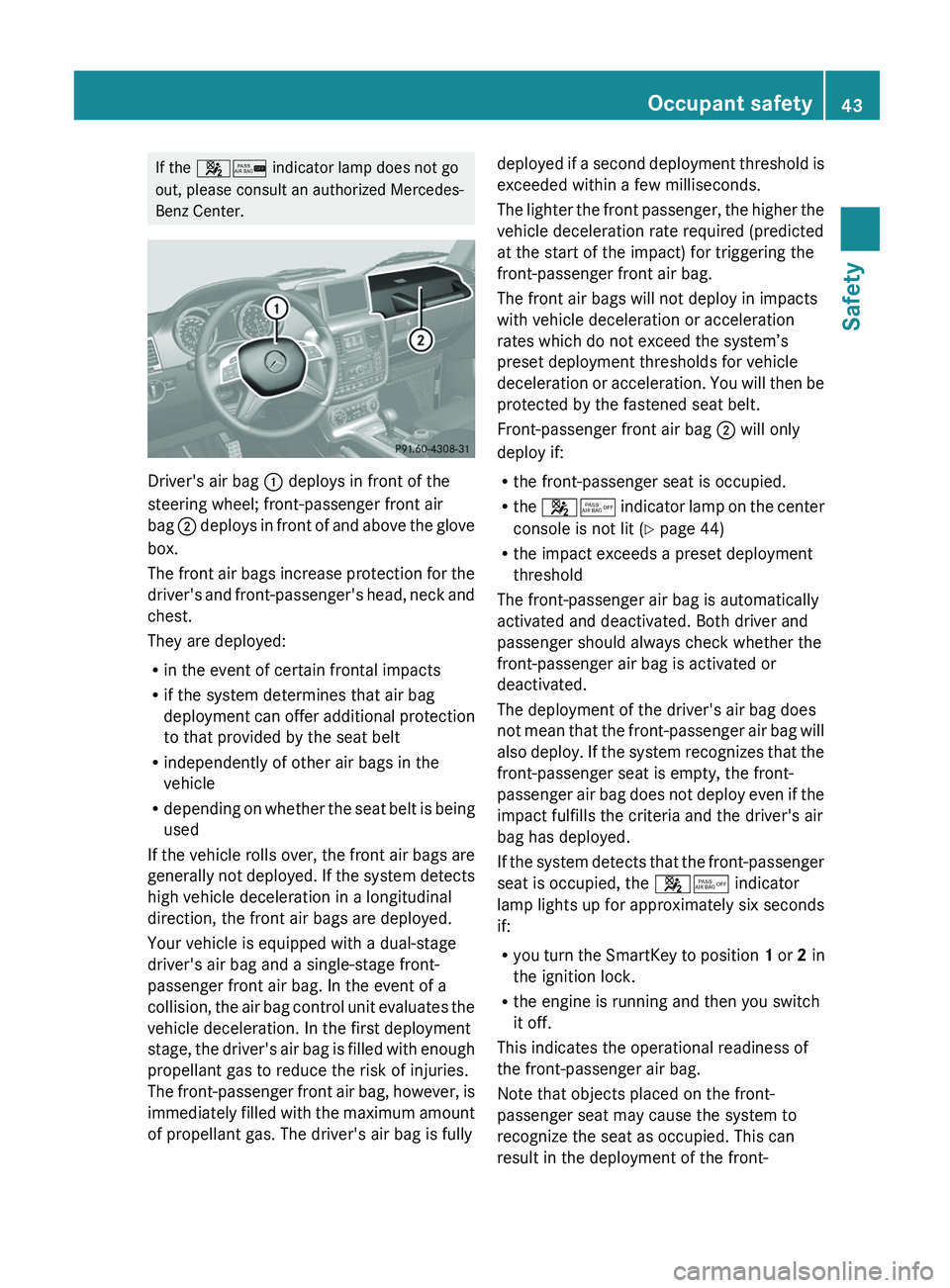
Benz Center. Driver's air bag
0043 deploys in front of the
steering wheel; front-passenger front air
bag 0044 deploys in front
of and above the glove
box.
The front air bags increase protection for the
driver's and front-passenger's head, neck and
chest.
They are deployed:
R in the event of certain frontal impacts
R if the system determines that air bag
deployment can offer additional protection
to that provided by the seat belt
R independently of other air bags in the
vehicle
R depending on whether the seat belt is being
used
If the vehicle rolls over, the front air bags are
generally not deployed. If the system detects
high vehicle deceleration in a longitudinal
direction, the front air bags are deployed.
Your vehicle is equipped with a dual-stage
driver's air bag and a single-stage front-
passenger front air bag. In the event of a
collision, the air bag control unit evaluates the
vehicle deceleration. In the first deployment
stage, the driver's air bag is filled with enough
propellant gas to reduce the risk of injuries.
The front-passenger front air bag, however, is
immediately filled with the maximum amount
of propellant gas. The driver's air bag is fully deployed if a second deployment threshold is
exceeded within a few milliseconds.
The
lighter the
front
passenger, the higher the
vehicle deceleration rate required (predicted
at the start of the impact) for triggering the
front-passenger front air bag.
The front air bags will not deploy in impacts
with vehicle deceleration or acceleration
rates which do not exceed the system’s
preset deployment thresholds for vehicle
deceleration or acceleration. You will then be
protected by the fastened seat belt.
Front-passenger front air bag 0044 will only
deploy if:
R the front-passenger seat is occupied.
R the 00730074 indicator lamp on the center
console is not lit (Y page 44)
R the impact exceeds a preset deployment
threshold
The front-passenger air bag is automatically
activated and deactivated. Both driver and
passenger should always check whether the
front-passenger air bag is activated or
deactivated.
The deployment of the driver's air bag does
not mean that the front-passenger air bag will
also deploy. If the system recognizes that the
front-passenger seat is empty, the front-
passenger air bag does not deploy even if the
impact fulfills the criteria and the driver's air
bag has deployed.
If the system detects that the front-passenger
seat is occupied, the 00730074 indicator
lamp lights up for approximately six seconds
if:
R you turn the SmartKey to position 1 or 2 in
the ignition lock.
R the engine is running and then you switch
it off.
This indicates the operational readiness of
the front-passenger air bag.
Note that objects placed on the front-
passenger seat may cause the system to
recognize the seat as occupied. This can
result in the deployment of the front- Occupant safety
43
Safety Z
Page 46 of 364
passenger air bag if the impact fulfills the
specified criteria. If the 00730074 indicator
lamp lights up, the front-passenger front air
bag is disabled and will not be deployed in
certain situations. If the
00730074 indicator
lamp does not light up, the front-passenger
front air bag is
enabled and can be deployed.
Window curtain air bags G
WARNING
Observe "Important safety notes"
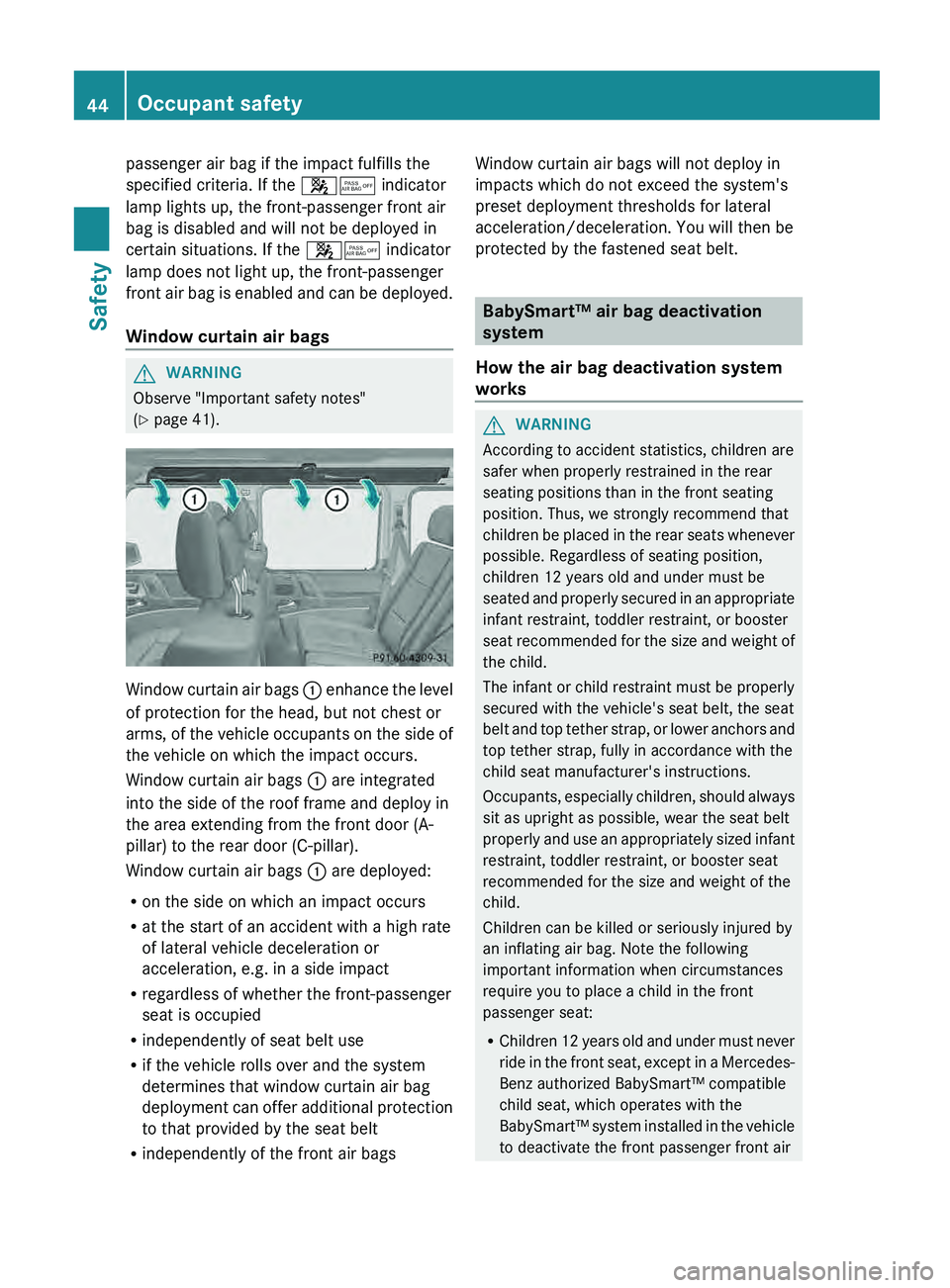
(Y page 41). Window curtain air bags
0043
enhance the
level
of protection for the head, but not chest or
arms,
of the vehicle occupants on the side of
the vehicle on which the impact occurs.
Window curtain air bags 0043 are integrated
into the side of the roof frame and deploy in
the area extending from the front door (A-
pillar) to the rear door (C-pillar).
Window curtain air bags 0043 are deployed:
R on the side on which an impact occurs
R at the start of an accident with a high rate
of lateral vehicle deceleration or
acceleration, e.g. in a side impact
R regardless of whether the front-passenger
seat is occupied
R independently of seat belt use
R if the vehicle rolls over and the system
determines that window curtain air bag
deployment can offer additional protection
to that provided by the seat belt
R independently of the front air bags Window curtain air bags will not deploy in
impacts which do not exceed the system's
preset deployment thresholds for lateral
acceleration/deceleration. You will then be
protected by the fastened seat belt.
BabySmart™ air bag deactivation
system
How the air bag deactivation system
works G
WARNING
According to accident statistics, children are
safer when properly restrained in the rear
seating positions than in the front seating
position. Thus, we strongly recommend that
children be placed in
the rear seats whenever
possible. Regardless of seating position,
children 12 years old and under must be
seated and properly secured in an appropriate
infant restraint, toddler restraint, or booster
seat recommended for the size and weight of
the child.
The infant or child restraint must be properly
secured with the vehicle's seat belt, the seat
belt and top tether strap, or lower anchors and
top tether strap, fully in accordance with the
child seat manufacturer's instructions.
Occupants, especially children, should always
sit as upright as possible, wear the seat belt
properly and use an appropriately sized infant
restraint, toddler restraint, or booster seat
recommended for the size and weight of the
child.
Children can be killed or seriously injured by
an inflating air bag. Note the following
important information when circumstances
require you to place a child in the front
passenger seat:
R Children 12 years old and under must never
ride in the front seat, except in a Mercedes-
Benz authorized BabySmart™ compatible
child seat, which operates with the
BabySmart™ system installed in the vehicle
to deactivate the front passenger front air44
Occupant safety
Safety