ECU MERCEDES-BENZ G-CLASS SUV 2013 Owner's Guide
[x] Cancel search | Manufacturer: MERCEDES-BENZ, Model Year: 2013, Model line: G-CLASS SUV, Model: MERCEDES-BENZ G-CLASS SUV 2013Pages: 364, PDF Size: 9.62 MB
Page 208 of 364
This will use the braking effect of the engine,
so that less braking will be required to
maintain the speed. which relieves the load
on the brake
system
and prevents the brakes
from overheating and wearing too quickly. If
you need additional braking, depress the
brake pedal repeatedly rather than
continuously.
Driving tips If the trailer swings from side to side:
X
Do not accelerate.
X Do not counter-steer.
X Brake if necessary.
R Maintain a greater distance from the
vehicle in front than
when driving without a
trailer.
R Avoid braking abruptly. If possible, brake
gently at first to allow the trailer to run on.
Then, increase the braking force rapidly.
R The values given for gradient-climbing
capabilities from a standstill refer to sea
level. When driving in mountainous areas,
note that the power output of the engine,
and consequently the vehicle's gradient-
climbing capability, decrease with
increasing altitude. Trailer power supply
! You can connect accessories with a
maximum power consumption
of
180 W to
the permanent power supply.
You must not charge a trailer battery using
the power supply.
The trailer socket of your vehicle is equipped
at the factory with a permanent power supply.
The permanent power supply is supplied via
trailer socket pin 9.
A qualified specialist workshop can provide
more information about installing the trailer
electrics. Trailer with 7-pin connector
General notes You can make a connection to the 13-pin
socket on the ball coupling using an adapter
or, if necessary, an adapter cable. Both can
be obtained in a qualified specialist
workshop.
Installing the adapter
!
Make sure that there is enough slack in
the cable for cornering so that the cable
cannot become detached. X
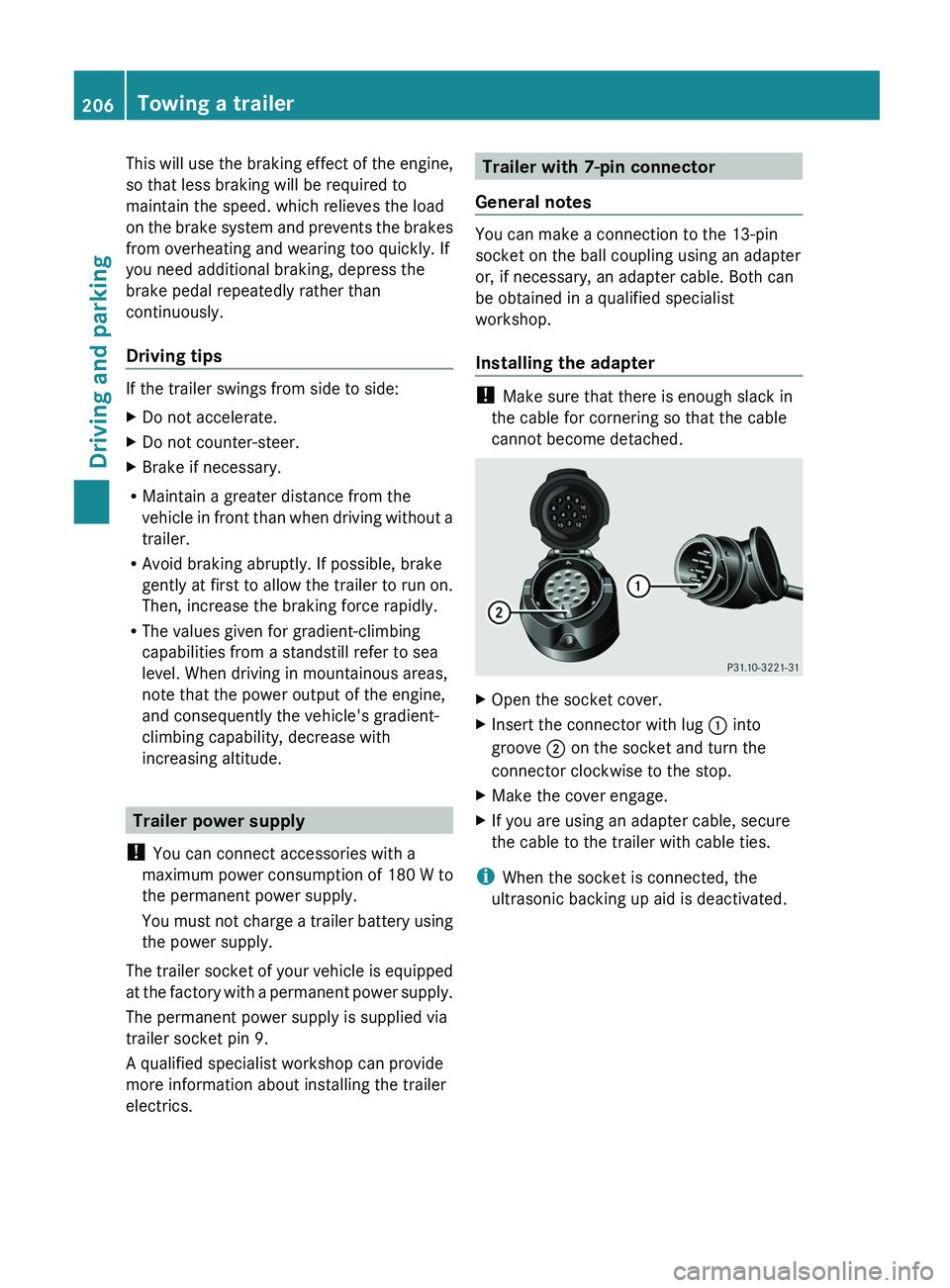
Open the socket cover.
X Insert the connector with lug 0043 into
groove 0044 on the socket and turn the
connector clockwise to the stop.
X Make the cover engage.
X If you are using an adapter cable, secure
the cable to the trailer with cable ties.
i When the socket is connected, the
ultrasonic backing up aid is deactivated. 206
Towing a trailer
Driving and parking
Page 231 of 364
Display messages Possible causes/consequences and
0050 Solutions0027(USA
only)004D(Canada
only)
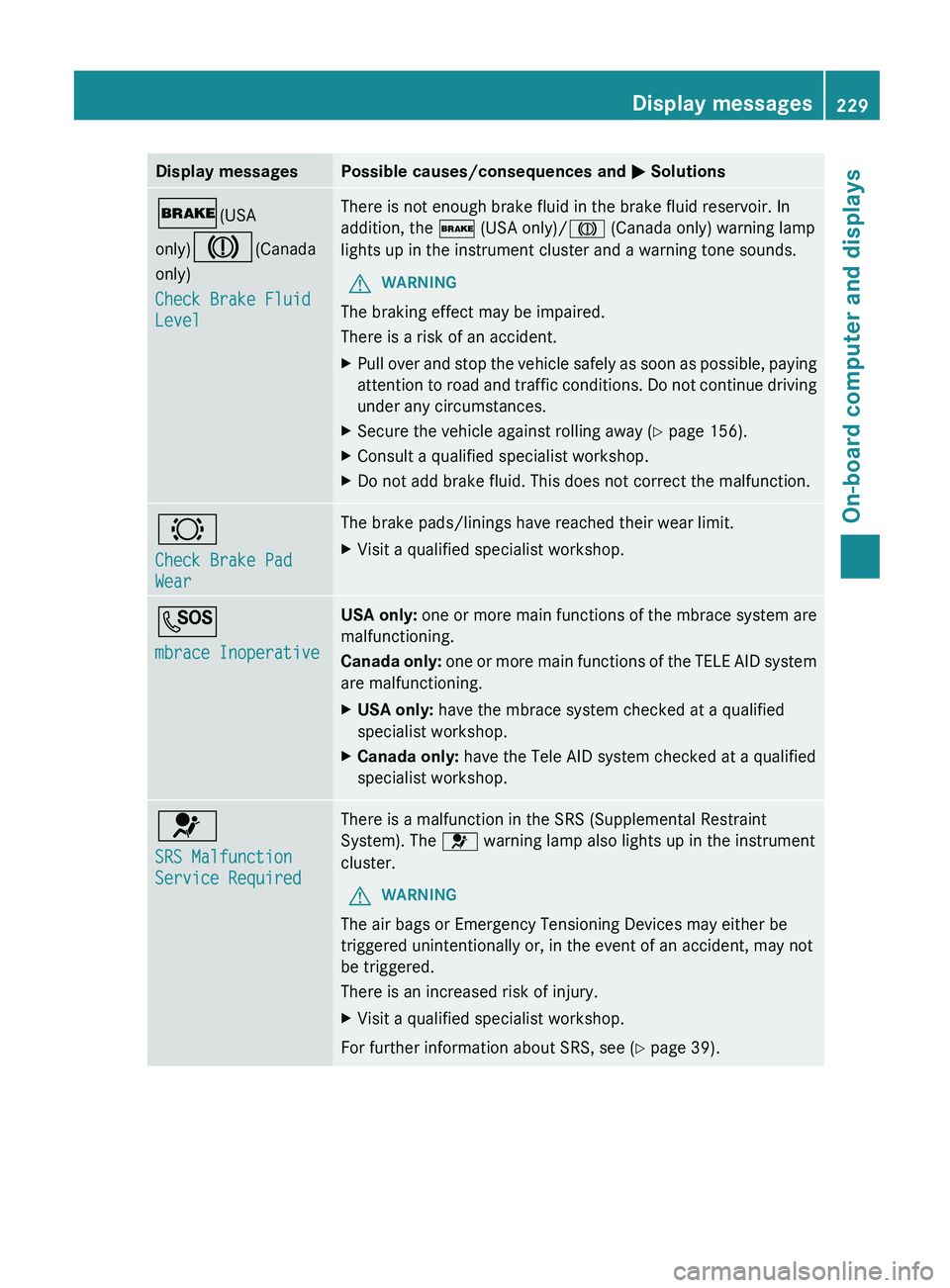
Check Brake Fluid
Level There is not enough brake fluid in the brake fluid reservoir. In
addition, the
0027 (USA only)/004D (Canada only) warning lamp
lights up in the instrument cluster and a warning tone sounds.
G WARNING
The braking effect may be impaired.
There is a risk of an accident.
X Pull over and stop the vehicle safely as soon as possible, paying
attention to road and
traffic conditions. Do not continue driving
under any circumstances.
X Secure the vehicle against rolling away ( Y page 156).
X Consult a qualified specialist workshop.
X Do not add brake fluid. This does not correct the malfunction. 0026
Check Brake Pad
Wear The brake pads/linings have reached their wear limit.
X
Visit a qualified specialist workshop. 0053
mbrace Inoperative USA only:
one or more main
functions of the mbrace system are
malfunctioning.
Canada only: one or more main functions of the TELE AID system
are malfunctioning.
X USA only: have the mbrace system checked at a qualified
specialist workshop.
X Canada only: have the Tele AID system checked at a qualified
specialist workshop. 0075
SRS Malfunction
Service Required There is a malfunction in the SRS (Supplemental Restraint
System). The 0075 warning lamp also lights up in the instrument
cluster.
G WARNING
The air bags or Emergency Tensioning Devices may either be
triggered unintentionally or, in the event of an accident, may not
be triggered.
There is an increased risk of injury.
X Visit a qualified specialist workshop.
For further information about SRS, see (Y page 39). Display messages
229
On-board computer and displays Z
Page 237 of 364
Display messages Possible causes/consequences and
0050 Solutions00AC
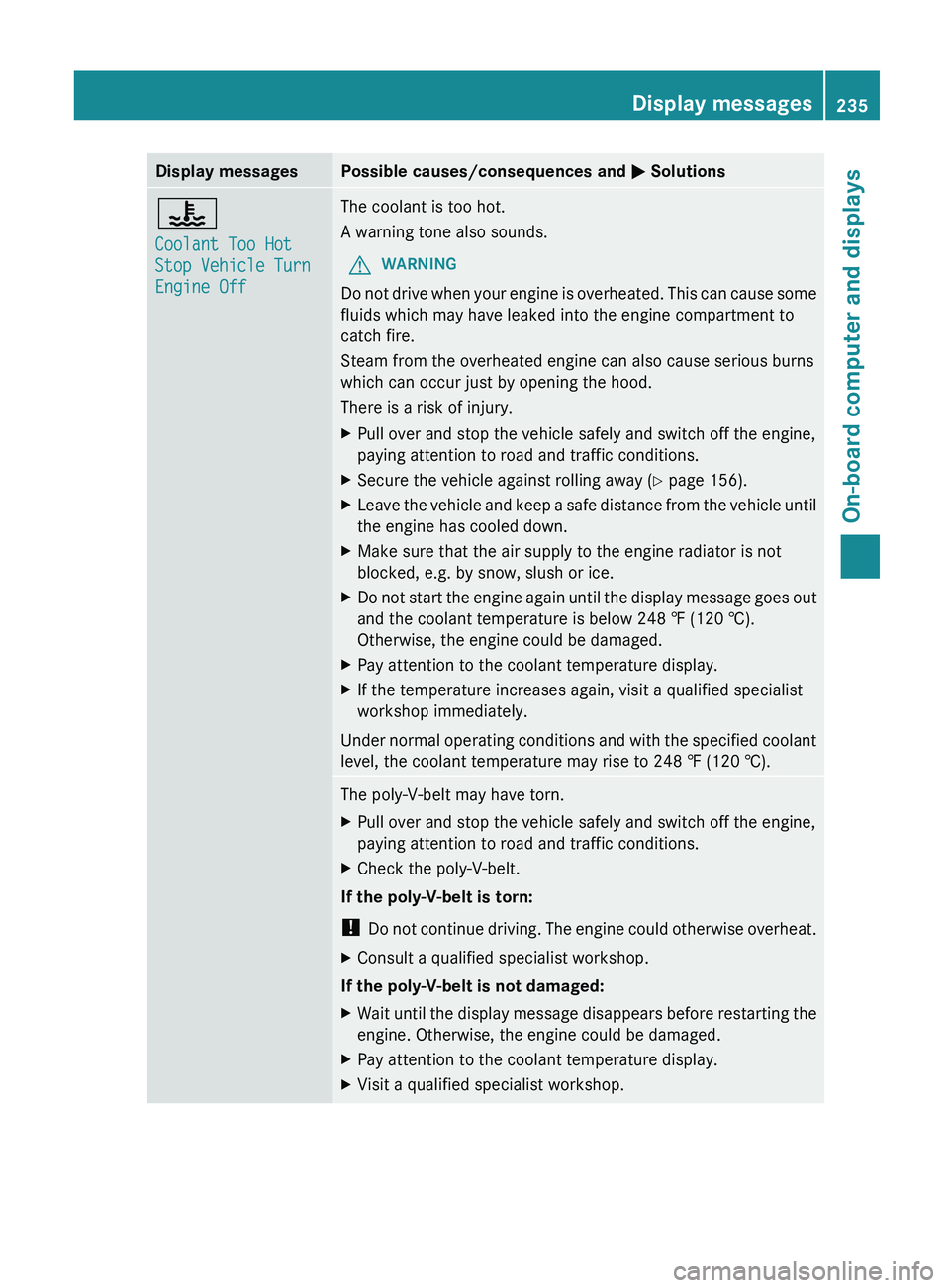
Coolant Too Hot
Stop Vehicle Turn
Engine Off The coolant is too hot.
A warning tone also sounds.
G WARNING
Do not drive when your engine is overheated. This can cause some
fluids which may have leaked into the engine compartment to
catch fire.
Steam from the overheated engine can also cause serious burns
which can occur just by opening the hood.
There is a risk of injury.
X Pull over and stop the vehicle safely and switch off the engine,
paying attention to road and traffic conditions.
X Secure the vehicle against rolling away ( Y page 156).
X Leave the vehicle and keep a safe distance from the vehicle until
the engine has cooled down.
X Make sure that the air supply to the engine radiator is not
blocked, e.g. by snow, slush or ice.
X Do not start the engine again until the display message goes out
and the coolant temperature is below 248 ‡ (120 †).
Otherwise, the engine could be damaged.
X Pay attention to the coolant temperature display.
X If the temperature increases again, visit a qualified specialist
workshop immediately.
Under normal
operating conditions and with the specified coolant
level, the coolant temperature may rise to 248 ‡ (120 †). The poly-V-belt may have torn.
X
Pull over and stop the vehicle safely and switch off the engine,
paying attention to road and traffic conditions.
X Check the poly-V-belt.
If the poly-V-belt is torn:
! Do not continue driving.
The engine could otherwise overheat.
X Consult a qualified specialist workshop.
If the poly-V-belt is not damaged:
X Wait until the display message disappears before restarting the
engine. Otherwise, the engine could be damaged.
X Pay attention to the coolant temperature display.
X Visit a qualified specialist workshop. Display messages
235
On-board computer and displays Z
Page 240 of 364
Driving systems
Display messages Possible causes/consequences and
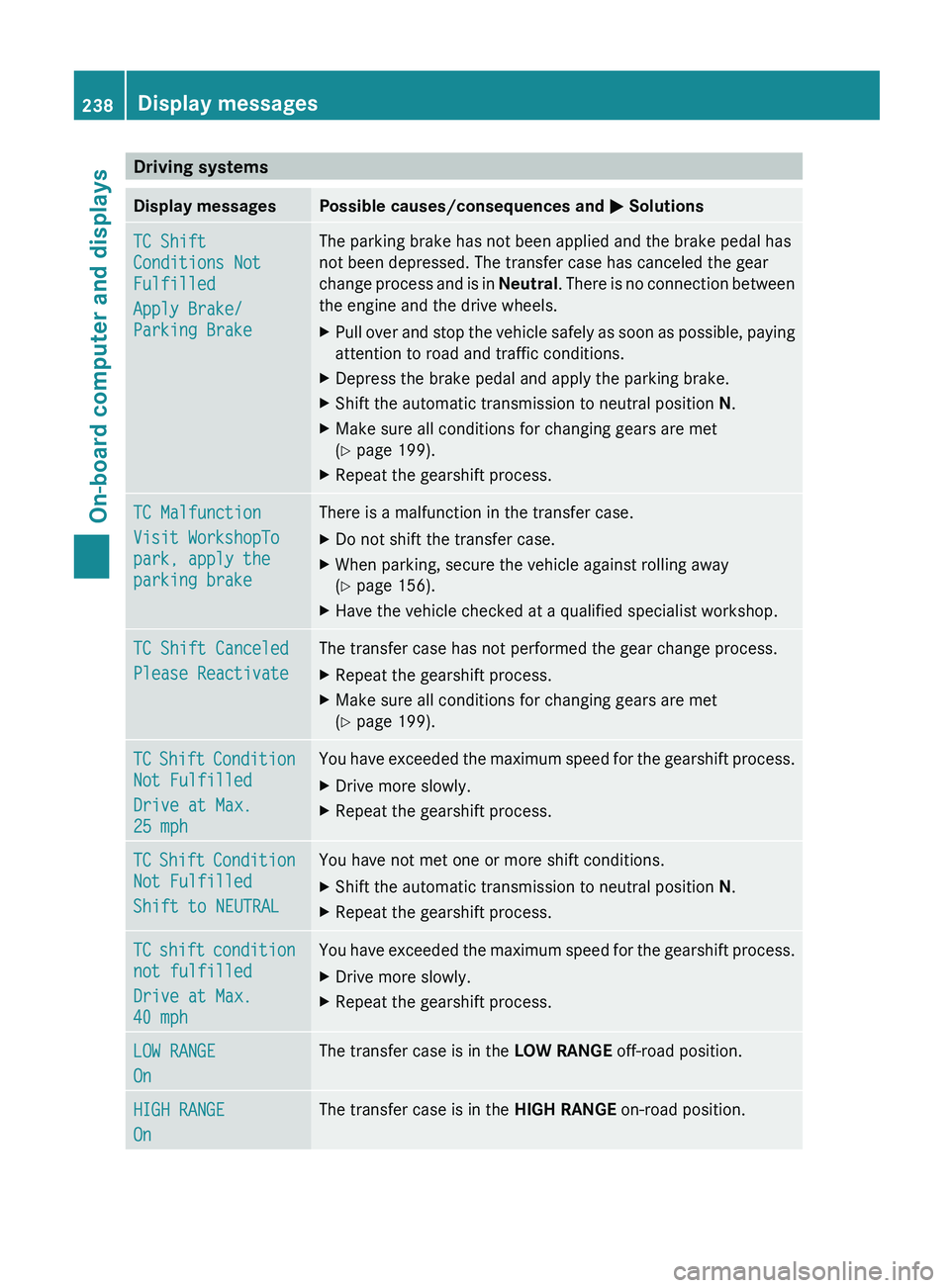
0050 SolutionsTC Shift
Conditions Not
Fulfilled
Apply Brake/
Parking Brake The parking brake has not been applied and the brake pedal has
not been depressed. The transfer case has canceled the gear
change
process and
is
in Neutral . There is no connection between
the engine and the drive wheels.
X Pull over and stop the vehicle safely as soon as possible, paying
attention to road and traffic conditions.
X Depress the brake pedal and apply the parking brake.
X Shift the automatic transmission to neutral position N.
X Make sure all conditions for changing gears are met
(Y page 199).
X Repeat the gearshift process. TC Malfunction
Visit WorkshopTo
park, apply the
parking brake There is a malfunction in the transfer case.
X
Do not shift the transfer case.
X When parking, secure the vehicle against rolling away
(Y page 156).
X Have the vehicle checked at a qualified specialist workshop. TC Shift Canceled
Please Reactivate The transfer case has not performed the gear change process.
X
Repeat the gearshift process.
X Make sure all conditions for changing gears are met
(Y page 199). TC Shift Condition
Not Fulfilled
Drive at Max.
25 mph You have exceeded the maximum speed for the gearshift process.
X
Drive more slowly.
X Repeat the gearshift process. TC Shift Condition
Not Fulfilled
Shift to NEUTRAL You have not met one or more shift conditions.
X
Shift the automatic transmission to neutral position N.
X Repeat the gearshift process. TC shift condition
not fulfilled
Drive at Max.
40 mph You have exceeded the maximum speed for the gearshift process.
X
Drive more slowly.
X Repeat the gearshift process. LOW RANGE
On The transfer case is in the LOW RANGE off-road position.
HIGH RANGE
On The transfer case is in the HIGH RANGE on-road position.238
Display messages
On-board computer and displays
Page 241 of 364
Display messages Possible causes/consequences and
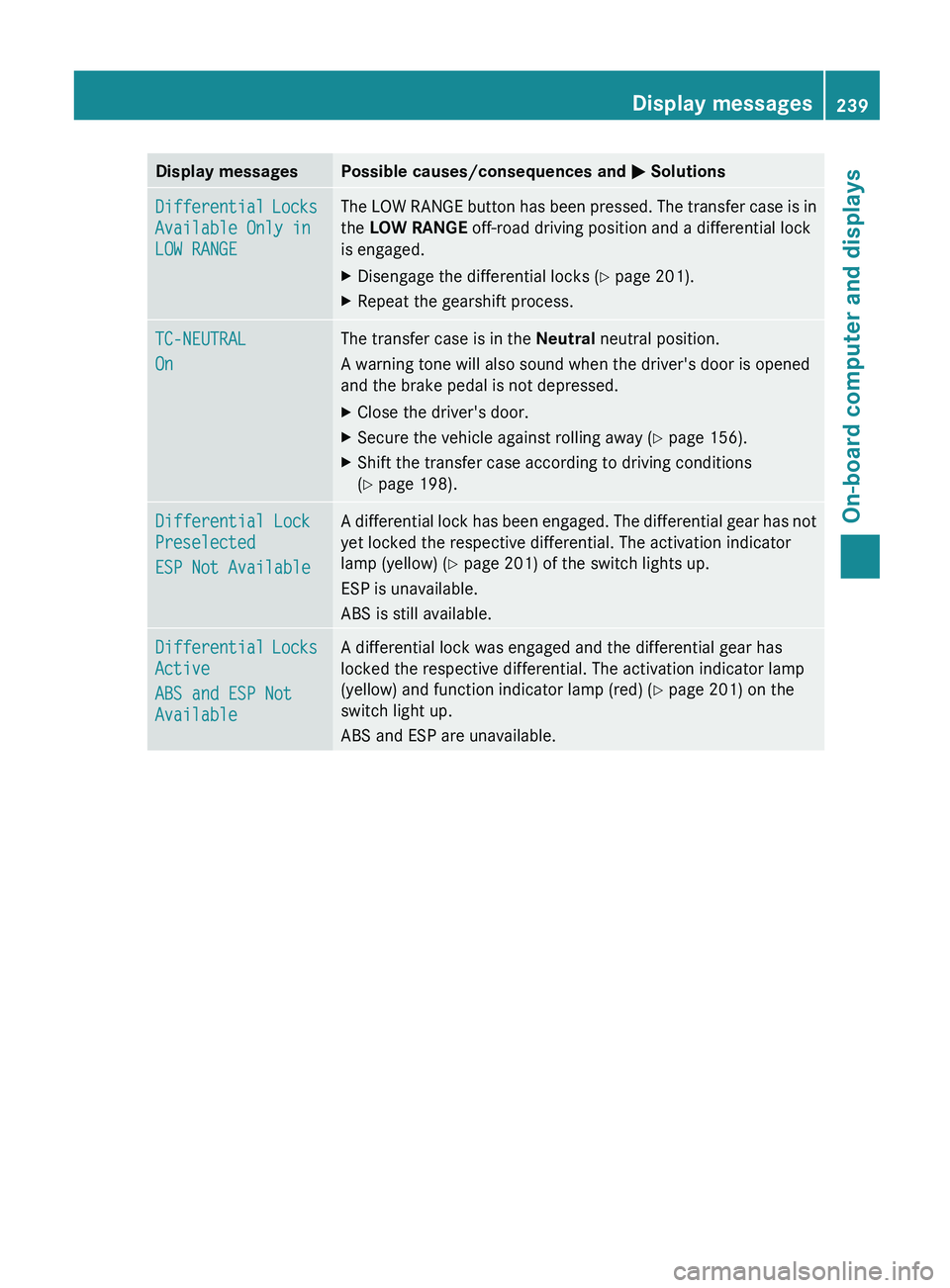
0050 SolutionsDifferential Locks
Available Only in
LOW RANGE The LOW RANGE button has been pressed. The transfer case is in
the LOW RANGE off-road driving position and a differential lock
is engaged.
X
Disengage the differential locks (Y page 201).
X Repeat the gearshift process. TC-NEUTRAL
On The transfer case is in the Neutral
neutral position.
A warning tone will also sound when the driver's door is opened
and the brake pedal is not depressed.
X Close the driver's door.
X Secure the vehicle against rolling away ( Y page 156).
X Shift the transfer case according to driving conditions
(Y page 198). Differential Lock
Preselected
ESP Not Available A differential lock has been engaged. The differential gear has not
yet locked the respective differential. The activation indicator
lamp (yellow) (
Y page 201) of the switch lights up.
ESP is unavailable.
ABS is still available. Differential Locks
Active
ABS and ESP Not
Available A differential lock was engaged and the differential gear has
locked the respective differential. The activation indicator lamp
(yellow) and function indicator lamp (red) (
Y page 201) on the
switch light up.
ABS and ESP are unavailable. Display messages
239On-board computer and displays Z
Page 245 of 364
Display messages Possible causes/consequences and
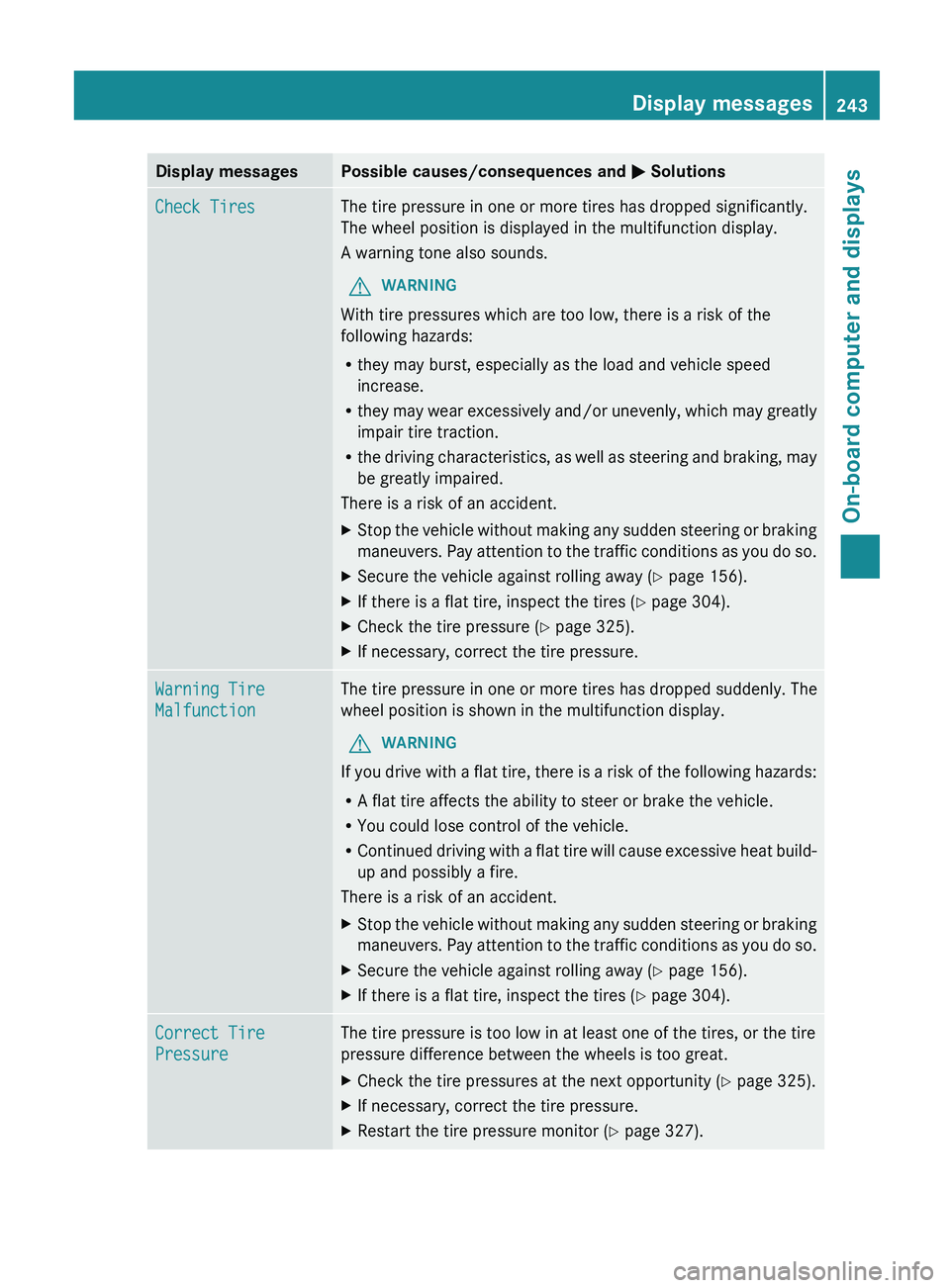
0050 SolutionsCheck Tires The tire pressure in one or more tires has dropped significantly.
The wheel position is displayed in the multifunction display.
A warning tone also sounds.
G WARNING
With tire pressures which are too low, there is a risk of the
following hazards:
R they may burst, especially as the load and vehicle speed
increase.
R they may wear
excessively
and/or unevenly, which may greatly
impair tire traction.
R the driving characteristics, as well as steering and braking, may
be greatly impaired.
There is a risk of an accident.
X Stop the vehicle without making any sudden steering or braking
maneuvers. Pay attention to
the traffic conditions as you do so.
X Secure the vehicle against rolling away ( Y page 156).
X If there is a flat tire, inspect the tires ( Y page 304).
X Check the tire pressure (Y page 325).
X If necessary, correct the tire pressure. Warning Tire
Malfunction The tire pressure in one or more tires has dropped suddenly. The
wheel position is shown in the multifunction display.
G WARNING
If you drive with a flat tire, there is a risk of the following hazards:
R A flat tire affects the ability to steer or brake the vehicle.
R You could lose control of the vehicle.
R Continued driving with
a
flat tire will cause excessive heat build-
up and possibly a fire.
There is a risk of an accident.
X Stop the vehicle without making any sudden steering or braking
maneuvers. Pay attention to
the traffic conditions as you do so.
X Secure the vehicle against rolling away ( Y page 156).
X If there is a flat tire, inspect the tires ( Y page 304).Correct Tire
Pressure The tire pressure is too low in at least one of the tires, or the tire
pressure difference between the wheels is too great.
X
Check the tire pressures at the next opportunity (Y page 325).
X If necessary, correct the tire pressure.
X Restart the tire pressure monitor (Y page 327). Display messages
243
On-board computer and displays Z
Page 246 of 364
Display messages Possible causes/consequences and
0050 SolutionsTirePress.
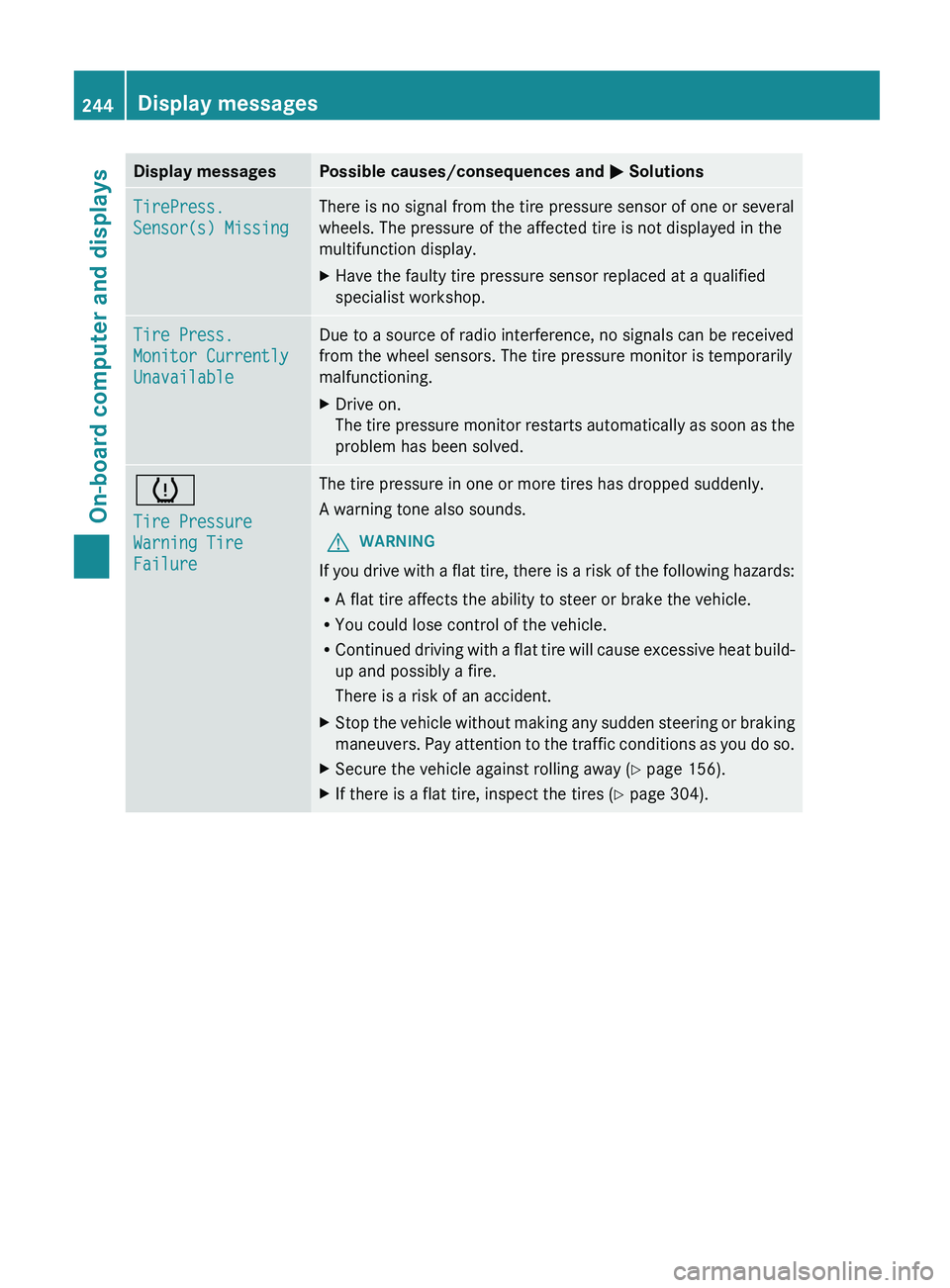
Sensor(s) Missing There is no signal from the tire pressure sensor of one or several
wheels. The pressure of the affected tire is not displayed in the
multifunction display.
X
Have the faulty tire pressure sensor replaced at a qualified
specialist workshop. Tire Press.
Monitor Currently
Unavailable Due to a source of radio interference, no signals can be received
from the wheel sensors. The tire pressure monitor is temporarily
malfunctioning.
X
Drive on.
The tire pressure
monitor
restarts automatically as soon as the
problem has been solved. 0077
Tire Pressure
Warning Tire
Failure The tire pressure in one or more tires has dropped suddenly.
A warning tone also sounds.
G WARNING
If you drive with a flat tire, there is a risk of the following hazards:
R A flat tire affects the ability to steer or brake the vehicle.
R You could lose control of the vehicle.
R Continued driving with
a
flat tire will cause excessive heat build-
up and possibly a fire.
There is a risk of an accident.
X Stop the vehicle without making any sudden steering or braking
maneuvers. Pay attention to
the traffic conditions as you do so.
X Secure the vehicle against rolling away ( Y page 156).
X If there is a flat tire, inspect the tires ( Y page 304).244
Display messages
On-board computer and displays
Page 247 of 364
Display messages Possible causes/consequences and
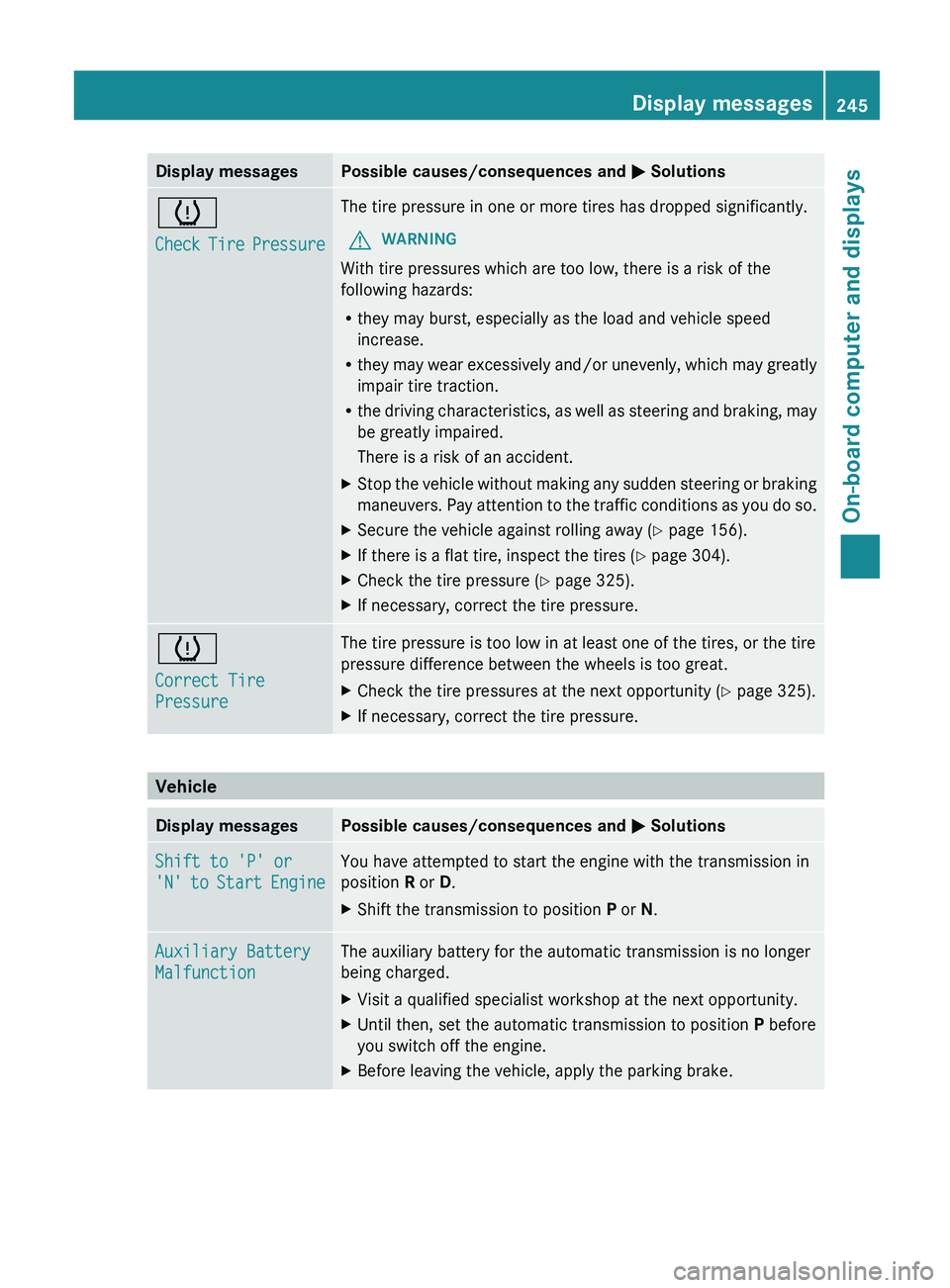
0050 Solutions0077
Check Tire Pressure The tire pressure in one or more tires has dropped significantly.
G WARNING
With tire pressures which are too low, there is a risk of the
following hazards:
R they may burst, especially as the load and vehicle speed
increase.
R they may wear
excessively
and/or unevenly, which may greatly
impair tire traction.
R the driving characteristics, as well as steering and braking, may
be greatly impaired.
There is a risk of an accident.
X Stop the vehicle without making any sudden steering or braking
maneuvers. Pay attention to
the traffic conditions as you do so.
X Secure the vehicle against rolling away ( Y page 156).
X If there is a flat tire, inspect the tires ( Y page 304).
X Check the tire pressure (Y page 325).
X If necessary, correct the tire pressure. 0077
Correct Tire
Pressure The tire pressure is too low in at least one of the tires, or the tire
pressure difference between the wheels is too great.
X
Check the tire pressures at the next opportunity (Y page 325).
X If necessary, correct the tire pressure. Vehicle
Display messages Possible causes/consequences and
0050 SolutionsShift to 'P' or
'N' to Start
Engine You have attempted to start the engine with the transmission in
position R or D.
X
Shift the transmission to position P or N.Auxiliary Battery
Malfunction The auxiliary battery for the automatic transmission is no longer
being charged.
X
Visit a qualified specialist workshop at the next opportunity.
X Until then, set the automatic transmission to position P before
you switch off the engine.
X Before leaving the vehicle, apply the parking brake. Display messages
245
On-board computer and displays Z
Page 248 of 364
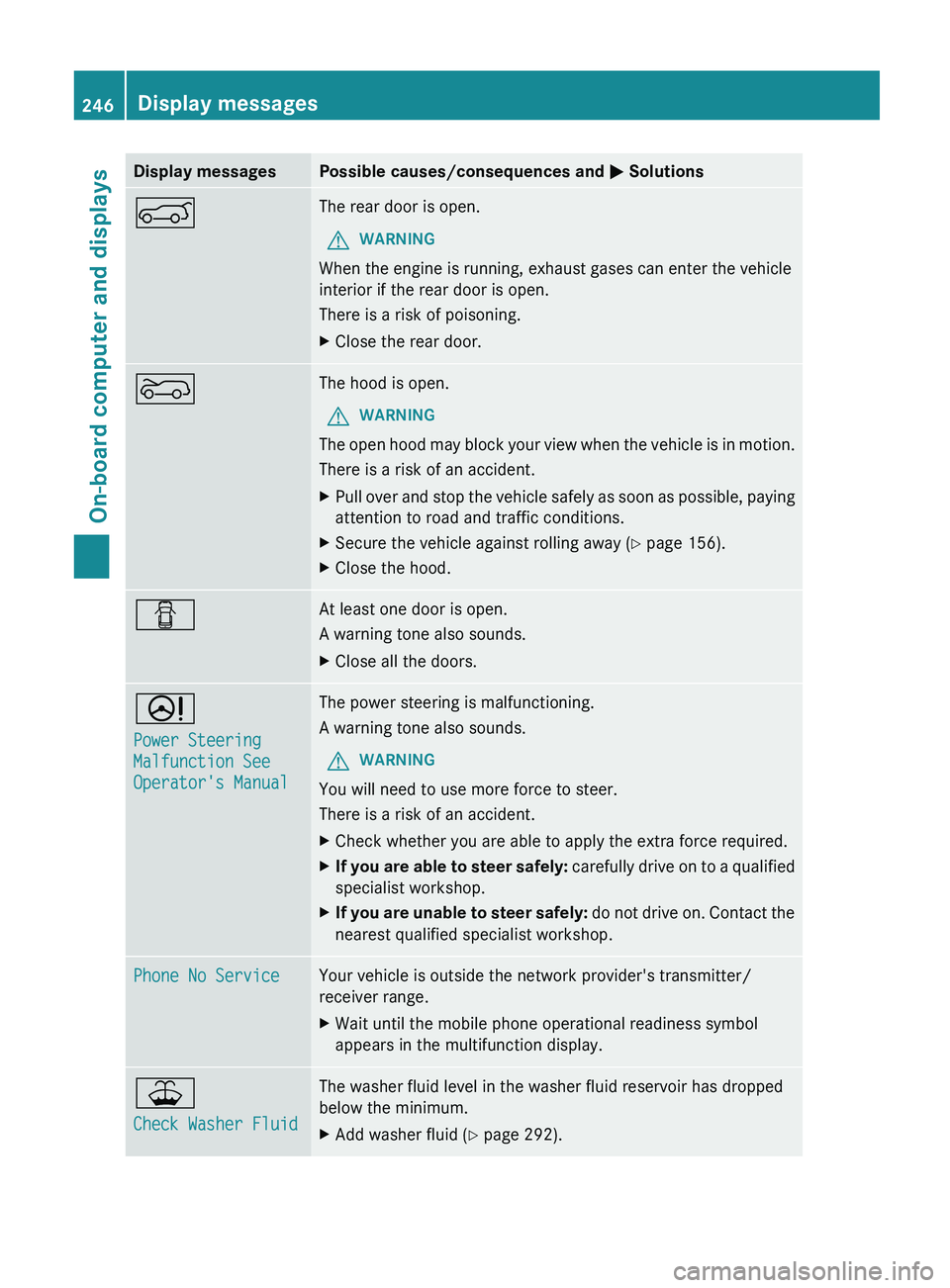
Display messages Possible causes/consequences and
0050 Solutions0065 The rear door is open.
G WARNING
When the engine is running, exhaust gases can enter the vehicle
interior if the rear door is open.
There is a risk of poisoning.
X Close the rear door. 0066 The hood is open.
G WARNING
The open hood may block your view when the vehicle is in motion.
There is a risk of an accident.
X Pull over and stop the vehicle safely as soon as possible, paying
attention to road and traffic conditions.
X Secure the vehicle against rolling away ( Y page 156).
X Close the hood. 0051 At least one door is open.
A warning tone also sounds.
X
Close all the doors. 0052
Power Steering
Malfunction See
Operator's Manual The power steering is malfunctioning.
A warning tone also sounds.
G WARNING
You will need to use more force to steer.
There is a risk of an accident.
X Check whether you are able to apply the extra force required.
X If you are able to steer safely:
carefully drive
on to a qualified
specialist workshop.
X If you are unable to steer safely: do not drive
on. Contact the
nearest qualified specialist workshop. Phone No Service Your vehicle is outside the network provider's transmitter/
receiver range.
X
Wait until the mobile phone operational readiness symbol
appears in the multifunction display. 00B2
Check Washer Fluid The washer fluid level in the washer fluid reservoir has dropped
below the minimum.
X
Add washer fluid ( Y page 292).246
Display messages
On-board computer and displays
Page 250 of 364
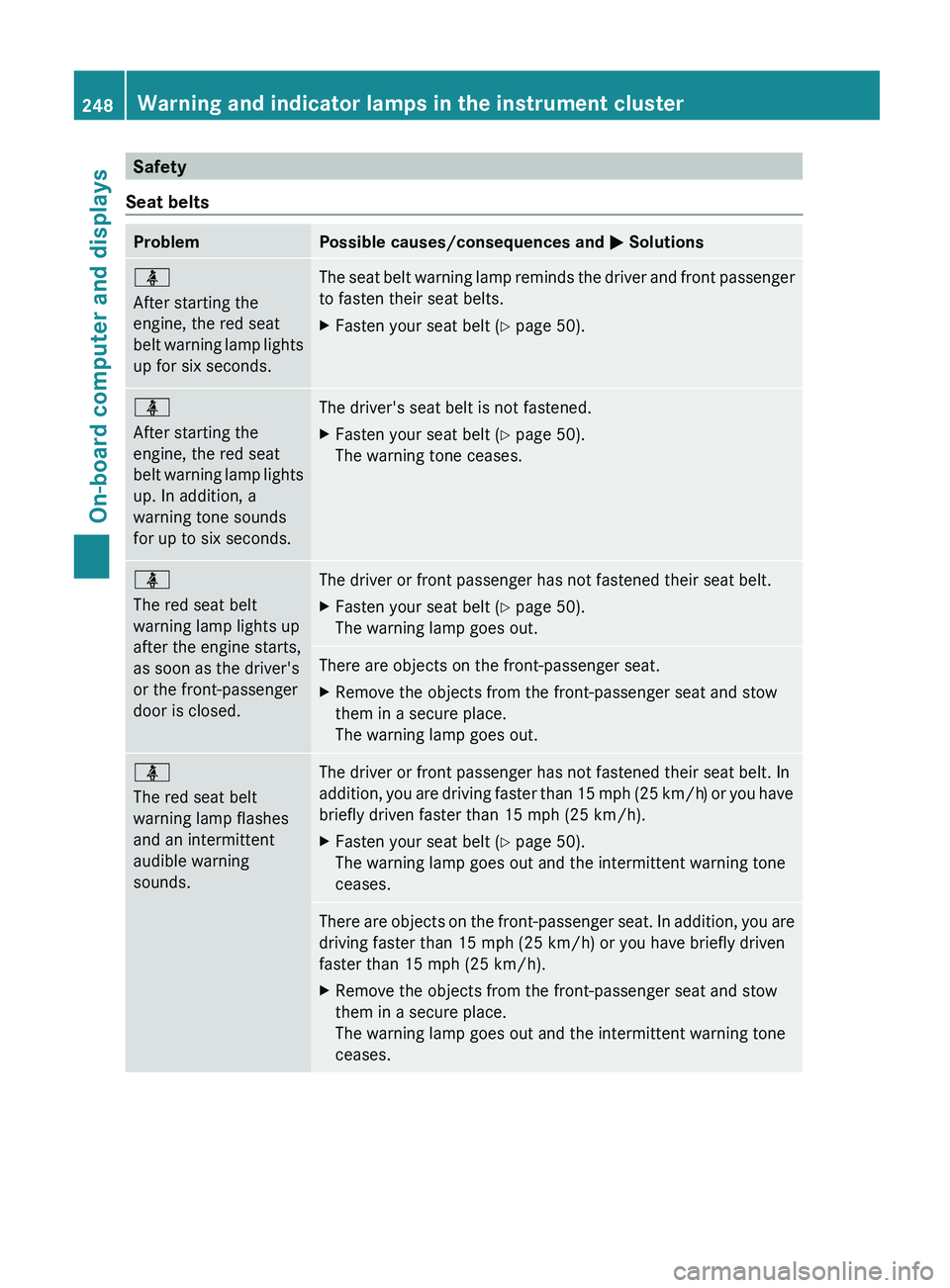
Safety
Seat belts Problem Possible causes/consequences and
0050 Solutions00E9
After starting the
engine, the red seat
belt warning lamp
lights
up for six seconds. The seat belt warning lamp reminds the driver and front passenger
to fasten their seat belts.
X
Fasten your seat belt ( Y page 50).00E9
After starting the
engine, the red seat
belt warning lamp
lights
up. In addition, a
warning tone sounds
for up to six seconds. The driver's seat belt is not fastened.
X
Fasten your seat belt ( Y page 50).
The warning tone ceases. 00E9
The red seat belt
warning lamp lights up
after the engine starts,
as soon as the driver's
or the front-passenger
door is closed.
The driver or front passenger has not fastened their seat belt.
X
Fasten your seat belt ( Y page 50).
The warning lamp goes out. There are objects on the front-passenger seat.
X
Remove the objects from the front-passenger seat and stow
them in a secure place.
The warning lamp goes out. 00E9
The red seat belt
warning lamp flashes
and an intermittent
audible warning
sounds.
The driver or front passenger has not fastened their seat belt. In
addition, you are
driving
faster than 15 mph (25 km/h) or you have
briefly driven faster than 15 mph (25 km/h).
X Fasten your seat belt ( Y page 50).
The warning lamp goes out and the intermittent warning tone
ceases. There are objects on the front-passenger seat. In addition, you are
driving faster than 15 mph (25 km/h) or you have briefly driven
faster than 15 mph (25 km/h).
X
Remove the objects from the front-passenger seat and stow
them in a secure place.
The warning lamp goes out and the intermittent warning tone
ceases.248
Warning and indicator lamps in the instrument cluster
On-board computer and displays