ECU MERCEDES-BENZ G-CLASS SUV 2013 User Guide
[x] Cancel search | Manufacturer: MERCEDES-BENZ, Model Year: 2013, Model line: G-CLASS SUV, Model: MERCEDES-BENZ G-CLASS SUV 2013Pages: 364, PDF Size: 9.62 MB
Page 58 of 364
G
WARNING
When leaving the vehicle, always remove the
SmartKey from the ignition lock. Always take
the SmartKey with you and lock the vehicle.
Do not leave children unattended in the
vehicle, even if they are secured in a child
restraint system, or with access to an
unlocked vehicle. A child's unsupervised
access to a vehicle
could result in an accident
and/or serious personal injury. The children
could:
R injure themselves on parts of the vehicle
R be seriously or fatally injured through
excessive exposure to extreme heat or cold
R injure themselves or cause an accident with
vehicle equipment that can be operated
even if the SmartKey is removed from the
ignition lock or removed from the vehicle,
such as seat adjustment, steering wheel
adjustment, or the memory function
If children open a door, they could injure other
persons or get out of the vehicle and injure
themselves or be injured by following traffic.
Do not expose the child restraint system to
direct sunlight. The child restraint system's
metal parts, for example, could become very
hot, and the child could be burned on these
parts. G
WARNING
Do not carry heavy or hard objects in the
passenger compartment or trunk
unless they
are firmly secured in place.
Unsecured or improperly positioned cargo
increases a child's risk of injury in the event
of
R strong braking maneuvers
R sudden changes of direction
R an accident
We recommend that all infants and children
be properly restrained using the infant or
child restraint systems at all times while the
vehicle is in motion. Always use a child restraint system that is
compatible with BabySmart™ on the front-
passenger seat.
The use of
infant
or child restraints is required
by law in all 50 states, the District of
Columbia, all U.S. territories and all Canadian
provinces.
Infants and small children must be seated in
an appropriate infant or child restraint system
recommended for the size and weight of the
child. The infant or child restraint system
must be properly secured in accordance with
the manufacturer's instructions. All infant or
child restraint systems must comply with U.S.
Federal Motor Vehicle Safety Standards 213
and 225 and Canadian Motor Vehicle Safety
Standards 213 and 210.2.
An information label on the child restraint
system indicates whether it meets these
standards. This confirmation can also be
found in the installation instructions that are
included with the child restraint system.
Always read and follow the manufacturer's
instructions when using an infant or child
restraint system or booster seat.
Observe the warning labels in the vehicle
interior or on the infant or child restraint.
If an infant or child is traveling in the vehicle:
X Secure the child with a child or infant seat
restraint system appropriate to
the age and
weight of the child.
X Make sure that the infant or child is
properly secured at all times while the
vehicle is in motion.
Special seat belt retractor G
WARNING
Observe "Important safety notes"
(Y page 54). G
WARNING
Never release the seat belt buckle while the
vehicle is in motion,
since the special seat belt
retractor will be deactivated. 56
Children in the vehicle
Safety
Page 59 of 364
All seat belts except the driver's seat belt are
equipped with a special seat belt retractor.
When activated, the special seat belt
retractor ensures that the seat belt will not
slacken once the child restraint system has
been secured.
Installing a child restraint system:
X
Always comply with the manufacturer's
installation instructions.
X Pull the seat belt smoothly from the seat
belt retractor.
X Engage the seat belt tongue in the belt
buckle.
Activating the special seat belt retractor:
X Pull the seat belt out fully and let the seat
belt retractor retract it again.
While the seat belt
is retracting, you should
hear a ratcheting sound. The special seat
belt retractor is activated.
X Push down on the child restraint system to
take up any slack.
Removing a child restraint system/
deactivating the special seat belt retractor:
X Always comply with the manufacturer's
installation instructions.
X Press the release button on the seat belt
buckle.
X Guide the seat belt tongue into the belt
outlet.
The special seat belt retractor is
deactivated.
LATCH-type (ISOFIX) child seat anchors
in the rear G
WARNING
Observe "Important safety notes"
(Y page 54). G
WARNING
Children that are too large for a child restraint
must travel in seats using normal seat belts.
Position shoulder belt across the chest and
shoulder, not face or neck. A booster seat may be necessary to achieve
proper seat belt positioning for children over
41 lb (18 kg) until they reach a height where
a lap/shoulder belt fits properly without a
booster.
Install the child restraint system in
accordance with the manufacturer's
instructions.
Attach the child restraint system to both
securing rings.
An incorrectly installed
child
restraint system
could come loose during an accident and
seriously or even fatally injure the child.
Child restraint systems or child seat securing
rings that are malfunctioning or damaged as
the result of a collision must be replaced.
! When installing the child restraint system,
make sure that the seat belt for the middle
seat does not get trapped. The seat belt
could otherwise be damaged.
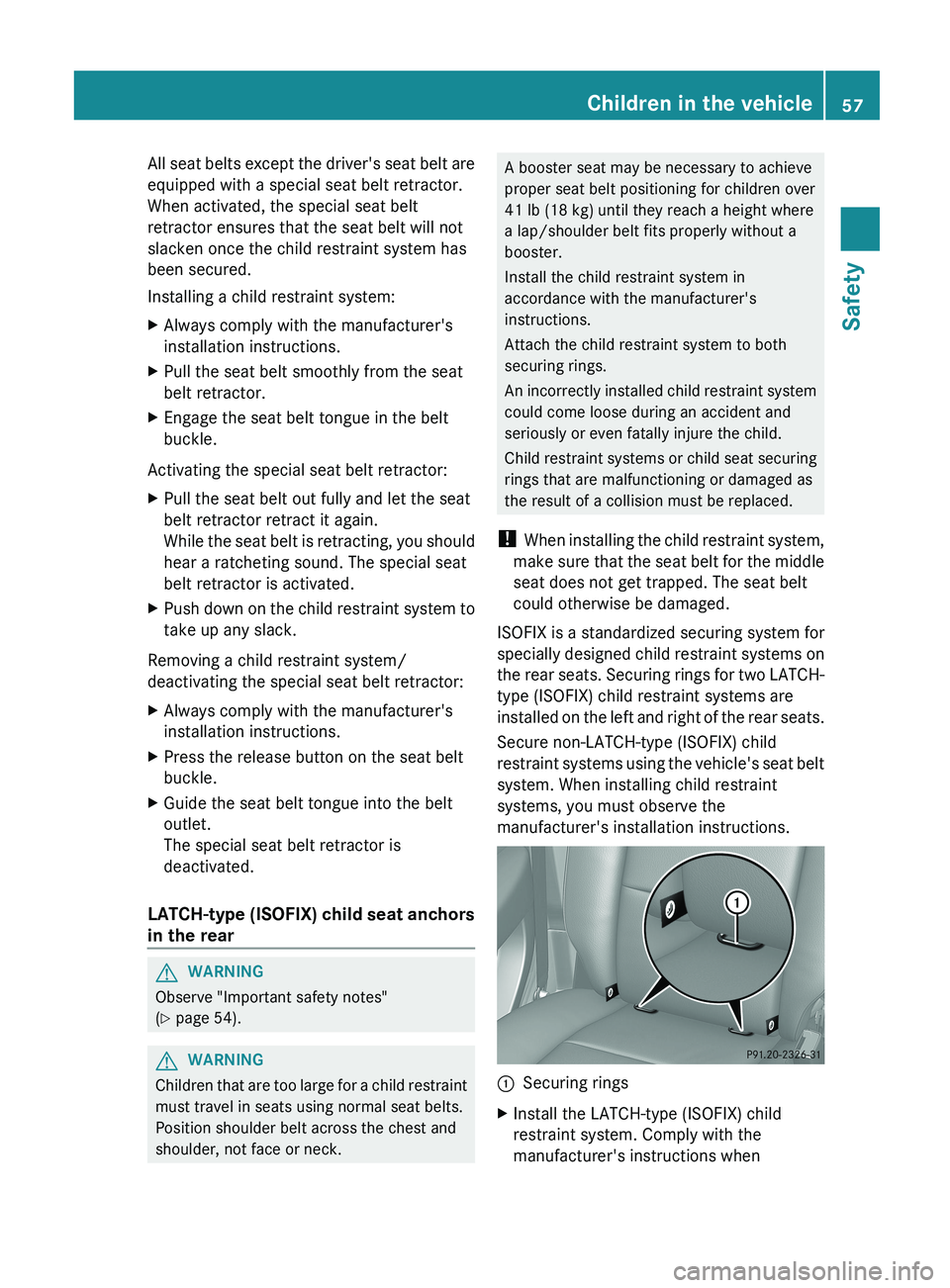
ISOFIX is a standardized securing system for
specially designed child restraint systems on
the rear seats. Securing rings for two LATCH-
type (ISOFIX) child restraint systems are
installed on the left and right of the rear seats.
Secure non-LATCH-type (ISOFIX) child
restraint systems using the vehicle's seat belt
system. When installing child restraint
systems, you must observe the
manufacturer's installation instructions. 0043
Securing rings
X Install the LATCH-type (ISOFIX) child
restraint system. Comply with the
manufacturer's instructions when Children in the vehicle
57
Safety Z
Page 60 of 364
installing the LATCH-type (ISOFIX) child
restraint system.
X When a LATCH-type (ISOFIX) child seat
securing system is installed, make sure
that the center seat belt in the rear
compartment is fully functional and can
move freely.
Top Tether G
WARNING
Observe "Important safety notes"
(Y page 54). G
WARNING
Always lock the rear seat backrests in their
upright position when the rear seats are
occupied by passengers. Lock the rear seat
backrests in their upright position before
installing the Top Tether straps or when the
cargo compartment is not in use. Make sure
that rear seat backrests
are secured properly
by pushing and pulling on the seat backrests.
If the seat backrest is not locked properly, the
seat backrest could fold forward. The child
restraint system is no longer supported
properly or held in position and can no longer
fulfill its function. This could cause serious or
even fatal injuries. G
WARNING
Only use the described top tether anchorage
rings for the respective child seat. Other
lashing eyelets could tear in case of an
accident. Make sure
the
top tether straps are
not crossed or twisted and the hook is
attached and closed properly.
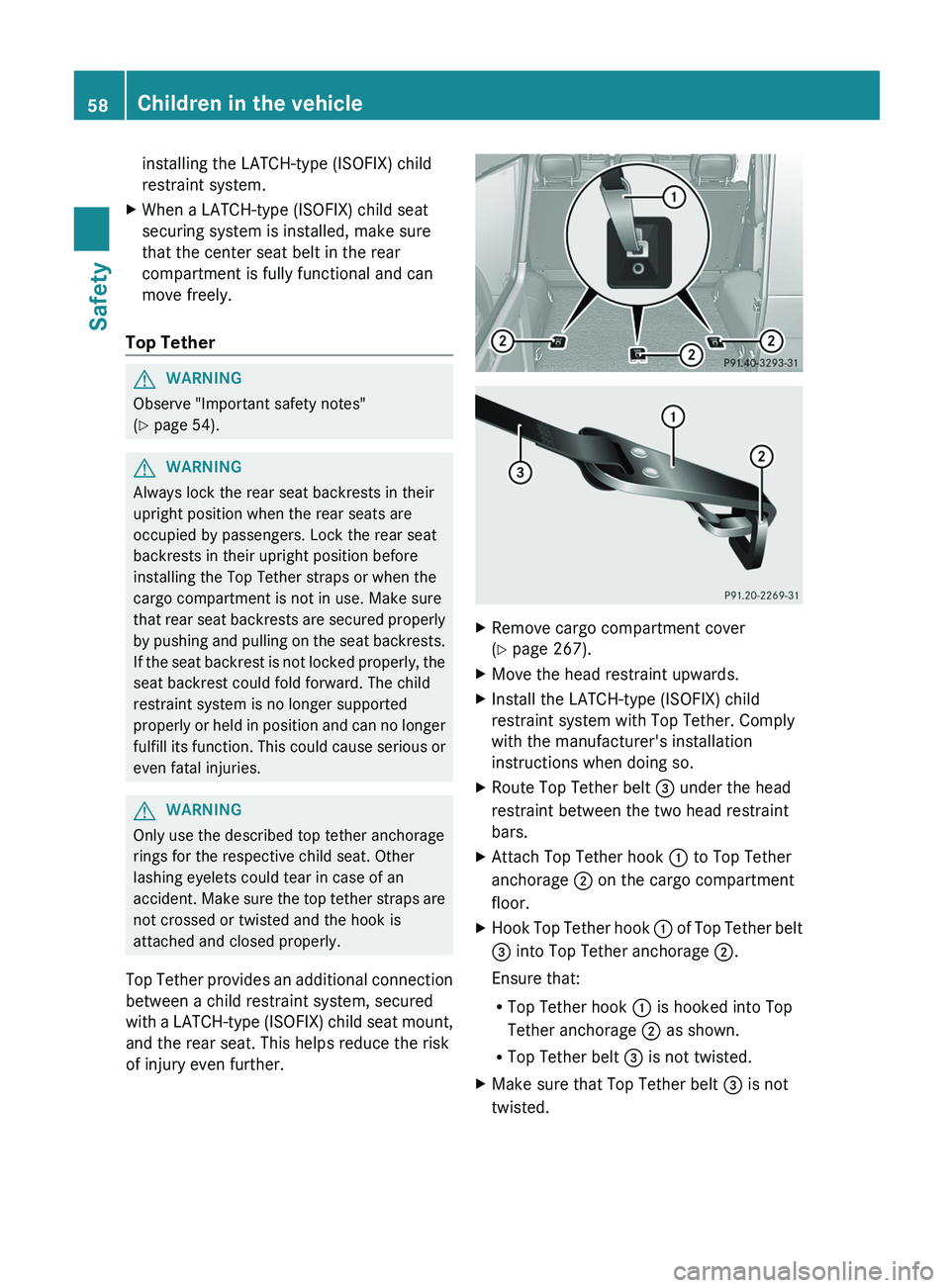
Top Tether provides an additional connection
between a child restraint system, secured
with a LATCH-type (ISOFIX) child seat mount,
and the rear seat. This helps reduce the risk
of injury even further. X
Remove cargo compartment cover
(Y page 267).
X Move the head restraint upwards.
X Install the LATCH-type (ISOFIX) child
restraint system with Top Tether. Comply
with the manufacturer's installation
instructions when doing so.
X Route Top Tether belt 0087 under the head
restraint between the two head restraint
bars.
X Attach Top Tether hook 0043 to Top Tether
anchorage 0044 on the cargo compartment
floor.
X Hook Top Tether hook 0043 of Top
Tether
belt
0087 into Top Tether anchorage 0044.
Ensure that:
R Top Tether hook 0043 is hooked into Top
Tether anchorage 0044 as shown.
R Top Tether belt 0087 is not twisted.
X Make sure that Top Tether belt 0087 is not
twisted. 58
Children in the vehicle
Safety
Page 61 of 364
X
Tension Top Tether belt 0087. Comply with
the manufacturer's installation
instructions when doing so.
X Move head restraint back down again
slightly if necessary ( Y page 86). Make
sure that you do not interfere with the
correct routing of Top Tether belt 0087. Child-proof locks
Important safety notes G
WARNING
When children ride on the vehicle's rear seats,
activate the override switch. Otherwise, the
children could be injured, e.g. by trapping
themselves in the rear side window. G
WARNING
When leaving the vehicle, always remove the
SmartKey from the ignition lock. Always take
the SmartKey with you and lock the vehicle.
Do not leave children unattended in the
vehicle, even if they are secured in a child
restraint system, or with access to an
unlocked vehicle. A child's unsupervised
access to a vehicle
could result in an accident
and/or serious personal injury. The children
could:
R injure themselves on parts of the vehicle
R be seriously or fatally injured through
excessive exposure to extreme heat or cold
R injure themselves or cause an accident with
vehicle equipment that can be operated
even if the SmartKey is removed from the
ignition lock or removed from the vehicle,
such as seat adjustment, steering wheel
adjustment, or the memory function
If children open a door, they could injure other
persons or get out of the vehicle and injure
themselves or be injured by following traffic.
Do not expose the child restraint system to
direct sunlight. The child restraint system's
metal parts, for example, could become very hot, and the child could be burned on these
parts.
Child-proof locks for the rear doors G
WARNING
Children could open a rear door from inside
the vehicle. This could result in serious
injuries or an accident. Therefore, when
children ride in the
rear always secure the rear
doors with the child-proof locks.
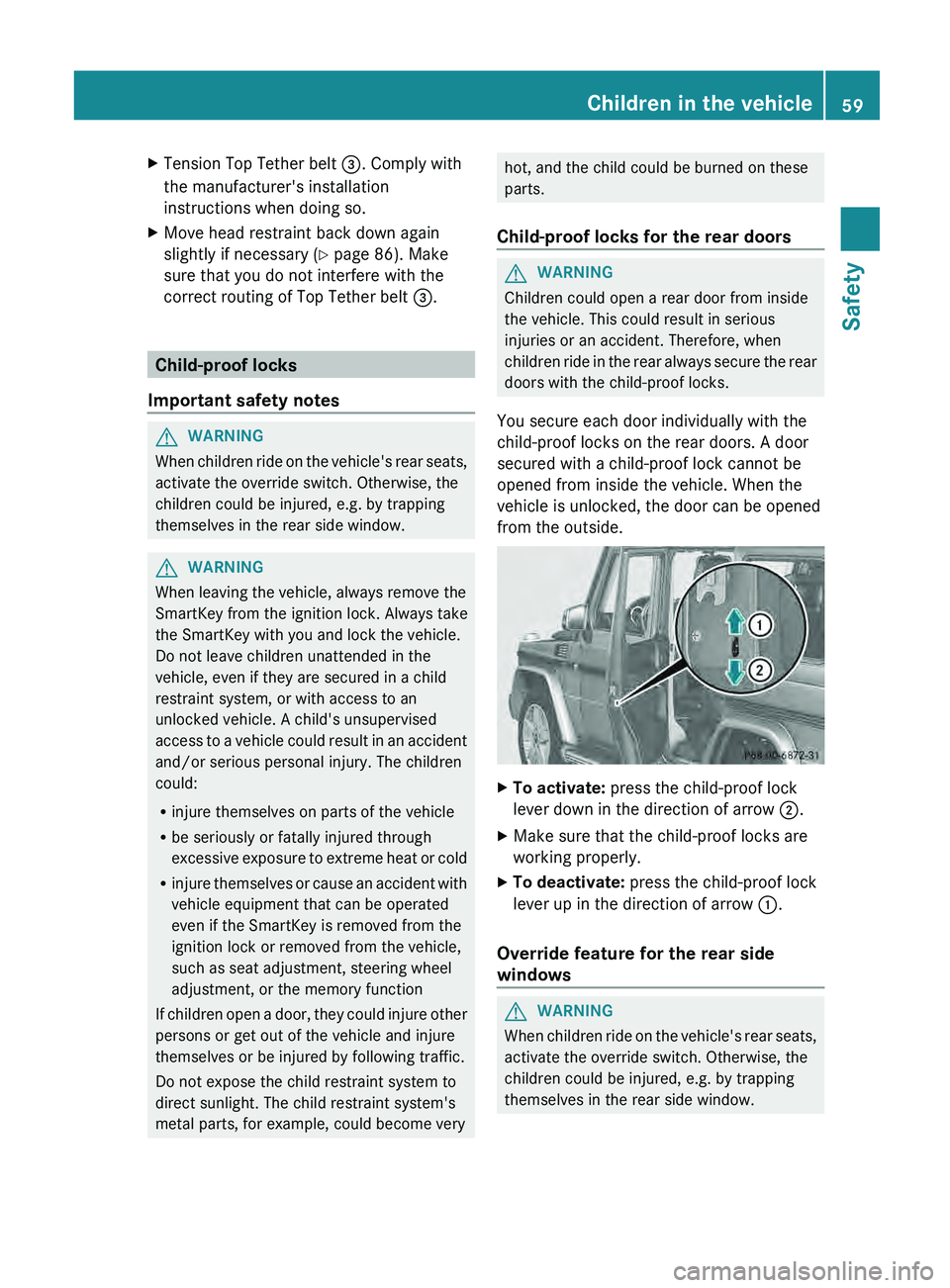
You secure each door individually with the
child-proof locks on the rear doors. A door
secured with a child-proof lock cannot be
opened from inside the vehicle. When the
vehicle is unlocked, the door can be opened
from the outside. X
To activate: press the child-proof lock
lever down in the direction of arrow 0044.
X Make sure that the child-proof locks are
working properly.
X To deactivate: press the child-proof lock
lever up in the direction of arrow 0043.
Override feature for the rear side
windows G
WARNING
When children ride on the vehicle's rear seats,
activate the override switch. Otherwise, the
children could be injured, e.g. by trapping
themselves in the rear side window. Children in the vehicle
59
Safety Z
Page 70 of 364
Useful information
i This Operator's Manual describes all
models and all standard and optional
equipment of your vehicle available at the
time of publication of the Operator's
Manual. Country-specific differences are
possible. Please note that
your vehicle may
not be equipped with all features
described. This also applies to safety-
related systems and functions.
i Read the information on qualified
specialist workshops: ( Y page 23).SmartKey
Important safety notes
G
WARNING
When leaving the vehicle, always remove the
SmartKey from the ignition lock. Always take
the SmartKey with you and lock the vehicle.
Do not leave children unsupervised in the
vehicle, even if they are secured in a child
restraint system, and do
not give them access
to an unlocked vehicle. A child's unsupervised
access to a vehicle could result in an accident
and/or serious personal injury. They could:
R injure themselves on vehicle parts
R be seriously or fatally injured by extreme
heat or cold
R injure themselves or have an accident with
vehicle equipment that may still be in
operation even after the SmartKey has
been removed from the ignition, such as the
seat adjustment, steering wheel
adjustment or memory function.
If children open a door, they could cause
severe or even fatal injury to other persons; if
they get out of the vehicle, they could injure
themselves when doing so or be seriously or
even fatally injured by any passing traffic.
Do not expose the child restraint system to
direct sunlight. The child restraint system's
metal parts, for example, could become very hot, and a child could be burned on these
parts.
G
WARNING
Do not carry heavy or hard objects in the
passenger compartment or cargo
compartment unless they are firmly secured
in place.
Unsecured or improperly positioned cargo
increases a child's risk of injury in the event
of
R strong braking maneuvers
R sudden changes of direction
R an accident G
WARNING
If you attach heavy or large objects to the
SmartKey, the SmartKey could be
unintentionally turned in the
ignition lock. This
could cause the engine to be switched off.
There is a risk of an accident.
Do not attach any heavy or large objects to
the SmartKey. Remove any bulky keyrings
before inserting the SmartKey into the
ignition lock. SmartKey functions
G
WARNING
If children are left unsupervised in the vehicle,
they could:
R open the doors, thus endangering other
people or road users.
R get out and disrupt traffic.
R operate the vehicle's equipment.
Additionally, children could set the vehicle in
motion if, for example, they:
R release the parking brake.
R shift the automatic transmission out of
parking position P.
R shift the manual transmission into neutral.
R starting the engine.
There is a risk of an accident and injury. 68
SmartKey
Opening/closing
Page 75 of 364
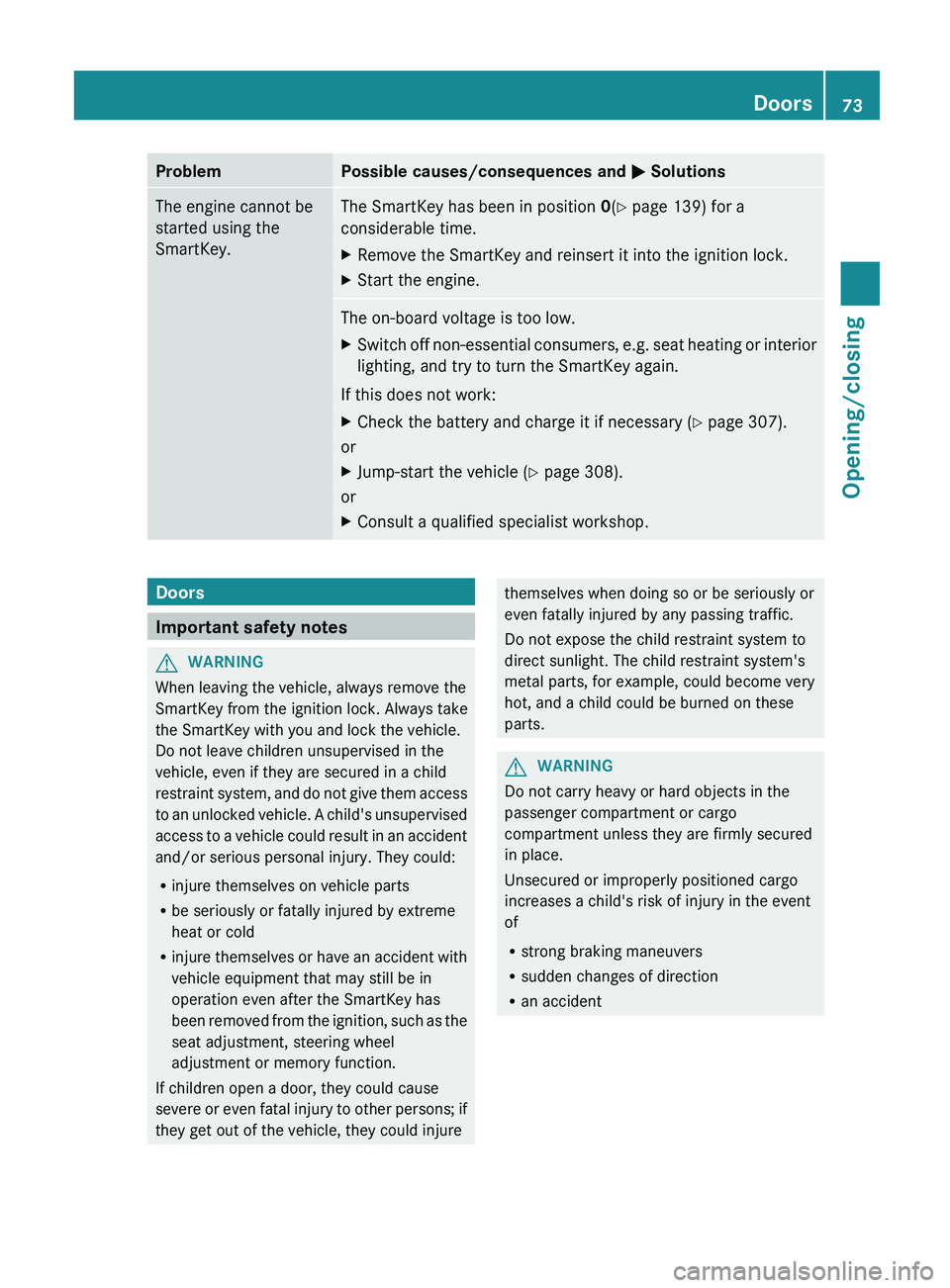
Problem Possible causes/consequences and
0050 SolutionsThe engine cannot be
started using the
SmartKey. The SmartKey has been in position
0(Y page 139) for a
considerable time.
X Remove the SmartKey and reinsert it into the ignition lock.
X Start the engine. The on-board voltage is too low.
X
Switch off non-essential consumers, e.g. seat heating or interior
lighting, and try to turn the SmartKey again.
If this does not work:
X Check the battery and charge it if necessary ( Y page 307).
or
X Jump-start the vehicle (Y page 308).
or
X Consult a qualified specialist workshop. Doors
Important safety notes
G
WARNING
When leaving the vehicle, always remove the
SmartKey from the ignition lock. Always take
the SmartKey with you and lock the vehicle.
Do not leave children unsupervised in the
vehicle, even if they are secured in a child
restraint system, and do
not give them access
to an unlocked vehicle. A child's unsupervised
access to a vehicle could result in an accident
and/or serious personal injury. They could:
R injure themselves on vehicle parts
R be seriously or fatally injured by extreme
heat or cold
R injure themselves or have an accident with
vehicle equipment that may still be in
operation even after the SmartKey has
been removed from the ignition, such as the
seat adjustment, steering wheel
adjustment or memory function.
If children open a door, they could cause
severe or even fatal injury to other persons; if
they get out of the vehicle, they could injure themselves when doing so or be seriously or
even fatally injured by any passing traffic.
Do not expose the child restraint system to
direct sunlight. The child restraint system's
metal parts, for example, could become very
hot, and a child could be burned on these
parts.
G
WARNING
Do not carry heavy or hard objects in the
passenger compartment or cargo
compartment unless they are firmly secured
in place.
Unsecured or improperly positioned cargo
increases a child's risk of injury in the event
of
R strong braking maneuvers
R sudden changes of direction
R an accident Doors
73
Opening/closing Z
Page 79 of 364
Rear door
Important safety notes
G
WARNING
When leaving the vehicle, always remove the
SmartKey from the ignition lock. Always take
the SmartKey with you and lock the vehicle.
Do not leave children unsupervised in the
vehicle, even if they are secured in a child
restraint system, and do
not give them access
to an unlocked vehicle. A child's unsupervised
access to a vehicle could result in an accident
and/or serious personal injury. They could:
R injure themselves on vehicle parts
R be seriously or fatally injured by extreme
heat or cold
R injure themselves or have an accident with
vehicle equipment that may still be in
operation even after the SmartKey has
been removed from the ignition, such as the
seat adjustment, steering wheel
adjustment or memory function.
If children open a door, they could cause
severe or even fatal injury to other persons; if
they get out of the vehicle, they could injure
themselves when doing so or be seriously or
even fatally injured by any passing traffic.
Do not expose the child restraint system to
direct sunlight. The child restraint system's
metal parts, for example, could become very
hot, and a child could be burned on these
parts. G
WARNING
Do not carry heavy or hard objects in the
passenger compartment or cargo
compartment unless they are firmly secured
in place.
Unsecured or improperly positioned cargo
increases a child's risk of injury in the event
of
R strong braking maneuvers
R sudden changes of direction
R an accident G
WARNING
Combustion engines emit poisonous exhaust
gases such as carbon monoxide. If the rear
door is open when the engine is running,
particularly if the vehicle is moving, exhaust
fumes could enter the passenger
compartment. There is a risk of poisoning.
Turn off the engine before opening the rear
door. Never drive with the rear door open.
! The tailgate swings out to the side when
opened. Therefore, make sure
that there is
sufficient clearance.
i Do not leave the SmartKey in the cargo
compartment. Otherwise, you could lock
yourself out. Opening
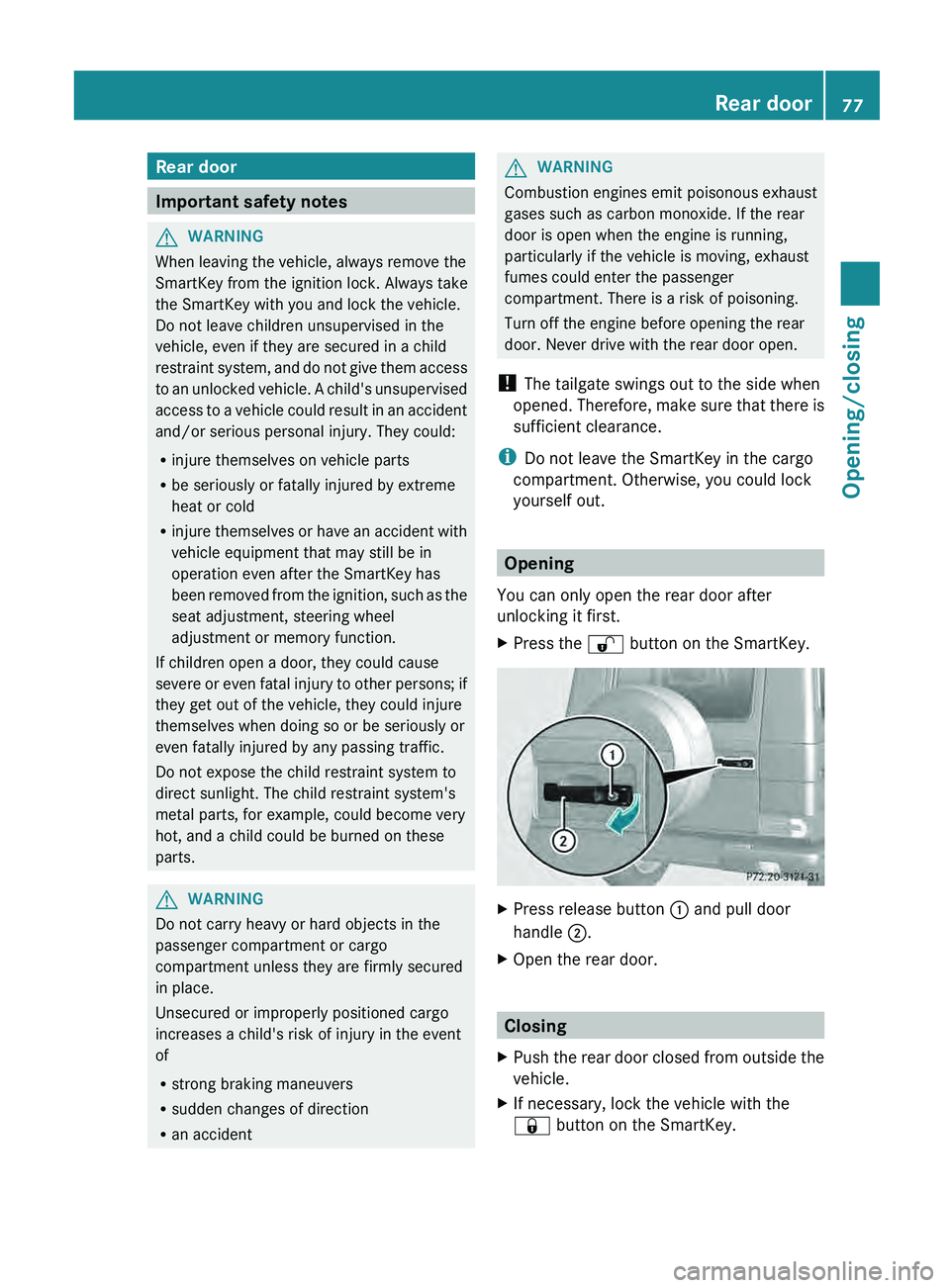
You can only open the rear door after
unlocking it first.
X Press the 0036 button on the SmartKey. X
Press release button 0043 and pull door
handle 0044.
X Open the rear door. Closing
X Push the rear door closed from outside the
vehicle.
X If necessary, lock the vehicle with the
0037 button on the SmartKey. Rear door
77
Opening/closing Z
Page 87 of 364
Seats
Important safety notes
G
WARNING
The seats can still be adjusted when there is
no key in the ignition lock. For this reason,
children should never be left unsupervised in
the vehicle. They could otherwise become
trapped when adjusting the seat. G
WARNING
In order to avoid possible loss of vehicle
control, all seat, head restraint, steering
wheel and rear view mirror adjustments, as
well as fastening of seat belts, must be done
before setting the vehicle in motion. G
WARNING
Do not adjust the driver's seat while driving.
Adjusting the seat while driving could cause
the driver to lose control of the vehicle.
Never travel in a
moving vehicle with the seat
backrest in an excessively reclined position as
this can be dangerous. You could slide under
the seat belt in a collision. If you slide under
it, the seat belt would apply force at the
abdomen or neck. This could cause serious or
fatal injuries. The seat backrest and seat belts
provide the best restraint when the wearer is
in a position that is as upright as possible and
seat belts are properly positioned on the
body. G
WARNING
Your seat belt must be adjusted so that you
can correctly fasten your seat belt.
Observe the following points:
R adjust the seat backrest
until your arms are
slightly angled when holding the steering
wheel.
R adjust the seat to a comfortable seating
position that still allows you to reach the
accelerator/brake pedal safely. The
position should be as far back as possible with the driver still able to operate the
controls properly.
R adjust the head restraint so that it is as
close to the head
as possible and the center
of the head restraint supports the back of
the head at eye level.
R never place hands under the seat or near
any moving parts while a seat is being
adjusted.
Failure to do so could result in an accident
and/or serious personal injury. G
WARNING
According to accident statistics, children are
safer when properly restrained on the rear
seats than on the
front-passenger seat. Thus,
we strongly recommend that children be
placed in the rear seat whenever possible.
Regardless of seating position, children 12
years old and under must be seated and
properly secured in an appropriately sized
child restraint system or booster seat
recommended for the size and weight of the
child. For additional information, see the
"Children in the vehicle" section.
A child's risk of serious or fatal injuries is
significantly increased if the child restraints
are not properly secured in the vehicle and/
or the child is not properly secured in the child
restraint. G
WARNING
For your protection, drive only with properly
positioned head restraints.
Adjust the head restraint
so that it is as close
to the head as possible and the center of the
head restraint supports the back of the head
at eye level. This will reduce the potential for
injury to the head and neck in the event of an
accident or similar situation.
Do not drive the vehicle without the seat head
restraints. Head restraints are intended to
help reduce injuries during an accident. Seats
85
Seats, steering wheel and mirrors Z
Page 115 of 364
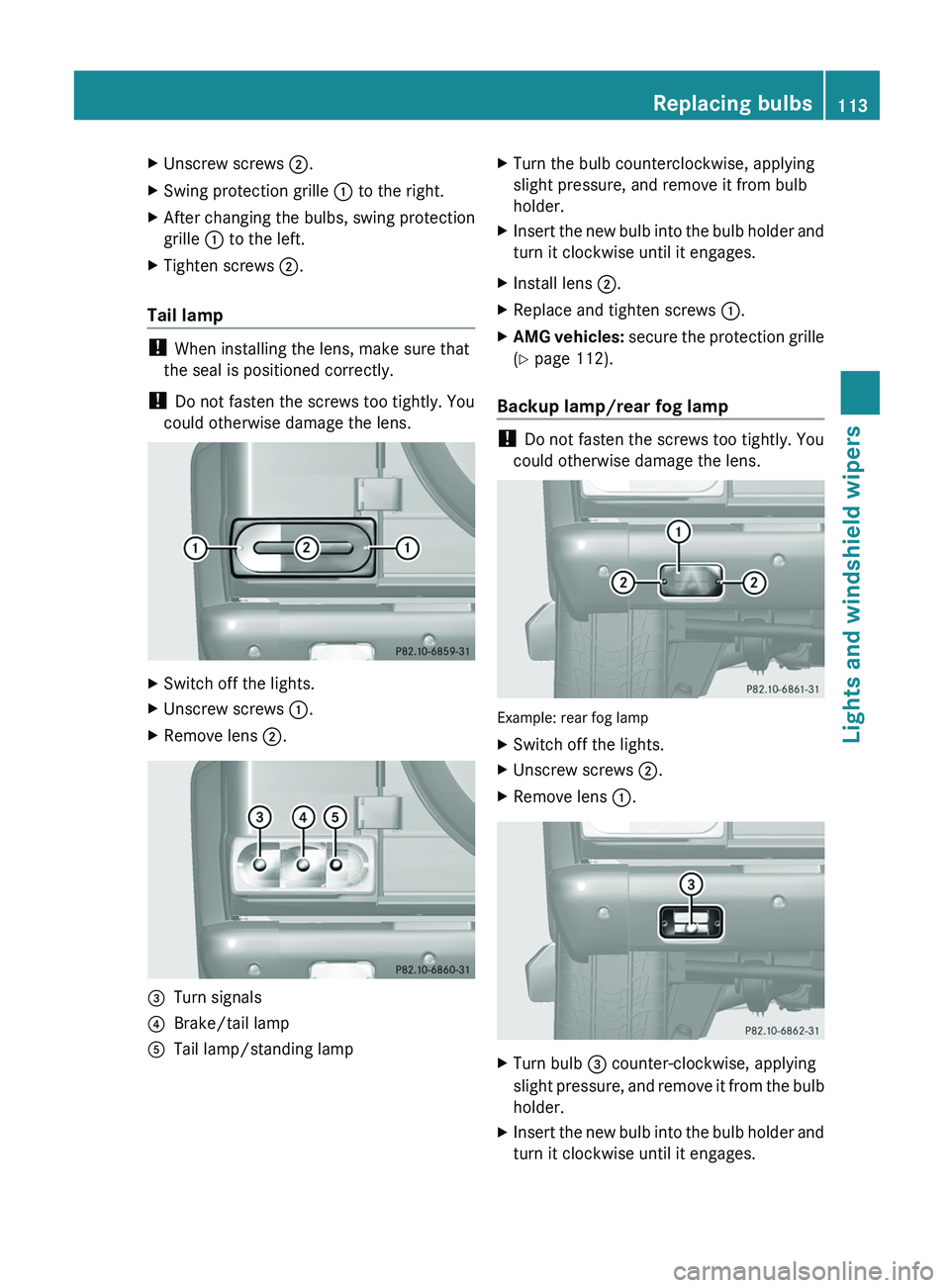
X
Unscrew screws 0044.
X Swing protection grille 0043 to the right.
X After changing the bulbs, swing protection
grille 0043 to the left.
X Tighten screws 0044.
Tail lamp !
When installing the lens, make sure that
the seal is positioned correctly.
! Do not fasten the screws too tightly. You
could otherwise damage the lens. X
Switch off the lights.
X Unscrew screws 0043.
X Remove lens 0044.0087
Turn signals
0085 Brake/tail lamp
0083 Tail lamp/standing lamp X
Turn the bulb counterclockwise, applying
slight pressure, and remove it from bulb
holder.
X Insert the new bulb into the bulb holder and
turn it clockwise until it engages.
X Install lens 0044.
X Replace and tighten screws 0043.
X AMG vehicles: secure
the protection
grille
(Y page 112).
Backup lamp/rear fog lamp !
Do not fasten the screws too tightly. You
could otherwise damage the lens. Example: rear fog lamp
X
Switch off the lights.
X Unscrew screws 0044.
X Remove lens 0043. X
Turn bulb 0087 counter-clockwise, applying
slight pressure, and remove
it from the bulb
holder.
X Insert the new bulb into the bulb holder and
turn it clockwise until it engages. Replacing bulbs
113
Lights and windshield wipers Z
Page 135 of 364
i
You should only select this setting until
the windshield is clear again. Switching the windshield defroster
on/off
G
WARNING
Any accumulation of snow and ice should be
removed from the windshield before driving.
Otherwise, your vision may be impaired,
which could endanger you or others. X
Turn the SmartKey to position
2 (Y page 139) in the ignition lock.
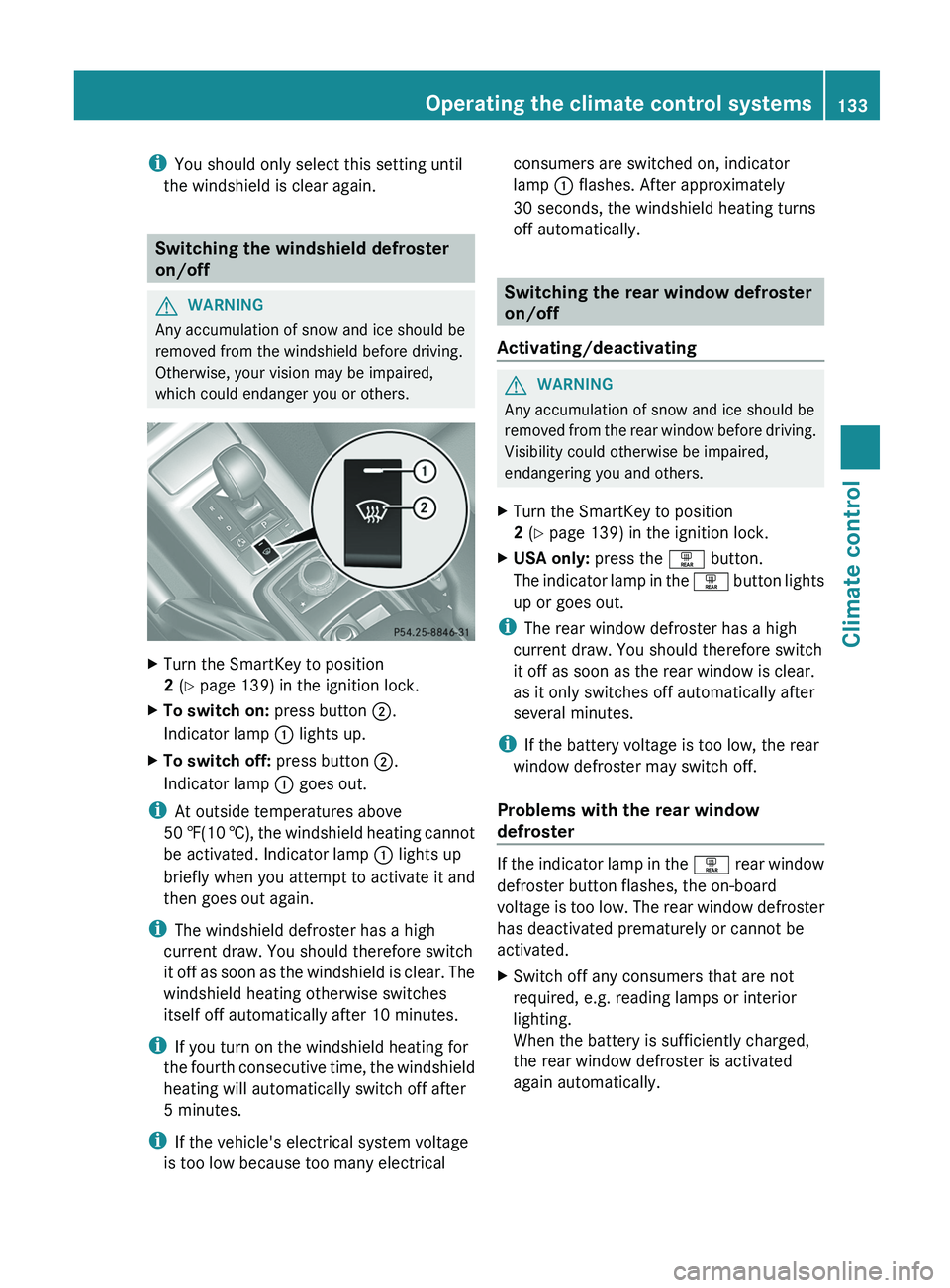
X To switch on: press button 0044.
Indicator lamp 0043 lights up.
X To switch off: press button 0044.
Indicator lamp 0043 goes out.
i At outside temperatures above
50 ‡(10 †), the windshield
heating
cannot
be activated. Indicator lamp 0043 lights up
briefly when you attempt to activate it and
then goes out again.
i The windshield defroster has a high
current draw. You should therefore switch
it off as soon as the windshield is clear. The
windshield heating otherwise switches
itself off automatically after 10 minutes.
i If you turn on the windshield heating for
the fourth consecutive time, the windshield
heating will automatically switch off after
5 minutes.
i If the vehicle's electrical system voltage
is too low because too many electrical consumers are switched on, indicator
lamp
0043 flashes. After approximately
30 seconds, the windshield heating turns
off automatically. Switching the rear window defroster
on/off
Activating/deactivating G
WARNING
Any accumulation of snow and ice should be
removed from the rear
window before driving.
Visibility could otherwise be impaired,
endangering you and others.
X Turn the SmartKey to position
2 (Y page 139) in the ignition lock.
X USA only: press the 0065 button.
The indicator lamp
in
the 0065 button lights
up or goes out.
i The rear window defroster has a high
current draw. You should therefore switch
it off as soon as the rear window is clear.
as it only switches off automatically after
several minutes.
i If the battery voltage is too low, the rear
window defroster may switch off.
Problems with the rear window
defroster If the indicator lamp in the
0065 rear window
defroster button flashes, the on-board
voltage is
too low. The rear window defroster
has deactivated prematurely or cannot be
activated.
X Switch off any consumers that are not
required, e.g. reading lamps or interior
lighting.
When the battery is sufficiently charged,
the rear window defroster is activated
again automatically. Operating the climate control systems
133
Climate control Z