ECU MERCEDES-BENZ G-CLASS SUV 2016 Workshop Manual
[x] Cancel search | Manufacturer: MERCEDES-BENZ, Model Year: 2016, Model line: G-CLASS SUV, Model: MERCEDES-BENZ G-CLASS SUV 2016Pages: 261, PDF Size: 6.01 MB
Page 202 of 261
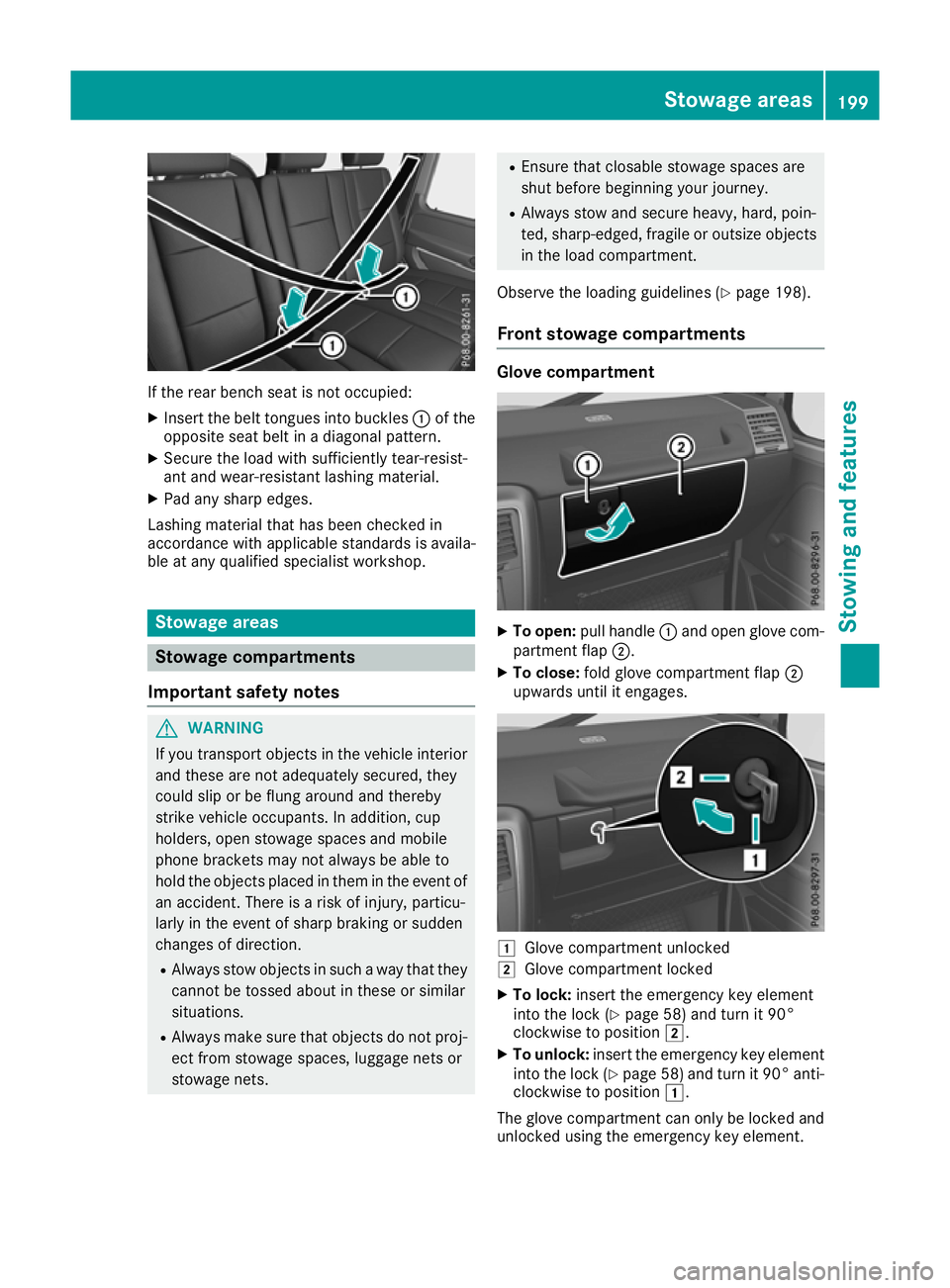
If the rear bench seat is not occupied:
X Insert the belt tongues into buckles :of the
opposite seat belt in adiagonal pattern.
X Secure the load with sufficiently tear-resist-
ant and wear-resistant lashing material.
X Pad any sharp edges.
Lashing materia lthat has been checked in
accordance with applicables tandards is availa-
ble at any qualifieds pecialist workshop. Stowage areas
Stowage compartments
Important safety notes G
WARNING
If you transport objects in the vehicle interior and these are not adequately secured, they
could slip or be flung around and thereby
strike vehicle occupants. In addition, cup
holders, open stowage spaces and mobile
phone brackets may not always be ableto
hold the objects placed in them in the event of an accident. There is arisk of injury ,particu-
larl yint he event of sharp braking or sudden
changes of direction.
R Always stow objects in such away that they
cannot be tossed about in these or similar
situations.
R Always make sure that objects do not proj-
ect from stowage spaces, luggage nets or
stowage nets. R
Ensure that closable stowag espacesa re
shu tbefor eb egin ning your journey.
R Alway sstow and secur eheavy, hard, poin-
ted ,sharp-edged ,fragile or outsize objects
in the load compartment.
Observe the loading guideline s(Ypage 198).
Front stowage compartments Glov
ecompartment X
To open: pull handle :and open glove com-
partment flap ;.
X To close: fold glove compartment flap ;
upwards until it engages. 1
Glove compar tmentu nlocked
2 Glove compartmen tlocked
X To lock: insert theemergency ke yelement
int ot he lock(Ypage 58) and tur nit90°
clockwise to position 2.
X To unlock: insert theemergency ke yelement
int othe lock(Ypage 58 )and tur nit90°anti-
clockwise to position 1.
The glov ecompartmen tcan only be locke dand
unlocked usin gthe emergency ke yelement. Stowage areas
199Stowing and feat ures Z
Page 205 of 261
Rear benc
hseat Folding th
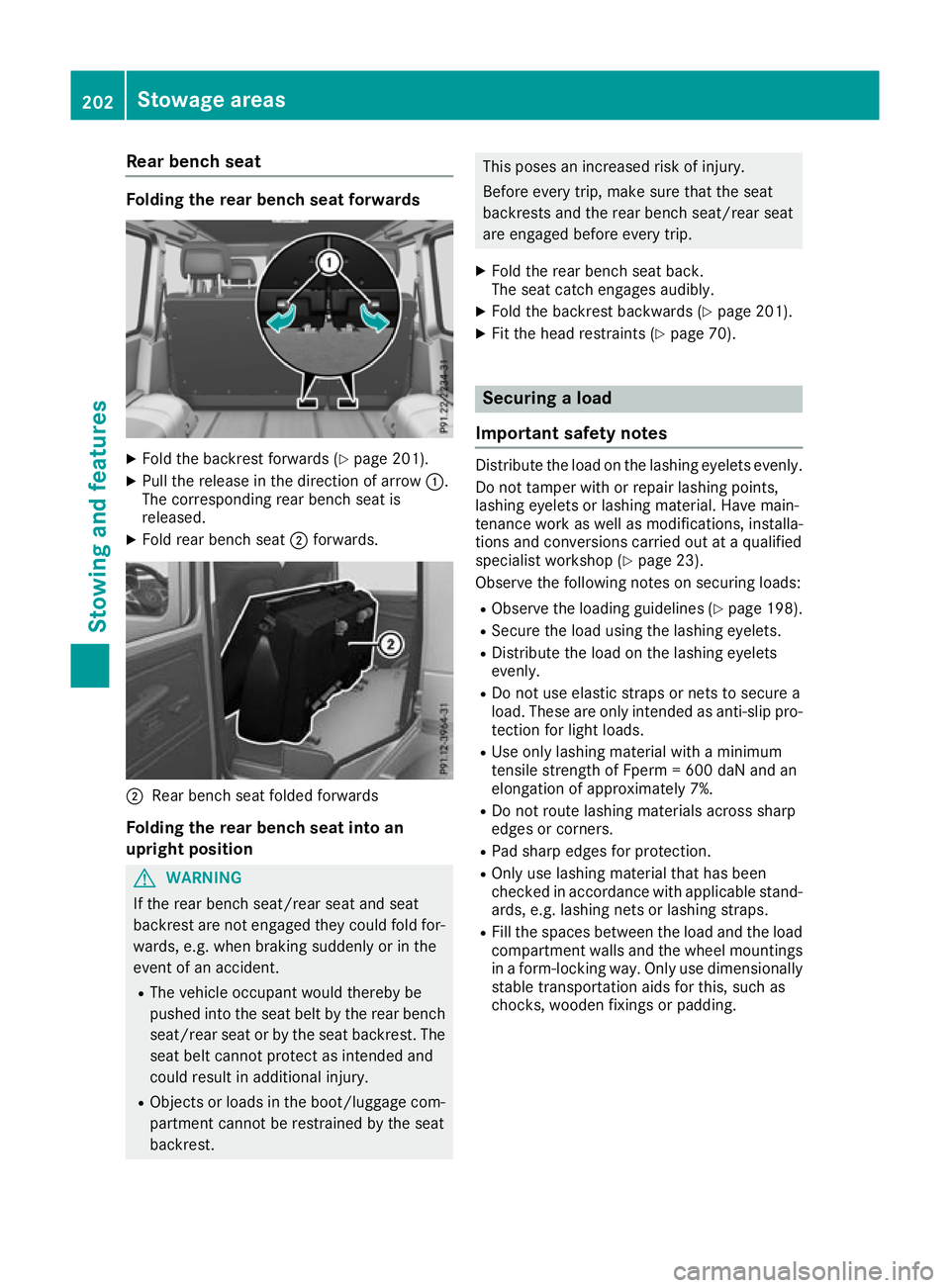
erearb ench seat forwards X
Fold th ebackrest forward s(Ypage 201).
X Pull the release in the directio nofarrow:.
The corresponding rea rbench sea tis
released.
X Fold rea rbench seat ;forwards. ;
Rear bench seat foldedf orwards
Folding th erearb ench sea tint oan
upright position G
WARNING
If th erear bench seat/rea rseat and seat
backrest are not engaged they coul dfold for-
wards, e.g. when braking suddenly or in the
event of an accident.
R The vehicl eoccupant would thereby be
pushed into the seat beltb ythe rear bench
seat/rea rseat or by the seat backrest. The
seat beltc annot protect as intended and
coul dresult in additiona linjury.
R Objects or loads in the boot/luggag ecom-
partment cannot be restrained by the seat
backrest. This poses an increased risk of injury.
Befor
eevery trip, make sure that the seat
backrest sand the rear bench seat/rear seat
are engaged before every trip.
X Fold the rear bench seat back.
The seat catche ngages audibly.
X Fold the backrest backwards (Y page 201).
X Fit the head restraints (Y page 70). Securing
aload
Important safety notes Distribute the load on the lashing eyelets evenly.
Do not tamper with or repair lashing points,
lashing eyelets or lashing mater ial.Hav emain-
tenance work as well as modifications, installa-
tions and conversions carrie doutataq uali fied
specialis tworkshop (Y page 23).
Observe the following note sonsecuring loads:
R Observe the loading guideline s(Ypage 198).
R Secure the load using the lashing eyelets.
R Distribute the load on the lashing eyelets
evenly.
R Do not us eelast ic straps or nets to secur ea
load .These ar eonlyi ntende dasanti-slip pro-
tection for light loads.
R Use onl ylas hing material with aminimum
tensil estrength of Fperm =600 da Nand an
elongation of approximately 7%.
R Do not route lashing material sacross sharp
edge sorc orners.
R Pa ds harp edge sfor protection.
R Onl yuselashing material tha thas been
checked in accordance with applicabl estand-
ards ,e.g.las hing nets or lashing straps.
R Fillthe space sbetween the load and the load
compartment wall sand the whee lmountings
in af orm-locking way. Onl yusedimensionally
stabl etransportatio naidsf or this, such as
chocks, wooden fixings or padding. 202
Stowag
eareasStowing and features
Page 206 of 261
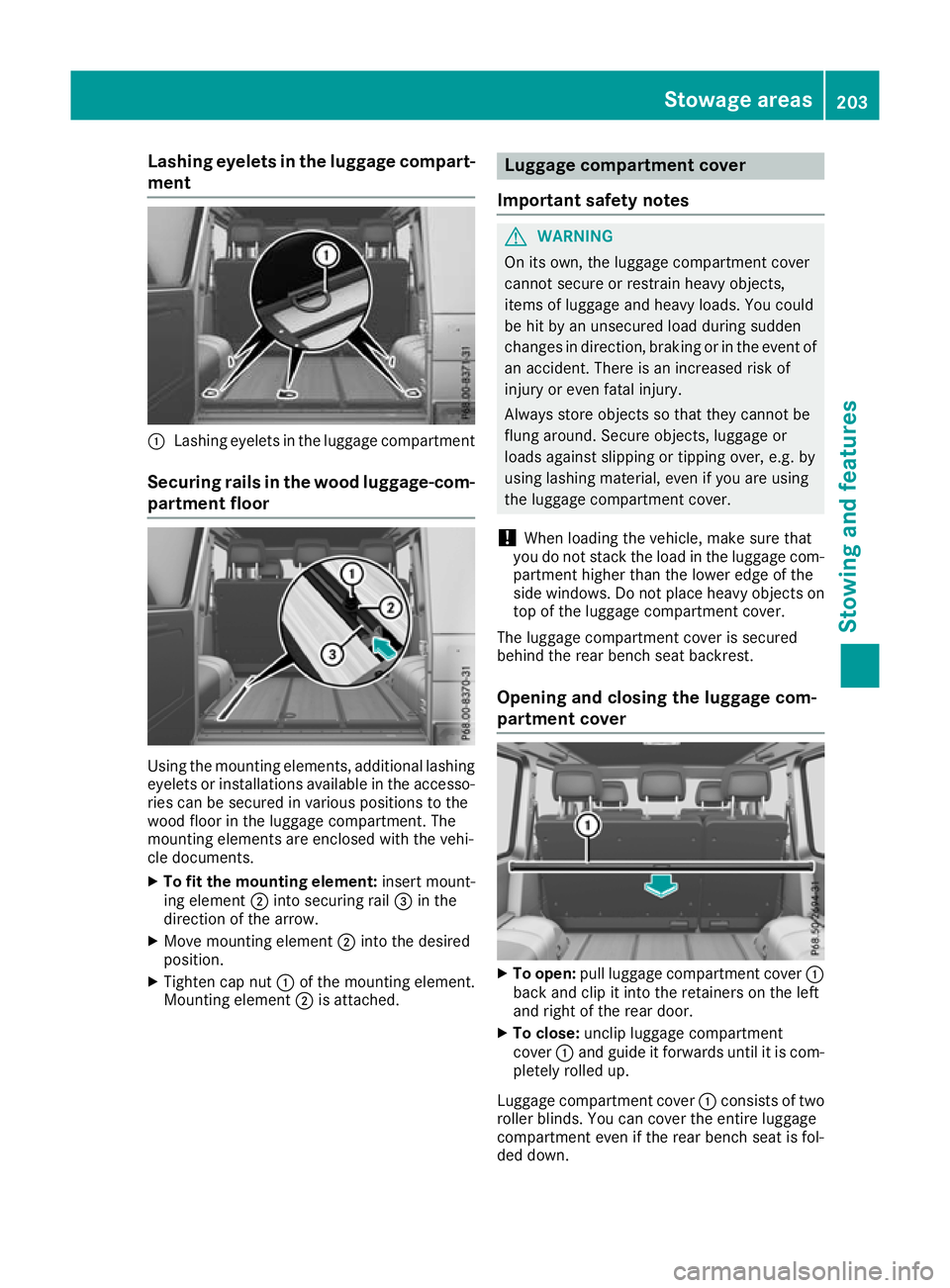
Lashing eyelet
sintheluggage compart-
ment :
Lashing eyelets in the luggage compartment
Securing rails in the wood luggage-com- partm ent floor Using the mounting elements, additional lashing
eyelets or installation savailable in the accesso-
ries can be secured in various positions to the
wood floor in the luggage compartment.T he
mounting elements are enclosed with the vehi-
cle documents.
X To fit the mounting element: insert mount-
ing element ;into securing rail =in the
direction of the arrow.
X Move mounting element ;into the desired
position.
X Tighten cap nut :of the mounting element.
Mounting element ;is attached. Luggage com
partment cover
Important safety notes G
WARNING
On its own ,the luggage compartment cover
cannot secure or restrai nheav yobjects,
items of luggage and heav yloads. You could
be hit by an unsecured loadd uring sudden
changes in direction, braking or in the event of an accident. There is an increased risk of
injury or even fatal injury.
Always store objects so that they cannot be
flung around. Secure objects, luggage or
loads against slipping or tipping over, e.g. by
using lashing material, even if you are using
the luggage compartment cover.
! When loading the vehicle, make sure that
you do not stack the loadint he luggage com-
partment higher than the lower edge of the
side windows. Do not place heav yobjects on
top of the luggage compartment cover.
The luggage compartment cover is secured
behind the rear bench seat backrest.
Opening and closing the luggage com-
partment cover X
To open: pull luggage compartment cover :
back and clip it into the retainers on the left
and right of the rear door.
X To close: unclip luggage compartment
cover :and guid eitforward suntilitisc om-
pletel yrolle dup.
Luggage compartment cover :consists of two
rolle rblinds. Yo ucan cove rthe entire luggage
compartment eve nifthe rea rbench sea tisf ol-
de dd own. Stowag
eareas
203Stowing and features Z
Page 207 of 261
Fitting/removing th
eluggage compart-
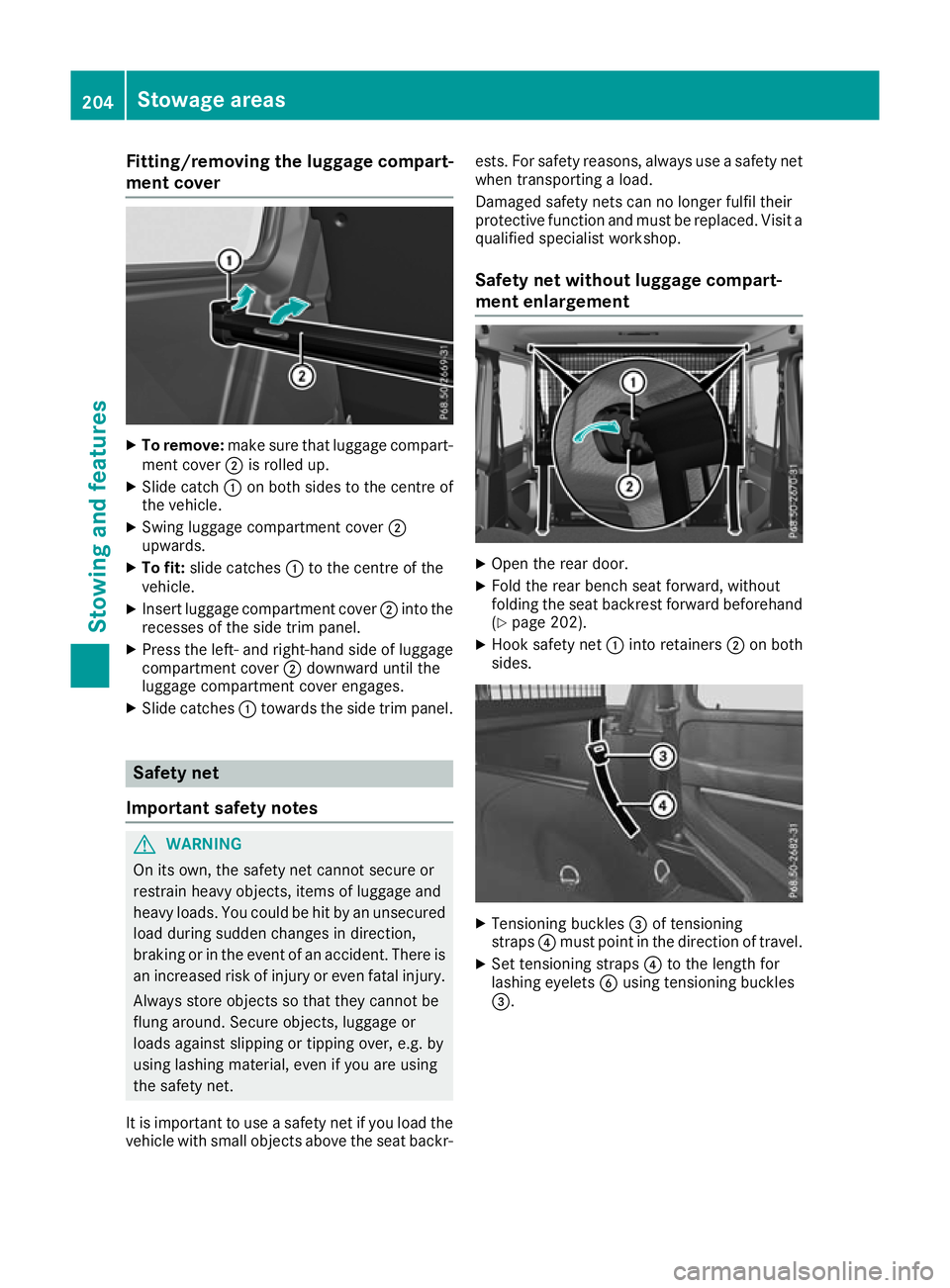
men tcover X
To remove: makesuret ha tlug gage compart-
ment cover ;is rolle dup.
X Slide catch :on both side stothe centre of
the vehicle.
X Swing luggage compartment cover ;
upwards.
X To fit: slidecatches :to the centre of the
vehicle.
X Insert luggage compartment cover ;into the
recesse softhe side trim panel.
X Press the left- and right-hand side of luggage
compartment cover ;downward unti lthe
luggage compartment cove rengages.
X Slide catches :toward sthe side trim panel. Safety net
Important safety notes G
WARNING
On its own, the safet ynet cannot secure or
restrai nheavy objects, items of luggage and
heavy loads. You coul dbehit by an unsecured
loadd uring sudden changes in direction,
braking or in the event of an accident. There is an increased risk of injury or even fatal injury.
Always store objects so that they cannot be
flung around. Secure objects, luggage or
loads against slipping or tipping over, e.g. by
using lashing material, even if you are using
the safety net.
It is important to use asafety net if you loadt he
vehicl ewith smal lobjects above the seat backr- ests
.For safety reasons, alway suseasafety net
when transporting aload.
Damaged safety netsc an no longer fulfil their
protective function and must be replaced. Visit a qualified specialist workshop.
Safet ynet without luggage compart-
ment enlargement X
Open the rear door.
X Fold the rear bench seat forward, without
folding the seat backrest forward beforehand
(Y page 202).
X Hook safety net :into retainers ;on both
sides. X
Tensionin gbuckles =of tensioning
straps ?must point in the direction of travel.
X Set tensioning straps ?to the length for
lashing eyelets Busing tensioning buckles
=. 204
Stowage areasStowing and features
Page 209 of 261
Releasin
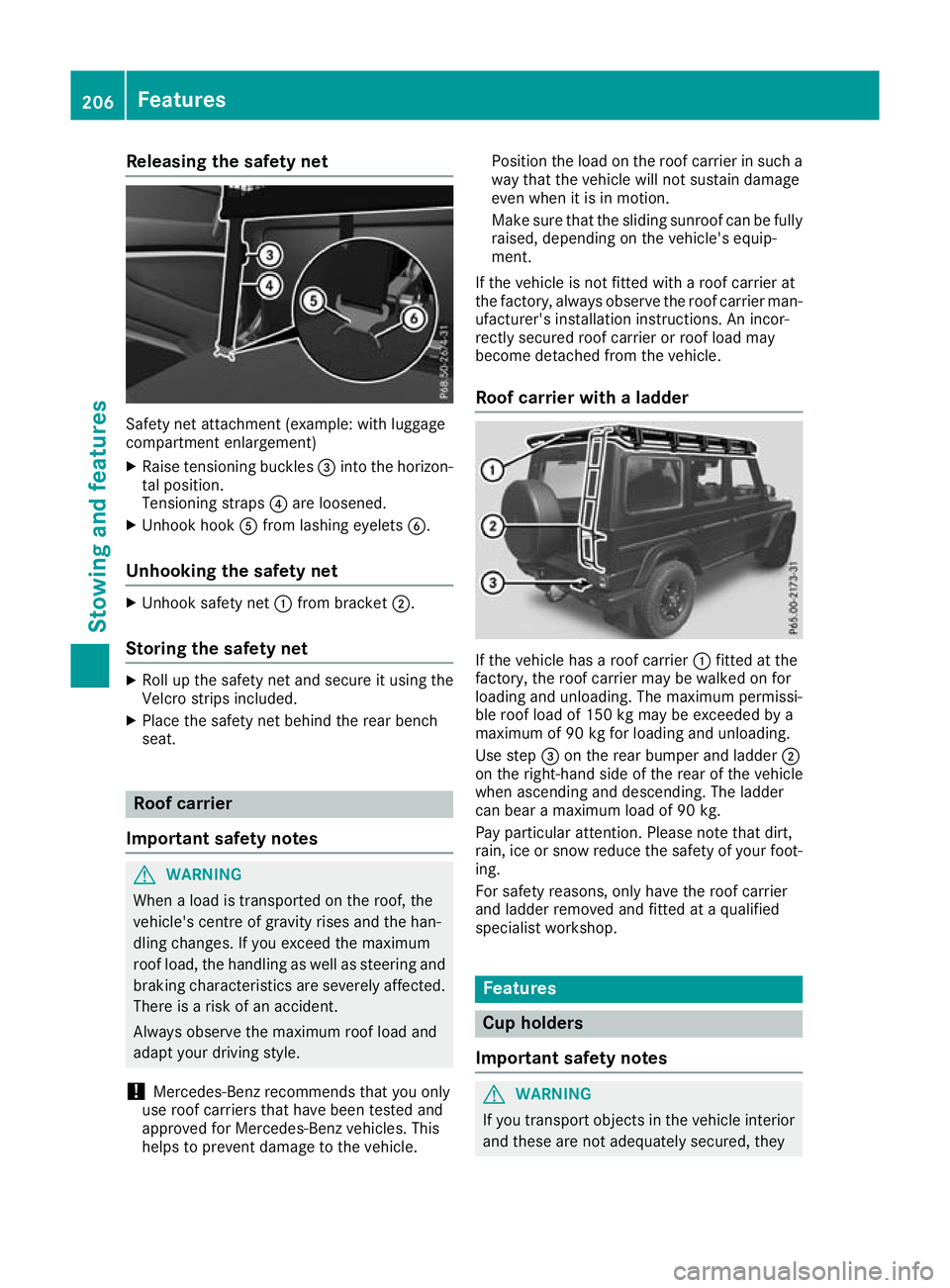
gthe safety net Safety net attachment (example
:withl ug gage
compartment enlargement)
X Raise tensioning buckles =into the horizon-
tal position.
Tensioning straps ?are loosened.
X Unhook hook Afrom lashing eyelets B.
Unhookin gthe safety net X
Unhook safety net :from bracket ;.
Storing the safety net X
Roll up the safety net an dsecure it usin gthe
Velcro strips included.
X Plac ethe safet ynetbehind th erear bench
seat. Roof carrier
Importan tsafety notes G
WARNING
When aloa dist ransported on the roof, the
vehicle's centre of gravity rises and the han-
dling changes .Ifyou exceed the maximum
roof load, the handling as wellass teering and
braking characteristics are severely affected.
There is arisk of an accident.
Always observe the maximu mroof loada nd
adapt yourd riving style.
! Mercedes-Benz recommends that you only
use roof carriers that have been tested and
approved for Mercedes-Benz vehicles. This
help stop revent damage to the vehicle. Position the load on the roof carrier in such a
way that the vehicle will not sustain damage
even when it is in motion.
Make sure that the sliding sunroof can be fully
raised, dependin gonthe vehicle's equip-
ment.
If the vehicle is not fitted with aroof carrier at
the factory, alway sobserve the roof carrier man-
ufacturer's installation instructions. An incor-
rectly secured roof carrier or roof load may
become detached from the vehicle.
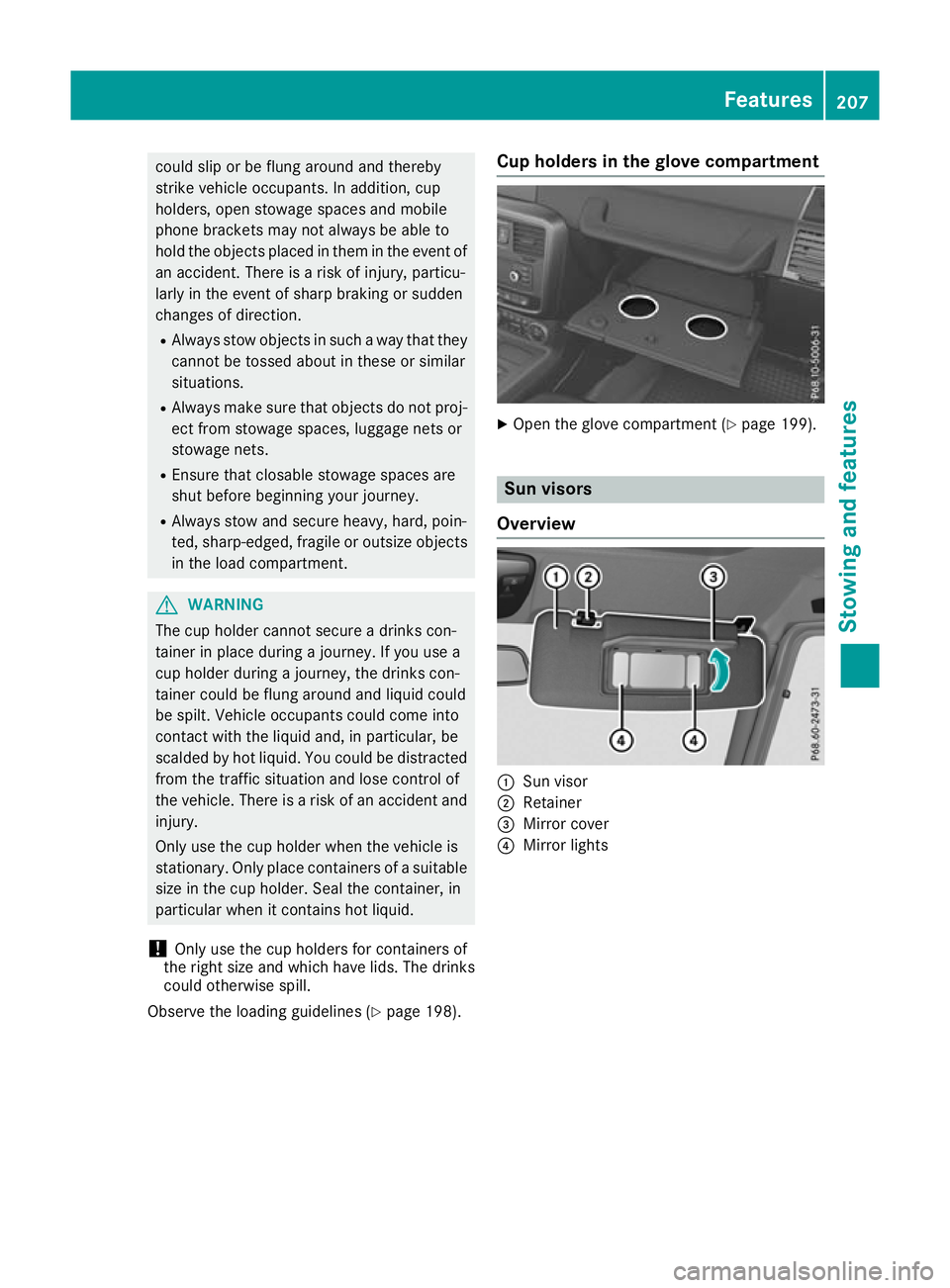
Roof carrier with aladder If the vehicl
ehasaroof carrier :fitted at the
factory, the roof carrier may be walked on for
loading and unloading. The maximum permissi-
ble roof load of 150 kg may be exceeded by a
maximum of 90 kg for loading and unloading.
Use step =on the rear bumpera nd ladder;
on the right-hand side of the rear of the vehicle
when ascending and descending. The ladder
can bear amaximum load of 90 kg.
Pay particular attention. Please note that dirt,
rain, ice or snow reduce the safety of yourf oot-
ing.
For safety reasons, only have the roof carrier
and ladder removed and fitted at aqualified
specialist workshop. Features
Cup holders
Important safety notes G
WARNING
If you transport objects in the vehicle interior and these are not adequately secured, they 206
FeaturesStowing and features
Page 210 of 261
could sli
porbef lung around and thereby
strike vehicle occupants. In addition, cup
holders, ope nstowag espaces and mobile
phone brackets may not always be able to
hol dthe objects place dinthem in the event of
an accident. There is ariskofi njury, particu-
larly in the event of sharp braking or sudden
changes of direction.
R Alway sstow objects in such awaythat they
cannot be tosse dabout in these or similar
situations.
R Alway smake sure that objects do not proj-
ect from stowag espaces, luggage nets or
stowag enets.
R Ensure that closable stowag espaces are
shu tbefore beginning your journey.
R Alway sstow and secure heavy, hard, poin-
ted, sharp-edged, fragil eoroutsize objects
in the loa dcompartment. G
WARNING
The cup holder cannot secure adrinks con-
tainer in place during ajourney .Ifyou use a
cup holder during ajourney ,the drinks con-
tainer coul dbeflung around and liquid could
be spilt. Vehicle occupants coul dcome into
contact with the liquid and, in particular, be
scalded by hot liquid.Y ou couldbedistracted
from the traffic situation and lose control of
the vehicle. There is arisk of an accident and
injury.
Only use the cup holder when the vehicl eis
stationary. Only place containers of asuitable
size in the cup holder. Seal the container, in
particular when it contains hot liquid.
! Only use the cup holders for containers of
the right size and which have lids. The drinks
coul dotherwise spill.
Observe the loading guidelines (Y page198). Cu
ph olders in th eglove compartment X
Ope nthe glove compartment (Y page 199). Sun visors
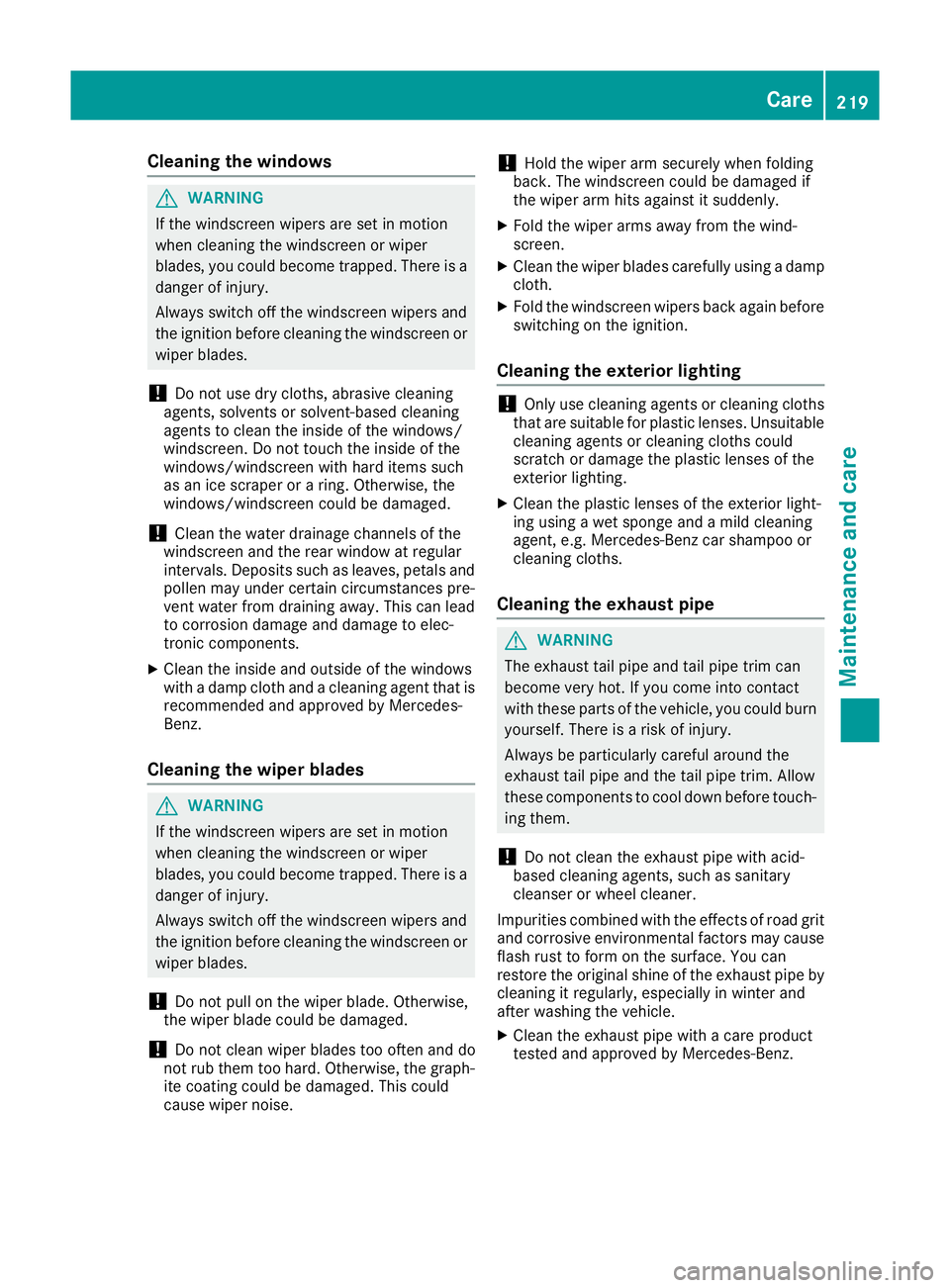
Overview :
Sun visor
; Retainer
= Mirror cover
? Mirror lights Features
207Stowing and features Z
Page 217 of 261
The following cause engine failure or damage
to the exhaust system:
R Use of engine oils and oil filters that have
not been expressly approved for the service
system
R Replacement of engine oil and oil filter after
the replacement interval specified by the
service system has expired
R Use of engine oil additives
! Do not add too much oil. If the oil level is
above the "max" mark on the dipstick ,too
much oil has been added. This can lead to
damage to the engine or the catalytic con-
verter .Have excess oil siphoned off. H
Environmental note
When topping up the oil, take care not to spill
any. If oil enters the soil or waterways, it is
harmful to the environment. X
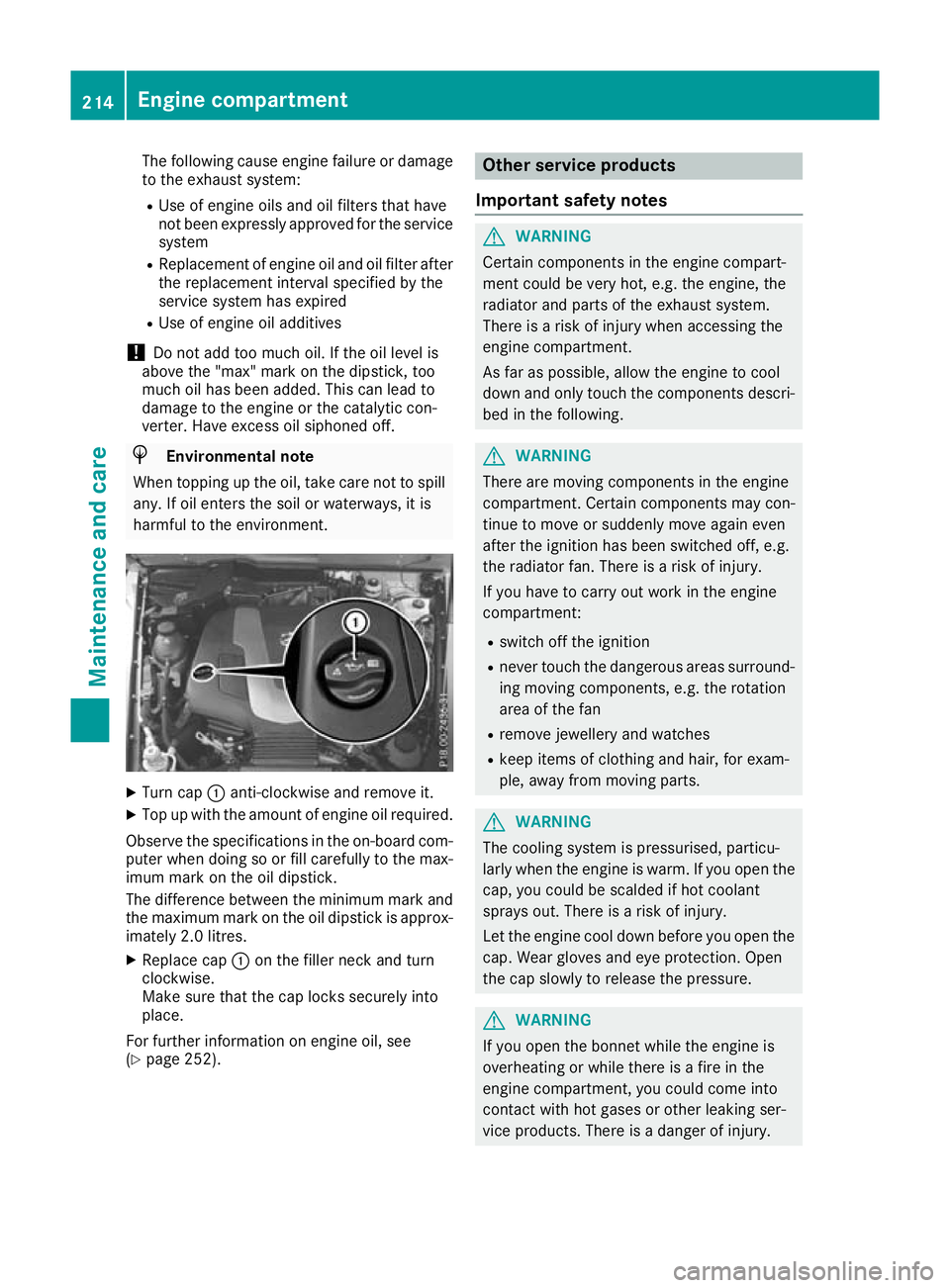
Turn cap :anti-clockwise and remove it.
X Top up with the amount of engine oil required.
Observe the specification sinthe on-board com-
puter when doing so or fill carefully to the max- imum mark on the oil dipstick.
The differenc ebetween the minimum mark and
the maximum mark on the oil dipstick is approx- imately 2.0 litres.
X Replace cap :on the filler neck and turn
clockwise.
Make sure that the cap locks securely into
place.
For further information on engine oil, see
(Y page 252). Other service products
Important safety notes G
WARNING
Certain components in the engin ecompart-
ment coul dbevery hot, e.g. the engine, the
radiator and parts of the exhaust system.
There is arisk of injury when accessing the
engine compartment.
As far as possible,a llow the engine to cool
downa nd only touch the components descri-
bed in the following. G
WARNING
There are moving components in the engine
compartment. Certain components may con-
tinue to move or suddenly move again even
after the ignitio nhas been switched off, e.g.
the radiator fan. There is arisk of injury.
If you have to carry out work in the engine
compartment:
R switch off the ignition
R never touch the dangerous area ssurround-
ing moving components, e.g. the rotation
area of the fan
R remove jewellery and watches
R keep items of clothing and hair, for exam-
ple,a wayfrom moving parts. G
WARNING
The cooling system is pressurised ,particu-
larl yw hen the engine is warm .Ifyou open the
cap, you coul dbescalded if hot coolant
sprays out. There is arisk of injury.
Let the engine cool downb efore you open the
cap. Wearg lovesand eye protection. Open
the cap slowly to release the pressure. G
WARNING
If you open the bonnet while the engine is
overheating or while there is afire in the
engine compartment, you coul dcome into
contact with hot gase sorother leaking ser-
vice products. There is adange rofinjury. 214
Engine compartmentMaintenanc
eand care
Page 222 of 261
Cleaning th
ewindows G
WARNING
If th ewindscreen wipers are set in motion
when cleaning the windscreen or wiper
blades, you coul dbecome trapped. There is a
dange rofinjury.
Always switch off the windscreen wipers and
the ignitio nbefore cleaning the windscreen or
wiper blades.
! Do not use dry cloths, abrasive cleaning
agents, solvents or solvent-based cleaning
agents to clea nthe insid eofthe windows/
windscreen. Do not touch the insid eofthe
windows/windscreen with hard items such
as an ice scrape roraring. Otherwise, the
windows/windscreen coul dbedamaged.
! Clean the water drainage channels of the
windscreen and the rear windo watregular
intervals. Deposits such as leaves, petal sand
pollen may under certain circumstances pre-
vent water from draining away. This can lead
to corrosio ndamage and damage to elec-
tronic components.
X Clean the insid eand outside of the windows
with adamp cloth and acleaning agent that is
recommende dand approved by Mercedes-
Benz.
Cleaning the wiper blades G
WARNING
If the windscreen wipers are set in motion
when cleaning the windscreen or wiper
blades, you coul dbecome trapped. There is a
dange rofinjury.
Always switch off the windscreen wipers and
the ignitio nbefore cleaning the windscreen or
wiper blades.
! Do not pullont
he wiper blade. Otherwise,
the wiper blade coul dbedamaged.
! Do not clea
nwiper blades too often and do
not rub them too hard .Otherwise, the graph-
ite coating coul dbedamaged. This could
caus ewiper noise. !
Hold the wiper arm securel
ywhen folding
back. The windscreen could be damagedif
the wiper arm hits against it suddenly.
X Fold the wiper arms awayf rom the wind-
screen.
X Cleant he wiper bladesc arefully usingadamp
cloth.
X Fold the windscreen wipers back againb efore
switching on the ignition.
Cleaning the exterior lighting !
Only use cleaning agents or cleaning cloths
that are suitablef or plastic lenses. Unsuitable
cleaning agents or cleaning cloths could
scratch or damage the plastic lenses of the
exterior lighting.
X Cleant he plastic lenses of the exterior light-
ing using awet sponge and amild cleaning
agent, e.g. Mercedes-Benz car shampoo or
cleaning cloths.
Cleaning the exhaust pipe G
WARNING
The exhaust tail pipe and tail pipe trim can
become very hot. If you come into contact
with these parts of the vehicle, you could burn
yourself. There is arisk of injury.
Always be particularl ycarefu laround the
exhaust tail pipea nd the tail pipetrim. Allow
these components to cool downb efore touch-
ing them.
! Do not clea
nthe exhaust pipew ith acid-
base dcleaning agents, such as sanitary
cleanser or whee lcleaner.
Impurities combined with the effects of road grit and corrosive environmental factors may cause
flas hrust to form on the surface. You can
restore the original shine of the exhaust pipeby
cleaning it regularly, especially in winter and
after washing the vehicle.
X Clean the exhaust pipew ithacare product
tested and approved by Mercedes-Benz. Ca
re
219Maintenance an dcare Z
Page 225 of 261
Where will
Ifind...? Warning triangle
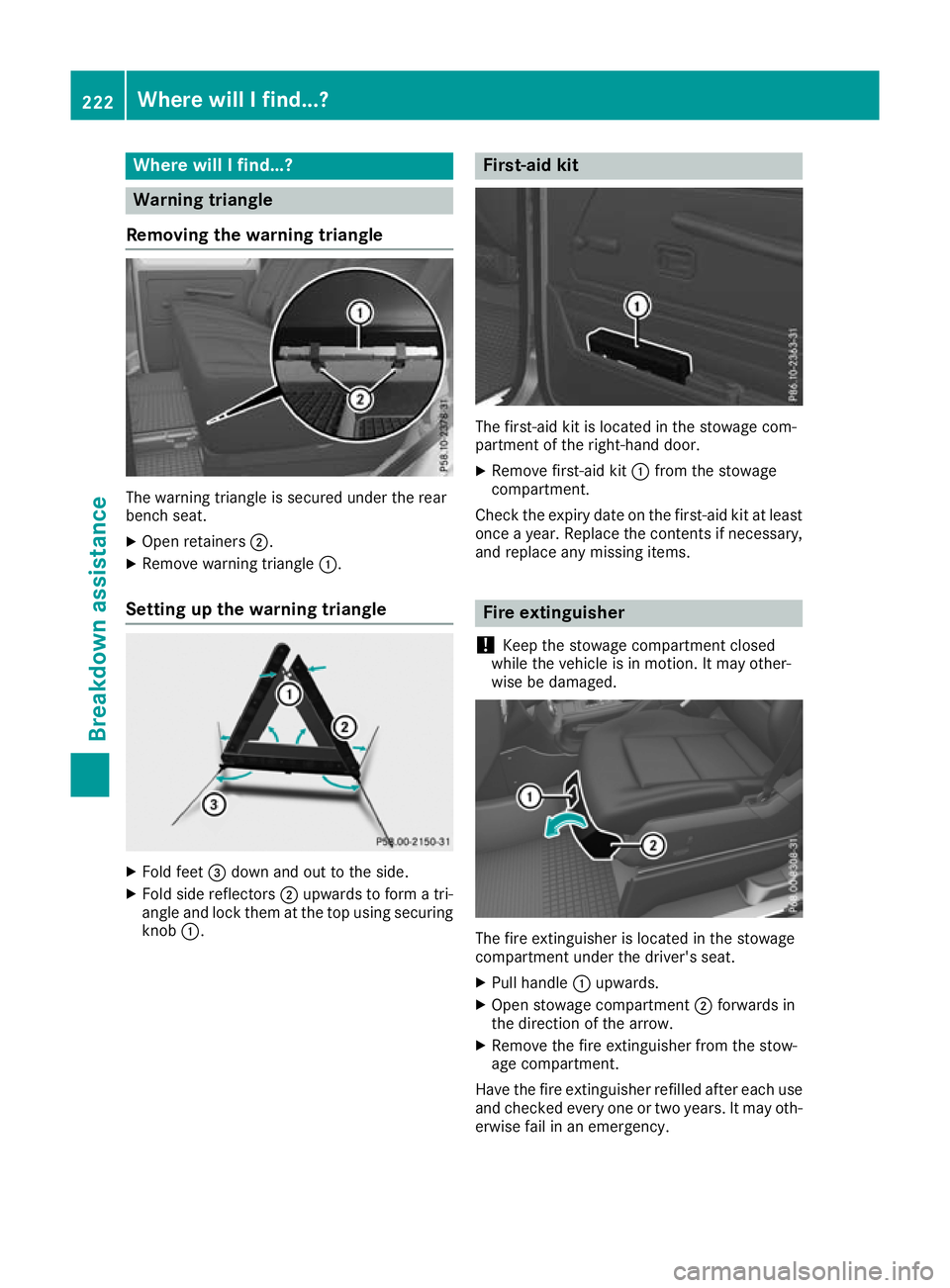
Removing the warning triangle The warning triangle is secured unde
rthe rear
bench seat.
X Open retainers ;.
X Remove warning triangle :.
Setting up the warning triangle X
Fol dfeet =dow nand ou ttothe side.
X Fold sid ereflectors ;upwards to form atri-
angl eand lock them at the top using securing
knob :. First-aid kit
The first-aid kit is locate
dinthe stowage com-
partmen tofthe right-hand door.
X Remove first-aid kit :from the stowage
compartment.
Check the expiry date on the first-aid kit at least
once ayear. Replace the contents if necessary,
and replace any missing items. Fire extinguisher
! Keep the stowage compartment closed
whilet hevehicl eisinm otion.Itm ay other-
wise be damaged. The fire exti
nguisher is located in the stowage
compartment under the driver's seat.
X Pull handle :upwards.
X Open stowage compartment ;forwards in
the direction of the arrow.
X Remove the fire extinguisher from the stow-
age compartment.
Have the fire extinguisher refilled after each use and checked every one or two years. It may oth-
erwise fail in an emergency. 222
Where will
Ifind...?Breakdowna ssistan ce
Page 227 of 261
Removin
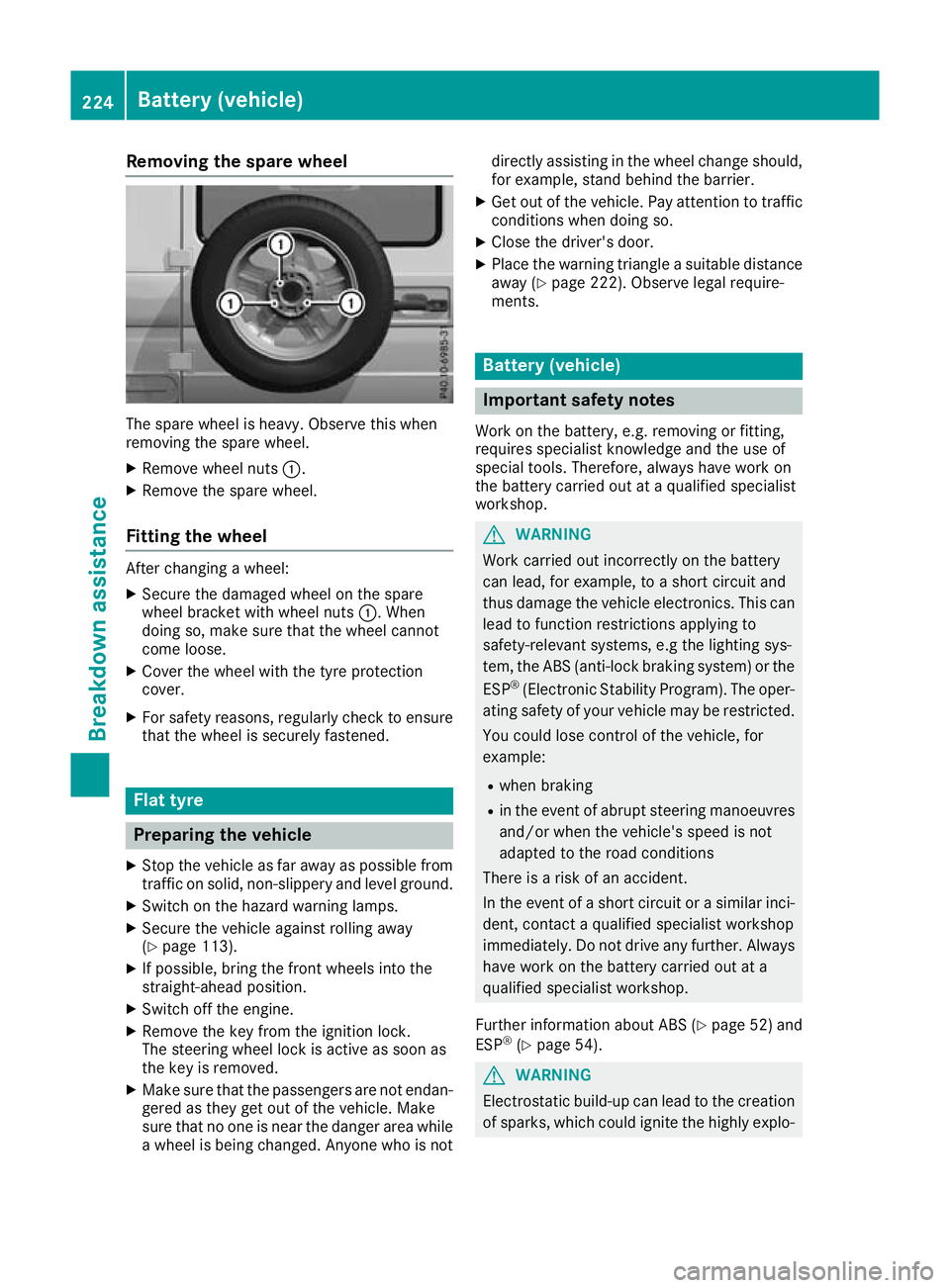
gthe spare wheel The spare wheel is heavy. Observ
ethis when
removing the spare wheel.
X Remove wheel nuts :.
X Remove the spare wheel.
Fitting the wheel After changing
awheel:
X Secure the damaged whee lonthe spare
whee lbracket with whee lnuts :.W hen
doing so, make sure tha tthe whee lcannot
come loose.
X Cover the whee lwitht he tyr eprotection
cover.
X For safety reasons ,regularly check to ensure
tha tthe whee lissecurel yfastened. Flat tyre
Preparing the vehicle
X Sto pthe vehicle as far away as possible from
traffic on solid, non-slippery and level ground.
X Switch on the hazard warning lamps.
X Secure the vehicle against rolling away
(Y page 113).
X If possible, bring the front wheels into the
straight-ahead position.
X Switch off the engine.
X Remove the key from the ignition lock.
The steering wheel lock is active as soon as
the key is removed.
X Make sure that the passengers are not endan-
gered as they get out of the vehicle. Make
sure that no one is near the danger area while
aw heel is being changed. Anyone who is not directly assisting in the wheel change should,
for example, stand behind the barrier.
X Get out of the vehicle. Pay attention to traffic
condition swhen doing so.
X Close the driver' sdoor.
X Place the warning triangle asuitable distance
away (Y page 222). Observe legal require-
ments. Batter
y(vehicle) Importan
tsafety notes
Wor kont hebattery, e.g. removing or fitting,
require sspecialist knowledge and th euse of
special tools. Therefore, always have wor kon
th eb attery carrie dout at aqualified specialist
workshop. G
WARNING
Work carried ou tincorrectly on the battery
can lead, for example, to ashort circui tand
thus damage the vehicl eelectronics. This can
leadtof unction restrictions applying to
safety-relevant systems ,e.g the lighting sys-
tem, the ABS (anti-lock braking system) or the
ESP ®
(Electronic Stability Program). The oper-
ating safety of yourv ehiclemay be restricted.
You coul dlose control of the vehicle, for
example:
R when braking
R in the event of abrupt steering manoeuvres
and/or when the vehicle's spee disnot
adapted to the road conditions
There is arisk of an accident.
In the event of ashort circui torasimilar inci-
dent, contact aqualified specialist workshop
immediately. Do not drive any further. Always have work on the battery carrie dout at a
qualified specialist workshop.
Further information about ABS (Y page52) and
ESP ®
(Y page5 4). G
WARNING
Electrostatic build-u pcan leadtot he creation
of sparks, which coul dignite the highly explo- 224
Battery (vehicle)Breakdown assistance