lock MERCEDES-BENZ G-CLASS SUV 2018 Owners Manual
[x] Cancel search | Manufacturer: MERCEDES-BENZ, Model Year: 2018, Model line: G-CLASS SUV, Model: MERCEDES-BENZ G-CLASS SUV 2018Pages: 549, PDF Size: 10.22 MB
Page 26 of 549
Jack
Copy and translation of
the original declaration
of confo rmity:
EC declaration of conformity
2006/42/EC
We WEBER-HYDRAULIK GMBH
Heilbronner Straße 30 — 74363 Güglingen
declare that the product "Weber hydraulic bottle
jack", types:
A AD ADX AH AHX AL AT ATDAT DX ATGAT N
AT GX ATPX ATQ AX
Capacity: 2,000 to100,000 kg
Serial no.: from year of manufacture 01/20 10
complies wi th there leva nt essential health and
sa fety requ irements of the EC Machinery Direc‐
tive.
This EC declaration of confo rmity becomes in va‐
lid:
R intheeve nt of modifications or repairs per‐
fo rm ed byan unqualified person R
ifth e products are not used cor rectly and in
acco rdance with the Owner's Manual
R ifth erequ iredregular checks are not per‐
fo rm ed.
Re leva nt EU Directi ves: EC Machinery Directive
2006/42/EC
Applicable standards: ISO 11530
Quality assu rance: DIN EN ISO 9001:2000
Gü glingen, 1 July 20 13
[Signature] [Signature]
Manager Representative of
Te ch nical
WEBER-HYDR AULIK
GMBH Documentation WEBER-HYDRAULIK GMBH
Heilbro
nnerStrasse 30 — 74363 Gügl ingen Diagnostics connection
The diagno stics connection is only intended for
th e connection of diagnostic devices at a quali‐
fi ed specialist workshop. &
WARNING Risk of accident due tocon‐
necting devices tothe diagnostics con‐
nection
If yo u connect equipment toa diagnostics
connection in theve hicle, it may af fect the
operation of vehicle sy stems.
As a result, the operating saf ety of theve hi‐
cle could be af fected. #
Only connect equipment toa diagnos‐
tics connection in theve hicle which is
appr ovedfo ryo ur vehicle byMercedes-
Benz. &
WARNING Risk of accident due to
objects in the driver's foot we ll
Objects in the driver's foot we ll may impede
pedal tr avel or block a depressed pedal. General no
tes23
Page 36 of 549
&
WARNING Risk of inju ryor death when
additional restra int sy stems are not used
fo r persons with a smaller build
Pe rsons under 1.50 m tall cannot wearthe
seat belt cor rectly wi thout a suitable addi‐
tional restra int sy stem.
If th e seat belt is not worncor rectly, it can‐
not per form its intended pr otective function.
In addition, an incor rectly fastened seat belt
can also cause injuries, forex ample, in the
ev ent of an accident or when braking or
ch anging direction sudden ly.#
Alw ays secure persons under 1.50 m
ta ll in a suitable restra int sy stem. &
WARNING Danger of inju ryor death due
to bloc ked seat belt anchorages
The restra int ef fect of the seat belt is
impaired if objects between the front seat
and the door are blocking the mo vable seat
belt anchorage on the front seat.
The seat belt may not then pr ovide the
proper pr otection. #
Before starting a journe y,make sure
th at there are no objects between the
front seat and the door. &
WARNING Risk of inju ryor death due to
damaged or modified seat belts
Seat belts cann otprov ide pr otection in the
fo llowing situations:
R Ifth e seat belts are damaged, modified,
ex treme lydirty, bleached or dyed
R Ifth e seat belt buckle is damaged or
ex treme lydirty
R Ifth e seat belt tensioners, seat belt
anchorages or seat belt retractors ha ve
been modified
Seat belts may be damaged in an accident,
although the damage may not be visible, e.g.
due tosplinters of glass.
Modified or damaged seat belts may tear or
fa il, e.g. in an accident.
Modified seat belt tensioners could acciden‐
ta lly trigger or failto function as intended. #
Never modify the seat belts, seat belt
te nsioners, seat belt anchorages or
seat belt retractors. #
Makesure that the seat belts are
undamaged, not wornand clean. #
Alw ays ha vethe seat belts checked
immediately af ter an accident at a
qu alified specialist workshop. Mercedes-Benz
recommends that you use seat
belts which ha vebeen appr ovedfo ryo ur vehicle
by Mercedes-Benz. &
WARNING Risk of inju ryor death from
deplo yedpy rotech nic seat belt tension‐
ers
Py rotech nic seat belt tensioners that ha ve
been deplo yed are no longer operational and
are unable toper form their intended pr otec‐
tive function. #
Therefore, ha vedeplo yedpy rotech nic
seat belt tensioners immedia tely
re placed at a qualified specialist work‐
shop. Occupant saf
ety33
Page 37 of 549
Mercedes-Benz
recommends that you ha vethe
ve hicle towe dto aqu alified specialist workshop
af te r an accident.
* NO
TEDama gecaused bytrapping the
seat belt If an unused seat belt is not fully
retracted, it
may become trapped in the door or in the
seat mechanism. #
Alw ays ensure that an unused seat belt
is fully retracted. Fa
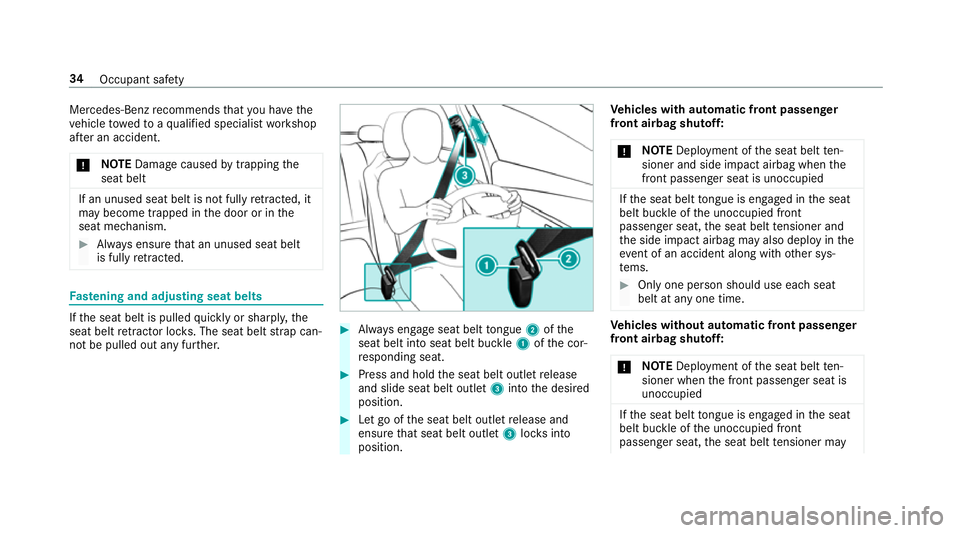
stening and adju sting seat belts If
th e seat belt is pulled quickly or sharpl y,the
seat belt retractor lo cks. The seat belt stra p can‐
not be pulled out any fur ther. #
Alw ays engage seat belt tongue 2ofthe
seat belt into seat belt buckle 1ofthe cor‐
re sponding seat. #
Press and hold the seat belt outlet release
and slide seat belt outlet 3into the desired
position. #
Let go of the seat belt outlet release and
ensure that seat belt outlet 3locksinto
position. Ve
hicles with automatic front passen ger
front airbag shu toff:
* NO
TEDeployment of the seat belt ten‐
sioner and side impact airbag when the
front passenger seat is unoccupied If
th e seat belt tongue is engaged in the seat
belt buckle of the unoccupied front
passenger seat, the seat belt tensioner and
th e side impact airbag may also deploy in the
ev ent of an accident along with other sys‐
te ms. #
Only one person should use each seat
belt at any one time. Ve
hicles without automatic front passen ger
front airbag shu toff:
* NO
TEDeployment of the seat belt ten‐
sioner when the front passenger seat is
unoccupied If
th e seat belt tongue is engaged in the seat
belt buckle of the unoccupied front
passenger seat, the seat belt tensioner may 34
Occupant saf ety
Page 47 of 549
#
Stow objects in a suitable place. Re
versing the PRE- SAFE®
sy stem measures If an accident did not occur,
the pre-em ptive
measures that we retak en are reve rsed.
Yo u will need toper form certain settings your‐
self. #
Ifth e seat belt pre-tensioning is not reduced,
mo vethe seat backrest back slightl y.
The locking mechanism releases. Safely transporting
children in theve hicle Alw
ays obser vewhen children are tr avelling
in theve hicle %
Also strictly obser vethe saf ety no tesfo rthe
specific situation. In this wa yyo u can recog‐
nise po tential risks and avoid dangers if chil‐
dren are tr avelling in theve hicle
(/ page 45). Be diligent
Bear in mind
that neglecting tosecure a child in
th ech ild restra int sy stem may ha veserious con‐
sequences. Alw ays be diligent in securing a child
carefully before everyjou rney.
To impr oveprotection forch ildren younger than
12 years old or under 1.50 m in height,
Mercedes-Benz recommends you obse rvethe
fo llowing information:
R Alw ays secure thech ild in a child restra int
sy stem suitable forth is Mercedes-Benz vehi‐
cle.
R The child restra int sy stem must be appropri‐
ate tothe age, weight and size of thech ild.
R The vehicle seat must be suitable forfitting a
ch ild restra int sy stem (/ page51).
Ac cident statistics show that children secured
on there ar seats are general lysafer than chil‐
dren secured on the front seats. Forth is reason,
Mercedes-Benz strongly advises that youfit a
ch ild restra int sy stem toare ar seat. Generic
term"child restra int sy stem"
The generic term child restra int sy stem is used
in this Owner's Manual. A child restra int sy stem
is, forex ample:
R a baby car seat
R are ar wa rd-f acing child seat
R afo rw ard-facing child seat
R ach ild boos ter seat with a backrest and seat
belt guide
Mercedes-Benz recommends using a child
boos ter seat with a backrest.
The child restra int sy stem must be appropriate
to the age, weight and size of thech ild.
Observing la wsand legal requirements
Alw ays obser vethe legal requ irements when
using a child restra int sy stem in theve hicle.
Make sure that thech ild restra int sy stem is
appr oved in accordance with theva lid test speci‐
fi cations and guidelines. Further information can
be obtained at a qualified specialist workshop.
Mercedes-Benz recommends that you use a
Mercedes-Benz Service Centre forth is purpose. 44
Occupant saf ety
Page 50 of 549
Only use
child restra int sy stems which are in
proper working condition &
WARNING Risk of inju ryor death caused
by the use of damaged child restra int
sy stems
Child restra int sy stems or their retaining sys‐
te ms that ha vebeen subjec tedto a load in
an accident may then not be able toper form
th eir intended pr otective function.
The child cannot be restra ined in theeve nt of
an accident, heavy braking or a sudden
ch ange of direction. #
Alw aysre place child restra int sy stems
immediately that ha vebeen damaged or
in vo lved in an accident. #
Have the securing sy stems forth ech ild
re stra int sy stems checked at a qualified
specialist workshop before ins talling a
ch ild restra int sy stem again. Av
oiding direct sunlight &
WARNING Risk of bu rns when thech ild
seat is exposed todirect sunlight
If th ech ild restra int sy stem is exposed to
direct sunlight or heat, parts could heat up.
Children could suf fer burns on these parts,
particularly on me tallic parts of thech ild
re stra int sy stem. #
Alw ays make sure that thech ild
re stra int sy stem is not exposed to
direct sunlight. #
Protect it with a blank et,fo rex ample. #
Ifth ech ild restra int sy stem has been
ex posed todirect sunlight, allow it to
cool before secu ring a child into it. #
Never lea vechildren unat tended in the
ve hicle. Obser
vewhen stopping or parking &
WARNING Risk of accident and inju ry
due tochildren and animals left unat ten‐
ded in theve hicle
If yo u lea vechildren and animals unat tended
in theve hicle, they may be able toset the
ve hicle in motion, forex ample by:
R releasing the parking brake
R shifting the automatic transmission out of
park position j.
R starting the engine.
In addition, they may operate vehicle equip‐
ment and become trapped. #
Never lea vechildren and animals unat‐
te nded in theve hicle. #
When leaving theve hicle, alw aysta ke
th eke y with you and lock theve hicle. Occupant saf
ety47
Page 63 of 549
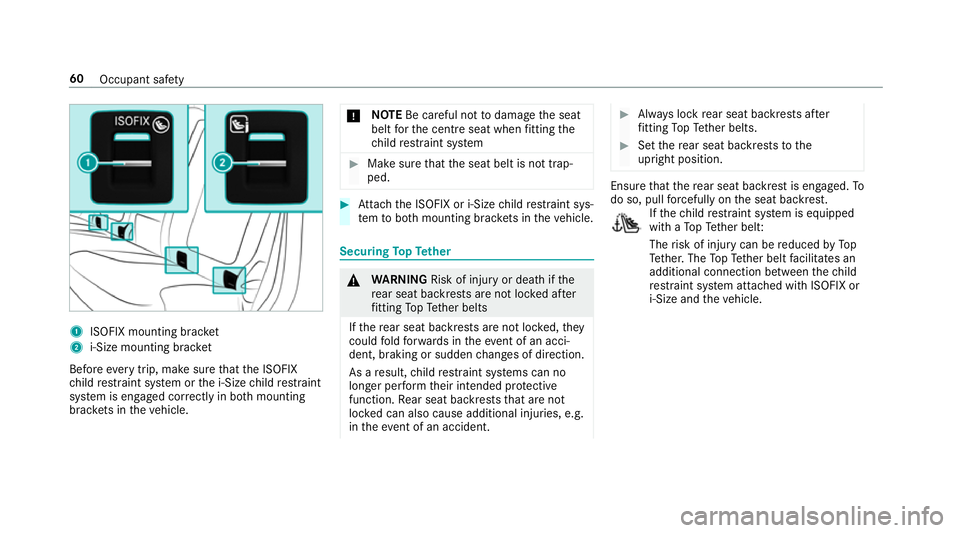
1
ISOFIX mounting brac ket
2 i‑Size mounting brac ket
Before every trip, make sure that the ISOFIX
ch ild restra int sy stem or the i‑Size child restra int
sy stem is engaged cor rectly in bo thmounting
brac kets in theve hicle. *
NO
TEBe careful not todamage the seat
belt forth e cent reseat when fitting the
ch ild restra int sy stem #
Make sure that the seat belt is not trap‐
ped. #
Attach the ISOFIX or i‑Size child restra int sys‐
te m to both mounting brac kets in theve hicle. Securing
TopTe ther &
WARNING Risk of inju ryor death if the
re ar seat backrests are not loc ked af ter
fi tting TopTe ther belts
If th ere ar seat backrests are not loc ked, they
could fold forw ards in theeve nt of an acci‐
dent, braking or sudden changes of direction.
As a result, child restra int sy stems can no
longer per form their intended pr otective
function. Rear seat backrests that are not
loc ked can also cause additional injuries, e.g.
in theev ent of an accident. #
Alw ays lock rear seat backrests af ter
fi tting TopTe ther belts. #
Set there ar seat backrests tothe
upright position. Ensure
that there ar seat backrest is engaged. To
do so, pull forc efully on the seat backrest. If
th ech ild restra int sy stem is equipped
with a TopTe ther belt:
The risk of injury can be reduced byTo p
Te ther. The TopTe ther belt facilitates an
additional connection between thech ild
re stra int sy stem attached with ISOFIX or
i‑Size and theve hicle. 60
Occupant saf ety
Page 71 of 549

outlet of
theve hicle tothe shoulder belt
guide on thech ild restra int sy stem.
The shoulder belt stra p must be routed for‐
wa rds and down wards from the seat belt out‐
let. #
If necessar y,adjust the seat belt outlet and
th e front passenger seat according ly.Child saf
ety loc ks Ac
tivating/deactivating the child saf ety lock
fo r the rear doors &
WARNING Risk of accident and inju ry
due tochildren and animals left unat ten‐
ded in theve hicle
If yo u lea vechildren and animals unat tended
in theve hicle, they may be able toset the
ve hicle in motion, forex ample by:
R releasing the parking brake
R shifting the automatic transmission out of
park position j.
R starting the engine. In addition,
they may operate vehicle equip‐
ment and become trapped. #
Never lea vechildren and animals unat‐
te nded in theve hicle. #
When leaving theve hicle, alw aysta ke
th eke y with you and lock theve hicle. &
WARNING Risk offata l injury due to
ex posure toextreme heat or cold in the
ve hicle
If people –particularly children – are exposed
to extreme temp eratures over an extended
pe riod of time, there is a risk of serious or
ev en fata l injury! #
Never lea veanyone – pa rticularly chil‐
dren – unat tended in theve hicle. #
Never lea veanimals in theve hicle unat‐
te nded. &
WARNING Risk of accident and inju ry
due tochildren left unat tended in the
ve hicle
When children are tra velling in theve hicle,
th ey could:
R open doo rs,th ereby endangering other
people or road users
R get out of theve hicle and be hit bytraf fic
R operate vehicle equipment and become
trapped, forex ample #
When children are tra velling in theve hi‐
cle, alw ays activate theav ailable child
saf ety loc ks. #
Never lea vechildren unat tended in the
ve hicle. #
When leaving theve hicle, alw aysta ke
th eke y with you and lock theve hicle. Child saf
ety loc ksforth ere ar doors and there ar
side wind owsareavailable.
The child saf ety lock on there ar doors secures
each door separatel y.The doors can no longer
be opened from the inside. 68
Occupant saf ety
Page 72 of 549

#
Press the le ver in direction 2(activate) or
1 (deactivate). #
Make sure that thech ild saf ety loc ksare
wo rking properly. Ac
tivating/deactivating the child saf ety lock
fo r the rear side windo ws #
Toactivate/deacti vate:press button 2.
The rear side wind owcan be opened or
closed in thefo llowing cases:
R with indicator lamp 1lit: via the switch
on the driver's door R
with indicator lamp 1off: via the switch
on the cor responding rear door or driv‐
er's door Note
s on pets in theve hicle &
WARNING Risk of accident and inju ry
due toanimals left unsecured or unat‐
te nded in theve hicle
If yo u lea veanimals in theve hicle unatten‐
ded or unsecured, they could possib lypress
down buttons or switches.
Thereby an animal may:
R activate vehicle equipment and become
trapped, forex ample
R swit chsystems on or off and endanger
ot her road users
Uns ecured animals may be throw n around in
th eve hicle in theeve nt of an accident or
sudden steering and braking manoeuvres
and injure vehicle occupants in the process. Occupant saf
ety69
Page 74 of 549
Key
Overview of
key functions &
WARNING Risk of accident and inju ry
due tochildren left unat tended in the
ve hicle
If ch ildren are left unat tended in theve hicle,
th ey could:
R open doo rs,th ereby endangering other
persons or road users.
R get out of theve hicle and be hit by
oncoming traf fic.
R ope rate ve hicle equipment and become
trapped, forex ample.
In addition, children could also set theve hi‐
cle in motion, forex ample, by:
R releasing the parking brake.
R shifting the automatic transmission out of
park position jor shifting manual trans‐
mission into neutral.
R starting the engine. #
When leaving theve hicle, alw aysta ke
th eke y with you and lock theve hicle. #
Never lea vechildren and animals unat‐
te nded in theve hicle. #
Keep theve hicle key out of reach of
ch ildren. *
NO
TEDama getotheke y caused by
magnetic fields #
Keep theke yaw ay from strong mag‐
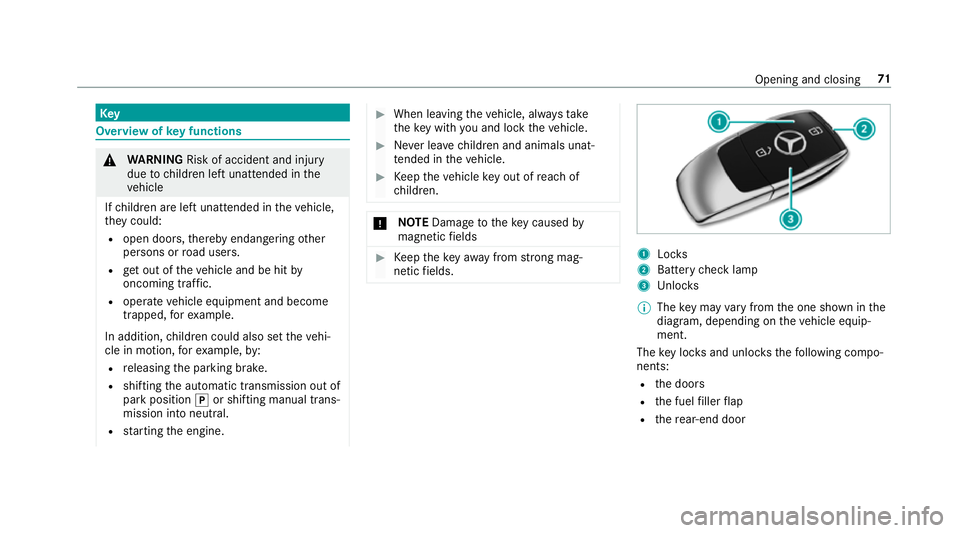
netic fields. 1
Locks
2 Battery check lamp
3 Unloc ks
% The key may vary from the one shown in the
diagram, depending on theve hicle equip‐
ment.
The key loc ksand unlo cksth efo llowing compo‐
nents:
R the doors
R the fuel filler flap
R there ar-end door Opening and closing
71
Page 75 of 549

If
th eve hicle is not opened within appr oximately
40 seconds af ter unlocking, it loc ksagain. Anti-
th eft pr otection is primed again.
Do not keep theke yto ge ther with electronic
devices or me tal objects. This can af fect the
ke y's functionalit y.
% If battery check lamp 2does not light up
af te r pressing the% or& button, the
battery is dischar ged.
Re placing theke y bat tery ( / page 73). Ac
tivating/deactivating the acoustic lo cking
ve rification signal Multimedia sy
stem:
4 Vehicle 5
î Vehicle settings
5 Acoustic lock #
Activate Oor deacti vate ª the function. Ac
tivating/deactivating the panic alarm Re
quirements:
R The ignition is switched off %
The panic alarm function is only available in
cer tain countries. #
Toactivate: press button 1for appro x‐
ima tely one second.
A visual and audible alarm is triggered. #
Todeactivate: briefly press but ton1 again.
or #
Press thest art/ stop button on the cockpit
(the key is inside theve hicle). Changing
the unlocking settings Po
ssible unlocking functions of theke y:
R cent ral unlocking R
unlocking the driver's door and fuel filler flap #
Toswitch between settings: pressthe
% and& buttons simultaneously for
appr oximately six seconds until the battery
ch eck lamp flashes twice.
If th e unlocking function forth e driver's door
and fuel filler flap has been selec ted:
R pressing the% button a second time cen‐
trally unloc kstheve hicle Deactivating
theke y functions If
yo u do not use theve hicle or a keyfo r an
ex tended pe riod of time, you can reduce the
energy consum ption of there spective key.Todo
so, deactivate theke y functions. #
Todeactivate: pressthe& button on the
ke y twice in quick succession.
The battery check lamp of theke yflashes
twice brief lyand lights up once. #
Toactivate: press any button on thekey. 72
Opening and closing