weight MERCEDES-BENZ GL SUV 2009 Owners Manual
[x] Cancel search | Manufacturer: MERCEDES-BENZ, Model Year: 2009, Model line: GL SUV, Model: MERCEDES-BENZ GL SUV 2009Pages: 309, PDF Size: 10.27 MB
Page 20 of 309
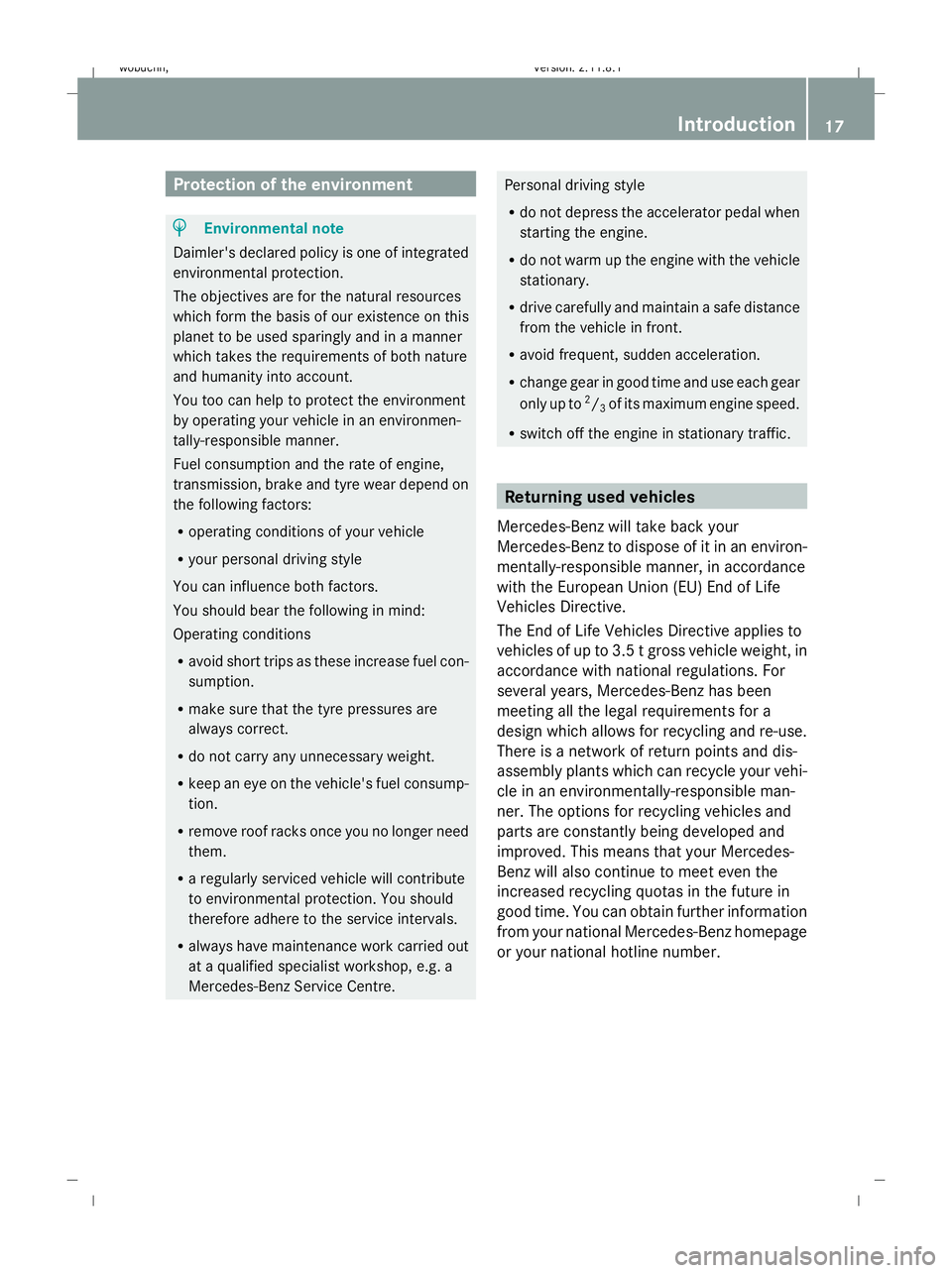
Protection of the environment
H
Environmental note
Daimler's declared policy is one of integrated
environmental protection.
The objectives are for the natural resources
which form the basis of our existence on this
planet to be used sparingly and in a manner
which takes the requirements of both nature
and humanity into account.
You too can help to protect the environment
by operating your vehicle in an environmen-
tally-responsible manner.
Fuel consumption and the rate of engine,
transmission, brake and tyre wear depend on
the following factors:
R operating conditions of your vehicle
R your personal driving style
You can influence both factors.
You should bear the following in mind:
Operating conditions
R avoid short trips as these increase fuel con-
sumption.
R make sure that the tyre pressures are
always correct.
R do not carry any unnecessary weight.
R keep an eye on the vehicle's fuel consump-
tion.
R remove roof racks once you no longer need
them.
R a regularly serviced vehicle will contribute
to environmental protection. You should
therefore adhere to the service intervals.
R always have maintenance work carried out
at a qualified specialist workshop, e.g. a
Mercedes-Benz Service Centre. Personal driving style
R
do not depress the accelerator pedal when
starting the engine.
R do not warm up the engine with the vehicle
stationary.
R drive carefully and maintain a safe distance
from the vehicle in front.
R avoid frequent, sudden acceleration.
R change gear in good time and use each gear
only up to 2
/ 3of its maximum engine speed.
R switch off the engine in stationary traffic. Returning used vehicles
Mercedes-Benz will take back your
Mercedes-Benz to dispose of it in an environ-
mentally-responsible manner, in accordance
with the European Union (EU) End of Life
Vehicles Directive.
The End of Life Vehicles Directive applies to
vehicles of up to 3.5 t gross vehicle weight, in
accordance with national regulations. For
several years, Mercedes-Benz has been
meeting all the legal requirements for a
design which allows for recycling and re-use.
There is a network of return points and dis-
assembly plants which can recycle your vehi-
cle in an environmentally-responsible man-
ner. The options for recycling vehicles and
parts are constantly being developed and
improved. This means that your Mercedes-
Benz will also continue to meet even the
increased recycling quotas in the future in
good time. You can obtain further information
from your national Mercedes-Benz homepage
or your national hotline number. Introduction
17X164_AKB; 2; 3, en-GB
wobuchh,
Version: 2.11.8.1 2009-03-31T14:14:58+02:00 - Seite 17 ZDateiname: 6515431202_buchblock.pdf; erzeugt am 01. Apr 2009 00:16:30; WK
Page 47 of 309
Signals from electronic equipment can cause
interference in the automatic child seat rec-
ognition sensor system. This could lead to a
system malfunction. This may cause the
4 PASSENGER AIRBAG OFF warning lamp
to light up without there being a child seat
with automatic child seat recognition fitted. This means that the front-passenger front air-
bag will not deploy during an accident. It is
also possible that the 6SRS warning lamp
lights up and/or the 4PASSENGER AIR-
BAG OFF warning lamp does not light up
briefly when you turn the key in the ignition
lock to position 2.
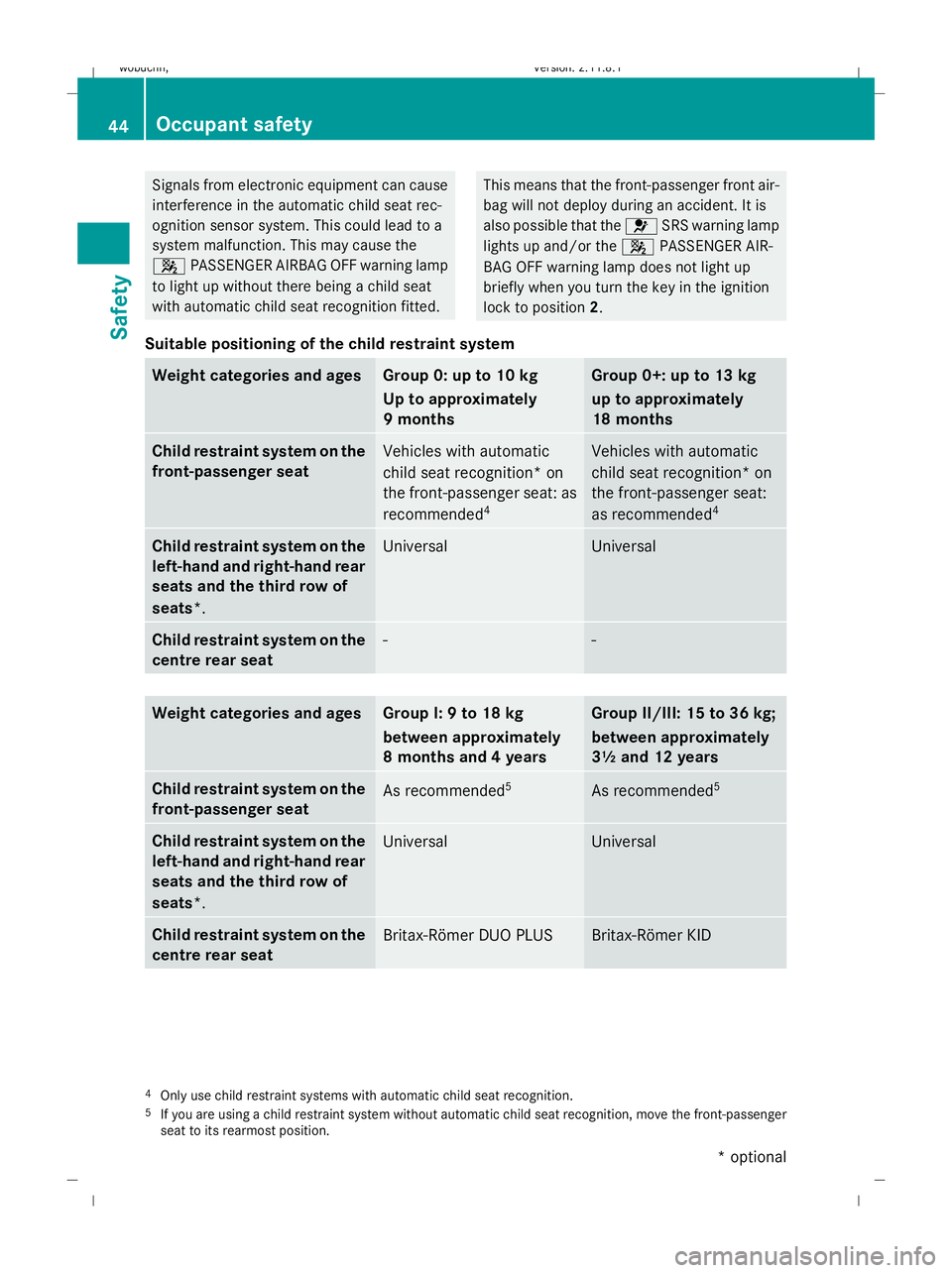
Suitable positioning of the child restraint system Weight categories and ages Group 0: up to 10 kg
Up to approximately
9 months Group 0+: up to 13 kg
up to approximately
18 months
Child restraint system on the
front-passenger seat Vehicles with automatic
child seat recognition* on
the front-passenger seat: as
recommended
4 Vehicles with automatic
child seat recognition* on
the front-passenger seat:
as recommended
4 Child restraint system on the
left-hand and right-hand rear
seats and the third row of
seats*. Universal Universal
Child restraint system on the
centre rear seat - -
Weight categories and ages Group I: 9 to 18 kg
between approximately
8 months and 4 years Group II/III: 15 to 36 kg;
between approximately
3½ and 12 years
Child restraint system on the
front-passenger seat As recommended
5 As recommended
5 Child restraint system on the
left-hand and right-hand rear
seats and the third row of
seats*. Universal Universal
Child restraint system on the
centre rear seat Britax-Römer DUO PLUS Britax-Römer KID
4
Only use child restraint systems with automatic child seat recognition.
5 If you are using a child restraint system without automatic child seat recognition, move the front-passenger
seat to its rearmost position. 44
Occupant safetySafety
* optional
X164_AKB; 2; 3, en-GB
wobuchh,
Version: 2.11.8.1 2009-03-31T14:14:58+02:00 - Seite 44
Dateiname: 6515431202_buchblock.pdf; erzeugt am 01. Apr 2009 00:16:46; WK
Page 48 of 309
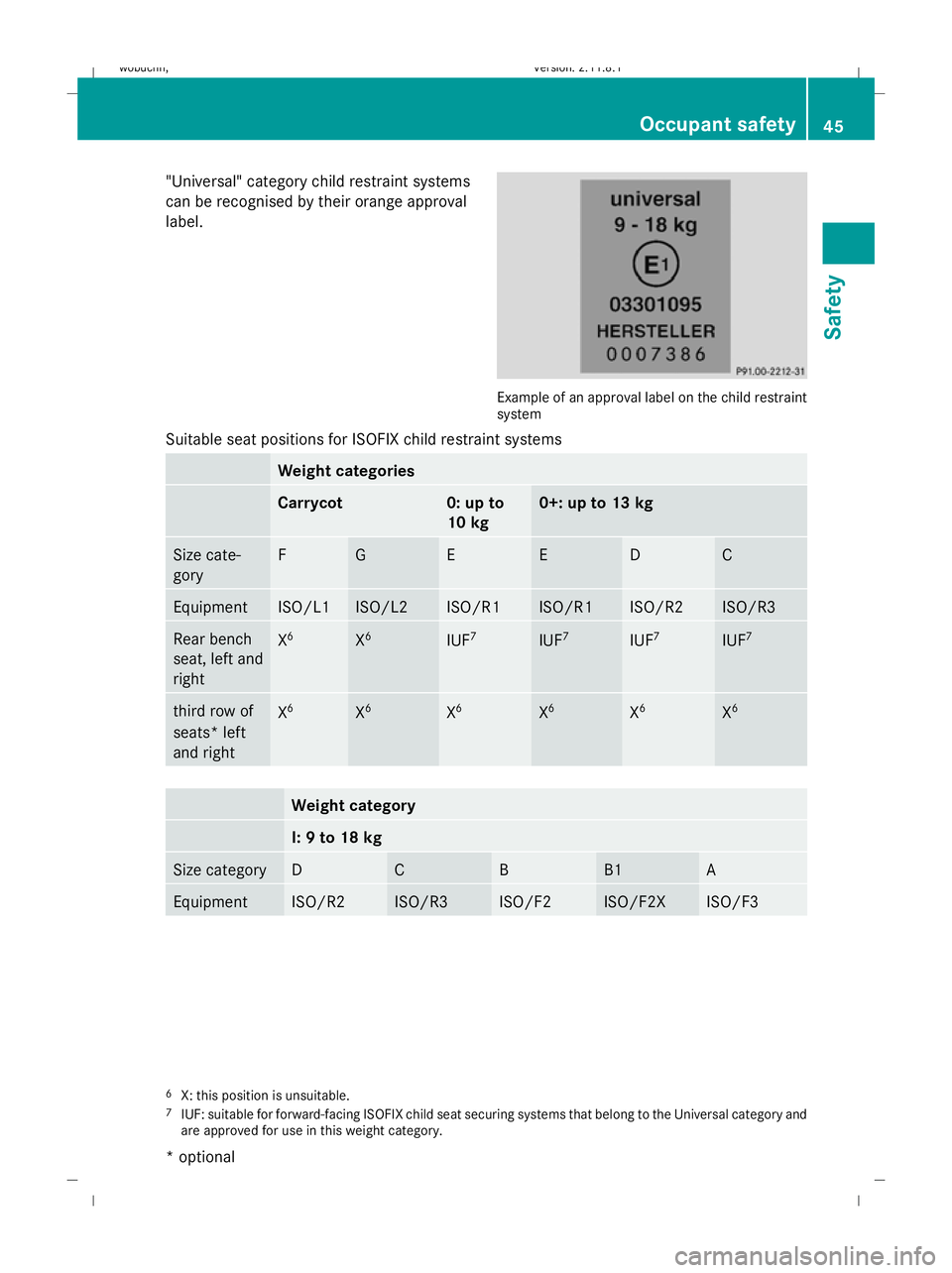
"Universal" category child restraint systems
can be recognised by their orange approval
label.
Example of an approval label on the child restraint
system
Suitable seat positions for ISOFIX child restraint systems Weight categories
Carrycot 0: up to
10 kg 0+: up to 13 kg
Size cate-
gory F G E E D C
Equipment ISO/L1 ISO/L2 ISO/R1 ISO/R1 ISO/R2 ISO/R3
Rear bench
seat, left and
right
X
6 X
6 IUF
7 IUF
7 IUF
7 IUF
7 third row of
seats* left
and right
X
6 X
6 X
6 X
6 X
6 X
6 Weight category
I: 9 to 18 kg
Size category D C B B1 A
Equipment ISO/R2 ISO/R3 ISO/F2 ISO/F2X ISO/F3
6
X: this position is unsuitable.
7 IUF: suitable for forward-facing ISOFIX child seat securing systems that belong to the Universal category and
are approved for use in this weight category. Occupant safety
45Safety
* optional
X164_AKB; 2; 3, en-GB
wobuchh,
Version: 2.11.8.1 2009-03-31T14:14:58+02:00 - Seite 45 Z
Dateiname: 6515431202_buchblock.pdf; erzeugt am 01. Apr 2009 00:16:46; WK
Page 49 of 309
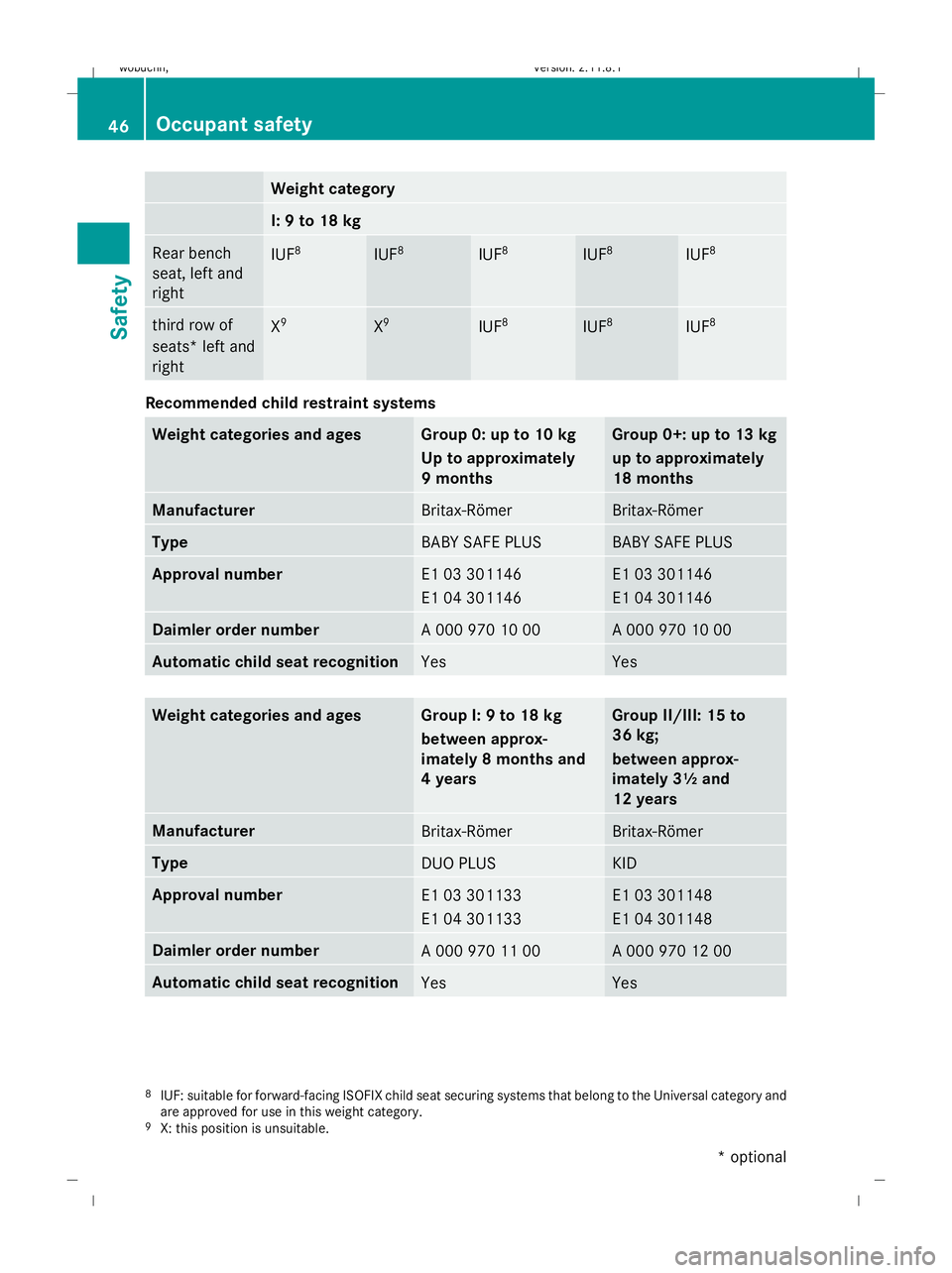
Weight category
I: 9 to 18 kg
Rear bench
seat, left and
right
IUF
8 IUF
8 IUF
8 IUF
8 IUF
8 third row of
seats* left and
right
X
9 X
9 IUF
8 IUF
8 IUF
8 Recommended child restraint systems
Weight categories and ages Group 0: up to 10 kg
Up to approximately
9 months Group 0+: up to 13 kg
up to approximately
18 months
Manufacturer
Britax-Römer Britax-Römer
Type
BABY SAFE PLUS BABY SAFE PLUS
Approval number
E1 03 301146
E1 04 301146 E1 03 301146
E1 04 301146
Daimler order number
A 000 970 10 00 A 000 970 10 00
Automatic child seat recognition
Yes Yes
Weight categories and ages Group I: 9 to 18 kg
between approx-
imately 8 months and
4 years Group II/III: 15 to
36 kg;
between approx-
imately 3½ and
12 years
Manufacturer
Britax-Römer Britax-Römer
Type
DUO PLUS KID
Approval number
E1 03 301133
E1 04 301133 E1 03 301148
E1 04 301148
Daimler order number
A 000 970 11 00 A 000 970 12 00
Automatic child seat recognition
Yes Yes
8
IUF: suitable for forward-facing ISOFIX child seat securing systems that belong to the Universal category and
are approved for use in this weight category.
9 X: this position is unsuitable. 46
Occupant safetySafety
* optional
X164_AKB; 2; 3, en-GB
wobuchh,
Version: 2.11.8.1 2009-03-31T14:14:58+02:00 - Seite 46
Dateiname: 6515431202_buchblock.pdf; erzeugt am 01. Apr 2009 00:16:46; WK
Page 50 of 309
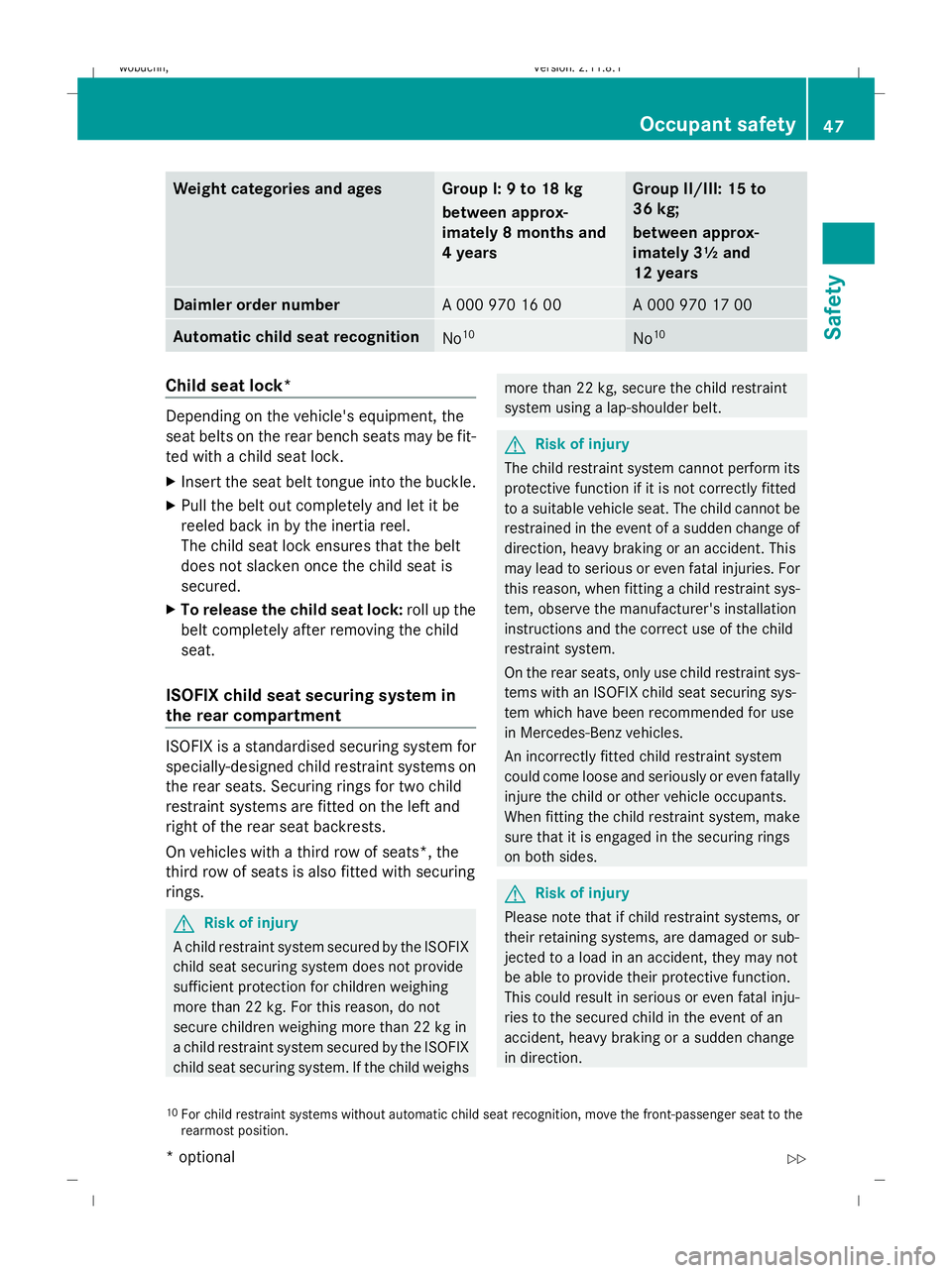
Weight categories and ages Group I: 9 to 18 kg
between approx-
imately 8 months and
4 years Group II/III: 15 to
36 kg;
between approx-
imately 3½ and
12 years
Daimler order number
A 000 970 16 00 A 000 970 17 00
Automatic child seat recognition
No
10 No
10 Child seat lock*
Depending on the vehicle's equipment, the
seat belts on the rear bench seats may be fit-
ted with a child seat lock.
X Insert the seat belt tongue into the buckle.
X Pull the belt out completely and let it be
reeled back in by the inertia reel.
The child seat lock ensures that the belt
does not slacken once the child seat is
secured.
X To release the child seat lock: roll up the
belt completely after removing the child
seat.
ISOFIX child seat securing system in
the rear compartment ISOFIX is a standardised securing system for
specially-designed child restraint systems on
the rear seats. Securing rings for two child
restraint systems are fitted on the left and
right of the rear seat backrests.
On vehicles with a third row of seats*, the
third row of seats is also fitted with securing
rings. G
Risk of injury
A child restraint system secured by the ISOFIX
child seat securing system does not provide
sufficient protection for children weighing
more than 22 kg. For this reason, do not
secure children weighing more than 22 kg in
a child restraint system secured by the ISOFIX
child seat securing system. If the child weighs more than 22 kg, secure the child restraint
system using a lap-shoulder belt.
G
Risk of injury
The child restraint system cannot perform its
protective function if it is not correctly fitted
to a suitable vehicle seat. The child cannot be
restrained in the event of a sudden change of
direction, heavy braking or an accident. This
may lead to serious or even fatal injuries. For
this reason, when fitting a child restraint sys-
tem, observe the manufacturer's installation
instructions and the correct use of the child
restraint system.
On the rear seats, only use child restraint sys-
tems with an ISOFIX child seat securing sys-
tem which have been recommended for use
in Mercedes-Benz vehicles.
An incorrectly fitted child restraint system
could come loose and seriously or even fatally
injure the child or other vehicle occupants.
When fitting the child restraint system, make
sure that it is engaged in the securing rings
on both sides. G
Risk of injury
Please note that if child restraint systems, or
their retaining systems, are damaged or sub-
jected to a load in an accident, they may not
be able to provide their protective function.
This could result in serious or even fatal inju-
ries to the secured child in the event of an
accident, heavy braking or a sudden change
in direction.
10 For child restraint systems without automatic child seat recognition, move the front-passenger seat to the
rearmost position. Occupant safety
47Safety
* optional
X164_AKB; 2; 3, en-GB
wobuchh,
Version: 2.11.8.1 2009-03-31T14:14:58+02:00 - Seite 47 Z
Dateiname: 6515431202_buchblock.pdf; erzeugt am 01. Apr 2009 00:16:46; WK
Page 154 of 309
direction of arrow
;until the sliding/tilt-
ing sunroof is closed.
The sliding/tilting sunroof is closed with
more force.
If the sliding/tilting sunroof locks up during
closing again:
X Immediately after it locks up, pull the
switch again to the pressure point in the
direction of arrow ;until the sliding/tilt-
ing sunroof is closed.
The sliding/tilting sunroof is closed without
the anti-entrapment feature.
Rain closing feature* The sliding/tilting sunroof closes automati-
cally:
R
if it starts to rain
R after 12 hours
The rear of the sliding/tilting sunroof is then
raised in order to ventilate the interior of the
vehicle.
i The sliding/tilting sunroof is opened
slightly again if it is obstructed while being
closed by the rain closing feature. The rain
closing feature is then deactivated.
The sliding/tilting sunroof does not close if:
R it is raised at the rear
R it is blocked
R no rain is falling on the area of the wind-
screen being monitored by the rain sensor
(e.g. because the vehicle is under a bridge
or in a carport)
Resetting Reset the sliding/tilting sunroof if it does not
open smoothly, or if the battery has been dis-
connected or has become discharged.
X
Switch the ignition off and then on again.
X The sliding/tilting sunroof is raised fully at
the rear. X
Keep the switch pressed for an additional
second.
X Make sure that the sliding/tilting sunroof
can be opened or closed fully again
(Y page 150).
X If this is not the case, consult a qualified
specialist workshop. Loading and stowing
Loading guidelines
G
Risk of injury
Secure and position the load as described in
the loading guidelines.
Otherwise, vehicle occupants could
be injured by the load being thrown around in
the event of sharp braking, a sudden change
in direction or an accident.
You will find further information in the "Secur-
ing a load" section.
Even if you follow all the loading guidelines,
the load will increase the risk of injury in the
event of an accident. G
Risk of poisoning
Keep the tailgate closed when the engine is
running. Otherwise, you could be poisoned by
exhaust fumes entering the vehicle.
The handling characteristics of a laden vehi-
cle are dependent on the distribution of the
load within the vehicle. For this reason, you
should observe the following notes when
transporting a load:
R never exceed the maximum permissible
gross vehicle weight or the permissible axle
loads for the vehicle (including occupants).
R position heavy loads as far forwards and as
low down in the luggage compartment as
possible.
R the load must not protrude above the upper
edge of the seat backrests.
R always place the load against the rear or
front seat backrests. Make sure that the Loading and stowing
151Controls
* optional
X164_AKB; 2; 3, en-GB
wobuchh,
Version: 2.11.8.1 2009-03-31T14:14:58+02:00 - Seite 151 Z
Dateiname: 6515431202_buchblock.pdf; erzeugt am 01. Apr 2009 00:17:32; WK
Page 157 of 309
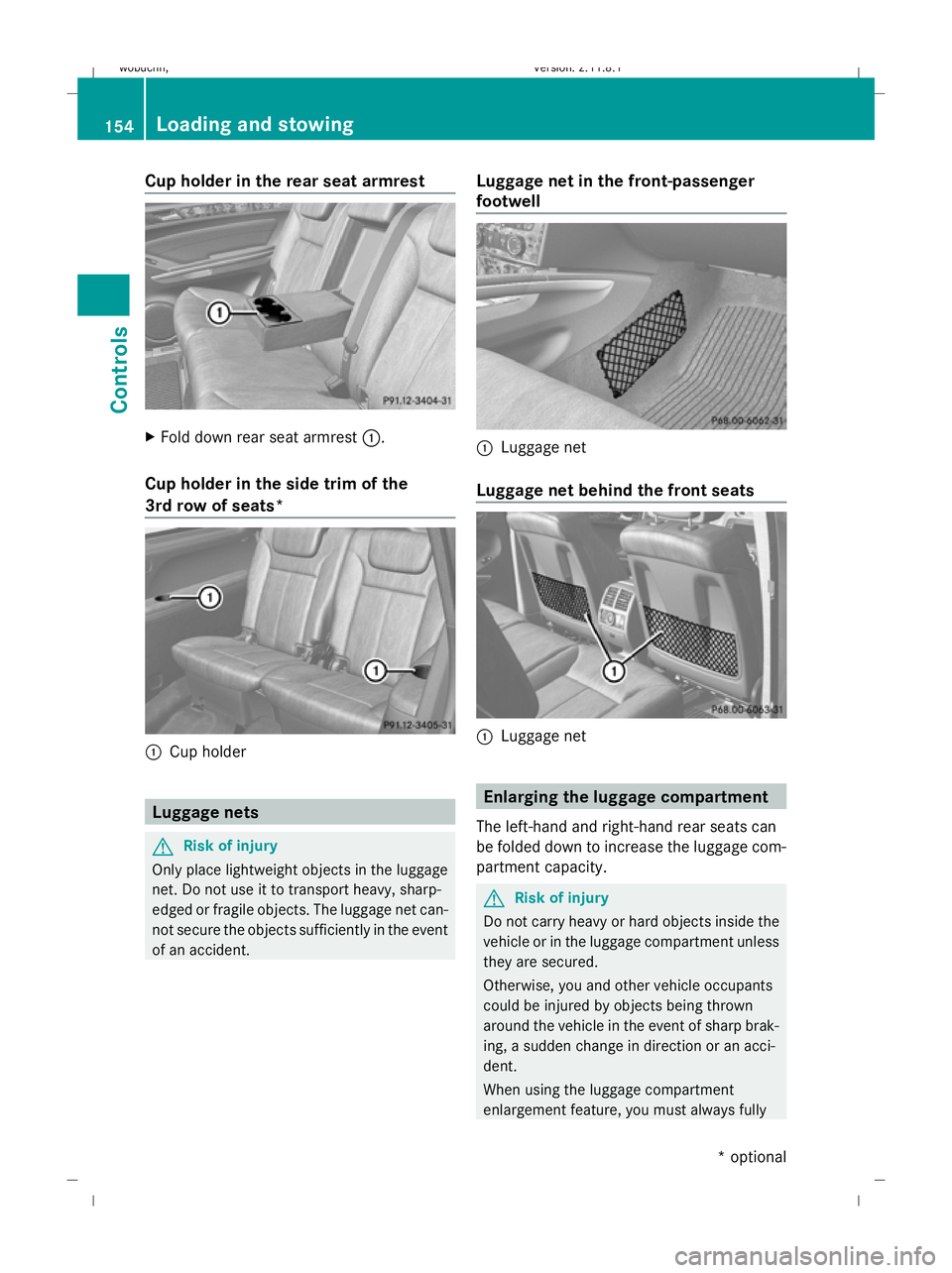
Cup holder in the rear seat armrest
X
Fold down rear seat armrest :.
Cup holder in the side trim of the
3rd row of seats* :
Cup holder Luggage nets
G
Risk of injury
Only place lightweight objects in the luggage
net. Do not use it to transport heavy, sharp-
edged or fragile objects. The luggage net can-
not secure the objects sufficiently in the event
of an accident. Luggage net in the front-passenger
footwell :
Luggage net
Luggage net behind the front seats :
Luggage net Enlarging the luggage compartment
The left-hand and right-hand rear seats can
be folded down to increase the luggage com-
partment capacity. G
Risk of injury
Do not carry heavy or hard objects inside the
vehicle or in the luggage compartment unless
they are secured.
Otherwise, you and other vehicle occupants
could be injured by objects being thrown
around the vehicle in the event of sharp brak-
ing, a sudden change in direction or an acci-
dent.
When using the luggage compartment
enlargement feature, you must always fully 154
Loading and stowingControls
* optional
X164_AKB; 2; 3, en-GB
wobuchh,
Version: 2.11.8.1 2009-03-31T14:14:58+02:00 - Seite 154
Dateiname: 6515431202_buchblock.pdf; erzeugt am 01. Apr 2009 00:17:35; WK
Page 160 of 309
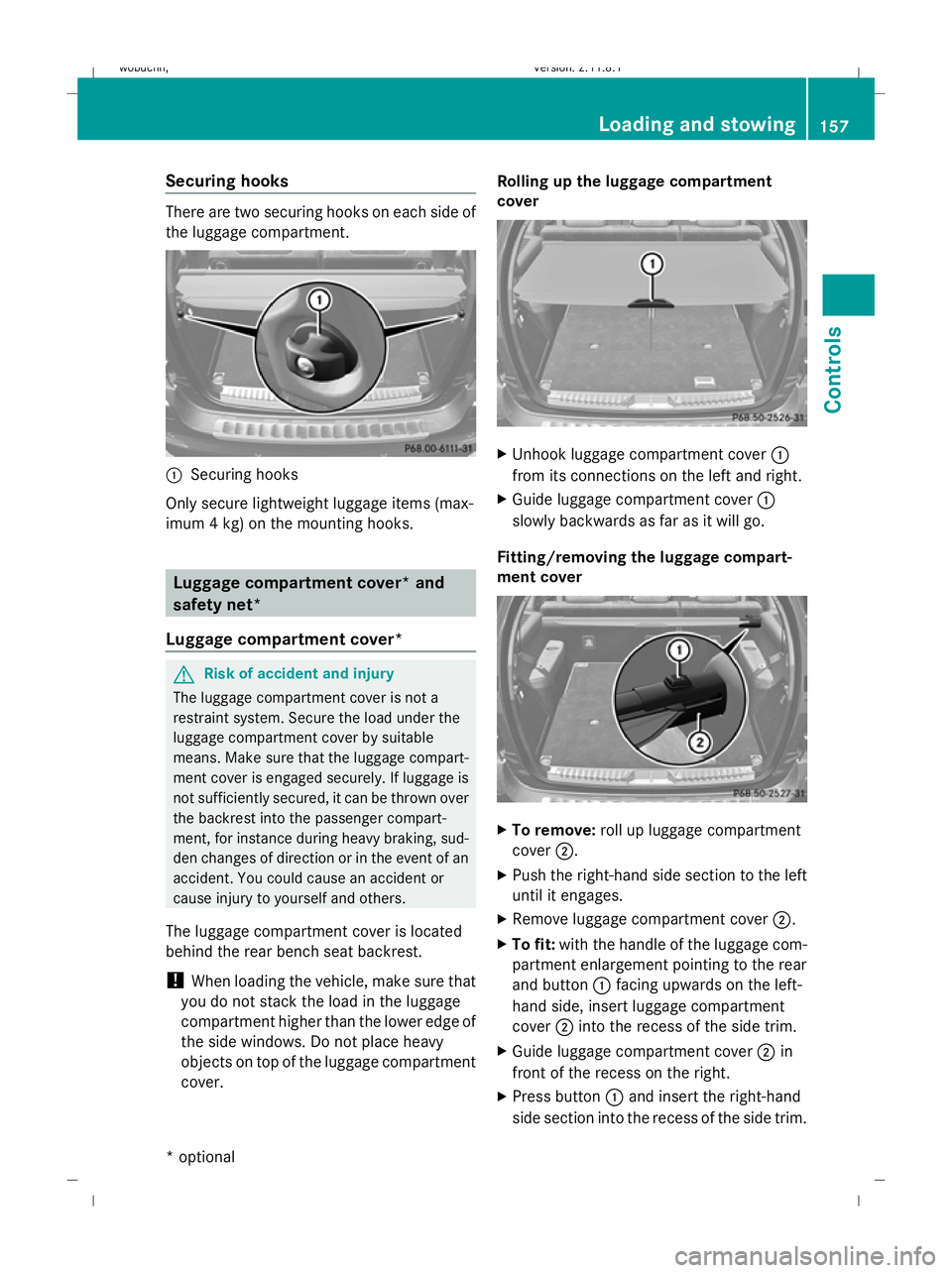
Securing hooks
There are two securing hooks on each side of
the luggage compartment.
:
Securing hooks
Only secure lightweight luggage items (max-
imum 4 kg) on the mounting hooks. Luggage compartment cover* and
safety net*
Luggage compartment cover* G
Risk of accident and injury
The luggage compartment cover is not a
restraint system. Secure the load under the
luggage compartment cover by suitable
means. Make sure that the luggage compart-
ment cover is engaged securely. If luggage is
not sufficiently secured, it can be thrown over
the backrest into the passenger compart-
ment, for instance during heavy braking, sud-
den changes of direction or in the event of an
accident. You could cause an accident or
cause injury to yourself and others.
The luggage compartment cover is located
behind the rear bench seat backrest.
! When loading the vehicle, make sure that
you do not stack the load in the luggage
compartment higher than the lower edge of
the side windows. Do not place heavy
objects on top of the luggage compartment
cover. Rolling up the luggage compartment
cover
X
Unhook luggage compartment cover :
from its connections on the left and right.
X Guide luggage compartment cover :
slowly backwards as far as it will go.
Fitting/removing the luggage compart-
ment cover X
To remove: roll up luggage compartment
cover ;.
X Push the right-hand side section to the left
until it engages.
X Remove luggage compartment cover ;.
X To fit: with the handle of the luggage com-
partment enlargement pointing to the rear
and button :facing upwards on the left-
hand side, insert luggage compartment
cover ;into the recess of the side trim.
X Guide luggage compartment cover ;in
front of the recess on the right.
X Press button :and insert the right-hand
side section into the recess of the side trim. Loading and stowing
157Controls
* optional
X164_AKB; 2; 3, en-GB
wobuchh,
Version: 2.11.8.1 2009-03-31T14:14:58+02:00 - Seite 157 Z
Dateiname: 6515431202_buchblock.pdf; erzeugt am 01. Apr 2009 00:17:38; WK
Page 176 of 309
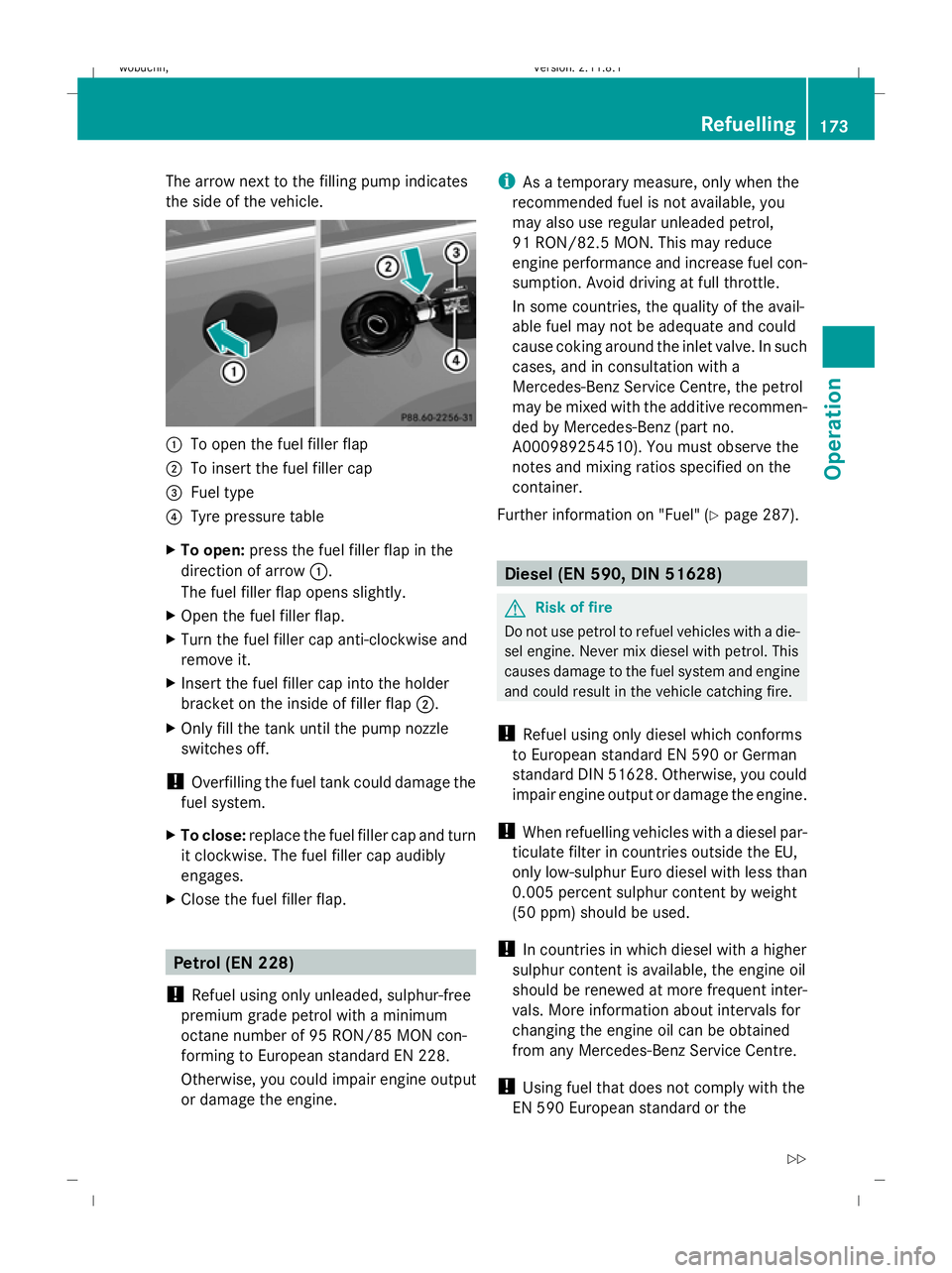
The arrow next to the filling pump indicates
the side of the vehicle.
:
To open the fuel filler flap
; To insert the fuel filler cap
= Fuel type
? Tyre pressure table
X To open: press the fuel filler flap in the
direction of arrow :.
The fuel filler flap opens slightly.
X Open the fuel filler flap.
X Turn the fuel filler cap anti-clockwise and
remove it.
X Insert the fuel filler cap into the holder
bracket on the inside of filler flap ;.
X Only fill the tank until the pump nozzle
switches off.
! Overfilling the fuel tank could damage the
fuel system.
X To close: replace the fuel filler cap and turn
it clockwise. The fuel filler cap audibly
engages.
X Close the fuel filler flap. Petrol (EN 228)
! Refuel using only unleaded, sulphur-free
premium grade petrol with a minimum
octane number of 95 RON/85 MON con-
forming to European standard EN 228.
Otherwise, you could impair engine output
or damage the engine. i
As a temporary measure, only when the
recommended fuel is not available, you
may also use regular unleaded petrol,
91 RON/82.5 MON. This may reduce
engine performance and increase fuel con-
sumption. Avoid driving at full throttle.
In some countries, the quality of the avail-
able fuel may not be adequate and could
cause coking around the inlet valve. In such
cases, and in consultation with a
Mercedes-Benz Service Centre, the petrol
may be mixed with the additive recommen-
ded by Mercedes-Benz (part no.
A000989254510). You must observe the
notes and mixing ratios specified on the
container.
Further information on "Fuel" (Y page 287). Diesel (EN 590, DIN 51628)
G
Risk of fire
Do not use petrol to refuel vehicles with a die-
sel engine. Never mix diesel with petrol. This
causes damage to the fuel system and engine
and could result in the vehicle catching fire.
! Refuel using only diesel which conforms
to European standard EN 590 or German
standard DIN 51628. Otherwise, you could
impair engine output or damage the engine.
! When refuelling vehicles with a diesel par-
ticulate filter in countries outside the EU,
only low-sulphur Euro diesel with less than
0.005 percent sulphur content by weight
(50 ppm) should be used.
! In countries in which diesel with a higher
sulphur content is available, the engine oil
should be renewed at more frequent inter-
vals. More information about intervals for
changing the engine oil can be obtained
from any Mercedes-Benz Service Centre.
! Using fuel that does not comply with the
EN 590 European standard or the Refuelling
173Operation
X164_AKB; 2; 3, en-GB
wobuchh, Version: 2.11.8.1 2009-03-31T14:14:58+02:00 - Seite 173 Z
Dateiname: 6515431202_buchblock.pdf; erzeugt am 01. Apr 2009 00:17:45; WK
Page 199 of 309
Never press the ADS button* or operate the
level control* while you are coupling up or
decoupling a trailer.
X Make sure the DIRECT SELECT selector
lever is set to P.
X Depress the parking brake.
X Start the engine.
X Set the vehicle to highway level
(Y page 132).
X Set the adaptive damping system (ADS)
setting to AUTOorCOMF (Ypage 129).
X Switch off the engine.
X Close the doors and tailgate.
X Position the trailer level behind the vehicle.
X Couple up the trailer.
X Establish the electrical connection
between the vehicle and the trailer.
i If you have coupled a trailer, the vehicle
will remain at highway level.
The vehicle automatically lowers to high-
way level if you drive faster than 8 km/h
with a trailer. The vehicle is not lowered to
the high-speed level even if you are travel-
ling at higher speeds.
This also applies when using accessories
that are plugged into the socket of the
trailer coupling (e.g. a bicycle rack).
Decoupling a trailer G
Risk of injury
Do not disconnect a trailer with an engaged
overrun brake. Otherwise, your hand could
become trapped between the bumper and
drawbar.
! Do not uncouple a trailer with overrun
brake between the bumper and drawbar,
otherwise your vehicle could be damaged
by the spring action of the overrun brake. X
Make sure the DIRECT SELECT selector
lever is set to P.
X Depress the parking brake.
X Start the engine.
X Close the doors and tailgate.
X Secure the trailer against rolling away. G
Risk of injury
The vehicle is lowered as soon as you discon-
nect the trailer cable. Make sure that nobody
is in the vicinity of the wheel arch or the
underbody. You could otherwise trap yourself
or others.
As soon as you decouple the trailer, the unla-
den vehicle rises slightly. Make sure that you
or others are not injured in the process.
X Remove the trailer cable and decouple the
trailer.
X Switch off the engine. Notes on towing a trailer
G
Risk of accident
When reversing the vehicle towards the
trailer, make sure there is nobody between
the trailer and the vehicle.
Couple and uncouple the trailer carefully. If
you do not couple the trailer to the towing
vehicle correctly, the trailer could become
detached.
Make sure that the following values are not
exceeded:
R the permissible trailer drawbar noseweight
R the permissible trailer load
R the permissible rear axle load of the towing
vehicle
R the maximum permissible gross vehicle
weight of both the towing vehicle and the
trailer
You will find the applicable permissible val-
ues, which must not be exceeded, in the vehi-
cle documents. 196
Trailer towing*Operation
* optional
X164_AKB; 2; 3, en-GB
wobuchh
,V ersion: 2.11.8.1
2009-03-31T14:14:58+02:00 - Seite 196
Dateiname: 6515431202_buchblock.pdf; erzeugt am 01. Apr 2009 00:17:51; WK