belt MERCEDES-BENZ GL SUV 2012 User Guide
[x] Cancel search | Manufacturer: MERCEDES-BENZ, Model Year: 2012, Model line: GL SUV, Model: MERCEDES-BENZ GL SUV 2012Pages: 441, PDF Size: 10.66 MB
Page 50 of 441
R
Persons under 1. 50mtall cannot wear the
seat belts correctly. For this reason secure
person sless than 1.50 mtall in specially
designed, suitable restraint systems.
R Children under 1. 50mt all and younger
than twelv eyears of age canno twear the
seat belts cor rectly. For thi sreason secure
them in special suitable child restraint sys-
tems installed on asuitable seat. Additional
information can be found in the Operating
Instructions in the chapter "Safety", "Chil-
dren in the Vehicle". Observe the installa-
tion instructions of the child restraint sys-
tem manufac turer.
R Do not secure an object wit haseat belt if
the seat belt is also being used by one of
the vehicle's occupants. G
WAR
NING
The seat belt doe snot offer the intended level
of protection unless the back rest is almost
ver tical. Under certain circumstances, this
coul dcause severe or even fatal injuries in the
event of an accident.
Befor estarting ajourney, mak esure that the
seat is properly adjusted and that the back-
rest is almost vertical. G
WARNING
Ad irtyo rdamaged seat belt or one that has
been modified or subjected to aload in an
accident no longer offers the intended level of
protection. Un dercertain cir cumstances, this
could caus esever eoreven fatal injurie sinthe
even tofana ccident.
For thi sreason ,chec kregularly that the seat
belts are not damaged or dirty.
Alway shave damaged seat belts or seat belts
that have been subjected to aload in an acci-
dent replaced at aqualified specialist work-
shop.
For safety reasons, Mercedes -Benz recom-
mends that you only use seat belts which have
been approved by Mercedes-Benz for your
vehicle. Seat belts are the most effectiv
emeans of
restraining the movemen tofvehicle occu-
pant sint he even tofanaccident. This
reduce sthe risk of vehicle occupan tscoming
into contact with parts of the vehicle interior.
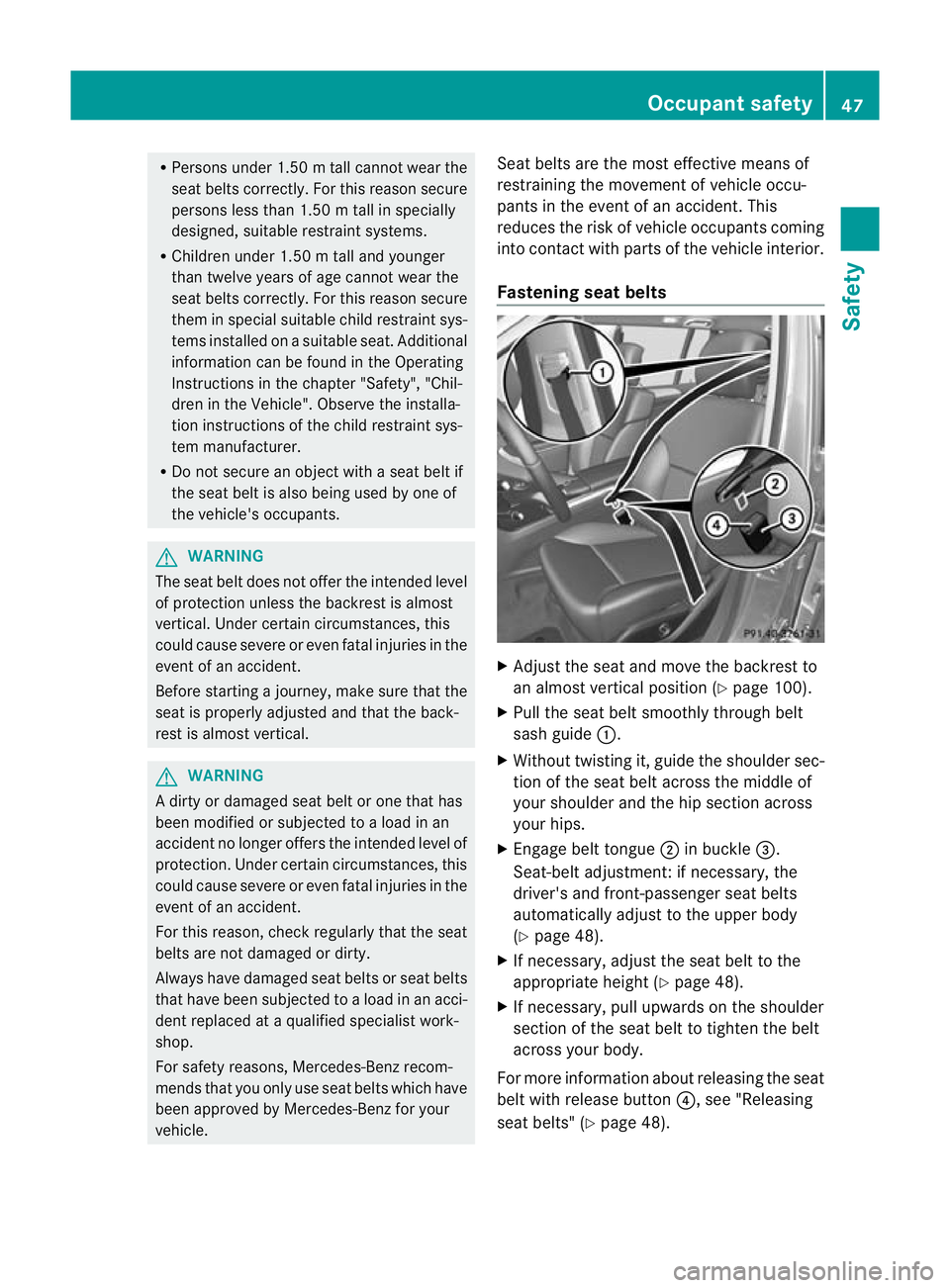
Fastenin gseat belts X
Adjust the seat and move the backrest to
an almost vertical position (Y page 100).
X Pull the seat belt smoothly through belt
sash guide :.
X Without twistin git, guid ethe shoulder sec-
tion of the seat belt across the middle of
your shoulder and the hip section across
your hips.
X Engage belt tongue ;in buckle =.
Seat-belt adjustment :ifnecessary, the
driver' sand front-passenger sea tbelts
automatically adjust to the upper body
(Y page 48).
X If necessary, adjust the seat belt to the
appropriate height (Y page 48).
X If necessary, pull upwards on the shoulder
section of the seat belt to tighten the belt
across your body.
For mor einformation about releasing the seat
bel tw ith release button ?,see "Releasing
seat belts" (Y page 48). Occupant safety
47Safety Z
Page 51 of 441
Sea
tbelt adjustment The seat-belt adjustment func
tion adjusts the
driver's and front-passenger seat belt to the
upper body of the occupants.
The belt strap is tighte neds lightly when:
R you engage the belt tongue in the belt
buckle and you then turn the key to position
2in the ignition lock.
R the key is in position 2in the ignition lock
and you then engage the belt tongue in the
buckle.
The seat-belt adjustment will apply acertain
tightening force if any slack is detected
between the occupant and the seat belt. Do
not hold on to the seat belt tightly while it is
adjusting. You can switch the seat-belt
adjustmen tonand off in the on-board com-
puter (Y page285).
Th es eat-belt adjustmen tisani ntegral part of
the PRE-SAFE ®
convenience function. More
information abou tPRE-SAFE ®
can be found
under "PRE-SAFE ®
(preventative occupant
protection)" (Y page 45).
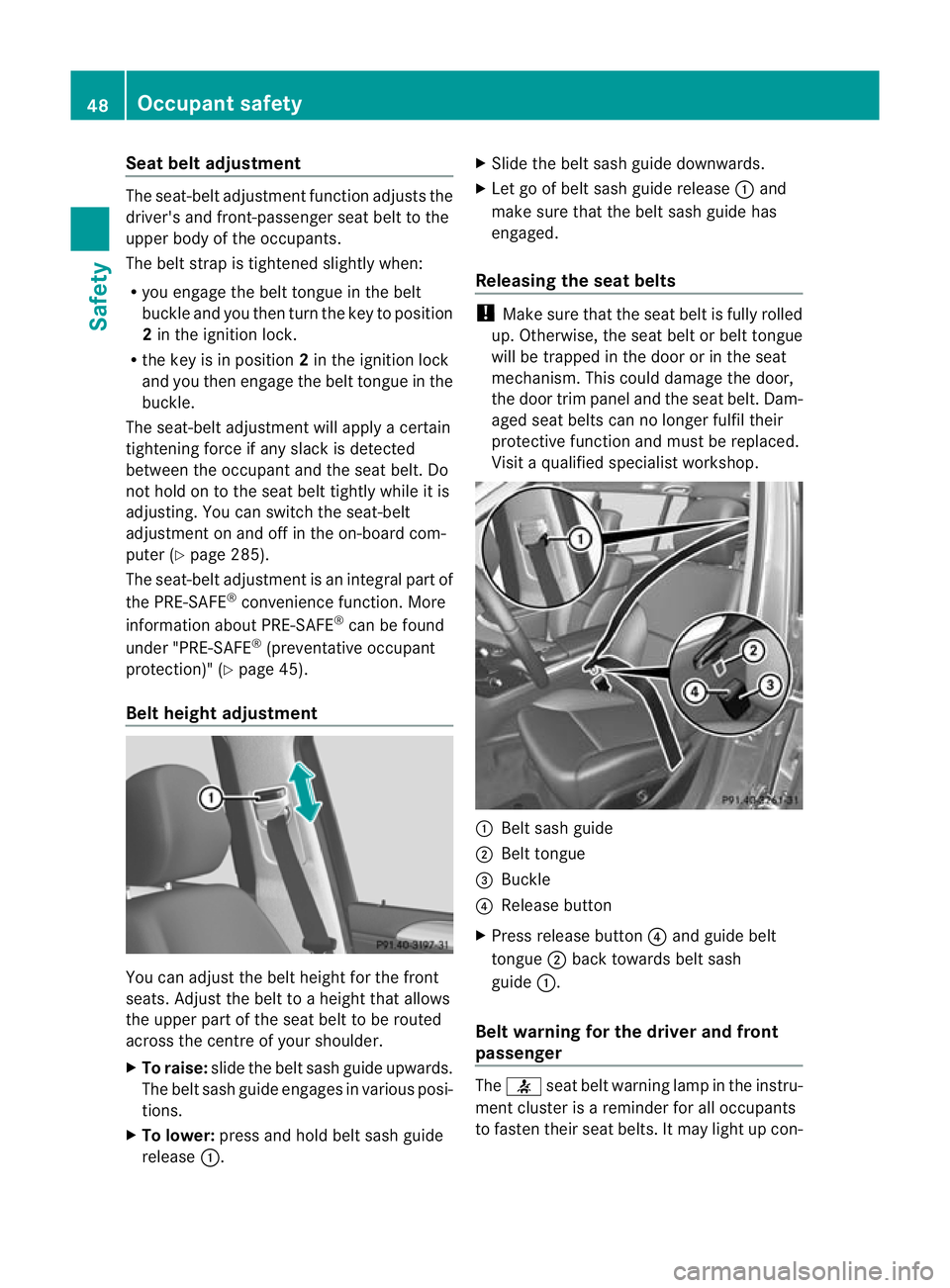
Belt height adjustment You can adjust the belt height for the front
seats
.Adjust the belt to aheight that allows
the upper part of the seat belt to be routed
across the centre of your shoulder.
X To raise: slide the belt sash guide upwards.
The belt sash guide engages in various posi-
tions.
X To lower: press and hold belt sash guide
release :. X
Slide the belt sash guide downwards.
X Let go of belt sash guide release :and
mak esure that the belt sash guide has
engaged.
Releasing the seat belts !
Make sure that the seat belt is fully rolled
up. Otherwise, the seat belt or belt tongue
will be trapped in the door or in the seat
mechanism. This could damage the door,
the door trim panel and the seat belt. Dam-
aged seat belts can no longer fulfil their
protective function and must be replaced.
Visit aqualified specialist workshop. :
Belt sash guide
; Belt tongue
= Buckle
? Release button
X Press release button ?and guide belt
tongue ;back towards belt sash
guide :.
Belt warning for the driver and front
passenger The
7 seat belt warning lamp in the instru-
ment cluster is areminder for all occupants
to fasten their seat belts. It may light up con- 48
Occupant safetySafety
Page 52 of 441
tinuousl
yorflash. In addition, th erem ay be a
warning tone.
The 7 seat belt warning lamp goes ou tand
the warning tone ceases when the driver and
the front pass enger hav efastened their seat
belt.
For certain coun tries only: regardless of
whether th edriver and the front passenger
have fastened their seat belts, the 7seat
bel tw arning lamp lights up for six seconds
after the engin eisstarted. It then goes out if
th ed river and the front passenger have fas-
tened thei rseat belts.
i For mor einformation on the 7seat
bel twarning lamp, see "Indicator and warn-
in gl am ps in the instrument cluster ,seat
belt" (Y page 325).
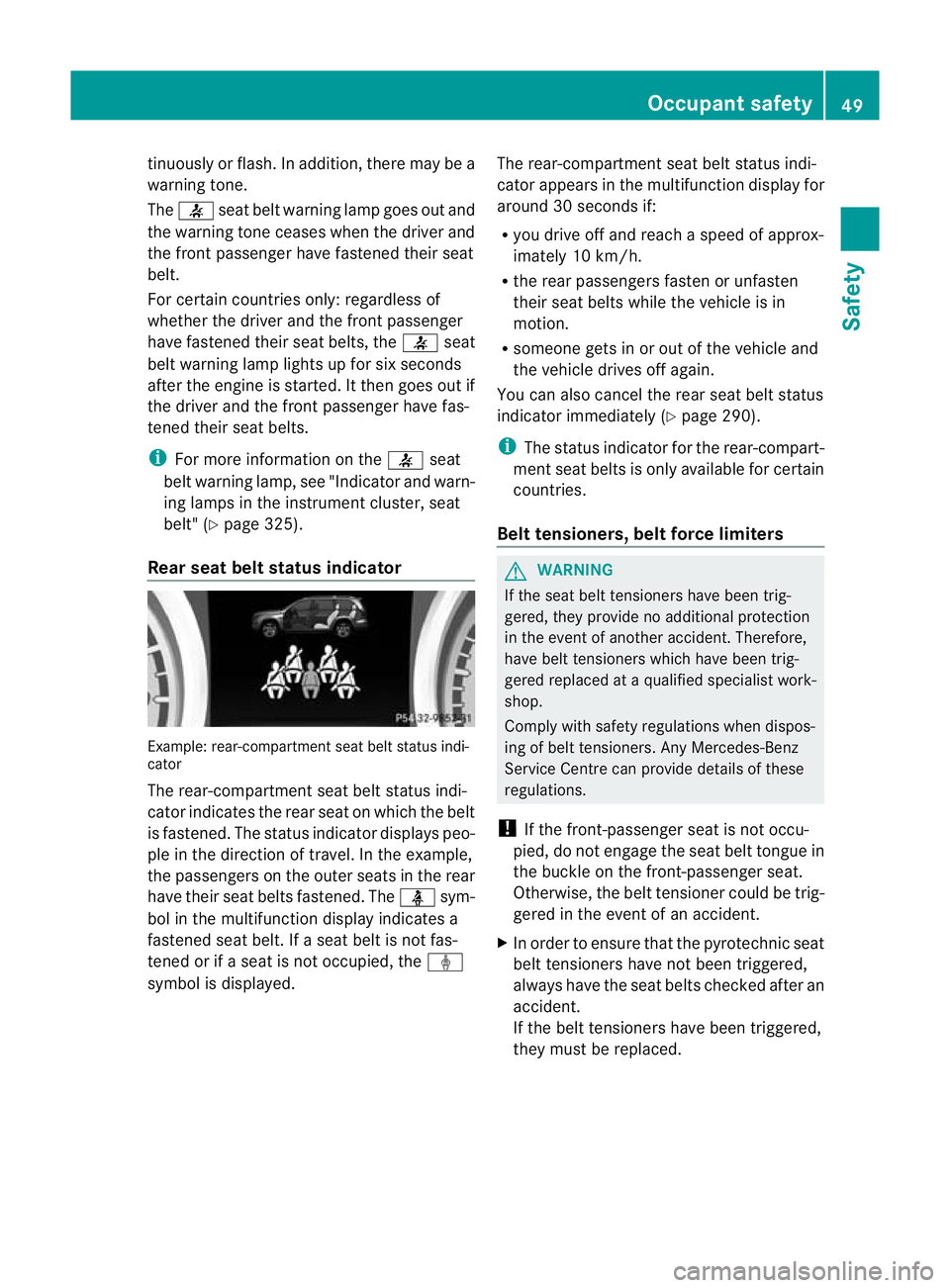
Rear seat belt status indicator Example: rear-compartment sea
tbelts tatus indi-
cator
The rear-comp artment sea tbelt status indi-
cator indicates the rear seat on which the belt
is fastened. The status indicator displays peo-
ple in the direc tion of travel. In the example,
the passenger sonthe outer seats in the rear
hav etheir seat belts fastened. The üsym-
bol in the multifunction displa yindicates a
fastened sea tbelt. If aseat belt is not fas-
tened or if aseat is not occupied, the ý
symbol is displayed. The rear-compartment seat belt status indi-
cator appear
sint he multifunction displa yfor
around 30 seconds if:
R you drive off and reach aspeed of approx-
imately 10 km/h.
R the rear passengers fasten or unfasten
their seat belts while the vehicle is in
motion.
R someon egets in or out of the vehicle and
the vehicle drives off again.
You can also can celthe rea rseat belt status
indicator immediately (Y page 290).
i The status indicator for the rear- compart-
ment seat belts is only available for certain
countries.
Bel ttensioners, belt force limiters G
WARNING
If the seat belt tensioners have been trig-
gered, they provide no additional protection
in the event of another accident. Therefore,
have belt tensioners which have been trig-
gered replaced at aqualified specialist work-
shop.
Comply with safety regulations when dispos-
ing of belt tensioners. An yMercedes-Benz
Ser vice Centre can provid edetails of these
regulations.
! If the front-passenger seat is not occu-
pied, do not engage the seat belt tongue in
the buckl eonthe front-passenger seat.
Otherwise, the belt tensioner could be trig-
gere dint he even tofanaccide nt.
X In order to ensur ethat the pyrotechnic seat
belt tensioner shave not been triggered,
alway shave the seat belts checked after an
accident.
If the belt tensioners have been triggered,
they must be replaced. Occupant safety
49Safety Z
Page 53 of 441
The seat belts on the following seats have belt
tensioner
sand bel tforc elimiters:
R driver's and front-passenger seat
R the outer seats in the second row
R the seats in the third row
The belt tensioners tighten the seat belts in
an accident ,pulling them close against the
body.
Belt tensioners do not correc tincorrect seat
positions or incorrectly fastened sea tbelts.
Belt tensioners do not pull vehicle occupants
back towards the backrest.
If the seat belt is also fit tedw ithabelt force
limiter and this is triggered, the force exer ted
by the seat belt on the vehicle occupant is
reduced.
The belt force limiters for the fron tseats are
synchronised with the fron tairbags, which
tak eona part of the deceleration force. This
result sinthe force exerted on the occupant
being distributed over agrea tera rea.
Th eb elt tensioners can only be activa ted
when:
R the ignition is switched on.
R the restraint system sare opera tional; see
"SR Swarnin glamp" (Y page 41).
The belt tensioners on the outside seats in the
second row and on the seats in the thir drow
ar et riggere dindependently of the lock status
of the sea tbelts.
The belt tensioners are triggere ddepending
on the type and severity of an accident:
R if, in the even tofahead-on or rear-end col-
lision, the vehicle decelerates or acceler-
ates rapidly in alongitudinal direction dur-
ing the initial stages of the impact
R if, in the even tofaside impact, on the side
opposit ethe impac tthe vehicle deceler-
ates or accelerates rapidly in alateral direc-
tion
R in certain situations where the vehicle over-
turns and the system determines that it can
provide additional protection If the airbags are deplo
yed,you will hear a
bang, and asmall amount of powder may also
be released. Only in rare cases will th ebang
affect your hearing. The powde rthat is
released generally does not constitute a
healt hhazard. The 6SRS warning lamp
lights up. Children in the vehicle
Child restraint systems
Important safety notes G
WARNING
To reduce the risk of serious or even fatal
injury to the child in the event of asudden
change in direction, braking or an accident:
R children less than 1.50 mtall and under
twelve years of age must always be secured
in special child restraint systems on asuit-
able vehicle seat. This is necessary
because the seat belts are not designed for
children.
R Do not drive with achild secured in arear-
ward-facing child restraint system on the
front-passenger seat. Exception: if the vehi-
cle is equipped with automatic child seat
recognition on the front-passenger seat
and the child is secured in achild restraint
system with transponders for automatic
chil dseat recognition
R if you secur eaforward-facing child
restraint system to the front-passenger
seat, you must mov ethe front-passenger
seat as fa rback as possible.
R children must never travel sitting on the lap
of another occupant. Due to the forces
which occur in the event of asudden
change of direction, heavy braking or an
accident, it would not be possible to
restrain the child. The child could be thrown
against parts of the vehicle interior and be
seriously or even fatally injured. 50
Children in the vehicleSafety
Page 56 of 441
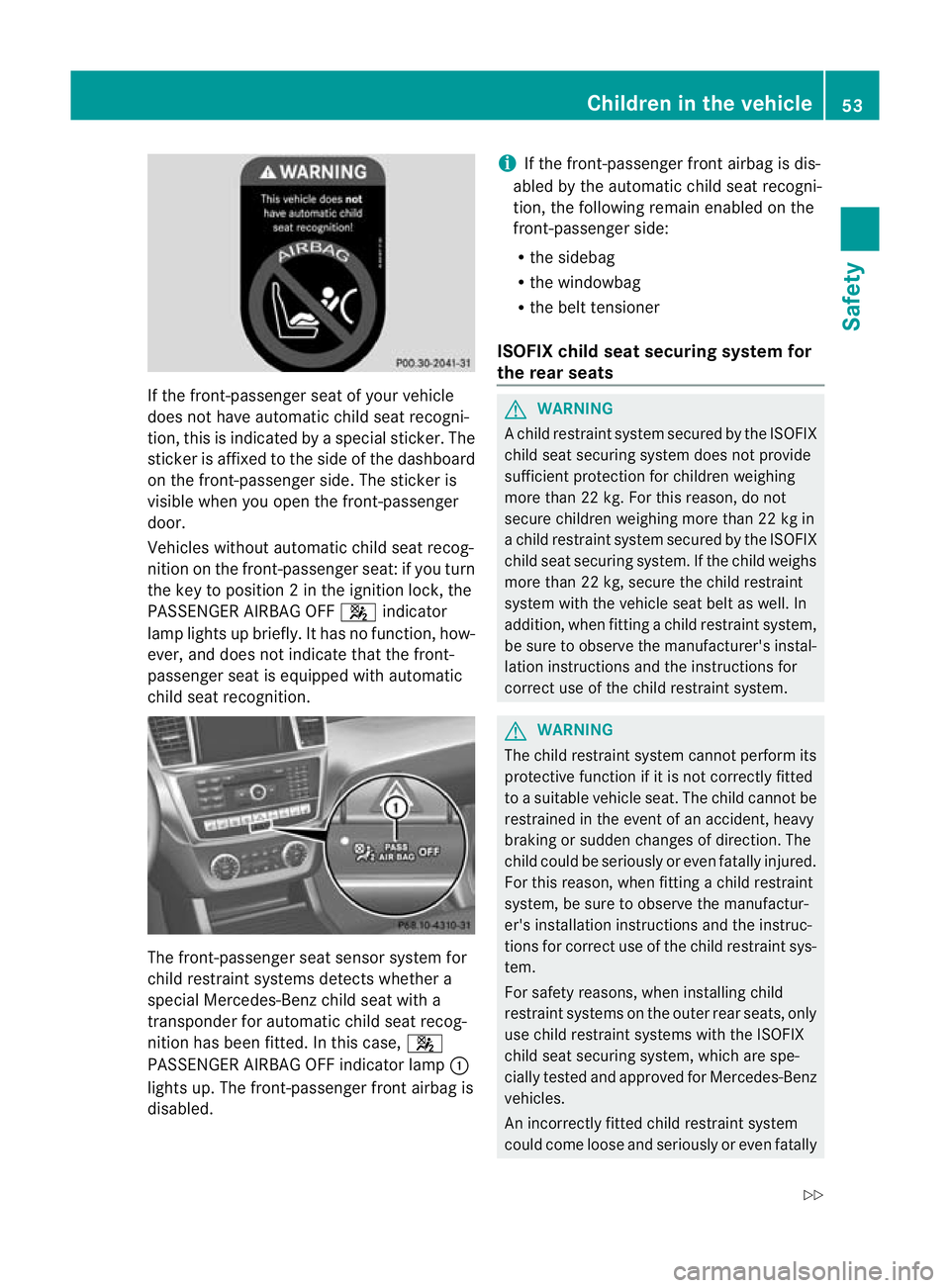
If th
efront-passenger seat of yo urvehicle
does no thave automatic child seat recogni-
tion, this is indicated by aspecial sticker. The
sticker is affixed to the side of the dashboard
on the front-passenger side. The sticker is
visible when you open the front-passenger
door.
Vehicles without automatic child seat recog-
nition on the front-passenger seat: if you turn
the key to position 2inthe ignition lock ,the
PAS SENG ER AIRBAG OFF 4indicator
lamp lights up briefly. It has no function, how-
ever, and doe snot indicate that the front-
passenger seat is equipped with automatic
child seat recognition. The front-passenger seat sensor system for
child restraint system
sdetect swhether a
special Mercedes-Ben zchild seat with a
transpo nder for automatic child seat recog-
nition has been fitted. In this case, 4
PASSENGER AIRBA GOFF indicato rlamp :
lights up. The front-passenger front airbag is
disabled. i
If the front-passenger front airbag is dis-
abled by the automatic child seat recogni-
tion, the following remain enabled on the
front-passenger side:
R the sidebag
R the windowbag
R the belt tensioner
ISOFI Xchilds eat securing system for
the rear seats G
WARNING
Ac hild restraint system secured by the ISOFIX
chil dseat securing system does not provide
sufficien tprotection for children weighing
more than 22 kg. For this reason, do not
secure children weighing more than 22 kg in
ac hild restraint system secured by the ISOFIX
chil dseat securing system. If the child weighs
mor ethan 22 kg, secur ethe chil drestraint
system with the vehicle seat belt as well. In
addition ,when fittin gachild restraint system,
be sur etoobservethe manufacturer' sinstal-
latio ninstructions and the instructions for
correct use of the child restraint system. G
WARNING
The child restraint system cannot perform its
protective function if it is not correctly fitted
to as uitable vehicle seat. The child cannot be
restrained in the event of an accident, heavy
braking or sudde nchanges of direction. The
chil dcould be seriously or even fatally injured.
For this reason, when fittin gachild restraint
system ,besure to observe the manufactur-
er's installatio ninstructions and the instruc-
tions for correct use of the child restraint sys-
tem.
For safety reasons, whe ninstalling child
restraint systems on the outer rear seats, only
use child restraint systems with the ISOFIX
child sea tsecuring system, which are spe-
ciall ytested and approved for Mercedes-Benz
vehicles.
An incorrectly fitted child restraint system
could com eloose and seriously or even fatally Children in the vehicle
53Safety
Z
Page 58 of 441
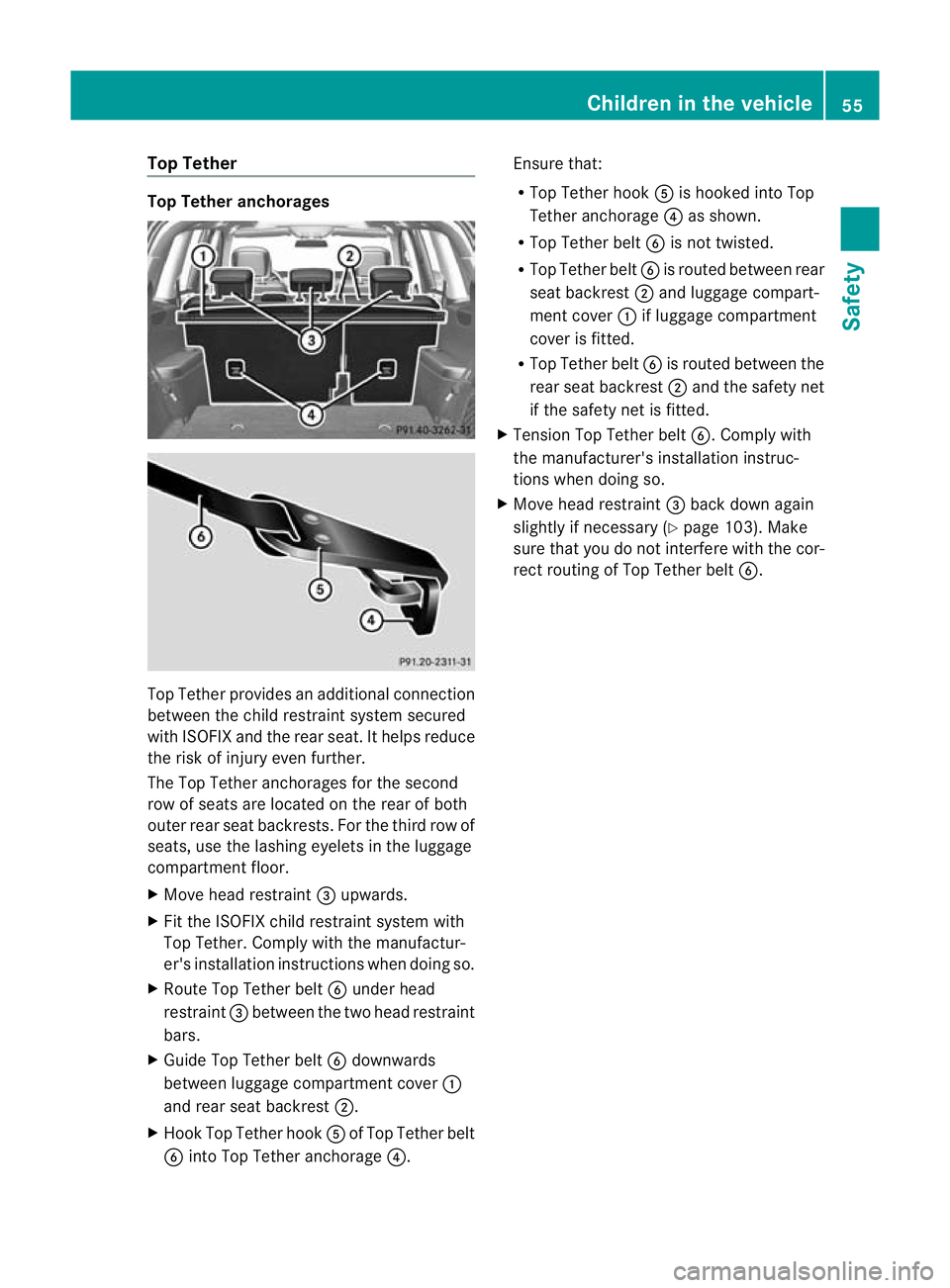
Top Tether
Top Tethe
ranchorages To
pT ethe rprovides an additional connecti on
between the child restraint system secured
with ISOFIX and the rear seat. It help sreduce
the risk of injury even further.
The Top Tether anchorages for the second
row of seats are located on the rear of both
outer rear seat back rests. For the thir drow of
seats, use the lashin geyelets in the luggage
compartment floor.
X Move head restraint =upwards.
X Fit the ISOFIX child restraint syste mwith
Top Tether .Compl ywith the manufactur-
er' sinstallatio ninstructions whe ndoing so.
X Rout eTop Tether belt Bunder head
rest raint = between the two head restraint
bars.
X Guide Top Tether belt Bdownwards
between luggage compar tment cover:
and rear seat backrest ;.
X Hook Top Tethe rhook Aof Top Tether belt
B intoT op Tether anchorage ?.Ensure that:
R
Top Tether hook Ais hooked int oTop
Tether anchorage ?as shown.
R Top Tether belt Bis not twisted.
R Top Tether belt Bis routed between rear
seat backrest ;and luggage compart-
men tcover :if luggage compartment
cover is fit ted.
R Top Tether belt Bis routed between the
rear seat backrest ;and the safety net
if the safety net is fit ted.
X Tension Top Tether belt B.Complywith
the manufacturer's installation instruc-
tions when doing so.
X Move head restraint =back down again
slightly if necessary (Y page 103). Make
sure that you do not interfere with the cor-
rect routing of Top Tether belt B. Children in the vehicle
55Safety Z
Page 72 of 441
X
Brake immediatel yinorder to increas ethe
distanc efrom th evehicle in front.
or
X Take evasive actio nprovided it is safe to do
so.
From aspeed of approxim ately 7km/h ,ifthe
driver and passengers hav efastened their
seat belts, PRE-SAFE ®
Brake can brake the
vehicl eautom atically at speeds up to approx-
imatel y200 km/h.
Due to the nature of the sy stem, particu larly
comp licate ddriving conditions may cause
unneces sary warnings or th eunneces sary
interventi onof PRE-SAFE ®
Brake.
You can stop PRE-SAFE ®
Brake interventi on
at any time by:
R depressing the accelerato rpedal further
R activa ting kickdown
R releasing the brake pedal.
The braking action of PRE-SAFE ®
Brak eis
ended automatically if:
R you manoeuvr etoavoidthe obstacle.
R ther eisnol onger any danger of arear-end
collision.
R ther eisnol onger an obstacle detected in
fron tofy our vehicle.
If you have activa tedD SR (Y page 25 1)PRE-
SAFE ®
Brak eisa lso deactiva ted.
With the help of the rada rsensor system,
PRE- SAFE ®
Brake can detect obstacles that
are in front of your vehicle for an extended
period of time.
At speed suptoapproximately 70 km/h, PRE-
SAFE ®
Brak ecan also detect stationary
obstacles such as stopped or parked vehi-
cles.
If you approach an obstacle and PRE-SAFE ®
Brak edetects arisk of acollision ,the system
will aler tyou both visually and acoustically .If
you do not brake or take evasive action, the
syste mwill warn you by automatically braking
the vehicle gently. If ther eisanincreased risk
of collision, preventativ epassenger protec-
tion measures (PRE-SAFE ®
)a re activated (Y
page 45). If, at speeds ove r30km/h, arisk
of collision remains and you do not brake,
take evasive action or significantly acceler-
ate, automatic brakin gmay be performed up
to alevel of automatic emergency braking.
Automatic emergency brakin gisnot per-
formed until immediately prior to an accident
that can no longer be avoided. G
WARNING
PRE- SAFE®
Brake wil linitiall ybrake your vehi-
cle by apartial application of the brakes if a
danger of collisio nisd etected. There may be
ac ollision unless you also brake. Automatic
emergency brakin gcannot preven tacolli-
sion. There is arisk of an accident.
Always apply the brakes yourself and try to
take evasive action. G
WARNING
PRE-SAFE ®
Brak ecannot alway sclearly iden-
tify objects and complex traf ficc onditions.
In these cases, PRE- SAFE®
Brake may:
R give an unnecessary warning and then
brake the vehicle
R neithe rgive awarning nor intervene
There is arisk of an accident.
Always pay particular attention to the traf fic
situation and be ready to brake, especiall yif
PRE- SAFE®
Brake warns you. Terminate the
intervention in anon-critical driving situation.
In particular, the detection of obstacles can
be impaired if ther eis:
R dir tont he sensor soranything els ecover-
ing the sensors
R snow or heav yrain
R interference by other radar sources
R the possibility of strong radar reflections,
for example, in multi-storey car parks
R an arrow vehicle travellin ginfront, e.g .a
motorcycle
R av ehicle travellin ginfront on adifferent
line Drivin
gsafety systems
69Safety Z
Page 96 of 441
Problems wit
hthe side windows G
WARNING
Closing the side windows wit hincrease dforc eorw ithout the anti-entrapment featur ecould lead
to seriou soreven fata linjury. Make sure that nobody can become trappe dwhen closing the side
windows. Problem Possible causes/consequences and
M Solutions
As
ide window cannot
be closed because it is
blocked by objec ts,e .g.
leave sinthe window
guide. X
Remove the objects.
X Close the side window. As
ide window cannot
be closed and you can-
not see the cause. If
as ide window is obstructed durin gclosing and reopen sagain
slightly:
X Im me diately after the window blocks, pull the corresponding
switc hagain until the side window has closed.
The side window is closed with increased force.
If as ide window is obstructed again durin gclosing and reopens
again slightly:
X Im me diately after the window blocks, pull the corresponding
switc hagain until the side window has closed.
The side window is closed without the anti-entrapmen tfeature. Sliding sunroof
Important safet
ynotes G
WARNING
Make sure that nobody can become trapped
when openin gand closing the sliding sunroo f.
If there is arisk of entrapment ,release the
switch immediately .Durin gautomatic opera-
tion, push the switch briefly in any direction
to stop the sliding sunroof. G
WARNING
The glass in the panorama sunroof could
break in an accident .Ifyou are not wearing a
seat belt, ther eisar isk that you could be
thrown through the openin ginthe even tofthe
vehicle over turning.Therefore, always wear a
seat belt to reduce the risk of injuries. G
WARNING
Children coul dinjure themselves if they oper-
ate the sliding sunroof.
Never leave children unsupervise dint he vehi-
cle. Always tak ethe key with you when leaving
the vehicle, even if you ar eonly leaving it for
as hort time.
! Only open the panoram asliding sunroof
if it is free of snow and ice. Otherwise, mal-
func tions ma yoccur.
Do not allo wanything to protrude from the
sliding sunroof. Otherwise, the seals could
be damaged.
i Resonance noises can occur in addition
to the usua lairflow noises when the sliding
sunroof is open. They are caused by minor
pressure fluctuations in the vehicle interior. Slidin
gsunroof
93Openingand closing Z
Page 103 of 441
Usefu
linfor mati on
i This Owner's Manual describes all mod-
els, series and optional equipment for your
vehicle that were available at the time of
going to press. National variation sare pos-
sible. Note that your vehicl emay not be
equippe dwith all of the function sdescri-
bed. This is also the case for system sand
functions relevant to safety.
i Read the information on qualified special-
ist workshops: (Y page25). Correc
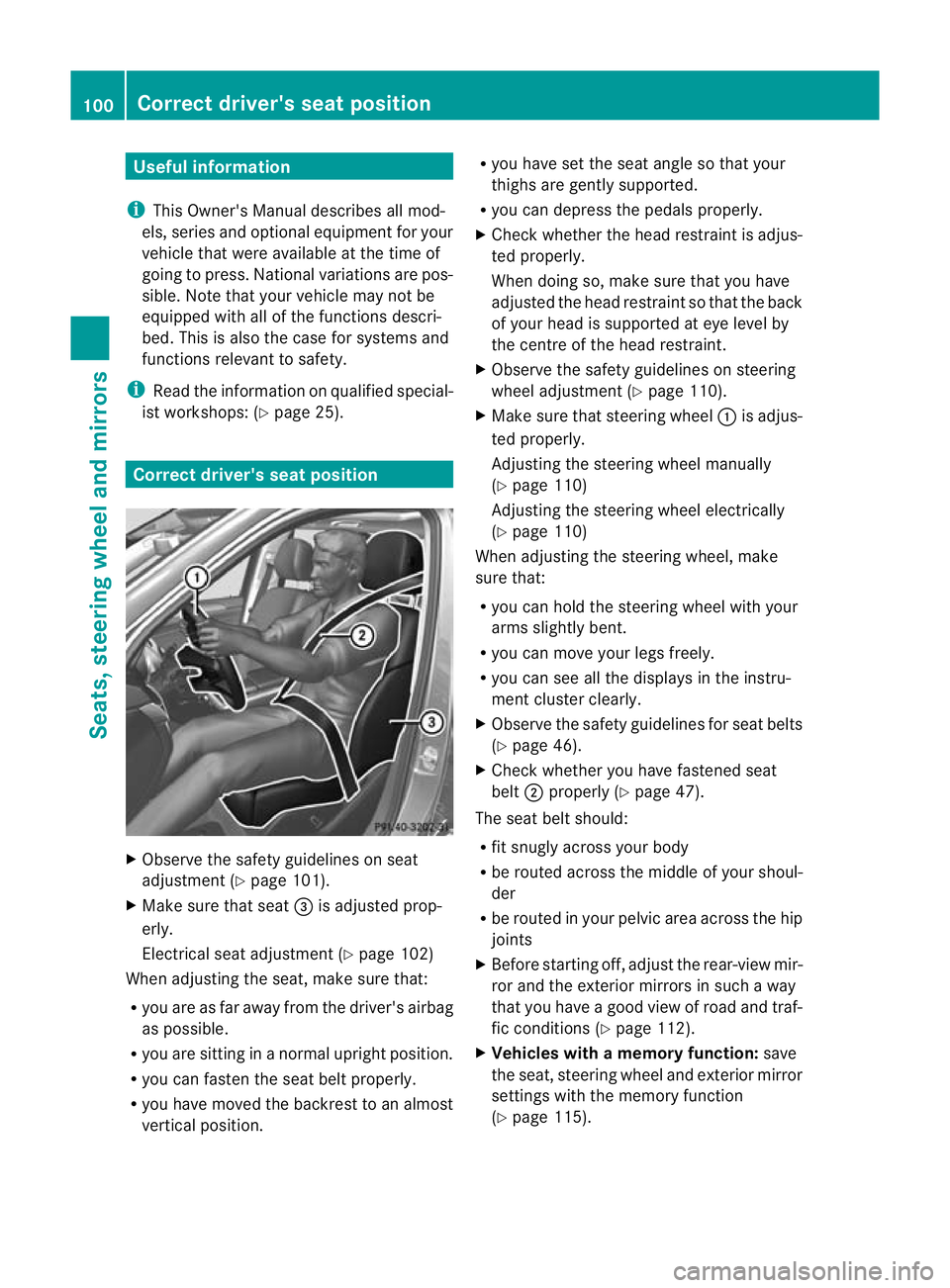
tdriver' sseat position X
Observ ethe safet yguideline sonseat
adjustmen t(Y page 10 1).
X Make sur ethat seat =is adjusted prop-
erly.
Electrical seat adjustmen t(Y page 10 2)
When adjusting the seat, mak esure that:
R you are as far away from the driver' sairbag
as possible.
R you are sitting in anorma lupright position.
R you can faste nthe seat belt properly.
R you hav emoved the backrest to an almost
vertical position. R
you have set the seat angle so that your
thighs ar egently supported.
R you can depress the pedals properly.
X Check whether the head restraint is adjus-
ted properly.
When doing so, mak esure that you have
adjusted the head restraint so that the back
of your head is supported at eye level by
the centre of the head restraint.
X Observe the safety guidelines on steering
wheel adjustment (Y page 110).
X Make sure that steering wheel :is adjus-
ted properly.
Adjusting the steering wheel manually
(Y page 110)
Adjusting the steering wheel electrically
(Y page 110)
When adjusting the steering wheel ,make
sure that:
R you can hold the steering wheel with your
arms slightly bent.
R you can move your legs freely.
R you can see all the displ aysint he instru-
men tcluster clearly.
X Observe the safety guidelines for seat belts
(Y page 46).
X Check whether you have fastened seat
belt ;properly (Y page 47).
The seat belt should:
R fit snugly across your body
R be routed across the middle of your shoul-
der
R be routed in your pelvic area across the hip
joints
X Befor estartin goff, adjus tthe rear-view mir-
ror and the exterior mirrors in such away
that you have agood view of roa dand traf-
fic conditions (Y page112).
X Vehicle switham emory function: save
the seat, steering wheel and exterior mirror
settings with the memor yfunction
(Y page 115). 100
Correct driver's seat positionSeats, steerin
gwhee land mirrors
Page 104 of 441

Seats
Important safety notes
G
WARNING
The seat scan still be adjusted when there is
no key in the ignition lock. For this reason,
children shoul dnever be left unsupervised in
the vehicle. They could adjust the seats and
becom etrapped. G
WARNING
Only adjus tthe driver's seat when the vehicle
is stationary .You will otherwise be distracted
from the road and traffic condition sand you
could los econtrol of the vehicle as aresult of
the seat moving. This could cause an acci-
dent. G
WARNING
If you adjust the seat height carelessly, you or
others could be trapped and thereby injured.
Children in particula rcould unintentionally
press the buttons to electrically adjust the
seats and becom etrapped.
Take care that:
R while moving th eseats, your hands do not
get under the lever assembly of the seat
adjustmen tsystem.
R children in the vehicle do not slid etheir
hands unde rthe levers. G
WARNING
Make sur ethat nobody can becom etrapped
when adjustin gthe seats.
Observ ethe note sonairbags.
Secur echildren as recommended; see the
"Childre ninthe vehicle" section. G
WARNING
Make sur ethat the bac kofyour head is sup-
ported at eye level by the cen tralarea of the
head restraint. If your head is not supported
correctly by th ehead restraint ,you coul dsuf-
fer asever eneck injury in the event of an accident
.Never driv eifthe head rest raints are
not engaged and set correctly. G
WARNING
As eat belt can only offer its intended degree
of protection when the back rest is almost ver-
tical and the occupan tiss itting upright. Avoid
seat positions that do not allow the seat belt
to be routed correctly. Adjust the backrest so
that it is as upright as possible .Never travel
with the back rest reclined too fa rbackwards.
You could otherwise be seriousl yoreven
fatally injured in th eevent of an accident or
sudden braking.
! To avoid damag etothe seats and the seat
heating, observe the followin ginformation:
R do not spill any liquids on the seats. If
liquid is spilled on the seats, dry them as
soon as possible.
R if the sea tcover sare damp or wet, do not
switc hont he seat heating. The seat
heating should also not be used to dry
the seats.
R clea nthe seat cover sasrecommended;
see "In terior care".
R do not transport heav yloads on the
seats. Do not plac eshar pobjects on the
seat cushions ,e.g. knives, nails or tools.
Th es eats should only be occupied by
passengers, if possible.
R when the seat heatin gisinoperation ,do
not cover the seats with insulating mate-
rials, e.g. blanke ts,c oats, bags, seat cov-
ers, child seats or booster seats.
! Make sure that ther eare no objects in the
footwell or behind th eseats when moving
the seat back .There is arisk that the seats
and/or the objects could be damaged.
i The head restraint scannot be removed
from the fron tseats. The rear-compart-
men thead restraints, however ,can be
removed (Y page 104).
For more information ,contac taqualified
specialist workshop. Seats
101Seats, steering wheel and mirrors Z