warning MERCEDES-BENZ GL SUV 2012 Owners Manual
[x] Cancel search | Manufacturer: MERCEDES-BENZ, Model Year: 2012, Model line: GL SUV, Model: MERCEDES-BENZ GL SUV 2012Pages: 441, PDF Size: 10.66 MB
Page 381 of 441
C
Warning triangle
D Wheel bolts
E Towing eye
X Lif tthe luggage compar tment floor up
(Y page 344). Flat ty
re Prep
aring the vehicle
Your vehicle may be equipped with:
R MOExtended tyres (tyres with run -flat char-
acteristics) (Y page 378)
R aT IREFIT kit (Y page 379)
R an emergency spare whee l(only for cer tain
countries) (Y page 414)
Information on changing/fitting awheel
(Y page 404).
Vehicle preparation is not necessar yonvehi-
cles with MOExtended tyres.
X Stop the vehicle as far away as possible
from traffic, on solid, non-slipper yand level
ground.
X Switch on the hazard warning lamps.
X Engag ethe electric parkin gbrake man-
ually.
X Bring th efront wheels into the straight-
ahead position.
X Move the DIRECT SELECT leve rtoP.
X Vehicle swith the ON&OFFROAD pack-
age: makesure that highway level is selec-
ted (Y page 207).
X Switch off the engine.
X Vehicles without KEYLESS-GO: remove
the key from the ignition lock.
X Vehicles with KEYLESS-GO: open the
driver' sdoor.
The on-boar delectronic shave status 0,
which is the same as the key having been
removed.
X Vehicles with KEYLESS-GO: remove the
Start/Stop button from the ignition lock
(Y page 159). X
All occupants must leave the vehicle. Make
sure that they are not endangered as they
do so.
X Make sure that no one is near the danger
area while awheel is being changed. Any-
one who is not directly assisting in the
wheel change should, for example, stand
behind the barrier.
X Get out of the vehicle. Pay attention to traf-
fic condition swhen doing so.
X Close the driver's door.
X Plac ethe warnin gtriangl easuitable dis-
tance away (Y page 376). Observe legal
requirements.
X Unload heavy luggage.
i Only operate the tyre inflation compres-
sor using a12Vs ocket,even if the ignition
is turned off (Y page 350).
An emergenc ycut-off ensures that the on-
board voltage does not drop too low. If the
on-board voltage is too low, the power to
the sockets is automatically cut. This
ensures that there is sufficient power to
start the engine. MOExtended tyres (tyres with run-flat
characteristics)
G
WARNING
When driving in emergenc ymode, the driving
characteristic sdeteriorate, e.g. when cor ner-
ing, accelerating quickly and when braking.
There is arisk of accident.
Do not exceed the stated maximum speed.
Avoid abrupt steering and drivin gmanoeu-
vres, and driving over obstacles (kerbs, pot-
holes ,off-road) .This applies in particular to a
laden vehicle.
Sto pdriving in emergency mod eif:
R you hear banging noises.
R the vehicl estart stos hake.
R you see smok eand smell rubber. 378
Flat tyreBreakdown assistance
Page 382 of 441
R
ESP ®
is intervening constantly.
R there are tears in the sidewall softhe tyre.
After driving in emergency mode, have the
whee lrims checked at aquali fied specialist
workshop with regar dtotheir furthe ruse. The
fault ytyre must be replaced.
With MOExtended tyres (tyres with run-flat
characteristics), you can continue to drive
your vehicle even if there is atotal loss of
pressure in one or mor etyres.
MOExtended tyres may only be used in con-
junction with an active tyre pressure loss
warning syste morwith an activ etyre pres-
sure monitor.
The maximum driving distance is approx-
imately 80 km when the vehicle is partially
laden, and approximatel y30kmwhen the
vehicle is fully laden.
In addition to the vehicle load, the drivin gdis-
tance possible depends upon:
R speed
R road condition
R outside temperature
The drivin gdistance possible in run-flat mode
may be reduced by extrem edriving condi-
tions/manoeuvres ,oritcan be increased
through amoderate style of driving.
The maximum permissible distance which
can be driven in run-flat mode is counted from
the moment the tyr epressure loss warning
appe arsint he multifunction display.
You must not exceed amaximum spee dof
80 km/h.
i When replacing one or all tyres, make
sure tha tyou only use tyres marked
"MOExtended". Make sure that you only
use the size of tyr especified for the vehicle.
i Vehicles with MOExtended tyres are not
equipped with aTIREFIT kit at th efactory.
It is therefore recommended that you addi-
tionally equip your vehicle with aTIREFIT kit
if yo ufit tyres that do not featur erun-flat
characteristics, e.g. winter tyres. ATIREFIT kit can be obtaine
dfrom aqualified spe-
cialist workshop. TIREFIT kit
Usin gthe TIREFIT kit TIREFIT is
atyre seal ant.
You can use TIREFIT to seal punctures of up
to 4m m, particularl ythose in the tyr etread.
Yo uc an use TIREFI Tatoutside temperatures
down to Ò20 †. G
WARNING
In the following situations, the tyre sealant is
unable to provide sufficient breakdown assis-
tance, as it is unable to seal the tyre properly:
R there are cuts or punctures in the tyre
larger than those mentioned above.
R the wheel rim is damaged.
R you have driven at very low tyre pressures
or on aflat tyre.
There is arisk of accident.
Do not drive any further. Contact aqualified
specialist workshop. G
WARNING
The tyre sealant is harmful and causes irrita-
tion. It must not come into contact with your
skin, eyes or clothing or be swallowed. Do not
inhale TIREFIT fumes. Keep tyre sealant away
from children. There is arisk of injury.
If you come into contact with the tyre sealant,
observe the following:
R Rinse off the tyre sealant from your skin
immediately with water.
R If the tyre sealant comes into contact with
your eyes, immediately rinse them thor-
oughly with clean water.
R If tyre sealant is swallowed, immediately
rinse your mouth out thoroughly and drink
plenty of water. Do not induce vomiting,
and seek medical attention immediately. Flat tyre
379Breakdown assistance
Z
Page 384 of 441
If
at yre press ureof1 80 kPa (1.8 bar/
26 psi) ha snot been attaine dafter five
minutes :(Ypage 381).
i If the tyr esealant leaks out, allow it to dry.
It can then be removed like alayer of film.
If you get tyre sealant on you rclothing,
have it cleaned as soon as possible with
perchloroethylene.
Tyre pressur enot reached If
ap ressure of 180 kPa (1.8 ba r/26 ps i)has
not been achieved after five minutes:
X Switc hoff th etyre inflation compressor.
X Unscrew the filler hos efrom the valve of
the faulty tyre.
X Very slowly drive forwards or reverse
approximatel y10m.
X Pum pupt he tyreagain.
Af teram aximum of five minutes the tyre
pressure must be at least 180 kPa (1.8 bar/
26 psi). G
WARNING
If the required tyre pressure is not reached
after the specified time, the tyre is too badly
damaged. The tyre sealant cannot repair the
tyre in this instance. Damaged tyres and atyre
pressure that is too low can significantly
impair the vehicle's braking and driving char-
acteristics. There is arisk of accident.
Do not continue driving. Contact aqualified
specialist workshop.
Tyr epressure reached G
WARNING
At yre temporarily sealed with tyr esealant
impairs th edrivin gcharacteristic sand is not
suitable for higher speeds. There is arisk of
accident.
You should therefor eadapt your driving style
accordingly and driv ecarefully. Do not exceed
the specified maximum spee dwithatyre that
has been repaired using tyre sealant. !
After use, excess tyre seal antm ay run out
of the filler hose. This could cause stains.
Therefore, place the filler hos einthe plastic
bag whic hcontaine dthe TIREFIT kit. H
Environmenta
lnote
Have the used tyre sealant bottle disposed of
professionally, e.g. at aqualified specialist
workshop.
If at yrep ressure of 18 0kPa (1. 8bar/2 6psi)
has been attained after five minutes:
X Switc hoff th etyre inflation compressor.
X Unscrew the filler hos efrom th evalve of
the faulty tyre.
X Stow the tyre sealant bottle, the tyre infla-
tion compressor and the warning triangle.
X Pull away immediately.
The maximum spee dfor atyre sealed with
tyre sealant is 80 km/h. The upper part of
the TIREFI Tsticker must be affixed to the
instrument cluster in the driver's field of
vision.
X Stop after driving for approximately ten
minutes and check the tyre pressure with
the tyre inflation compressor.
The tyre pressure must now be at least
130 kPa (1.3 bar/19 psi). G
WARNING
If the required tyre pressure is not reached
after driving for ashort period, the tyr eistoo
badly damaged. The tyr esealant can not
re pair the tyr einthis instance. Damaged tyres
and atyre pressure that is too low can signif-
icantly impair the vehicle's braking and driv-
ing characteristics. There is arisk of accident.
Do not continue driving. Contact aqualified
specialist workshop.
X Correct the tyre pressure if it is still at least
130 kPa (1.3 bar/19 psi) (see the fuel filler
flap for values).
X To increase the tyre pressure: switch on
the tyre inflation compressor. Flat tyre
381Breakdown assistance Z
Page 385 of 441
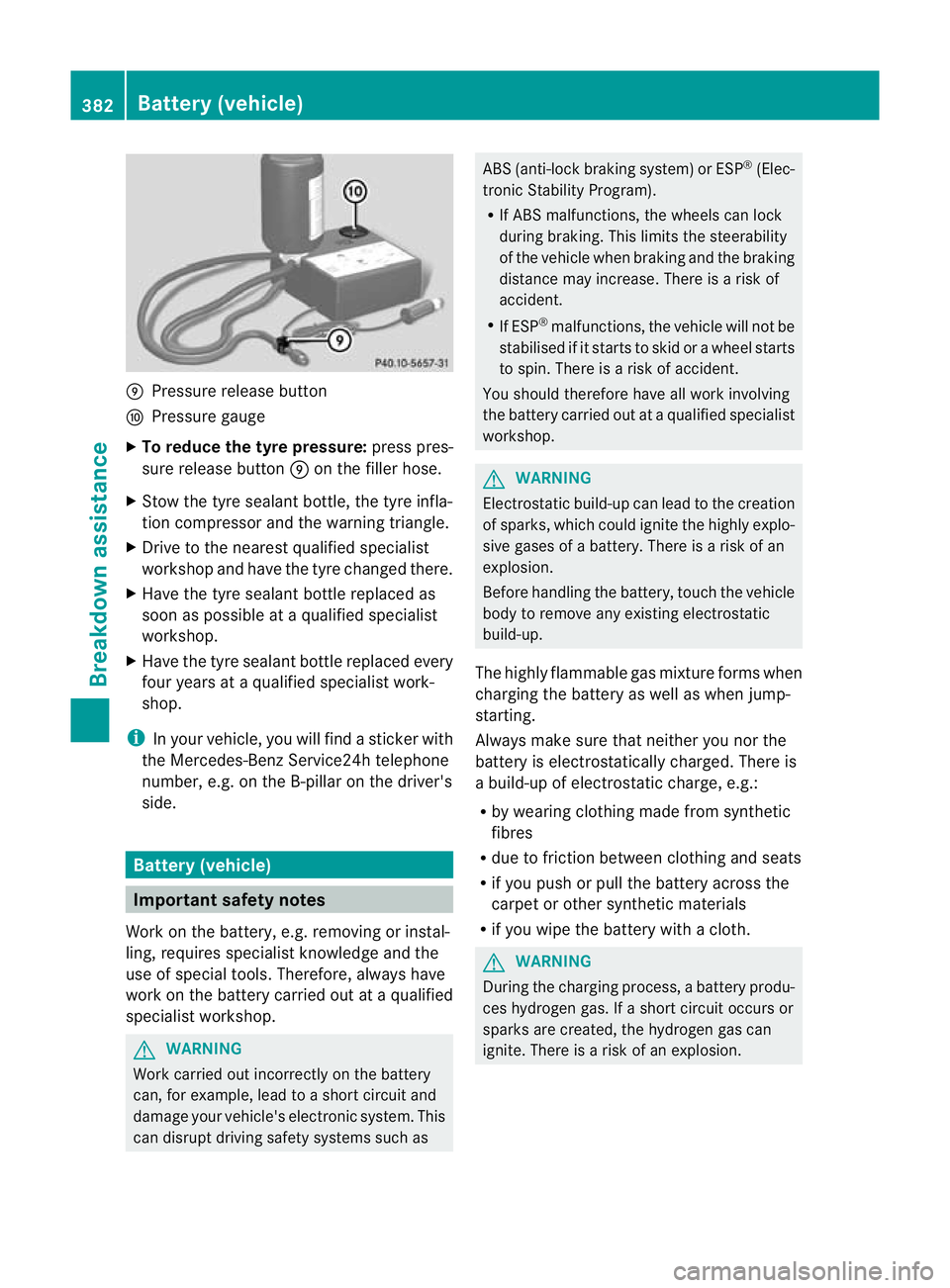
E
Pressur erelease button
F Pressur egauge
X To reduce the tyr epressure: press pres-
sure releas ebutton Eon the filler hose.
X Stow the tyre sealant bottle, the tyre infla-
tion compressor and the warning triangle.
X Drive to the nearest qualified specialist
worksho pand have the tyre changed there.
X Have the tyre sealant bottle replace das
soon as possible at aqualified specialist
workshop.
X Have the tyre sealant bottle replaced every
four years at aqualified specialist work-
shop.
i In your vehicle, you will find asticker with
the Mercedes-Benz Service24h telephone
number, e.g. on the B-pillar on the driver's
side. Battery (vehicle)
Important safety notes
Work on the battery, e.g. removin gorinstal-
ling ,requires specialist knowledge and the
use of special tools. Therefore, always have
work on the batter ycarried out at aqualified
specialist workshop. G
WARNING
Work carried out incorrectly on the battery
can, for example, lead to ashort circui tand
damage your vehicle's electronic system. This
can disrupt driving safety systems such as ABS (anti-lock braking system) or ESP
®
(Elec-
tronic Stability Program).
R If ABS malfunctions ,the wheels can lock
during braking. This limits the steerability
of the vehicle when brakin gand the braking
distance may increase. There is arisk of
accident.
R If ESP ®
malfunctions, the vehicle will not be
stabilised if it start stoskid or awheel star ts
to spin. There is arisk of accident.
You should therefore have all work involving
the batter ycarried out at aqualified specialist
workshop. G
WARNING
Electrostatic build-up can lead to the creation
of sparks, which could ignite the highly explo-
sive gases of abattery. There is arisk of an
explosion.
Befor ehandling the battery, touch the vehicle
body to remove any existing electrostatic
build-up.
The highly flammable gas mixture forms when
charging the battery as well as when jump-
starting.
Always make sure that neither you nor the
batter yiselectrostatically charged. There is
ab uild-up of electrostatic charge, e.g.:
R by wearing clothing made from synthetic
fibres
R due to friction betwee nclothin gand seats
R if you pus horpull the batter yacross the
carpe torother synthe ticm aterials
R if you wipe the batter ywithacloth. G
WARNING
Durin gthe charging process, abatter yprodu-
ces hydroge ngas. If ashort circui toccurs or
sparks are created, the hydroge ngas can
ignite. There is arisk of an explosion. 382
Battery (vehicl
e)Breakdown assistance
Page 386 of 441
R
Make sur ethat the positive terminal of a
con nected battery doe snot com einto con-
tact with vehicl eparts.
R Never place metal objects or tools on abat-
tery.
R It is important that you observe the descri-
bed order of the battery terminals when
connectin gand disconnectin gabattery.
R When jump-starting, make sure that the
battery poles with identical polarity are
connected.
R It is particularly important to observe the
described order when connectin gand dis-
connectin gthe jum pleads.
R Never connect or disconnect the battery
terminals while the engine is running. G
WARNING
Bat tery acid is caustic. There is arisk of injury.
Avoid contact with the skin, eyes or clothing.
Do not inhale any battery gases. Do not lean
over the battery. Keep children away from
batteries. Wash battery acid immediately with
water and seek medical attention. H
Environmental note Batteries contain pollutants.
It is illegal to dispose of them
with the household rubbish.
They must be collected sep-
arately and dispose
dofinan
environmen tally responsible
recycling system. Dispose of batteries in an
environmentally responsible
manner
.Take discharged
batteries to aqualified spe-
cialist workshop or to acol-
lection point for used batter-
ies.
! Hav ethe battery chec kedr egularly at a
qualified specialist workshop.
Observ ethe service intervals in the Service
Booklet or con tact aq ualified specialist
worksho pfor mor einformation. !
You should have all work involving the
battery carried out at aqualified specialist
workshop. In the exceptional case that it is
necessar yfor you to disconnect th ebattery
yourself, mak esure that:
R you switc hoff the engine and remove the
key. On vehicles with KEYLESS-GO,
ensure that the ig nition is switched off.
Chec kthat all the indicator lamps in the
instrumen tcluster are off. Otherwise,
electronic components, such as the
alternator, may be damaged.
R you first remov ethe negativ eterminal
clam pand then the positive terminal
clamp. Never swap the terminal clamps.
Otherwise, the vehicle's electronic sys-
tem may be damaged.
R the transmissio nislocke dinp osition P
after disconnectin gthe battery .The vehi-
cle is secured against rolling away. You
can then no longer mov ethe vehicle.
The battery and the cover of the positive
termi nalclamp must be fitted securely dur-
ing operation.
Comply with safety precautions and take pro-
tective measures when handling batteries. WARNING
Fire, naked flames and smoking
are prohibited when handling the
battery
.Avoi dc reating sparks. Battery aci
discaustic. Avoid con-
tact with the skin, eyes or clothing.
Wear suitable protective clothing,
in particular gloves, an apron and
af ace mask.
Immediately rinse acid splashes
off with clean water. Consult adoc-
tor if necessary. Wear eye protection. Ba
ttery (vehicle)
383Breakdown assistance Z
Page 387 of 441
Kee
pchildr en away. Obse
rve this Owner' sManual.
For safet yreasons ,Mercedes-Ben zrecom-
mends that you only use batteries which have
been tested and approved for your vehicle by
Mercedes-Benz. These batteries provide
inc reased impact protection to preven tvehi-
cle occupant sfrom suffering aci dburns
should the batter ybedamaged in the event
of an accident.
In order for the batter ytoachieve the maxi-
mum possibl eservic elife, it must always be
sufficiently charged.
The vehicle battery, like other batteries, can
discharge over time if you do not use the
vehicle. In such cases, have the batter ydis-
connected at aqualified specialist workshop.
You can also charge the batter ywith a
charger recommended by Mercedes-Benz.
For more information ,please contact aquali-
fied specialist workshop.
Have the batter ycharge checked mor efre-
quently if yo uuse the vehicle mainl yfor short
trips or if you leav eitstanding idle for a
lengthy period .Consult aqualified specialist
workshop if you wish to leave your vehicle
parked up for along period of time.
i When you par kthe vehicle, remove the
key if you do not requir eany electrical con-
sumers .The vehicle will then use ver ylittle
energy, thus conservin gbatter ypower.
i If the power supply has been interrupted,
e.g. if the batter ywas discharged ,you will
have to:
R set the cloc k.Informatio nonsetting the
cloc kcan be found in the separate oper-
ating instructions. On vehicles with COMAND Online and a
navigation system, the clock is set auto-
matically.
R reset the function for folding the exterior
mirror sin/out automati cally, by folding
the mirror sout onc e(Ypage 11 3). Charging the battery
G
WARNING
Durin gchargin gand jump-starting, explosive
gases can escap efrom th ebattery. There is a
risk of an explosion.
Particularly avoid fire, naked flames, creating
sparks and smoking. Ensure there is sufficient
ventilation while chargin gand jump-starting.
Do not lean over abattery. G
WARNING
Battery acid is caustic .There is arisk of injury.
Avoid contact with the skin, eyes or clothing.
Do not inhale any battery gases. Do not lean
over the battery. Keep children away from
batteries. Wash battery acid immediately with
water and seek medical attention. G
WARNING
Ad ischarged battery can freeze at tempera-
tures below freezin gpoint .When jump-start-
ing the vehicle or charging the battery ,gases
can escape from the battery. There is arisk of
an explosion.
Allow the frozen battery to thaw out before
charging it or jump-starting.
! Only use battery chargers with amaxi-
mum charging voltage of 14.8 V.
! Only charge the battery using the jump-
start connection point.
Never charge abattery still installed in the
vehicle unless abattery charger unit
approved by Mercedes-Ben zisbeing used. A
batter ycharger uni tspecially adapted for
Mercedes-Benz vehicles and tested and
approved by Mercedes-Benz is available as an 384
Battery (vehicle)Breakdown assistance
Page 389 of 441
Jum
p-starting G
WARNING
Battery acid is caustic. There is arisk of injury.
Avoid contact with the skin, eyes or clothing. Do not inhale any battery gases. Do not lean over
the battery. Keep children away from batteries. Wash battery acid immediately with water and
seek medical attention. G
WARNING
Durin gcharging and jump-starting, explosive gases can escap efrom th ebattery. There is arisk
of an explosion.
Particularly avoid fire, naked flames, creating sparks and smoking. Ensure there is sufficient
ventilation while charging and jump-starting. Do not lean over abattery. G
WARNING
During the charging process, abattery produces hydrogen gas. If ashort circui toccurs or sparks
are created, the hydroge ngas can ignite. There is arisk of an explosion.
R Make sure that the positive terminal of aconnecte dbattery does not come into contact with
vehicle parts.
R Never place metal objects or tools on abattery.
R It is important that you observe the described order of the battery terminals when connecting
and disconnecting abattery.
R When jump-starting, make sure that the battery poles with identical polarity are connected.
R It is particularly important to observe the described order when connecting and disconnecting
the jump leads.
R Never connect or disconnect the battery terminals while the engine is running. G
WARNING
Ad ischarged battery can freeze at temperatures below freezin gpoint .When jump-startin gthe
vehicle or charging the battery ,gases can escape from the battery. There is arisk of an explosion.
Allow the frozen battery to thaw out before charging it or jump-starting. G
WARNING
Non-combusted fuel can collect in the exhaust system and ignite. There is arisk of fire. Avoid
repeated and lengthy startin gattempts.
! Vehicles with apetrol engine: avoid repeated and lengthy starting attempts. Otherwise,
the non-combusted fuel may damage the catalytic converter. 386
Jump-sta
rtingBreak down assistance
Page 391 of 441
X
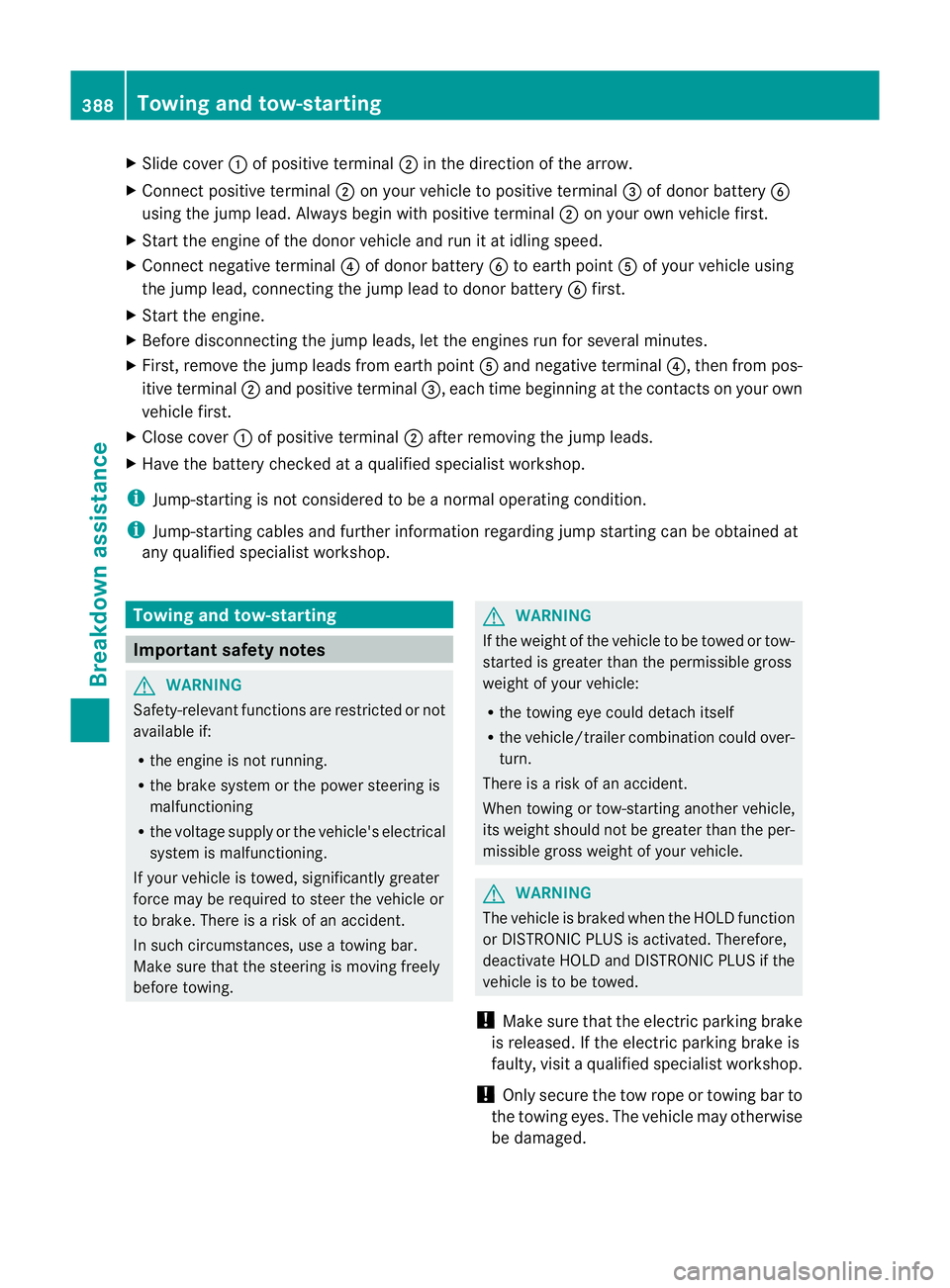
Slide cover :of positive terminal ;in the direction of the arro w.
X Connect positive terminal ;on your vehicl etopositive terminal =of donor battery B
using the jum plead. Alway sbegin with positive terminal ;on your own vehicle fir st.
X Start th eengine of the donor vehicle and run it at idling speed.
X Connec tnegativ eterminal ?of donor battery Bto eart hpoint Aof your vehicle using
the jum plead, connectin gthe jum plead to donor battery Bfirst.
X Start the engine.
X Before disconnecting the jum pleads, let the engines run for several minutes.
X First, remove the jum pleads from eart hpoint Aand negative terminal ?,then from pos-
itiv eterminal ;and positiv eterminal =,each time beginning at the contacts on your own
vehicle first.
X Close cover :of positive terminal ;after removing the jump leads.
X Have the battery checked at aqualified specialist workshop.
i Jump-starting is not considered to be anormal operatin gcondition.
i Jump-starting cables and further information regarding jum pstartin gcan be obtained at
any qualified specialis tworkshop. Towing and tow-starting
Important safety notes
G
WARNING
Safety-relevant func tions are restric tedorn ot
available if:
R the engin eisnot running.
R the brake system or the power steering is
malfunctioning
R the voltage supply or the vehicle' selectrical
system is malfunctioning.
If your vehicle is towed, significantly greater
forc emay be required to steer the vehicle or
to brake. There is arisk of an accident.
In such circumstances, use atowing bar.
Make sure that the steering is moving freely
befor etowing. G
WARNING
If the weight of the vehicle to be towed or tow-
started is greater than the permissible gross
weight of your vehicle:
R the towin geye could detach itself
R the vehicle/traile rcombination coul dover-
turn.
There is arisk of an accident.
When towing or tow-startin ganothe rvehicle,
its weight should not be greater than the per-
missible gross weight of your vehicle. G
WARNING
The vehicle is braked when the HOL Dfunction
or DISTRONIC PLUS is activated. Therefore,
deactivate HOLD and DISTRONIC PLUS if the
vehicle is to be towed.
! Make sure that the electric parking brake
is released. If the electric parking brake is
faulty, visit aqualified specialist workshop.
! Only secure the tow rope or towing bar to
the towing eyes. The vehicle may otherwise
be damaged. 388
Towin
gand tow-startingBreakdow nassistance
Page 393 of 441
Fitting/removing th
etowing eye
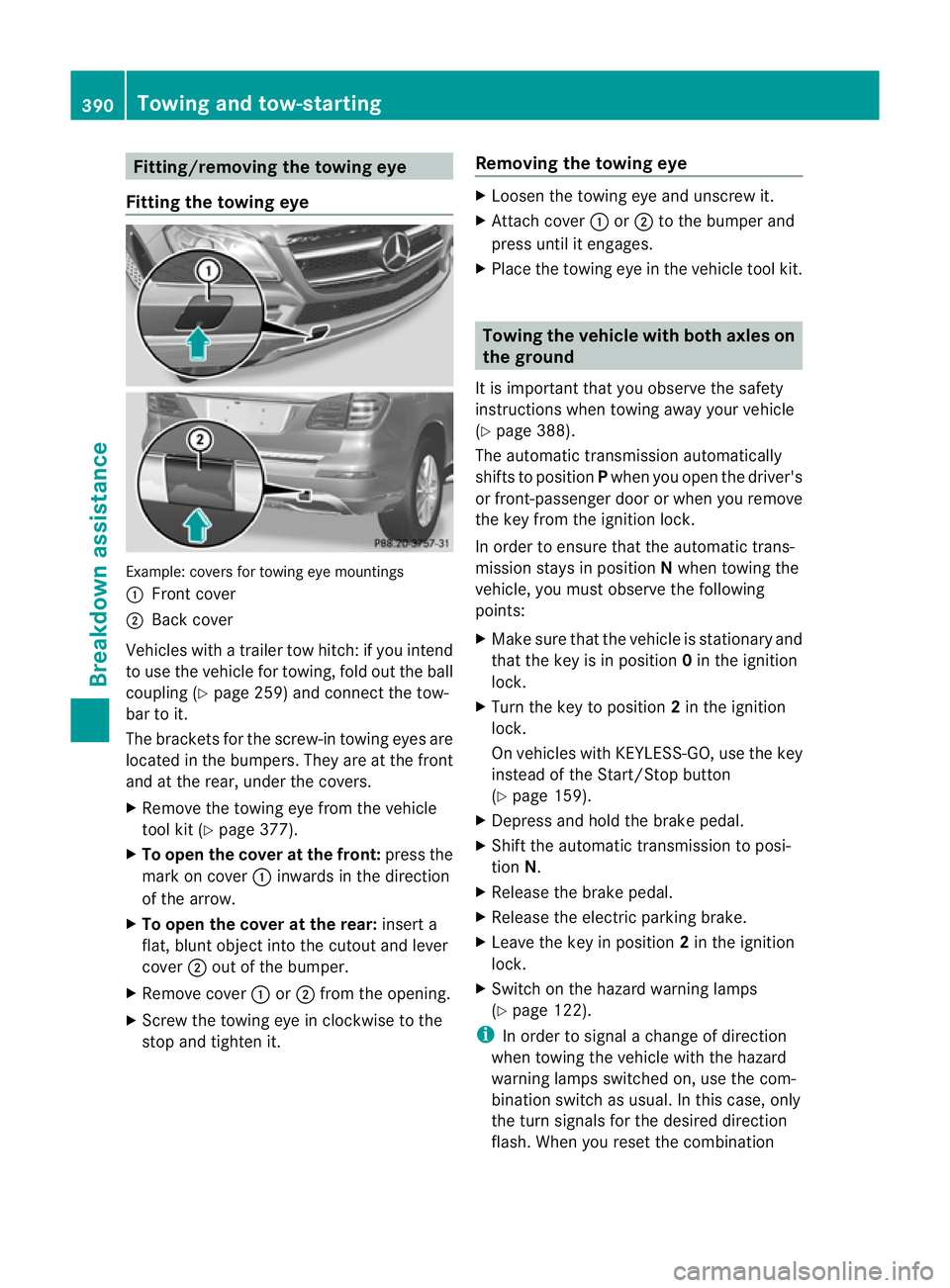
Fitting th etowing eye Example: cover
sfor towin geye mountings
: Front cover
; Bac kcover
Vehicles with atrailer to whitch :ify ou intend
to use the vehicle for towing, fold out the ball
coupling (Y page 259) and con nect the tow-
bar to it.
Th eb rackets for th escrew-i ntowing eyes are
located in the bumpers. They ar eatthe front
and at the rear, under the covers.
X Remove the towing eye from the vehicle
tool kit (Y page 377).
X To ope nthe cover at the front: press the
mark on cover :inwards in th edirection
of the arrow.
X To open the cover at the rear: insert a
flat, blunt object into the cutout and lever
cover ;out of the bumper.
X Remove cover :or; from the opening.
X Screw the towing eye in clockwise to the
stop and tighten it. Removing the towing eye X
Loosen the towing eye and unscrew it.
X Attach cover :or; to the bumper and
press until it engages.
X Place the towing eye in the vehicle tool kit. Towing the vehicle with both axles on
the ground
It is important that you observe the safety
instructions when towing away your vehicle
(Y page 388).
The automatic transmission automatically
shifts to position Pwhen you open the driver's
or front-passenger door or when you remove
the key from the ignition lock.
In order to ensure that the automatic trans-
mission stays in position Nwhen towing the
vehicle, you must observe the following
points:
X Make sure that the vehicle is stationary and
that the key is in position 0in the ignition
lock.
X Turn the key to position 2in the ignition
lock.
On vehicles with KEYL ESS-GO, use the key
instead of the Start/Stop button
(Y pag e159).
X Depres sand hol dthe brake pedal.
X Shif tthe automatic transmission to posi-
tion N.
X Release the brake pedal.
X Release the electric parkin gbrake.
X Leave th ekey in position 2in the ignition
lock.
X Switch on the hazar dwarning lamps
(Y page 122).
i In order to signal achange of direction
when towing the vehicle with the hazard
warnin glamps switched on, use the com-
bination switch as usual .Inthis case ,only
the turn signals for the desired direction
flash .When you reset the combination 390
Towing and tow-startingBreakdown assistance
Page 394 of 441
switch, the hazard warnin
glamps start
flashing again. Transporting the vehicle
! Only lash the vehicle down by the wheels
or wheel rims, not by parts of the vehicle
such as axle or steering components. Oth-
erwise, the vehicle could be damaged.
The towing eyes or trailer tow hitch can be
used to pull the vehicle onto atrailer or trans-
porter if yo uwish to transport it.
X Turn the key to position 2in the ignition
lock.
X Shift the automatic transmission to posi-
tion N.
As soon as the vehicle is loaded:
X Prevent the vehicle from rolling away by
applying the electric parkin gbrake.
X Shift th eautomatic transmission to posi-
tion P.
X Turn the key to position 0in the ignition
lock and remove it.
X Secure the vehicle. Information for 4MATIC vehicles
! Vehicles with 4MATIC must not be towed
with the front or rear axle raised; otherwise,
the transmission may be damaged.
If the vehicle has transmission damage or
damage to the front or rear axle, have it trans-
ported on atransporter or trailer.
In the even tofdamage to the ele ctrical
system
If the battery is defective, the automatic
transmission will be locked in position P.To
shif tthe automatic transmission to position
N,y ou must provide power to the vehicle's
electrical system in the same way as when
jump-starting (Y page 386).
Hav ethe vehicle transported on atransporter
or trailer. Recov
ering avehicle that ha sbecome
stuck
! When recovering atrapped vehicle ,donot
je rk the vehicle or pull it at an angle. If the
tractive powe rist oo high, th evehicles
could be damaged.
If th edrive wheels ge ttrapped on loose or
muddy ground, recover th evehicle with the
utmost care, especially so if the vehicle is
laden.
Never attempt to recover avehicle with a
trailer atta ched.
Pull out the vehicle backwards, if possible,
using the tracks it made when it became
stuck. Tow-starting (emergency engine
starting)
! Vehicles with automatic transmission
must not be tow-star ted. Otherwise, you
could damage the automatic tra nsmission.
You ca nfind information on "Jump-starting"
at (Y page 386). Electrical fuses
Important safet
ynotes G
WARNING
Only use fuses that have been approved for
Mercedes-Benz vehicles and which have the
correct fuse ratin gfor the system scon-
cer ned. Do not attempt to repair or bridge
faulty fuses. Usin gfuses which have not been
approved or attempting to repair or bridge
faulty fuses could cause the fuse to be over-
loaded and result in afire. Have the cause
traced and rectified at aqualified specialist
workshop.
! Only use fuses marked with an "S" for the
fuse box in the engine compartment and
under the rear bench seat. Components or
systems could othe rwise be damaged. Electrical fuses
391Breakdown assistance Z