tyre pressure MERCEDES-BENZ GL SUV 2012 Owner's Manual
[x] Cancel search | Manufacturer: MERCEDES-BENZ, Model Year: 2012, Model line: GL SUV, Model: MERCEDES-BENZ GL SUV 2012Pages: 441, PDF Size: 10.66 MB
Page 339 of 441
Tyres
Problem Possible caus
es/consequences andM Solutions
h
Th
ey ello wtyre pres-
sure monitor warning
lamp is on. The tyre pressure monitor ha
sdetected alossofp ressureinat
leas tone of the tyres.
G WARNING
With tyre press ures which are too low, there is ariskoft he fol-
lowin ghazards:
R they may burst, especiall yasthe load and vehicle speed
increase.
R they ma ywear excessively and/or unevenly, which may greatly
impair tyr etraction.
R thed riving characteristics, as well as steering and braking, may
be greatl yimpaired.
There is arisk of an accident.
X Stop the vehicle without makin gany sudden steering or braking
manoeuvres .Pay attention to the traffic conditions as you do
so.
X Secure the vehicle against rolling away (Y page 181).
X Observe the additional displ aymessage sint he multifunction
display.
X If ther eisaflat tyre ,inspect the tyres (Y page378).
X Check the tyre pressure (Y page402).
X If necessary, correct the tyre pressure. 336
Warnin
gand indicator lam psin th einstru ment clusterOn-board computer and displays
Page 371 of 441
High-pressure cl
eaning equipment G
WARNING
Do not use high-pressure cleaner swith circu-
lar-jet nozzles (dirt grinders) to clean your
vehicle ,inparticular the tyres. You could oth-
erwise damage the tyres and cause an acci-
dent.
! Always maintain adistance of at least
30 cm between the vehicle and the high-
pressure cleaner nozzle. Information about
the correc tdistanc eisavailable from the
equipment manufacturer.
Move the high-pressure cleane rnozzle
around when cleanin gyour vehicle.
Do not aim directly at any of the following:
R tyres
R door gaps, roof gaps, join tsetc.
R electrical components
R battery
R connectors
R lights
R seals
R trim elements
R ven tilation slots
Damaged seals or electrical components
can lead to leaks or failures.
Cleanin gthe paintwork !
Do not affix:
R stickers
R films
R magnetic plate sorsimilar items
to painted surfaces. You could otherwise
damage the paintwork.
Scratches, corrosive deposits, areas affected
by corrosion and damage caused by inade-
quate care cannot always be completely
repaired. In such cases, visit aqualified spe-
cialist workshop. X
Remove impurities immediately, where
possible, whils tavoiding rubbing to ohard.
X Soak insect remains with insect remover
and rinse off the treated areas afterwards.
X Soak bird droppings with water and rinse
off the treated areas afterwards.
X Remove coolant, brake fluid, tree resin,
oils, fuels and greases by rubbing gently
with acloth soaked in petroleum ether or
lighter fluid.
X Use tar remover to remov etar stains.
X Use silicone remover to remove wax.
Care and treatment of mat tpaintwork !
Never polis hthe vehicle or the light alloy
wheels. Polishin gmakes the paintwork
shiny.
! The following may cause the paint to
become shiny and thus reduce the matt
effect:
R Vigorous rubbing with unsuitable mate-
rials.
R Frequent use of car washes.
R Washing the vehicle in direct sunlight.
! Never use paint cleaner, buffing or pol-
ishing products, or glos spreserver, e.g.
wax .These product sare onl ysuitable for
high-glos ssurfaces. Thei ruse on vehicles
wit hm att finish leads to considerable sur-
face damage (shiny, spotted areas).
Always have paintwork repairs performed
at aq ualified specialist workshop, e.g. a
Mercedes-Ben zService Centre.
! Do not use wash programs with ahot wax
treatmen tunder any circumstances.
Observe thes enotes if your vehicle has a
clea rmatt finish. This will help you to avoid
damage to the paintwork due to incorrect
treatment.
Thes enotes also apply to light-alloy wheels
with aclear matt finish. 368
CareMaintenance and care
Page 382 of 441
R
ESP ®
is intervening constantly.
R there are tears in the sidewall softhe tyre.
After driving in emergency mode, have the
whee lrims checked at aquali fied specialist
workshop with regar dtotheir furthe ruse. The
fault ytyre must be replaced.
With MOExtended tyres (tyres with run-flat
characteristics), you can continue to drive
your vehicle even if there is atotal loss of
pressure in one or mor etyres.
MOExtended tyres may only be used in con-
junction with an active tyre pressure loss
warning syste morwith an activ etyre pres-
sure monitor.
The maximum driving distance is approx-
imately 80 km when the vehicle is partially
laden, and approximatel y30kmwhen the
vehicle is fully laden.
In addition to the vehicle load, the drivin gdis-
tance possible depends upon:
R speed
R road condition
R outside temperature
The drivin gdistance possible in run-flat mode
may be reduced by extrem edriving condi-
tions/manoeuvres ,oritcan be increased
through amoderate style of driving.
The maximum permissible distance which
can be driven in run-flat mode is counted from
the moment the tyr epressure loss warning
appe arsint he multifunction display.
You must not exceed amaximum spee dof
80 km/h.
i When replacing one or all tyres, make
sure tha tyou only use tyres marked
"MOExtended". Make sure that you only
use the size of tyr especified for the vehicle.
i Vehicles with MOExtended tyres are not
equipped with aTIREFIT kit at th efactory.
It is therefore recommended that you addi-
tionally equip your vehicle with aTIREFIT kit
if yo ufit tyres that do not featur erun-flat
characteristics, e.g. winter tyres. ATIREFIT kit can be obtaine
dfrom aqualified spe-
cialist workshop. TIREFIT kit
Usin gthe TIREFIT kit TIREFIT is
atyre seal ant.
You can use TIREFIT to seal punctures of up
to 4m m, particularl ythose in the tyr etread.
Yo uc an use TIREFI Tatoutside temperatures
down to Ò20 †. G
WARNING
In the following situations, the tyre sealant is
unable to provide sufficient breakdown assis-
tance, as it is unable to seal the tyre properly:
R there are cuts or punctures in the tyre
larger than those mentioned above.
R the wheel rim is damaged.
R you have driven at very low tyre pressures
or on aflat tyre.
There is arisk of accident.
Do not drive any further. Contact aqualified
specialist workshop. G
WARNING
The tyre sealant is harmful and causes irrita-
tion. It must not come into contact with your
skin, eyes or clothing or be swallowed. Do not
inhale TIREFIT fumes. Keep tyre sealant away
from children. There is arisk of injury.
If you come into contact with the tyre sealant,
observe the following:
R Rinse off the tyre sealant from your skin
immediately with water.
R If the tyre sealant comes into contact with
your eyes, immediately rinse them thor-
oughly with clean water.
R If tyre sealant is swallowed, immediately
rinse your mouth out thoroughly and drink
plenty of water. Do not induce vomiting,
and seek medical attention immediately. Flat tyre
379Breakdown assistance
Z
Page 383 of 441
R
Immediately chang eout of clothing which
has come into contact with tyre sealant.
R If an allergic reaction occurs, seek medical
attention immediately.
! Do not operate the tyre inflation com-
pressor for longe rthan eight minutes at a
tim ew ithou tabreak. It may othe rwise
overheat.
The tyre inflation compressor can be oper-
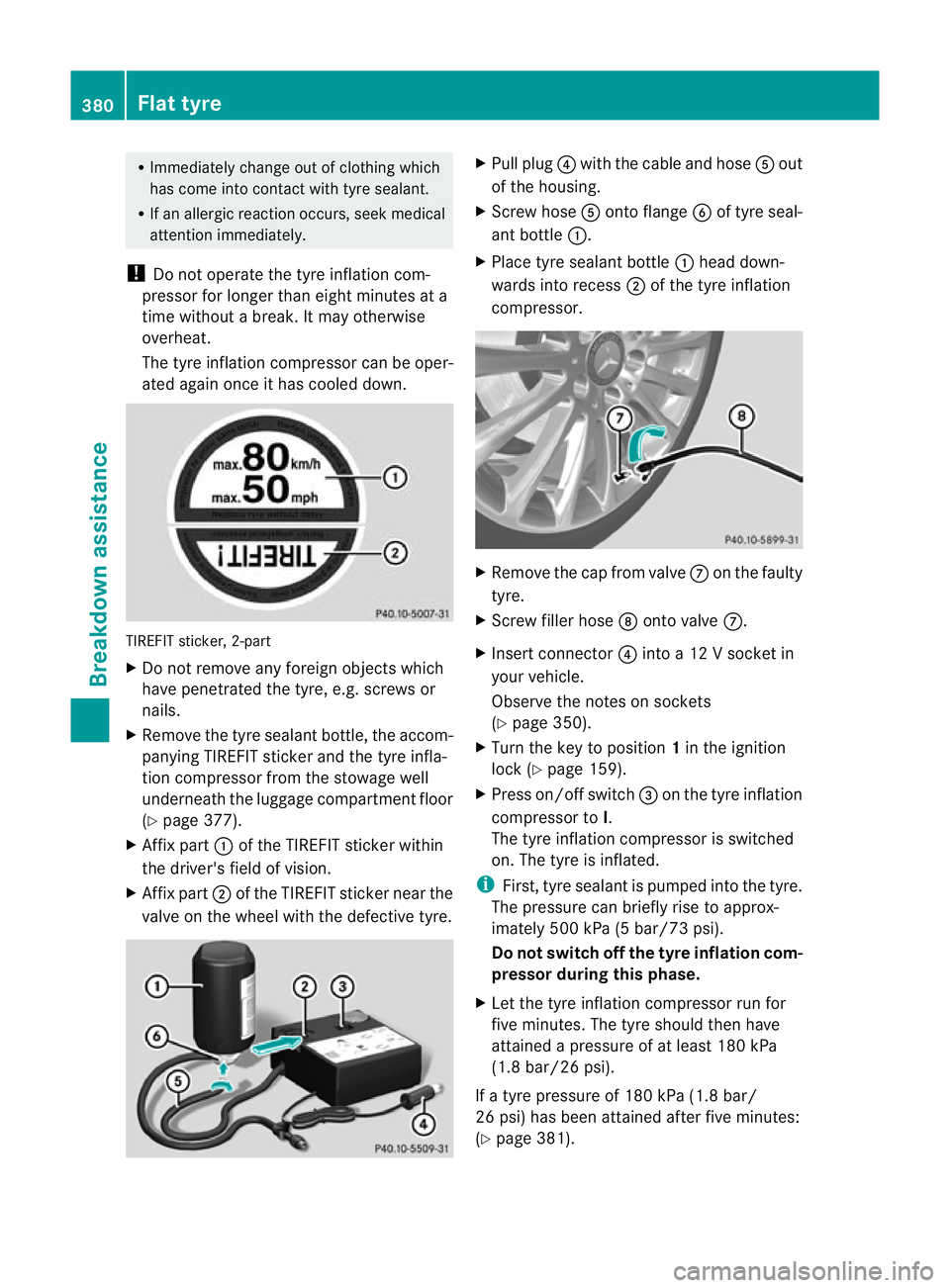
ated again onc eithas cooled down. TIREFIT sticker, 2-part
X
Do not remov eany foreig nobjects which
have penetrated the tyre, e.g. screws or
nails.
X Remov ethe tyr esealan tbottle, the accom-
panying TIREFIT sticker and the tyr einfla-
tion compressor from the stowage well
underneath the luggage compartment floor
(Y pag e377).
X Affix part :of the TIRE FITsticker within
the driver 'sfield of vision.
X Affix part ;of th eTIREFIT sticker near the
valve on th ewheel with the defective tyre. X
Pull plug ?with the cable and hose Aout
of the housing.
X Screw hose Aontoflange Bof tyre seal-
ant bottle :.
X Place tyre sealant bottle :head down-
wards int orecess ;of the tyr einflation
compressor. X
Remove the cap from valve Con the faulty
tyre.
X Screw filler hose Donto valve C.
X Insert connector ?into a12Vs ocket in
your vehicle.
Observ ethe notes on sockets
(Y page 35 0).
X Tur nthe key to position 1in the igni tion
lock (Y page 15 9).
X Press on/off switch =on the tyr einflation
compressor to I.
The tyre inflation compressor is switched
on. The tyre is inflated.
i First, tyre sealant is pumpe dintot he tyre.
The pressur ecan briefly rise to approx-
imately 500 kPa (5 bar/73 psi).
Do not switch off the tyr einfla tion com-
pressor during this phase.
X Let the tyre inflation compresso rrun for
five minutes. The tyre should then have
attained apressure of at leas t180 kPa
(1.8 bar/26 psi).
If at yre pressure of 180 kPa (1.8 bar/
26 psi) has been attained after five minutes:
(Y page 381). 380
Flat tyreBreakdown assistance
Page 384 of 441
If
at yre press ureof1 80 kPa (1.8 bar/
26 psi) ha snot been attaine dafter five
minutes :(Ypage 381).
i If the tyr esealant leaks out, allow it to dry.
It can then be removed like alayer of film.
If you get tyre sealant on you rclothing,
have it cleaned as soon as possible with
perchloroethylene.
Tyre pressur enot reached If
ap ressure of 180 kPa (1.8 ba r/26 ps i)has
not been achieved after five minutes:
X Switc hoff th etyre inflation compressor.
X Unscrew the filler hos efrom the valve of
the faulty tyre.
X Very slowly drive forwards or reverse
approximatel y10m.
X Pum pupt he tyreagain.
Af teram aximum of five minutes the tyre
pressure must be at least 180 kPa (1.8 bar/
26 psi). G
WARNING
If the required tyre pressure is not reached
after the specified time, the tyre is too badly
damaged. The tyre sealant cannot repair the
tyre in this instance. Damaged tyres and atyre
pressure that is too low can significantly
impair the vehicle's braking and driving char-
acteristics. There is arisk of accident.
Do not continue driving. Contact aqualified
specialist workshop.
Tyr epressure reached G
WARNING
At yre temporarily sealed with tyr esealant
impairs th edrivin gcharacteristic sand is not
suitable for higher speeds. There is arisk of
accident.
You should therefor eadapt your driving style
accordingly and driv ecarefully. Do not exceed
the specified maximum spee dwithatyre that
has been repaired using tyre sealant. !
After use, excess tyre seal antm ay run out
of the filler hose. This could cause stains.
Therefore, place the filler hos einthe plastic
bag whic hcontaine dthe TIREFIT kit. H
Environmenta
lnote
Have the used tyre sealant bottle disposed of
professionally, e.g. at aqualified specialist
workshop.
If at yrep ressure of 18 0kPa (1. 8bar/2 6psi)
has been attained after five minutes:
X Switc hoff th etyre inflation compressor.
X Unscrew the filler hos efrom th evalve of
the faulty tyre.
X Stow the tyre sealant bottle, the tyre infla-
tion compressor and the warning triangle.
X Pull away immediately.
The maximum spee dfor atyre sealed with
tyre sealant is 80 km/h. The upper part of
the TIREFI Tsticker must be affixed to the
instrument cluster in the driver's field of
vision.
X Stop after driving for approximately ten
minutes and check the tyre pressure with
the tyre inflation compressor.
The tyre pressure must now be at least
130 kPa (1.3 bar/19 psi). G
WARNING
If the required tyre pressure is not reached
after driving for ashort period, the tyr eistoo
badly damaged. The tyr esealant can not
re pair the tyr einthis instance. Damaged tyres
and atyre pressure that is too low can signif-
icantly impair the vehicle's braking and driv-
ing characteristics. There is arisk of accident.
Do not continue driving. Contact aqualified
specialist workshop.
X Correct the tyre pressure if it is still at least
130 kPa (1.3 bar/19 psi) (see the fuel filler
flap for values).
X To increase the tyre pressure: switch on
the tyre inflation compressor. Flat tyre
381Breakdown assistance Z
Page 385 of 441
E
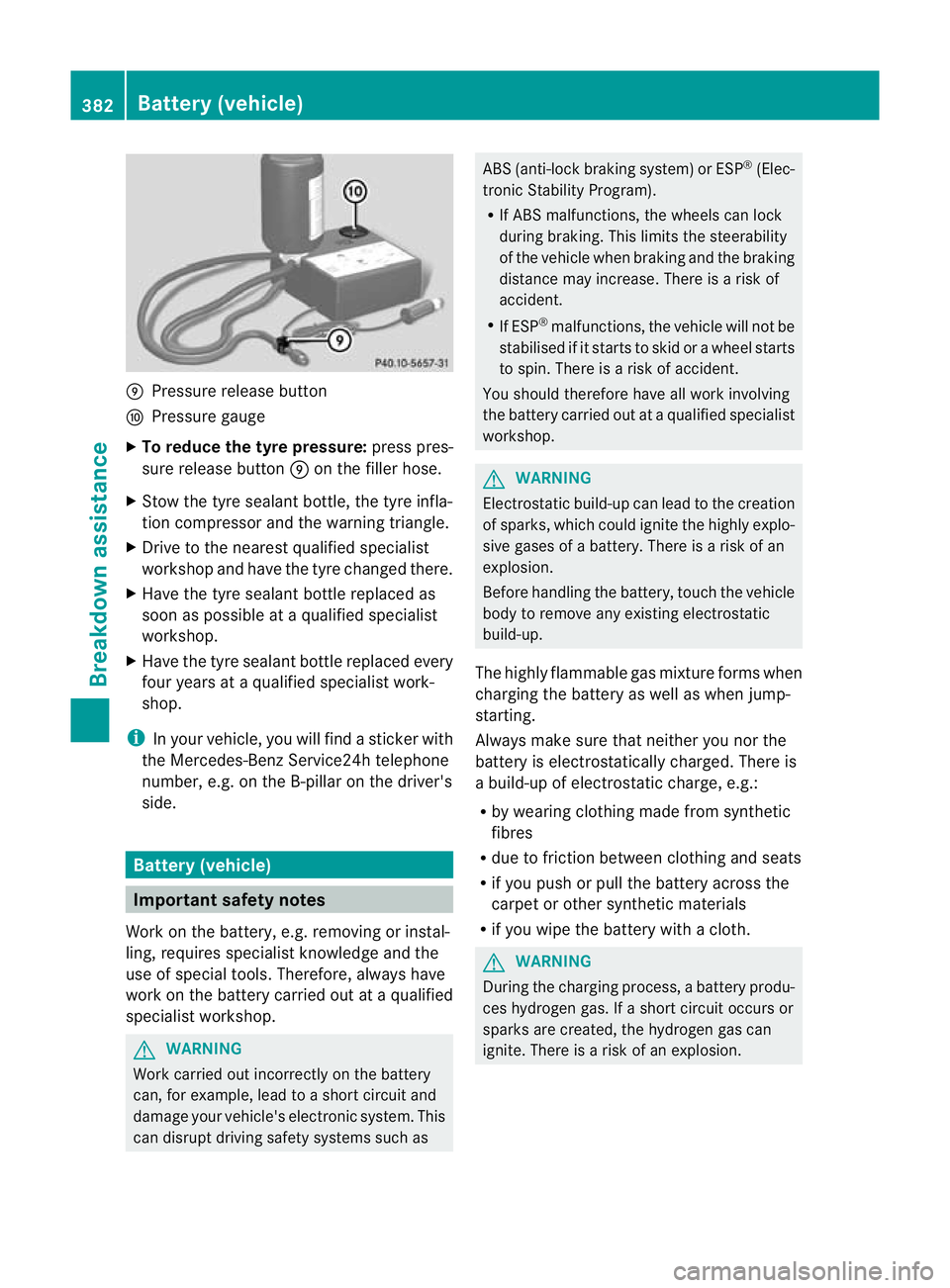
Pressur erelease button
F Pressur egauge
X To reduce the tyr epressure: press pres-
sure releas ebutton Eon the filler hose.
X Stow the tyre sealant bottle, the tyre infla-
tion compressor and the warning triangle.
X Drive to the nearest qualified specialist
worksho pand have the tyre changed there.
X Have the tyre sealant bottle replace das
soon as possible at aqualified specialist
workshop.
X Have the tyre sealant bottle replaced every
four years at aqualified specialist work-
shop.
i In your vehicle, you will find asticker with
the Mercedes-Benz Service24h telephone
number, e.g. on the B-pillar on the driver's
side. Battery (vehicle)
Important safety notes
Work on the battery, e.g. removin gorinstal-
ling ,requires specialist knowledge and the
use of special tools. Therefore, always have
work on the batter ycarried out at aqualified
specialist workshop. G
WARNING
Work carried out incorrectly on the battery
can, for example, lead to ashort circui tand
damage your vehicle's electronic system. This
can disrupt driving safety systems such as ABS (anti-lock braking system) or ESP
®
(Elec-
tronic Stability Program).
R If ABS malfunctions ,the wheels can lock
during braking. This limits the steerability
of the vehicle when brakin gand the braking
distance may increase. There is arisk of
accident.
R If ESP ®
malfunctions, the vehicle will not be
stabilised if it start stoskid or awheel star ts
to spin. There is arisk of accident.
You should therefore have all work involving
the batter ycarried out at aqualified specialist
workshop. G
WARNING
Electrostatic build-up can lead to the creation
of sparks, which could ignite the highly explo-
sive gases of abattery. There is arisk of an
explosion.
Befor ehandling the battery, touch the vehicle
body to remove any existing electrostatic
build-up.
The highly flammable gas mixture forms when
charging the battery as well as when jump-
starting.
Always make sure that neither you nor the
batter yiselectrostatically charged. There is
ab uild-up of electrostatic charge, e.g.:
R by wearing clothing made from synthetic
fibres
R due to friction betwee nclothin gand seats
R if you pus horpull the batter yacross the
carpe torother synthe ticm aterials
R if you wipe the batter ywithacloth. G
WARNING
Durin gthe charging process, abatter yprodu-
ces hydroge ngas. If ashort circui toccurs or
sparks are created, the hydroge ngas can
ignite. There is arisk of an explosion. 382
Battery (vehicl
e)Breakdown assistance
Page 398 of 441
Usefu
linfor mation ............................ 396
Important safet ynotes .................... 396
Operation ........................................... 396
Winter oper ation ............................... 398
Ty re pressure .................................... 399
Changing awheel ............................. 404
Wheel and ty recombinations ..........409
Emergency spa rewheel ................... 414 395Wheels and tyres
Page 399 of 441
Usefu
linfor mati on
i This Owner's Manual describes all mod-
els, series and optional equipment for your
vehicle that were available at the time of
going to press. National variation sare pos-
sible. Note that your vehicl emay not be
equippe dwith all of the function sdescri-
bed. This is also the case for system sand
functions relevant to safety.
i Read the information on qualified special-
ist workshops: (Y page25). Impo
rtantsafety notes G
WARNING
If wheels and tyres of the wron gsize are used,
the wheel brakes or suspension components
may be damaged. There is arisk of accident.
Always replac ewheels and tyr es with those
that fulfil th especifications of the original part
(designation ,manufacturer, model). G
WARNING
Af lat tyre severely impair sthe driving, steer-
ing and bra king characteristics of the vehicle.
There is arisk of accident.
Tyres withou trun-flat characteristics:
R do not drive with aflat tyre.
R immediately replac ethe fla ttyre with your
emergenc yspare wheel or spare wheel, or
consult aqualified specialist workshop.
Tyres with run-flat characteristics:
R pay attention to the information and warn-
ing notices on MOExtended tyre s(tyres
with run-flat charac teristics).
Accessorie sthat ar enot approved for your
vehicle by Mercedes-Ben zorare not be ing
use dcorrectly can impair the operating
safety. Before purchasing and using non-approved
accessories, visi
taqualified specialist work-
sho pand enquire about:
R suitability
R leg alstipulations
R factory recommendations
Information on the dimensions and types of
wheels and tyres for your vehicle can be
found in the "Wheel/tyre combinations" sec-
tion (Y page 409).
Information on air pressure for the tyres on
your vehicle can be found:
R on the tyre pressure label on the fuel filler
flap (Y page 175)
R in the "Tyre pressure" section
R under "Tyre pressure" (Y page 399)
Modification work on the brake system and
wheels is not permitted. The use of wheel
spacers or brake dust shields is not permit-
ted. This invalidates the general operating
permit for the vehicle.
i Further information on wheels and tyres
can be obtained at any qualified specialist
workshop. Operation
Information on driving
Check the tyre pressures when the vehicle is
heavily laden and, if necessary, adjust.
While driving, pay attention to vibrations,
noises and unusual handling charac teristics,
e.g .pulling to one side .This ma yindicate that
the wheels or tyres are damaged. If you sus-
pect that atyre is defective, reduce your
speed immediately. Stop the vehicle as soon
as possibl etocheckthe wheels and tyres for
damage. Hidden tyr edamage could also be
causing the unusual handling characteristics.
If you find no signs of damage, have the tyres
and wheel schecked at aqualified specialist
workshop.
When parking your vehicle, make sure that
the tyres do not get deformed by the kerb or 396
OperationWheels and tyres
Page 400 of 441
other obstacles. If it is necessary to drive over
kerbs, speed humps or similar elevations, try
to do so slowly and at an obtuse angle .Oth-
erwise ,the tyres, particularly the sidewalls,
ma ybed amaged. Regular checking of wheels and tyres
G
WARNING
Damaged tyres can cause tyre inflation pres-
sure loss .Asaresult,you coul dlose control
of your vehicle. There is arisk of accident.
Check the tyres regularly for signs of damage
and replace any damaged tyres immediately.
Regularly check the wheels and tyres of your
vehicle for damage at least once amonth, as
well as after drivin goff-road or on rough
roads .Damaged wheels can cause aloss of
tyr ep ressure. Pa yparticular attention to
damage such as:
R cuts in the tyres
R punctures
R tears in the tyres
R bulges on tyres
R deformation or severe corrosion on wheels
Regularly check the tyre tread depth and the
condition of the tread across the whole width
of the tyre (Y page 397). If necessary, turn
the front wheelst ofull lock in order to inspect
the inner side of the tyre surface.
All wheel smust have avalve cap to protect
the valve against dirt and moisture. Do not fit
anything onto the valve other than the stand-
ard valve cap or other valve caps approved by
Mercedes-Benz for your vehicle. Do not fit any
other valve caps or systems, e.g. tyre pres-
sure monitoring systems.
Regularly check the pressure of all the tyres,
particularly prior to long trips. Adjust the tyre
pressure as necessary (Y page 399).
Observe the notes on the emergenc yspare
wheel (Y page 414). The service life of tyres depends on various
factors, including the following:
R
driving style
R tyr ep ressure
R tyre mileage Tyre tread
G
WARNING
Insufficient tyre trea dwill reduce tyre trac-
tion. The tyre is no longer able to dissipate
water. This means that on wet road surfaces,
the risk of aquaplaning increases, in particular
where speed is not adapted to suit the driving
conditions. There is arisk of accident.
If the tyre pressure is too high or too low, tyres
may exhibit different levels of wear at differ-
ent locations on the tyre tread. Thus, you
should regularly check the tread depth and
the condition of the tread across the entire
width of all tyres.
Minimum tyre tread depth for:
R summer tyres: 3mm
R M+S tyres: 4mm
For safety reasons ,replace the tyres before
the legally prescribed limi tfor the minimum
tyr etrea ddepth is reached.. Selecting, fitting and replacing ty
res
R Only fi ttyres and wheels of the same type
and make.
R Only fit tyres of the correc tsize ont othe
wheels.
R Run in new tyres at moderate speeds for
the first 10 0km. They onl yreach their full
performanc eafter this distance.
R Do not drive wit htyres which have too little
tread depth .This otherwise significantly
reduce sthe traction on wet roads (aqua-
planing).
R Replace the tyres after six year satthe lat-
est, regardless of wear. Operation
397Wheels and ty res Z
Page 401 of 441
Observe the notes on the emergenc
yspare
wheel (Y page 414). MOExtended tyres (tyres with run-flat
characteristics)
With MOExtended tyres (tyres with run-flat
characteristics), you can continue to drive
your vehicle even if there is atotal loss of
pressure in one or mor etyres.
MOExtended tyres may only be used in con-
junction with an active tyre pressure loss
warning syste morwith an activ etyre pres-
sure monitor and on wheels specificall ytes-
ted by Mercedes-Ben z.
No tes on driving with MOExtended tyres with
af lat tyre (Y page 378).
i Vehicles with MOExtended tyres are not
equipped with aTIREFIT kit at th efactory.
It is therefore recommended that you addi-
tionally equi pyour vehicle with aTIREFIT kit
if yo ufit tyres that do not featur erun-flat
characteristics, e.g. winter tyres. ATIREFIT
kit can be obtaine dfrom aqualified spe-
cialist workshop. Winter operation
General notes
Have your vehicle winterproofed at aqualified
specialist worksho patthe onset of winter.
Observ ethe notes in the "Changin gawheel"
section (Y page 404). Driving wit
hsummer tyres
At temperatures belo w+7† ,summer tyres
lose elasticity and therefore traction and
braking power. Change the tyres on your vehi-
cle to M+S tyres .Using summer tyres at very
cold temperatures could cause tears to form,
thereby damaging the tyres permanently.
Mercedes-Benz cannot accept responsibility
for this typ eofdamage. M+S tyres
G
WARNING
M+S tyres with atyre tread depth of less than
4mma re not su itable for use in winter as they
do not provid esufficient traction. There is a
risk of accident.
M+S tyres with atrea ddepth of less than
4mmm ust be replaced.
At temperatures below +7 †, use winter tyres
or all-seas ontyres.B oth types of tyr eare
identified by th eM+S marking.
Onl ywinter tyres bearing the isnowflake
symbol in addition to the M+S marking pro-
vide the best possible grip in wintr yroad con-
ditions.
Only these tyres will allow drivin gsafety sys-
tems such as ABS and ESP ®
to function opti-
mally in winter. Thes etyres have been devel-
ope dspecifically for driving in snow.
Use M+S tyres of the same mak eand tread
on all wheels to maintain safe handling char-
acteris tics.
Alway sobserv ethe maximum permissible
speed specifie dfor the M+S tyres you have
fit ted.
If you fit M+S tyres that have alower maxi-
mu mp ermissible speed than that of the vehi-
cle, affix acorresponding warnin glabel in the
driver' sfield of vision. This can be obtained
at aq ualified specialist workshop.
Under these circumstances, you should also
restrict the maximum spee dofthe vehicle
usin gpermanen tSPEEDTRONIC so that it
does not exceed the maximu mpermissible
speed for the M+S tyres(Y page 198).
When you have fit tedt he M+S tyres:
X Chec kthe tyr epressures (Y page 399).
X Restart th etyre pressure monitor
(Y page 403).
X Restart the tyre pressure los swarning sys-
tem (Y page 401).
For more information on driving with the
emergenc yspare wheel, see (Y page 414).398
Winter opera
tionWheels and tyres