steering MERCEDES-BENZ GL SUV 2012 Owner's Guide
[x] Cancel search | Manufacturer: MERCEDES-BENZ, Model Year: 2012, Model line: GL SUV, Model: MERCEDES-BENZ GL SUV 2012Pages: 441, PDF Size: 10.66 MB
Page 127 of 441
Not acti
ve:if yo uare dr iving at speeds above
40 km/ horswitch off the turn signa lorturn
the steering whee ltothe str aight-ahead posi-
tion.
Th ec orn erin glam pm ayremai nlit for ashort
time, but is automati cally switched off after
no mor ethan three mi nutes.
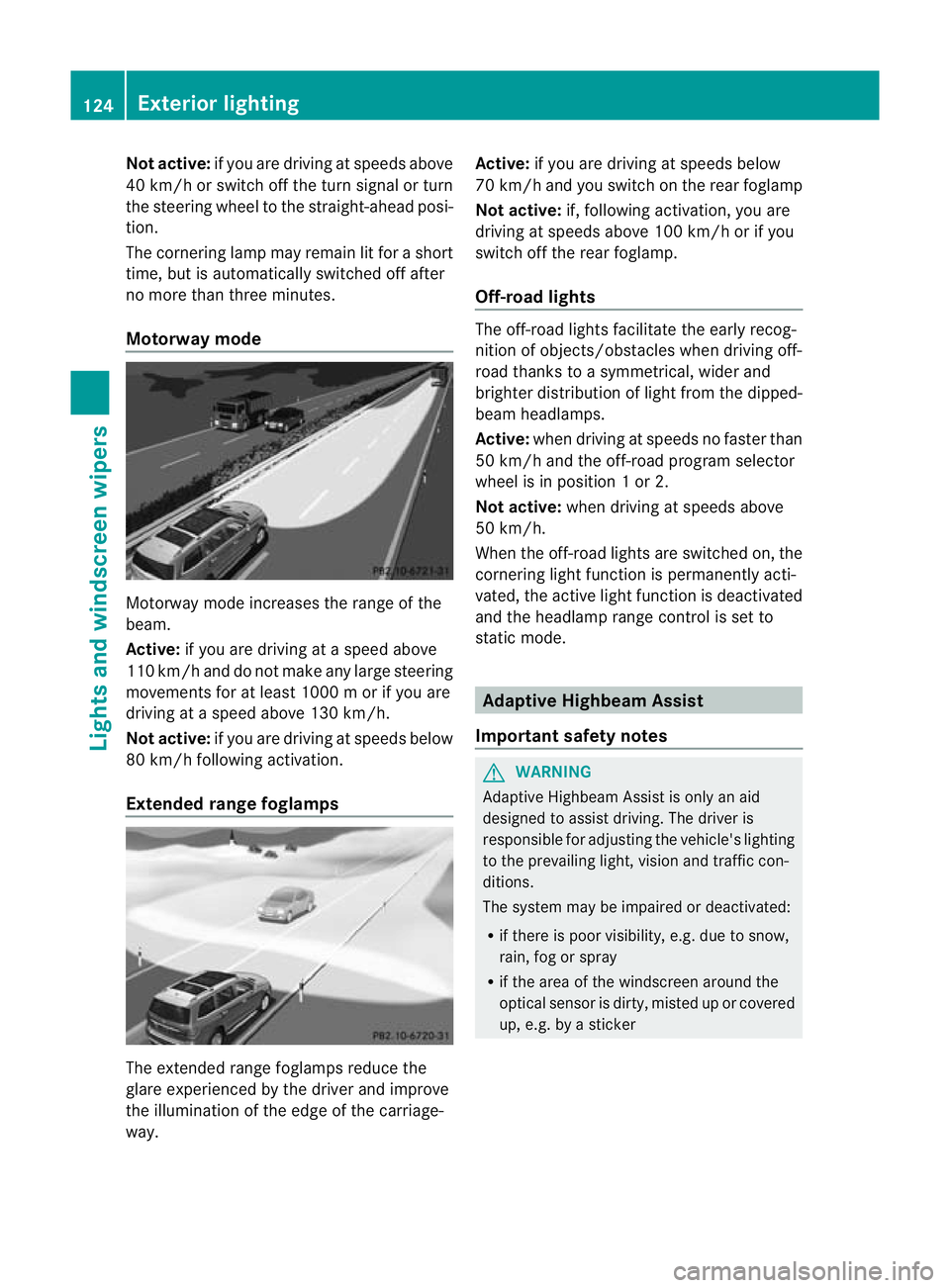
Motorway mode Motorway mode increases the rang
eofthe
beam.
Active: if you ar edriving atas peed above
11 0k m/ hand do not make any large steering
movements for at leas t1000 morify ou are
driving at aspeed abov e130 km/h.
Not active: if you are driving at speeds below
80 km/ hfollowin gactivation.
Extende drange fogla mps The extended range foglamps reduce the
glar
eexperie nced by the driver and improve
the illumination of the edge of the carriage-
way. Active:
if you are drivin gatspeeds below
70 km/ hand yo uswitc honthe rear foglamp
No tactive: if, following activation, you are
driving at speeds above 10 0km/ horify ou
switch off th erear foglamp.
Off-road lights The off-road light
sfacilitat ethe earl yrecog-
nition of objects/obstacles when driving off-
road thank stoasymmetrical, wider and
brighter distribution of ligh tfrom the dipped-
beam headlamps.
Active: whendriving at speeds no faster than
50 km/h and th eoff-road progra mselector
wheel is in position 1or2.
Not acti ve:when driving at speeds above
50 km/h.
When the off-roa dlights are switched on, the
cornering light function is permanent lyacti-
vated ,the act ivel ight function is deactivated
and the headlamp range control is set to
static mode. Adaptive Highbeam Assi
st
Important safety notes G
WARNING
Adaptive Highbeam Assist is only an aid
designed to assist driving. The driver is
responsible for adjusting the vehicle's lighting
to the prevailing light, vision and traffic con-
ditions.
The system may be impaired or deactivated:
R if there is poor visibility, e.g. due to snow,
rain, fog or spray
R if the area of the windscreen around the
optical sensor is dirty, misted up or covered
up, e.g. by asticker 124
Exterior lightingLights and windscree
nwipers
Page 161 of 441
Usefu
linfor mati on
i This Owner's Manual describes all mod-
els, series and optional equipment for your
vehicle that were available at the time of
going to press. National variation sare pos-
sible. Note that your vehicl emay not be
equippe dwith all of the function sdescri-
bed. This is also the case for system sand
functions relevant to safety.
i Read the information on qualified special-
ist workshops: (Y page25). Running-in notes
Impo
rtantsafety notes
New brak epads/brak epads and discs that
have been replaced only achieve optimum
brakin geffect after severa lhundre dkilome-
tres of driving. Compensate for the reduced
braking effec tbyapplying greater force to the
brak epedal. Th
ef irst 1,500 km
If you trea tthe engin ewith sufficient care
from the very start, you wil lberewarded with
excel lent performance for the remainder of
the engine' slife.
R Driv eatv arying vehicle speeds and engine
speeds for the first 1,500 km.
R Avoid overstraining the vehicle during this
period, e.g. driving at full throttle.
R Change gea ringood time, befor ethe rev
counter needl eisÔof the way to the red
area of the rev coun ter.
R Do not shift down agear manually in order
to brake.
R Try to avoid depressing the accelerator
pedal beyond the point of resistanc e(kick-
down).
R Shift ranges 3,2or 1should only be
engaged whe ndriving slowly, e.g .when
drivin ginm ountainou sterrain. Af
ter1 ,50 0km,you may graduall yaccelerate
the vehicle to full road and engine speeds.
Additional running-in notes for AMG vehicles:
R do not drive at speed sabove 14 0km/h for
th ef irst 1,50 0km.
R onl yallow the engine to reach amaximum
engine spee dof4,50 0rpm briefly.
R driv ethe vehicle mainly in drive program
C for the first 1,500 km.
i You should also observe these notes on
runnin ginift he engin eorparts of the drive
train on your vehicle have been replaced. Driving
Important safety notes
G
WARNING
Object sinthe driver's footwell can restric tthe
pedal travel or obstruct adepressed pedal.
The operatin gand road safety of the vehicle
is jeopardised. There is arisk of an accident.
Make sure that all objects in the vehicle are
stowed correctly, and that they cannot enter
the driver's footwell. Fit the floormats
securely and as specified in order to ensure
sufficien tclearanc efor the pedals. Do not use
loose floormat s. G
WARNING
Unsuita ble footwear can hinde rcorrect usage
of the pedals, e.g.:
R shoes with thic ksoles
R shoes with high heels
R slippers
There is arisk of an accident.
Wear suitable footwear to ensure correct
usage of the pedals. G
WARNING
If you switch off the ignition while driving,
safety-relevant func tions are only available
with limitations, or not at all. This coul daffect,
for example, the powe rsteering and the brake 158
DrivingDrivin
gand pa rking
Page 170 of 441
Problem Possible causes/consequences and
M Solutions
The coolant tempera-
tur
ed isplay is showing
more than 120 †. The
coolant warnin glamp
may also be lit and a
warning tone may
sound. The coolant level is too low. The coolant is too hot and the engine
is no longer being cooled sufficiently.
X
Stop as soon as possible and allow the engine and the coolant
to cool down.
X Check the coolant level (Y page 363). Observe the warning
notes as you do so and top up the coolant if necessary. If the coolant level is correct
,the radiator fa nmay be faulty. The
coolant is too hot and the engine is no longer being cooled suffi-
ciently.
X At coolant temperatures under 120 †, drive on to the nearest
qualified specialis tworkshop, e.g. to aMercedes-Benz Service
Centre.
X Avoid heavy loads on the engine as you do so, e.g. driving in
mountainous terrai nand stop-start traffic. Automatic transmission
Important safety notes
G
WARNING
If the engine speed is above the idling speed
and you engag etrans mission position Dor
R,t he vehicle coul dpull away suddenly. There
is ar isk of an accident.
When engaging transmission position Dor R,
always firmly depress the brake pedal and do
not simultaneously accelerate. DIRECT SELECT lever
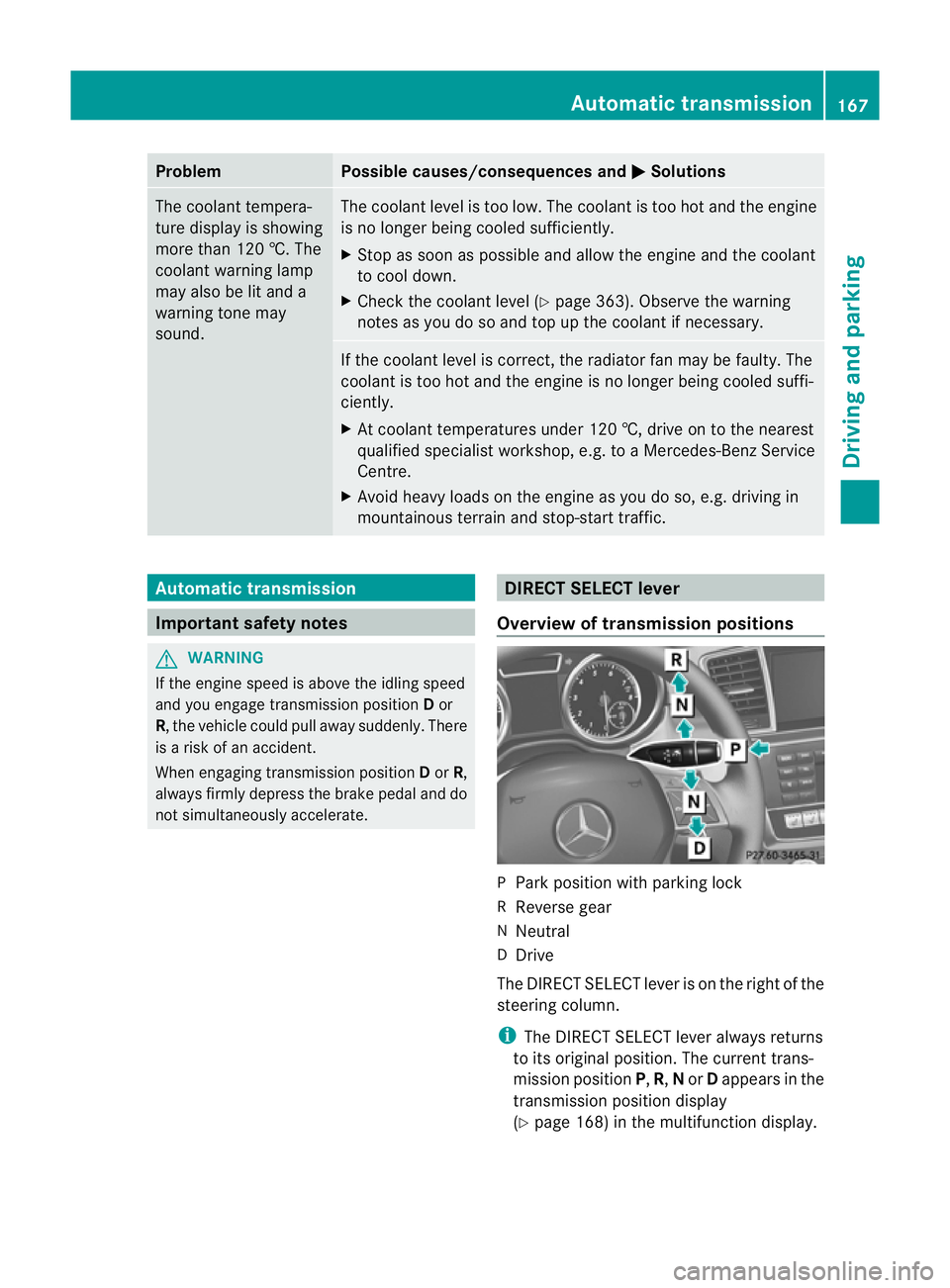
Overview of transmissio npositions P
Park position with parking lock
R Reverse gear
N Neutral
D Drive
The DIRECT SELECT leve risonthe right of the
steering column.
i The DIREC TSELECT lever always returns
to its origina lposition .The curren ttrans-
mission position P,R, Nor Dappe arsint he
transmission position display
(Y page 168) in the multifunction display. Automa
tict ran smission
167Driving and pa rking Z
Page 174 of 441
Drive progra
mson AMG vehicles C
Controlled
Efficiency Comfortable, economical
driving
S
Sport Sport
ydrivin gstyle M
Manual Manual gearshif
ting i
For further information on the automatic
drive program, se e(Ypage 171). Steering whee
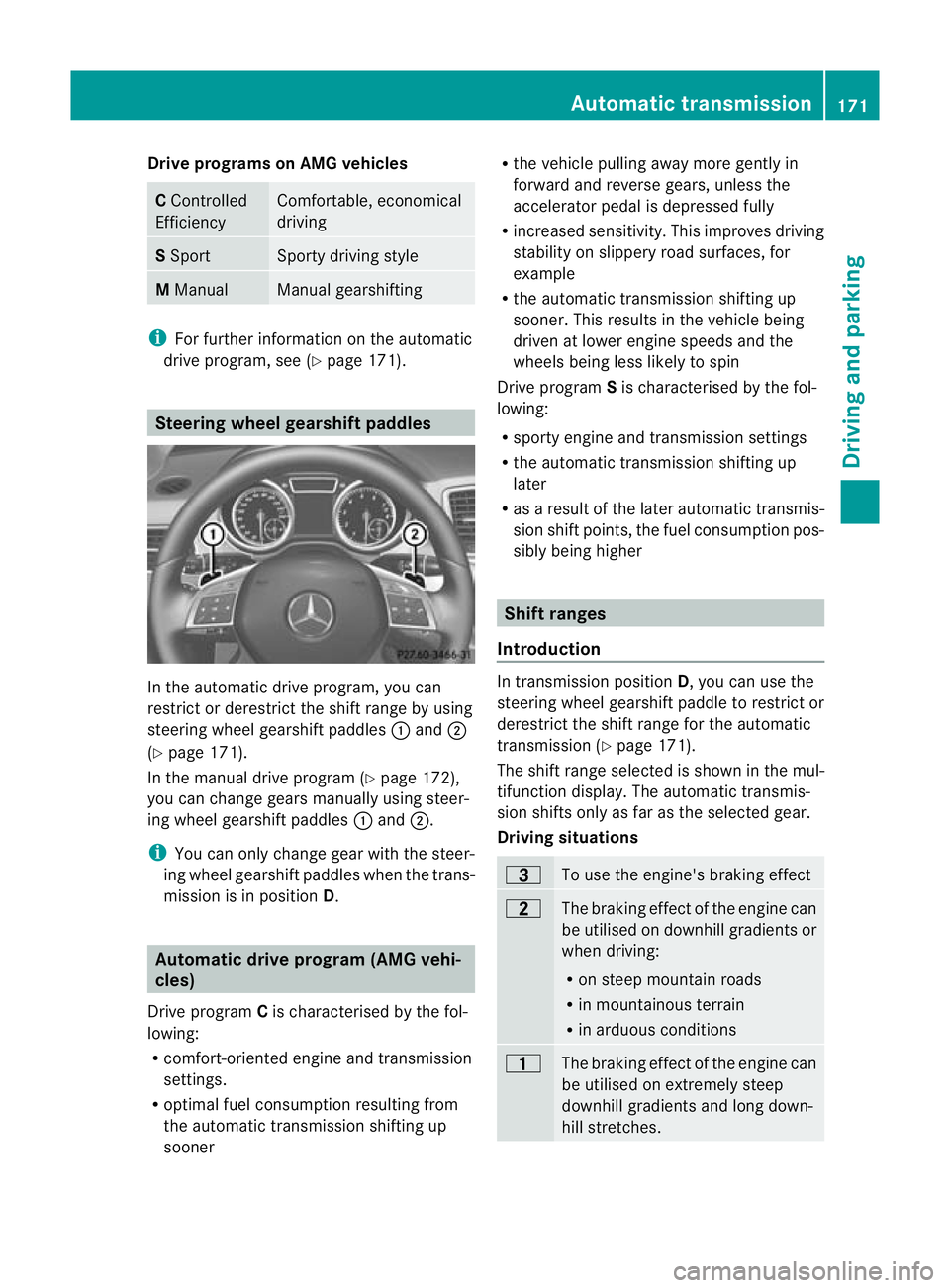
lgearshif tpaddles In the automatic driv
eprogram, yo ucan
restrict or derestrict the shift range by using
steering wheel gearshift paddles :and ;
(Y pag e171).
In the manual drive pro gram (Y page172),
you can change ge arsm anually using steer-
ing wheel gearshift paddles :and ;.
i You can only change gea rwith the steer-
ing wheel gearshif tpaddles when the trans-
mission is in position D.Automatic drive progra
m(AMG vehi-
cles)
Drive program Cis characterised by the fol-
lowing:
R comfort-oriented engine and transmission
settings.
R optimal fuel consumption resulting from
the automatic transmission shifting up
sooner R
the vehicle pulling awa ymore gentl yin
forward and reverse gears ,unles sthe
accelerator pedal is depressed fully
R increased sensitivity. This improves driving
stability on slippery roa dsurfaces, for
example
R the automatic transmission shifting up
sooner. This results in the vehicle being
driven at lower engine speeds and the
wheel sbeing less likely to spin
Drive program Sis characterised by the fol-
lowing:
R sporty engine and transmission settings
R the automatic transmission shiftin gup
later
R as aresult of the later automatic transmis-
sion shift points, the fuel consumption pos-
sibly being higher Shif
tranges
Introduction In transmission position
D,you can use the
steering wheel gearshift paddle to restric tor
derestrict the shift range for the automatic
transmission (Y page 171).
The shift range selected is shown in the mul-
tifunc tion display. The automatic transmis-
sion shift sonly as far as the selected gear.
Driving situations =
To use the engine's braking effect
5
The braking effect of the engine can
be utilised on downhil
lgradients or
when driving:
R on stee pmountain roads
R in mountainous terrain
R in arduous conditions 4
The brakin
geffect of th eengine can
be utilised on extremel ysteep
downhill gradients and long down-
hill stretches. Automatic transmission
171Drivingand pa rking Z
Page 175 of 441
Restrictin
gthe shift range X
Pull th eleft-hand steering wheel gearshift
paddle.
The automatic transmissio nshift sdown
one gear and restric tsthe shift range to the
relevant gear.
i If the engine exceed sthe maximum
engin espeed when shiftin gdown, the auto-
matic transmission protect sagainst engine
damage by not shifting down.
i If the maximum engin espeed for the shift
range is reached and you continue to accel-
erate, the automatic transmission shifts up,
even if the shift range is restricted. This
prevents the engine from overrevving.
Extending the shif trange X
Pul lthe right-hand steering wheel gearshift
paddle.
The shift range is derestricted.
Clearing th eshift rang erestriction X
Pull and hold the right-hand steering wheel
gearshift paddle until Dis shown again in
the multifunction display.
The automatic transmission shifts from the
current shift range directly to D.
or
X Use the DIRECT SELECT lever to shift the
transmission to position D.
The automatic transmission shifts from the
current shift range directly to D.
Selecting the ideal shift range X
Pull the left-hand steering wheel gearshift
paddle and hold it in position.
The automatic transmission shifts to the
gear which allow soptimum acceleration
and deceleration. To do this, the automatic
transmission shifts down one or more
gears. Manua
ldrive program
Activatin gthe manua ldrive program In manual drive program
M,you can change
gear using the steering wheel gearshift pad-
dles if the transmission is in position D.The
curren tdrive progra mand the engaged gear
are shown in the multifunctio ndisplay.
X AMG vehicles: press the program selector
button (Y page 170)until Mappe arsint he
multifunction display.
X Vehicle swith the ON&OFFROAD pack-
age: press the program selector button
(Y page 170).
The letter Mappears in the multifunction
display.
Upshifting (all vehicles except AMG
vehicles) X
Pull the right-han dsteering whee lgearshift
paddle (Y page 171).
The automatic transmission shifts up to the
next gear.
Upshifting (AM Gvehicles) !
In manua lgearshif tprogram M,the auto-
matic transmission does not shift up auto-
matically even when the engin elimiting
speed for the current gear is reached.
When the engine limitin gspeed is reached,
the fuel supply is cut to prevent the engine
from overrevving. You must mak esure that
the engine spee ddoes not reach the red
area of the rev counter .Otherwise, there is
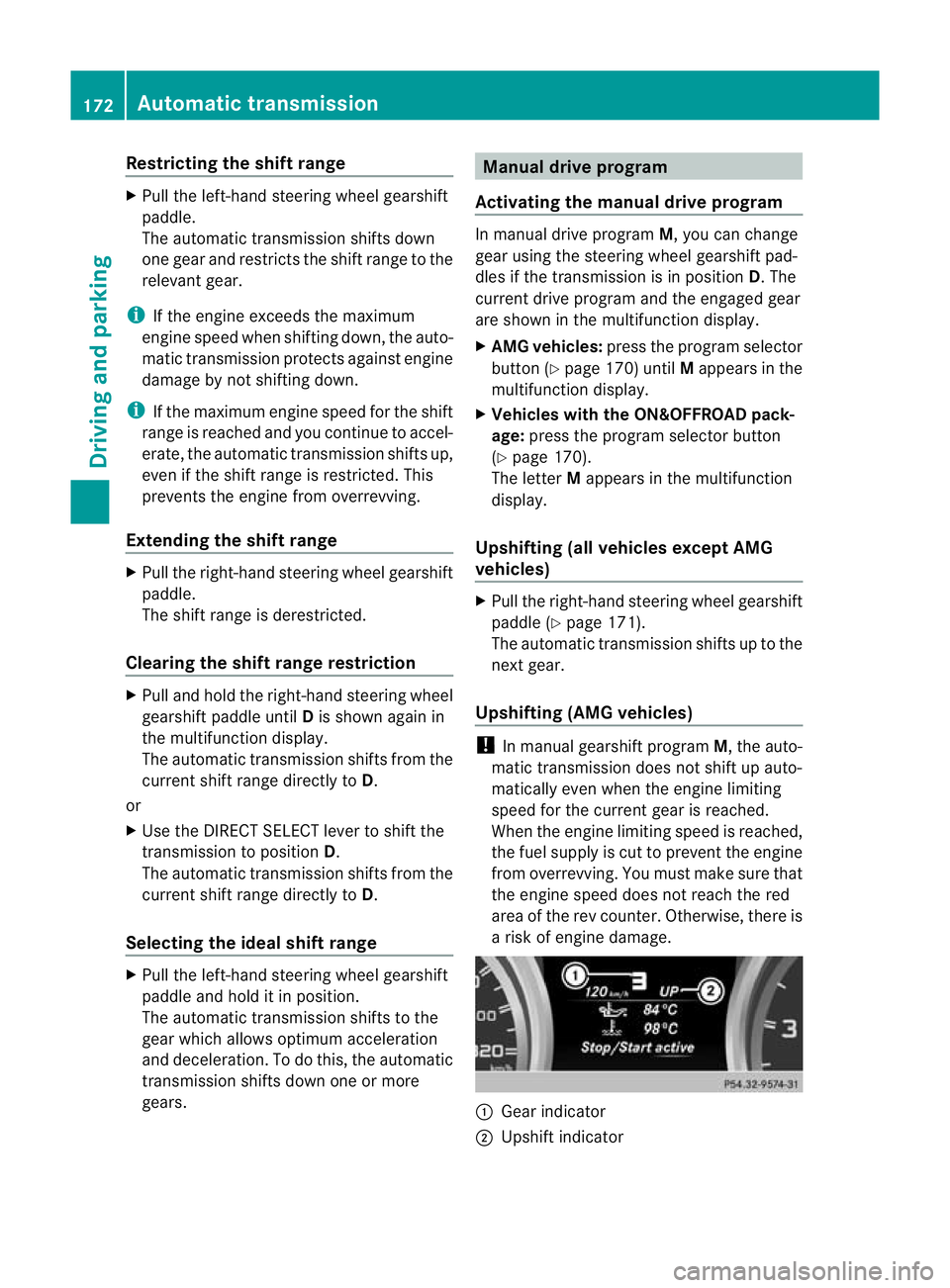
ar isk of engine damage. :
Gear indicator
; Upshift indicator 172
Automa
tict ran smissionDriving and pa rking
Page 176 of 441
Befor
ethe engine speed reaches the red ar ea,
an upshift indicator will be shown in the mul-
tifunction display.
X If the colour in the speedometer multifunc-
tion display changes to red and the UP dis-
play messag eisshown, shift up agear.
Downshifting X
Pull the left-han dsteering wheel gearshift
paddl e(Ypage 171).
The automatic transmission shifts dow nto
the next gear.
Maximu macceleration
X Pull the left-hand steering whee lgears hift
paddle unt ilthe transmission selects the
optimu mgearfor the curr ents peed.
i If yo uslowd ownors topw ithou tshifting
down, the automati ctransmissio nauto-
matically shift sdown.
Kickdown You can also use kickdown for maximum
acceleration in manua
ldrive program M.
X Dep ress the ac celerator pedal beyond the
pressure point.
The transmission shift stoalower gear
depending on the engine speed.
X Shif tback up onc ethe desired speed is
reached.
i All vehicles (excep tAMG vehicles): if
yo ua pply full throttle, the automatic trans-
mission shifts up to the next gear when the
maximum engine speed is reached. This
prevents the engine from overrevving.
i AMG vehicles: it is not possible to use
kickdown in manual drive program M.Deactivating the manua
ldrive program X
AMG vehicles: press the program selector
button (Y page 170) repeatedly until Cor
S appe arsint he multifunction display.
X Vehicle swith the ON&OFFROAD pack-
age: press the program selector button
(Y page 170).
M is no longer shown in the multifunction
display. Automa
tict ran smission
173Driving and pa rking Z
Page 184 of 441
take
noff ag aina fter be ingo nly partially
emptied.
X Releas eAdBlue ®
refil lbottle :.
X Tur nAdBlue ®
refil lbottle :anti-clockwise
and remove it.
X Screw the protective cap onto AdBlue ®
refill bottle :again.
AdBlue ®
refill bottles can be obtained at many
fil ling stations or at aMercedes-Benz Ser vice
Centre. Refil lbottles withou tathreaded seal
offer no protection agains toverfilling.
AdBlue ®
may leak ou tasaresult of overfilling.
Mercedes Ben zoffers special refi llbottles
with athrea deds eal. Thes eare avail able at
any Mercedes-Benz Service Centre.
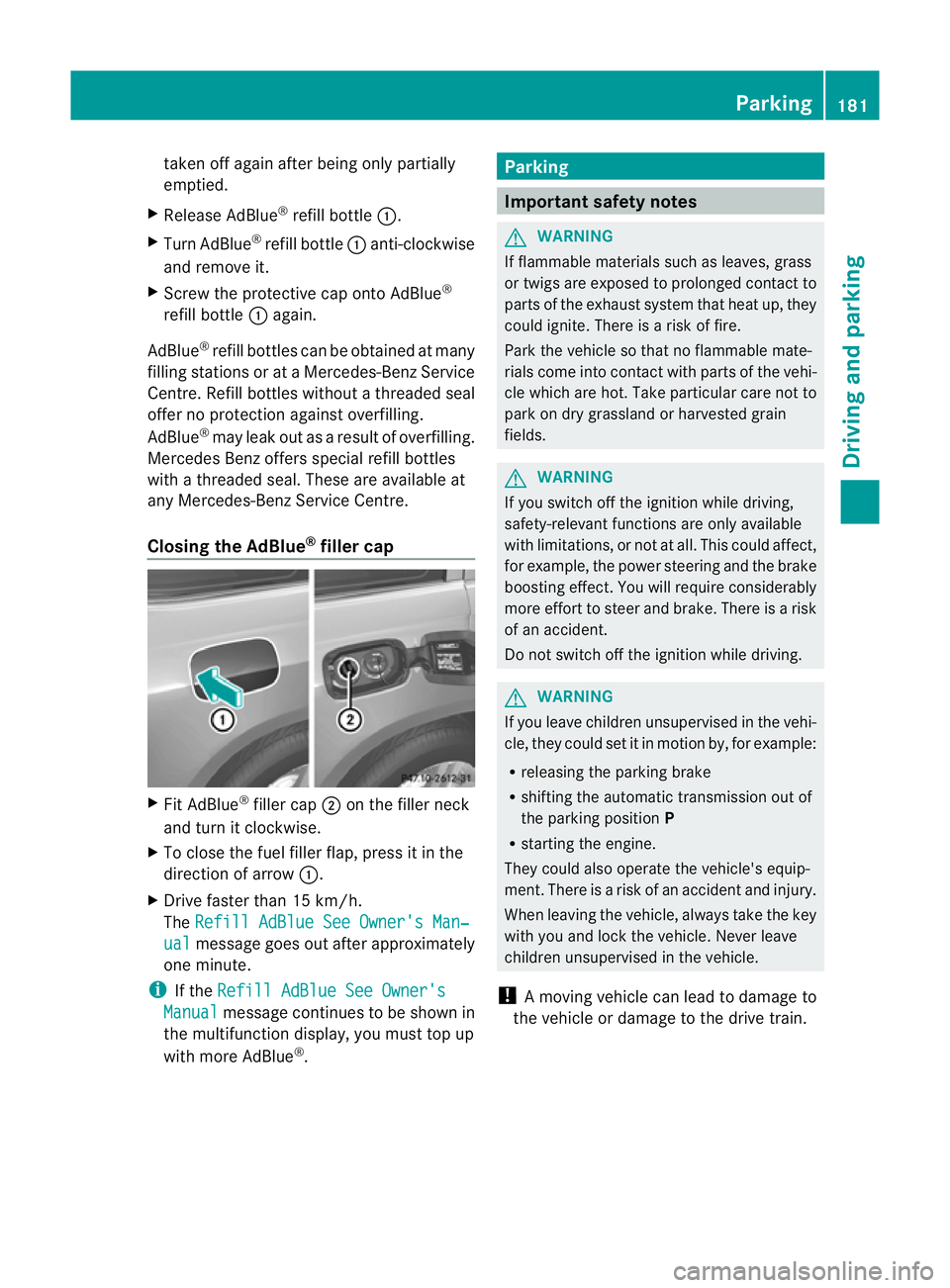
Closin gthe AdBlue ®
fil lerc ap X
Fit AdBl ue®
filler cap ;on th efiller neck
and turn it clockwise.
X To close the fuel filler flap, press it in the
direction of arrow :.
X Driv efaster than 15 km/h.
The Refill AdBlue Se eOwner' sMan‐ ual message goes ou
tafter approximately
one minute.
i If the Refill AdBlue See Owner's Manual message continues to be show
nin
the multifunctio ndisplay, you must top up
with mor eAdBlue ®
. Parking
Important safety notes
G
WAR
NING
If flammable materials such as leaves ,grass
or twigs are exposed to prolo nged contac tto
part soft he exhaust system that heat up, they
coul dignite. There is arisk of fire.
Park the vehicle so that no flammable mate-
rials come int ocontac twith parts of the vehi-
cle which are hot. Take particular care not to
park on dry grassland or harvested grain
fields. G
WARNING
If you switch off the ignition while driving,
safety-relevan tfunctions are only available
with lim itations, or not at all .This coul daffect,
for example, the powe rsteering and the brake
boosting effect .You will require considerably
mor eeffort to steer and brake. There is arisk
of an accident.
Do not switch off the ignition while driving. G
WARNING
If you leave children unsupervised in the vehi-
cle, they could set it in motion by, for example:
R releasing the parking brake
R shifting the automatic transmission out of
the parking position P
R starting the engine.
They could also operate the vehicle's equip-
ment .There is arisk of an accident and injury.
When leaving the vehicle, always take the key
with you and lock the vehicle. Never leave
children unsupervised in the vehicle.
! Am ovin gvehicle can lead to damage to
the vehicle or damage to the driv etrain. Parking
181Driving and parking Z
Page 187 of 441
X
While driving, push handle :of the elect ric
parking brake.
The vehicle can also be braked durin gan
emergency using the electric parking brake.
i The vehicle is braked for as long as the
handle of the electric parking brak eis
pressed. The longer the electric parking
brak ehandle is depressed, the greater the
braking force.
During braking:
R aw arning ton esounds
R the Releas epark. brake message
appears
R ther ed ! indicato rlamp in the instru-
ment cluster flashes
When the vehicle has been braked to astand-
still ,the electric parkin gbrake is engaged. Parkin
gupthe vehicle
If you leave th evehicle parked up for longer
than four weeks, the batter ymay be damaged
by exhaustive discharging.
X Disconnect the batter yorconnec tittoa
trickle charger.
i You can obtai ninformation about trickle
chargers from aqualified specialist work-
shop.
If you leave the vehicl eparked up for longer
than six weeks, the vehicl emay suffer dam-
age as aresult of lack of use.
X Visi taq ualifieds pecialist workshop and
seek advice. Driving tips
General notes
Impo rtant safety notes G
WARNING
If you switch off the ignition while driving,
safety-relevant functions are only available with limitations, or not at all
.This coul daffect,
for example, the powe rsteering and the brake
boosting effect .You will require considerably
mor eeffort to steer and brake. There is arisk
of an accident.
Do not switch off the ignition while driving.
Drive sensibly –save fuel Observe the fol
lowing tips to save fuel:
X The tyres should always be inflated to the
recomm ended tyr epressure.
X Remove unnecessary lo ads.
X Remov eroof carriers when they are not
needed.
X Warm up the engine at low engine speeds.
X Avoid frequent acceleration or braking.
X observe the service intervals in the Service
Booklet or in the service interval display.
Have all the maintenan cework carried in
accordanc ewith Daimler AG regulations.
Fuel consumption also increases when driv-
ing in cold weather, in stop-start traffic and in
hilly terrain. Short journeys
! Vehicles with adiesel particle filter: if
the vehicle is mostly driven for short dis-
tances, it is possible that malfunctions may
occur durin gthe automa ticc leaning of the
diesel particle filter. This may lead to fuel
collectin ginthe engin eoil and cause
engin efailure. Therefore, if you frequently
drive short distances, you should tak ea20
minu tetrip on amotorwa yorrural road at
least every 500km. Braking
Important safet ynotes G
WARNING
If you shift down on aslippery road surfac ein
an attempt to increase the engine's braking 184
Driving tipsDrivin
gand parking
Page 191 of 441
At the onse
tofwinter, have your vehicle win-
terproofed at aqualified specialist workshop.
Vehicles with th eON&OFFROAD pack-
age: if drivin ginsnow or with snow chains,
select the snow program (Y page 249)with
the off- road program selector wheel in the
centre console.
Observe the notes in the "Winter operation"
section (Y page 398).
Driving with summer tyres Observe the notes in the "Winter operation"
section (Y
page 398).
Slippery road surfaces G
WARNING
If you shift down on aslippery road surfac ein
an attempt to increase the engine's braking
effect ,the drive wheels coul dlose their grip.
This increases the risk of skiddin gand having
an accident.
Do not shift down for additional engine brak-
ing on aslippery road surface.
If the vehicle threaten stoskid or cannot be
stopped whe nmovin gatl ow speed:
X Move the transmission to position N.
X Try to bring the vehicle under con trolby
using corrective steering.
i For more information on driving with
snow chains, see (Y page 399).
You should drive particularly carefully on slip-
pery road surfaces. Avoid sudde naccelera-
tion, steering and brakin gmanoeuvres. Off-road driving
Important safety notes G
WARNING
If you drive up asteep incline at an angle or
turn on asteep incline, the vehicle could slip sideways, tip and overturn. There is
arisk of
an accident.
When drivin gupanincline, drive into the line
of fall (upw ards or downwards in astraight
line) and do not turn. G
WARNING
If the vehicle level is high, the vehicle centre
of gravity is raised .This coul dcause the vehi-
cle to tip over more easily on uphill or downhill
gradients. There is arisk of an accident.
Select the lowest possible vehicle level.
When drivin goff-road, sand, mud and water,
possibly mixe dwith oil, for example, could get
into the brakes. This could result in areduced
braking effect or in total brak efailure and also
in increased wear and tear. The braking char-
acteristic schange depending on the material
ingressing the brakes. Clean the brakes after
driving off-road. If you detec tareduce dbrak-
ing effect or grinding noises, have th ebrake
system checked in aqualified specialist work-
sho pass oon as possible. Adapt your driving
style to the differen tbraking characteristics.
Driving off- road increases the likelihood of
damage to the vehicle, which, in turn, can lead
to failure of the mechanical assembly or sys-
tems. Adapt your driving style to suit the ter-
rain conditions. Drive carefully. Have damage
to the vehicle rectified immediately at aquali-
fied specialist workshop.
Do not switch to transmission position N
when driving off-road. You could lose control
of the vehicle if you attempt to brake using
the service brake. If the gradient is too steep,
drive backwards in reverse gear.
General notes H
Environmental note
Protection of the environment is of primary
importance. Treat nature with respect.
Observe all prohibiting signs. 188
Driving tipsDrivin
gand pa rking
Page 193 of 441
Checklist after driving off-road
!
If you detect damag etothe vehicl eafter
dri ving off-road, have the vehicle checked
immediately at aqualified specialist work-
shop.
X Vehicles with th eON&O FFROAD pack-
age: activat ethe on-road program
(Y page 253).
X Vehicles without th eON&O FFROAD
package: deactivate the on- road program
(Y page 252).
X Deac tivate the LOW RANGE off-roa dgear
(Y page 254).
X Deactiva teDS R(Ypage 251).
X Lowe rthe vehicle level again to alevel suit-
able to the road conditions, e.g. to the high-
way/high-speed level.
X Clean the headlamps and rear lights and
check for damage.
X Clean the front and rear licence plates.
X Clean the wheels/tyres with awater jet and
remove any foreign objects.
X Clea nthe wheels, wheel arches and the
vehicle underside with awater jet; check
for any foreign objects and damage.
X Check whethe rtwigs or other parts of
plants have become trapped. These
increase the risk of fire and can damage
fuel pipes, brake hose sorthe rubber bel-
lows of the axl ejoint sand propeller shafts.
X After the trip, examine without fail the
entire undercarriage, wheels ,tyres, brakes,
bodywork structure, steering, chassis and
exhaus tsystem for damage.
X After driving for extended period sacross
sand ,mud, gravel, water or in similarly dirty
conditions, have the brake discs, wheels,
brake pads/lining sand axle joints checked
and cleaned.
X If you detect strong vibrations after off-road
travel, check for foreig nobject sinthe
wheels and drive train and remove them if
necessary. Foreign objec ts candisturb the
balance and cause vibrations. Driving over rough terrain places greater
demands on your vehicle than drivin
gonnor-
ma lroads. Af terd riving off- road, check the
vehicle. This allow syou to detec tdamage
promptly and reduce the risk of an accident
to yourself and other road users.
Driving on sand Observe the following rules when driving on
sand:
R
vehicle swith the ON&OFFROAD pack-
age: select off- road program 1
(Y page 253).
R vehicle swithou tthe ON&OFFROAD
package: select theoff-road program
(Y pag e252).
R select ahigher vehicle level.
R select ashift range appropriate to the ter-
rain.
R drive quickly to overcom ethe rolling resist-
ance. Otherwise, the vehicle' swheels
could becom estuck in loose ground.
R drive in the track sofother vehicle sifpos-
sible. Make sure that:
- the tyr eruts are not too deep.
- the sand is sufficiently firm.
- the ground clearance of the vehicle is
sufficient.
Tyr eruts and gravel roads !
Check that th eruts are not too deep and
that your vehicle has sufficient clearance.
Otherwise, your vehicle could be damaged
or bottom out and get stuck.
Observe the following rules when driving
along ruts in off-road terrain or on roads with
loos egravel:
R Activate th eoff-road program
(Y pag e252).
R Vehicle swith the AIRMATIC package:
select araised vehicle level.
R Avoid high engine speeds.
R Restrict the shift range to 1.190
Driving tipsDriving and parking