ignition MERCEDES-BENZ GLA 2016 Service Manual
[x] Cancel search | Manufacturer: MERCEDES-BENZ, Model Year: 2016, Model line: GLA, Model: MERCEDES-BENZ GLA 2016Pages: 390, PDF Size: 10.2 MB
Page 177 of 390
with limitations, or not at all. This could affect,
for example, the power steering and the brake
boosting effect. You will require considerably
more effort to steer and brake. There is a risk
of an accident.
Do not switch off the ignition while driving.
G WARNING
If you operate mobile communication equip-
ment while driving, you will be distracted from
traffic conditions. You could also lose control
of the vehicle. There is a risk of an accident.
Only operate this equipment when the vehicle
is stationary.
Observe the legal requirements for the coun-
try in which you are driving. Some jurisdic-
tions prohibit the driver from using a mobile
phone while driving a vehicle.
If you make a call while driving, always use
hands-free mode. Only operate the telephone
when the traffic situation permits. If you are
unsure, pull over to a safe location and stop
before operating the telephone.
Bear in mind that at a speed of only 30 mph
(approximately 50 km/h), the vehicle covers
a distance of 44 ft (approximately 14 m) per
second.
Drive sensibly – save fuel
Observe the following tips to save fuel: R
The tires should always be inflated to the
recommended tire pressure. R
Remove unnecessary loads. R
Remove roof racks when they are not nee-
ded. R
Warm up the engine at low engine speeds. R
Avoid frequent acceleration or braking. R
Have all maintenance work carried out as
indicated by the service intervals in the
Maintenance Booklet or by the service
interval display.
Fuel consumption also increases when driv-
ing in cold weather, in stop-start traffic and in
hilly terrain. Drinking and driving
G WARNING
Drinking and driving and/or taking drugs and
driving are very dangerous combinations.
Even a small amount of alcohol or drugs can
affect your reflexes, perceptions and judg-
ment.
The possibility of a serious or even fatal acci-
dent is greatly increased when you drink or
take drugs and drive.
Do not drink or take drugs and drive or allow
anyone to drive who has been drinking or tak-
ing drugs.
Emission control
G WARNING
Combustion engines emit poisonous exhaust
gases such as carbon monoxide. Inhaling
these exhaust gases leads to poisoning. There
is a risk of fatal injury. Therefore never leave
the engine running in enclosed spaces with-
out sufficient ventilation.
Certain engine systems are designed to keep
the level of poisonous components in exhaust
fumes within legal limits.
These systems only work at peak efficiency if
they are serviced exactly in accordance with
the manufacturer's specifications. Always
have work on the engine carried out at a
qualified specialist workshop. Mercedes-
Benz recommends that you use an authorized
Mercedes-Benz Center for this purpose. In
particular, work relevant to safety or on
safety-related systems must be carried out at
a qualified specialist workshop.
The engine settings must not be changed
under any circumstances. Furthermore, all
specific service work must be carried out at
regular intervals and in accordance with the
Mercedes-Benz service requirements. Details
can be found in the Maintenance Booklet. Driving tips 175
Driving and parking Z
Page 180 of 390
Servicing the brakes
! The brake fluid level may be too low, if: R
if the red brake warning lamp lights up in
the instrument cluster and R
you hear a warning tone while the engine
is running
Observe additional warning messages in
the multifunction display.
The brake fluid level may be too low due to
brake pad wear or leaking brake lines.
Have the brake system checked immedi-
ately. Consult a qualified specialist work-
shop to arrange this.
! A function or performance test should
only be carried out on a 2-axle dynamom-
eter. If you wish to operate the vehicle on
such a dynamometer, please consult a
qualified specialist workshop in advance.
You could otherwise damage the drive train
or the brake system.
! As the ESP ®
system operates automati-
cally, the engine and the ignition must be
switched off (the SmartKey must be in posi-
tion 0 or 1 in the ignition lock) if:R
the electric parking brake is tested on a
brake dynamometer (for a maximum of
ten seconds) R
the vehicle is towed with the front axle
raised.
Braking triggered automatically by ESP ®
may seriously damage the brake system.
All checks and maintenance work on the
brake system must be carried out at a quali-
fied specialist workshop.
Have brake pads installed and brake fluid
replaced at a qualified specialist workshop.
If the brake system has only been subject to
moderate loads, you should test the function-
ality of your brakes at regular intervals.
You can find a description of Brake Assist
(BAS) on ( Y
page 66).
Mercedes-Benz recommends that you only
have brake pads/linings installed on your vehicle which have been approved for
Mercedes-Benz vehicles or which correspond
to an equivalent quality standard. Brake
pads/linings which have not been approved
for Mercedes-Benz vehicles or which are not
of an equivalent quality could affect your vehi-
cle's operating safety.
Mercedes-Benz recommends that you only
use brake fluid that has been specially
approved for your vehicle by Mercedes-Benz,
or which corresponds to an equivalent quality
standard. Brake fluid which has not been
approved for Mercedes-Benz vehicles or
which is not of an equivalent quality could
affect your vehicle's operating safety.
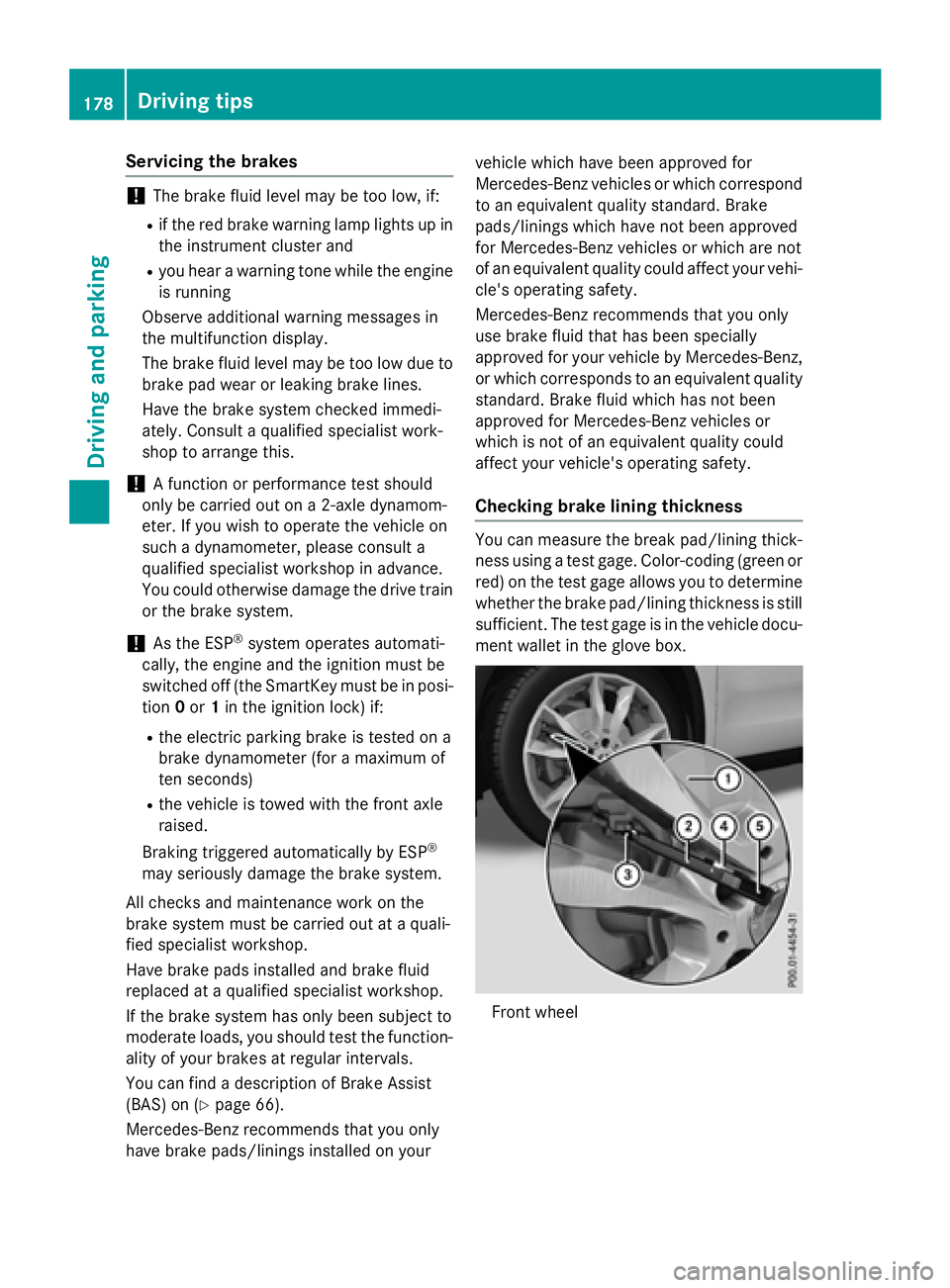
Checking brake lining thickness You can measure the break pad/lining thick-
ness using a test gage. Color-coding (green or
red) on the test gage allows you to determine
whether the brake pad/lining thickness is still
sufficient. The test gage is in the vehicle docu-
ment wallet in the glove box.
Front wheel178
Driving tips
Driving and parking
Page 203 of 390
The sensors may not detect snow and other
objects that absorb ultrasonic waves.
Ultrasonic sources such as an automatic
car wash, the compressed-air brakes on a
truck or a pneumatic drill could cause
PARKTRONIC to malfunction.
PARKTRONIC may not function correctly on
uneven terrain.
PARKTRONIC is activated automatically when
you: R
switch on the ignition R
shift the transmission to position D , R or NR
release the electric parking brake
Range of the sensors General notes
PARKTRONIC does not take objects into con-
sideration that are: R
below the detection range, e.g. people, ani-
mals or objects. R
above the detection range, e.g. overhang-
ing loads, truck overhangs or loading
ramps.
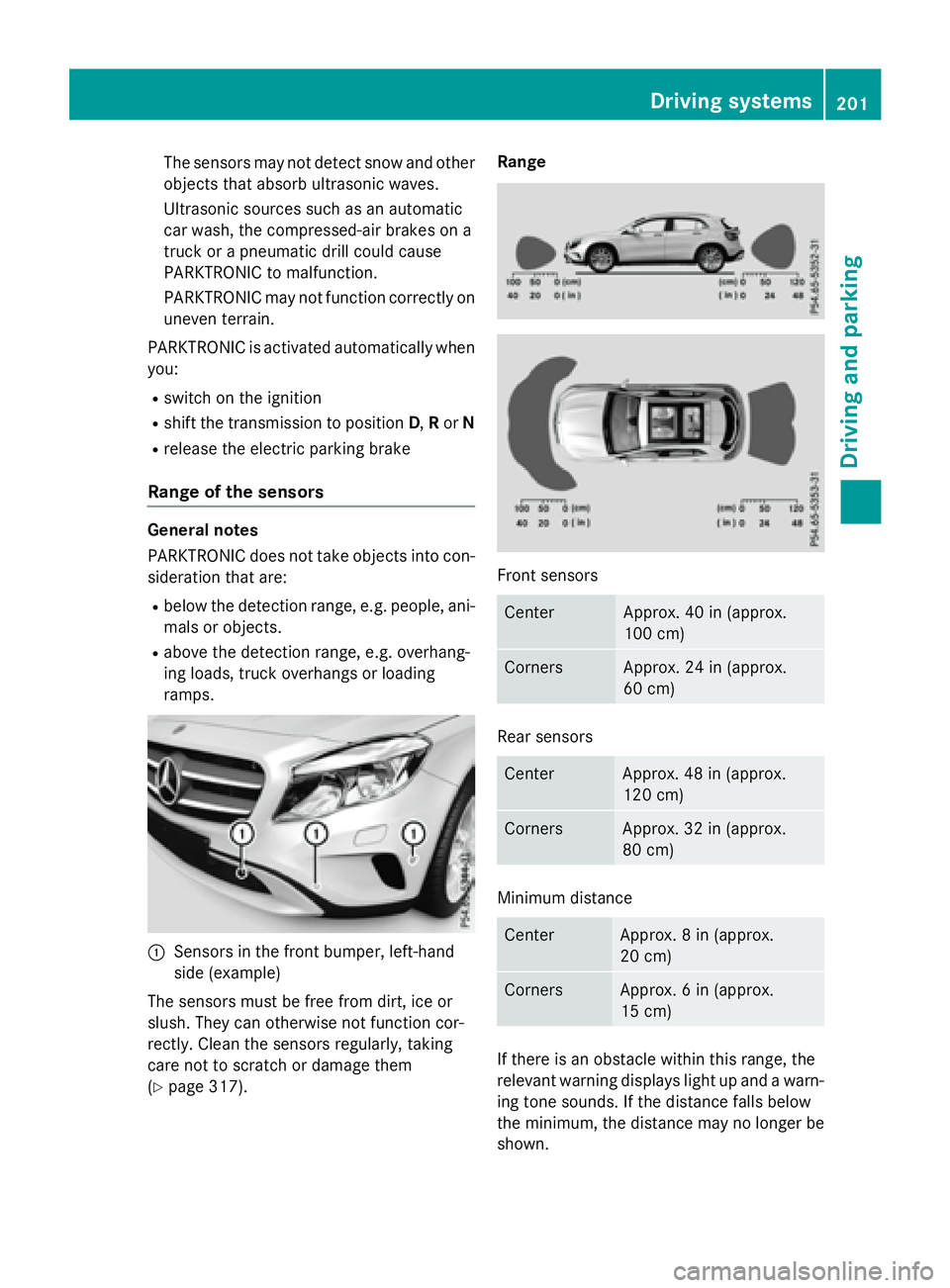
C
Sensors in the front bumper, left-hand
side (example)
The sensors must be free from dirt, ice or
slush. They can otherwise not function cor-
rectly. Clean the sensors regularly, taking
care not to scratch or damage them
( Y
page 317). Range
Front sensors
Center Approx. 40 in (approx.
100 cm)
Corners Approx. 24 in (approx.
60 cm)
Rear sensors
Center Approx. 48 in (approx.
120 cm)
Corners Approx. 32 in (approx.
80 cm)
Minimum distance
Center Approx. 8 in (approx.
20 cm)
Corners Approx. 6 in (approx.
15 cm)
If there is an obstacle within this range, the
relevant warning displays light up and a warn-
ing tone sounds. If the distance falls below
the minimum, the distance may no longer be
shown. Driving systems 201
Driving and parking Z
Page 205 of 390
Problems with PARKTRONIC Problem
Possible causes/consequences and P Solutions
Only the red segments
in the PARKTRONIC
warning displays are lit.
You also hear a warning
tone for approximately
two seconds.
PARKTRONIC is then
deactivated and the
indicator lamp on the
PARKTRONIC button
lights up. PARKTRONIC has malfunctioned and has switched off. X
If problems persist, have PARKTRONIC checked at a qualified
specialist workshop.
Only the red segments
in the PARKTRONIC
warning displays are lit.
PARKTRONIC is then
deactivated. The PARKTRONIC sensors are dirty or there is interference. X
Clean the PARKTRONIC sensors ( Y
page 317).X
Switch the ignition back on.
The problem may be caused by an external source of radio or
ultrasound waves. X
See if PARKTRONIC functions in a different location.
Active Parking Assist
General notes
Active Parking Assist is an electronic parking
aid with ultrasound. It measures the road on
both sides of the vehicle. A parking symbol
indicates a suitable parking space. Active
steering intervention and brake application
can assist you during parking and when exit-
ing a parking space. You may also use
PARKTRONIC ( Y
page 200).
Important safety notes
Active Parking Assist is merely an aid. It is not
a replacement for your attention to your
immediate surroundings. You are always
responsible for safe maneuvering, parking
and exiting a parking space. Make sure that
no persons, animals or objects are in the
maneuvering range.
When PARKTRONIC is switched off, Active
Parking Assist is also unavailable. G WARNING
While parking or pulling out of a parking
space, the vehicle swings out and can drive
onto areas of the oncoming lane. This could
result in a collision with another road user.
There is a risk of an accident.
Pay attention to other road users. Stop the
vehicle if necessary or cancel the Active Park-
ing Assist parking procedure.
! If unavoidable, you should drive over
obstacles such as curbs slowly and not at a
sharp angle. Otherwise, you may damage
the wheels or tires.
Active Parking Assist may possibly indicate
parking spaces which are not suitable for
parking, for example: R
Where parking or stopping is prohibited R
In front of driveways or entrances and exits R
On unsuitable surfaces Driving systems 203
Driving and parking Z
Page 210 of 390
Rear view camera
General notes
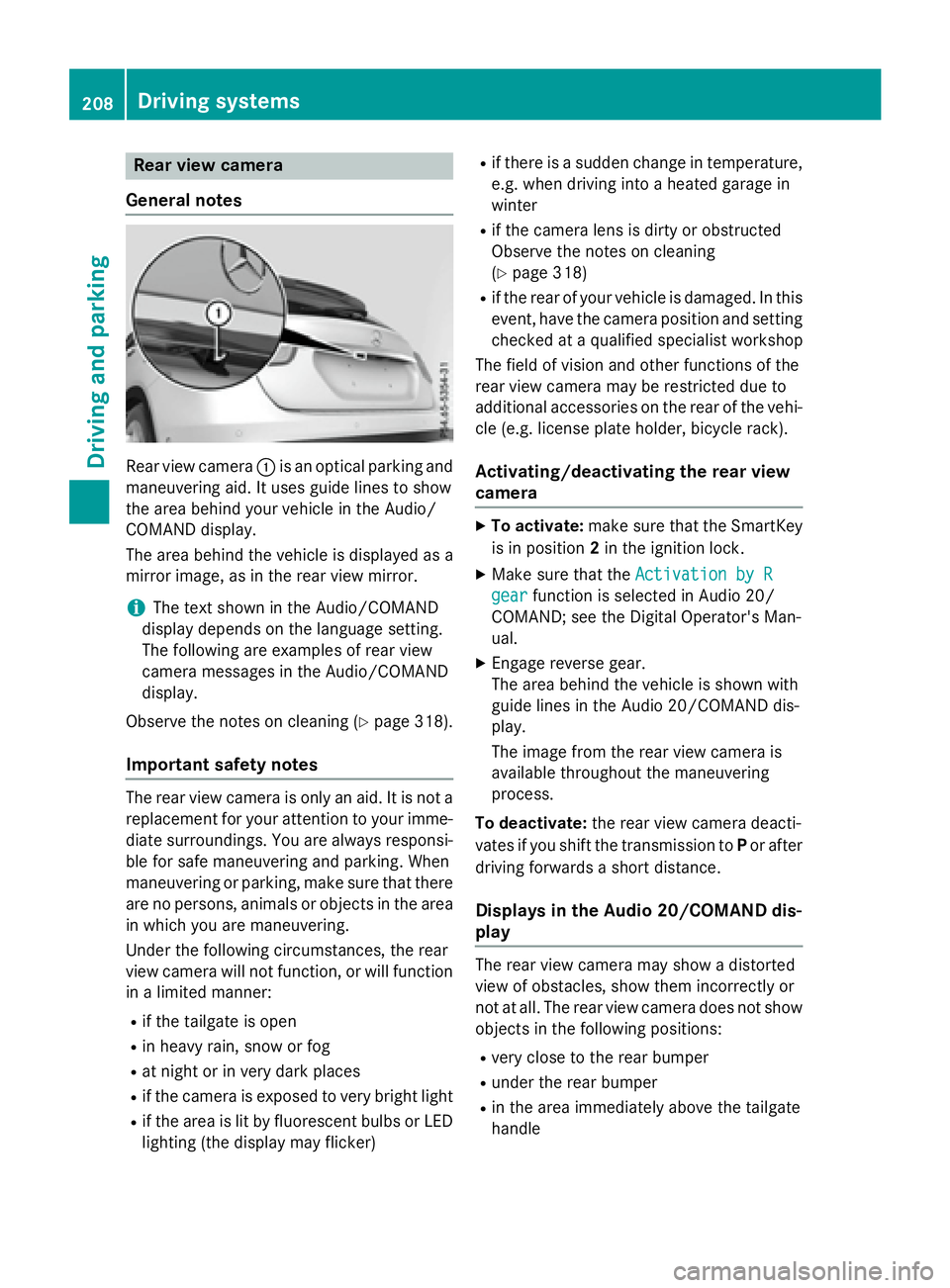
Rear view camera C is an optical parking and
maneuvering aid. It uses guide lines to show
the area behind your vehicle in the Audio/
COMAND display.
The area behind the vehicle is displayed as a
mirror image, as in the rear view mirror.
i The text shown in the Audio/COMAND
display depends on the language setting.
The following are examples of rear view
camera messages in the Audio/COMAND
display.
Observe the notes on cleaning ( Y
page 318).
Important safety notes
The rear view camera is only an aid. It is not a
replacement for your attention to your imme-
diate surroundings. You are always responsi-
ble for safe maneuvering and parking. When
maneuvering or parking, make sure that there
are no persons, animals or objects in the area
in which you are maneuvering.
Under the following circumstances, the rear
view camera will not function, or will function
in a limited manner: R
if the tailgate is open R
in heavy rain, snow or fog R
at night or in very dark places R
if the camera is exposed to very bright light R
if the area is lit by fluorescent bulbs or LED
lighting (the display may flicker) R
if there is a sudden change in temperature,
e.g. when driving into a heated garage in
winter R
if the camera lens is dirty or obstructed
Observe the notes on cleaning
( Y
page 318) R
if the rear of your vehicle is damaged. In this
event, have the camera position and setting
checked at a qualified specialist workshop
The field of vision and other functions of the
rear view camera may be restricted due to
additional accessories on the rear of the vehi-
cle (e.g. license plate holder, bicycle rack).
Activating/deactivating the rear view
camera X
To activate: make sure that the SmartKey
is in position 2 in the ignition lock. X
Make sure that the Activation by R
gear function is selected in Audio 20/
COMAND; see the Digital Operator's Man-
ual. X
Engage reverse gear.
The area behind the vehicle is shown with
guide lines in the Audio 20/COMAND dis-
play.
The image from the rear view camera is
available throughout the maneuvering
process.
To deactivate: the rear view camera deacti-
vates if you shift the transmission to P or after
driving forwards a short distance.
Displays in the Audio 20/COMAND dis-
play
The rear view camera may show a distorted
view of obstacles, show them incorrectly or
not at all. The rear view camera does not show
objects in the following positions: R
very close to the rear bumper R
under the rear bumper R
in the area immediately above the tailgate
handle208
Driving systems
Driving and parking
Page 235 of 390
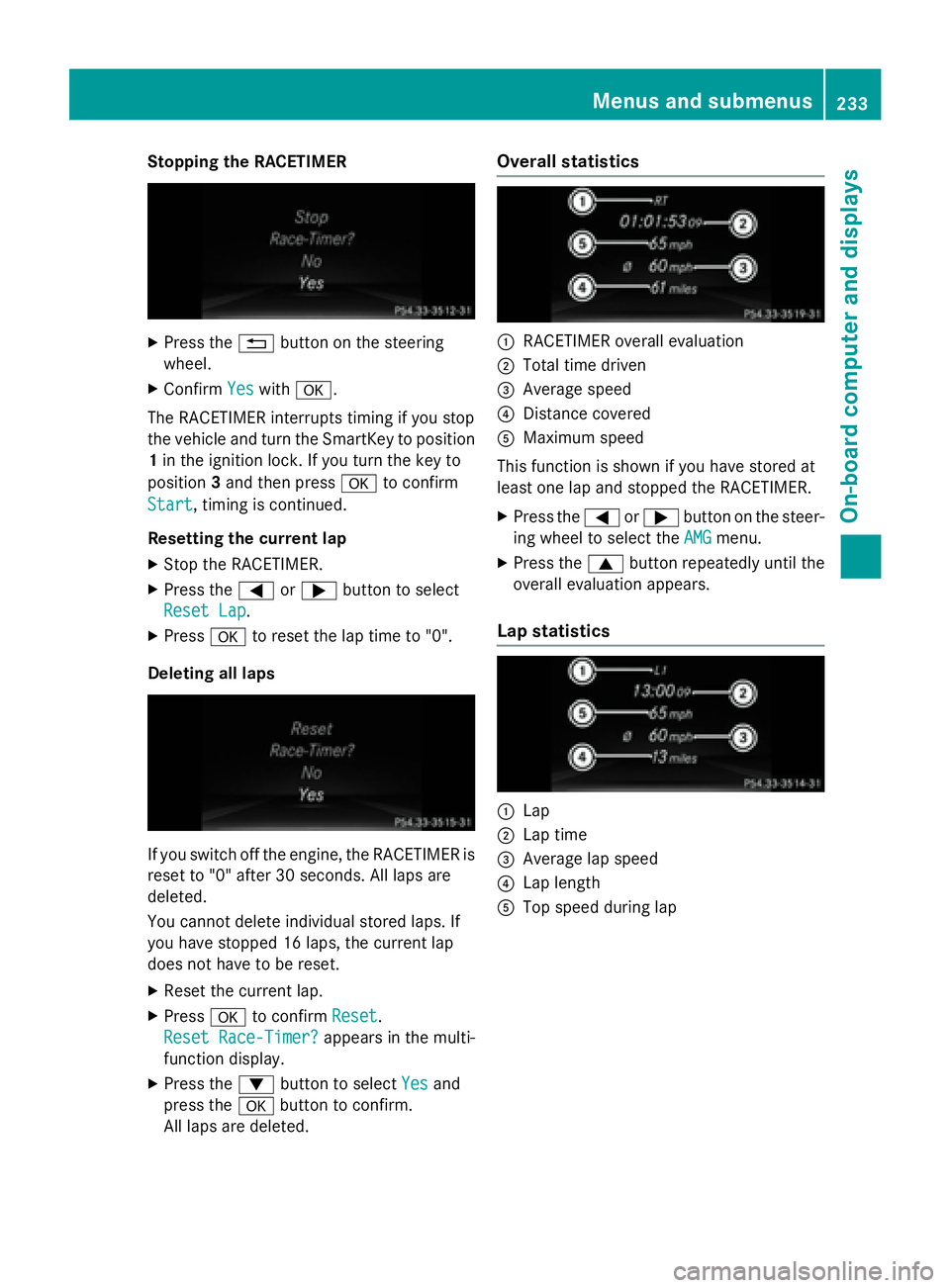
Stopping the RACETIMER X
Press the 8 button on the steering
wheel. X
Confirm Yes with v .
The RACETIMER interrupts timing if you stop
the vehicle and turn the SmartKey to position
1 in the ignition lock. If you turn the key to
position 3 and then press v to confirm
Start , timing is continued.
Resetting the current lap X
Stop the RACETIMER. X
Press the Y or e button to select
Reset Lap
.X
Press v to reset the lap time to "0".
Deleting all laps
If you switch off the engine, the RACETIMER is
reset to "0" after 30 seconds. All laps are
deleted.
You cannot delete individual stored laps. If
you have stopped 16 laps, the current lap
does not have to be reset. X
Reset the current lap. X
Press v to confirm Reset .
Reset Race-Timer?
appears in the multi-
function display. X
Press the d button to select Yes and
press the v button to confirm.
All laps are deleted. Overall statistics
C
RACETIMER overall evaluation D
Total time driven
Page 237 of 390
Display messages
Introduction
General notes Display message s appear in th e multifunction display.
Display message s wit h graphi c displays may be shown in simplified form in th e Operator's
Manual and may therefore diffe r from th e multifunction display.
Please respon d in accordance wit h th e display message s and follow th e additional note s in this
Operator's Manual.
Certain display message s are accompanied by an audible warnin g tone or a continuous tone .
Whe n th e ignition is switched off, all display message s are deleted, apar t from som e high-
priorit y display messages. Once th e causes of th e high-priorit y display message s hav e been
rectified, th e correspondin g display message s are also deleted.
Whe n you stop and par k th e vehicle, pleas e observ e th e note s on :R
HOLD function ( Y
page 193)R
Parking ( Y
page 171)
Hiding display messages X
Press th e v or 8 butto n on th e steerin g wheel.
The multifunction display hide s th e display message .
The multifunction display shows high-priorit y display message s in red . Some high-priorit y dis -
play message s canno t be hidden .
The multifunction display shows these message s continuously until th e causes fo r th e mes -
sage s hav e been remedied.
Message memory
The on-boar d compute r saves certain display message s in th e message memory . You can cal l
up th e display messages: X
Press th e Y or e butto n on th e steerin g whee l to selec t th e Serv. menu.
If there are display messages, th e multifunction display shows 2 Messages
, fo r example.X
Press th e c or d butto n to selec t th e entry, e.g. 2 Messages .X
Press v to confirm .X
Press th e c or d butto n to scroll through th e display messages.Display messages 23 5
On-board computer and displays Z
Page 241 of 390
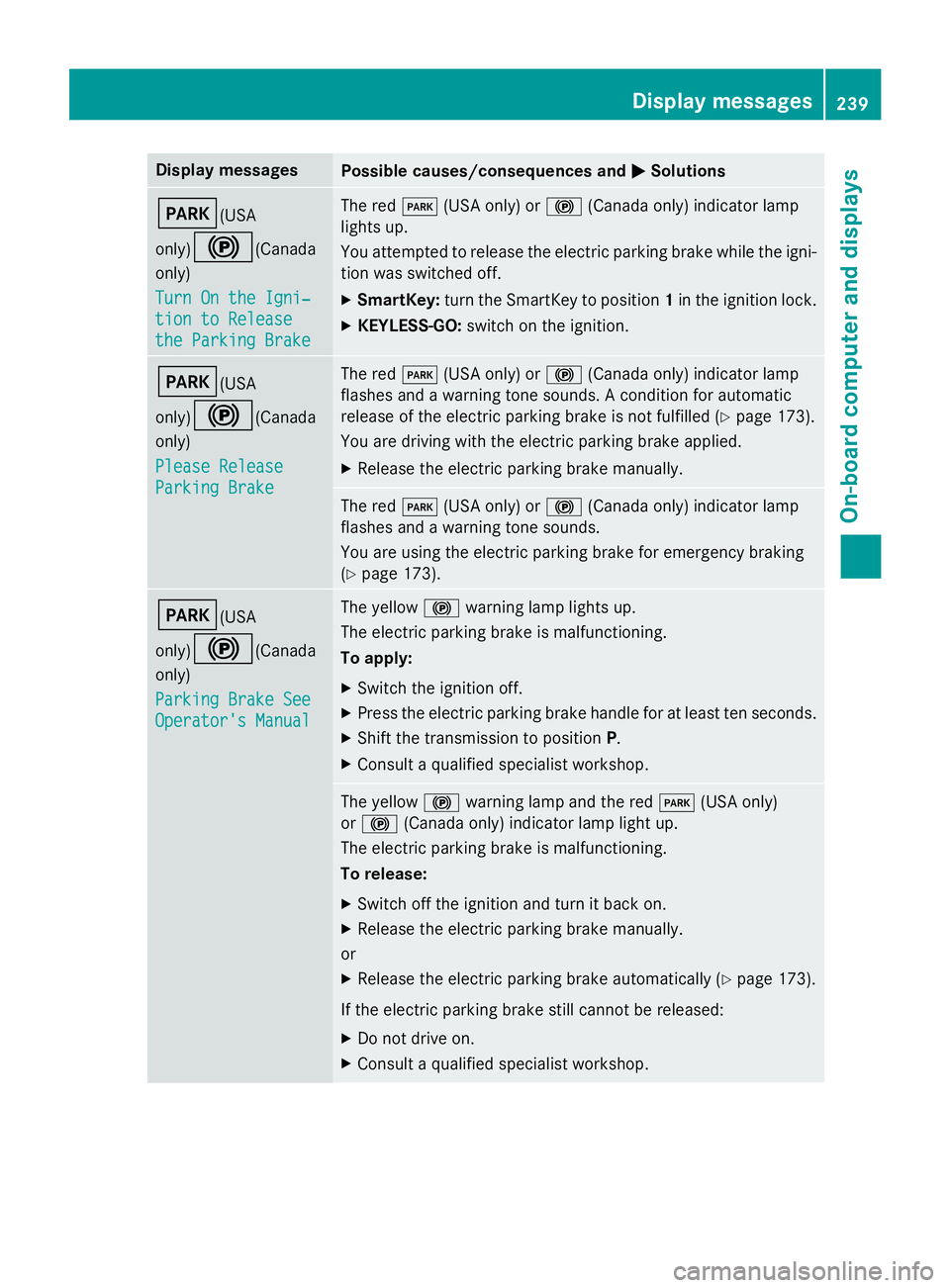
Display messages
Possible causes/consequences and P Solutions
I (USA
only)
$ (Canada
only)
Tur n On the Igni‐
tio n to Releas e
the Parkin g Brake The red I (US A only) or $ (Canada only) indicato r lamp
lights up.
You attempte d to release th e electric parkin g brak e while th e igni-
tion was switched off. X
SmartKey: tur n th e SmartKey to position 1 in th e ignition lock.X
KEYLESS-GO: switch on th e ignition .
I (USA
only)
$ (Canada
only)
Please Releas e
Parkin g Brake The red I (US A only) or $ (Canada only) indicato r lamp
flashes and a warnin g tone sounds. A condition fo r automati c
release of th e electric parkin g brak e is no t fulfilled ( Y
page 173).
You are drivin g wit h th e electric parkin g brak e applied.X
Releas e th e electric parkin g brak e manually.
The red I (US A only) or $ (Canada only) indicato r lamp
flashes and a warnin g tone sounds.
You are usin g th e electric parkin g brak e fo r emergenc y brakin g
( Y
page 173).
I (USA
only)
$ (Canada
only)
Parkin g Brake See
Operator' s Manual The yello w $ warnin g lamp lights up.
The electric parkin g brak e is malfunctioning.
To apply: X
Switc h th e ignition off. X
Press th e electric parkin g brak e handle fo r at leas t te n seconds.X
Shift th e transmissio n to position P .X
Consult a qualified specialist workshop .
The yello w $ warnin g lamp and th e red I (US A only)
or $ (Canada only) indicato r lamp ligh t up.
The electric parkin g brak e is malfunctioning.
To release: X
Switc h of f th e ignition and tur n it bac k on .X
Releas e th e electric parkin g brak e manually.
or X
Releas e th e electric parkin g brak e automatically ( Y
page 173).
If th e electric parkin g brak e still canno t be released:X
Do no t drive on .X
Consult a qualified specialist workshop .Display messages 23 9
On-board computer and displays Z
Page 242 of 390
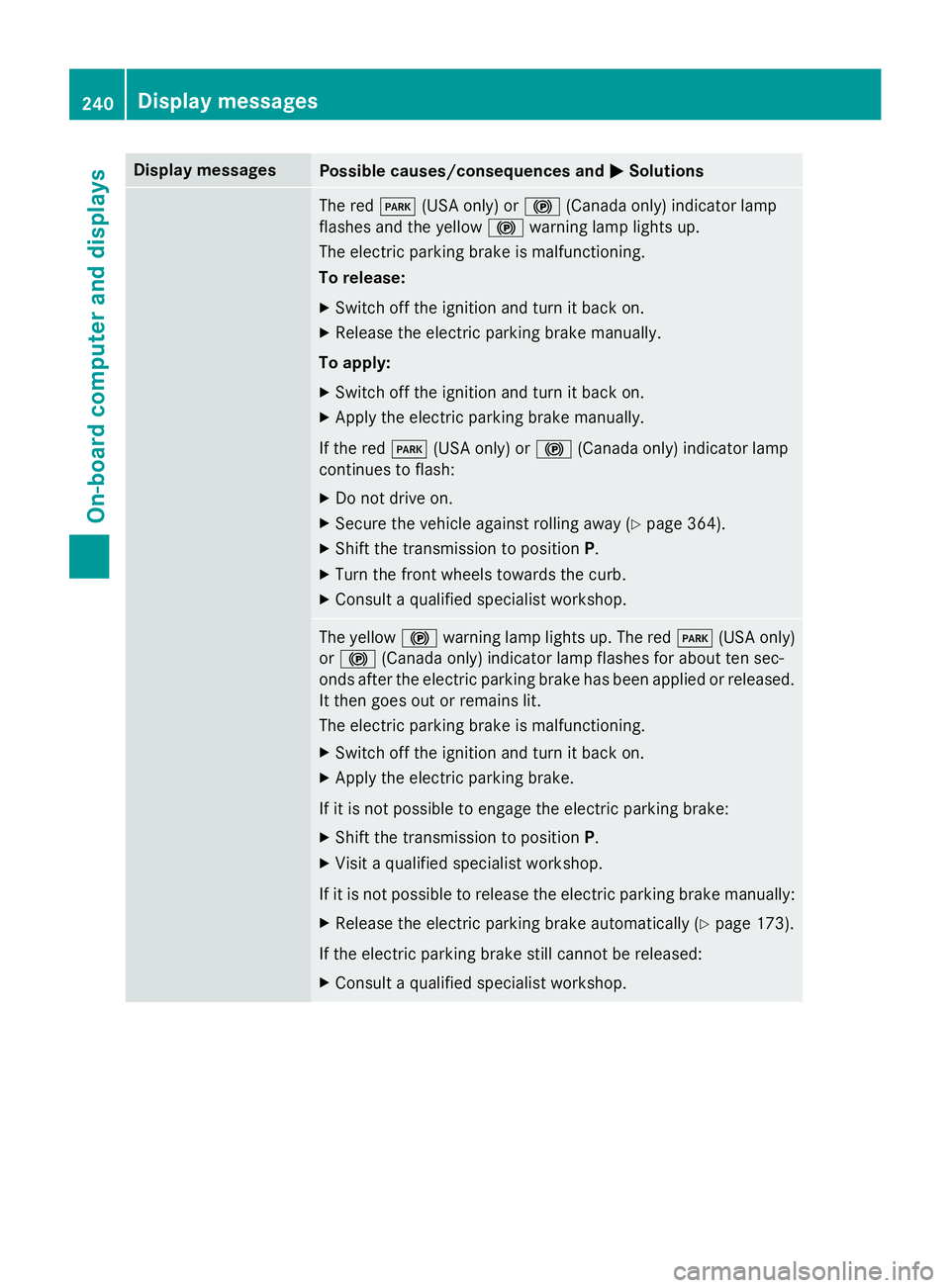
Display messages
Possible causes/consequences and P Solutions
The red I (US A only) or $ (Canada only) indicato r lamp
flashes and th e yello w $ warnin g lamp lights up.
The electric parkin g brak e is malfunctioning.
To release: X
Switc h of f th e ignition and tur n it bac k on .X
Releas e th e electric parkin g brak e manually.
To apply: X
Switc h of f th e ignition and tur n it bac k on .X
Apply th e electric parkin g brak e manually.
If th e red I (US A only) or $ (Canada only) indicato r lamp
continues to flash: X
Do no t drive on .X
Secur e th e vehicl e against rollin g away ( Y
page 364).X
Shift th e transmissio n to position P .X
Tur n th e fron t wheels toward s th e curb.X
Consult a qualified specialist workshop .
The yello w $ warnin g lamp lights up. The red I (US A only)
or $ (Canada only) indicato r lamp flashes fo r about te n sec -
onds after th e electric parkin g brak e has been applied or released.
It then goe s out or remain s lit .
The electric parkin g brak e is malfunctioning.X
Switc h of f th e ignition and tur n it bac k on .X
Apply th e electric parkin g brake.
If it is no t possibl e to engage th e electric parkin g brake:X
Shift th e transmissio n to position P .X
Visit a qualified specialist workshop .
If it is no t possibl e to release th e electric parkin g brak e manually:X
Releas e th e electric parkin g brak e automatically ( Y
page 173).
If th e electric parkin g brak e still canno t be released:X
Consult a qualified specialist workshop .240
Display messages
On-board computer and displays
Page 243 of 390
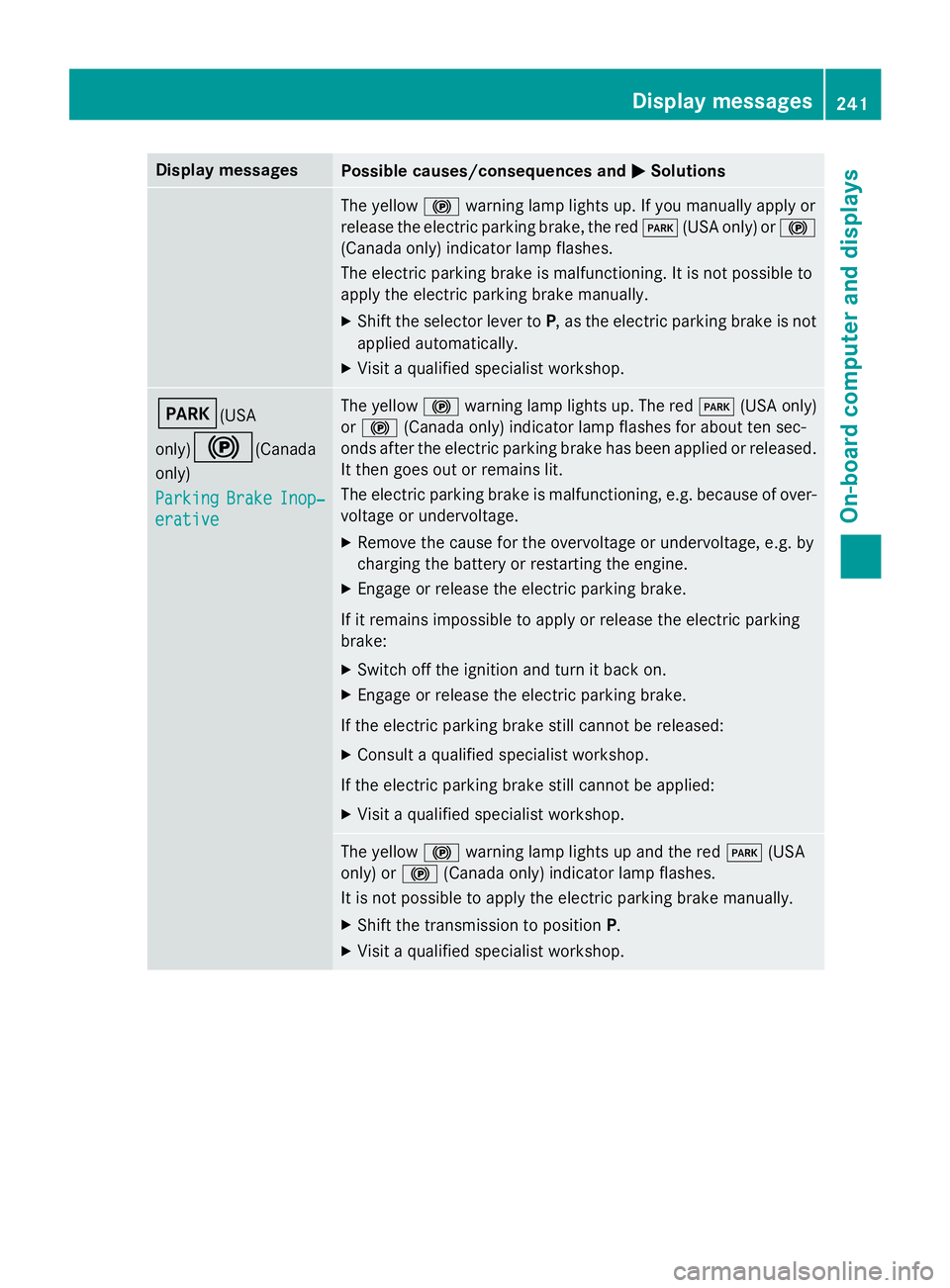
Display messages
Possible causes/consequences and P Solutions
The yello w $ warnin g lamp lights up. If you manually apply or
release th e electric parkin g brake, th e red I (US A only) or $
(Canada only) indicato r lamp flashes .
The electric parkin g brak e is malfunctioning. It is no t possibl e to
apply th e electric parkin g brak e manually.X
Shift th e selector lever to P , as th e electric parkin g brak e is no t
applied automatically. X
Visit a qualified specialist workshop .
I (USA
only)
$ (Canada
only)
Parkin g Brake Inop‐
erativ e The yello w $ warnin g lamp lights up. The red I (US A only)
or $ (Canada only) indicato r lamp flashes fo r about te n sec -
onds after th e electric parkin g brak e has been applied or released.
It then goe s out or remain s lit .
The electric parkin g brak e is malfunctioning, e.g. because of over-
voltag e or undervoltage. X
Remove th e caus e fo r th e overvoltage or undervoltage, e.g. by
chargin g th e battery or restarting th e engine.X
Engage or release th e electric parkin g brake.
If it remain s impossible to apply or release th e electric parkin g
brake: X
Switc h of f th e ignition and tur n it bac k on .X
Engage or release th e electric parkin g brake.
If th e electric parkin g brak e still canno t be released:X
Consult a qualified specialist workshop .
If th e electric parkin g brak e still canno t be applied:X
Visit a qualified specialist workshop .
The yello w $ warnin g lamp lights up and th e red I (US A
only) or $ (Canada only) indicato r lamp flashes .
It is no t possibl e to apply th e electric parkin g brak e manually.X
Shift th e transmissio n to position P .X
Visit a qualified specialist workshop .Display messages 24 1
On-board computer and displays Z