automatic transmission MERCEDES-BENZ GLA 2019 User Guide
[x] Cancel search | Manufacturer: MERCEDES-BENZ, Model Year: 2019, Model line: GLA, Model: MERCEDES-BENZ GLA 2019Pages: 346, PDF Size: 16.66 MB
Page 60 of 346
you install the child restraint system on a rearseat.
If it is absolutely necessary to install a childrestraint system on the front-passenger seat,always observe the instructions and safetynotes on the "Occupant Classification System(OCS)" (Ypage 47).
You can thus avoid the risks that could ariseas a result of:
Ran incorrectly categorized person in thefront-passenger seat
Rdeactivating the front passenger front airbag unintentionally
Rthe unsuitable positioning of the childrestraint system, e.g. too close to the dash-board
Rearward-facing child restraint system
If circumstances require you to secure a childin a rearward-facing child restraint system onthe front-passenger seat, always make surethat the front passenger front air bag is deacti-vated. Only if the PASSENGER AIR BAG OFFindicator lamp is lit continuously (Ypage 40),is the front passenger front air bag deactiva-ted.
Always observe the child restraint systemmanufacturer's installation and operatinginstructions.
Forward-facing child restraint system
If it is absolutely necessary to install aforward-facing child restraint system on thefront-passenger seat, always move the front-passenger seat as far back as possible. Fullyretract the seat cushion length. The entirebase of the child restraint system must alwaysrest on the seat cushion of the front-passenger seat. The backrest of the childrestraint system must lie as flat as possibleagainst the backrest of the front-passengerseat. The child restraint system must nottouch the roof or be subjected to a load by thehead restraint. Adjust the angle of the seatbackrest and the head restraint positionaccordingly. Always make sure that the shoul-der belt strap is correctly routed from the vehi-cle belt outlet to the shoulder belt guide onthe child restraint system. The shoulder beltstrap must be routed forward and down fromthe vehicle belt outlet. If necessary, adjust the
vehicle belt outlet and the front-passengerseat accordingly.
Always observe the child restraint systemmanufacturer's installation and operatinginstructions.
Child-proof locks
Important safety notes
GWARNING
If children are traveling in the vehicle, they
could:
Ropen doors, thus endangering other peo-
ple or road users
Rexit the vehicle and be caught by oncom-
ing traffic
Roperate vehicle equipment and become
trapped
There is a risk of an accident and injury.
Always activate the child-proof locks and
override feature if children are traveling in
the vehicle. When leaving the vehicle,
always take the key with you and lock the
vehicle. Never leave children unattended in
the vehicle.
Override feature for:
Rthe rear doors (Ypage 59)
Rthe rear side windows (Ypage 59)
GWARNING
If you leave children unsupervised in the
vehicle, they could set it in motion by, for
example:
Rrelease the parking brake.
Rshift the automatic transmission out of
the parking positionP.
Rstart the engine.
In addition, they may operate vehicle equip-
ment and become trapped. There is a risk of
an accident and injury.
When leaving the vehicle, always take the
SmartKey with you and lock the vehicle.
Never leave children unsupervised in the
vehicle.
58Children in the vehicle
Safety
Page 65 of 346
Situation-dependent braking assis-
tance
General information
iObserve the "Important safety notes" sec-tion (Ypage 60).
With the help of the radar sensor system,Active Brake Assist can detect obstacles thatare in the path of your vehicle for an extendedperiod of time.
If Active Brake Assist detects a risk of collisionwith the vehicle in front, it calculates the brakepressure necessary to avoid a collision. If youapply the brakes forcefully, situation-depend-ent braking assistance adapts to the situationand automatically increases the brake pres-sure to a degree appropriate to the traffic sit-uation.
Situation-dependent braking assistance pro-vides braking assistance in hazardous situa-tions at speeds above 4 mph (7 km/h). It usesradar sensor technology to assess the trafficsituation.
Situation-dependent braking assistance iscapable of reacting to moving objects thathave already been detected as such at leastonce over the period of observation, up tovehicle speeds of around 155 mph(250 km/h).
Situation-dependent braking assistance canalso detect stationary objects, up to vehiclespeeds of around 44 mph (70 km/h).
XKeep the brake pedal depressed until theemergency braking situation is over.ABS prevents the wheels from locking.
The brakes will work normally again if:
Ryou release the brake pedal
Rthere is no longer any danger of a collision
Rno obstacle is detected in front of your vehi-cle
Situation-dependent braking assistance is thendeactivated.
Important safety notes
iObserve the "Important safety notes" sec-tion for driving safety systems (Ypage 60).
GWARNING
Active Brake Assist does not react:
Rto persons, bicycles, motorcycles or ani-
mals
Rto approaching vehicles
Rto cross traffic
Ron bends
As a result, Active Brake Assist cannot inter-
vene in all critical situations. There is a risk
of an accident.
Always pay careful attention to the traffic
situation and be prepared to brake.
GWARNING
Adaptive Brake Assist cannot always clearly
identify objects and complex traffic situa-
tions.
In such cases, Adaptive Brake Assist might:
Rintervene unnecessarily
Rnot intervene
There is a risk of an accident.
Always pay careful attention to the traffic
situation and be ready to brake. Terminate
the intervention in a non-critical driving sit-
uation.
Due to the nature of the system, complex butnon-critical driving conditions may also causeActive Brake Assist to intervene.
Even if Active Brake Assist is not available dueto a malfunction in the radar sensor system,the brake system is still available with fullbrake boosting effect and BAS.
ESP®(Electronic Stability Program)
General notes
iObserve the "Important safety notes" sec-tion (Ypage 60).
ESP®monitors driving stability and traction,i.e. power transmission between the tires andthe road surface.
If ESP®detects that the vehicle is deviatingfrom the direction desired by the driver, one ormore wheels are braked to stabilize the vehi-
Driving safety systems63
Safety
Z
Page 71 of 346
SmartKey
Important safety notes
GWARNING
If children are left unsupervised in the vehi-
cle, they could:
Roperate the vehicle's equipment
Additionally, children could set the vehicle in
motion if, for example, they:
Rrelease the parking brake
Rshift the automatic transmission out of
park position]
Rstart the engine
There is a risk of an accident and injury.
Never leave children or animals unattended
in the vehicle.
When leaving the vehicle, always take the
SmartKey with you and lock the vehicle. This
also applies for the Digital Vehicle Key if the
"Digital Vehicle Key" function is activated via
Mercedes me connect.
GWARNING
If you attach heavy or large objects to the
SmartKey, the SmartKey could be uninten-
tionally turned in the ignition lock. This
could cause the engine to be switched off.
There is a risk of an accident.
Do not attach any heavy or large objects to
the SmartKey. Remove any bulky key rings
before inserting the SmartKey into the igni-
tion lock.
!Keep the SmartKey away from strong mag-netic fields. Otherwise, the remote controlfunction could be affected.
Strong magnetic fields can occur in thevicinity of powerful electrical installations.
Do not keep the SmartKey:
Rwith electronic devices, e.g. a mobile phoneor another SmartKey
Rwith metallic objects, e.g. coins or metal foil
Rinside metallic objects, e.g. a metal case
Vehicles with KEYLESS-GO start function:do not keep the SmartKey in the cargo com-
partment. Otherwise, the SmartKey may notbe detected, e.g. when starting the engineusing the Start/Stop button.
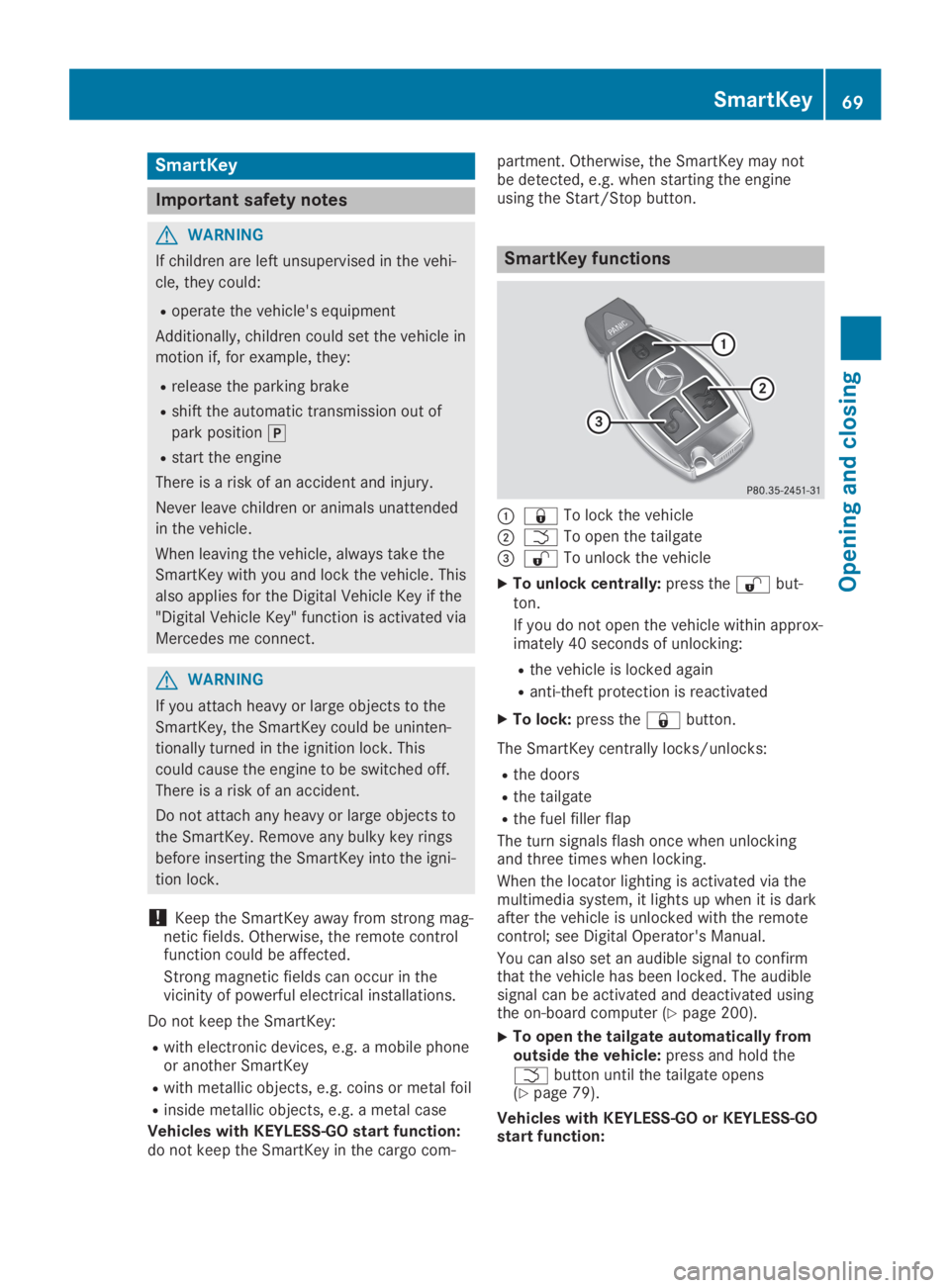
SmartKey functions
C7To lock the vehicle
DTTo open the tailgate
Page 77 of 346
ProblemPossible causes/consequences andPPSolutions
You have lost a Smart-Key.XHave the SmartKey deactivated at a qualified specialist work-shop.
XReport the loss immediately to the vehicle insurers.
XIf necessary, have the locks changed as well.
You have lost themechanical key.XReport the loss immediately to the vehicle insurers.
XIf necessary, have the locks changed as well.
Doors
Important safety notes
GWARNING
If children are left unsupervised in the vehi-
cle, they could:
Roperate the vehicle's equipment
Additionally, children could set the vehicle in
motion if, for example, they:
Rrelease the parking brake
Rshift the automatic transmission out of
park position]
Rstart the engine
There is a risk of an accident and injury.
Never leave children or animals unattended
in the vehicle.
When leaving the vehicle, always take the
SmartKey with you and lock the vehicle. This
also applies for the Digital Vehicle Key if the
"Digital Vehicle Key" function is activated via
Mercedes me connect.
You should preferably place luggage or loadsin the cargo compartment. Observe the load-ing guidelines (Ypage 250).
Unlocking and opening doors from
the inside
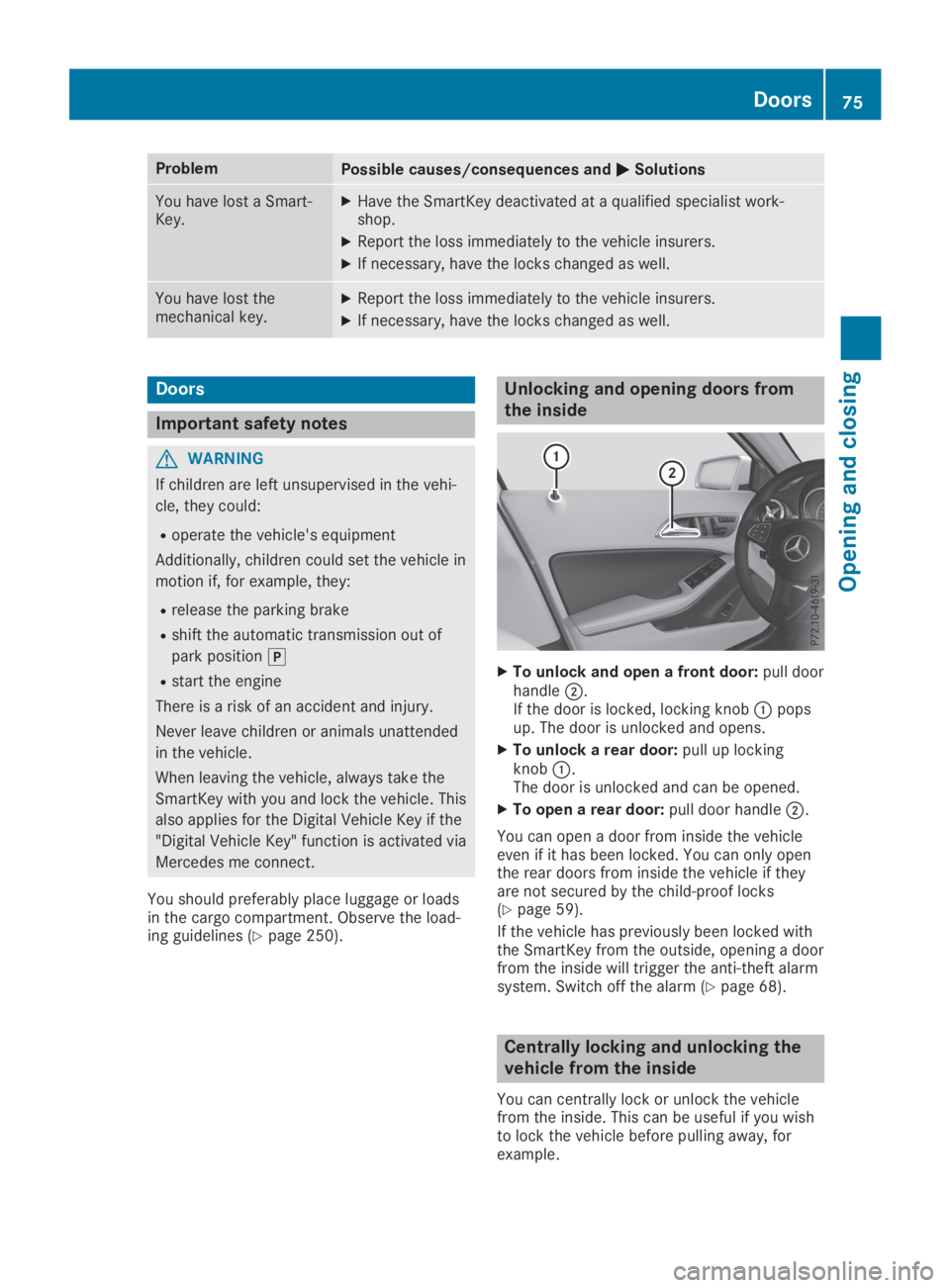
XTo unlock and open a front door:pull doorhandleD.If the door is locked, locking knobCpopsup. The door is unlocked and opens.
XTo unlock a rear door:pull up lockingknobC.The door is unlocked and can be opened.
XTo open a rear door:pull door handleD.
You can open a door from inside the vehicleeven if it has been locked. You can only openthe rear doors from inside the vehicle if theyare not secured by the child-proof locks(Ypage 59).
If the vehicle has previously been locked withthe SmartKey from the outside, opening a doorfrom the inside will trigger the anti-theft alarmsystem. Switch off the alarm (Ypage 68).
Centrally locking and unlocking the
vehicle from the inside
You can centrally lock or unlock the vehiclefrom the inside. This can be useful if you wishto lock the vehicle before pulling away, forexample.
Doors75
Opening and closing
Z
Page 127 of 346
There is a risk of fire and an accident.
Release the parking brake fully before driv-
ing off.
!Do not warm up the engine while station-ary. Pull away immediately. Avoid highengine speeds and full throttle until theengine has reached its operating tempera-ture.
In vehicles with automatic transmission,engage positions P and R only when thevehicle is stationary.
Where possible, avoid spinning the drivewheels when pulling away on slippery roads.You could otherwise damage the drive train.
!Mercedes-AMG vehicles:avoid full-loadoperation and engine speeds greater than5000 rpm when the engine is cold. Thishelps to protect the engine and avoidsuncomfortable driving.
Key positions
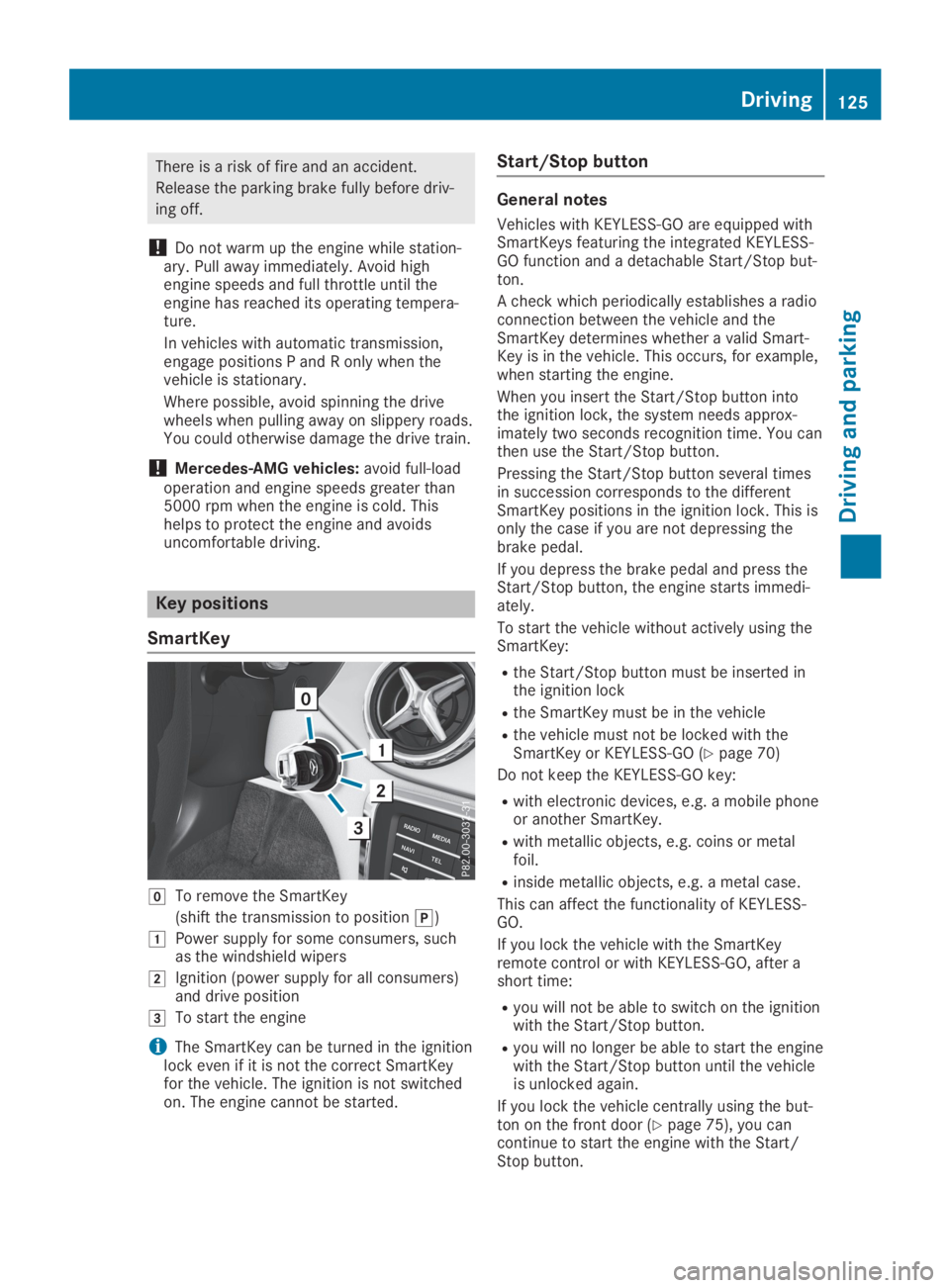
SmartKey
ZTo remove the SmartKey
(shift the transmission to position])
GPower supply for some consumers, suchas the windshield wipers
HIgnition (power supply for all consumers)and drive position
ITo start the engine
iThe SmartKey can be turned in the ignitionlock even if it is not the correct SmartKeyfor the vehicle. The ignition is not switchedon. The engine cannot be started.
Start/Stop button
General notes
Vehicles with KEYLESS-GO are equipped withSmartKeys featuring the integrated KEYLESS-GO function and a detachable Start/Stop but-ton.
A check which periodically establishes a radioconnection between the vehicle and theSmartKey determines whether a valid Smart-Key is in the vehicle. This occurs, for example,when starting the engine.
When you insert the Start/Stop button intothe ignition lock, the system needs approx-imately two seconds recognition time. You canthen use the Start/Stop button.
Pressing the Start/Stop button several timesin succession corresponds to the differentSmartKey positions in the ignition lock. This isonly the case if you are not depressing thebrake pedal.
If you depress the brake pedal and press theStart/Stop button, the engine starts immedi-ately.
To start the vehicle without actively using theSmartKey:
Rthe Start/Stop button must be inserted inthe ignition lock
Rthe SmartKey must be in the vehicle
Rthe vehicle must not be locked with theSmartKey or KEYLESS-GO (Ypage 70)
Do not keep the KEYLESS-GO key:
Rwith electronic devices, e.g. a mobile phoneor another SmartKey.
Rwith metallic objects, e.g. coins or metalfoil.
Rinside metallic objects, e.g. a metal case.
This can affect the functionality of KEYLESS-GO.
If you lock the vehicle with the SmartKeyremote control or with KEYLESS-GO, after ashort time:
Ryou will not be able to switch on the ignitionwith the Start/Stop button.
Ryou will no longer be able to start the enginewith the Start/Stop button until the vehicleis unlocked again.
If you lock the vehicle centrally using the but-ton on the front door (Ypage 75), you cancontinue to start the engine with the Start/Stop button.
Driving125
Driving and parking
Z
Page 128 of 346
The engine can be switched off while the vehi-cle is in motion by pressing and holding theStart/Stop button for three seconds. Thisfunction operates independently of the ECOstart/stop automatic engine switch-off func-tion.
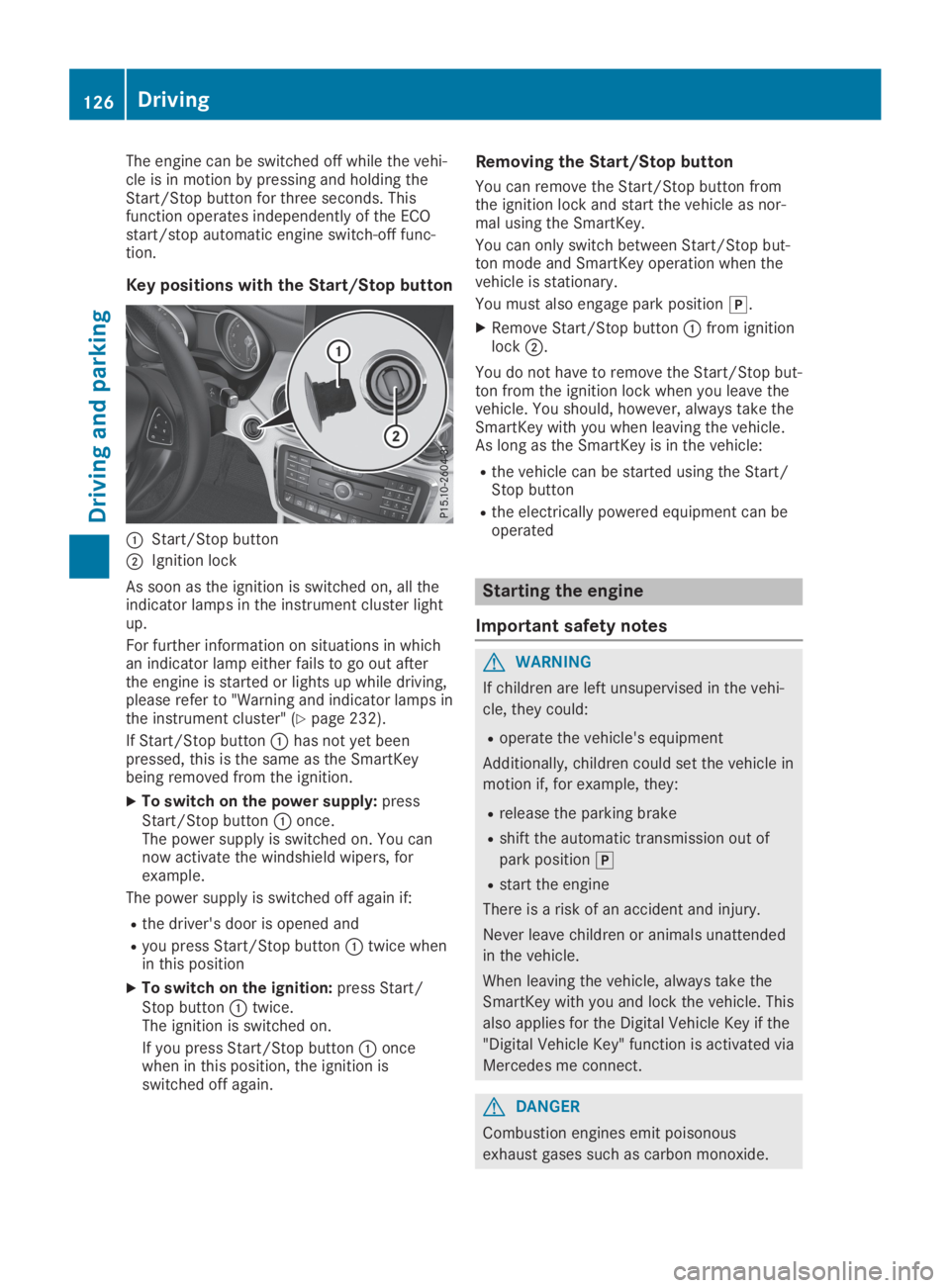
Key positions with the Start/Stop button
CStart/Stop button
DIgnition lock
As soon as the ignition is switched on, all theindicator lamps in the instrument cluster lightup.
For further information on situations in whichan indicator lamp either fails to go out afterthe engine is started or lights up while driving,please refer to "Warning and indicator lamps inthe instrument cluster" (Ypage 232).
If Start/Stop buttonChas not yet beenpressed, this is the same as the SmartKeybeing removed from the ignition.
XTo switch on the power supply:pressStart/Stop buttonConce.The power supply is switched on. You cannow activate the windshield wipers, forexample.
The power supply is switched off again if:
Rthe driver's door is opened and
Ryou press Start/Stop buttonCtwice whenin this position
XTo switch on the ignition:press Start/Stop buttonCtwice.The ignition is switched on.
If you press Start/Stop buttonConcewhen in this position, the ignition isswitched off again.
Removing the Start/Stop button
You can remove the Start/Stop button fromthe ignition lock and start the vehicle as nor-mal using the SmartKey.
You can only switch between Start/Stop but-ton mode and SmartKey operation when thevehicle is stationary.
You must also engage park position].
XRemove Start/Stop buttonCfrom ignitionlockD.
You do not have to remove the Start/Stop but-ton from the ignition lock when you leave thevehicle. You should, however, always take theSmartKey with you when leaving the vehicle.As long as the SmartKey is in the vehicle:
Rthe vehicle can be started using the Start/Stop button
Rthe electrically powered equipment can beoperated
Starting the engine
Important safety notes
GWARNING
If children are left unsupervised in the vehi-
cle, they could:
Roperate the vehicle's equipment
Additionally, children could set the vehicle in
motion if, for example, they:
Rrelease the parking brake
Rshift the automatic transmission out of
park position]
Rstart the engine
There is a risk of an accident and injury.
Never leave children or animals unattended
in the vehicle.
When leaving the vehicle, always take the
SmartKey with you and lock the vehicle. This
also applies for the Digital Vehicle Key if the
"Digital Vehicle Key" function is activated via
Mercedes me connect.
GDANGER
Combustion engines emit poisonous
exhaust gases such as carbon monoxide.
126Driving
Driving and parking
Page 129 of 346
Inhaling these exhaust gases is hazardous to
health and can result in poisoning. There is a
risk of fatal injury. Therefore, never leave the
engine running an enclosed space without
adequate ventilation.
GWARNING
Flammable materials introduced through
environmental influence or by animals can
ignite if in contact with the exhaust system
or parts of the engine that heat up. There is
a risk of fire.
Carry out regular checks to make sure that
there are no flammable foreign materials in
the engine compartment or in the exhaust
system.
General notes
During a cold start, the engine runs at higherspeeds to enable the catalytic converter toreach its operating temperature. The sound ofthe engine may change during this time.
Automatic transmission
XShift the transmission to position](Ypage 134).The transmission position indicator on themultifunction display shows](Ypage 134).
iYou can start the engine in transmissionpositions]and\\.
Starting procedure with the SmartKey
To start the engine using the SmartKey insteadof the Start/Stop button, pull the Start/Stopbutton out of the ignition lock.
XTurn the SmartKey to positionIin the igni-tion lock (Ypage 125) and release it assoon as the engine is running.
Starting procedure with the Start/
Stop button
The Start/Stop button can be used to start thevehicle manually without inserting the Smart-Key into the ignition lock. The Start/Stop but-ton must be inserted in the ignition lock and
the SmartKey must be in the vehicle. Thismode for starting the engine operates inde-pendently of the ECO start/stop automaticengine start function.
You can start the engine if a valid SmartKey isin the vehicle. Switch off the engine andalways take the SmartKey with you when leav-ing the vehicle, even if you only leave it for ashort time. Pay attention to the importantsafety notes.
XDepress the brake pedal and keep itdepressed.
XPress the Start/Stop button once(Ypage 125).The engine starts.
Starting procedure via smartphone
Observe the important safety notes on startingthe engine (Ypage 126).
You can also start your engine via your smart-phone from outside the vehicle. In this case,the previously selected climate control settingis activated. In this way you can cool or heatthe interior of the vehicle before starting thejourney.
Only start the engine via your smartphone if itis safe to start and run the engine where yourvehicle is parked.
Observe the legal stipulations in the areawhere your vehicle is parked. Engine start viasmartphone may be limited to certain coun-tries or regions.
You can execute a maximum of two consecu-tive starting attempts via your smartphone. Ifyou insert the SmartKey into the ignition lock,you can carry out two more starting attempts.
Once you have started the engine, you canswitch the engine off via your smartphone atany time.
You can only start the engine via your smart-phone if:
Rthe SmartKey is in the ignition lock
Rpark position]is selected
Rthe accelerator pedal is not depressed
Rthe alarm for the anti-theft alarm system isnot set
Rthe panic alarm is not activated
Rthe hazard warning lamps are switched off
Rthe hood is closed
Driving127
Driving and parking
Z
Page 130 of 346
Rthe doors are closed and locked
Rthe windows and sliding sunroof are closed
Also make sure that:
Rthe fuel tank is sufficiently filled
Rthe starter battery has been sufficientlycharged
GWARNING
Limbs could be crushed or trapped if the
engine is started unintentionally during ser-
vice or maintenance work. There is a risk of
injury.
Always secure the engine against uninten-
tional starting before carrying out mainte-
nance or repair work.
Make sure that the engine cannot be startedvia your smartphone before carrying out main-tenance or repairs. You can prevent an enginestart via your smartphone, for example, if you:
Rswitch on the hazard warning lamps
Rdo not lock the doors
Ropen the hood
Pulling away
General notes
GWARNING
If the engine speed is above the idling speed
and you engage transmission position:
orF, the vehicle could pull away sud-
denly. There is a risk of an accident.
When engaging transmission position:
orF, always firmly depress the brake
pedal and do not simultaneously accelerate.
Depress the accelerator carefully when pullingaway.
The vehicle locks centrally once you havepulled away. The locking knobs in the doorsdrop down.
You can open the doors from the inside at anytime.
You can also deactivate the automatic lockingfeature (Ypage 199).
Vehicles with automatic transmission:it ispossible to shift the transmission from posi-
tion]to the desired position only if youdepress the brake pedal. Only then can theparking lock be deactivated.
All vehicles (except Mercedes-AMG vehi-cles):if you do not depress the brake pedal,the DIRECT SELECT lever can still be movedbut the parking lock remains engaged.
Mercedes-AMG vehicles:if you do notdepress the brake pedal, the selector lever canstill be moved but the parking lock remainsengaged.
At transmission fluid temperatures below
Page 132 of 346
![MERCEDES-BENZ GLA 2019 User Guide Rthe system detects moisture on the wind-shield when the air-conditioning system isswitched on
Rthe condition of charge of the battery is toolow
Shifting the transmission to position]doesnot start th](/img/4/59079/w960_59079-131.png "MERCEDES-BENZ GLA 2019 User Guide Rthe system detects moisture on the wind-shield when the air-conditioning system isswitched on
Rthe condition of charge of the battery is toolow
Shifting the transmission to position]doesnot start th")
Rthe system detects moisture on the wind-shield when the air-conditioning system isswitched on
Rthe condition of charge of the battery is toolow
Shifting the transmission to position]doesnot start the engine.
Deactivating or activating the ECO
start/stop function
XTo deactivate:press ECO buttonC.Indicator lampDgoes out.
XTo activate:press ECO buttonC.Indicator lampDlights up.
If indicator lampDis off, the ECO start/stopfunction has been deactivated manually or asthe result of a malfunction. The engine will
then not be switched off automatically whenthe vehicle stops.
AMG Performance exhaust system
(Mercedes-AMG vehicles)
You can choose between different AMG Per-formance exhaust system volumes using theposition of the exhaust flap.
Each time you start the engine with the Smart-Key or the Start/Stop button, the quietest set-ting is activated.
Setting the volume:
XPress buttonC.If you select the loudest setting, indicatorlampDlights up.
130Driving
Driving an d parking
Page 136 of 346
Automatic transmission
Important safety notes
GWARNING
If the engine speed is above the idling speed
and you engage transmission position:
orF, the vehicle could pull away sud-
denly. There is a risk of an accident.
When engaging transmission position:
orF, always firmly depress the brake
pedal and do not simultaneously accelerate.
GWARNING
The automatic transmission switches to neu-
tral positionNwhen you switch off the
engine. The vehicle may roll away. There is a
risk of an accident.
After switching off the engine, always switch
to parking positionP. Prevent the parked
vehicle from rolling away by applying the
parking brake.
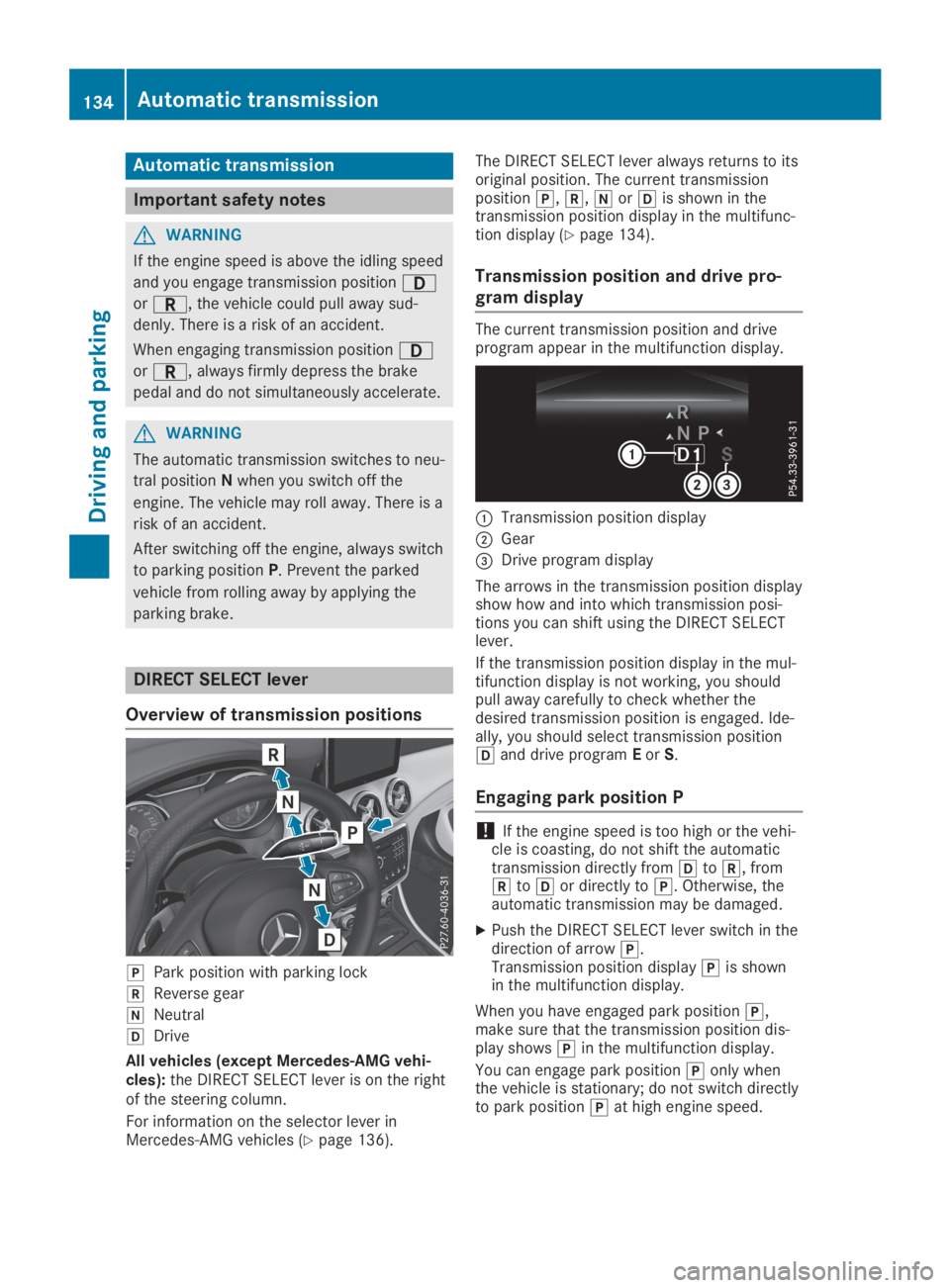
DIRECT SELECT lever
Overview of transmission positions
]Park position with parking lock
^Reverse gear
\\Neutral
[Drive
All vehicles (except Mercedes-AMG vehi-cles):the DIRECT SELECT lever is on the rightof the steering column.
For information on the selector lever inMercedes-AMG vehicles (Ypage 136).
The DIRECT SELECT lever always returns to itsoriginal position. The current transmissionposition],^,\\or[is shown in thetransmission position display in the multifunc-tion display (Ypage 134).
Transmission position and drive pro-
gram display
The current transmission position and driveprogram appear in the multifunction display.
CTransmission position display
DGear