height MERCEDES-BENZ GLA 2019 Owners Manual
[x] Cancel search | Manufacturer: MERCEDES-BENZ, Model Year: 2019, Model line: GLA, Model: MERCEDES-BENZ GLA 2019Pages: 346, PDF Size: 16.66 MB
Page 19 of 346
Remote control
Garage door opener ....................... 268
Programming (garage door
opener) .......................................... 268
Replacing bulbs
Brake lamp .................................... 108
High-beam headlamps................... 107
Important safety notes .................. 106
Installing/removing the cover
(front wheel arch) .......................... 107
Low-beam headlamps.................... 107
Overview of bulb types .................. 106
Rear fog lamp ................................ 108
Turn signals (front) ......................... 108
Turn signals (rear) .......................... 108
Rescue card......................................... 28
Reserve (fuel tank)
see Fuel
Reserve fuel
Display message ............................ 218
Warning lamp ................................. 238
see Fuel
Residual heat (climate control)........ 122
Restraint system
Display message ............................ 211
Introduction ..................................... 39
Warning lamp ................................. 237
Warning lamp (function) ................... 40
Reverse gear (selector lever)........... 136
Reversing feature
Roller sunblind ................................. 89
Side windows ................................... 83
Tailgate ............................................ 78
Roadside Assistance (breakdown).... 26
Roller sunblind
Panorama roof with power tilt/
sliding panel ..................................... 89
Roof carrier........................................ 256
Roof lining and carpets (cleaning
guidelines)......................................... 285
Roof load (maximum)........................ 339
Route guidance
see also Digital Operator's Man-
ual .................................................. 242
S
Safety
Children in the vehicle ..................... 53
see Occupant safety
Safety system
see Driving safety systems
SD card
Inserting ........................................ 249
Inserting/removing ........................ 248
Removing ....................................... 249
SD memory card
see also Digital Operator's Man-
ual .................................................. 242
Search & Send
see also Digital Operator's Man-
ual .................................................. 242
Seat
Correct driver's seat position ........... 92
Seat belts
Adjusting the height ......................... 43
Cleaning ......................................... 285
Correct usage .................................. 42
Fastening ......................................... 43
Important safety guidelines ............. 41
Introduction ..................................... 41
Releasing ......................................... 43
Warning lamp ................................. 230
Warning lamp (function) ................... 44
Seats
Adjusting (electrically) ..................... 94
Adjusting (manually) ........................ 94
Adjusting (Performance Seat) .......... 96
Adjusting the 4-way lumbar sup-
port .................................................. 96
Adjusting the head restraint ............ 95
Cleaning the cover ......................... 284
Folding the backrest (rear com-
partment) forwards/back .............. 254
Important safety notes .................... 92
Seat heating problem ...................... 97
Storing settings (memory func-
tion) ............................................... 101
Switching seat heating on/off......... 96
Section
Cargo compartment ......................... 77
Securing a load
see Securing cargo
Index17
Page 44 of 346
the shoulder section of your seat belt is
routed across the center of your shoulder.
GWARNING
Persons less than 5 ft (1.50m)tall cannot
wear the seat belt correctly without an addi-
tional and suitable restraint system. If the
seat belt is not worn correctly, it cannot per-
form its intended protective function. An
incorrectly fastened seat belt can also cause
injuries, for example, in the event of an acci-
dent or when braking or changing direction
abruptly. This poses an increased risk of
injury or even fatal injury.
For this reason, always secure persons
under 5 ft (1.50m)tall in suitable additional
restraint systems.
If a child younger than twelve years old andunder 5 ft (1.50m)in height is traveling in thevehicle:
Ralways secure the child in a child restraintsystem suitable for this Mercedes-Benzvehicle. The child restraint system must beappropriate to the age, weight and size ofthe child.
Ralways observe the instructions and safetynotes on "Children in the vehicle"(Ypage 53) in addition to the childrestraint system manufacturer's installationand operating instructions
Ralways observe the instructions and safetynotes on the "Occupant Classification Sys-tem (OCS)" (Ypage 47)
GWARNING
The seat belts may not perform their inten-
ded protective function if:
Rthey are damaged, modified, extremely
dirty, bleached or dyed
Rthe seat belt buckle is damaged or
extremely dirty
Rthe Emergency Tensioning Devices, belt
anchorages or inertia reels have been
modified.
Seat belts may be damaged in an accident,
although the damage may not be visible, e.g.
due to splinters of glass. Modified or dam-
aged seat belts may tear or fail, e.g. in an
accident. Modified Emergency Tensioning
Devices could accidentally trigger or fail to
deploy when necessary. This poses an
increased risk of injury or even fatal injury.
Never modify the seat belts, Emergency Ten-
sioning Devices, belt anchorages and inertia
reels. Make sure that the seat belts are
undamaged, not worn out and clean. Follow-
ing an accident, have the seat belts checked
immediately at a qualified specialist work-
shop.
Only use seat belts that have been approvedfor your vehicle by Mercedes-Benz.
Sports seat or AMG Performance seat:thisseat is designed for the standard three-pointseat belt. If you install another multi-point seatbelt, e.g. sport or racing seat belts, therestraint system cannot provide the best levelof protection.
GWARNING
If you feed seat belts through the opening in
the seat backrest, the seat backrest may be
damaged or may even break in the event of
an accident. This poses an increased risk of
injury or even fatal injury.
Only use the standard three-point seat belt.
Never modify the seat belt system.
Proper use of the seat belts
Observe the safety notes on the seat belt(Ypage 41).
Every vehicle occupant must observe the fol-lowing notes to ensure a properly worn seatbelt can provide full protection. Also makesure that all vehicle occupants are alwayswearing the seat belt correctly while the vehi-cle is in motion.
When fastening the seat belt, always makesure that:
Rthe seat belt buckle tongue is inserted onlyinto the belt buckle belonging to that seat
Rthe seat belt is pulled tight across your body
Avoid wearing bulky clothing, e.g. a wintercoat.
Rthe seat belt is not twisted
42Occupant safety
Safety
Page 45 of 346
Only then can the forces which occur be dis-tributed over the area of the belt.
Rthe shoulder section of the belt is routedacross the center of your shoulder
The shoulder section of the seat belt shouldnot touch your neck or be routed under yourarm or behind your back. Where possible,adjust the seat belt to the appropriateheight.
Rthe lap belt is taut and passes across yourlap as low down as possible
The lap belt must always be routed acrossyour hip joints and not across your abdo-men. This applies particularly to pregnantwomen. If necessary, push the lap belt downto your hip joint and pull it tight using theshoulder section of the belt.
Rthe seat belt is not routed across sharp,pointed or fragile objects
If you have such items located on or in yourclothing, e.g. pens, keys or eyeglasses,store these in a suitable place.
Ronly one person is using a seat belt
Infants and children must never travel sit-ting on the lap of a vehicle occupant. In theevent of an accident, they could be crushedbetween the vehicle occupant and seat belt.
Robjects are never secured with a seat belt ifthe seat belt is also being used by one ofthe vehicle's occupants
Also ensure that there are never objectsbetween a person and the seat, e.g. cush-ions.
Seat belts are only intended to secure andrestrain vehicle occupants. Always observe the"Loading guidelines" for securing objects, lug-gage or loads (Ypage 250).
Fastening and adjusting the seat belts
Observe the safety notes on the seat belt(Ypage 41) and the notes on correct use ofseat belts (Ypage 42).
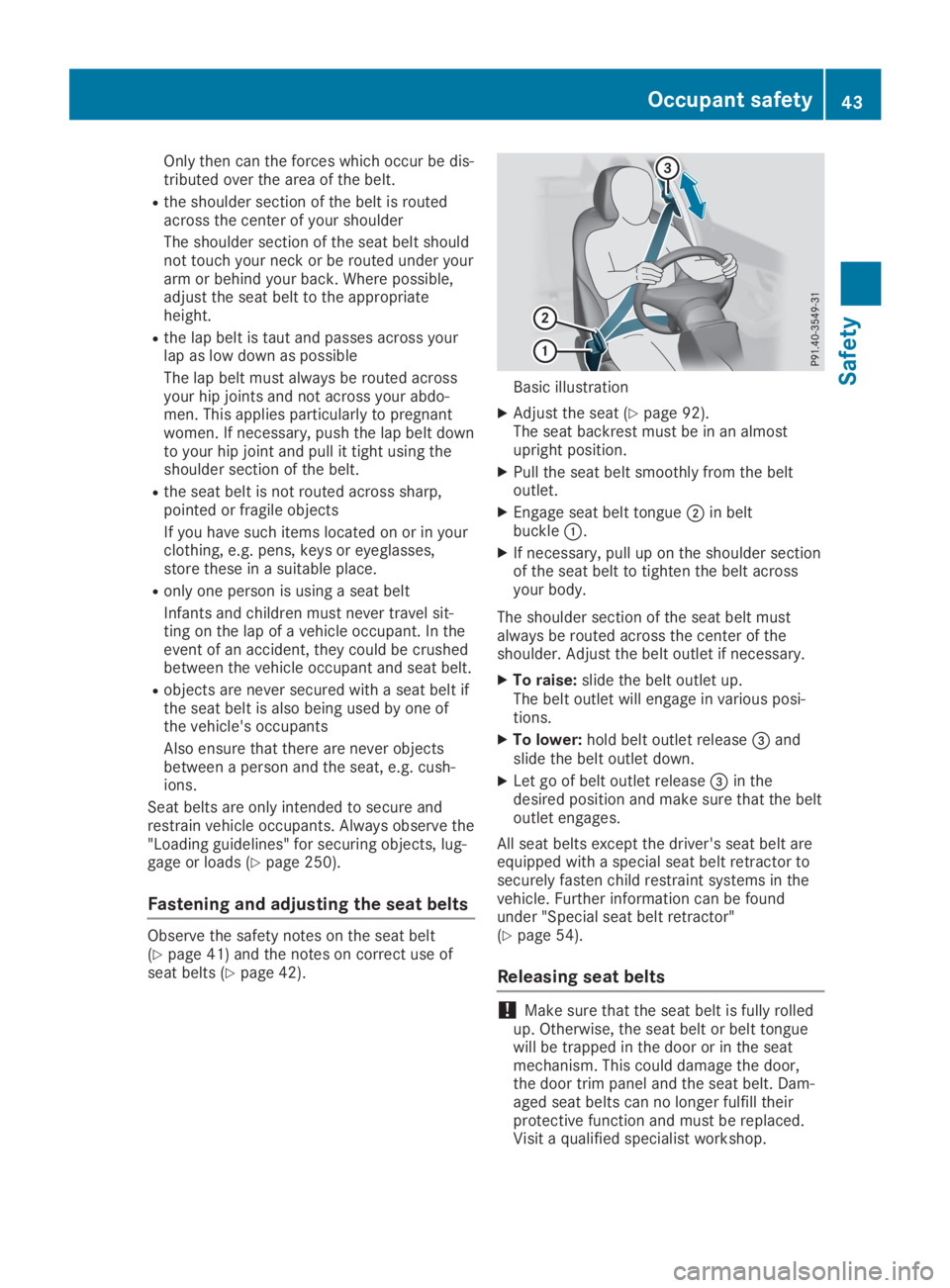
Basic illustration
XAdjust the seat (Ypage 92).The seat backrest must be in an almostupright position.
XPull the seat belt smoothly from the beltoutlet.
XEngage seat belt tongueDin beltbuckleC.
XIf necessary, pull up on the shoulder sectionof the seat belt to tighten the belt acrossyour body.
The shoulder section of the seat belt mustalways be routed across the center of theshoulder. Adjust the belt outlet if necessary.
XTo raise:slide the belt outlet up.The belt outlet will engage in various posi-tions.
XTo lower:hold belt outlet release
Page 47 of 346
systems. Up to this height, the seat beltcannot be worn correctly.
If a child is traveling in your vehicle, alsoobserve the following notes:
RAlways secure children under twelve yearsof age and less than 5 ft (1.50m)tall in suit-able child restraint systems.
RChild restraint systems should be installedon the rear seats.
RSecure a child to the front-passenger seatonly when the front-passenger front airbagis deactivated, and then only in a rearward-facing child restraint system. The front-passenger front airbag is deactivated whenthe PASSENGER AIR BAG OFF indicatorlamp is lit continuously (Ypage 40).
RAlways observe the instructions and safetynotes on the "Occupant Classification Sys-tem (OCS)" (Ypage 47) and on "Childrenin the vehicle" (Ypage 53) in addition tothe child restraint system manufacturer'sinstallation and operating instructions.
Objects in the vehicle interior may restrictthe airbag from functioning correctly.Toavoid risks resulting from the speed of the air-bag as it deploys, vehicle occupants mustensure the following points.
Before commencing your journey, ensure that:
Rthere are no people, animals or objectsbetween the vehicle occupants and an air-bag
Rthere are no objects between the seat, doorand B-pillar
Rthere are no hard objects, e.g. coat hangers,hanging on the grab handles or coat hooks
Rno accessories, such as cup holders, areattached to the vehicle within the deploy-ment area of an airbag, e.g. to doors, sidewindows, rear side trim or side walls
Rno heavy, sharp-edged or fragile objects arein the pockets of your clothing. Store suchobjects in a suitable place
GWARNING
If you modify the cover of an air bag or affix
objects such as stickers to it, the air bag
can no longer perform its intended function.
There is an increased risk of injury.
Never modify the cover of an air bag or affix
objects to it.
GWARNING
Sensors to control the air bags are located
in the doors. Modifications or work not per-
formed correctly to the doors or door panel-
ing, as well as damaged doors, can lead to
the function of the sensors being impaired.
The air bags might therefore not function
properly anymore. Consequently, the air
bags cannot protect vehicle occupants as
they are designed to do. There is an
increased risk of injury.
Never modify the doors or parts of the
doors. Always have work on the doors or
door paneling carried out at a qualified spe-
cialist workshop.
Front air bags
!Do not place heavy objects on the front-passenger seat. This could cause the sys-tem to identify the seat as being occupied.In the event of an accident, the restraintsystems on the front-passenger side may betriggered and have to be replaced.
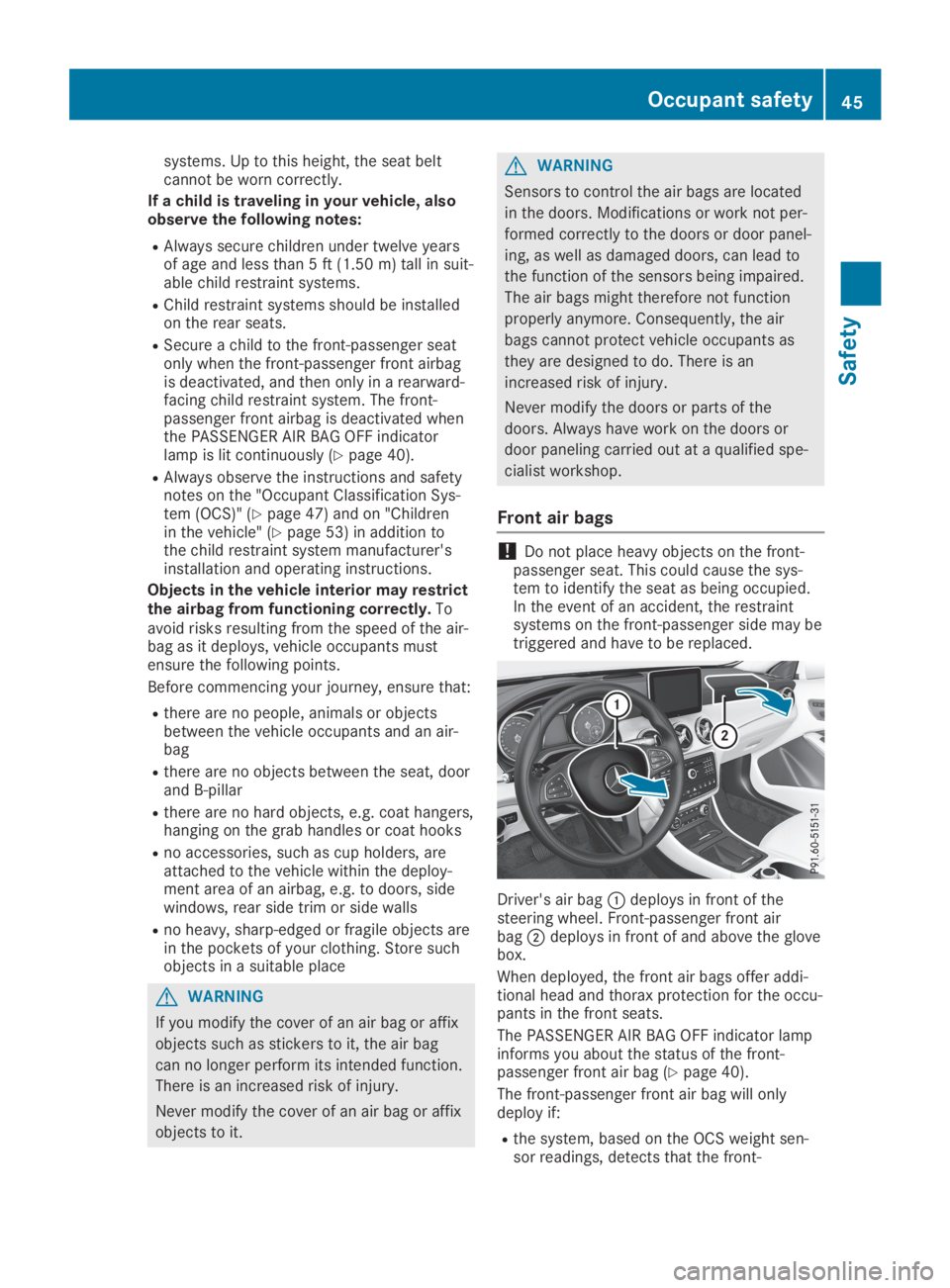
Driver's air bagCdeploys in front of thesteering wheel. Front-passenger front airbagDdeploys in front of and above the glovebox.
When deployed, the front air bags offer addi-tional head and thorax protection for the occu-pants in the front seats.
The PASSENGER AIR BAG OFF indicator lampinforms you about the status of the front-passenger front air bag (Ypage 40).
The front-passenger front air bag will onlydeploy if:
Rthe system, based on the OCS weight sen-sor readings, detects that the front-
Occupant safety45
Safety
Z
Page 55 of 346
The rate of vehicle deceleration or accelera-tion and the direction of the force are essen-tially determined by:
Rthe distribution of forces during the collision
Rthe collision angle
Rthe deformation characteristics of the vehi-cle
Rthe characteristics of the object with whichthe vehicle has collided
Factors which can only be seen and measuredafter a collision has occurred do not play adecisive role in the deployment of an air bag.Nor do they provide an indication of air bagdeployment.
The vehicle can be deformed considerably,without an air bag being deployed. This is thecase if only parts which are relatively easilydeformed are affected and the rate of deceler-ation is not high. Conversely, air bags may bedeployed even though the vehicle suffers onlyminor deformation. This is the case if, forexample, very rigid vehicle parts such as longi-tudinal body members are hit, and sufficientdeceleration occurs as a result.
If the restraint system control unit detects aside impact or if the vehicle rolls over, theapplicable components of the restraint systemare deployed independently of each otherdepending on the apparent type of accident.
RSide impact air bags on the side where theimpact takes place, independently of theEmergency Tensioning Device and the useof the seat belt on the driver's seat andouter seats in the second row
The side impact air bag on the frontpassenger side deploys under the followingconditions:
-the OCS system detects that the frontpassenger seat is occupied or
-the seat belt buckle tongue is engaged inthe belt buckle of the front passengerseat
RWindow curtain air bag on the side ofimpact, independently of the use of the seatbelt and independently of whether the front-passenger seat is occupied
REmergency Tensioning Devices, if the sys-tem determines that deployment can offeradditional protection in this situation
RWindow curtain air bags on the driver's andfront-passenger side in certain situationswhen the vehicle rolls over, if the system
determines that deployment can offer addi-tional protection to that provided by theseat belt
iNot all air bags are deployed in an acci-dent. The different air bag systems workindependently of each other.
How the air bag system works is determinedby the severity of the accident detected,especially the vehicle deceleration or accel-eration and the apparent type of accident:
RHead-on collision
RSide impact
RRollover
Automatic measures after an acci-
dent
Immediately after an accident, the followingmeasures are implemented, depending on thetype and severity of the impact:
Rthe hazard warning lamps are switched on
Rthe emergency lighting is activated
Rthe vehicle doors are unlocked
Rthe front side windows are lowered
Rthe engine is switched off and the fuel sup-ply is cut off
Rvehicles with Mercedes me connect: auto-matic emergency call
Children in the vehicle
Important safety notes
Accident statistics show that children securedin the rear seats are safer than childrensecured in the front-passenger seat. For thisreason, Mercedes-Benz strongly advises thatyou install a child restraint system on a rearseat. Children are generally better protectedthere.
If a child younger than twelve years old andunder 5 ft (1.50 m) in height is traveling in thevehicle:
Ralways secure the child in a child restraintsystem suitable for Mercedes-Benz vehicles.The child restraint system must be appropri-ate to the age, weight and size of the child.
Rbe sure to observe the instructions andsafety notes in this section in addition to the
Children in the vehicle53
Safety
Z
Page 56 of 346
child restraint system manufacturer's instal-lation instructions.
Ralways observe the instructions and safetynotes on the "Occupant classification sys-tem (OCS)". (Ypage 47)
GWARNING
If you leave children unsupervised in the
vehicle, they could set it in motion by, for
example:
Rrelease the parking brake.
Rshift the automatic transmission out of
the parking positionP.
Rstart the engine.
In addition, they may operate vehicle equip-
ment and become trapped. There is a risk of
an accident and injury.
When leaving the vehicle, always take the
SmartKey with you and lock the vehicle.
Never leave children unsupervised in the
vehicle.
GWARNING
If persons, particularly children are subjec-
ted to prolonged exposure to extreme heat
or cold, there is a risk of injury, possibly
even fatal. Never leave children unattended
in the vehicle.
GWARNING
If the child restraint system is subjected to
direct sunlight, parts may get very hot. Chil-
dren may burn themselves on these parts,
particularly on the metal parts of the child
restraint system. There is a risk of injury.
If you leave the vehicle, taking the child with
you, always ensure that the child restraint
system is not exposed to direct sunlight.
Protect it with a blanket, for example. If the
child restraint system has been exposed to
direct sunlight, let it cool down before secur-
ing the child in it. Never leave children unat-
tended in the vehicle.
Always ensure that all vehicle occupants havetheir seat belts fastened correctly and are sit-ting properly. Particular attention must be paidto children.
Observe the safety notes on the seat belt(Ypage 41) and the notes on correct use ofseat belts (Ypage 42).
A booster seat may be necessary to achieveproper seat belt positioning for children over40 lbs (18 kg) until they reach a height wherea three-point seat belt can be properly fas-tened without a booster seat.
Special seatbelt retractor
GWARNING
If the seat belt is released while driving, the
child restraint system will no longer be
secured properly. The special seat belt
retractor is disabled and the inertia real
draws in a portion of the seat belt. The seat
belt cannot be immediately refastened.
There is an increased risk of injury, possibly
even fatal.
Stop the vehicle immediately, paying atten-
tion to road and traffic conditions. Reacti-
vate the special seat belt retractor and
secure the child restraint system properly.
All seat belts in the vehicle, except the driver'sseat belt, are equipped with a special seat beltretractor. When activated, the special seat beltretractor ensures that the seat belt cannotslacken once the child seat is secured.
Installing a child restraint system:
XMake sure you observe the child restraintsystem manufacturer's installation instruc-tions.
XPull the seat belt smoothly from the beltoutlet.
XEngage seat belt tongue in belt buckle.
Activating the special seat belt retractor:
XPull the seat belt out fully and let the inertiareel retract it again.While the seat belt is retracting, you shouldhear a ratcheting sound. The special seatbelt retractor is enabled.
XPush the child restraint system down so thatthe seat belt is tight and does not loosen.
54Children in the vehicle
Safety
Page 95 of 346
GWARNING
If the driver's seat is not engaged, it could
move forwards as far as the next catch dur-
ing movement such as braking or abrupt
changes of direction. As a result, you would
be pushed against your seat belt by the
unsecured driver's seat.
This could cause you to lose control of the
vehicle. The seat belt cannot protect as
intended and could result in additional
injury.
There is a risk of an accident and injury.
Before every journey, make sure that the
driver's seat is fully engaged.
Observe the safety notes on "Air bags"(Ypage 44) and "Children in the vehicle"(Ypage 53).
GWARNING
If the driver's seat is not engaged, it could
move unexpectedly while the vehicle is in
motion. This could cause you to lose control
of the vehicle. There is a risk of an accident.
Always make sure that the driver's seat is
engaged before starting the vehicle.
GWARNING
You could lose control of your vehicle if you
do the following while driving:
Radjust the driver's seat, head restraint,
steering wheel or mirrors
Rfasten the seat belt
There is a risk of an accident.
Adjust the driver's seat, head restraint,
steering wheel and mirror and fasten your
seat belt before starting the engine.
GWARNING
If you adjust the seat height carelessly, you
or other vehicle occupants could be trapped
and thereby injured. Children in particular
could accidentally press the electrical seat
adjustment buttons and become trapped.
There is a risk of injury.
While moving the seats, make sure that your
hands or other body parts do not get under
the lever assembly of the seat adjustment
system.
!To prevent damage to the seats and theseat heating, observe the following notes:
RDo not spill liquids onto the seats. Dry theseats as soon as possible if liquid doesget spilled on the seats.
RIf the seat covers are damp or wet, do notswitch on the seat heating. Also, do notuse the seat heating to dry the seats.
RClean the seat covers as recommended;see the "Interior care" section.
RDo not transport heavy loads on theseats. Do not place pointed objects onthe seat cushions such as knives, nails ortools. Where possible, use the seats onlyfor carrying passengers.
RWhen operating the seat heating, do notcover the seats with insulating materials,e.g. blankets, coats, bags, protective cov-ers, child seats or booster seats.
RWhen the seat heating is switched on, theseat surface can be damaged as a resultof objects being placed on the seats, forexample, seat cushions, child seats andprotective covers not approved byMercedes-Benz.
!Make sure that there are no objects in thefootwell under or behind the seats whenmoving the seats back. There is a risk thatthe seats and/or the objects could be dam-aged.
iFurther related subjects:
RCargo compartment enlargement (foldingdown the rear seats) (Ypage 253)
Seats93
Seats, steering wheel and mirrors
Z
Page 97 of 346
Adjusting the head restraints
Important safety notes
GWARNING
You could lose control of your vehicle if you
do the following while driving:
Radjust the driver's seat, head restraint,
steering wheel or mirrors
Rfasten the seat belt
There is a risk of an accident.
Adjust the driver's seat, head restraint,
steering wheel and mirror and fasten your
seat belt before starting the engine.
GWARNING
If the head restraints are not installed or not
adjusted correctly, they cannot provide pro-
tection as intended. There is an increased
risk of injury in the head and neck area, e.g.
in the event of an accident or when braking.
Always drive with the head restraints instal-
led. Before driving off, make sure for every
vehicle occupant that the center of the head
restraint supports the back of the head at
about eye level.
Using the fore-and-aft adjustment, adjust thehead restraint so that it is as close as possibleto your head.
General notes
For vehicles with sports seats you cannotadjust the front head restraints or the outerrear head restraints.
Adjusting the head restraints manually
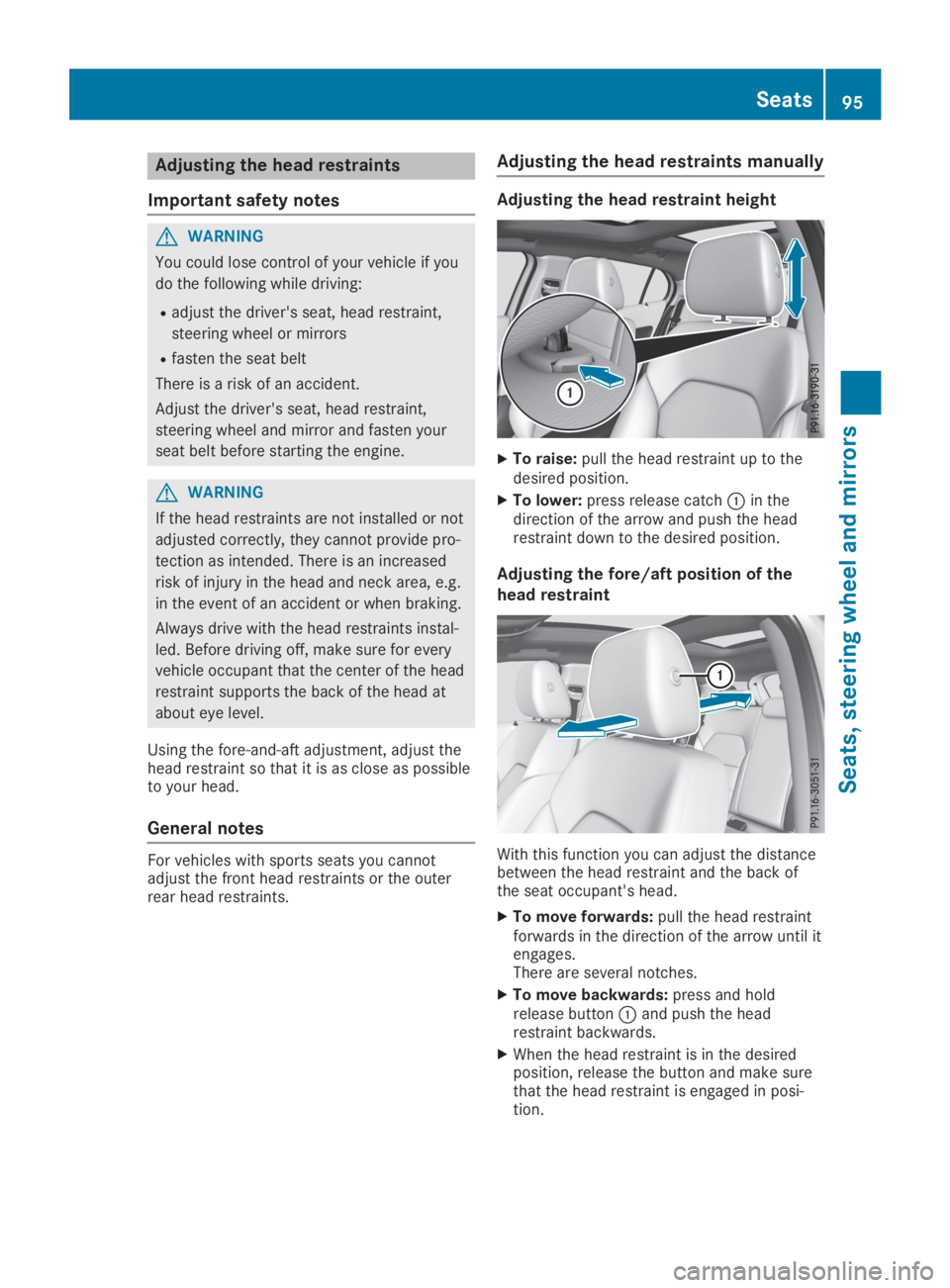
Adjusting the head restraint height
XTo raise:pull the head restraint up to thedesired position.
XTo lower:press release catchCin thedirection of the arrow and push the headrestraint down to the desired position.
Adjusting the fore/aft position of the
head restraint
With this function you can adjust the distancebetween the head restraint and the back ofthe seat occupant's head.
XTo move forwards:pull the head restraintforwards in the direction of the arrow until itengages.There are several notches.
XTo move backwards:press and holdrelease buttonCand push the headrestraint backwards.
XWhen the head restraint is in the desiredposition, release the button and make surethat the head restraint is engaged in posi-tion.
Seats95
Seats , ste ering wheel and mirrors
Z
Page 98 of 346
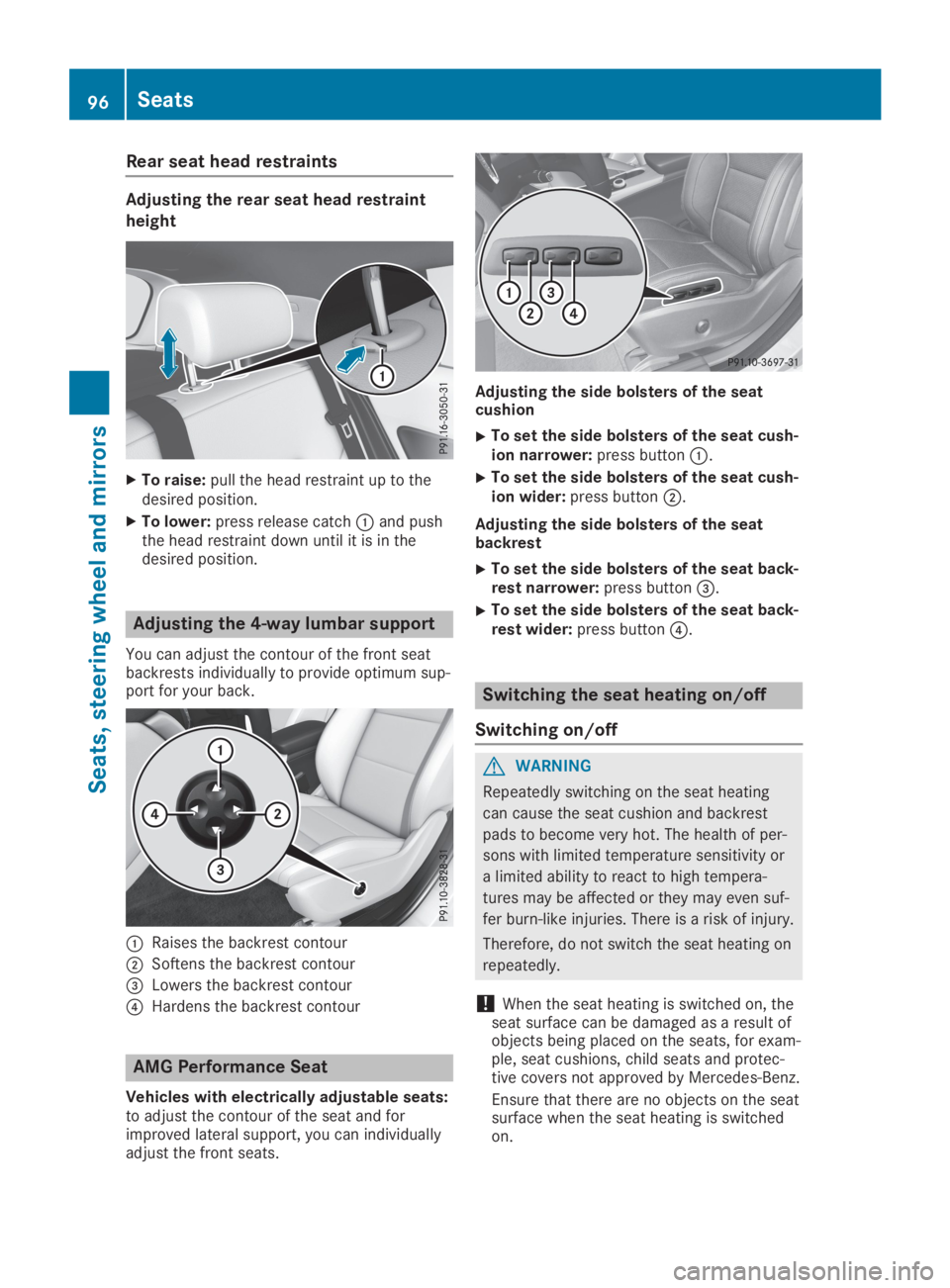
Rear seat head restraints
Adjusting the rear seat head restraint
height
XTo raise:pull the head restraint up to thedesired position.
XTo lower:press release catchCand pushthe head restraint down until it is in thedesired position.
Adjusting the 4-way lumbar support
You can adjust the contour of the front seatbackrests individually to provide optimum sup-port for your back.
CRaises the backrest contour
DSoftens the backrest contour
Page 100 of 346
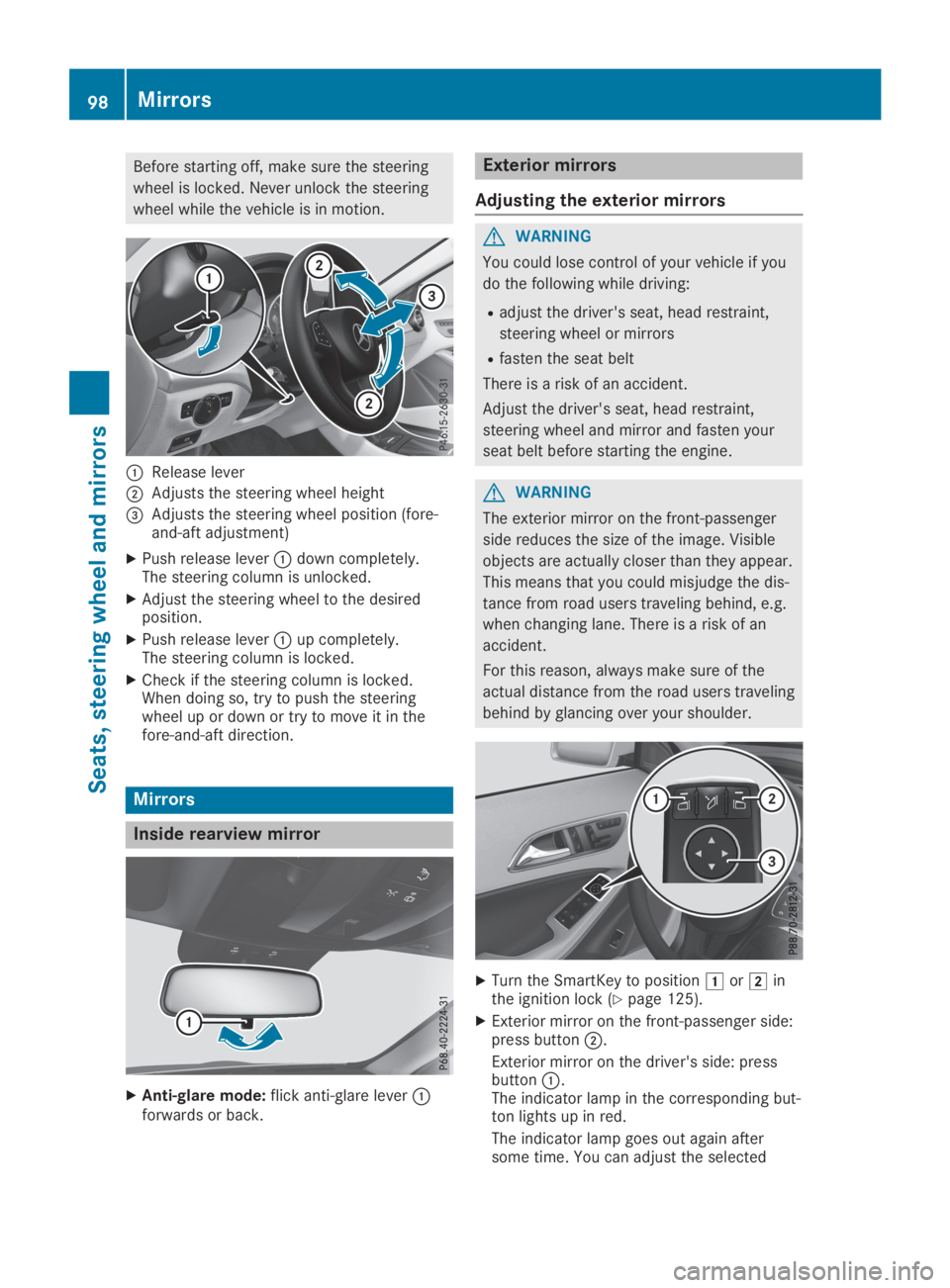
Before starting off, make sure the steering
wheel is locked. Never unlock the steering
wheel while the vehicle is in motion.
CRelease lever
DAdjusts the steering wheel height