height MERCEDES-BENZ GLA 2019 User Guide
[x] Cancel search | Manufacturer: MERCEDES-BENZ, Model Year: 2019, Model line: GLA, Model: MERCEDES-BENZ GLA 2019Pages: 346, PDF Size: 16.66 MB
Page 323 of 346
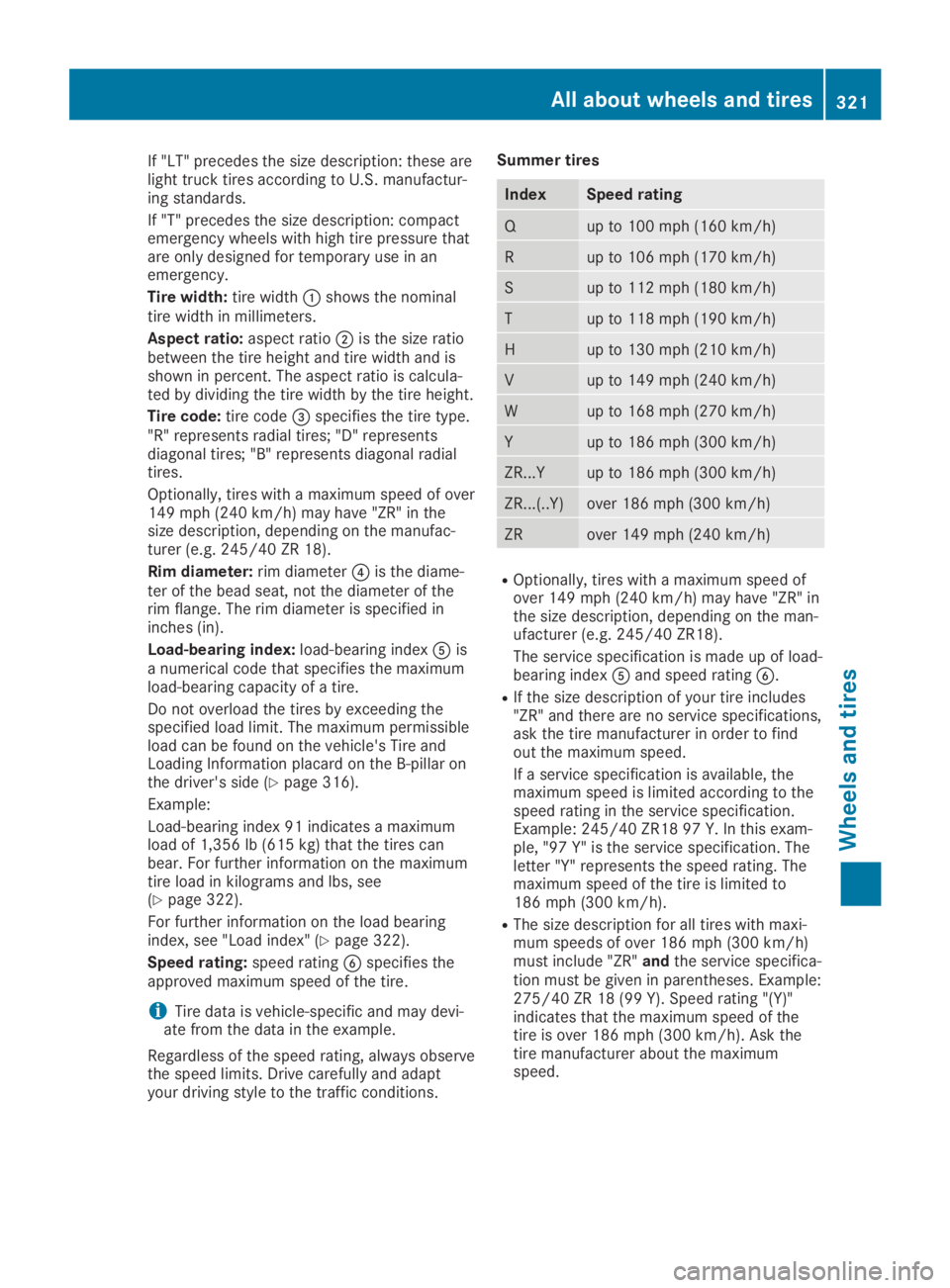
If "LT" precedes the size description: these arelight truck tires according to U.S. manufactur-ing standards.
If "T" precedes the size description: compactemergency wheels with high tire pressure thatare only designed for temporary use in anemergency.
Tire width:tire widthCshows the nominaltire width in millimeters.
Aspect ratio:aspect ratioDis the size ratiobetween the tire height and tire width and isshown in percent. The aspect ratio is calcula-ted by dividing the tire width by the tire height.
Tire code:tire code
Page 326 of 346
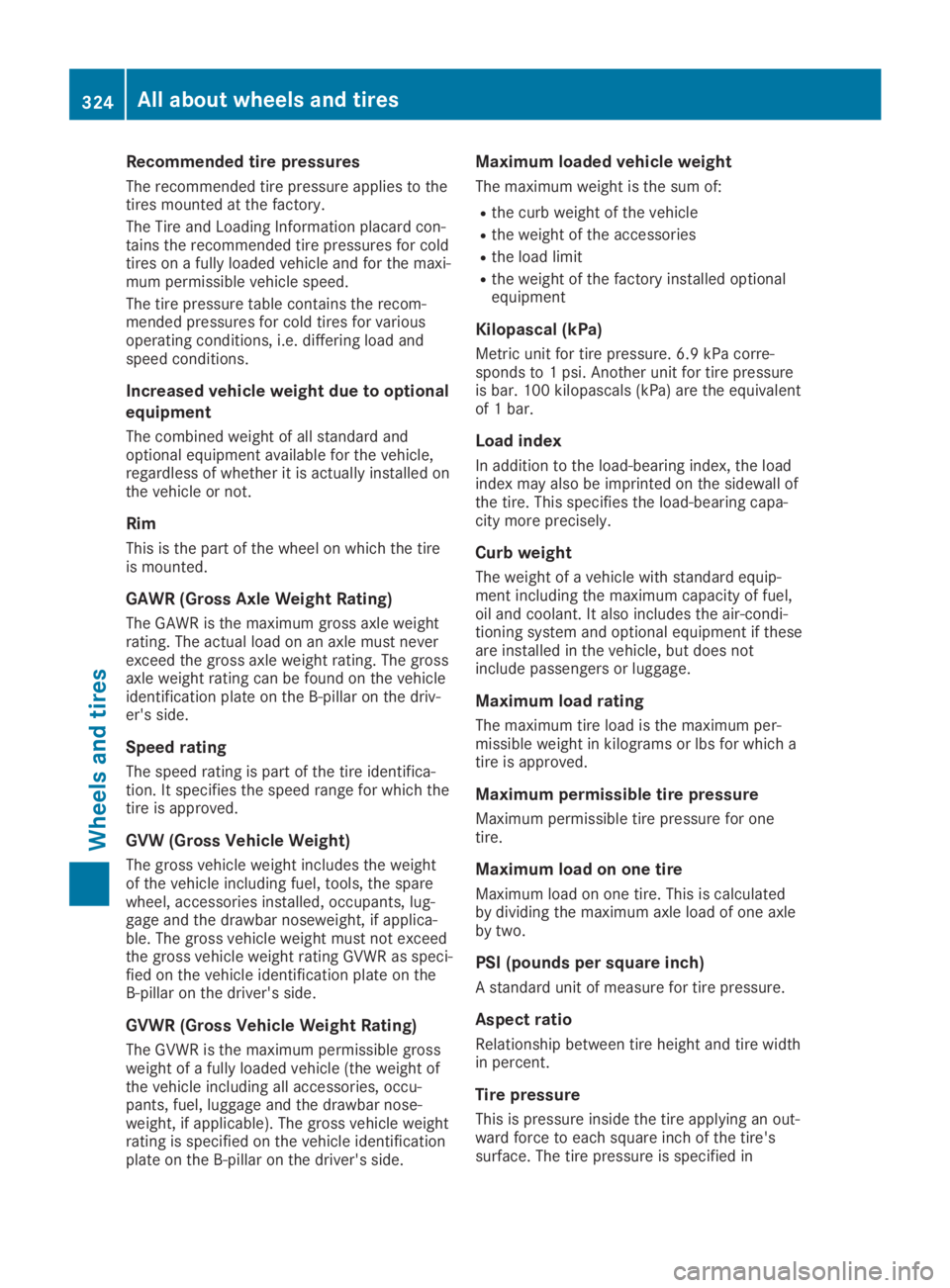
Recommended tire pressures
The recommended tire pressure applies to thetires mounted at the factory.
The Tire and Loading Information placard con-tains the recommended tire pressures for coldtires on a fully loaded vehicle and for the maxi-mum permissible vehicle speed.
The tire pressure table contains the recom-mended pressures for cold tires for variousoperating conditions, i.e. differing load andspeed conditions.
Increased vehicle weight due to optional
equipment
The combined weight of all standard andoptional equipment available for the vehicle,regardless of whether it is actually installed onthe vehicle or not.
Rim
This is the part of the wheel on which the tireis mounted.
GAWR (Gross Axle Weight Rating)
The GAWR is the maximum gross axle weightrating. The actual load on an axle must neverexceed the gross axle weight rating. The grossaxle weight rating can be found on the vehicleidentification plate on the B-pillar on the driv-er's side.
Speed rating
The speed rating is part of the tire identifica-tion. It specifies the speed range for which thetire is approved.
GVW (Gross Vehicle Weight)
The gross vehicle weight includes the weightof the vehicle including fuel, tools, the sparewheel, accessories installed, occupants, lug-gage and the drawbar noseweight, if applica-ble. The gross vehicle weight must not exceedthe gross vehicle weight rating GVWR as speci-fied on the vehicle identification plate on theB-pillar on the driver's side.
GVWR (Gross Vehicle Weight Rating)
The GVWR is the maximum permissible grossweight of a fully loaded vehicle (the weight ofthe vehicle including all accessories, occu-pants, fuel, luggage and the drawbar nose-weight, if applicable). The gross vehicle weightrating is specified on the vehicle identificationplate on the B-pillar on the driver's side.
Maximum loaded vehicle weight
The maximum weight is the sum of:
Rthe curb weight of the vehicle
Rthe weight of the accessories
Rthe load limit
Rthe weight of the factory installed optionalequipment
Kilopascal (kPa)
Metric unit for tire pressure. 6.9 kPa corre-sponds to 1 psi. Another unit for tire pressureis bar. 100 kilopascals (kPa) are the equivalentof 1 bar.
Load index
In addition to the load-bearing index, the loadindex may also be imprinted on the sidewall ofthe tire. This specifies the load-bearing capa-city more precisely.
Curb weight
The weight of a vehicle with standard equip-ment including the maximum capacity of fuel,oil and coolant. It also includes the air-condi-tioning system and optional equipment if theseare installed in the vehicle, but does notinclude passengers or luggage.
Maximum load rating
The maximum tire load is the maximum per-missible weight in kilograms or lbs for which atire is approved.
Maximum permissible tire pressure
Maximum permissible tire pressure for onetire.
Maximum load on one tire
Maximum load on one tire. This is calculatedby dividing the maximum axle load of one axleby two.
PSI (pounds per square inch)
A standard unit of measure for tire pressure.
Aspect ratio
Relationship between tire height and tire widthin percent.
Tire pressure
This is pressure inside the tire applying an out-ward force to each square inch of the tire'ssurface. The tire pressure is specified in
324All about wheels and tires
Wheels and tires
Page 342 of 346
Mercedes‑AMGvehicles
Vehicle length175.3 in
(4455 mm)
Vehicle widthincluding exteriormirrors
79.6 in
(2022 mm)
Vehicle height58.2 in
(1479 mm)
Wheelbase106.3 in
(2699 mm)
Minimum groundclearance6.1 in
(155 mm)
Turning radius38.7 ft
(11.8 m)
Maximum roof load165.3 lb
(75 kg)
All other models
Vehicle length174.1 in
(4424 mm)
Vehicle widthincluding exteriormirrors
79.6 in
(2022 mm)
Vehicle height60.3 in
(1532 mm)
Minimum groundclearance8.0 in
(204 mm)
Wheelbase106.3 in
(2699 mm)
Turning radius38.7 ft
(11.84m)
Maximum roof load165.3 lb
(75 kg)
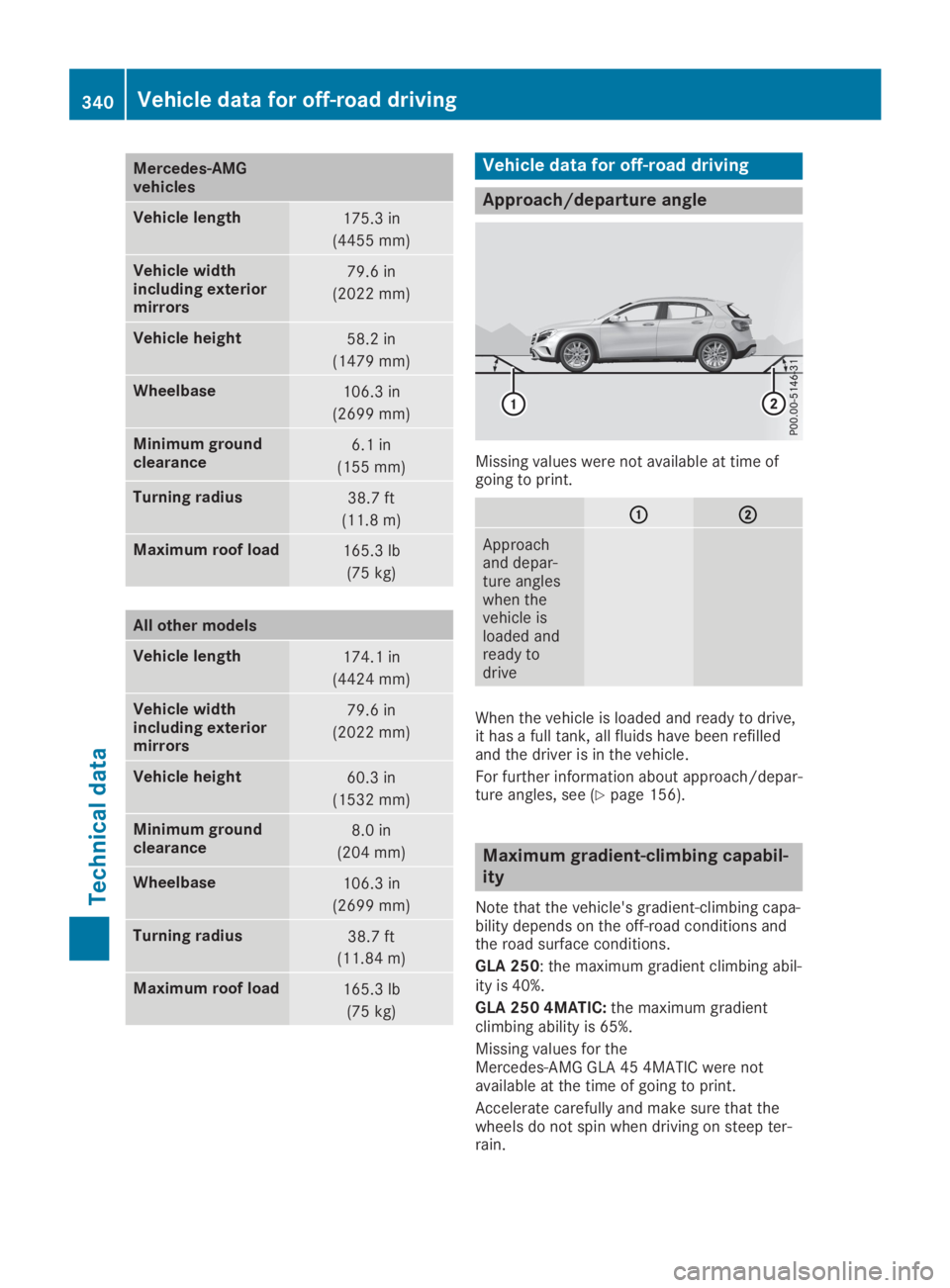
Vehicle data for off-road driving
Approach/departure angle
Missing values were not available at time ofgoing to print.
CCDD
Approachand depar-ture angleswhen thevehicle isloaded andready todrive
When the vehicle is loaded and ready to drive,it has a full tank, all fluids have been refilledand the driver is in the vehicle.
For further information about approach/depar-ture angles, see (Ypage 156).
Maximum gradient-climbing capabil-
ity
Note that the vehicle's gradient-climbing capa-bility depends on the off-road conditions andthe road surface conditions.
GLA 250: the maximum gradient climbing abil-ity is 40%.
GLA 250 4MATIC:the maximum gradientclimbing ability is 65%.
Missing values for theMercedes‑AMG GLA 45 4MATIC were notavailable at the time of going to print.
Accelerate carefully and make sure that thewheels do not spin when driving on steep ter-rain.
340Vehicle data for off-road driving
Technical data