rims MERCEDES-BENZ GLA 2019 Owners Manual
[x] Cancel search | Manufacturer: MERCEDES-BENZ, Model Year: 2019, Model line: GLA, Model: MERCEDES-BENZ GLA 2019Pages: 346, PDF Size: 16.66 MB
Page 157 of 346
RDrive slowly and evenly, if necessary at awalking pace.
REnsure that the wheels are in contact withthe ground at all times.
RDrive with extreme care on unfamiliar off-road routes where visibility is poor. Forsafety reasons, get out of the vehicle firstand survey the off-road route.
RCheck the depth of water before fording riv-ers and streams.
RWatch out for obstacles.
RTake care when turning on an uphill ordownhill slope or when driving across aslope. The vehicle could otherwise tip over.
RAlways keep the side windows and the pan-orama roof with power tilt/sliding panelclosed during the journey.
RDo not deviate from marked routes.
RDo not use the HOLD function when drivingoff-road, on steep uphill or downhill gradi-ents or on slippery or loose surfaces. TheHOLD function cannot hold the vehicle onsuch surfaces.
Checklist before driving off-road
XEngine oil level:check the engine oil leveland add oil if necessary.
When driving on steep gradients, the engineoil level must be sufficiently high to ensure acorrect oil supply in the vehicle.
XWheels and tires:check the tire treaddepth and tire pressure.
XCheck for damage and remove any foreignobjects, e.g. small stones, from the wheels/tires.
XReplace any missing valve caps.
XReplace dented or damaged wheels.
XRims:dented or bent rims can result in aloss of tire pressure and damage the tirebead. Before driving off-road, check thewheels and replace them if necessary.
Checklist after driving off-road
!If you detect damage to the vehicle afterdriving off-road, have the vehicle checkedimmediately at a qualified specialist work-shop.
XDeactivate off-road program (Ypage 132).
XDeactivate DSR (Ypage 169).
XClean the headlamps and rear lights andcheck for damage.
XClean the front and rear license plates.
XClean the wheels and tires with a water jetand remove any foreign objects.
XClean the wheels, wheel housings and thevehicle underside with a water jet; check forany foreign objects and damage.
XCheck whether twigs or other parts of plantshave become trapped. These increase therisk of fire and can damage fuel pipes, brakehoses or the air bellows of the axle jointsand propeller shafts.
XAfter the trip, examine without fail the entireundercarriage, wheels, tires, brakes, body-work structure, steering, chassis andexhaust system for damage.
XAfter driving in sand, mud, gravel, water orsimilar dirty conditions, have the followingchecked and cleaned:
Rbrake discs
Rwheels
Rbrake pads
Raxle joints
XIf you detect strong vibrations after off-roadtravel, check for foreign objects in thewheels and drive train and remove them ifnecessary. Foreign objects can disturb thebalance and cause vibrations.
Driving over poor road surfaces places greaterdemands on your vehicle than driving on nor-mal roads. After driving off-road, check thevehicle. This allows you to detect damagepromptly and reduce the risk of an accident toyourself and other road users.
Driving on sand
Observe the following rules when driving onsand:
RActivate the off-road program (Ypage 132).
RAvoid high engine speeds.
RUse the left-hand steering wheel paddleshifter to shift to a lower gear appropriate tothe terrain.
Drivingtips155
Driving an d parking
Z
Page 252 of 346
Loading guidelines
GWARNING
If objects, luggage or loads are not secured
or not secured sufficiently, they could slip,
tip over or be flung around and thereby hit
vehicle occupants. There is a risk of injury,
particularly in the event of sudden braking
or a sudden change in direction.
Always store objects so that they cannot be
flung around. Secure objects, luggage or
loads against slipping or tipping before the
journey.
GDANGER
Combustion engines emit poisonous
exhaust gases such as carbon monoxide.
Exhaust gases can enter the vehicle interior
if the tailgate is open while the engine is
running, especially if the vehicle is in
motion. There is a risk of poisoning.
Always switch off the engine before opening
the tailgate. Never drive with the tailgate
open.
GWARNING
The exhaust tail pipe and tail pipe trim can
become very hot. If you come into contact
with these parts of the vehicle, you could
burn yourself. There is a risk of burns.
Always be particularly careful and supervise
children closely around the exhaust pipe and
the exhaust pipe trims. Allow these compo-
nents to cool down before touching them.
The handling characteristics of a laden vehicleare dependent on the distribution of the loadwithin the vehicle.
Observe the following notes when loading andtransporting a load:
RNever exceed the maximum permissiblegross vehicle mass or the gross axle weightrating for the vehicle (including occupants).The values are specified on the vehicle iden-
tification plate on the B-pillar of the driver'sdoor.
RThe cargo compartment is the preferredplace to carry objects.
RPosition heavy loads as far forward as possi-ble and as low down in the cargo compart-ment as possible.
RThe load must not protrude above the upperedge of the seat backrests.
RAlways place the load against the rear orfront seat backrests. Make sure that theseat backrests are securely locked intoplace.
RAlways place the load behind unoccupiedseats if possible.
RUse the cargo tie-down rings and the parcelnets to transport loads and luggage.
RUse cargo tie-down rings and fasteningmaterials appropriate for the weight andsize of the load.
RThe maximum load capacity of the stowagewell under the cargo compartment floor is55 lbs(25 kg).
RSecure the load with sufficiently strong andwear-resistant tie-downs. Pad sharp edgesfor protection.
!Do not position the load on one part of thefolding cargo compartment floor only. Themaximum load capacity of the folding cargocompartment floor is 220 lbs(100 kg). Dis-tribute theweight evenly to avoid damagingthe cargo compartment floor. Place a solidboard under the load if necessary. Pleasenote that the load on the cargo compart-ment floor will be increased when the loadis lashed down.
Stowage areas
Stowage spaces
Important safety notes
GWARNING
If you transport objects in the vehicle inte-
rior and these are not adequately secured,
they could slip or be flung around and
thereby strike vehicle occupants. In addi-
tion, cup holders, open stowage spaces and
mobile phone brackets may not always be
250Stowage areas
Stowage and features
Page 285 of 346
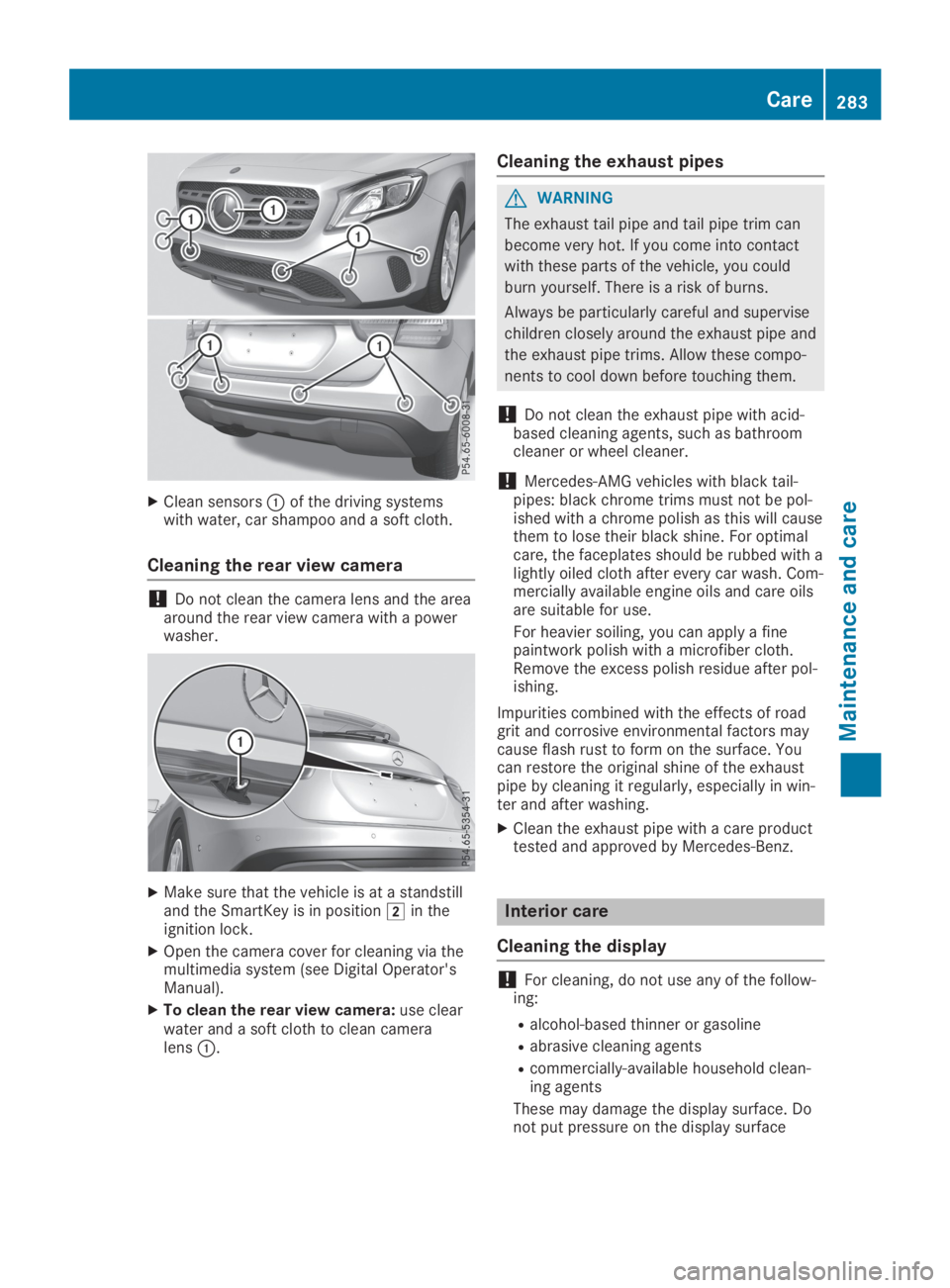
XClean sensorsCof the driving systemswith water, car shampoo and a soft cloth.
Cleaning the rear view camera
!Do not clean the camera lens and the areaaround the rear view camera with a powerwasher.
XMake sure that the vehicle is at a standstilland the SmartKey is in positionHin theignition lock.
XOpen the camera cover for cleaning via themultimedia system (see Digital Operator'sManual).
XTo clean the rear view camera:use clearwater and a soft cloth to clean cameralensC.
Cleaning the exhaust pipes
GWARNING
The exhaust tail pipe and tail pipe trim can
become very hot. If you come into contact
with these parts of the vehicle, you could
burn yourself. There is a risk of burns.
Always be particularly careful and supervise
children closely around the exhaust pipe and
the exhaust pipe trims. Allow these compo-
nents to cool down before touching them.
!Do not clean the exhaust pipe with acid-based cleaning agents, such as bathroomcleaner or wheel cleaner.
!Mercedes‑AMG vehicles with black tail-pipes: black chrome trims must not be pol-ished with a chrome polish as this will causethem to lose their black shine. For optimalcare, the faceplates should be rubbed with alightly oiled cloth after every car wash. Com-mercially available engine oils and care oilsare suitable for use.
For heavier soiling, you can apply a finepaintwork polish with a microfiber cloth.Remove the excess polish residue after pol-ishing.
Impurities combined with the effects of roadgrit and corrosive environmental factors maycause flash rust to form on the surface. Youcan restore the original shine of the exhaustpipe by cleaning it regularly, especially in win-ter and after washing.
XClean the exhaust pipe with a care producttested and approved by Mercedes-Benz.
Interior care
Cleaning the display
!For cleaning, do not use any of the follow-ing:
Ralcohol-based thinner or gasoline
Rabrasive cleaning agents
Rcommercially-available household clean-ing agents
These may damage the display surface. Donot put pressure on the display surface
Care283
Maintenance and care
Z
Page 291 of 346
Important safety notes
GWARNING
When you drive in emergency mode, the
handling characteristics are impaired. e.g.
when cornering, when accelerating strongly
and when braking. There is a risk of an acci-
dent.
Do not exceed the maximum specified
speed. Avoid any abrupt steering and driving
maneuvers as well as driving over obstacles
(curbs, pot holes, off-road). This applies, in
particular, to a loaded vehicle.
Stop driving in emergency mode if you
notice:
Rbanging noise
Rvehicle vibration
Rsmoke which smells like rubber
Rcontinuous ESP®intervention
Rcracks in the tire side walls
After driving in emergency mode, have the
rims checked by a qualified specialist work-
shop with regard to their further use. The
defective tire must be replaced in every
case.
TIREFIT kit
Important safety notes
TIREFIT is a tire sealant.
For USA only:You can use TIREFIT to sealpunctures of up to 0.16 in (4 mm), particularlythose in the tire tread. You can use TIREFIT atoutside temperatures down to