ESP MERCEDES-BENZ GLC 2019 User Guide
[x] Cancel search | Manufacturer: MERCEDES-BENZ, Model Year: 2019, Model line: GLC, Model: MERCEDES-BENZ GLC 2019Pages: 370, PDF Size: 19.55 MB
Page 36 of 370
Information on copyright
Free and open-source software
Information on license for free and open-sourcesoftware used in your vehicle can be found onthe data carrier in your vehicle document walletand, including updates, on the following web-site:
http://www.mercedes-benz.com/opensource
Registered trademarks
Registered trademarks:
RBluetooth®is a registered trademark of Blue-tooth SIG Inc.
RDTS™ is a registered trademark of DTS, Inc.
RDolby®and MLP™ are registered trademarksof DOLBY Laboratories.
RBabySmart™, ESP®and PRE-SAFE®are reg-istered trademarks of Daimler AG.
RHomeLink®is a registered trademark of John-son Controls.
RiPod®and iTunes®are registered trademarksof Apple Inc.
RBurmester®is a registered trademark ofBurmester Audiosysteme GmbH.
RMicrosoft®and Windows media®are regis-tered trademarks of Microsoft Corporation.
RSIRIUS®is a registered trademark of SiriusXM Radio Inc.
RHD Radio™ is a registered trademark of iBiq-uity Digital Corporation.
RGracenote®is a registered trademark ofGracenote, Inc.
RZAGAT Survey®and related brands are regis-tered trademarks of Zagat Survey, LLC.
34Information on copyright
Int roduction
Page 52 of 370
The front-passenger front air bag will onlydeploy if:
Rthe system, based on the OCS weight sensorreadings, detects that the front-passengerseat is occupied (Ypage 51). ThePASSENGER AIR BAG OFF indicator lamp isnot lit (Ypage 51)
Rthe restraint system control unit predicts ahigh accident severity
Driver's knee bag
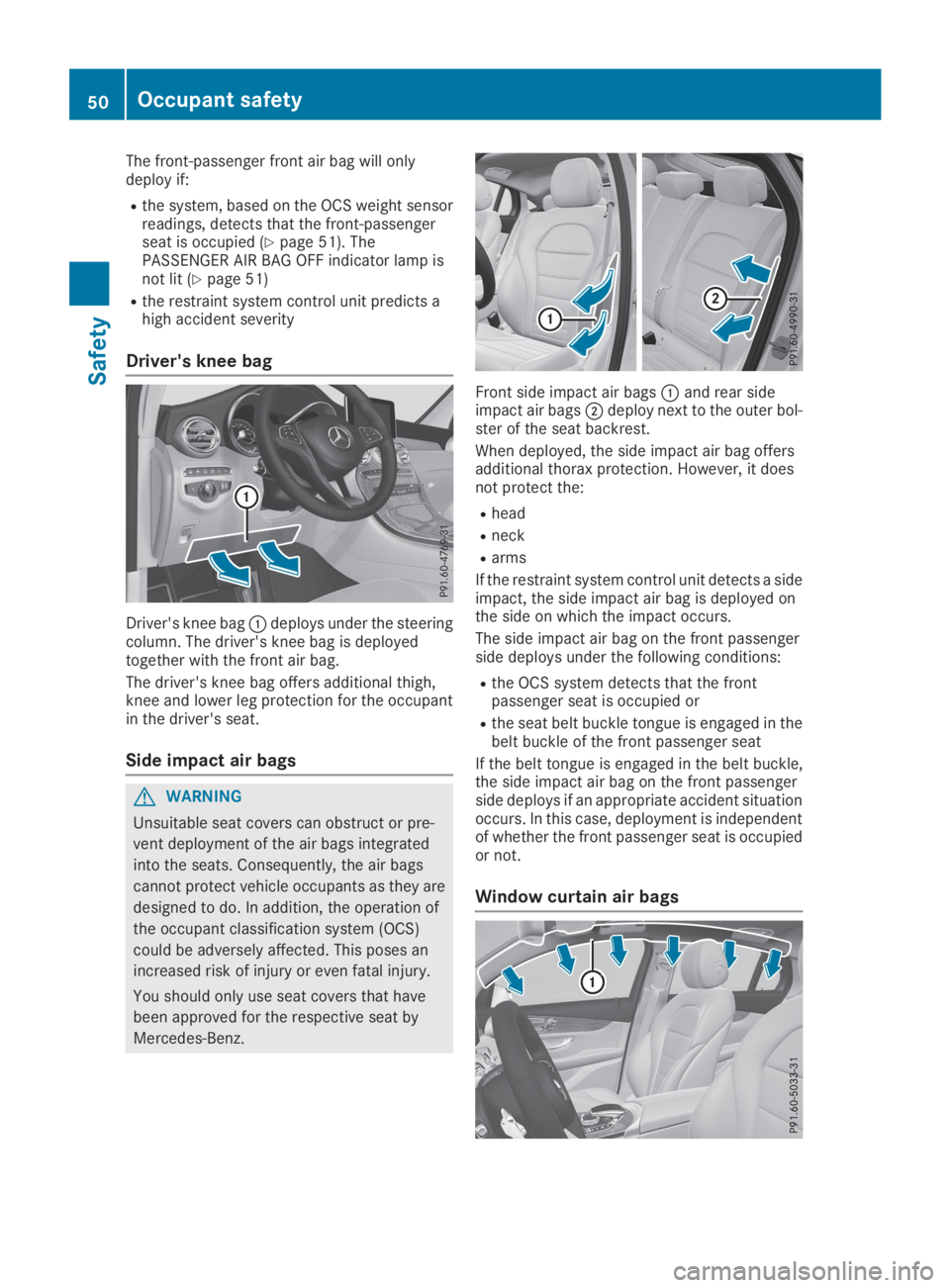
Driver's knee bagCdeploys under the steeringcolumn. The driver's knee bag is deployedtogether with the front air bag.
The driver's knee bag offers additional thigh,knee and lower leg protection for the occupantin the driver's seat.
Side impact air bags
GWARNING
Unsuitable seat covers can obstruct or pre-
vent deployment of the air bags integrated
into the seats. Consequently, the air bags
cannot protect vehicle occupants as they are
designed to do. In addition, the operation of
the occupant classification system (OCS)
could be adversely affected. This poses an
increased risk of injury or even fatal injury.
You should only use seat covers that have
been approved for the respective seat by
Mercedes-Benz.
Front side impact air bagsCand rear sideimpact air bagsDdeploy next to the outer bol-ster of the seat backrest.
When deployed, the side impact air bag offersadditional thorax protection. However, it doesnot protect the:
Rhead
Rneck
Rarms
If the restraint system control unit detects a sideimpact, the side impact air bag is deployed onthe side on which the impact occurs.
The side impact air bag on the front passengerside deploys under the following conditions:
Rthe OCS system detects that the frontpassenger seat is occupied or
Rthe seat belt buckle tongue is engaged in thebelt buckle of the front passenger seat
If the belt tongue is engaged in the belt buckle,the side impact air bag on the front passengerside deploys if an appropriate accident situationoccurs. In this case, deployment is independentof whether the front passenger seat is occupiedor not.
Window curtain air bags
50Occupant safety
Safety
Page 54 of 370
If the PASSENGER AIR BAG ON indicator lamp isoff, only the PASSENGER AIR BAG OFF indicatorlamp shows the status of the front-passengerfront air bag. The PASSENGER AIR BAG OFFindicator lamp may be lit continuously or be off.
If the status of the front-passenger front air bagchanges while the vehicle is in motion, an air bagdisplay message appears in the instrument clus-ter (Ypage 237). When the front-passengerseat is occupied, always pay attention to thePASSENGER AIR BAG OFF indicator lamp. Beaware of the status of the front-passenger frontair bag both before and during the journey.
GWARNING
If the PASSENGER AIR BAG OFF indicator
lamp is lit, the front-passenger front air bag is
disabled. It will not be deployed in the event of
an accident and cannot perform its intended
protective function. A person in the front-
passenger seat could then, for example, come
into contact with the vehicle's interior, espe-
cially if the person is sitting too close to the
dashboard. This poses an increased risk of
injury or even fatal injury.
When the front-passenger seat is occupied,
always ensure that:
Rthe classification of the person in the front-
passenger seat is correct and the front-
passenger front air bag is enabled or disa-
bled in accordance with the person in the
front-passenger seat
Rthe front-passenger seat has been moved
back as far back as possible.
Rthe person is seated correctly.
Make sure, both before and during the jour-
ney, that the status of the front-passenger
front air bag is correct.
GWARNING
If you secure a child in a rearward-facing child
restraint system on the front-passenger seat
and the PASSENGER AIR BAG OFF indicator
lamp is off, the front-passenger front air bag
can deploy in the event of an accident. The
child could be struck by the air bag. This poses
an increased risk of injury or even fatal injury.
Make sure that the front-passenger front air
bag has been deactivated. The PASSENGER
AIR BAG OFF indicator lamp must be lit.
NEVER use a rearward-facing child restraint
on a seat protected by an ACTIVE FRONT AIR-
BAG in front of it; DEATH or SERIOUS INJURY
to the child can occur.
If the PASSENGER AIR BAG OFF indicator lampstays off, do not install a rearward-facing childrestraint system on the front-passenger seat.You can find more information on OCS under"Problems with the Occupant Classification Sys-tem" (Ypage 54).
GWARNING
If you secure a child in a forward-facing child
restraint system on the front-passenger seat
and you position the front-passenger seat too
close to the dashboard, in the event of an
accident, the child could:
Rcome into contact with the vehicle's inte-
rior if the PASSENGER AIR BAG OFF indi-
cator lamp is lit, for example
Rbe struck by the air bag if the PASSENGER
AIR BAG OFF indicator lamp is off
This poses an increased risk of injury or even
fatal injury.
Always move the front-passenger seat as far
back as possible and fully retract the seat
cushion length. Always make sure that the
shoulder belt strap is correctly routed from
the vehicle belt sash guide to the shoulder
belt guide on the child restraint system. The
shoulder belt strap must be routed forwards
and downwards from the vehicle belt sash
guide. If necessary, adjust the vehicle belt
sash guide and the front-passenger seat
accordingly. Always observe the child
restraint system manufacturer's installation
instructions.
If OCS determines that:
RThe front-passenger seat is unoccupied, thePASSENGER AIR BAG OFF indicator lamplights up after the system self-test and
52Occupant safety
Safety
Page 55 of 370
remains lit. This indicates that the front-passenger front air bag is deactivated.
RThe front-passenger seat is occupied by achild of up to twelve months old, in a standardchild restraint system, the PASSENGER AIRBAG OFF indicator lamp lights up after thesystem self-test and remains lit. This indi-cates that the front-passenger front air bag isdeactivated.
But even in the case of a twelve-month-oldchild, in a standard child restraint system, thePASSENGER AIR BAG OFF indicator lamp cango out after the system self-test. This indi-cates that the front-passenger front air bag isactivated. The result of the classification isdependent on, among other factors, the childrestraint system and the child's stature. It isrecommended that you install the childrestraint system on a suitable rear seat.
RThe front-passenger seat is occupied by aperson of smaller stature (e.g. a teenager orsmall adult), the PASSENGER AIR BAG OFFindicator lamp lights up and remains lit afterthe system self-test depending on the resultof the classification or, alternatively, goes out.
-If the PASSENGER AIR BAG OFF indicatorlamp is off, move the front-passenger seatas far back as possible. Alternatively, a per-son of smaller stature can sit on a rear seat.
-If the PASSENGER AIR BAG OFF indicatorlamp is lit, a person of smaller statureshould not use the front-passenger seat.
RThe front-passenger seat is occupied by anadult or a person of adult stature, thePASSENGER AIR BAG OFF indicator lampgoes out after the system self-test. This indi-cates that the front-passenger front air bag isactivated.
If children are traveling in the vehicle, be sure toobserve the notes on "Children in the vehicle"(Ypage 59).
When the Occupant Classification System(OCS) is malfunctioning, the redurestraintsystem warning lamp on the instrument clusterand the PASSENGER AIR BAG OFF indicatorlamp light up simultaneously. The front-passenger front air bag is deactivated in thiscase and does not deploy during an accident.Have the Occupant Classification System (OCS)checked and repaired immediately at a qualifiedspecialist workshop. Mercedes-Benz recom-mends that you use an authorized Mercedes-Benz Center for this purpose.
If the front-passenger seat, the seat cover or theseat cushion are damaged, have the necessaryrepair work carried out at a qualified specialistworkshop. Mercedes-Benz recommends thatyou use an authorized Mercedes-Benz Centerfor this purpose.
For safety reasons, Mercedes-Benz recom-mends that you only use seat accessories thathave been approved by Mercedes-Benz.
If the driver's air bag deploys, this does notmean that the front-passenger front air bag willalso deploy. The Occupant Classification Sys-tem (OCS) categorizes the occupant on thefront-passenger seat. Depending on that result,the front-passenger front air bag is either ena-bled or deactivated.
Self-check
GDANGER
If the PASSENGER AIR BAG OFF and
PASSENGER AIR BAG ON indicator lamps do
not both light up during the self-test, the sys-
tem is malfunctioning. The front-passenger
front air bag might be triggered unintention-
ally or might not be triggered at all in the event
of an accident with high deceleration. This
poses an increased risk of injury or even fatal
injury.
In this case the front-passenger seat may not
be used. Do not install a child restraint system
on the front-passenger seat. Have the Occu-
pant Classification System (OCS) checked
and repaired immediately at a qualified spe-
cialist workshop.
GWARNING
If the PASSENGER AIR BAG OFF indicator
lamp remains lit after the self-test, the front-
passenger front air bag is deactivated. It will
not be deployed in the event of an accident. In
this case, the front-passenger front air bag
cannot perform its intended protective func-
tion, e.g. when a person is seated in the front-
passenger seat.
That person could, for example, come into
contact with the vehicle's interior, especially
if the person is sitting too close to the dash-
Occupant safety53
Safety
Z
Page 58 of 370
and to have any malfunctioning air bagsrepaired. This will help to make sure the air bagscontinue to perform their protective function forthe vehicle occupants in the event of a crash.
GWARNING
Emergency Tensioning Devices that have
deployed pyrotechnically are no longer opera-
tional and are unable to perform their inten-
ded protective function. This poses an
increased risk of injury or even fatal injury.
Have pyrotechnically triggered Emergency
Tensioning Devices replaced immediately at a
qualified specialist workshop.
An electric motor is used by PRE-SAFE®to trig-ger the tightening of the seat belt in hazardoussituations. This procedure is reversible.
If Emergency Tensioning Devices are triggeredor air bags are deployed, you will hear a bang,and some powder may also be released. Theurestraint system warning lamp lights up.
Only in rare cases will the bang affect your hear-ing. The powder that is released generally doesnot constitute a health hazard, but it may causeshort-term breathing difficulties in people withasthma or other respiratory problems. Providedit is safe to do so, you should leave the vehicleimmediately or open the window in order to pre-vent breathing difficulties.
Air bags and pyrotechnic Emergency TensioningDevices (ETDs) contain perchlorate material,which may require special handling and regardfor the environment. National guidelines mustbe observed during disposal. In California, seewww.dtsc.ca.gov/HazardousWaste/Perchlorate/index.cfm.
Method of operation
During the first stage of a collision, the restraintsystem control unit evaluates important physi-cal data relating to vehicle deceleration or accel-eration, such as:
Rduration
Rdirection
Rintensity
Based on the evaluation of this data, therestraint system control unit triggers the Emer-gency Tensioning Devices during a head-on orrear-end collision.
An Emergency Tensioning Device can only betriggered, if:
Rthe ignition is switched on
Rthe components of the restraint system areoperational. You can find further informationunder "Restraint system warning lamp"(Ypage 44)
Rthe seat belt buckle tongue has engaged inthe belt buckle of the respective front seat
The Emergency Tensioning Devices in the rearpassenger compartment are triggered inde-pendently of the lock status of the seat belts.
If the restraint system control unit detects amore severe accident, further components ofthe restraint system are activated independ-ently of each other in certain frontal collisionsituations:
RFront air bags and driver's knee bag
RWindow curtain air bag, if the system deter-mines that deployment can offer additionalprotection to that provided by the seat belt
Depending on the person in the front-passengerseat, the front-passenger front air bag is eitherdisabled or enabled. The front-passenger frontair bag can be deployed in an accident only if thePASSENGER AIR BAG OFF indicator lamp is off.Observe the information on the PASSENGER AIRBAG indicator lamps (Ypage 44).
Your vehicle has two-stage front air bags. At thefirst deployment threshold the front air bag fillswith gas. If the second deployment threshold isthen reached within a few milliseconds, the frontair bag is filled with the maximum quantity ofgas.
The activation threshold of the Emergency Ten-sioning Devices and the air bags is determinedby evaluating the rate of vehicle deceleration oracceleration which occurs at various points inthe vehicle. This process is pre-emptive innature. Deployment should take place in goodtime at the start of the collision.
The rate of vehicle deceleration or accelerationand the direction of the force are essentiallydetermined by:
Rthe distribution of forces during the collision
Rthe collision angle
Rthe deformation characteristics of the vehicle
Rthe characteristics of the object with whichthe vehicle has collided
Factors which can only be seen and measuredafter a collision has occurred do not play a deci-sive role in the deployment of an air bag. Nor do
56Occupant safety
Safety
Page 59 of 370
they provide an indication of air bag deploy-ment.
The vehicle can be deformed considerably, with-out an air bag being deployed. This is the case ifonly parts which are relatively easily deformedare affected and the rate of deceleration is nothigh. Conversely, air bags may be deployed eventhough the vehicle suffers only minor deforma-tion. This is the case if, for example, very rigidvehicle parts such as longitudinal body mem-bers are hit, and sufficient deceleration occursas a result.
If the restraint system control unit detects a sideimpact or if the vehicle rolls over, the applicablecomponents of the restraint system aredeployed independently of each other depend-ing on the apparent type of accident.
RSide impact air bags on the side where theimpact takes place, independently of theEmergency Tensioning Device and the use ofthe seat belt on the driver's seat and outerseats in the second row
The side impact air bag on the front-passenger side deploys under the followingconditions:
-the OCS system detects that the front-passenger seat is occupied or
-the seat belt buckle tongue is engaged inthe belt buckle of the front-passenger seat
RWindow curtain air bag on the side of impact,independently of the use of the seat belt andindependently of whether the front-passenger seat is occupied
RFront Emergency Tensioning Devices, if thesystem determines that deployment can offeradditional protection for the vehicle occu-pants in this situation
RRear passenger compartment EmergencyTensioning Devices in certain situations if thevehicle rolls over
RWindow curtain air bags on the driver's andfront-passenger side in certain situationswhen the vehicle rolls over, if the systemdetermines that deployment can offer addi-tional protection to that provided by the seatbelt
iNot all air bags are deployed in an accident.The different air bag systems work independ-ently of each other.
How the air bag system works is determinedby the severity of the accident detected,especially the vehicle deceleration or accel-eration and the apparent type of accident:
RHead-on collision
RSide impact
RRollover
PRE-SAFE®(anticipatory occupant
protection system)
Introduction
In certain hazardous situations, PRE-SAFE®
takes pre-emptive measures to protect the vehi-cle occupants.
Important safety notes
!Make sure that there are no objects in thefootwell or behind the seats. There is a dangerthat the seats and/or objects could be dam-
aged when PRE-SAFE®is activated.
Despite your vehicle being equipped with the
PRE-SAFE®system, the possibility of personalinjuries occurring as a result of an accident can-not be eliminated. Always adapt your drivingstyle to suit the prevailing road and weatherconditions and maintain a safe distance fromthe vehicle in front. Drive carefully.
Function
PRE-SAFE®intervenes:
Rin emergency braking situations, e.g. whenBAS is activated
Rin critical driving situations, e.g. when physi-cal limits are exceeded and the vehicle under-steers or oversteers severely
Rvehicles with the Driving Assistance package:when a driver assistance system intervenespowerfully or the radar sensor system detectsan imminent danger of collision in certain sit-uations
Occupant safety57
Safety
Z
Page 63 of 370

information on the "Occupant ClassificationSystem (OCS)" (Ypage 51). There you will alsofind information on disabling the frontpassenger front air bag.
All child restraint systems must meet the fol-lowing standards:
RU.S. Federal Motor Vehicle Safety Standards213 and 225
RCanadian Motor Vehicle Safety Standards213 and 210.2
Confirmation that the child restraint system cor-responds to the standards can be found on aninstruction label on the child restraint system.This confirmation can also be found in the instal-lation instructions that are included with thechild restraint system.
Observe the warning labels in the vehicle inte-rior and on the child restraint system.
LATCH-type (ISOFIX) child seat secur-
ing system
GWARNING
For LATCH-type (ISOFIX) child restraint sys-
tems in which the child is secured using the
safety belt integrated in the child restraint
system, the maximum permissible weight of
the child and child restraint system together
is 73 lbs (33 kg).
If the child and the child restraint system
together weigh more than 73 lbs (33 kg), the
LATCH-type (ISOFIX) child restraint system
with integrated safety belt no longer offers
sufficient protection. The LATCH-type (ISO-
FIX) child seat securing system may be over-
loaded, and the child may not be restrained in
an accident, for example. This poses an
increased risk of injury or even fatal injury.
If the child and the child restraint system
together weigh more than 73 lbs (33 kg), use
only a LATCH-type (ISOFIX) child restraint sys-
tem in which the child is also secured with the
vehicle seat belt. Also secure the child
restraint system with the Top Tether belt, if
available.
Regularly check that the permissible grossweight of the child together with the childrestraint system is still maintained.
Always comply with the manufacturer's instal-lation and operating instructions for the childrestraint system used.
Before every trip, make sure that the LATCH-type (ISOFIX) child restraint system is engagedcorrectly in both LATCH-type (ISOFIX) securingrings
!When installing the child restraint system,make sure that the seat belt for the middleseat does not get trapped. The seat belt couldotherwise be damaged.
Vehicles with rear seat armrest:adjust therear seat armrest so that LATCH-type (ISOFIX)securing ringsCfor the LATCH-type (ISOFIX)child restraint system are accessible.
XInstall the LATCH-type (ISOFIX) child restraintsystem on both LATCH-type (ISOFIX) securingringsC.
LATCH-type (ISOFIX) is a standardized securingsystem for specially designed child restraintsystems on the rear seats. LATCH-type (ISOFIX)securing rings for two LATCH-type (ISOFIX) childrestraint systems are installed on the left andright of the rear seats.
Non-LATCH-type (ISOFIX) child seats may alsobe used and can be installed using the vehicle'sseat belt system. Install the child seat accordingto the manufacturer's instructions.
Top Tether
Introduction
Top Tether provides an additional connectionbetween the LATCH-type (ISOFIX) child restraintsystem secured with a LATCH-type (ISOFIX) sys-
Children in the vehicle61
Safety
Z
Page 67 of 370
Driving safety systems
Overview of driving safety systems
In this section, you will find information aboutthe following driving safety systems:
RABS (Anti-lockBrakingSystem)(Ypage 65)
RBAS (BrakeAssistSystem) (Ypage 66)
RActive Brake Assist (Ypage 66)
RESP®(ElectronicStabilityProgram)(Ypage 68)
REBD (ElectronicBrake forceDistribution)(Ypage 72)
RADAPTIVE BRAKE (Ypage 72)
RActive Brake Assist with cross-traffic function(Ypage 72)
RSTEER CONTROL (Ypage 75)
Important safety notes
If you fail to adapt your driving style or if you areinattentive, the driving safety systems can nei-ther reduce the risk of an accident nor overridethe laws of physics. Driving safety systems aremerely aids designed to assist driving. You areresponsible for maintaining the distance to thevehicle in front, for vehicle speed, for braking ingood time, and for staying in lane. Always adaptyour driving style to suit the prevailing road andweather conditions and maintain a safe distancefrom the vehicle in front. Drive carefully.
The driving safety systems described only workas effectively as possible when there is ade-quate contact between the tires and the roadsurface. Pay particular attention to the informa-tion regarding tires, recommended minimumtire tread depths etc. in the "Wheels and tires"section (Ypage 330).
In wintry driving conditions, always use wintertires (M+S tires)and if necessary, snow chains.Only in this way will the driving safety systemsdescribed in this section work as effectively aspossible.
ABS (Anti-lock Braking System)
General information
ABS regulates brake pressure in such a way thatthe wheels do not lock when you brake. Thisallows you to continue steering the vehicle whenbraking.
The%ABS warning lamp in the instrumentcluster lights up when the ignition is switchedon. It goes out when the engine is running.
ABS works from a speed of about 5 mph(8 km/h), regardless of road-surface conditions.ABS works on slippery surfaces, even when youonly brake gently.
Important safety notes
iObserve the "Important safety notes" sec-tion (Ypage 65).
GWARNING
If ABS is faulty, the wheels could lock when
braking. The steerability and braking charac-
teristics may be severely impaired. Addition-
ally, further driving safety systems are deac-
tivated. There is an increased danger of skid-
ding and accidents.
Drive on carefully. Have ABS checked imme-
diately at a qualified specialist workshop.
When ABS is malfunctioning, other systems,including driving safety systems, will alsobecome inoperative. Observe the informationon the ABS warning lamp (Ypage 259) and dis-play messages which may be shown in theinstrument cluster (Ypage 228).
Braking
XIf ABS intervenes:continue to depress thebrake pedal vigorously until the braking sit-uation is over.
XTo make a full brake application:depressthe brake pedal with full force.
If ABS intervenes when braking, you will feel apulsing in the brake pedal.
The pulsating brake pedal can be an indicationof hazardous road conditions, and functions as areminder to take extra care while driving.
Driving safety systems65
Safety
Z
Page 70 of 370
reacting to moving objects that have alreadybeen detected as such at least once over theperiod of observation.
Up to a speed of approximately 44 mph(70 km/h), Adaptive Brake Assist reacts to sta-tionary obstacles.
If adaptive Brake Assist demands particularlyhigh braking force, preventative passenger pro-
tection measures (PRE-SAFE®) are activatedsimultaneously (Ypage 57).
XKeep the brake pedal depressed until theemergency braking situation is over.ABS prevents the wheels from locking.
The brakes will work normally again if:
Ryou release the brake pedal
Rthere is no longer any danger of a collision
Rno obstacle is detected in front of your vehicle
Adaptive Brake Assist is then deactivated.
Important safety notes
iObserve the "Important safety notes" sec-tion for driving safety systems (Ypage 65).
GWARNING
Adaptive Brake Assist cannot always clearly
identify objects and complex traffic situa-
tions.
In such cases, Adaptive Brake Assist can:
Rintervene unnecessarily
Rnot intervene
There is a risk of an accident.
Always pay careful attention to the traffic sit-
uation and be ready to brake. Terminate the
intervention in a non-critical driving situation.
GWARNING
Adaptive Brake Assist does not react:
Rto people or animals
Rto oncoming vehicles
Rto crossing traffic
Rwhen cornering
As a result, the Adaptive Brake Assist may not
intervene in all critical conditions. There is a
risk of an accident.
Always pay careful attention to the traffic sit-
uation and be ready to brake.
Always adapt your speed to suit the prevailing
road and traffic conditions.
Due to the nature of the system, particularlycomplicated but non-critical driving conditionsmay also cause Brake Assist to intervene.
If adaptive Brake Assist is not available due to amalfunction in the radar sensor system, thebrake system remains available with full brakeboosting effect and BAS.
ESP®(Electronic Stability Program)
General notes
iObserve the "Important safety notes" sec-tion (Ypage 65).
ESP®monitors driving stability and traction, i.e.power transmission between the tires and theroad surface.
If ESP®detects that the vehicle is deviating fromthe direction desired by the driver, one or morewheels are braked to stabilize the vehicle. Theengine output is also modified to keep the vehi-cle on the desired course within physical limits.
ESP®assists the driver when pulling away on
wet or slippery roads. ESP®can also stabilizethe vehicle during braking.
4ETS (Electronic Traction System)
iObserve the "Important safety notes" sec-tion (Ypage 65).
ETS traction control is part of ESP®. On vehicles
with 4MATIC, 4ETS is part of ESP®.
Traction control brakes the drive wheels indi-vidually if they spin. This enables you to pullaway and accelerate on slippery surfaces, forexample if the road surface is slippery on oneside. In addition, more drive torque is transfer-red to the wheel or wheels with traction.
Traction control remains active, even if you
deactivate ESP®.
Important safety notes
iObserve the "Important safety notes" sec-tion (Ypage 65).
68Driving safety systems
Safety
Page 71 of 370
GWARNING
If ESP®is malfunctioning, ESP®is unable to
stabilize the vehicle. Additionally, further driv-
ing safety systems are deactivated. This
increases the risk of skidding and an accident.
Drive on carefully. Have ESP®checked at a
qualified specialist workshop.
If the