maintenance MERCEDES-BENZ GLC 2019 Owner's Manual
[x] Cancel search | Manufacturer: MERCEDES-BENZ, Model Year: 2019, Model line: GLC, Model: MERCEDES-BENZ GLC 2019Pages: 370, PDF Size: 19.55 MB
Page 314 of 370
!Do not clean the seat belts using chemicalcleaning agents. Do not dry the seat belts byheating at temperatures above 176‡(80 †)or in direct sunlight.
XUse clean, lukewarm water and soap solution.
Cleaning the headliner and carpets
XHeadliner:if it is very dirty, use a soft brush ordry shampoo.
XCarpets:use the carpet and textile cleaningagents recommended and approved byMercedes-Benz.
312Care
Maintenance and care
Page 340 of 370
Information on the message display can befound in the "Checking the tire pressure elec-tronically" section (Ypage 339).
Important safety notes
GWARNING
Each tire, including the spare (if provided),
should be checked at least once every two
weeks when cold and inflated to the pressure
recommended by the vehicle manufacturer
on the Tire and Loading Information placard
on the driver's door B-pillar or the tire pres-
sure label on the inside of the fuel filler flap. If
your vehicle has tires of a different size than
the size indicated on the Tire and Loading
Information placard or, if available, the tire
pressure label, you should determine the
proper tire pressure for those tires.
As an added safety feature, your vehicle has
been equipped with a tire pressure monitoring
system (TPMS) that illuminates a low tire pres-
sure telltale when one or more of your tires
are significantly underinflated. Accordingly,
when the low tire pressure telltale lights up,
you should stop and check your tires as soon
as possible, and inflate them to the proper
pressure. Driving on a significantly underin-
flated tire causes the tire to overheat and can
lead to tire failure.
Underinflation also reduces fuel efficiency
and tire tread life, and may affect the vehicle's
handling and stopping ability. Please note that
the TPMS is not a substitute for proper tire
maintenance, and it is the driver's responsi-
bility to maintain correct tire pressure, even if
underinflation has not reached the level to
trigger illumination of the TPMS low tire pres-
sure telltale.
Your vehicle has also been equipped with a
TPMS malfunction indicator to indicate when
the system is not operating properly. The
TPMS malfunction indicator is combined with
the low tire pressure telltale. When the sys-
tem detects a malfunction, the warning lamp
will flash for approximately a minute and then
remain continuously illuminated. This
sequence will be repeated every time the vehi-
cle is started as long as the malfunction
exists. When the malfunction indicator is illu-
minated, the system may not be able to detect
or signal low tire pressure as intended.
TPMS malfunctions may occur for a variety of
reasons, including the installation of incom-
patible replacement or alternate tires or
wheels on the vehicle that prevent the TPMS
from functioning properly. Always check the
TPMS malfunction telltale after replacing one
or more tires or wheels on your vehicle to
ensure that the replacement or alternate Tires
and wheels allow the TPMS to continue to
function properly.
It is the driver's responsibility to set the tirepressure to that recommended for cold tireswhich is suitable for the operating situation(Ypage 333). Note that the correct tire pressurefor the current operating situation must first betaught-in to the tire pressure monitor. If a sub-stantial loss of pressure occurs, the warningthreshold for the warning message is aligned tothe taught-in reference values. Restart the tirepressure monitor after adjusting the pressure ofthe cold tires (Ypage 339). The current pres-sures are saved as new reference values. As aresult, a warning message will appear if the tirepressure drops significantly.
The tire pressure monitor does not warn you ofan incorrectly set tire pressure. Observe thenotes on the recommended tire pressure(Ypage 333).
The tire pressure monitor is not able to warn youof a sudden loss of pressure, e.g. if the tire ispenetrated by a foreign object. In the event of asudden loss of pressure, bring the vehicle to ahalt by braking carefully. Avoid abrupt steeringmovements.
The tire pressure monitor has a yellow warninglamp in the instrument cluster for indicatingpressure loss or a malfunction. Whether thewarning lamp flashes or lights up indicateswhether a tire pressure is too low or the tirepressure monitor is malfunctioning:
Rif the warning lamp is lit continuously, the tirepressure on one or more tires is significantly
338Tire pressure
Wheels and tires
Page 354 of 370
must be positioned vertically, directly under
the jacking point of the vehicle.
!Only position the jack at the appropriatejacking point of the vehicle. Otherwise, youcould damage the vehicle.
Observe the following when raising the vehi-cle:
RTo raise the vehicle, only use the vehicle-spe-cific jack that has been tested and approvedby Mercedes-Benz. If used incorrectly, thejack could tip over with the vehicle raised.
RThe jack is designed only to raise and hold thevehicle for a short time while a wheel is beingchanged. It must not be used for performingmaintenance work under the vehicle.
RAvoid changing the wheel on uphill and down-hill slopes.
RBefore raising the vehicle, secure it from roll-ing away by applying the parking brake andinserting wheel chocks. Do not disengage theparking brake while the vehicle is raised.
RThe jack must be placed on a firm, flat andnon-slip surface. On a loose surface, a large,flat, load-bearing underlay must be used. On aslippery surface, a non-slip underlay must beused, e.g. rubber mats.
RDo not use wooden blocks or similar objectsas a jack underlay. Otherwise, the jack will notbe able to achieve its load-bearing capacitydue to the restricted height.
RMake sure that the distance between theunderside of the tires and the ground does notexceed 1.2 in (3 cm).
RDo not place your hands or feet under theraised vehicle.
RDo not lie under the vehicle.
RDo not start the engine when the vehicle israised.
RNever open or close a door or the tailgatewhen the vehicle is raised.
RMake sure that no persons are present in thevehicle when the vehicle is raised.
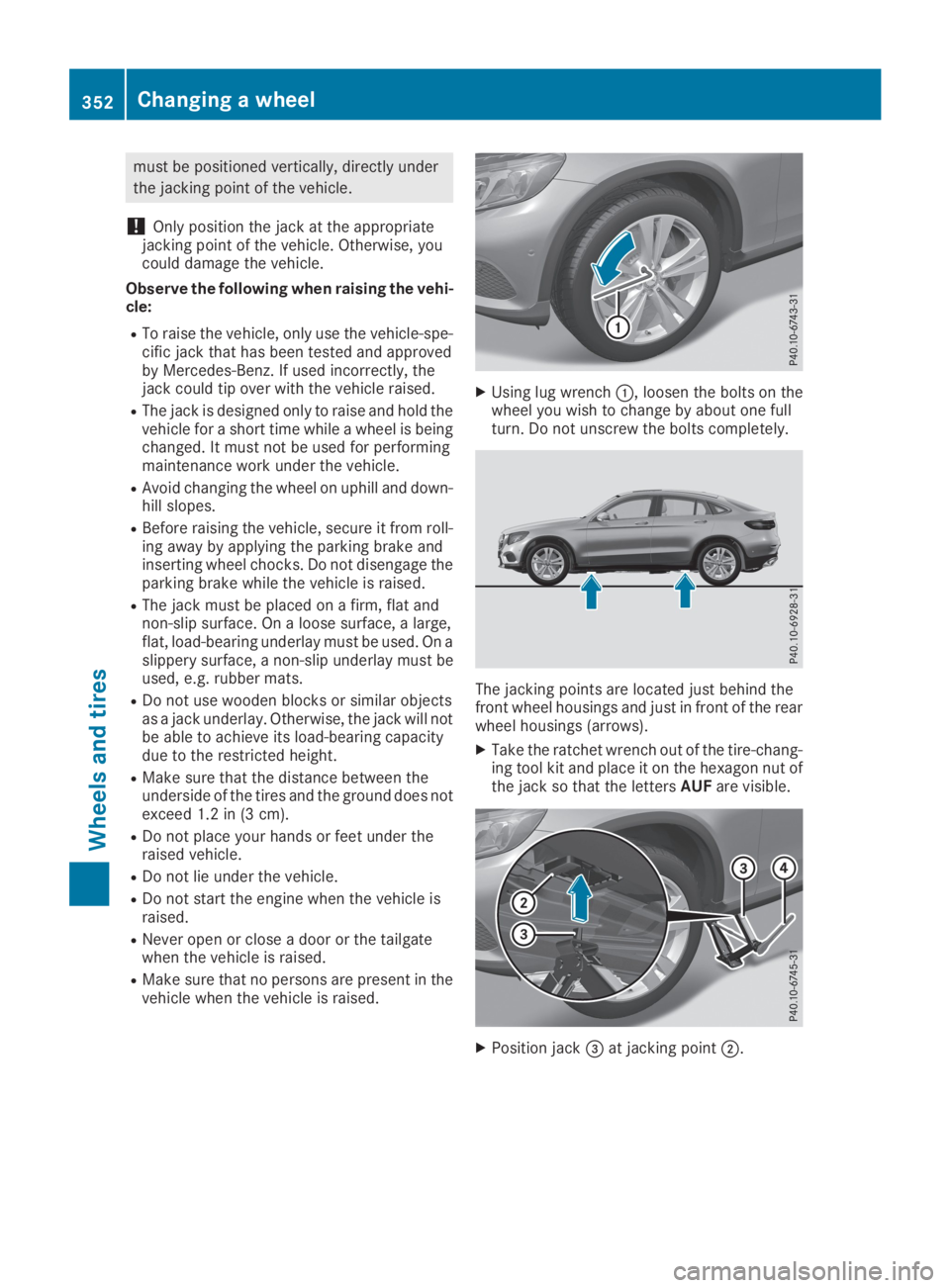
XUsing lug wrenchC, loosen the bolts on thewheel you wish to change by about one fullturn. Do not unscrew the bolts completely.
The jacking points are located just behind thefront wheel housings and just in front of the rearwheel housings (arrows).
XTake the ratchet wrench out of the tire-chang-ing tool kit and place it on the hexagon nut ofthe jack so that the lettersAUFare visible.
XPosition jack
Page 357 of 370
Observe the notes on recommended tire pres-sures under various operating conditions(Ypage 333).
Check tire pressures regularly, and only whenthe tires are cold. Comply with the maintenancerecommendations of the tire manufacturer inthe vehicle document wallet.
Notes on the vehicle equipment – always equipthe vehicle:
Rwith tires of the same size on a given axle (leftand right)
Rwith the same type of tires at a given time(summer tires, winter tires, MOExtendedtires)
Exception: it is permissible to install a differ-ent type or make in the event of a flat tire.Observe the "MOExtended tires (tires withrun-flat characteristics" section (Ypage 315).
Vehicles equipped with MOExtended tires arenot equipped with a TIREFIT kit at the factory. Itis therefore recommended that you additionallyequip your vehicle with a TIREFIT kit if you mounttires that do not feature run-flat properties, e.g.winter tires. A TIREFIT kit may be obtained froma qualified specialist workshop.
Wheel/tire combination355
Wheels and tires
Z
Page 363 of 370
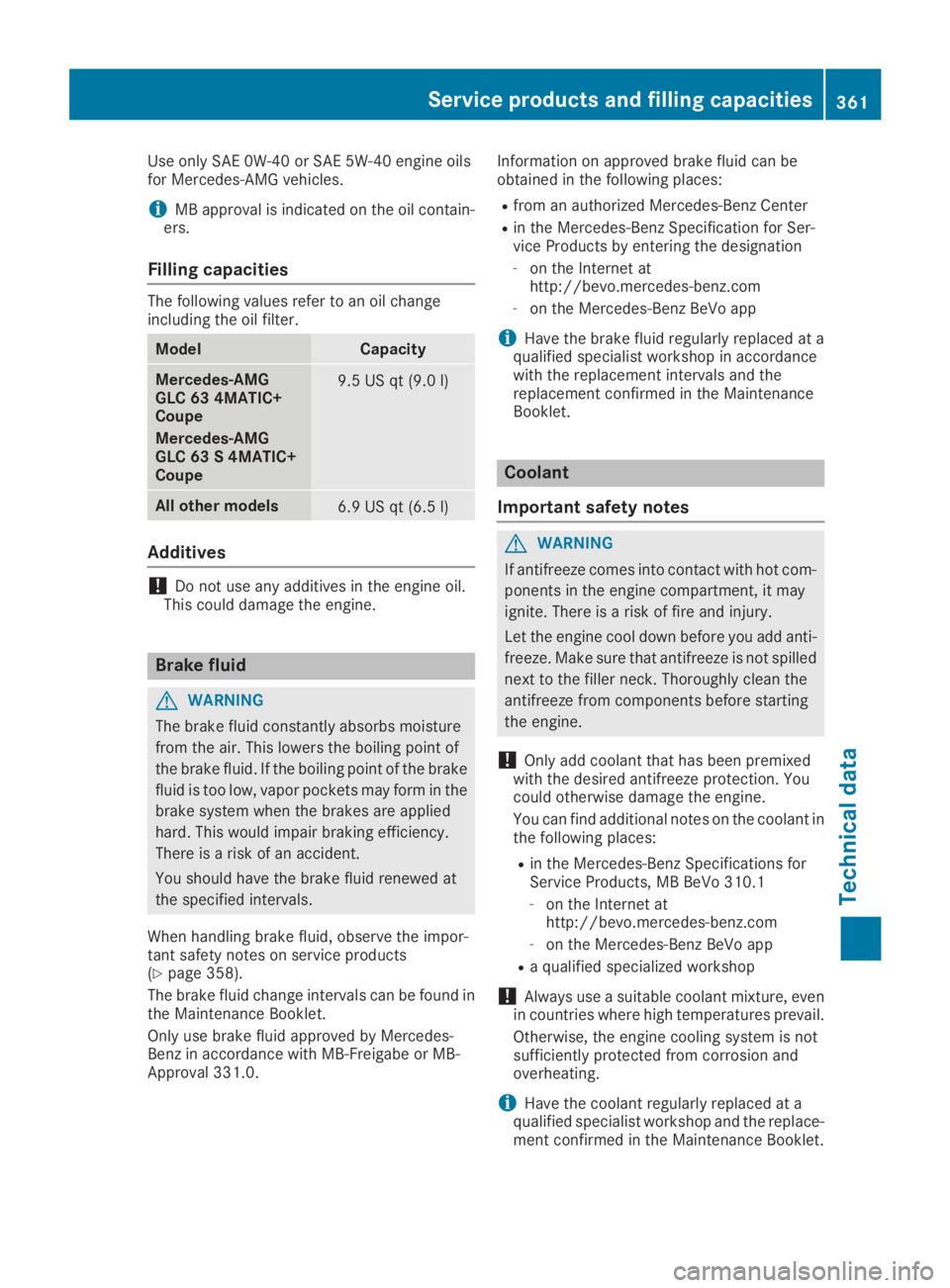
Use only SAE 0W-40 or SAE 5W-40 engine oilsfor Mercedes-AMG vehicles.
iMB approval is indicated on the oil contain-ers.
Filling capacities
The following values refer to an oil changeincluding the oil filter.
ModelCapacity
Mercedes-AMGGLC 63 4MATIC+Coupe
Mercedes-AMGGLC 63 S 4MATIC+Coupe
9.5 US qt (9.0l)
All other models6.9 US qt (6.5l)
Additives
!Do not use any additives in the engine oil.This could damage the engine.
Brake fluid
GWARNING
The brake fluid constantly absorbs moisture
from the air. This lowers the boiling point of
the brake fluid. If the boiling point of the brake
fluid is too low, vapor pockets may form in the
brake system when the brakes are applied
hard. This would impair braking efficiency.
There is a risk of an accident.
You should have the brake fluid renewed at
the specified intervals.
When handling brake fluid, observe the impor-tant safety notes on service products(Ypage 358).
The brake fluid change intervals can be found inthe Maintenance Booklet.
Only use brake fluid approved by Mercedes-Benz in accordance with MB-Freigabe or MB-Approval 331.0.
Information on approved brake fluid can beobtained in the following places:
Rfrom an authorized Mercedes-Benz Center
Rin the Mercedes-Benz Specification for Ser-vice Products by entering the designation
-on the Internet athttp://bevo.mercedes-benz.com
-on the Mercedes-Benz BeVo app
iHave the brake fluid regularly replaced at aqualified specialist workshop in accordancewith the replacement intervals and thereplacement confirmed in the MaintenanceBooklet.
Coolant
Important safety notes
GWARNING
If antifreeze comes into contact with hot com-
ponents in the engine compartment, it may
ignite. There is a risk of fire and injury.
Let the engine cool down before you add anti-
freeze. Make sure that antifreeze is not spilled
next to the filler neck. Thoroughly clean the
antifreeze from components before starting
the engine.
!Only add coolant that has been premixedwith the desired antifreeze protection. Youcould otherwise damage the engine.
You can find additional notes on the coolant inthe following places:
Rin the Mercedes-Benz Specifications forService Products, MB BeVo 310.1
-on the Internet athttp://bevo.mercedes-benz.com
-on the Mercedes-Benz BeVo app
Ra qualified specialized workshop
!Always use a suitable coolant mixture, evenin countries where high temperatures prevail.
Otherwise, the engine cooling system is notsufficiently protected from corrosion andoverheating.
iHave the coolant regularly replaced at aqualified specialist workshop and the replace-ment confirmed in the Maintenance Booklet.
Service products and filling capacities361
Technical data
Z