key MERCEDES-BENZ GLC 2019 Manual PDF
[x] Cancel search | Manufacturer: MERCEDES-BENZ, Model Year: 2019, Model line: GLC, Model: MERCEDES-BENZ GLC 2019Pages: 370, PDF Size: 19.55 MB
Page 309 of 370
RLight bulbs
RSeals
RTrim elements
RVentilation slots
Damaged seals or electrical components canlead to leaks or failures.
!Vehicles with decorative film: parts of yourvehicle are covered with decorative film.Maintain a distance of at least 27.5 in (70 cm)between the film-covered parts of the vehicleand the nozzle of the power washer.
Information about the correct distance isavailable from the equipment manufacturer.
Move the power washer nozzle around whencleaning your vehicle.
The water temperature of the power washermust not exceed 140 ‡ (60 †).
!If the SmartKey is within the rear detectionrange of KEYLESS-GO, the following situa-tions, for example, could lead to the uninten-tional opening of the tailgate:
Rwhen using an automatic car wash
Rwhen using a power washer
Make sure that the SmartKey is at least 10 ft(3 m) away from the vehicle.
Cleaning the paintwork
!Do not affix:
Rstickers
Rfilms
Rmagnetic plates or similar items
to painted surfaces. You could otherwisedamage the paintwork.
Scratches, corrosive deposits, areas affected bycorrosion and damage caused by inadequatecare cannot always be completely repaired. Insuch cases, visit a qualified specialist workshop.
XRemove dirt immediately, where possible,while avoiding rubbing too hard.
XSoak insect remains with insect remover andrinse off the treated areas afterwards.
XSoak bird droppings with water and rinse offthe treated areas afterwards.
XRemove tree resin, oils, fuels and greases byrubbing gently with a cloth soaked in petro-leum ether or lighter fluid
XRemove coolant and brake fluid with a moistcloth and clear water.
XUse tar remover to remove tar stains.
XUse silicone remover to remove wax.
When water no longer forms beads on the paintsurface, use the care product Paint Care, whichhas been approved for Mercedes-Benz. This isthe case approximately every three to fivemonths, depending on the climate conditionsand the care product used.
The cleaning product Paint Cleaner, which hasbeen recommended and approved forMercedes-Benz, should be used when dirt haspenetrated the paint surface.
Also use Paint Cleaner on paint that has becomedull.
Do not use these care products in the sun or onthe hood while the hood is hot.
XUse a suitable touch-up stick, e.g. MB Touch-Up Stick, to repair slight damage to the paint-work quickly and provisionally.
Matte finish care
!Never polish the vehicle or the light alloywheels. Polishing causes the finish to shine.
!The following can give the paint a glossyappearance and thus reduce the matt effect:
RRubbing hard with unsuitable agents
RWashing the vehicle in direct sunlight
!Never use paint cleaner, buffing or polishingproducts, or gloss preserver, e.g. wax, for thepurpose of paintwork care. These productsare only suitable for high-gloss surfaces. Theiruse on vehicles with matte paintwork leads toconsiderable surface damage or, more spe-cifically, to shiny, spotted areas.
Always have paintwork repairs carried out at aqualified specialist workshop.
!Only use automatic car washes which cor-respond to the latest technological stand-ards. Never use wash programs which finishby treating the vehicle with hot wax.
Observe these notes if your vehicle has a clearmatte finish. This will help you to avoid damageto the paintwork due to incorrect treatment.
These notes also apply to light alloy wheels witha clear matte finish.
Use only insect remover and car shampoo fromthe range of approved Mercedes-Benz careproducts.
Care307
Maintenance and care
Z
Page 311 of 370
Cleaning the mirror turn signals
!Only use cleaning agents or cleaning clothsthat are suitable for plastic lenses. Unsuitablecleaning agents or cleaning cloths couldscratch or damage the plastic lenses of themirror turn signals.
XClean the plastic lenses of the mirror turn sig-nals in the exterior mirror housing using a wetsponge and mild cleaning agent, e.g.Mercedes-Benz car shampoo or cleaningcloths.
Cleaning the side running board
!Do not clean the aluminum insert of the siderunning board with alkaline or acid-basedcleaning agents, such as wheel cleaner. Donot use acidic wheel cleaners to removebrake dust. The aluminum inserts could oth-erwise be damaged.
Cleaning the sensors
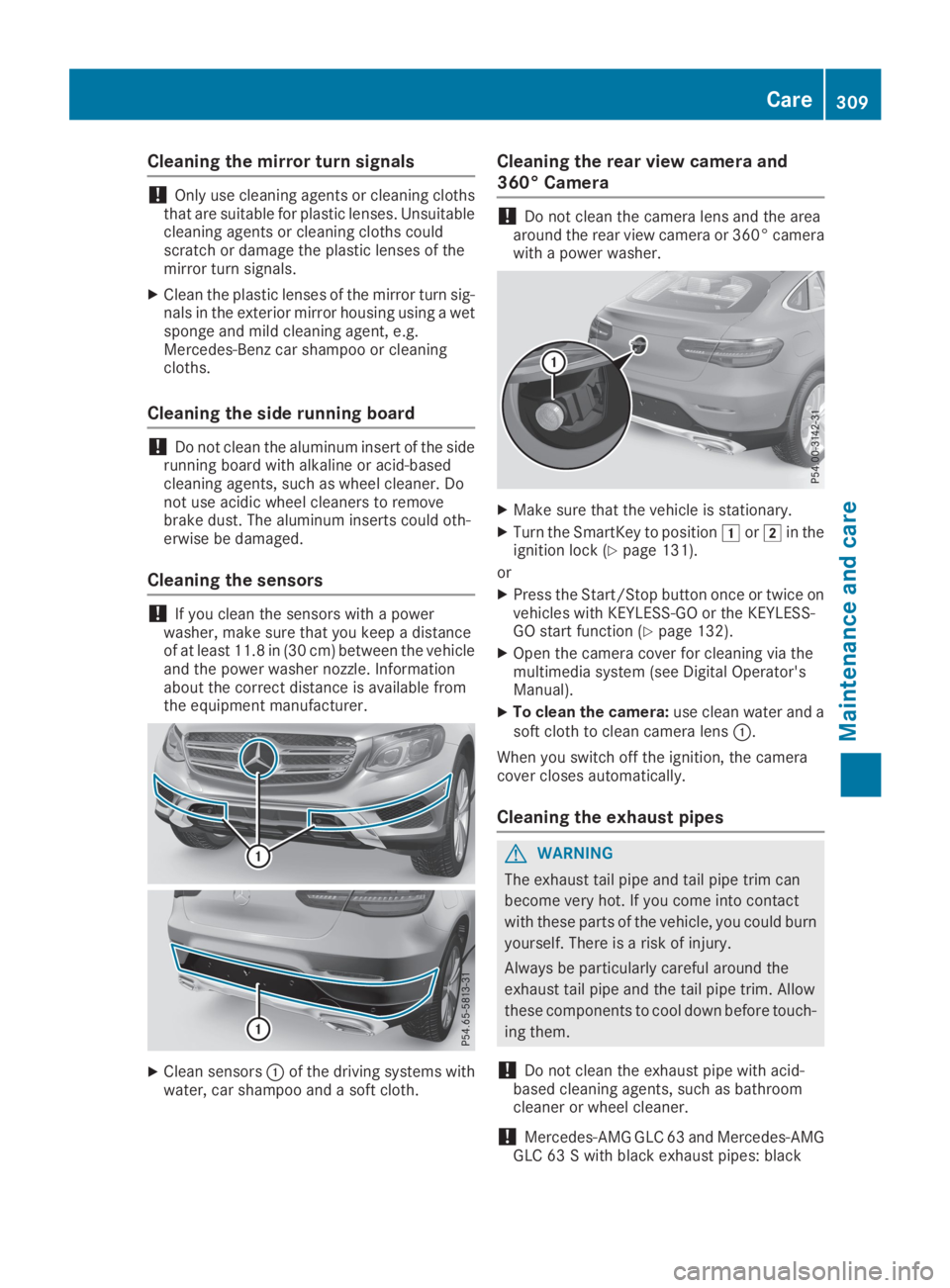
!If you clean the sensors with a powerwasher, make sure that you keep a distanceof at least 11.8 in(30 cm) between the vehicleand the power washer nozzle. Informationabout the correct distance is available fromthe equipment manufacturer.
XClean sensorsCof the driving systems withwater, car shampoo and a soft cloth.
Cleaning the rear view camera and
360° Camera
!Do not clean the camera lens and the areaaround the rear view camera or 360° camerawith a power washer.
XMake sure that the vehicle is stationary.
XTurn the SmartKey to positionGorHin theignition lock (Ypage 131).
or
XPress the Start/Stop button once or twice onvehicles with KEYLESS-GO or the KEYLESS-GO start function (Ypage 132).
XOpen the camera cover for cleaning via themultimedia system (see Digital Operator'sManual).
XTo clean the camera:use clean water and asoft cloth to clean camera lensC.
When you switch off the ignition, the cameracover closes automatically.
Cleaning the exhaust pipes
GWARNING
The exhaust tail pipe and tail pipe trim can
become very hot. If you come into contact
with these parts of the vehicle, you could burn
yourself. There is a risk of injury.
Always be particularly careful around the
exhaust tail pipe and the tail pipe trim. Allow
these components to cool down before touch-
ing them.
!Do not clean the exhaust pipe with acid-based cleaning agents, such as bathroomcleaner or wheel cleaner.
!Mercedes‑AMG GLC 63 and Mercedes‑AMGGLC 63 S with black exhaust pipes: black
Care309
Maintenance and care
Z
Page 317 of 370
Flat tire
Preparing the vehicle
Your vehicle may be equipped with:
RMOExtended tires (tires with run-flat proper-ties) (Ypage 315)
Vehicle preparation is not necessary on vehi-cles with MOExtended tires.
Ra TIREFIT kit (Ypage 314)
Vehicles equipped with MOExtended tires arenot equipped with a TIREFIT kit at the factory. Itis therefore recommended that you additionallyequip your vehicle with a TIREFIT kit if you mounttires that do not feature run-flat characteristics,e.g. winter tires. A TIREFIT kit may be obtainedfrom a qualified specialist workshop.
Vehicles with a Mercedes-Benz emergency callsystem which are not equipped with a TIREFITkit: in the event of a flat tire, contact the Cus-tomer Assistance Center for the Mercedes-Benzemergency call system (Ypage 294).
Information on changing and mounting wheels(Ypage 351).
XStop the vehicle on solid, non-slippery andlevel ground, as far away as possible fromtraffic.
XSwitch on the hazard warning lamps.
XSecure the vehicle against rolling away(Ypage 152).
XIf possible, bring the front wheels into thestraight-ahead position.
XSwitch off the engine.
XRemove the SmartKey from the ignition lock.
or, in vehicles with KEYLESS-GO start-functionor KEYLESS‑GO
XOpen the driver's door.The vehicle electronics are now in position
Page 323 of 370
Mercedes-Benz. These batteries provideincreased impact protection to prevent vehicleoccupants from suffering acid burns should thebattery be damaged in the event of an accident.
In order for the battery to achieve the maximumpossible service life, it must always be suffi-ciently charged.
Like other batteries, the vehicle battery maydischarge over time if you do not use the vehicle.In this case, have the battery disconnected at aqualified specialist workshop. You can alsocharge the battery with a charger recommendedby Mercedes-Benz. Contact a qualified special-ist workshop for further information.
Have the battery charge state checked morefrequently if you use the vehicle mainly for shorttrips or if you leave it standing idle for a lengthyperiod. Consult a qualified specialist workshopif you wish to leave your vehicle parked for a longperiod of time.
Remove the SmartKey if you park the vehicleand do not require any electrical consumers.The vehicle will then use very little energy, thusconserving battery power.
Charging the 12 V battery
Vehicles with a lithium-ion battery:
!Only use battery chargers with a maximumcharging voltage of 14.4 V.
All vehicles except vehicles with a lithium-ion battery:
!Only use battery chargers with a maximumcharging voltage of 14.8 V.
GWARNING
During charging and jump-starting, explosive
gases can escape from the battery. There is a
risk of an explosion.
Particularly avoid fire, open flames, creating
sparks and smoking. Ensure there is sufficient
ventilation while charging and jump-starting.
Do not lean over a battery.
GWARNING
Battery acid is caustic. There is a risk of injury.
Avoid contact with skin, eyes or clothing. Do
not inhale any battery gases. Do not lean over
the battery. Keep children away from batter-
ies. Wash away battery acid immediately with
plenty of clean water and seek medical atten-
tion.
GWARNING
A discharged battery can freeze at tempera-
tures below freezing point. When jump-start-
ing the vehicle or charging the battery, gases
can escape from the battery. There is a risk of
an explosion.
Allow the frozen battery to thaw out before
charging it or jump-starting.
All vehicles:
!Only charge the battery using the jump-starting connection point.
The jump-starting connection point is in theengine compartment (Ypage 322).
XOpen the hood.
XConnect the battery charger to the positiveterminal and ground point in the same orderas when connecting the donor battery in thejump-starting procedure (Ypage 322).
Keep away from fire and open flames. Do notlean over a battery. Never charge the battery if itis still installed in the vehicle, unless you use abattery charger which has been tested andapproved by Mercedes-Benz. A battery chargerunit specially adapted for Mercedes-Benz vehi-cles and tested and approved by Mercedes-Benz is available as an accessory. It permits thecharging of the battery in its installed position.Contact an authorized Mercedes-Benz Centerfor further information and availability. Read thebattery charger's operating instructions beforecharging the battery.
All vehicles except vehicles with a lithium-ion battery:if the warning and indicator lampson the instrument cluster do not light up at lowtemperatures, it is very likely that the dis-charged battery has frozen. In this case you mayneither jump-start the vehicle nor charge thebattery. The service life of a thawed-out batterymay be shorter. The starting characteristics canbe impaired, particularly at low temperatures.Have the thawed-out battery checked at a quali-fied specialist workshop.
Vehicles with a lithium-ion battery:at lowtemperatures, do not charge a battery which hasbeen removed using a battery charger. Allow the
Battery (vehicle)321
Breakdown assistance
Z
Page 325 of 370
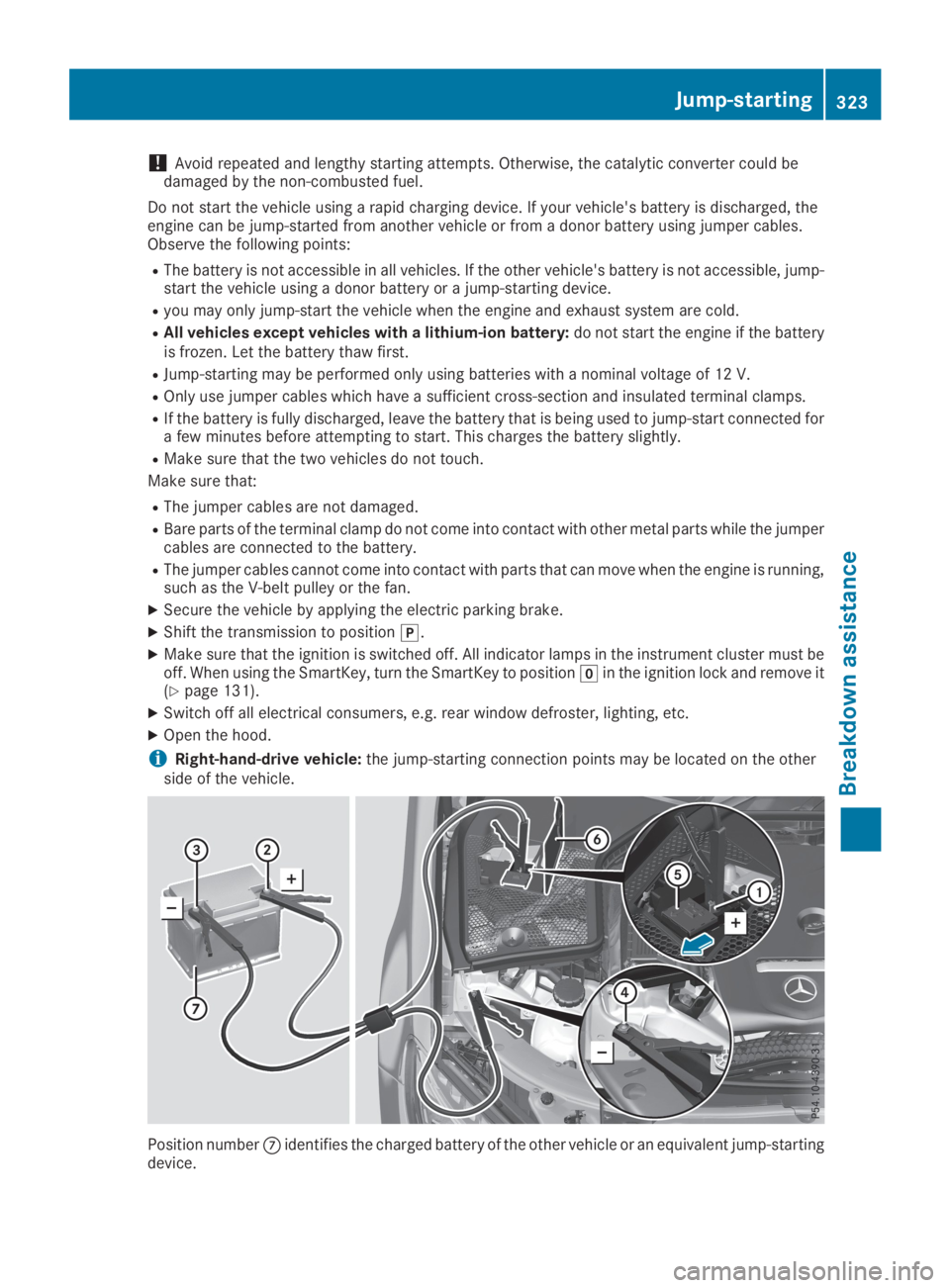
!Avoid repeated and lengthy starting attempts. Otherwise, the catalytic converter could bedamaged by the non-combusted fuel.
Do not start the vehicle using a rapid charging device. If your vehicle's battery is discharged, theengine can be jump-started from another vehicle or from a donor battery using jumper cables.Observe the following points:
RThe battery is not accessible in all vehicles. If the other vehicle's battery is not accessible, jump-start the vehicle using a donor battery or a jump-starting device.
Ryou may only jump-start the vehicle when the engine and exhaust system are cold.
RAll vehicles except vehicles with a lithium-ion battery:do not start the engine if the batteryis frozen. Let the battery thaw first.
RJump-starting may be performed only using batteries with a nominal voltage of 12 V.
ROnly use jumper cables which have a sufficient cross-section and insulated terminal clamps.
RIf the battery is fully discharged, leave the battery that is being used to jump-start connected fora few minutes before attempting to start. This charges the battery slightly.
RMake sure that the two vehicles do not touch.
Make sure that:
RThe jumper cables are not damaged.
RBare parts of the terminal clamp do not come into contact with other metal parts while the jumpercables are connected to the battery.
RThe jumper cables cannot come into contact with parts that can move when the engine is running,such as the V-belt pulley or the fan.
XSecure the vehicle by applying the electric parking brake.
XShift the transmission to position].
XMake sure that the ignition is switched off. All indicator lamps in the instrument cluster must beoff. When using the SmartKey, turn the SmartKey to positionZin the ignition lock and remove it(Ypage 131).
XSwitch off all electrical consumers, e.g. rear window defroster, lighting, etc.
XOpen the hood.
iRight-hand-drive vehicle:the jump-starting connection points may be located on the otherside of the vehicle.
Position numberkidentifies the charged battery of the other vehicle or an equivalent jump-startingdevice.
Jump-starting323
Breakdown assistance
Z
Page 327 of 370
!Only secure the tow rope or tow bar at thetowing eyes, or the trailer tow hitch, if availa-ble. You could otherwise damage the vehicle.
!Do not use the trailer tow hitch for recoveryor towing. Do not use the towing eye forrecovery. this could damage the vehicle. If indoubt, have the vehicle recovered using acrane.
!When towing, pull away slowly andsmoothly. If the tractive power is too high, thevehicles could be damaged.
!Shift the automatic transmission to position\\and do not open the driver's or front pas-senger's door during towing. The automatictransmission may otherwise shift to position], which could damage the transmission.
!Do not tow with sling-type equipment. Thiscould damage the vehicle.
!You may tow the vehicle for a maximum dis-tance of 30 miles (50 kilometers). A towingspeed of 30 mph (50 km/h) must not beexceeded.
For towing distances over 30 miles(50 kilometers), the entire vehicle must beraised and transported.
It is better to have the vehicle transported thanto have it towed away.
If the vehicle has suffered transmission damage,have it transported on a transporter or trailer.
The automatic transmission must be in position\\when the vehicle is being towed. If the auto-matic transmission cannot be shifted to position\\, have the vehicle transported on a trans-porter or trailer.
The battery must be connected and charged.Otherwise, you:
Rcannot turn the SmartKey to positionHinthe ignition lock
Rcannot release the electric parking brake.
Rcannot shift the automatic transmission toposition\\
Disarm the automatic locking feature before thevehicle is towed (Ypage 84). You could other-wise be locked out when pushing or towing thevehicle.
Installing/removing the towing eye
Installing the towing eye
GWARNING
The exhaust tail pipe may be very hot. There is
a risk of burns when removing the rear cover.
Do not touch the exhaust pipe. Take particular
care when removing the rear cover.
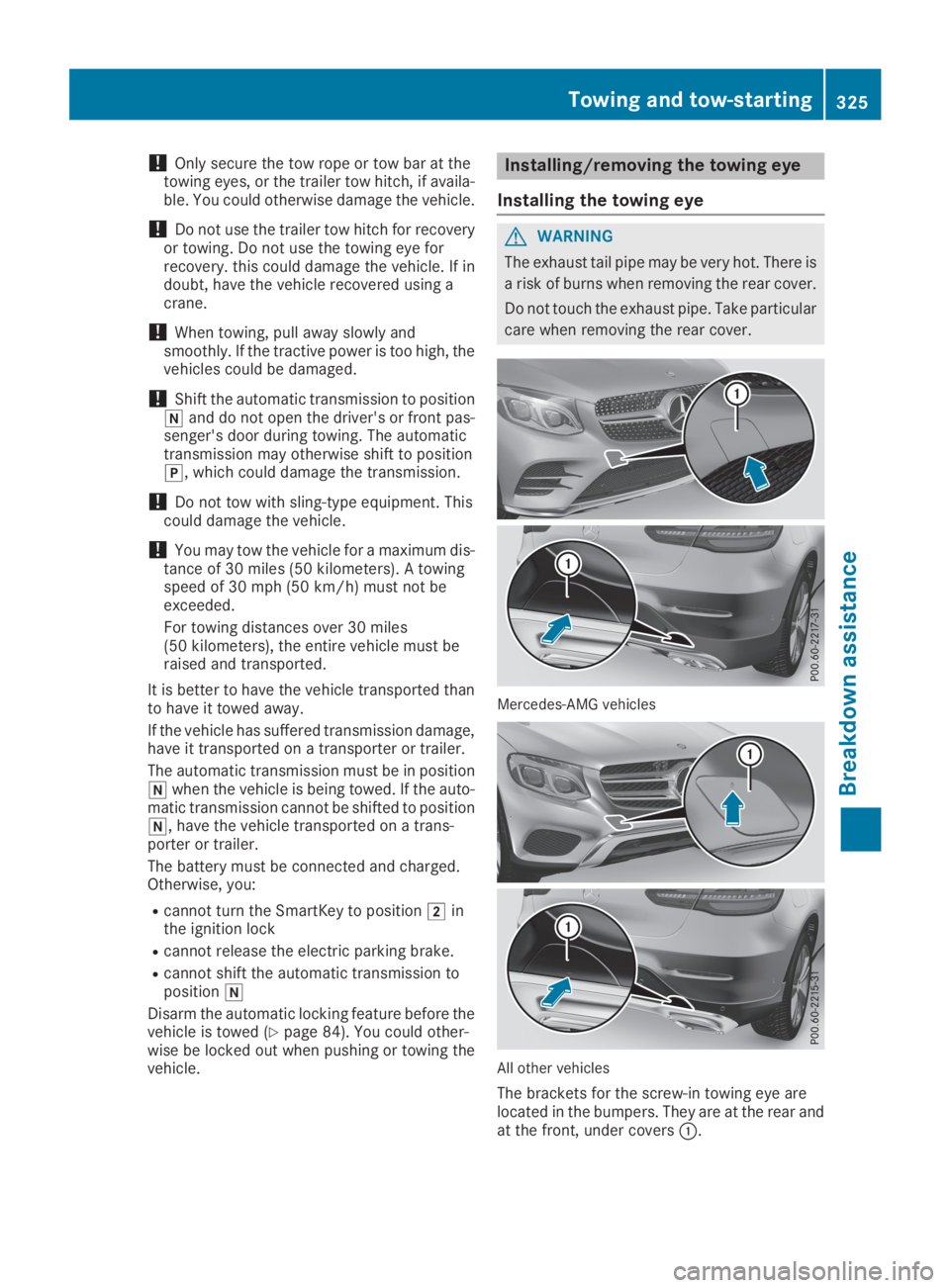
Mercedes-AMG vehicles
All other vehicles
The brackets for the screw-in towing eye arelocated in the bumpers. They are at the rear andat the front, under coversC.
Towing and tow-starting325
Breakdown assistance
Z
Page 328 of 370
XRemove the towing eye from the retainer(Ypage 314).
XMercedes-AMG vehicles:use a suitableobject, e.g. a screwdriver, to pry off coverCon the front bumper from underneath. Takethe cover from the opening, but do notremove it.
Press the mark on coverCon the rearbumper inward and remove.
XAll other vehicles:press the mark oncoverCinward and remove.
XScrew in the towing eye clockwise as far as itwill go and tighten it.
Vehicles with a trailer tow hitch do not have abracket for the screw-in towing eye at the back.Connect the towbar to the trailer tow hitch(Ypage 204).
Removing the towing eye
XUnscrew and remove the towing eye.
XAttach coverCto the bumper and press untilit engages.
Towing a vehicle with both axles on
the ground
The automatic transmission automatically shiftsto position]when you open the driver's orfront-passenger door or when you remove theSmartKey from the ignition lock. It is essential toobserve the following steps to ensure that theautomatic transmission remains in position\\during towing.
XMake sure that the vehicle is stationary.
XTurn the SmartKey to positionHin the igni-tion lock.
XDepress and hold the brake pedal.
XShift the automatic transmission to position\\.
XLeave the SmartKey in positionHin the igni-tion lock.
XRelease the brake pedal.
XRelease the electric parking brake.
XSwitch on the hazard warning lamps(Ypage 111).
In order to signal a change of direction whentowing the vehicle with the hazard warninglamps switched on, use the combination switchas usual. In this case, only the indicator lamps
for the direction of travel flash. After resettingthe combination switch, the hazard warninglamp starts flashing again.
Transporting the vehicle
General notes
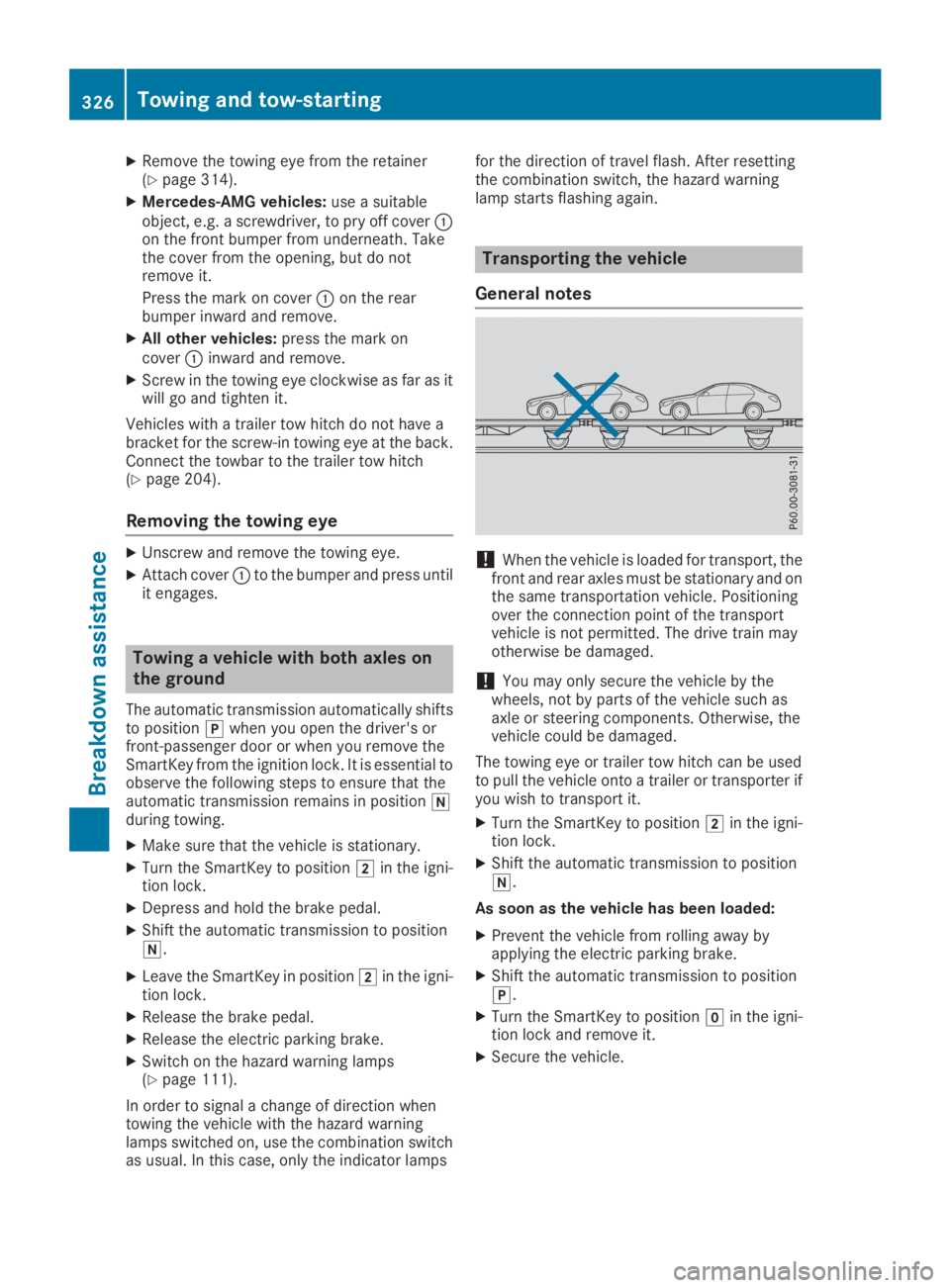
!When the vehicle is loaded for transport, thefront and rear axles must be stationary and onthe same transportation vehicle. Positioningover the connection point of the transportvehicle is not permitted. The drive train mayotherwise be damaged.
!You may only secure the vehicle by thewheels, not by parts of the vehicle such asaxle or steering components. Otherwise, thevehicle could be damaged.
The towing eye or trailer tow hitch can be usedto pull the vehicle onto a trailer or transporter ifyou wish to transport it.
XTurn the SmartKey to positionHin the igni-tion lock.
XShift the automatic transmission to position\\.
As soon as the vehicle has been loaded:
XPrevent the vehicle from rolling away byapplying the electric parking brake.
XShift the automatic transmission to position].
XTurn the SmartKey to positionZin the igni-tion lock and remove it.
XSecure the vehicle.
326Towing and tow-starting
Breakdown assistance
Page 329 of 370
Notes on 4MATIC vehicles
!Vehicles with 4MATIC must not be towedwith either the front or the rear axle raised, asdoing so will damage the transmission.
Vehicles with 4MATIC may either be towed awaywith both axles on the ground or be loaded upand transported.
If the vehicle's transmission, front, or rear axle isdamaged, have the vehicle transported on atruck or trailer.
In the event of damage to the electrical sys-tem:if the battery is defective, the automatictransmission will be locked in positionP. To shiftthe automatic transmission to positionN, youmust provide power to the vehicle's electricalsystem in the same way as when jump-starting(Ypage 322).
Have the vehicle transported on a transporter ortrailer.
Tow-starting (emergency engine
starting)
!Vehicles with automatic transmission mustnot be tow-started. You could otherwise dam-age the automatic transmission.
iYou can find information on "Jump-starting"under (Ypage 322).
Fuses
Important safety notes
GWARNING
If you manipulate or bridge a faulty fuse or if
you replace it with a fuse with a higher amper-
age, the electric cables could be overloaded.
This could result in a fire. There is a risk of an
accident and injury.
Always replace faulty fuses with the specified
new fuses having the correct amperage.
Blown fuses must be replaced with fuses of thesame rating, which you can recognize by thecolor and value. The fuse ratings are listed in thefuse allocation chart.
The fuse allocation chart is on the fuse box in thecargo compartment (Ypage 328).
If a newly inserted fuse also blows, have thecause traced and rectified at a qualified special-ist workshop, e.g. an authorized Mercedes-BenzCenter.
!Only use fuses that have been approved forMercedes-Benz vehicles and which have thecorrect fuse rating for the system concerned.Otherwise, components or systems could bedamaged.
!Make sure that no moisture can enter thefuse box when the cover is open.
!When closing the cover, make sure that it islying correctly on the fuse box. Moisture seep-ing in or dirt could otherwise impair the oper-ation of the fuses.
The fuses in your vehicle serve to close downfaulty circuits. If a fuse blows, all the compo-nents on the circuit and their functions stopoperating.
Before changing a fuse
Observe the important safety notes(Ypage 327)
XSwitch off the engine.
XSwitch off all electrical consumers.
XMake sure that the ignition is switched off(Ypage 132).
or
XWhen using the SmartKey, turn the SmartKeyto position
Page 339 of 370
Ryou are driving on sand or gravel.
Ryou adopt a very sporty driving style (corner-ing at high speeds or driving with high rates ofacceleration).
Ryou are towing a very heavy or large trailer.
Ryou are driving with a heavy load (in the vehi-cle or on the roof).
Restarting the tire pressure loss warn-
ing system
Restart the tire pressure loss warning system ifyou have:
Rchanged the tire pressure
Rchanged the wheels or tires
Rmounted new wheels or tires
XBefore restarting, make sure that the tirepressures are set properly on all four tires forthe respective operating conditions.
The recommended tire pressure can be foundon the Tire and Loading Information placardon the B-pillar. Additionally, a tire pressuretable is attached to the fuel filler flap. The tirepressure loss warning system can only givereliable warnings if you have set the correcttire pressure. If an incorrect tire pressure isset, these incorrect values will be monitored.
XAlso observe the notes in the section on tirepressures (Ypage 333).
XMake sure that the SmartKey is in positionHin the ignition lock (Ypage 131).
XPress
Page 341 of 370
too low. The tire pressure monitor is not mal-functioning.
Rif the warning lamp flashes for around aminute and then remains lit constantly, thetire pressure monitor is malfunctioning.
In addition to the warning lamp, a messageappears in the multifunction display. Observethe information on display messages(Ypage 250).
It may take up to ten minutes for a malfunctionof the tire pressure monitor to be indicated. Amalfunction will be indicated by the tire pres-sure warning lamp flashing for approximatelyone minute and then remaining lit. When themalfunction has been rectified, the tire pressurewarning lamp goes out after a few minutes ofdriving.
The tire pressure values indicated by the on-board computer may differ from those meas-ured at a gas station with a pressure gauge. Thetire pressures shown by the on-board computerrefer to those measured at sea level. At highaltitudes, the tire pressure values indicated by apressure gauge are higher than those shown bythe on-board computer. In this case, do notreduce the tire pressures.
The operation of the tire pressure monitor canbe affected by interference from radio transmit-ting equipment (e.g. radio headphones, two-wayradios) that may be being operated in or near thevehicle.
Checking the tire pressure electroni-
cally
XMake sure that the SmartKey is in positionH(Ypage 131) in the ignition lock.
XPress