display MERCEDES-BENZ GLC SUV 2015 Owner's Manual
[x] Cancel search | Manufacturer: MERCEDES-BENZ, Model Year: 2015, Model line: GLC SUV, Model: MERCEDES-BENZ GLC SUV 2015Pages: 497, PDF Size: 15.27 MB
Page 27 of 497
Wheel bolt tightening torque
........... 467
Wheel chock ...................................... 465
Wheels
Changing a wheel .......................... 463
Changing/replacing ....................... 463
Checking ........................................ 455
Cleaning ......................................... 423
Emergency spare wheel ................. 474
Fitting a new wheel ........................ 467
Fitting a wheel .............................. .464
General notes ................................ 468
Important safety notes .................. 454
Information on driving .................... 454
Removing a wheel .......................... 466
Snow chains .................................. 457
Storing .......................................... .464
Tightening torque ........................... 467
Wheel size/tyre size ..................... .468
Windowbag
Display message ............................ 347
Operation ......................................... 56
Windows
Cleaning ......................................... 424
see Side windows
Windscreen
Demisting ...................................... 168
Windscreen washer fluid
see Windscreen washer system
Windscreen washer system
Important safety notes .................. 487
Topping up ..................................... 418
Windscreen wipers
Problem (malfunction) ................... 154
Rear window wiper ........................ 151
Replacing the wiper blades ............ 151
Switching on/off ........................... 150
Winter operation
Important safety notes .................. 456
Radiator cover ............................... 416
Slippery road surfaces ................... 226
Snow chains .................................. 457
Summer tyres ................................ 456
Winter tyres
Limiting the speed (on-board com-
puter) ............................................. 333
M+S tyres ...................................... 456
Wiper blades
Cleaning ......................................... 424 Important safety notes .................. 151
Replacing ....................................... 151
Replacing (on the rear window) ..... 153
Replacing (windscreen) .................. 151
Wooden trim (cleaning instruc-
tions) ................................................. .427 24
Index
Page 35 of 497
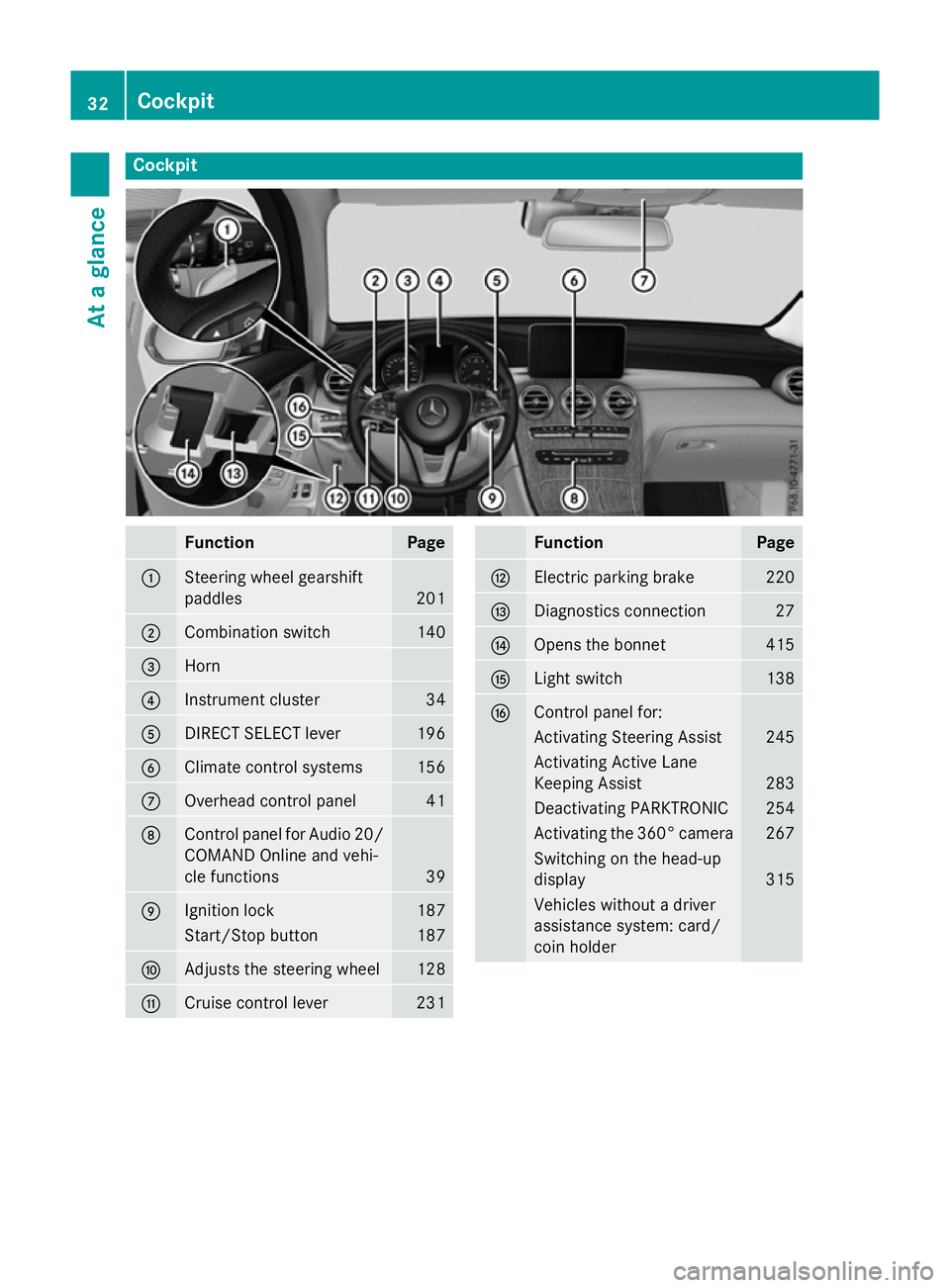
Cockpit
Function Page
:
Steering wheel gearshift
paddles
201
;
Combination switch 140
=
Horn
?
Instrument cluster 34
A
DIRECT SELECT lever 196
B
Climate control systems 156
C
Overhead control panel 41
D
Control panel for Audio 20/
COMAND Online and vehi-
cle functions 39
E
Ignition lock 187
Start/Stop button 187
F
Adjusts the steering wheel 128
G
Cruise control lever 231 Function Page
H
Electric parking brake 220
I
Diagnostics connection 27
J
Opens the bonnet 415
K
Light switch 138
L
Control panel for:
Activating Steering Assist 245
Activating Active Lane
Keeping Assist 283
Deactivating PARKTRONIC 254
Activating the 360° camera 267
Switching on the head-up
display
315
Vehicles without a driver
assistance system: card/
coin holder32
CockpitAt a glance
Page 36 of 497
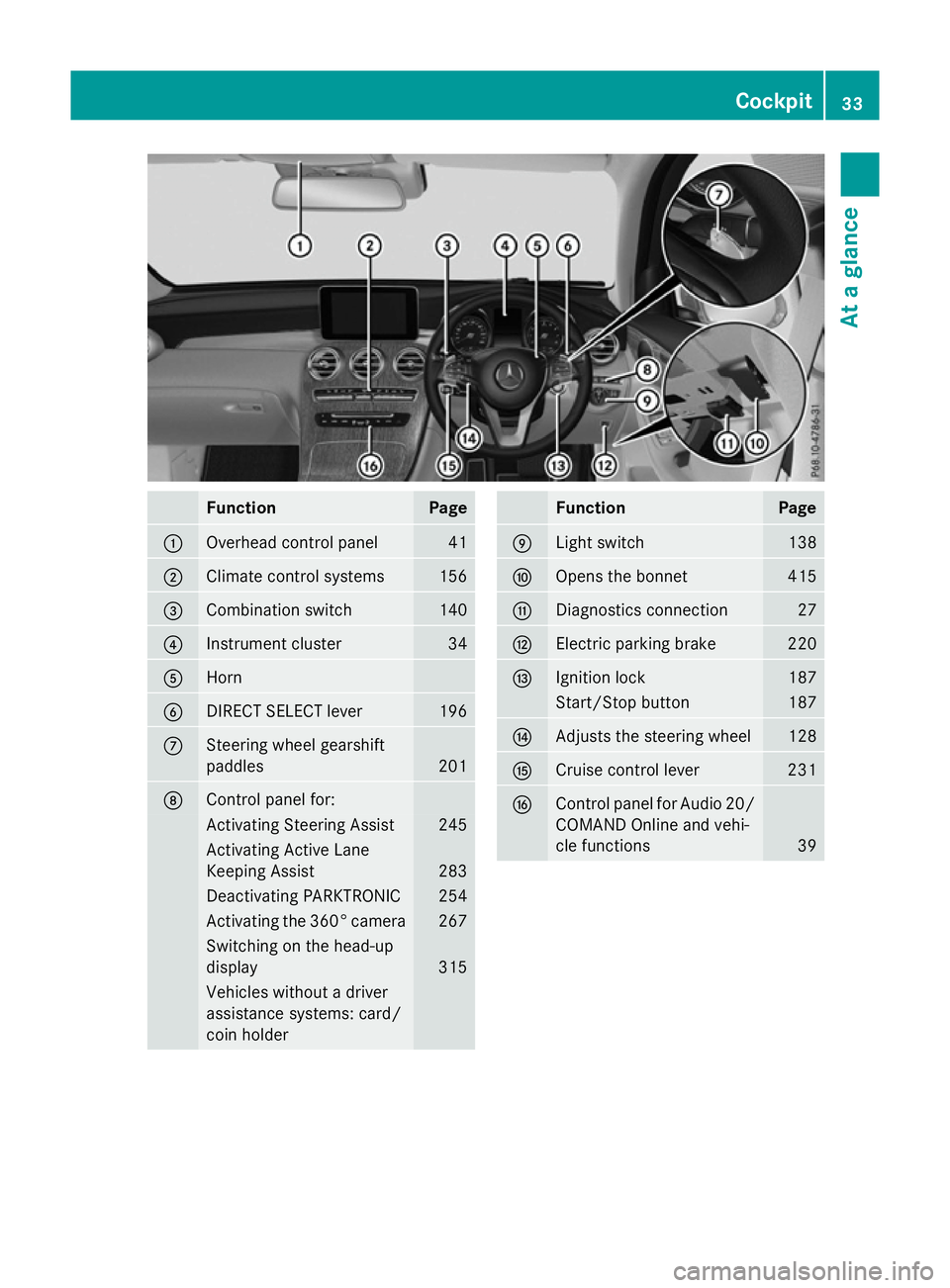
Function Page
:
Overhead control panel 41
;
Climate control systems 156
=
Combination switch 140
?
Instrument cluster 34
A
Horn
B
DIRECT SELECT lever 196
C
Steering wheel gearshift
paddles
201
D
Control panel for:
Activating Steering Assist 245
Activating Active Lane
Keeping Assist
283
Deactivating PARKTRONIC 254
Activating the 360° camera 267
Switching on the head-up
display
315
Vehicles without a driver
assistance systems: card/
coin holder Function Page
E
Light switch 138
F
Opens the bonnet 415
G
Diagnostics connection 27
H
Electric parking brake 220
I
Ignition lock 187
Start/Stop button 187
J
Adjusts the steering wheel 128
K
Cruise control lever 231
L
Control panel for Audio 20/
COMAND Online and vehi-
cle functions 39Cockpit
33At a glance
Page 37 of 497
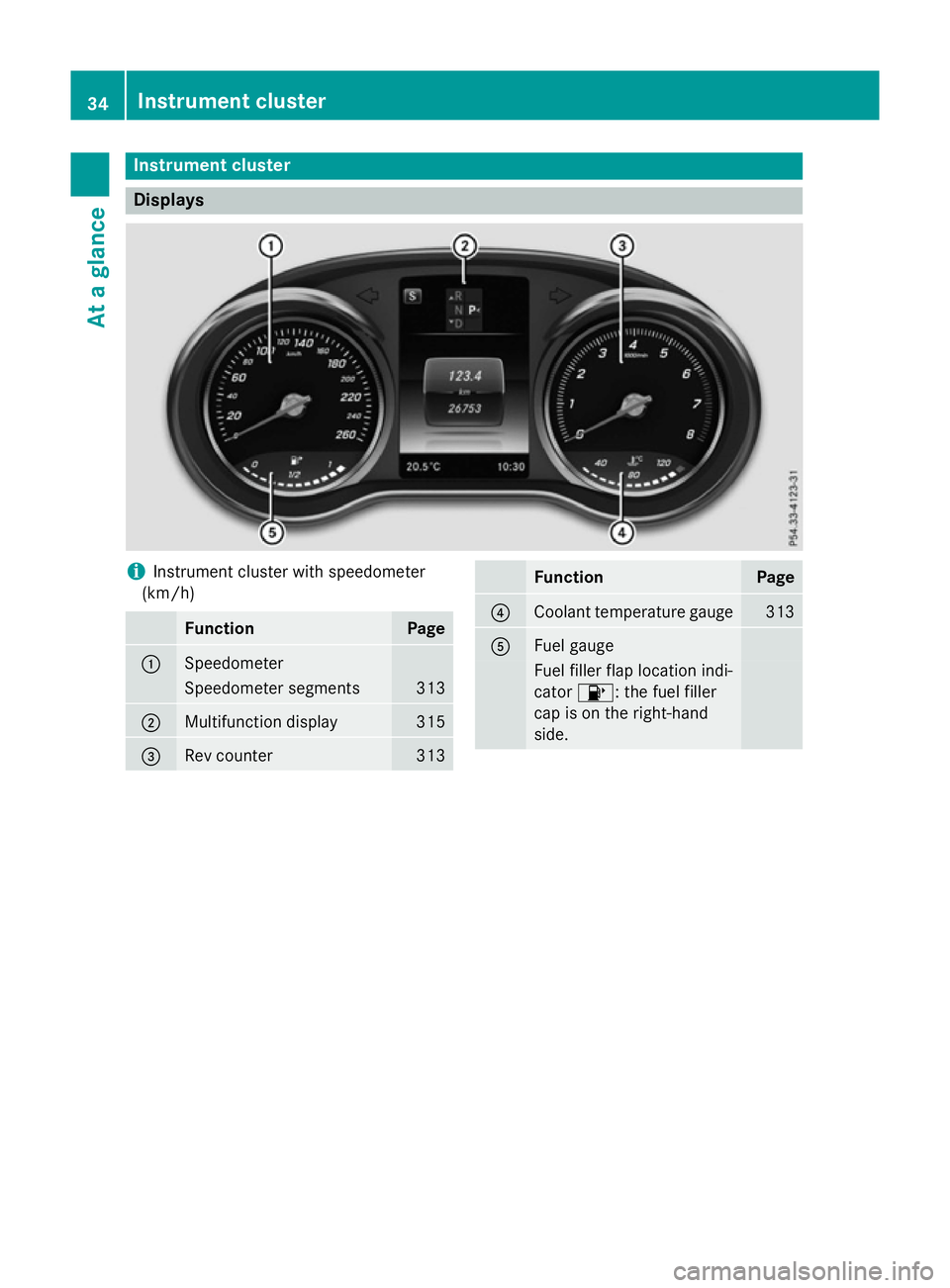
Instrument cluster
Displays
i
Instrument cluster with speedometer
(km/h) Function Page
:
Speedometer
Speedometer segments 313
;
Multifunction display 315
=
Rev counter 313 Function Page
?
Coolant temperature gauge 313
A
Fuel gauge
Fuel filler flap location indi-
cator 8: the fuel filler
cap is on the right-hand
side. 34
Instrument clusterAt a glance
Page 38 of 497
i
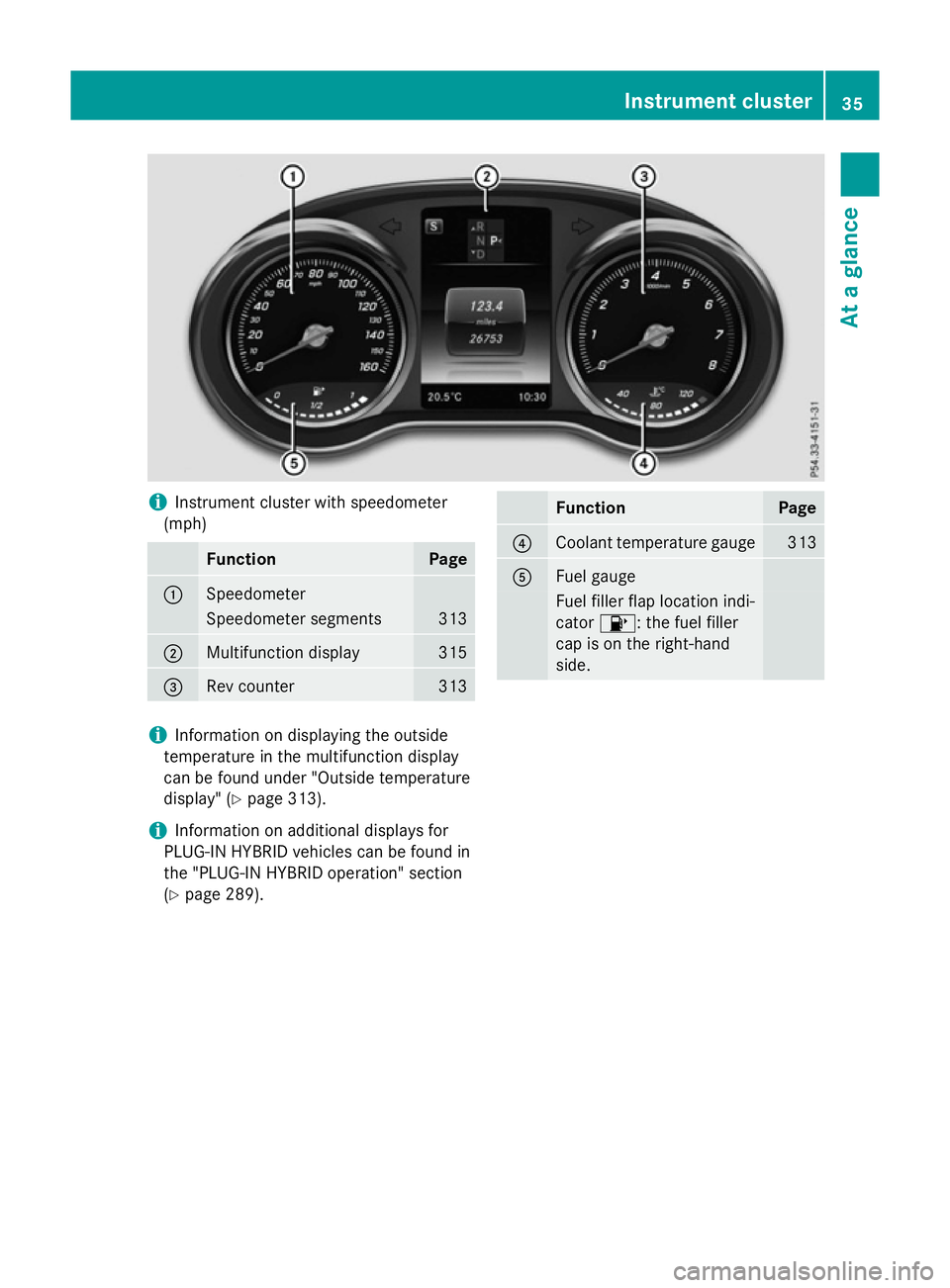
Instrument cluster with speedometer
(mph) Function Page
:
Speedometer
Speedometer segments 313
;
Multifunction display 315
=
Rev counter 313 Function Page
?
Coolant temperature gauge 313
A
Fuel gauge
Fuel filler flap location indi-
cator
8: the fuel filler
cap is on the right-hand
side. i
Information on displaying the outside
temperature in the multifunction display
can be found under "Outside temperature
display" (Y page 313).
i Information on additional displays for
PLUG-IN HYBRID vehicles can be found in
the "PLUG-IN HYBRID operation" section
(Y page 289). Instrument cluster
35At a glance
Page 40 of 497
Multifunction steering wheel
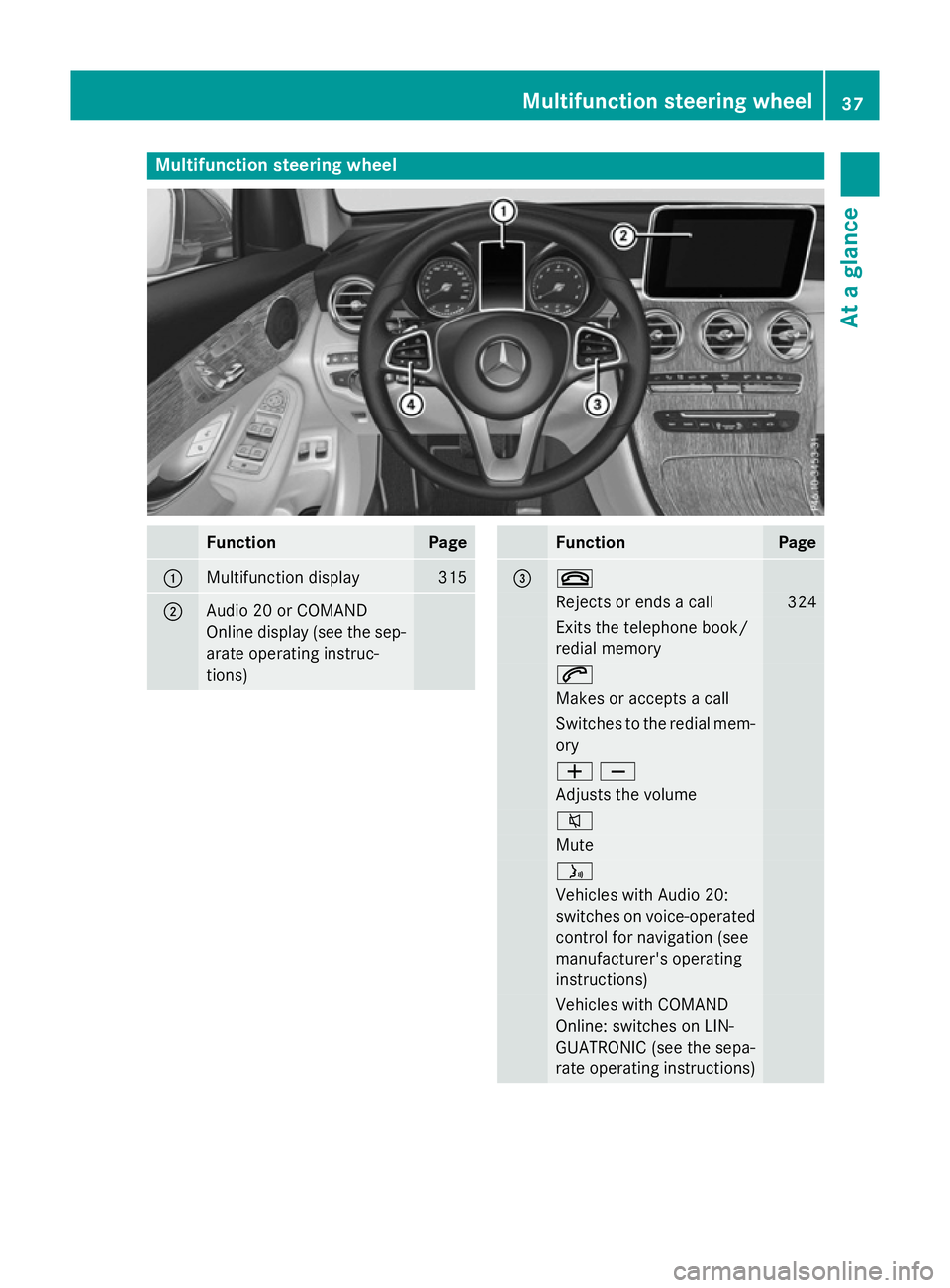
Function Page
:
Multifunction display 315
;
Audio 20 or COMAND
Online display (see the sep-
arate operating instruc-
tions) Function Page
= ~
Rejects or ends a call 324
Exits the telephone book/
redial memory
6
Makes or accepts a call
Switches to the redial mem-
ory WX
Adjusts the volume
8
Mute
ó
Vehicles with Audio 20:
switches on voice-operated
control for navigation (see
manufacturer's operating
instructions) Vehicles with COMAND
Online: switches on LIN-
GUATRONIC (see the sepa-
rate operating instructions)Multifunction steering wheel
37At a glance
Page 41 of 497
Function Page
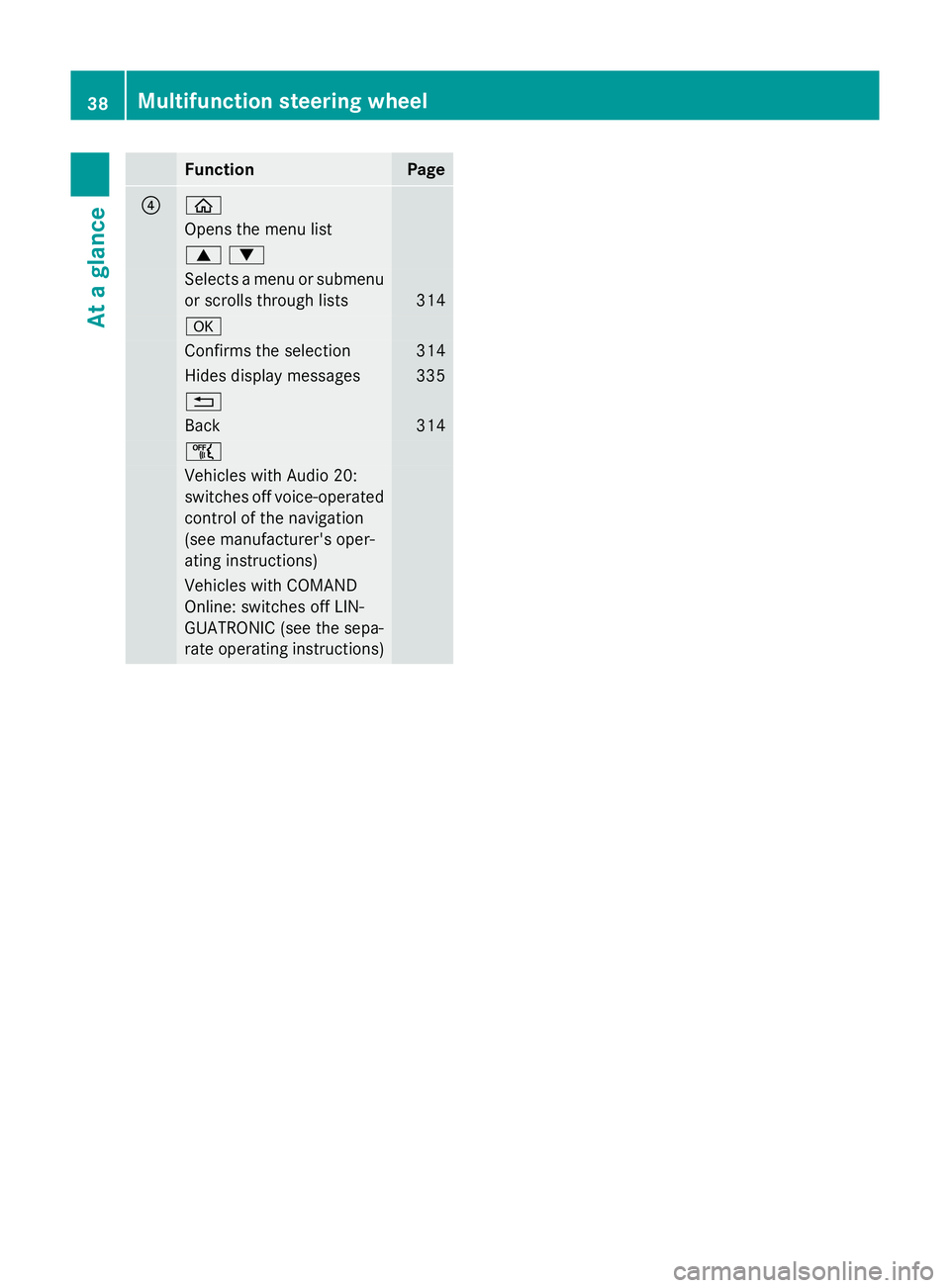
? ò
Opens the menu list
9:
Selects a menu or submenu
or scrolls through lists 314
a
Confirms the selection 314
Hides display messages 335
%
Back 314
ñ
Vehicles with Audio 20:
switches off voice-operated
control of the navigation
(see manufacturer's oper-
ating instructions) Vehicles with COMAND
Online: switches off LIN-
GUATRONIC (see the sepa-
rate operating instructions)38
Multifunction steering wheelAt a glance
Page 51 of 497
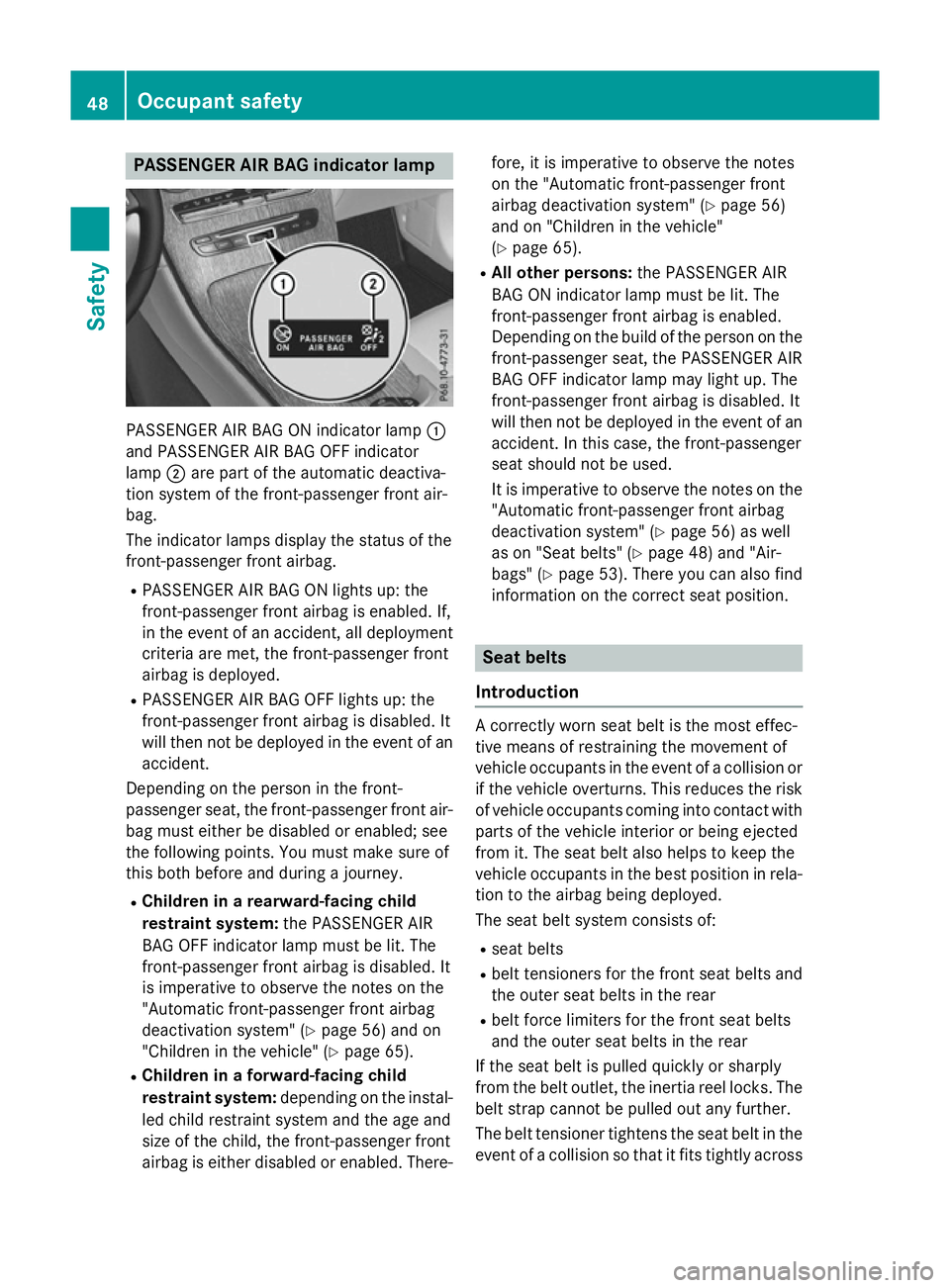
PASSENGER AIR BAG indicator lamp
PASSENGER AIR BAG ON indicator lamp
:
and PASSENGER AIR BAG OFF indicator
lamp ;are part of the automatic deactiva-
tion system of the front-passenger front air-
bag.
The indicator lamps display the status of the
front-passenger front airbag.
R PASSENGER AIR BAG ON lights up: the
front-passenger front airbag is enabled. If,
in the event of an accident, all deployment
criteria are met, the front-passenger front
airbag is deployed.
R PASSENGER AIR BAG OFF lights up: the
front-passenger front airbag is disabled. It
will then not be deployed in the event of an
accident.
Depending on the person in the front-
passenger seat, the front-passenger front air-
bag must either be disabled or enabled; see
the following points. You must make sure of
this both before and during a journey.
R Children in a rearward-facing child
restraint system: the PASSENGER AIR
BAG OFF indicator lamp must be lit. The
front-passenger front airbag is disabled. It
is imperative to observe the notes on the
"Automatic front-passenger front airbag
deactivation system" (Y page 56) and on
"Children in the vehicle" (Y page 65).
R Children in a forward-facing child
restraint system: depending on the instal-
led child restraint system and the age and
size of the child, the front-passenger front
airbag is either disabled or enabled. There- fore, it is imperative to observe the notes
on the "Automatic front-passenger front
airbag deactivation system" (Y
page 56)
and on "Children in the vehicle"
(Y page 65).
R All other persons: the PASSENGER AIR
BAG ON indicator lamp must be lit. The
front-passenger front airbag is enabled.
Depending on the build of the person on the front-passenger seat, the PASSENGER AIR
BAG OFF indicator lamp may light up. The
front-passenger front airbag is disabled. It
will then not be deployed in the event of an
accident. In this case, the front-passenger
seat should not be used.
It is imperative to observe the notes on the "Automatic front-passenger front airbag
deactivation system" (Y page 56) as well
as on "Seat belts" (Y page 48) and "Air-
bags" (Y page 53). There you can also find
information on the correct seat position. Seat belts
Introduction A correctly worn seat belt is the most effec-
tive means of restraining the movement of
vehicle occupants in the event of a collision or
if the vehicle overturns. This reduces the risk of vehicle occupants coming into contact with
parts of the vehicle interior or being ejected
from it. The seat belt also helps to keep the
vehicle occupants in the best position in rela-
tion to the airbag being deployed.
The seat belt system consists of:
R seat belts
R belt tensioners for the front seat belts and
the outer seat belts in the rear
R belt force limiters for the front seat belts
and the outer seat belts in the rear
If the seat belt is pulled quickly or sharply
from the belt outlet, the inertia reel locks. The
belt strap cannot be pulled out any further.
The belt tensioner tightens the seat belt in the event of a collision so that it fits tightly across 48
Occupant safetySafety
Page 60 of 497
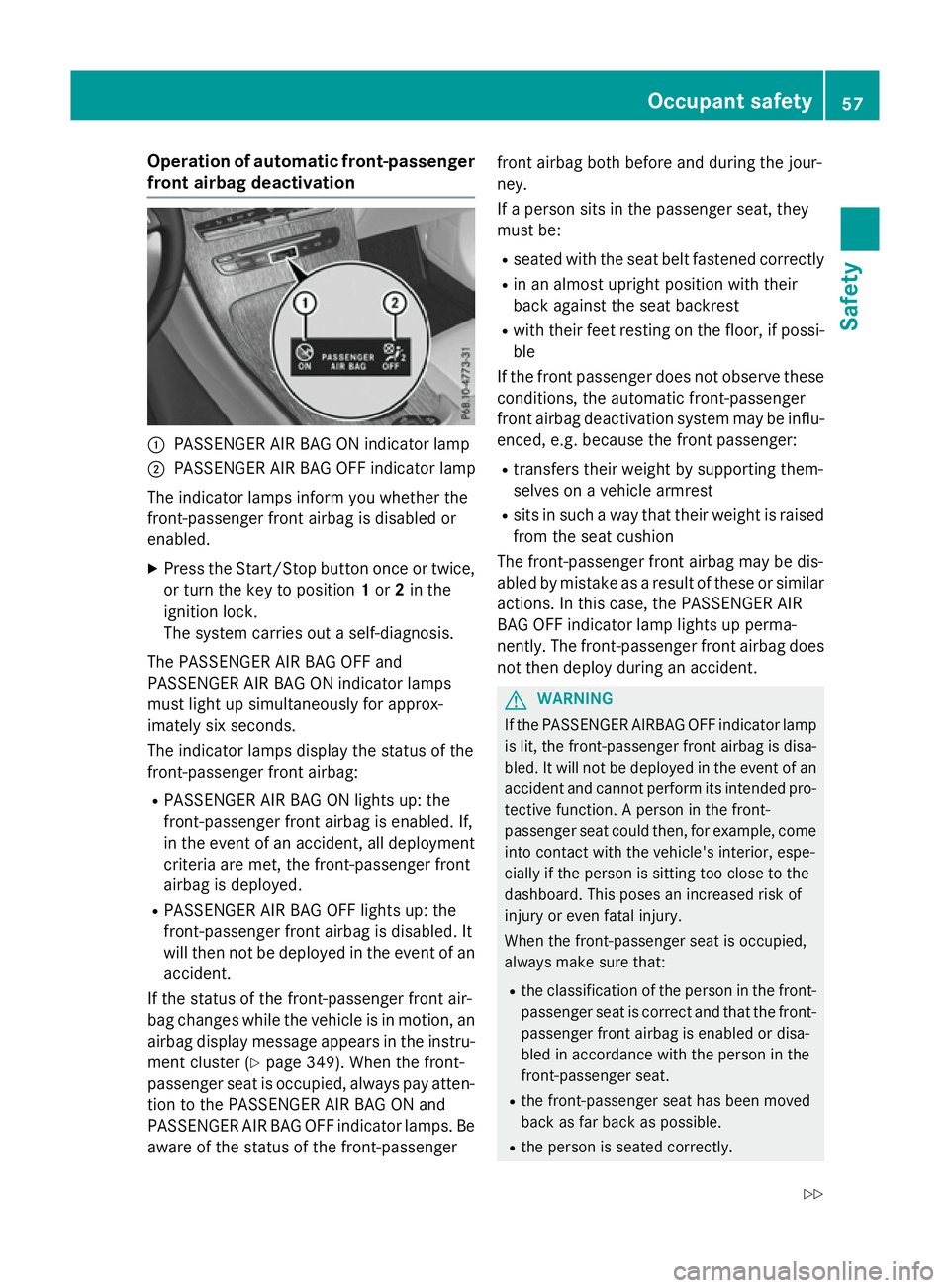
Operation of automatic front-passenger
front airbag deactivation :
PASSENGER AIR BAG ON indicator lamp
; PASSENGER AIR BAG OFF indicator lamp
The indicator lamps inform you whether the
front-passenger front airbag is disabled or
enabled.
X Press the Start/Stop button once or twice,
or turn the key to position 1or 2in the
ignition lock.
The system carries out a self-diagnosis.
The PASSENGER AIR BAG OFF and
PASSENGER AIR BAG ON indicator lamps
must light up simultaneously for approx-
imately six seconds.
The indicator lamps display the status of the
front-passenger front airbag: R PASSENGER AIR BAG ON lights up: the
front-passenger front airbag is enabled. If,
in the event of an accident, all deployment
criteria are met, the front-passenger front
airbag is deployed.
R PASSENGER AIR BAG OFF lights up: the
front-passenger front airbag is disabled. It
will then not be deployed in the event of an
accident.
If the status of the front-passenger front air-
bag changes while the vehicle is in motion, an
airbag display message appears in the instru-
ment cluster (Y page 349). When the front-
passenger seat is occupied, always pay atten-
tion to the PASSENGER AIR BAG ON and
PASSENGER AIR BAG OFF indicator lamps. Be aware of the status of the front-passenger front airbag both before and during the jour-
ney.
If a person sits in the passenger seat, they
must be:
R seated with the seat belt fastened correctly
R in an almost upright position with their
back against the seat backrest
R with their feet resting on the floor, if possi-
ble
If the front passenger does not observe these
conditions, the automatic front-passenger
front airbag deactivation system may be influ-
enced, e.g. because the front passenger:
R transfers their weight by supporting them-
selves on a vehicle armrest
R sits in such a way that their weight is raised
from the seat cushion
The front-passenger front airbag may be dis-
abled by mistake as a result of these or similar actions. In this case, the PASSENGER AIR
BAG OFF indicator lamp lights up perma-
nently. The front-passenger front airbag doesnot then deploy during an accident. G
WARNING
If the PASSENGER AIRBAG OFF indicator lamp is lit, the front-passenger front airbag is disa-
bled. It will not be deployed in the event of an
accident and cannot perform its intended pro-
tective function. A person in the front-
passenger seat could then, for example, come
into contact with the vehicle's interior, espe-
cially if the person is sitting too close to the
dashboard. This poses an increased risk of
injury or even fatal injury.
When the front-passenger seat is occupied,
always make sure that:
R the classification of the person in the front-
passenger seat is correct and that the front-
passenger front airbag is enabled or disa-
bled in accordance with the person in the
front-passenger seat.
R the front-passenger seat has been moved
back as far back as possible.
R the person is seated correctly. Occupant safety
57Safety
Z
Page 71 of 497
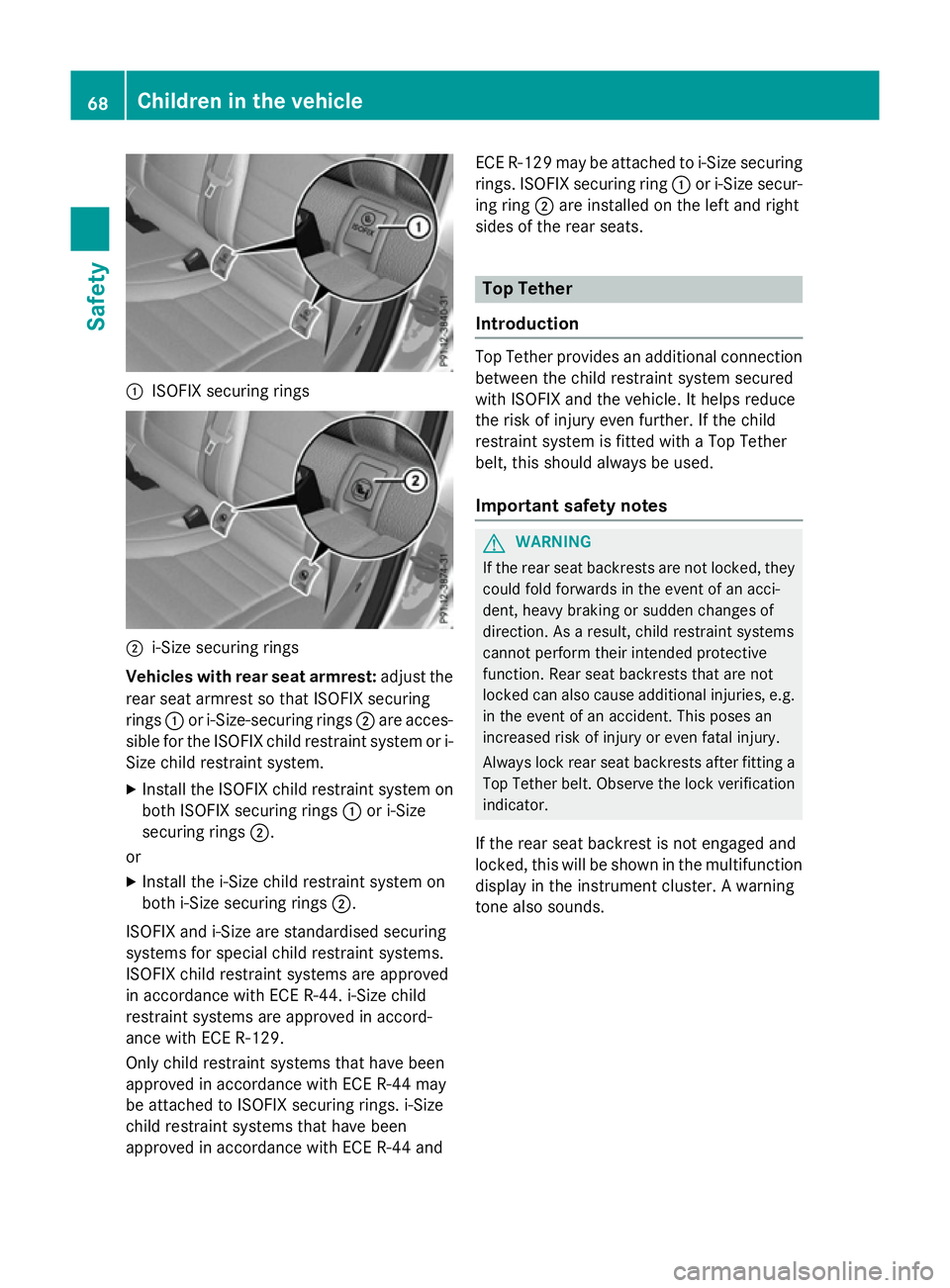
:
ISOFIX securing rings ;
i-Size securing rings
Vehicles with rear seat armrest: adjust the
rear seat armrest so that ISOFIX securing
rings :or i-Size-securing rings ;are acces-
sible for the ISOFIX child restraint system or i-
Size child restraint system.
X Install the ISOFIX child restraint system on
both ISOFIX securing rings :or i-Size
securing rings ;.
or
X Install the i-Size child restraint system on
both i-Size securing rings ;.
ISOFIX and i-Size are standardised securing
systems for special child restraint systems.
ISOFIX child restraint systems are approved
in accordance with ECE R-44. i-Size child
restraint systems are approved in accord-
ance with ECE R-129.
Only child restraint systems that have been
approved in accordance with ECE R-44 may
be attached to ISOFIX securing rings. i-Size
child restraint systems that have been
approved in accordance with ECE R-44 and ECE R-129 may be attached to i-Size securing
rings. ISOFIX securing ring :or i-Size secur-
ing ring ;are installed on the left and right
sides of the rear seats. Top Tether
Introduction Top Tether provides an additional connection
between the child restraint system secured
with ISOFIX and the vehicle. It helps reduce
the risk of injury even further. If the child
restraint system is fitted with a Top Tether
belt, this should always be used.
Important safety notes G
WARNING
If the rear seat backrests are not locked, they
could fold forwards in the event of an acci-
dent, heavy braking or sudden changes of
direction. As a result, child restraint systems
cannot perform their intended protective
function. Rear seat backrests that are not
locked can also cause additional injuries, e.g. in the event of an accident. This poses an
increased risk of injury or even fatal injury.
Always lock rear seat backrests after fitting a Top Tether belt. Observe the lock verificationindicator.
If the rear seat backrest is not engaged and
locked, this will be shown in the multifunction
display in the instrument cluster. A warning
tone also sounds. 68
Children in the vehicleSafety