display MERCEDES-BENZ GLC SUV 2015 Service Manual
[x] Cancel search | Manufacturer: MERCEDES-BENZ, Model Year: 2015, Model line: GLC SUV, Model: MERCEDES-BENZ GLC SUV 2015Pages: 497, PDF Size: 15.27 MB
Page 163 of 497
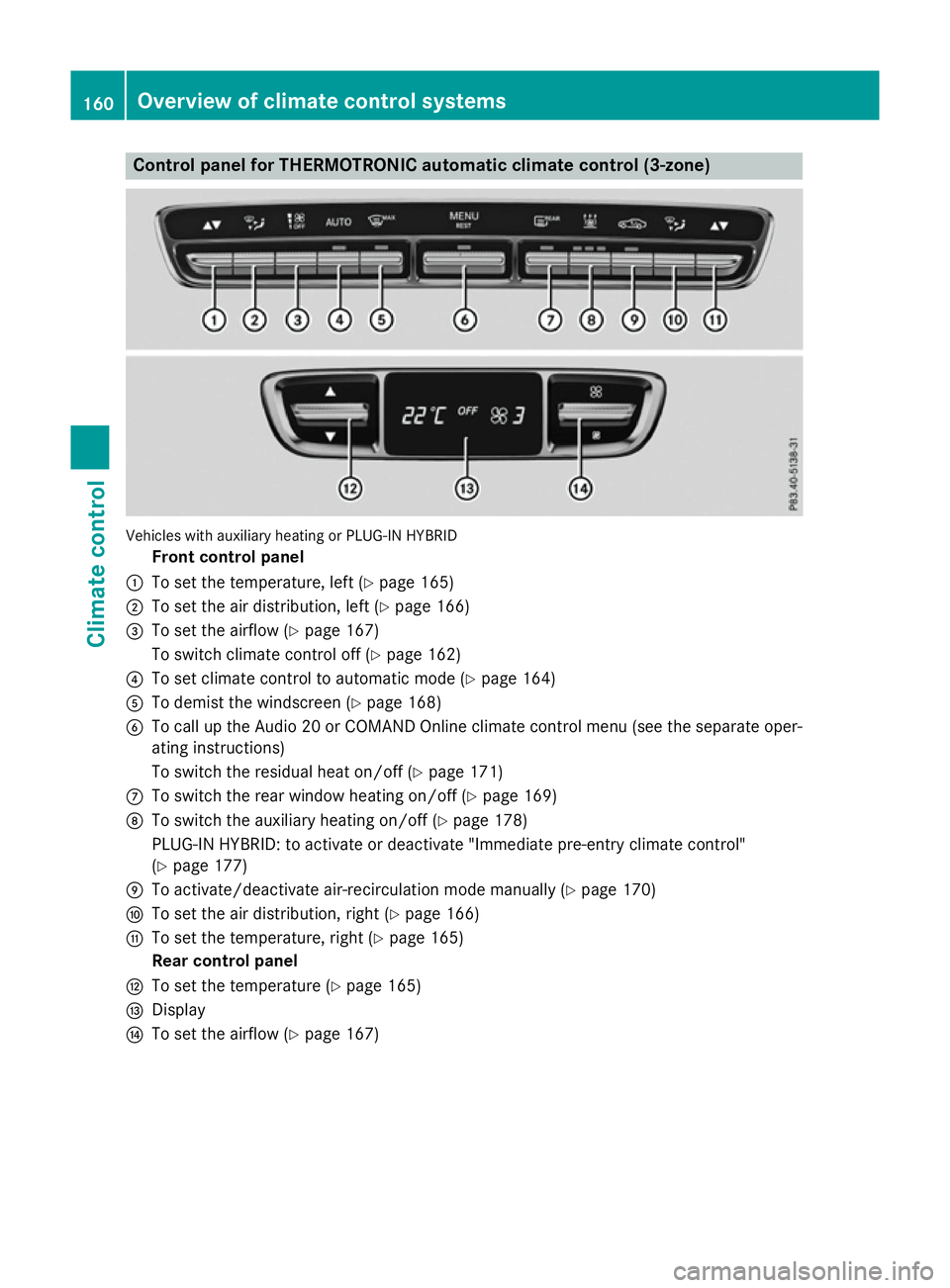
Control panel for THERMOTRONIC automatic climate control (3-zone)
Vehicles with auxiliary heating or PLUG-IN HYBRID
Front control panel
: To set the temperature, left (Y page 165)
; To set the air distribution, left (Y page 166)
= To set the airflow (Y page 167)
To switch climate control off (Y page 162)
? To set climate control to automatic mode (Y page 164)
A To demist the windscreen (Y page 168)
B To call up the Audio 20 or COMAND Online climate control menu (see the separate oper-
ating instructions)
To switch the residual heat on/off (Y page 171)
C To switch the rear window heating on/off (Y page 169)
D To switch the auxiliary heating on/off (Y page 178)
PLUG-IN HYBRID: to activate or deactivate "Immediate pre-entry climate control"
(Y page 177)
E To activate/deactivate air-recirculation mode manually (Y page 170)
F To set the air distribution, right (Y page 166)
G To set the temperature, right (Y page 165)
Rear control panel
H To set the temperature (Y page 165)
I Display
J To set the airflow (Y page 167)160
Overview of climate control systemsClimate control
Page 164 of 497
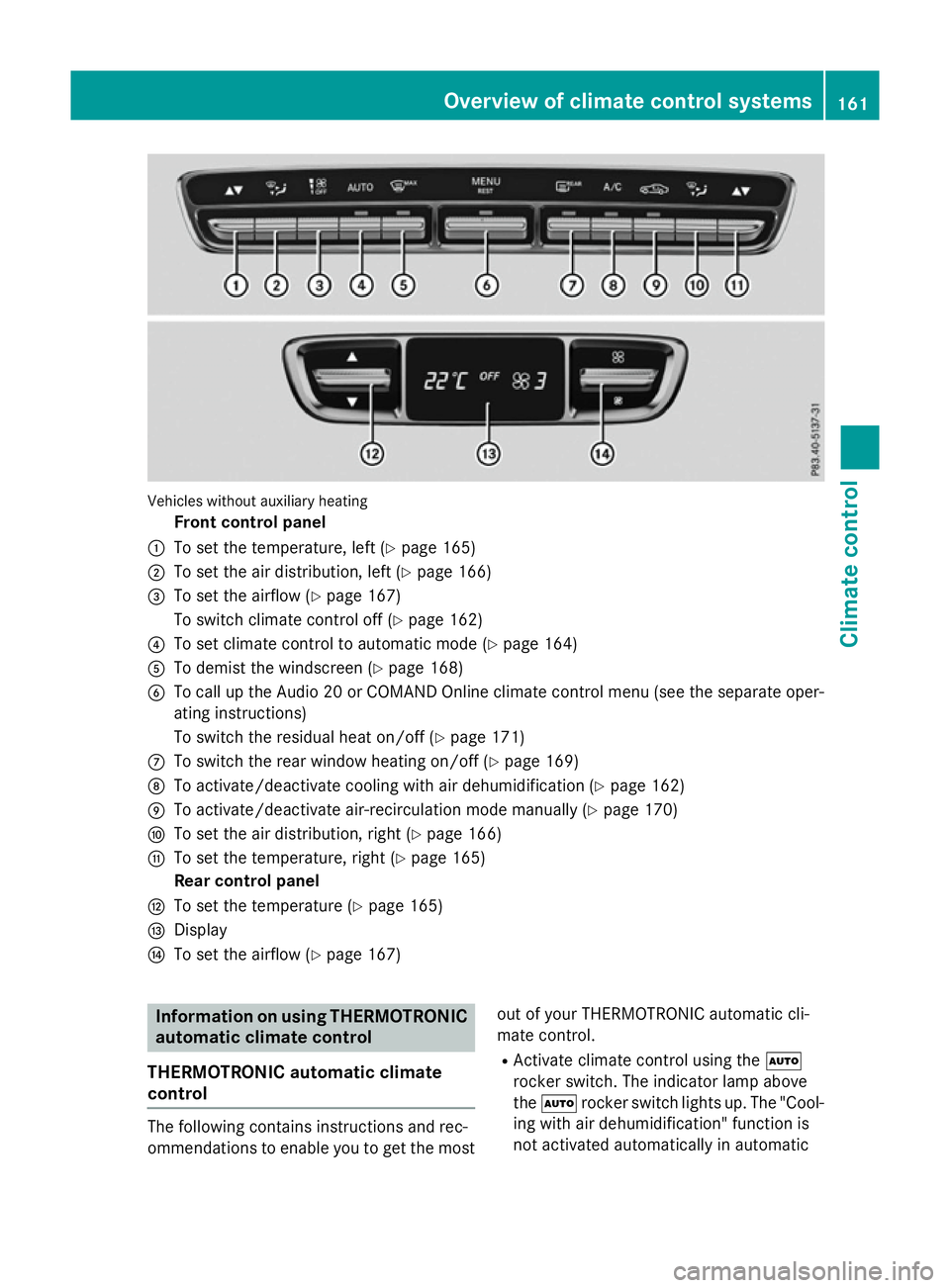
Vehicles without auxiliary heating
Front control panel
: To set the temperature, left (Y page 165)
; To set the air distribution, left (Y page 166)
= To set the airflow (Y page 167)
To switch climate control off (Y page 162)
? To set climate control to automatic mode (Y page 164)
A To demist the windscreen (Y page 168)
B To call up the Audio 20 or COMAND Online climate control menu (see the separate oper-
ating instructions)
To switch the residual heat on/off (Y page 171)
C To switch the rear window heating on/off (Y page 169)
D To activate/deactivate cooling with air dehumidification (Y page 162)
E To activate/deactivate air-recirculation mode manually (Y page 170)
F To set the air distribution, right (Y page 166)
G To set the temperature, right (Y page 165)
Rear control panel
H To set the temperature (Y page 165)
I Display
J To set the airflow (Y page 167) Information on using THERMOTRONIC
automatic climate control
THERMOTRONIC automatic climate
control The following contains instructions and rec-
ommendations to enable you to get the most
out of your THERMOTRONIC automatic cli-
mate control.
R Activate climate control using the Ã
rocker switch. The indicator lamp above
the à rocker switch lights up. The "Cool-
ing with air dehumidification" function is
not activated automatically in automatic Overview of climate control systems
161Climate control
Page 169 of 497
You can select different temperature settings
for the driver's and front-passenger sides as
well as for the rear compartment.
Setting the temperature in the front com-
partment using the front control panel
X Turn the key to position 2in the ignition
lock (Y page 187).
X To increase or reduce: press thew
rocker switch up or down.
or X Set the temperature using Audio 20 or
COMAND Online (see the separate operat- ing instructions).
Only change the temperature setting in
small increments. Start at 22 †.
Setting the temperature in the rear com-
partment using the front control panel
X Turn the key to position 2in the ignition
lock (Y page 187).
X Press the upper or lower section of
the ! rocker switch.
The climate control menu in Audio 20 or
COMAND Online opens.
X Select the "Synchronisation" function (see
separate operating instructions).
The temperature setting for the driver's
side is adopted for the front-passenger side
and the rear compartment.
X Set the temperature with the wrocker
switch on the front control panel.
or X Set the temperature using Audio 20 or
COMAND Online (see the separate operat- ing instructions).
Only change the temperature setting in
small increments. Start at 22 †.
Setting the temperature in the rear com-
partment using the rear control panel
X Turn the key to position 2in the ignition
lock (Y page 187).
X To increase or reduce: press the upper or
lower section of the wrocker switch on
the rear control panel (Y page 160).Only change the temperature setting in
small increments. Start at 22 †.
The set temperature appears on the rear-
compartment display. Setting the air distribution
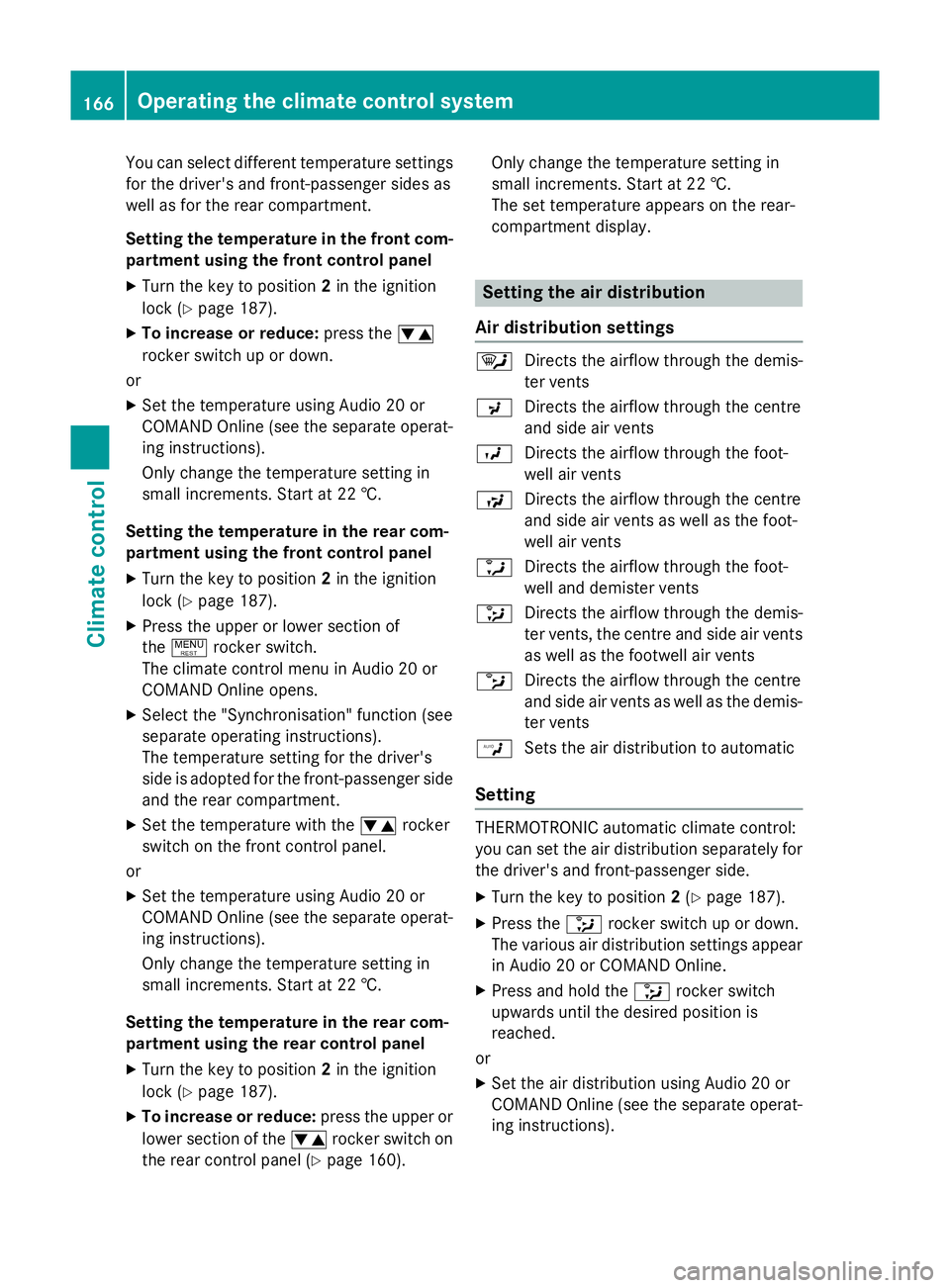
Air distribution settings ¯
Directs the airflow through the demis-
ter vents
P Directs the airflow through the centre
and side air vents
O Directs the airflow through the foot-
well air vents
S Directs the airflow through the centre
and side air vents as well as the foot-
well air vents
a Directs the airflow through the foot-
well and demister vents
_ Directs the airflow through the demis-
ter vents, the centre and side air vents as well as the footwell air vents
b Directs the airflow through the centre
and side air vents as well as the demis-
ter vents
W Sets the air distribution to automatic
Setting THERMOTRONIC automatic climate control:
you can set the air distribution separately for
the driver's and front-passenger side.
X Turn the key to position 2(Y page 187).
X Press the _rocker switch up or down.
The various air distribution settings appear in Audio 20 or COMAND Online.
X Press and hold the _rocker switch
upwards until the desired position is
reached.
or
X Set the air distribution using Audio 20 or
COMAND Online (see the separate operat- ing instructions). 166
Operating the climate control systemClimate control
Page 170 of 497
Setting the airflow
THERMATIC automatic climate control X
Turn the key to position 2in the ignition
lock (Y page 187).
X To increase or reduce: press theH
rocker switch up or down.
or
X Set the airflow using Audio 20 or COMAND
Online (see the separate operating instruc-
tions).
THERMOTRONIC automatic climate
control Setting the front-compartment airflow
You can set the airflow separately for the
front and rear compartment.
X Turn the key to position 2in the ignition
lock (Y page 187).
X To increase or reduce: press theH
rocker switch up or down.
or
X Set the airflow using Audio 20 or COMAND
Online (see the separate operating instruc-
tions).
Setting the rear-compartment airflow X Turn the key to position 2in the ignition
lock (Y page 187).
X Press the upper or lower section of
the ! rocker switch.
The Audio 20 or COMAND Online climate
control menu opens.
X Select the "Synchronisation" function in
the climate control menu (see separate
operating instructions).
The airflow setting for the front area is
adopted for the rear compartment. Setting the rear compartment airflow
using the rear control panel
X Turn the key to position 2in the ignition
lock (Y page 187).
X To increase or reduce: press the upper or
lower section of the KorI rocker
switch on the rear control panel.
The selected airflow level appears in the
rear display. Activating/deactivating the synchro-
nisation function
General notes Climate control can be set centrally using the
synchronisation function. The temperature
setting is adopted for the front-passenger
side. For THERMOTRONIC automatic climatecontrol, the temperature setting is adopted
for the front-passenger side and rear com-
partment.
Activating/deactivating THERMATIC automatic climate control (2-
zone) without auxiliary heating
X Press the 0rocker switch up or down.
The indicator lamp above the 0rocker
switch lights up or goes out.
or X Activate or deactivate the synchronisation
function using Audio 20 or COMAND Online
(see the separate operating instructions).
The synchronisation function is deactivated if the settings for the front-passenger side are
changed.
THERMATIC automatic climate control (2-
zone) with auxiliary heating
X Activate or deactivate the synchronisation
function using Audio 20 or COMAND Online
(see the separate operating instructions).
The synchronisation function is deactivated if
the settings for the front-passenger side are
changed. Operating the climate control system
167Climate control
Page 183 of 497
Switching the auxiliary heating/venti-
lation on or off using the remote control
General notes
Your vehicle comes with one remote control.
You may use two additional remote controls
for your vehicle. For more information, pleasecontact a qualified specialist workshop.
Store the remote control for the auxiliary
heating so that the auxiliary heating cannot
be switched on unintentionally. In particular,
ensure that the remote control for the auxili-
ary heating is kept out of the reach of chil-
dren.
The remote control has a range of approx-
imately 300 metres. This range is reduced by:
R sources of radio interference
R solid objects between the remote control
and the vehicle
R the remote control being in an unfavoura-
ble position in relation to the vehicle
R transmitting from an enclosed space
If the remote control battery is low, the bat-
tery symbol on the left of the display is shown as empty. Replace the remote control battery and observe the important safety notes when
doing so (Y page 181).
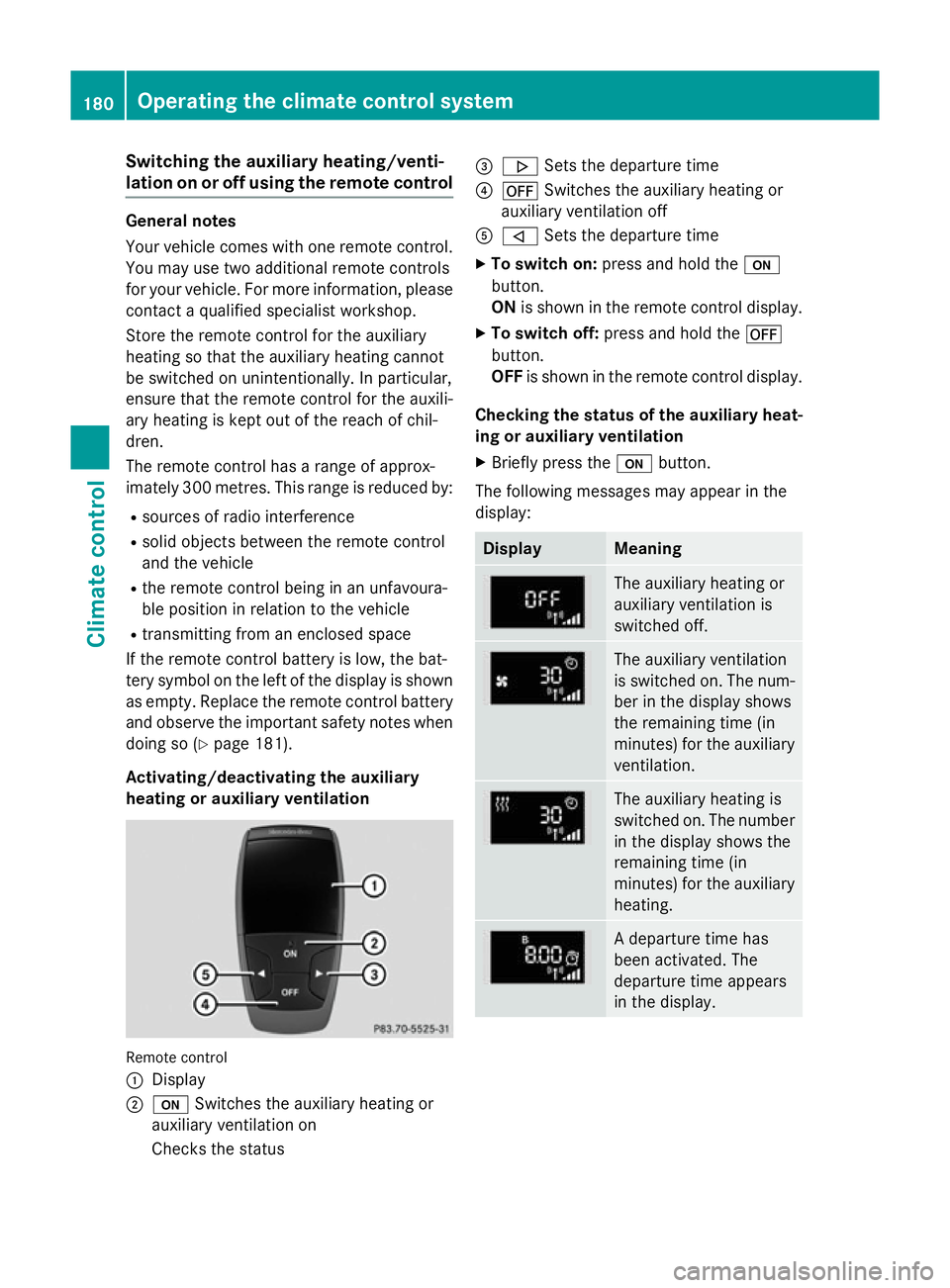
Activating/deactivating the auxiliary
heating or auxiliary ventilation Remote control
:
Display
; u Switches the auxiliary heating or
auxiliary ventilation on
Checks the status =
. Sets the departure time
? ^ Switches the auxiliary heating or
auxiliary ventilation off
A , Sets the departure time
X To switch on: press and hold the u
button.
ON is shown in the remote control display.
X To switch off: press and hold the ^
button.
OFF is shown in the remote control display.
Checking the status of the auxiliary heat- ing or auxiliary ventilation
X Briefly press the ubutton.
The following messages may appear in the
display: Display Meaning
The auxiliary heating or
auxiliary ventilation is
switched off.
The auxiliary ventilation
is switched on. The num-
ber in the display shows
the remaining time (in
minutes) for the auxiliary
ventilation. The auxiliary heating is
switched on. The number
in the display shows the
remaining time (in
minutes) for the auxiliary heating. A departure time has
been activated. The
departure time appears
in the display.180
Operating the climate control systemClimate control
Page 184 of 497
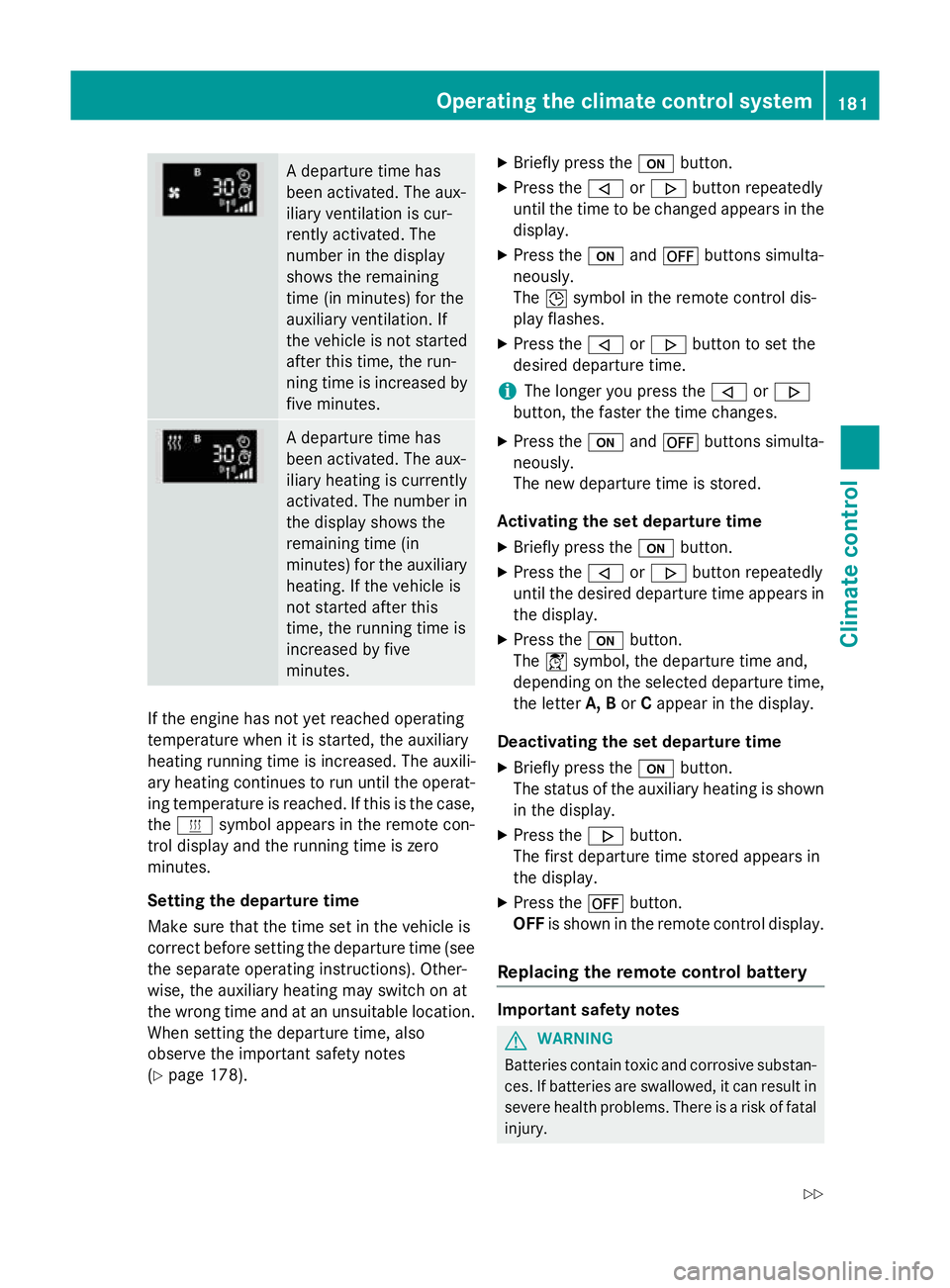
A departure time has
been activated. The aux-
iliary ventilation is cur-
rently activated. The
number in the display
shows the remaining
time (in minutes) for the
auxiliary ventilation. If
the vehicle is not started
after this time, the run-
ning time is increased by
five minutes. A departure time has
been activated. The aux-
iliary heating is currently
activated. The number in
the display shows the
remaining time (in
minutes) for the auxiliary heating. If the vehicle is
not started after this
time, the running time is
increased by five
minutes. If the engine has not yet reached operating
temperature when it is started, the auxiliary
heating running time is increased. The auxili-
ary heating continues to run until the operat- ing temperature is reached. If this is the case,
the y symbol appears in the remote con-
trol display and the running time is zero
minutes.
Setting the departure time
Make sure that the time set in the vehicle is
correct before setting the departure time (see the separate operating instructions). Other-
wise, the auxiliary heating may switch on at
the wrong time and at an unsuitable location.
When setting the departure time, also
observe the important safety notes
(Y page 178). X
Briefly press the ubutton.
X Press the ,or. button repeatedly
until the time to be changed appears in the display.
X Press the uand^ buttons simulta-
neously.
The Îsymbol in the remote control dis-
play flashes.
X Press the ,or. button to set the
desired departure time.
i The longer you press the
,or.
button, the faster the time changes.
X Press the uand^ buttons simulta-
neously.
The new departure time is stored.
Activating the set departure time X Briefly press the ubutton.
X Press the ,or. button repeatedly
until the desired departure time appears in the display.
X Press the ubutton.
The Ísymbol, the departure time and,
depending on the selected departure time, the letter A, BorCappear in the display.
Deactivating the set departure time
X Briefly press the ubutton.
The status of the auxiliary heating is shown in the display.
X Press the .button.
The first departure time stored appears in
the display.
X Press the ^button.
OFF is shown in the remote control display.
Replacing the remote control battery Important safety notes
G
WARNING
Batteries contain toxic and corrosive substan- ces. If batteries are swallowed, it can result in
severe health problems. There is a risk of fatal injury. Operating the climate control system
181Climate control
Z
Page 185 of 497
Keep batteries out of the reach of children. If
a battery is swallowed, seek medical attention
immediately. H
Environmental note Batteries contain pollutants.
It is illegal to dispose of them with the household rubbish.
They must be collected sep-
arately and disposed of in anenvironmentally responsible
recycling system. Dispose of batteries in an
environmentally responsible
manner. Take discharged
batteries to a qualified spe-
cialist workshop or to a col-
lection point for used batter-
ies.
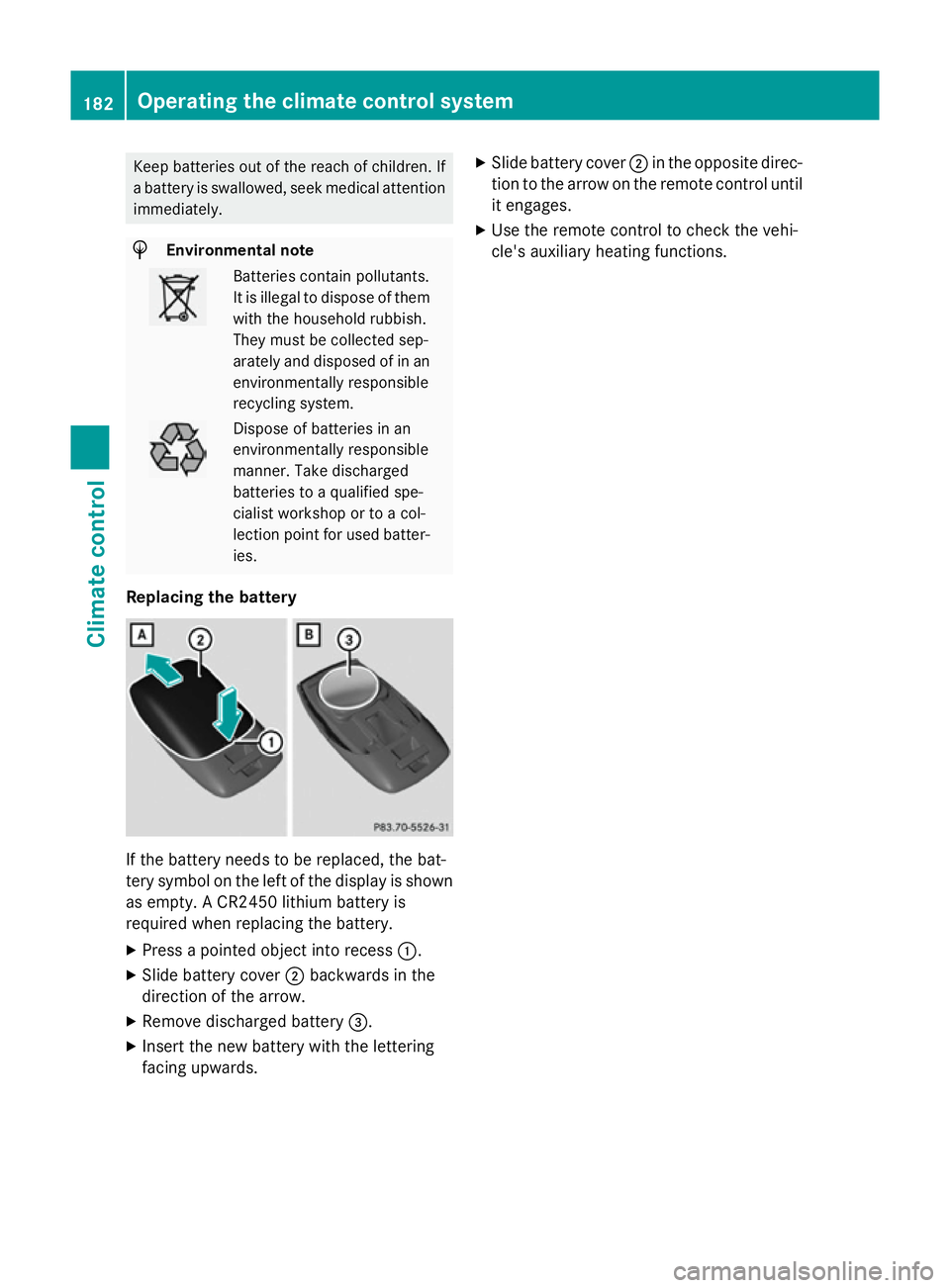
Replacing the battery If the battery needs to be replaced, the bat-
tery symbol on the left of the display is shown as empty. A CR2450 lithium battery is
required when replacing the battery.
X Press a pointed object into recess :.
X Slide battery cover ;backwards in the
direction of the arrow.
X Remove discharged battery =.
X Insert the new battery with the lettering
facing upwards. X
Slide battery cover ;in the opposite direc-
tion to the arrow on the remote control until
it engages.
X Use the remote control to check the vehi-
cle's auxiliary heating functions. 182
Operating the climate control systemClimate control
Page 192 of 497
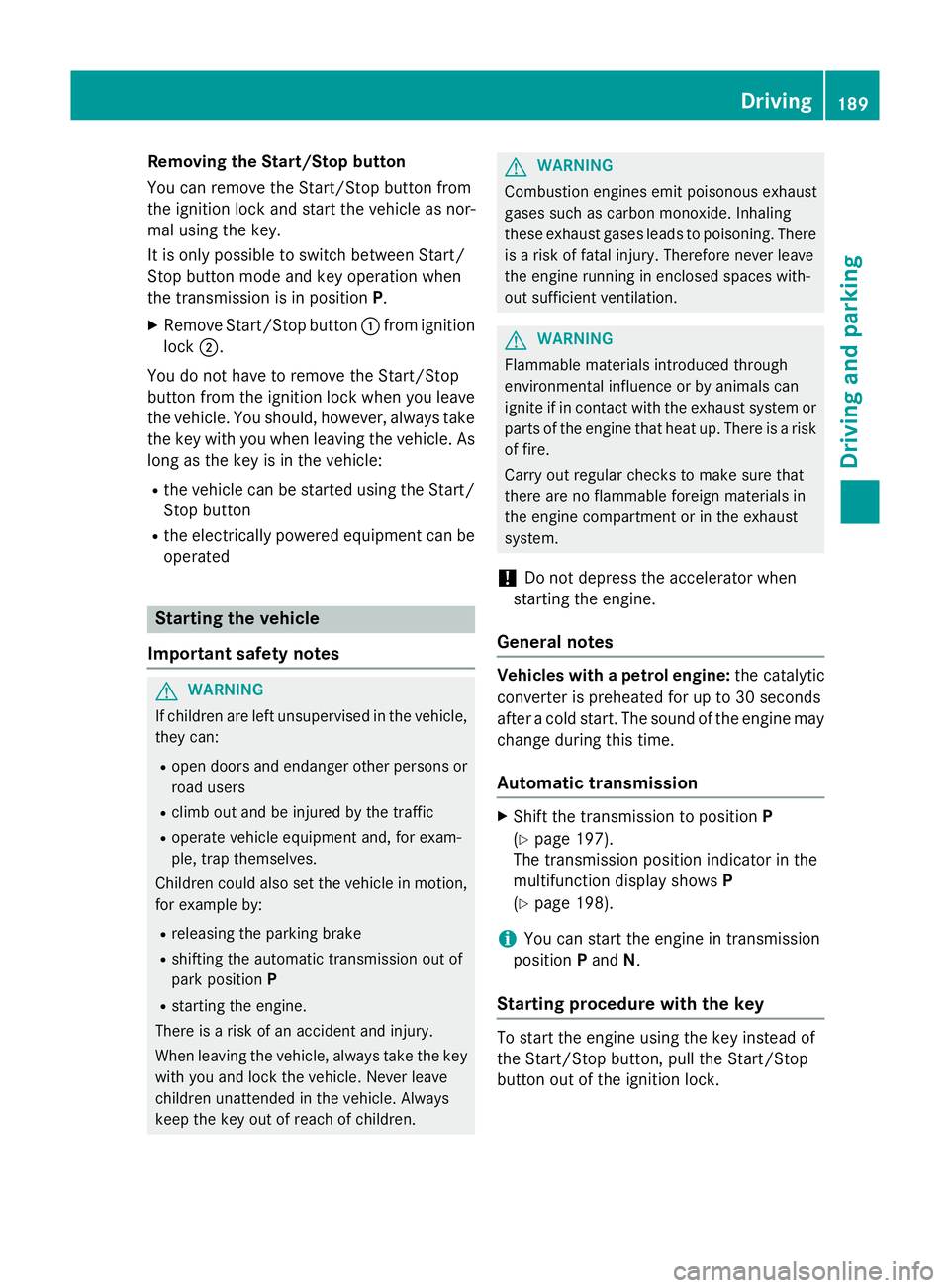
Removing the Start/Stop button
You can remove the Start/Stop button from
the ignition lock and start the vehicle as nor-
mal using the key.
It is only possible to switch between Start/
Stop button mode and key operation when
the transmission is in position P.
X Remove Start/Stop button :from ignition
lock ;.
You do not have to remove the Start/Stop
button from the ignition lock when you leave
the vehicle. You should, however, always take the key with you when leaving the vehicle. As
long as the key is in the vehicle:
R the vehicle can be started using the Start/
Stop button
R the electrically powered equipment can be
operated Starting the vehicle
Important safety notes G
WARNING
If children are left unsupervised in the vehicle, they can:
R open doors and endanger other persons or
road users
R climb out and be injured by the traffic
R operate vehicle equipment and, for exam-
ple, trap themselves.
Children could also set the vehicle in motion, for example by:
R releasing the parking brake
R shifting the automatic transmission out of
park position P
R starting the engine.
There is a risk of an accident and injury.
When leaving the vehicle, always take the key
with you and lock the vehicle. Never leave
children unattended in the vehicle. Always
keep the key out of reach of children. G
WARNING
Combustion engines emit poisonous exhaust
gases such as carbon monoxide. Inhaling
these exhaust gases leads to poisoning. There is a risk of fatal injury. Therefore never leave
the engine running in enclosed spaces with-
out sufficient ventilation. G
WARNING
Flammable materials introduced through
environmental influence or by animals can
ignite if in contact with the exhaust system or parts of the engine that heat up. There is a risk
of fire.
Carry out regular checks to make sure that
there are no flammable foreign materials in
the engine compartment or in the exhaust
system.
! Do not depress the accelerator when
starting the engine.
General notes Vehicles with a petrol engine:
the catalytic
converter is preheated for up to 30 seconds
after a cold start. The sound of the engine may
change during this time.
Automatic transmission X
Shift the transmission to position P
(Y page 197).
The transmission position indicator in the
multifunction display shows P
(Y page 198).
i You can start the engine in transmission
position Pand N.
Starting procedure with the key To start the engine using the key instead of
the Start/Stop button, pull the Start/Stop
button out of the ignition lock. Driving
189Driving and parking Z
Page 195 of 497
General notes
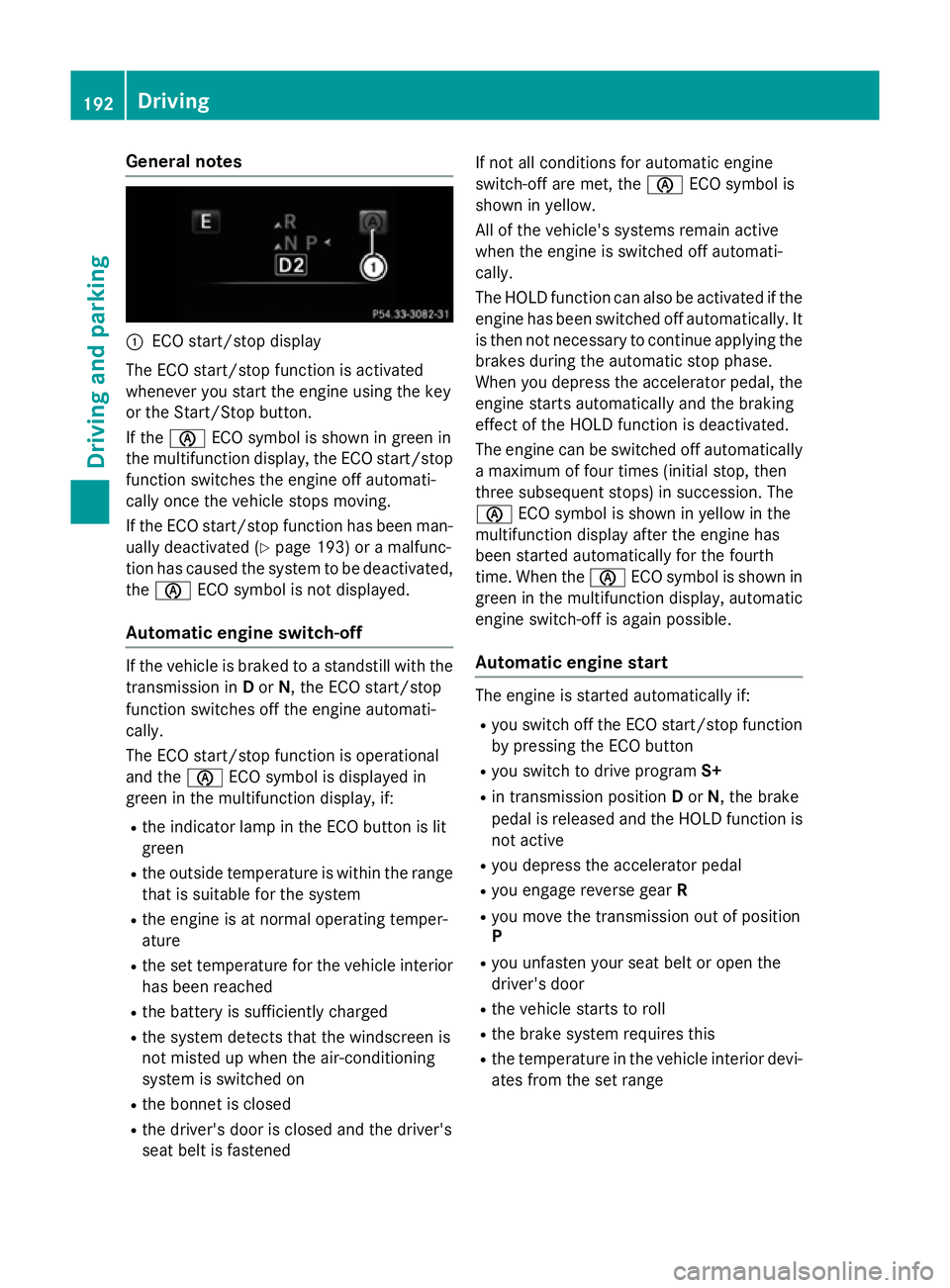
:
ECO start/stop display
The ECO start/stop function is activated
whenever you start the engine using the key
or the Start/Stop button.
If the è ECO symbol is shown in green in
the multifunction display, the ECO start/stop
function switches the engine off automati-
cally once the vehicle stops moving.
If the ECO start/stop function has been man-
ually deactivated (Y page 193) or a malfunc-
tion has caused the system to be deactivated, the è ECO symbol is not displayed.
Automatic engine switch-off If the vehicle is braked to a standstill with the
transmission in Dor N, the ECO start/stop
function switches off the engine automati-
cally.
The ECO start/stop function is operational
and the èECO symbol is displayed in
green in the multifunction display, if:
R the indicator lamp in the ECO button is lit
green
R the outside temperature is within the range
that is suitable for the system
R the engine is at normal operating temper-
ature
R the set temperature for the vehicle interior
has been reached
R the battery is sufficiently charged
R the system detects that the windscreen is
not misted up when the air-conditioning
system is switched on
R the bonnet is closed
R the driver's door is closed and the driver's
seat belt is fastened If not all conditions for automatic engine
switch-off are met, the
èECO symbol is
shown in yellow.
All of the vehicle's systems remain active
when the engine is switched off automati-
cally.
The HOLD function can also be activated if the engine has been switched off automatically. Itis then not necessary to continue applying the
brakes during the automatic stop phase.
When you depress the accelerator pedal, the engine starts automatically and the braking
effect of the HOLD function is deactivated.
The engine can be switched off automatically
a maximum of four times (initial stop, then
three subsequent stops) in succession. The
è ECO symbol is shown in yellow in the
multifunction display after the engine has
been started automatically for the fourth
time. When the èECO symbol is shown in
green in the multifunction display, automatic engine switch-off is again possible.
Automatic engine start The engine is started automatically if:
R
you switch off the ECO start/stop function
by pressing the ECO button
R you switch to drive program S+
R in transmission position Dor N, the brake
pedal is released and the HOLD function is not active
R you depress the accelerator pedal
R you engage reverse gear R
R you move the transmission out of position
P
R you unfasten your seat belt or open the
driver's door
R the vehicle starts to roll
R the brake system requires this
R the temperature in the vehicle interior devi-
ates from the set range 192
DrivingDriving and parking
Page 196 of 497
R
the system detects moisture on the wind-
screen when the air-conditioning system is
switched on
R the battery's charge status is too low
Shifting the transmission to position Pdoes
not start the engine.
If you shift the transmission from Rto D, the
ECO start/stop function is available again
once the èECO symbol reappears in
green in the multifunction display.
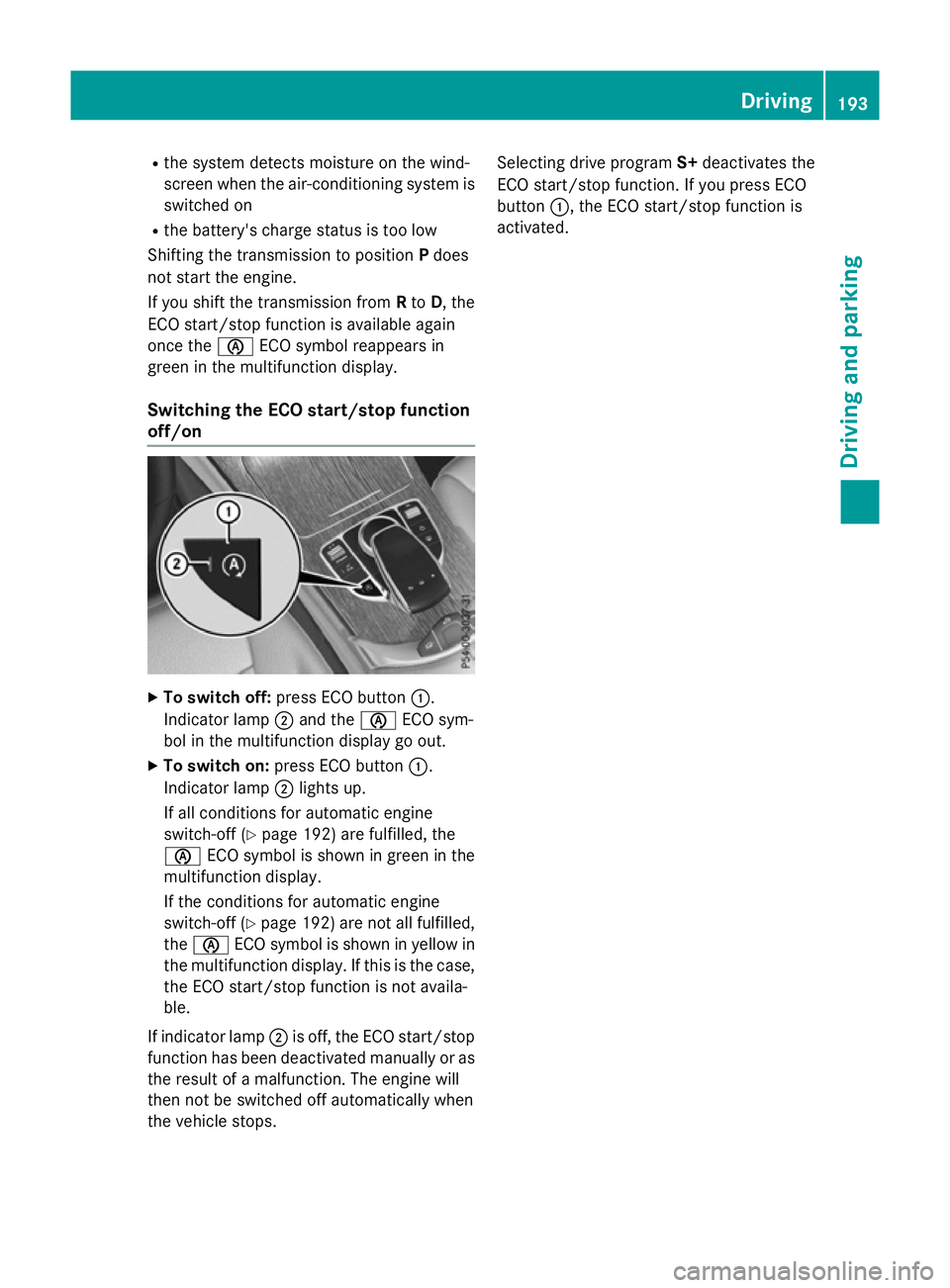
Switching the ECO start/stop function
off/on X
To switch off: press ECO button :.
Indicator lamp ;and the èECO sym-
bol in the multifunction display go out.
X To switch on: press ECO button :.
Indicator lamp ;lights up.
If all conditions for automatic engine
switch-off (Y page 192) are fulfilled, the
è ECO symbol is shown in green in the
multifunction display.
If the conditions for automatic engine
switch-off (Y page 192) are not all fulfilled,
the è ECO symbol is shown in yellow in
the multifunction display. If this is the case,
the ECO start/stop function is not availa-
ble.
If indicator lamp ;is off, the ECO start/stop
function has been deactivated manually or as the result of a malfunction. The engine will
then not be switched off automatically when
the vehicle stops. Selecting drive program
S+deactivates the
ECO start/stop function. If you press ECO
button :, the ECO start/stop function is
activated. Driving
193Driving an d parking Z