climate control MERCEDES-BENZ GLE 2016 Owner's Manual
[x] Cancel search | Manufacturer: MERCEDES-BENZ, Model Year: 2016, Model line: GLE, Model: MERCEDES-BENZ GLE 2016Pages: 450, PDF Size: 12.92 MB
Page 173 of 450
energy and stored in the high-voltage battery.
Information on overrun mode ( Y
page 253).
The high-voltage battery can be charged as fol-
lows: R
through energy recuperation while the vehicle
is in motion R
through the combustion engine while driving
in CHARGE operating mode ( Y
page 246)R
with the relevant charging cable at an electri-
cal outlet while the vehicle is stationary R
at a wallbox while the vehicle is stationary R
at a charging station while the vehicle is sta-
tionary
The high-voltage battery can be charged in a
nominal voltage range from 100 V to 240 V.
You can view the condition of charge of the high-
voltage battery in the multifunction display. You
can find information in "PLUG-IN HYBRID oper-
ation", section "Menus and submenus" under
"Energy flow display" ( Y
page 247).
High and low outside temperatures Low outside temperatures
At very low outside temperatures the maximum
power output of the high-voltage battery may be
reduced. The high-voltage battery is then no
longer able to provide the normal electrical
power output.
High outside temperatures
To prevent damage to the high-voltage battery
due to very high outside temperatures, the max-
imum power output of the high-voltage battery
is reduced by the vehicle.
Energy consumption and electrical
range The maximum electrical range is generally
reduced by: R
high and low outside temperatures R
operating the climate control system R
switching on consumers
The battery's physical characteristics are such
that leaving the vehicle parked for long periods
at low outdoor temperatures without charging it
can lead to: R
a reduction in battery performance R
longer charge times Notes on battery care Avoid storing or transporting the vehicle at
excessively high or low temperatures over a long
period.
If you park the vehicle and leave it stationary for
long periods: R
check the condition of charge of the high-
voltage battery more often R
connect the vehicle to a power supply
This prevents self-discharge and damage to the
high-voltage battery.
Terms of use Please note the information on exceptions and
limitations in warranty documentation and in
the Maintenance Booklet.
Handling the charging cable and charg-
ing cable controls Do not leave the charging cable controls
( Y
page 172) hanging loose from an electrical
outlet. Otherwise, this could result in a poor
contact with the electrical outlet and malfunc-
tions when charging the vehicle.
To ensure that the brackets within the charging
cable controls are not subjected to incorrect
loads, observe the following: R
Never lift or carry the controls by the charging
cable connector or the mains plug. R
To transport the charging cable, the charging
cable can be: -
wrapped around the controls or -
secured to the housing of the controls
Heat generated by the charging cable
and charging cable connector Pay attention to the "Important safety notes"
( Y
page 169).
During the charging process, the charging cable
and charging cable connector may heat up.
The charging cable and the charging cable con-
nector will only heat up within the permissible
limiting values, provided that: R
the power supply and the charging cable are
not damaged R
the instructions for handling the charging
cable and controls on the charging cable are
observedCharging the high-voltage battery 171
Driving and parking Z
Page 180 of 450
Every person who has access to the informa-
tion stated can use the functions of the online
access to the vehicle.
i Information when selling a vehicle or
buying a used vehicle: R
If you sell your vehicle, you are obliged to
delete the vehicle from your personal area
on the online access to the vehicle. R
If you have bought a used vehicle, it is pos-
sible that the previous owner still has
access to the online access to the vehicle.
Calling up functions The online access to the vehicle allows you
access to your vehicle's information and func-
tions using remote query and remote configu-
ration.
The following functions can be accessed: R
request the current condition of charge of the
high-voltage battery R
program the departure time ( Y
page 274)R
set or activate the "Pre-entry climate control
at departure time" function (see the separate
COMAND operating instructions)
Information on additional functions and operat-
ing instructions can be found within the online
access to the vehicle.
Connecting the vehicle to the Internet
i This function is not available in all countries
and requires activated access to the mbrace
emergency call system.
You can use the online access to the vehicle if
the vehicle has a connection to the Internet via a
mobile phone network. The necessary data is
transmitted by radio. The vehicle automatically
recognizes whether a connection to the Internet
is possible or not. No presets are necessary.
i Restrictions in reception are possible if the
vehicle is in an underground car park, for
example. Restrictions may also occur in areas
with poor mobile network coverage. Parking
Important safety notes
G WARNING
Flammable material such as leaves, grass or
twigs may ignite if they come into contact with
hot parts of the exhaust system or exhaust
gas flow. There is a risk of fire.
Park the vehicle so that no flammable mate-
rials come into contact with parts of the vehi-
cle which are hot. Take particular care not to
park on dry grassland or harvested grain
fields.
G WARNING
If you leave children unsupervised in the vehi-
cle, they could set it in motion by, for example: R
release the parking brake. R
shift the automatic transmission out of the
parking position P .R
start the engine.
In addition, they may operate vehicle equip-
ment and become trapped. There is a risk of
an accident and injury.
When leaving the vehicle, always take the
SmartKey with you and lock the vehicle. Never
leave children unsupervised in the vehicle.
! Always secure the vehicle correctly against
rolling away. Otherwise, the vehicle or its driv-
etrain could be damaged.
To ensure that the vehicle is secured against
rolling away unintentionally: R
the electric parking brake must be applied. R
the transmission must be in position P and the
SmartKey must be removed from the ignition
lock. R
the front wheels must be turned towards the
curb on steep uphill or downhill gradients. R
the empty vehicle must be secured at the
front axle with a wheel chock or similar, for
example, on uphill or downhill gradients. R
a laden vehicle must also be secured at the
rear axle with a wheel chock or s imilar, for
e xample, on uphill or downhill gradients.178
Parking
Driving an d parking
Page 254 of 450
Activating when driving with the electric motor: X
Pull the left or right steering wheel paddle
shifter ( Y
page 159).
The combustion engine is switched on. Man-
ual gearshifting is activated temporarily. The
selected gear and M appear in the multifunc-
tion display.
Activating when driving with the combustion
engine: X
Pull the left or right steering wheel paddle
shifter ( Y
page 159).
Manual gearshifting is activated temporarily.
The selected gear and M appear in the multi-
function display.
The ECO start/stop function is not available
when manually changing gear.
For further information on the manual drive pro-
gram ( Y
page 159).
Driving tips
General driving tips Drive carefully and maintain a safe distance
from the vehicle in front. Avoid frequent and
sudden acceleration as well as abrupt braking.
During partial electric driving, pulling away and
acceleration, the electric motor supports the
internal combustion engine.
During overrun in transmission position D and
braking, the electric motor will operate as a gen-
erator.
Further information on the ECO start/stop func-
tion ( Y
page 253).
Additional driving tips ( Y
page 181).
Stationary vehicle
If the vehicle is stopped, the combustion engine
is, for the most part, switched off. Automatic
climate control continues to function. The elec-
tromechanically assisted steering gear allows
you to use the power steering without reduced
comfort.
Acceleration
Depending on the operating mode, pulling away
and driving under low load conditions are per-
formed: R
entirely by electric propulsion R
in combination with the internal combustion
engine When accelerating rapidly under increased or
full load, increased boost mode is utilized. The
electric motor supports the combustion engine
by providing additional drive torque.
Overrun mode or braking There are three possible operating modes when
the hybrid vehicle is decelerating: R
energy recovery takes place even when the
vehicle is decelerating purely in overrun mode
( Y
page 242). The electric motor operates as
a generator and stores the recovered energy
in the high-voltage battery. R
when the brakes are applied lightly, the vehi-
cle is slowed down further by the electric
motor. This increases the energy recovery
taking place ( Y
page 242). The electric motor
operates as a generator and stores the recov-
ered energy in the high-voltage battery. R
when the brakes are applied with greater
force, the service brakes are also used to slow
the vehicle down. The two systems work
together.
Urban driving In city traffic, energy is recuperated during fre-
quent deceleration phases.
The vehicle can be driven by the electric motor
alone up to a speed of approximately 80 mph
(130 km/h).
The vehicle is driven by the electric motor alone
only when all conditions for the automatic
engine switch-off are fulfilled.
Further information on the automatic engine
switch-off ( Y
page 253).
Driving on inter-urban roads
The following phases are possible when driving
on inter-urban roads: R
rapid acceleration (boost mode) R
energy recuperation R
electric operation mode
The vehicle can be driven by the electric motor
alone up to a speed of approximately 74 mph
(120 km/h).
A great deal of recovered energy may be avail-
able, depending on the route profile. This
reduces consumption and emissions.252
PLUG-IN HYBRID operation
Driving an d parking
Page 255 of 450
Highway driving When driving on a highway, switching off the
combustion engine has a particularly positive
effect on fuel consumption and emissions.
If the driver removes his/her foot from the
accelerator pedal in the Comfort drive program
and a speed of 80 mph (130 km/h) is not excee-
ded, the combustion engine is automatically
switched off.
Further information on the automatic engine
switch-off ( Y
page 253).
ECO start/stop function General notes The ECO start/stop function switches the com-
bustion engine off automatically when the vehi-
cle stops moving and at speeds below 80 mph
(130 km/h) ( Y
page 253).
All vehicle systems remain active, e.g. the auto-
matic climate control.
The ECO start/stop function is neither available
in the Sport drive program nor during manual
shifting.
Automatic engine switch-off The engine is switched off automatically, includ-
ing when: R
the driver removes his/her foot from the
accelerator in the Comfort drive program and
a speed of 80 mph (130 km/h) is not excee-
ded ( Y
page 253)R
the engine has reached its operating temper-
ature R
the driver’s seat belt is fastened and the
driver’s door is closed R
the driver only slightly depresses the accel-
erator pedal in order to, for example, maintain
the current speed for a limited distance R
the hood is closed and engaged properly R
the high-voltage battery is charged suffi-
ciently R
no malfunctions are present in the hybrid
drive system
The internal combustion engine will not be
switched off automatically, if: R
the self-diagnosis function of the engine man-
agement is active R
there is a malfunction in the hybrid drive sys-
tem R
the climate control of the vehicle requires it R
the high-voltage battery is being charged
( Y
page 248)
Automatic engine start The automatically switched-off internal combus-
tion engine starts automatically in certain situa-
tions, if: R
the power demand from the driver via the
accelerator pedal is greater than the electric
motor alone can provide R
the driver switches to the Sport drive pro-
gram or to manual gearshifting R
the condition of charge of the high-voltage
battery has reached the lower limit R
the driver has selected the CHARGE operating
mode
Overrun mode In overrun mode, the combustion engine is
switched off and is disconnected from the drive
train. The electric motor: R
generates low thrust, which corresponds to
the overrun mode of an active combustion
engine R
functions as a generator and produces the
necessary energy for the auxiliary consumers
and charges the high-voltage battery
Overrun mode is available in the Comfort drive
program at speeds below 80 mph (130 km/h).
Route-based operating strategy For the route-based operating strategy, the sys-
tem factors in information about the expected
route when route guidance is active.
The information on the route is provided by the
multimedia system and includes the following: R
road categories R
speed limitations
The use of electric energy is automatically opti-
mally distributed from the beginning to the end
of the journey, using information about the
route. The distribution is pre-emptive and takes
into consideration: R
the sections of the journey ahead R
the energy consumption on the whole routePLUG-IN HYBRID operation 253
Driving and parking Z
Page 301 of 450
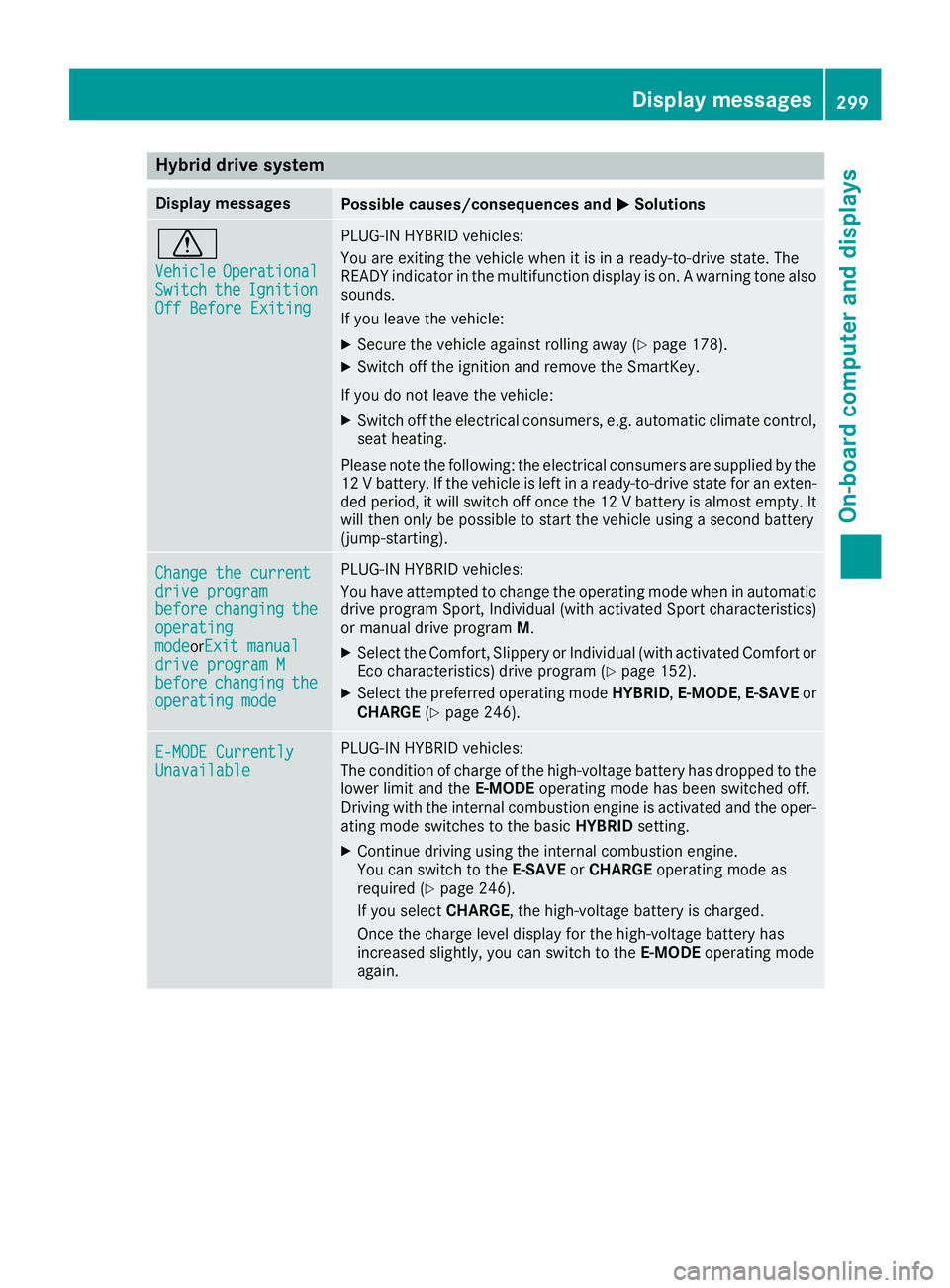
Hybrid drive system Display messages
Possible causes/consequences and P Solutions
r Vehicle Operational
Switch the Ignition
Off Before Exiting PLUG-IN HYBRID vehicles:
You are exiting the vehicle when it is in a ready-to-drive state. The
READY indicator in the multifunction display is on. A warning tone also
sounds.
If you leave the vehicle: X
Secure the vehicle against rolling away ( Y
page 178).X
Switch off the ignition and remove the SmartKey.
If you do not leave the vehicle: X
Switch off the electrical consumers, e.g. automatic climate control,
seat heating.
Please note the following: the electrical consumers are supplied by the
12 V battery. If the vehicle is left in a ready-to-drive state for an exten-
ded period, it will switch off once the 12 V battery is almost empty. It
will then only be possible to start the vehicle using a second battery
(jump-starting).
Change the current
drive program
before changing the
operating
mode or Exit manual
drive program M
before changing the
operating mode PLUG-IN HYBRID vehicles:
You have attempted to change the operating mode when in automatic
drive program Sport, Individual (with activated Sport characteristics)
or manual drive program M .X
Select the Comfort, Slippery or Individual (with activated Comfort or
Eco characteristics) drive program ( Y
page 152).X
Select the preferred operating mode HYBRID , E-MODE , E-SAVE or
CHARGE ( Y
page 246).
E-MODE Currently
Unavailable PLUG-IN HYBRID vehicles:
The condition of charge of the high-voltage battery has dropped to the
lower limit and the E-MODE operating mode has been switched off.
Driving with the internal combustion engine is activated and the oper-
ating mode switches to the basic HYBRID setting.X
Continue driving using the internal combustion engine.
You can switch to the E-SAVE or CHARGE operating mode as
required ( Y
page 246).
If you select CHARGE , the high-voltage battery is charged.
Once the charge level display for the high-voltage battery has
increased slightly, you can switch to the E-MODE operating mode
again. Display messages 299
On-board computer and displays Z
Page 442 of 450
At temperatures above freezing: X
Fill the washer fluid reservoir with a mixture of
water and windshield washer fluid, e.g. MB
SummerFit.
Add 1 part MB SummerFit to 100 parts water.
At temperatures below freezing: X
Fill the washer fluid reservoir with a mixture of
water and washer fluid, e.g. MB WinterFit.
For the correct mixing ratio refer to the infor-
mation on the antifreeze reservoir.
i Add windshield washer fluid, e.g. MB Sum-
merFit or MB WinterFit, to the washer fluid all
year round.
Climate control system refrigerant
Important safety notes The climate control system of your vehicle is fil-
led with refrigerant R ‑ 134a.
The instruction label regarding the refrigerant
type used can be found on the radiator cross
member.
! Only the refrigerant R ‑ 134a and the PAG oil
approved by Mercedes-Benz may be used.
The approved PAG oil may not be mixed with
any other PAG oil that is not approved for
R-134a refrigerant. Otherwise, the climate
control system may be damaged.
Service work, such as topping up refrigerant or
replacing components, may only be carried out
by a qualified specialist workshop. All applicable
regulations, as well as SAE standard J639, must
be adhered to.
Always have work on the climate control system
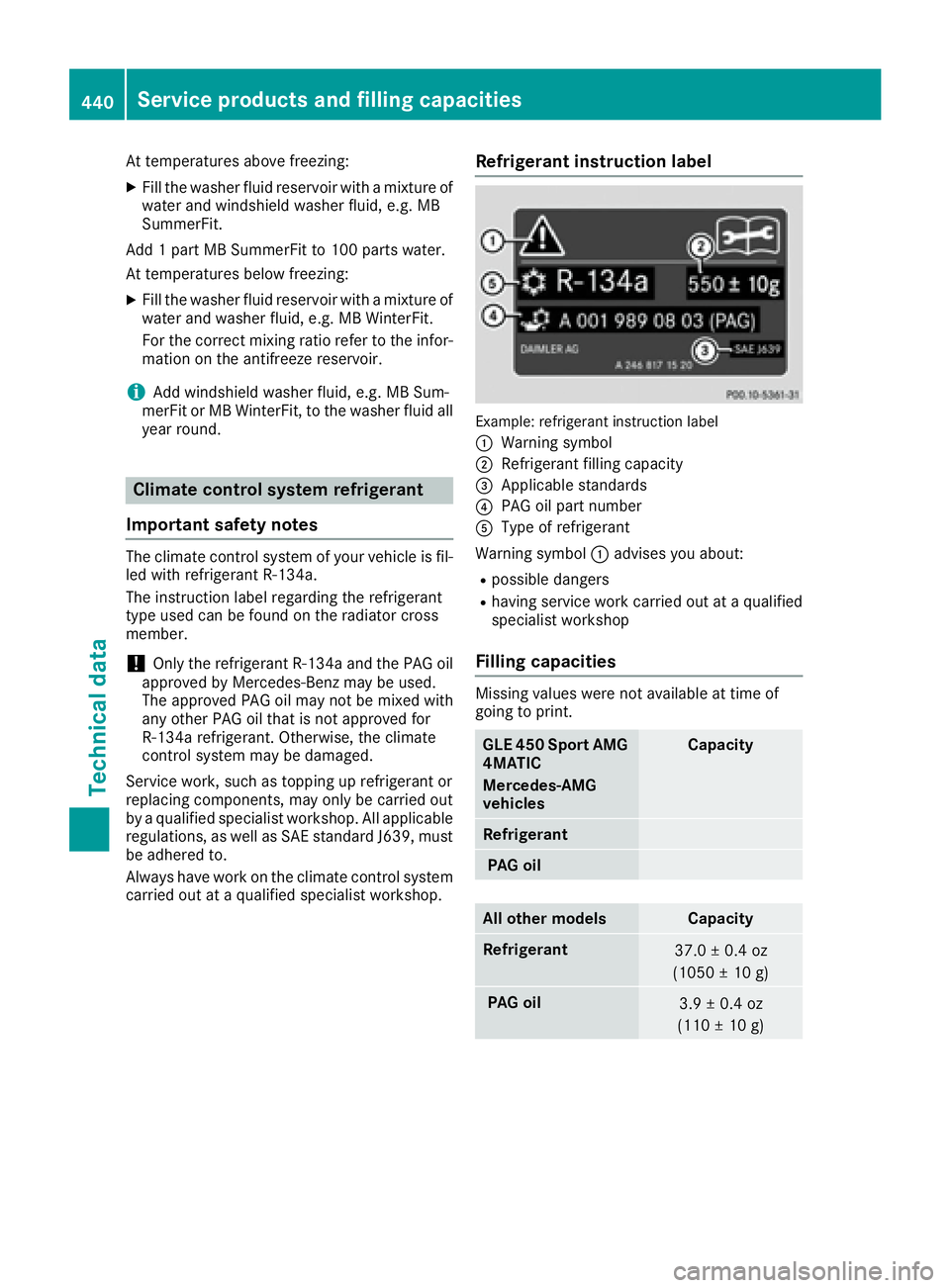
carried out at a qualified specialist workshop. Refrigerant instruction label
Example: refrigerant instruction label
C
Warning symbol D
Refrigerant filling capacity