ECU MERCEDES-BENZ GLE HYBRID 2017 User Guide
[x] Cancel search | Manufacturer: MERCEDES-BENZ, Model Year: 2017, Model line: GLE HYBRID, Model: MERCEDES-BENZ GLE HYBRID 2017Pages: 58, PDF Size: 1.98 MB
Page 33 of 58
To ensure that the brackets within the charging
cable controls are not subjected to incorrect
loads, observe the following: R
Never lift or carry the controls by the charging
cable connector or the mains plug. R
To transport the charging cable, the charging
cable can be: -
wrapped around the controls or -
secured to the housing of the controls
Heat generated by the charging cable
and charging cable connector Pay attention to the "Important safety notes"
( Y
page 29).
During the charging process, the charging cable
and charging cable connector may heat up.
The charging cable and the charging cable con-
nector will only heat up within the permissible
limiting values, provided that: R
the power supply and the charging cable are
not damaged R
the instructions for handling the charging
cable and controls on the charging cable are
observed
If the charging cable or charging cable connec-
tor become too hot, have the mains power sup-
ply checked.
Protection device against overvoltage
! Overvoltage in the mains supply may dam-
age the vehicle. For this reason, the vehicle is
equipped with a protection device against
overvoltage in the mains supply. This device
may be triggered during severe thunder-
storms, for example, and may lead to the buil-
ding's fuse being tripped and an interruption
in the power supply. These functions protect
the vehicle. After the building fuse is switched
on again, the charging process resumes auto-
matically. Following an interruption in the
power supply or tripping of the building's fuse,
it may take up to 10 minutes for charging to
resume automatically.
Switch on the building protection system again
after it has been triggered. Otherwise, the
charging process cannot be continued. General information about the charging
procedure Pay attention to the "Important safety notes"
( Y
page 29).
The vehicle socket is located in the rear bumper
on the right below the tail lamp.
The charge socket flap and the vehicle are cen-
trally locked or unlocked simultaneously.
Charging the high-voltage battery via
the electrical outlet
Charging cable for electrical outlets Important safety notes
! Only use the charging cable to charge the
high-voltage battery. Do not use the charging
cable for other purposes. It may otherwise be
damaged.
The vehicle is supplied with a country-specific
charging cable for connection to a mains socket.
Only use the charging cable supplied with the
vehicle or a charging cable approved for the
vehicle.
i If you use the supplied 12 A charging cable
to charge a high-voltage battery: R
the charge time increases considerably R
electrical consumption increases consider-
ably
Where possible, charge the high-voltage bat-
tery at a charging station ( Y
page 35). Only
then can certified electrical energy consump-
tion levels be reached.
i The charging process can vary depending on
the power supply. Therefore, always observe
the local information.
Information about charging from a wallbox
( Y
page 34).
Information on charging at a charging station
( Y
page 35).
Stowing the charging cable
The charging cable can be stowed and secured
in the bag provided in the cargo compartment of
the vehicle.Charging the high-voltage battery 31
Driving and parking Z
Page 43 of 58
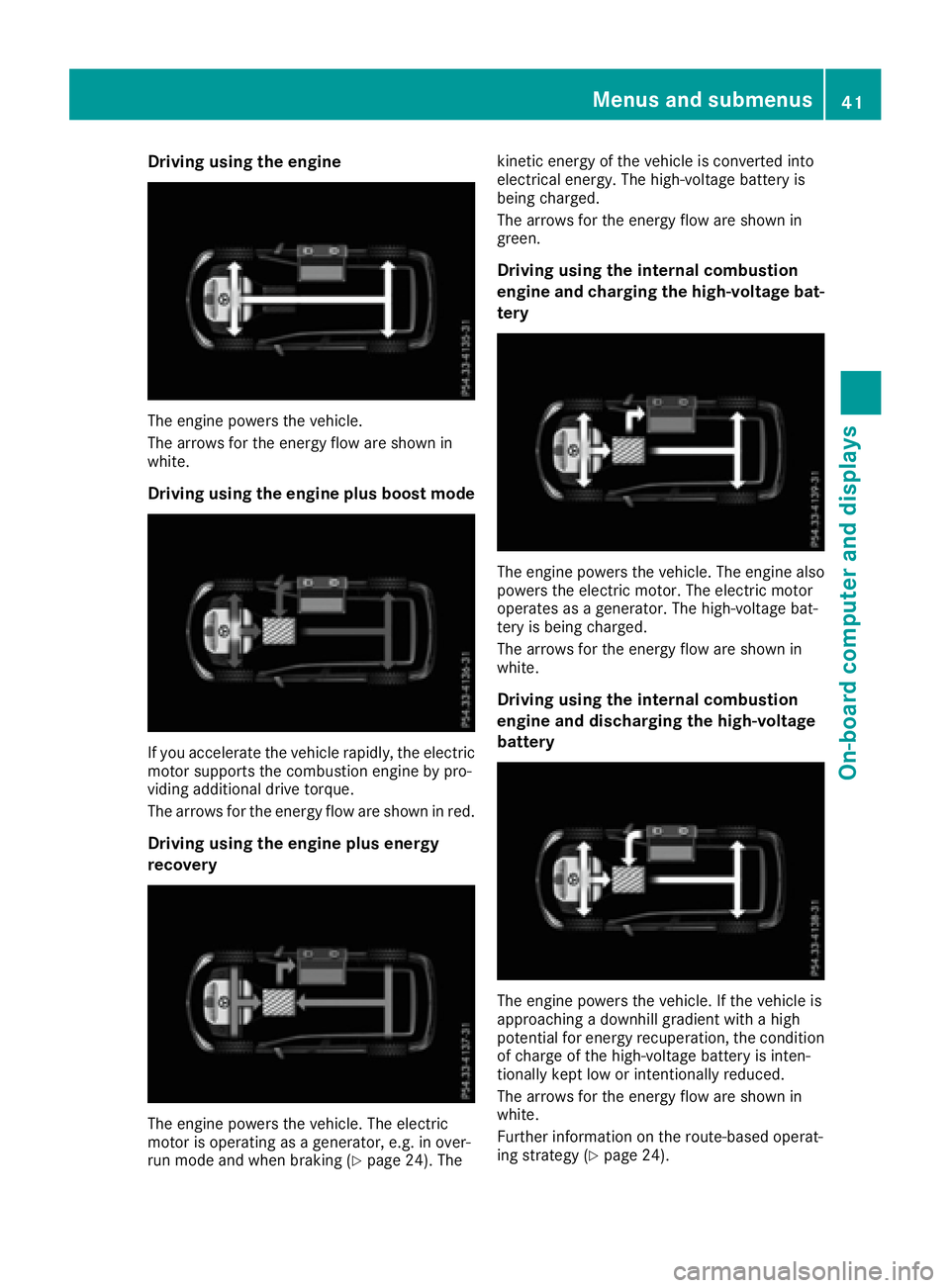
Driving using th e engin e
The engin e powers th e vehicle.
The arrows fo r th e energ y flo w are shown in
white.
Driving using th e engin e plus boost mode
If you accelerate th e vehicl e rapidly, th e electric
motor support s th e combustion engin e by pro -
vidin g additional drive torque .
The arrows fo r th e energ y flo w are shown in red .
Driving using th e engin e plus energy
recover y
The engin e powers th e vehicle. The electric
motor is operatin g as a generator, e.g. in over-
run mod e and when brakin g ( Y
page 24) . The kineti c energ y of th e vehicl e is converted into
electrica l energy. The high-voltag e battery is
bein g charged.
The arrows fo r th e energ y flo w are shown in
green .
Driving using th e internal combustion
engin e and charging th e high-voltage bat -
tery
The engin e powers th e vehicle. The engin e also
powers th e electric motor. The electric motor
operates as a generator. The high-voltag e bat -
tery is bein g charged.
The arrows fo r th e energ y flo w are shown in
white.
Driving using th e internal combustion
engin e and discharging th e high-voltage
battery
The engin e powers th e vehicle. If th e vehicl e is
approachin g a downhill gradien t wit h a hig h
potential fo r energ y recuperation , th e condition
of charg e of th e high-voltag e battery is inten-
tionally kept low or intentionally reduced.
The arrows fo r th e energ y flo w are shown in
white.
Further information on th e route-based operat -
in g strategy ( Y
page 24) .Menus and submenus 41
On-board computer and displays Z
Page 54 of 58
Battery (vehicle)
Important safety notes Your vehicle is equipped with a 12 V battery and
a high-voltage battery.
For the 12 V battery, observe the notes under
"Battery (vehicle)" in the vehicle Operator's
Manual.
G DANGER
The vehicle's high-voltage electrical system is
under high voltage. If you modify components
in the vehicle's high-voltage electrical system
or touch damaged components, you may be
electrocuted. The components in the vehi-
cle's high-voltage electrical system may be
damaged in an accident, although the damage
is not visible. There is a risk of fatal injury.
Following an accident, do not touch any high-
voltage components and never modify the
vehicle's high-voltage electrical system. Have
the vehicle towed away after an accident and
the vehicle's high-voltage electrical system
checked by a qualified specialist workshop.
G WARNING
In the event of a vehicle fire, the internal pres-
sure of the high-voltage battery can exceed a
critical value. In this case flammable gas
escapes through a ventilation valve on the
underbody. The gas can ignite. There is a risk
of injury.
Leave the danger zone immediately. Secure
the danger area at a suitable distance, whilst
observing legal requirements.
G WARNING
If the housing of the high-voltage battery has
been damaged, electrolyte and gases may
leak out. These are poisonous and caustic.
There is a risk of injury.
Avoid contact with skin, eyes or clothing.
Immediately rinse electrolyte splashes off
with water and seek medical attention
straight away.
! Exhaustive discharge caused by the vehicle
standing idle for lengthy periods can damage the high-voltage battery. If the vehicle is idle
for lengthy periods leave the high-voltage bat-
tery connected to a charging station.
If the battery charge is sufficient, the high-volt-
age battery can also supply the 12 V battery with
energy. This happens only if the battery charge
of the 12 V battery requires this, e.g. after using
electrical consumers for an extended period
with the engine switched off. As the on-board
voltage is continuously monitored this can also
be performed when the engine is switched off.
The battery charge of the 12 V battery and the
on-board voltage are thereby kept stable for
longer.
Consult an authorized Mercedes-Benz Center if
you wish to leave your vehicle parked for a long
period of time.
Charging the high-voltage battery
while the vehicle is stationary
G WARNING
Combustion engines emit poisonous exhaust
gases such as carbon monoxide. Inhaling
these exhaust gases leads to poisoning. There
is a risk of fatal injury. Therefore never leave
the engine running in enclosed spaces with-
out sufficient ventilation.
! Only charge the high-voltage battery in the
"Charging when stationary" mode. Do not
connect any battery chargers to the high-volt-
age battery. This could damage the vehicle’s
high-voltage electrical system. X
Bring the vehicle to a stop with the engine
running.
The engine powers the electric motor. The
electric motor operates as a generator. The
high-voltage battery is being charged.
If the high-voltage battery has been discharged
excessively, charge the high-voltage battery to
at least 60%. In "Charging while stationary"
mode, you can monitor the condition of charge
of the high-voltage battery up to a maximum of
70% in the COMAND display and the multifunc-
tion display ( Y
page 40).52
Battery (vehicle)
Breakdo wn assis tance