fuel consumption MERCEDES-BENZ GLE HYBRID 2017 Owners Manual
[x] Cancel search | Manufacturer: MERCEDES-BENZ, Model Year: 2017, Model line: GLE HYBRID, Model: MERCEDES-BENZ GLE HYBRID 2017Pages: 58, PDF Size: 1.98 MB
Page 6 of 58
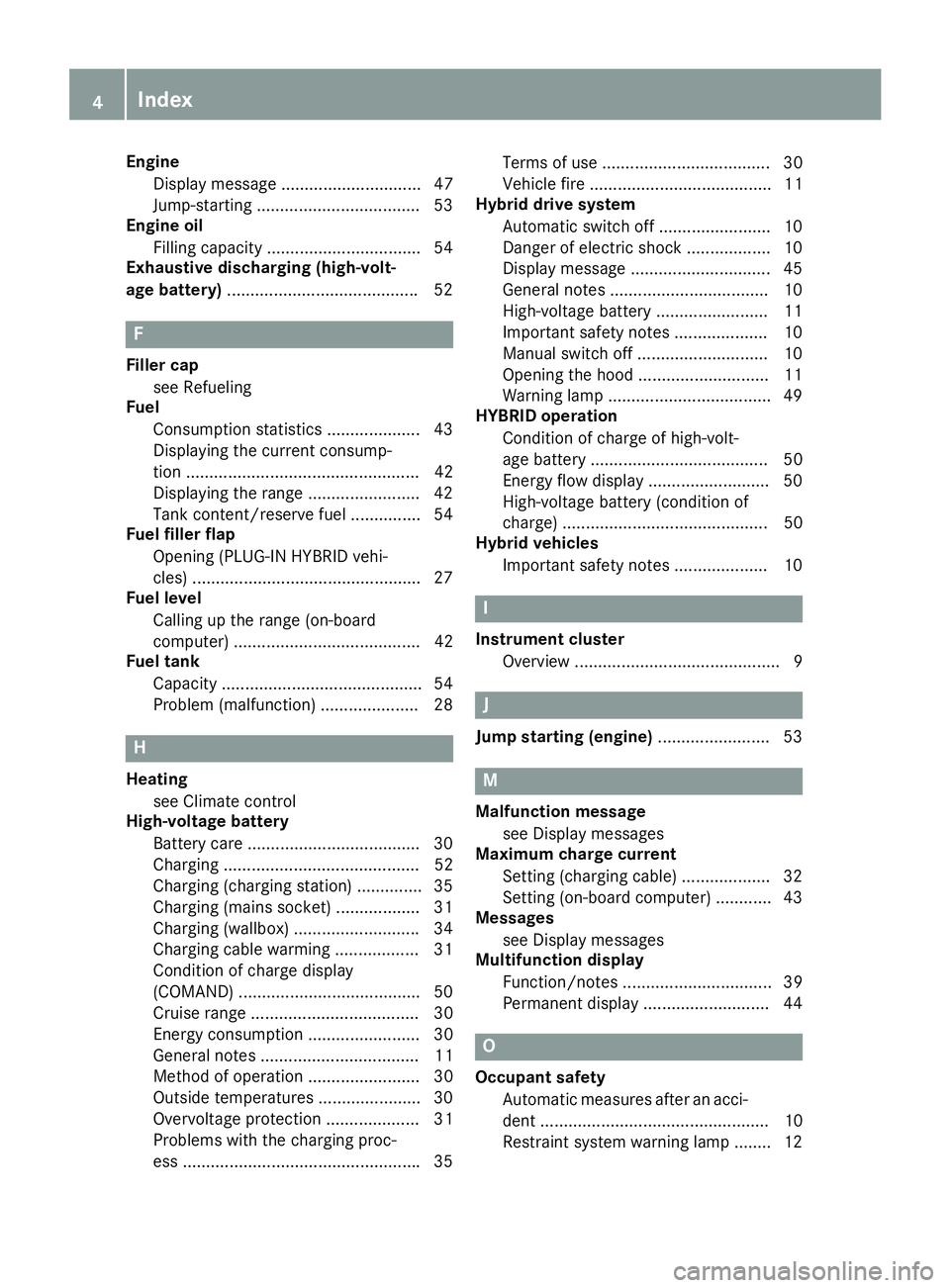
Engine
Display message .............................. 47
Jump-starting .................................. .5 3
Engine oil
Filling capacity ................................ .5 4
Exhaustive discharging (high-volt-
age battery) ........................................ .5 2
FFiller cap
see Refueling
Fuel
Consumption statistics .................... 43
Displaying the current consump-
tion .................................................. 42
Displaying the range ........................ 42
Tank content/reserve fuel .............. .5 4
Fuel filler flap
Opening (PLUG-IN HYBRID vehi-
cles) ................................................ .2 7
Fuel level
Calling up the range (on-board
computer) ........................................ 42
Fuel tank
Capacity .......................................... .5 4
Problem (malfunction) ..................... 28
H
Heating
see Climate control
High-voltage battery
Battery care .................................... .3 0
Charging .......................................... 52
Charging (charging station) .............. 35
Charging (mains socket) .................. 31
Charging (wallbox) .......................... .3 4
Charging cable warming .................. 31
Con dit ion of charge display
(COMAND) ...................................... .5 0
Cruise range .................................... 30
Energy consumption ........................ 30
General notes .................................. 11
Method of operation ........................ 30
Out side temperatures ...................... 30
Overvoltage protection .................... 31
Pro blem s wit h the charging proc-
ess .................................................. .3 5 Terms of use .................................... 30
Vehicle fire ....................................... 11
Hybrid drive system
Automatic switch off ........................ 10
Danger of electric shock .................. 10
Display message .............................. 45
General notes ................................. .1 0
High-voltage battery ........................ 11
Imp ortant safety notes .................... 10
Manual switch off ............................ 10
Opening the hood ............................ 11
Warning lamp ................................... 49
HYBRID operation
Condition of charge of high-volt-
age battery ...................................... 50
Energy flow display .......................... 50
High-voltage battery (condition of
charge) ............................................ 50
Hybrid vehicles
Important safety notes .................... 10
I Instrument cluster
Overview ............................................ 9
J
Jump starting (engine) ........................ 53
M
Malfunction message
see Display messages
Maximum charge current
Setting (charging cable) ................... 32
Setting (on-board computer) ............ 43
Messages
see Display messages
Multifunction display
Function/notes ................................ 39
Permanent display ........................... 44
O
Occupant safety
Automatic measures after an acci-
dent ................................................. 10
Restraint system warning lamp ........ 124
Index
Page 7 of 58
On-board computer
Display messages ........................... .4 5
HYBRID menu .................................. 43
Important safety notes .................... 38
Instrument cluster menu .................. 44
Menu overview ................................. 39
Settings menu .................................. 43
Trip menu ......................................... 40
Online access to the vehicle
Data protection ................................ 37
Functions ......................................... 37
General information ........................ .3 6
Internet ............................................ 37
Operating safety .................................... 7
Operator's Manual
Vehicle equipment ............................ .7
P PLUG-IN HYBRID operating
Electrical energy generated ............ .5 0
PLUG-IN HYBRID operation
Automatic engine start (ECO
start/stop function) ........................ .2 3
Automatic engine switch-off (ECO
start/stop function) ......................... 23
Charge level of the high-voltage
battery ............................................. 40
Charging the high-voltage battery .... 40
Displaying the total range and
electric range ................................... 43
Driving tips ...................................... 26
DYNAMIC SELECT controller ............ 22
ECO start/stop function .................. 23
Electric motor (power display) ......... 38
Energy flow display .......................... 40
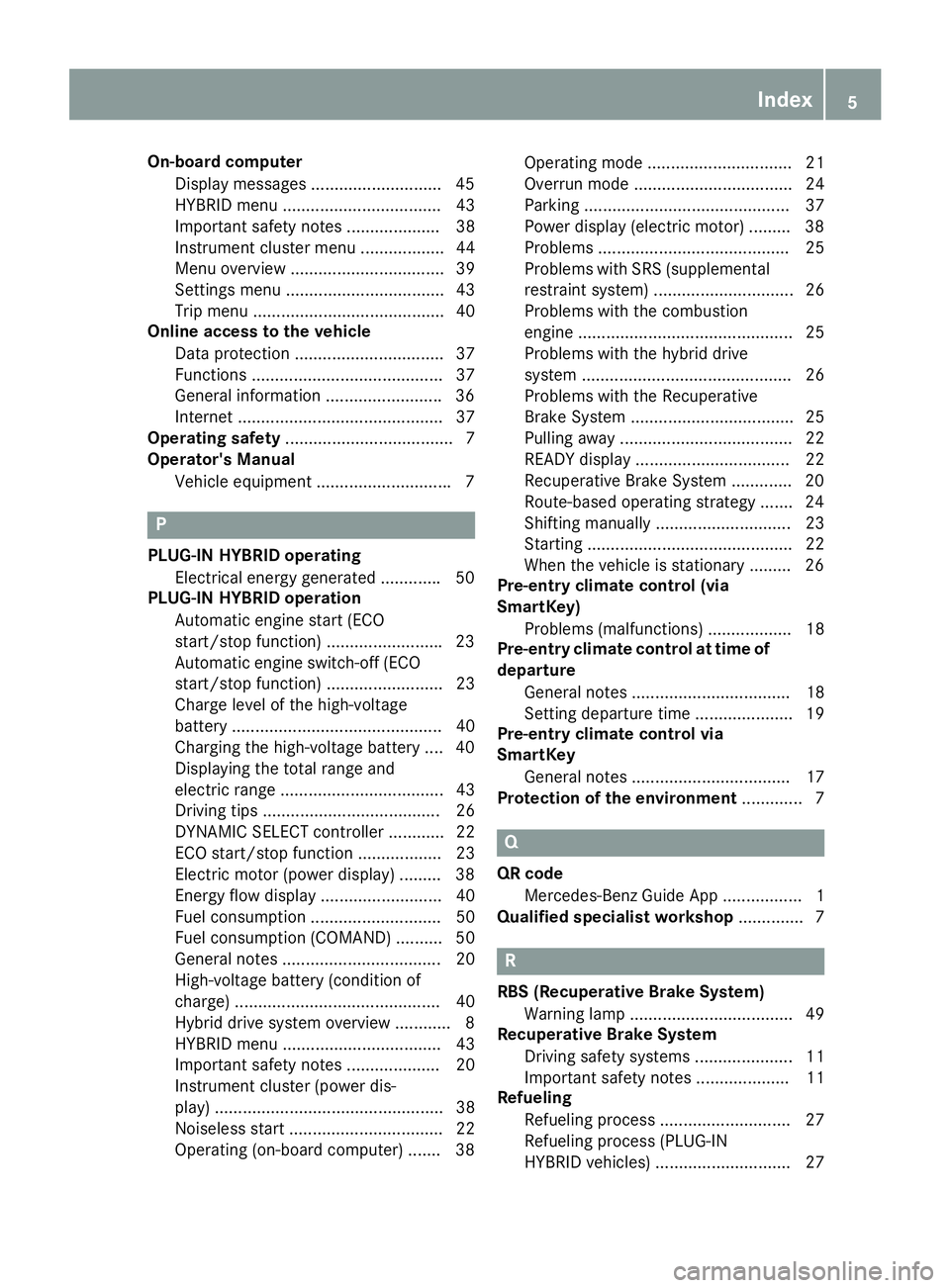
Fuel consumption ............................ 50
Fuel consumption (COMAND) .......... 50
General notes .................................. 20
High-voltage battery (condition of
charge) ............................................ 40
Hybrid drive system overview ............ 8
HYBRID menu .................................. 43
Important safety notes .................... 20
Instrument cluster (power dis-
play) ................................................. 38
Noiseless start ................................. 22
Operating (on-board computer) ....... 38 Operating mode ............................... 21
Overrun mode .................................. 24
Parking ............................................ 37
Power display (electric motor) ......... 38
Problems ......................................... 25
Problems with SRS (supplemental
restraint system) .............................. 26
Problems with the combustion
engine .............................................. 25
Problems with the hybrid drive
system ............................................. 26
Problems with the Recuperative
Brake System ................................... 25
Pulling away ..................................... 22
READY display ................................. 22
Recuperative Brake System ............. 20
Route-based operating strategy ....... 24
Shifting manually ............................. 23
Starting ............................................ 22
When the vehicle is stationary ......... 26
Pre-entry cli mate control (via
SmartKe y)
Problems (malfunctions) .................. 18
Pre-entry climate control at time of
departure
General notes .................................. 18
Setting departure time ..................... 19
Pre-entry climate control via
SmartKey
General notes .................................. 17
Protection of the environment ............. 7
Q
QR code
Mercedes-Benz Guide App ................. 1
Qualified specialist workshop .............. 7
R
RBS (Recuperative Brake System)
Warning lamp ................................... 49
Recuperative Brake System
Driving safety systems ..................... 11
Important safety notes .................... 11
Refueling
Refueling process ............................ 27
Refueling process (PLUG-IN
HYBRID vehicles) ............................. 27 Index 5
Page 26 of 58
Overrun mode In overrun mode, the combustion engine is
switched off and is disconnected from the drive
train. The electric motor: R
generates low thrust, which corresponds to
the overrun mode of an active combustion
engine R
functions as a generator and produces the
necessary energy for the auxiliary consumers
and charges the high-voltage battery
Overrun mode is available in the Comfort drive
program at speeds below 80 mph (130 km/h).
Route-based operating strategy For the route-based operating strategy, the sys-
tem factors in information about the expected
route when route guidance is active.
The information on the route is provided by the
multimedia system and includes the following: R
road categories R
speed limitations
The use of electric energy is automatically opti-
mally distributed from the beginning to the end
of the journey, using information about the
route. The distribution is pre-emptive and takes
into consideration: R
the sections of the journey ahead R
the energy consumption on the whole route The condition of charge of the high-voltage bat-
tery is thus systematically controlled. In addi-
tion, the control function takes into account
that: R
the fuel saving through the use of electrical
energy can vary, dependent on the route (e.g.
urban, interurban or highway) R
the use of electrical energy is held available
for electric driving, particularly for urban
routes
The vehicle thus automatically selects the opti-
mum driving mode for the respective section of
the route.
The route-based operating strategy is available
under the following conditions: R
the Individual drive program is selected R
in the Individual drive program, the ECO set-
ting is selected under Drive R
HYBRID driving mode is selected R
active route guidance is activated R
suitable map data is available
When the route-based operating strategy is
being used, the area in front of the vehicle is
shown as green in the multifunction display.24
Driving
Driving and parking
Page 29 of 58
Urban driving In city traffic, energy is recuperated during fre-
quent deceleration phases.
The vehicle can be driven by the electric motor
alone up to a speed of approximately 80 mph
(130 km/h).
The vehicle is driven by the electric motor alone
only when all conditions for the automatic
engine switch-off are fulfilled.
Further information on the automatic engine
switch-off ( Y
page 23).
Driving on inter-urban roads The following phases are possible when driving
on inter-urban roads: R
rapid acceleration (boost mode) R
energy recuperation R
electric operation mode
The vehicle can be driven by the electric motor
alone up to a speed of approximately 74 mph
(120 km/ h) .
A great deal of recovered energy may be avail-
able, depending on the route profile. This
reduces consumption and emissions.
Highway driving When driving on a highway, switching off the
combustion engine has a particularly positive
effect on fuel consumption and emissions.
If the driver removes his/her foot from the
accelerator pedal in the Comfort drive program
and a speed of 80 mph (130 km/h) is not excee-
ded, the combustion engine is automatically
switched off.
Further information on the automatic engine
switch-off ( Y
page 23).
Refueling
Refueling
General information
Observe the important safety notes under
"Refueling" in the vehicle Operator's Manual. Pressure in the fuel tank must be released
before refueling. Otherwise, the fuel filler flap
cannot be opened.
If you unlock/lock the vehicle from the outside,
the fuel filler flap also unlocks/locks.
The position of the fuel filler cap is displayed in
the instrument cluster
Page 44 of 58
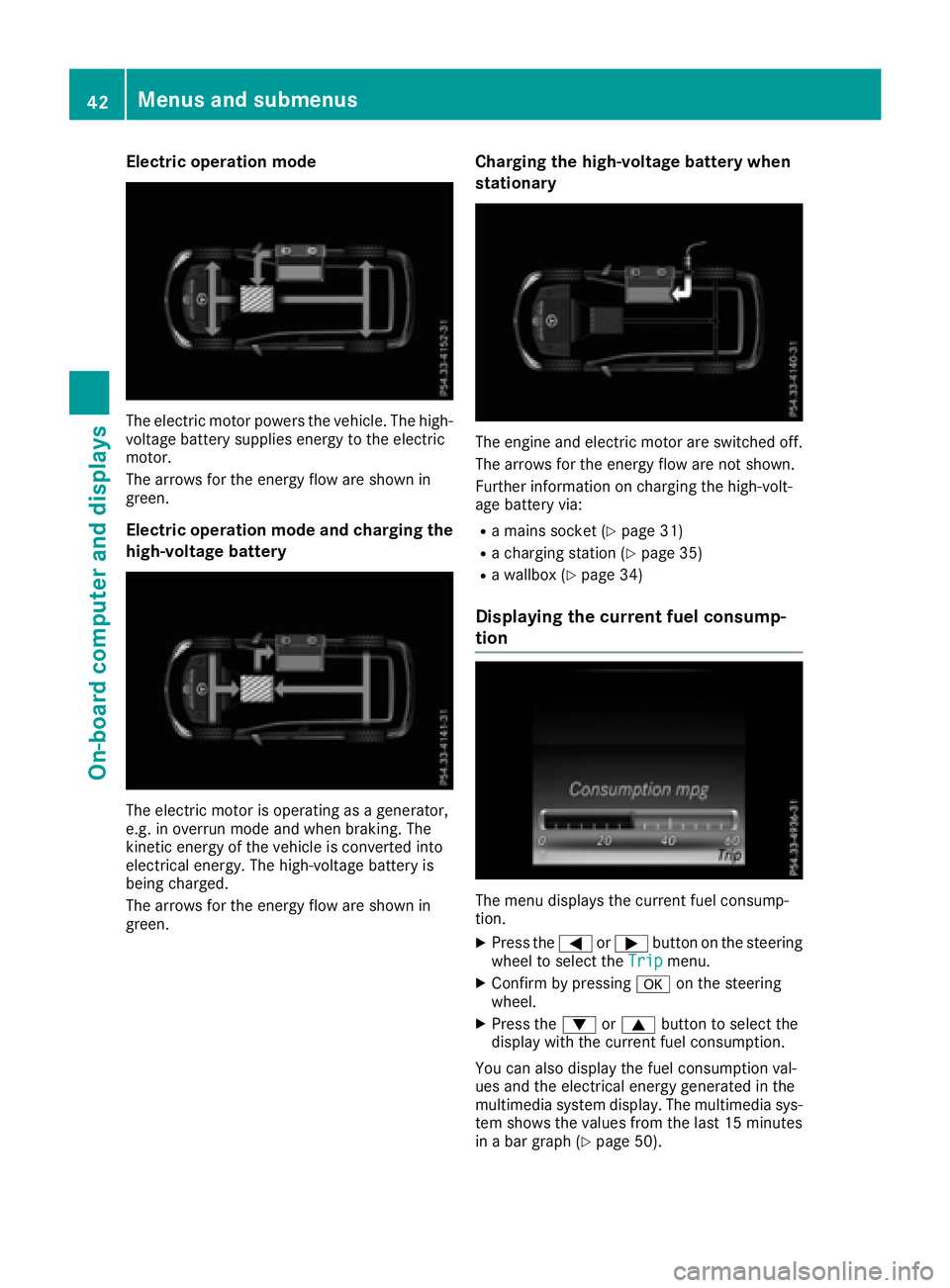
Electric operation mode
The electric motor powers the vehicle. The high-
voltage battery supplies energy to the electric
motor.
The arrows for the energy flow are shown in
green.
Electric operation mode and charging the
high-voltage battery
The electric motor is operating as a generator,
e.g. in overrun mode and when braking. The
kinetic energy of the vehicle is converted into
electrical energy. The high-voltage battery is
being charged.
The arrows for the energy flow are shown in
green. Charging the high-voltage battery when
stationary
The engine and electric motor are switched off.
The arrows for the energy flow are not shown.
Further information on charging the high-volt-
age battery via: R
a mains socket ( Y
page 31)R
a charging station ( Y
page 35)R
a wallbox ( Y
page 34)
Displaying the current fuel consump-
tion
The menu displays the current fuel consump-
tion. X
Press the Y or e button on the steering
wheel to select the Trip menu.X
Confirm by pressing v on the steering
wheel. X
Press the d or c button to select the
display with the current fuel consumption.
You can also display the fuel consumption val-
ues and the electrical energy generated in the
multimedia system display. The multimedia sys-
tem shows the values from the last 15 minutes
in a bar graph ( Y
page 50).42
Menus and submenus
On-board computer and displays