lock MERCEDES-BENZ GLE HYBRID 2017 Owners Manual
[x] Cancel search | Manufacturer: MERCEDES-BENZ, Model Year: 2017, Model line: GLE HYBRID, Model: MERCEDES-BENZ GLE HYBRID 2017Pages: 58, PDF Size: 1.98 MB
Page 13 of 58
X
If possible, move the vehicle out of the
danger zone: shift the automatic transmis-
sion into position N .X
Release the electric parking brake. X
Roll the vehicle to a safe place and park it
safely.
Get assistance from others if necessary.
The vehicle is locked automatically when the
ignition is switched on and the wheels are turn-
ing. There is therefore a risk of being locked out
if the vehicle is being pushed or tested on a
dynamometer. X
Switch the ignition off. X
Shift the automatic transmission to park posi-
tion P .
Apply the electric parking brake.
Safeguard the vehicle against rolling away
(see the vehicle Operator's Manual). X
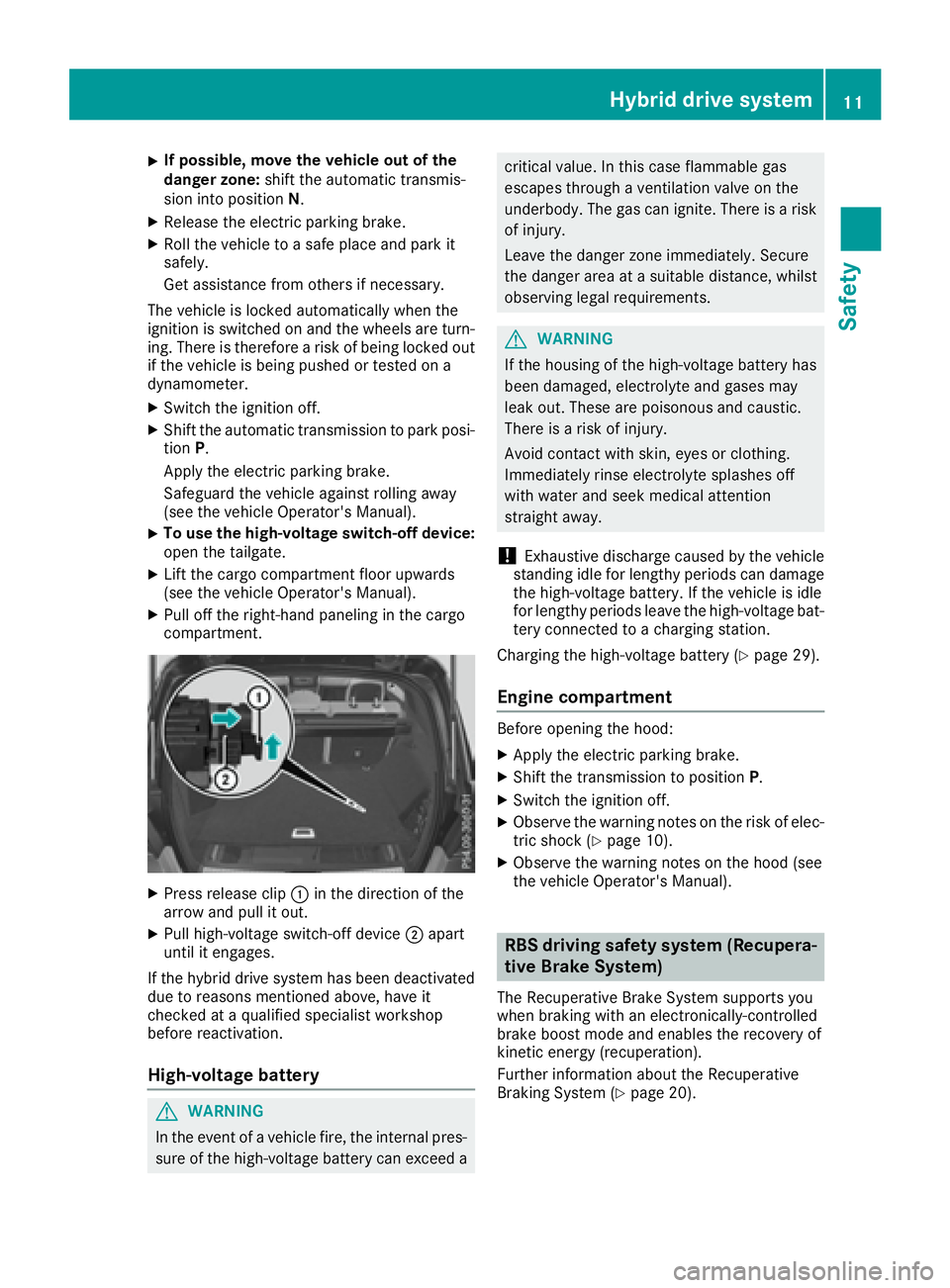
To use the high-voltage switch-off device:
open the tailgate. X
Lift the cargo compartment floor upwards
(see the vehicle Operator's Manual). X
Pull off the right-hand paneling in the cargo
compartment.
X
Press release clip C in the direction of the
arrow and pull it out. X
Pull high-voltage switch-off device D apart
until it engages.
If the hybrid drive system has been deactivated
due to reasons mentioned above, have it
checked at a qualified specialist workshop
before reactivation.
High-voltage battery
G WARNING
In the event of a vehicle fire, the internal pres-
sure of the high-voltage battery can exceed a critical value. In this case flammable gas
escapes through a ventilation valve on the
underbody. The gas can ignite. There is a risk
of injury.
Leave the danger zone immediately. Secure
the danger area at a suitable distance, whilst
observing legal requirements.
G WARNING
If the housing of the high-voltage battery has
been damaged, electrolyte and gases may
leak out. These are poisonous and caustic.
There is a risk of injury.
Avoid contact with skin, eyes or clothing.
Immediately rinse electrolyte splashes off
with water and seek medical attention
straight away.
! Exhaustive discharge caused by the vehicle
standing idle for lengthy periods can damage
the high-voltage battery. If the vehicle is idle
for lengthy periods leave the high-voltage bat-
tery connected to a charging station.
Charging the high-voltage battery ( Y
page 29).
Engine compartment Before opening the hood: X
Apply the electric parking brake. X
Shift the transmission to position P .X
Switch the ignition off. X
Observe the warning notes on the risk of elec-
tric shock ( Y
page 10). X
Observe the warning notes on the hood (see
the vehicle Operator's Manual).
RBS driving safety system (Recupera-
tive Brake System) The Recuperative Brake System supports you
when braking with an electronically-controlled
brake boost mode and enables the recovery of
kinetic energy (recuperation).
Further information about the Recuperative
Braking System ( Y
page 20).Hybrid drive system 11
Safety Z
Page 14 of 58
Occupant safety
Restraint system warning lamp If the restraint system is disrupted, the high-
voltage on-board electrical system may not be
switched off in the event of an accident as inten-
ded.
G DANGER
If the restraint system is malfunctioning,
restraint system components may be trig-
gered unintentionally or may not deploy as
intended during an accident. This can affect
for example the Emergency Tensioning
Device or the air bag. Furthermore, in the
event of an accident, the vehicle's high-volt-
age electrical system may not be deactivated
as intended. You may be electrocuted if you
touch the damaged components of the vehi-
cle's high-voltage electrical system. This
poses an increased risk of injury or even fatal
injury.
Have the restraint system checked and
repaired in a qualified specialist workshop as
soon as possible. After an accident, switch off
the ignition immediately and remove the key
from the ignition lock.
A malfunction has occurred if the u restraint
system warning lamp: R
does not light up after the ignition is switched
on R
does not go out after a few seconds while the
combustion engine or hybrid system is run-
ning R
lights up again while the combustion engine
or hybrid system is running12
Occupant safety
Safety
Page 20 of 58
When the vehicle is pre-heated, the following
functions are activated if required: R
Climate control system R
Blower R
Seat heating
If you have activated ionization via the multime-
dia system, it is activated together with pre-
entry climate control.
Activating/deactivating Before "Pre-entry climate control via SmartKey"
can be activated, you must activate the function
using the on-board computer. X
To activate: unlock the vehicle with the
SmartKey or KEYLESS-GO.
The climate control functions are activated
for up to 5 minutes for pre-heating and pre-
cooling. X
To deactivate: "Pre-entry climate control via
SmartKey" deactivates automatically when
the engine is started.
The following functions remain active after the
engine is started: R
Seat heating (heating) R
Seat ventilation (ventilation) R
Ionization
Problems with "Pre-entry climate control via SmartKey" Problem
Possible causes/consequences and P Solutions
"Pre-entry climate con-
trol via SmartKey" can-
not be switched on or
has switched itself off. The condition of charge of the high-voltage battery is under the speci-
fied minimum condition of charge. X
Start the engine when the vehicle is at a standstill.
The engine powers the electric motor. The electric motor operates
as a generator. The high-voltage battery is being charged.
Further information on charging the high-voltage battery via: R
a mains socket ( Y
page 31)R
a charging station ( Y
page 35)R
a wallbox ( Y
page 34)
"Pre-entry climate control via SmartKey" has been started more than
twice with the engine switched off. X
Switch on the engine and let it run for more than ten seconds. X
Try again to switch on "Pre-entry climate control via SmartKey".
Pre-entry climate control at time of
departure
Important safety notes
G WARNING
If persons, particularly children are subjected
to prolonged exposure to extreme heat or
cold, there is a risk of injury, possibly even
fatal. Never leave children unattended in the
vehicle. General notes You can use the "Pre-entry climate control at
departure time" function to cool or heat the
vehicle interior if the engine is not running.
The "Pre-entry climate control at departure
time" function can be activated regardless of
whether or not the vehicle is connected to an
electric power supply. The condition of charge of
the high-voltage battery must be higher than the
specified minimum condition of charge, how-
ever.
When the vehicle is connected to an electric
power supply, priority is given to charging the
high-voltage battery to the specified minimum
charge. "Pre-entry climate control at departure
time" is only activated subsequently.18
Operating the climate control systems
Climate control
Page 29 of 58
Urban driving In city traffic, energy is recuperated during fre-
quent deceleration phases.
The vehicle can be driven by the electric motor
alone up to a speed of approximately 80 mph
(130 km/h).
The vehicle is driven by the electric motor alone
only when all conditions for the automatic
engine switch-off are fulfilled.
Further information on the automatic engine
switch-off ( Y
page 23).
Driving on inter-urban roads The following phases are possible when driving
on inter-urban roads: R
rapid acceleration (boost mode) R
energy recuperation R
electric operation mode
The vehicle can be driven by the electric motor
alone up to a speed of approximately 74 mph
(120 km/ h) .
A great deal of recovered energy may be avail-
able, depending on the route profile. This
reduces consumption and emissions.
Highway driving When driving on a highway, switching off the
combustion engine has a particularly positive
effect on fuel consumption and emissions.
If the driver removes his/her foot from the
accelerator pedal in the Comfort drive program
and a speed of 80 mph (130 km/h) is not excee-
ded, the combustion engine is automatically
switched off.
Further information on the automatic engine
switch-off ( Y
page 23).
Refueling
Refueling
General information
Observe the important safety notes under
"Refueling" in the vehicle Operator's Manual. Pressure in the fuel tank must be released
before refueling. Otherwise, the fuel filler flap
cannot be opened.
If you unlock/lock the vehicle from the outside,
the fuel filler flap also unlocks/locks.
The position of the fuel filler cap is displayed in
the instrument cluster
Page 30 of 58
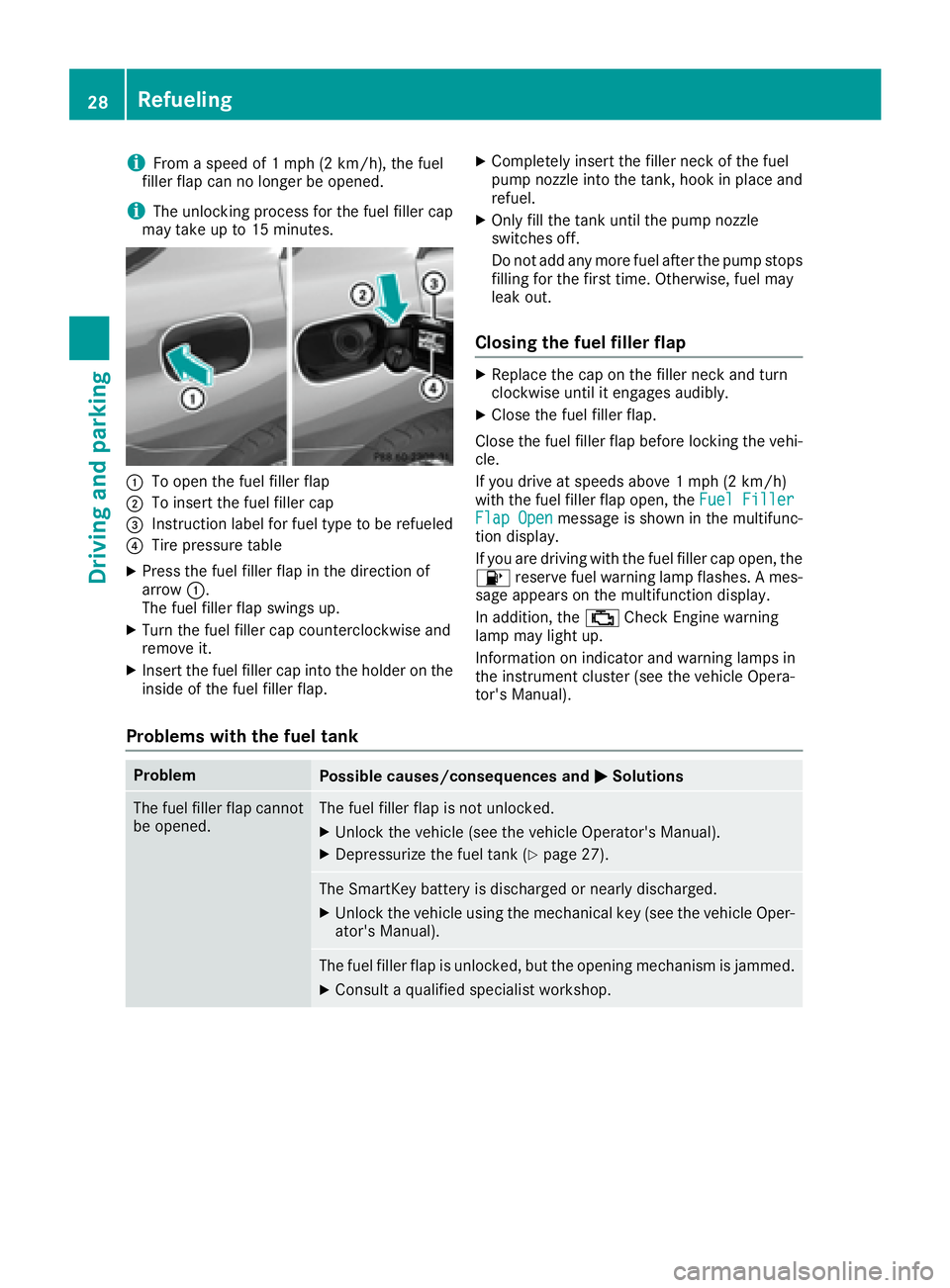
i From a speed of 1 mph (2 km/h), the fuel
filler flap can no longer be opened.
i The unlocking process for the fuel filler cap
may take up to 15 minutes.
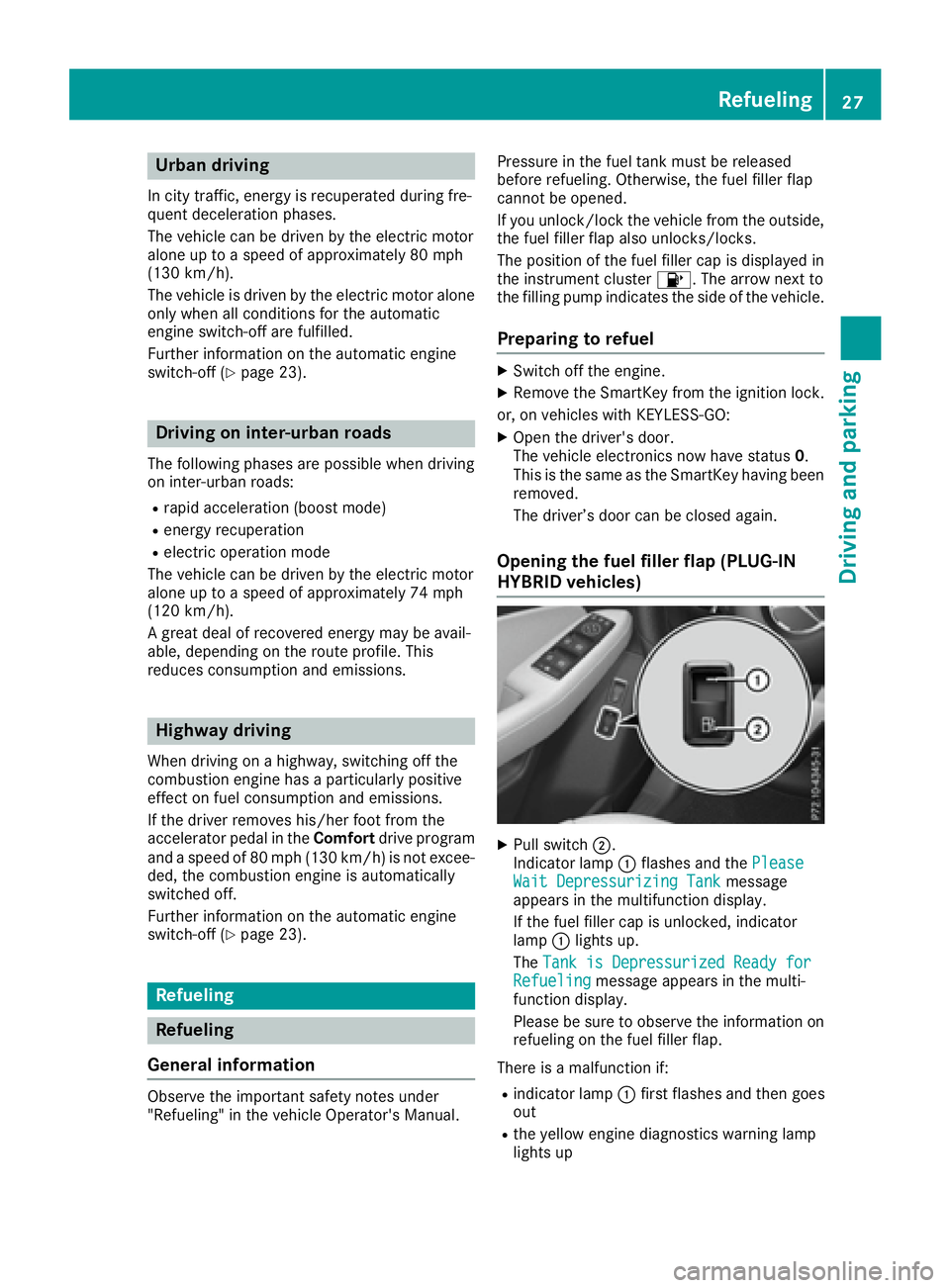
C
To open the fuel filler flapD
To insert the fuel filler cap
Page 33 of 58
To ensure that the brackets within the charging
cable controls are not subjected to incorrect
loads, observe the following: R
Never lift or carry the controls by the charging
cable connector or the mains plug. R
To transport the charging cable, the charging
cable can be: -
wrapped around the controls or -
secured to the housing of the controls
Heat generated by the charging cable
and charging cable connector Pay attention to the "Important safety notes"
( Y
page 29).
During the charging process, the charging cable
and charging cable connector may heat up.
The charging cable and the charging cable con-
nector will only heat up within the permissible
limiting values, provided that: R
the power supply and the charging cable are
not damaged R
the instructions for handling the charging
cable and controls on the charging cable are
observed
If the charging cable or charging cable connec-
tor become too hot, have the mains power sup-
ply checked.
Protection device against overvoltage
! Overvoltage in the mains supply may dam-
age the vehicle. For this reason, the vehicle is
equipped with a protection device against
overvoltage in the mains supply. This device
may be triggered during severe thunder-
storms, for example, and may lead to the buil-
ding's fuse being tripped and an interruption
in the power supply. These functions protect
the vehicle. After the building fuse is switched
on again, the charging process resumes auto-
matically. Following an interruption in the
power supply or tripping of the building's fuse,
it may take up to 10 minutes for charging to
resume automatically.
Switch on the building protection system again
after it has been triggered. Otherwise, the
charging process cannot be continued. General information about the charging
procedure Pay attention to the "Important safety notes"
( Y
page 29).
The vehicle socket is located in the rear bumper
on the right below the tail lamp.
The charge socket flap and the vehicle are cen-
trally locked or unlocked simultaneously.
Charging the high-voltage battery via
the electrical outlet
Charging cable for electrical outlets Important safety notes
! Only use the charging cable to charge the
high-voltage battery. Do not use the charging
cable for other purposes. It may otherwise be
damaged.
The vehicle is supplied with a country-specific
charging cable for connection to a mains socket.
Only use the charging cable supplied with the
vehicle or a charging cable approved for the
vehicle.
i If you use the supplied 12 A charging cable
to charge a high-voltage battery: R
the charge time increases considerably R
electrical consumption increases consider-
ably
Where possible, charge the high-voltage bat-
tery at a charging station ( Y
page 35). Only
then can certified electrical energy consump-
tion levels be reached.
i The charging process can vary depending on
the power supply. Therefore, always observe
the local information.
Information about charging from a wallbox
( Y
page 34).
Information on charging at a charging station
( Y
page 35).
Stowing the charging cable
The charging cable can be stowed and secured
in the bag provided in the cargo compartment of
the vehicle.Charging the high-voltage battery 31
Driving and parking Z
Page 35 of 58
If, after the charging process, the charging cable
is: R
left connected to the power socket, the cur-
rently selected values will be used for the next
charging process. R
removed from the power socket, the values
will be reset to the minimum setting for the
next charging process. You may then need to
reset the values of the maximum charge cur-
rent.
i If the vehicle requires more time than usual
when charging, check the maximum charge
current settings using the controls on the
charging cable or in the on-board computer's
menu.
Indicator lamp on the vehicle socket When the indicator lamp on the vehicle socket
lights up, this means the following:
Indicator
lamp
Flashes
orange The connection between the
vehicle and the current
source is being established
before charging begins.
Flashes
green The high-voltage battery is
being charged.
Flashes red A malfunction has occurred
while charging.
The indicator lamp goes out
after approximately
90 seconds.
Lights up
orange A charging break for the high-
voltage battery is taking
place.
The indicator lamp goes out
after approximately
90 seconds.
Lights up
green The high-voltage battery is
fully charged.
The indicator lamp goes out
after approximately
90 seconds.
i If the indicator lamp is off, lock or unlock the
vehicle. The indicator lamp then displays the
current status of the charging process again. Connecting the charging cable
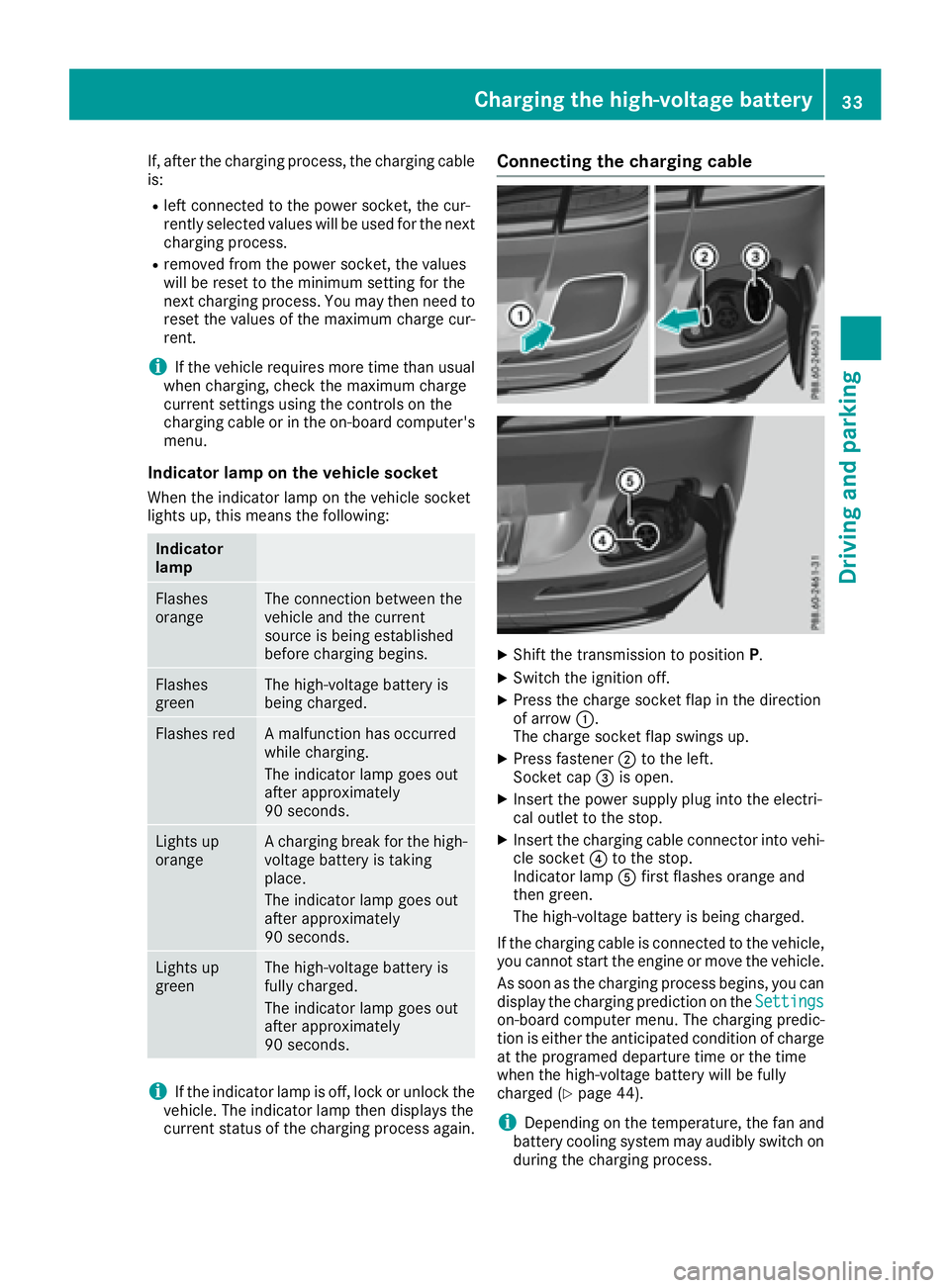
X
Shift the transmission to position P .X
Switch the ignition off. X
Press the charge socket flap in the direction
of arrow C .
The charge socket flap swings up. X
Press fastener D to the left.
Socket cap
Page 36 of 58
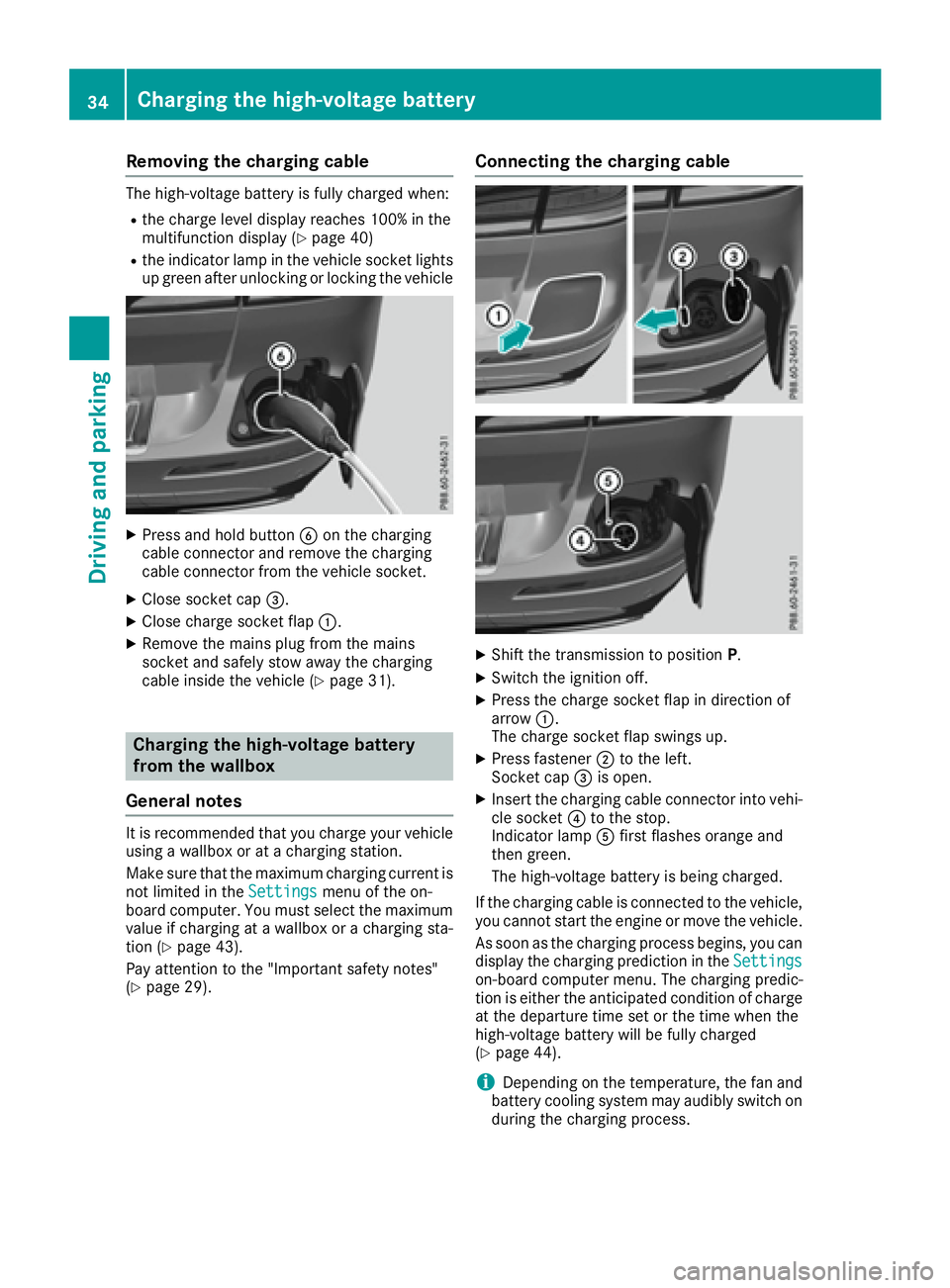
Removing the charging cable The high-voltage battery is fully charged when: R
the charge level display reaches 100% in the
multifunction display ( Y
page 40)R
the indicator lamp in the vehicle socket lights
up green after unlocking or locking the vehicle
X
Press and hold button
Page 37 of 58
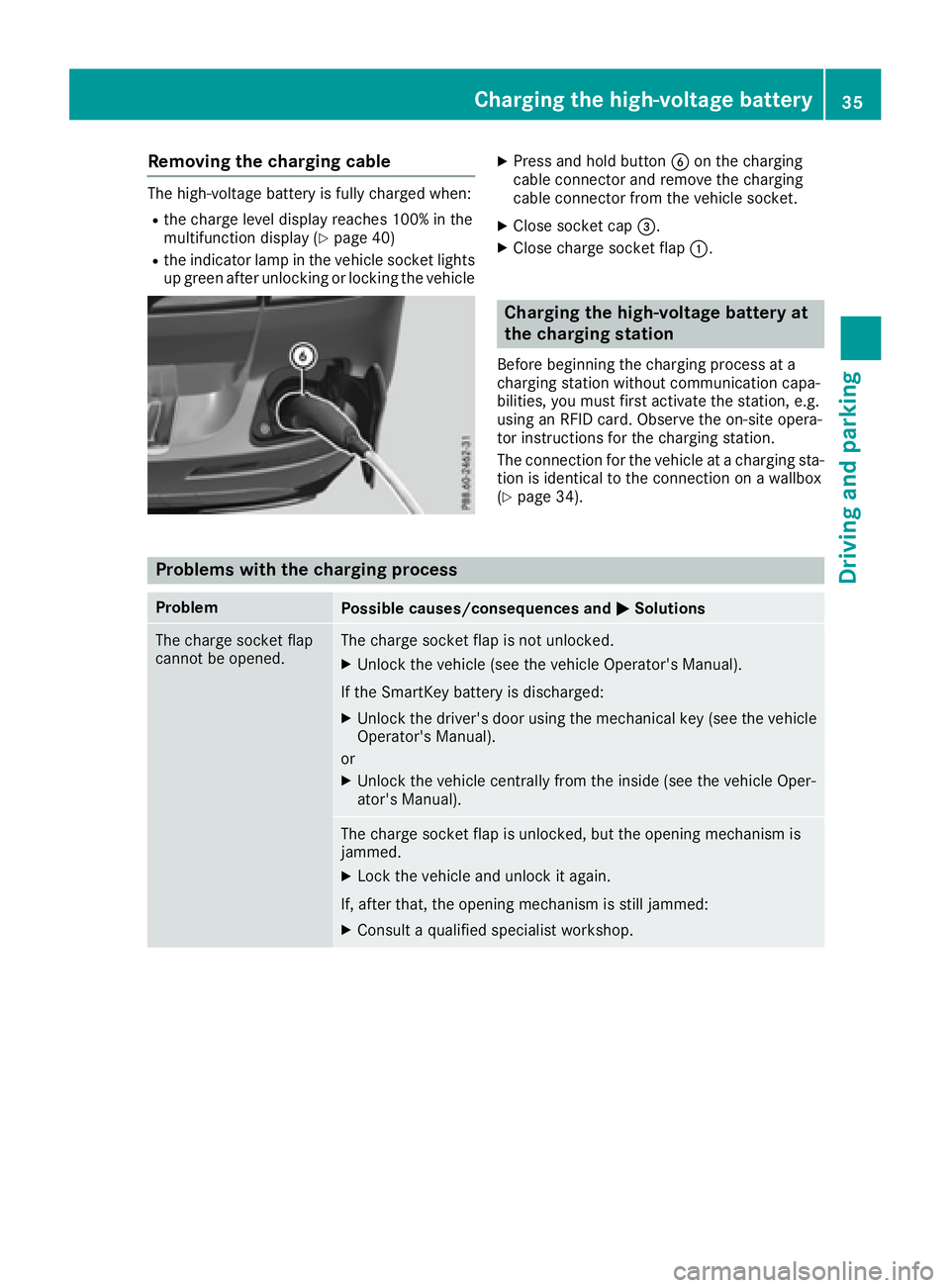
Removing the charging cable The high-voltage battery is fully charged when: R
the charge level display reaches 100% in the
multifunction display ( Y
page 40)R
the indicator lamp in the vehicle socket lights
up green after unlocking or locking the vehicle X
Press and hold button
Page 38 of 58
Problem
Possible causes/consequences and P Solutions
The high-voltage battery
is not being charged. The indicator lamp on the vehicle socket flashes red.
A malfunction has occurred during the initialization of the charging
process or during charging. X
Disconnect the charging cable connector from the vehicle socket
and plug it back into the vehicle socket.
If the problem persists: X
Have the mains socket checked for correct function or use another
mains socket.
or X
Use a different charging station.
or X
Consult a qualified specialist workshop.
The indicator lamp on the vehicle socket does not light up.
No connection can be established between the vehicle and the exter-
nal power source. X
Connect the charging cable once again.
If the problem persists: X
Have the mains socket checked for correct function or use another
mains socket.
or X
Use a different charging station.
or X
Consult a qualified specialist workshop.
The charging cable con-
nector cannot be
removed from the vehi-
cle socket. The snap fastener on the charging cable connector is locked. X
Press and hold the button on the charging cable connector. The
snap fastener on the vehicle socket is unlocked. X
Remove the charging cable connector from the vehicle socket.
If the snap fastener on the charging cable connector is locked: X
Press and hold the button on the charging cable connector and try
to release the lock.
Online access to the vehicle
General information
G WARNING
If you operate information systems and com-
munication equipment integrated in the vehi-
cle while driving, you will be distracted from
traffic conditions. You could also lose control
of the vehicle. There is a risk of an accident. Only operate the equipment when the traffic
situation permits. If you are not sure that this
is possible, park the vehicle paying attention
to traffic conditions and operate the equip-
ment when the vehicle is stationary.
i Operation of integrated information sys-
tems and communications equipment in
the vehicle: you must observe the legal
requirements for the country in which you are
currently driving.36
Charging the high-voltage battery
Driving and parking