reset MERCEDES-BENZ GLK-Class 2011 X204 Owner's Manual
[x] Cancel search | Manufacturer: MERCEDES-BENZ, Model Year: 2011, Model line: GLK-Class, Model: MERCEDES-BENZ GLK-Class 2011 X204Pages: 304, PDF Size: 13.08 MB
Page 12 of 304
Low-beam headlamps ....................103
Rear fog lamp ................................ 104
Switching the daytime driving
lights on/off (on-board computer) . 172
Switching the exterior lighting
delayed switch-off on/off (on-
board computer) ............................ 172
Switching the surround lighting
on/off (on-board computer) ..........172
Light sensor (display message) ....... 186
Loading guidelines ............................ 206
Locking Automatic ........................................ 76
Emergency locking ........................... 77
From inside the vehicle (central
locking button) ................................. 76
Locking verification signal (on-
board computer) ............................... 173
Low-beam headlamp (display
message) ............................................ 183
Luggage net ....................................... 208
Lumbar support ................................... 94
4-way lumbar support ......................94
M
M+S tires ............................................ 148
Main-beam headlamps (display
message) ............................................ 184
Malfunction message see Display messages
Malfunctions relevant to safety
Reporting ......................................... 21
mbrace
Call priority .................................... 223
Display message ............................ 177
Downloading destinations
(COMAND) ..................................... 223
Emergency call .............................. 220
Important safety notes ..................219
Locating a stolen vehicle ...............224
MB info call button ........................222
Remote vehicle locking ..................224
Roadside Assistance button ..........221
Self-test ......................................... 219
System .......................................... 219
Vehicle remote unlocking ..............223
Mechanical key
Function/notes ................................ 71
Memory card (on-board computer) . 169
Memory function ............................... 100
Menu (on-board computer) Audio ............................................. 168
DVD ............................................... 169
Navigation ..................................... 167
Overview of menus ........................165
Service ........................................... 170
Settings ......................................... 171
Telephone ...................................... 169
Trip ................................................ 166
Message memory .............................. 175
Messages see Display messages
Mirrors
Sun visor ........................................ 215
see Exterior mirrors or Rear-view mirror
MP3
Operating (on-board computer) .....169
see separate operating instructions
Multifunction display ........................ 164
Multifunction steering wheel Operating the on-board computer . 163
Overview .......................................... 28
N
Navigation On-board computer .......................167
see separate operating instructions
NECK-PRO head restraints
Operation ......................................... 49
Resetting after being triggered ........50
Notes on breaking-in a new
vehicle ................................................ 128
O
Occupant Classification System
(OCS) Faults ............................................... 45
Operation ......................................... 41
System self-test ............................... 44
Occupant safety
Children in the vehicle .....................55
System overview .............................. 34
10IndexBA 204.9 USA, CA Edition A 2011; 1; 6, en-USd2mwentsVersion: 3.0.3.62010-06-15T08:58:39+02:00 - Seite 10
Page 13 of 304
Octane number (fuel) ........................ 296
Odometer ........................................... 166
Off-road 4MATIC .......................................... 156
Oil
see Engine oil
On-board computer
Audio menu ................................... 168
Convenience submenu ..................173
Display messages ..........................175
Factory settings ............................. 174
Important safety notes ..................162
Instrument cluster submenu ..........171
Lighting submenu .......................... 172
Message memory .......................... 175
Navigation menu ............................ 167
Operating video DVD .....................169
Operation ....................................... 163
Overview of menus ........................165
Service menu ................................. 170
Settings menu ............................... 171
Standard display submenu ............166
Telephone menu ............................ 169
Time/Date submenu .....................171
Trip menu ...................................... 166
Vehicle submenu ........................... 173
Opening and closing the side trim
panels ................................................. 112
Operating system see On-board computer
Outside temperature
Display ........................................... 163
Overhead control panel
Overview .......................................... 30
Override feature
Rear side windows ...........................60
P
Paint code number ............................ 293
Paintwork (cleaning instructions) ... 239
Panic alarm .......................................... 61
Panorama roof with power tilt/
sliding panel Opening/closing .............................. 86
Resetting ......................................... 87
Parking ............................................... 142
Parking aid
PARKTRONIC ................................. 151
Rear view camera .......................... 154
Parking brake .................................... 143
Parking lamp (display message) ...... 185
Parking lock Releasing manually (automatic
transmission) ................................. 139
Parking position
Exterior mirror on the front-
passenger side ................................. 99
PARKTRONIC
Activating/deactivating .................153
Function/notes ............................. 151
Malfunction .................................... 154
Problem ......................................... 154
Range of the sensors .....................152
Trailer towing ................................. 153
Warning display ............................. 152
PASSENGER AIRBAG OFF indicator
lamp (only Canada) ............................. 46
PASSENGER AIRBAG OFF indicator
lamp (only USA) ................................... 41
Pedals ................................................. 144
Permanent display (on-board
computer) .......................................... 171
Permanent four-wheel drive see 4MATIC
Plastic trim (cleaning instructions) . 241
Power supply (trailer) ....................... 159
Power washers .................................. 238
Power windows see Side windows
Product information ............................ 17
Program selector button .................. 137
Pulling away Automatic transmission .................131
R
Radio Changing stations (on-board
computer) ...................................... 168
see separate operating instructions
Range (on-board computer) ............. 166
Rear compartment Setting the airflow .........................122
Setting the air vents ......................125
Index11BA 204.9 USA, CA Edition A 2011; 1; 6, en-USd2mwentsVersion: 3.0.3.62010-06-15T08:58:39+02:00 - Seite 11
Page 15 of 304
Service productsBrake fluid ..................................... 298
Capacities ...................................... 295
Coolant (engine) ............................ 298
Engine oil ....................................... 297
Fuel ................................................ 296
Important safety notes ..................294
Notes ............................................. 294
Refrigerant (air-conditioning
system) .......................................... 298
Washer fluid ................................... 299
Settings
Factory (on-board computer) .........174
On-board computer .......................171
Shift ranges ....................................... 137
Side impact air bag ............................. 39
Side marker lamp (display
message) ............................................ 185
Side windows Convenience closing feature ............83
Convenience opening feature ..........83
Important safety information ...........81
Opening/closing .............................. 82
Resetting ......................................... 84
Troubleshooting ............................... 84
Sliding sunroof
Important safety information ...........85
Troubleshooting ............................... 88
see Panorama roof with power
tilt/sliding panel
SmartKey
Changing the battery .......................72
Changing the programming .............71
Checking the battery .................68, 72
Convenience closing feature ............83
Convenience opening feature ..........83
Display message ............................ 193
Important safety notes ....................68
Malfunction ...................................... 74
Starting the engine ........................131
Snow chains ...................................... 148
Socket ................................................ 217
Dashboard ..................................... 217
Luggage compartment ...................217
Rear compartment .........................217
SOS
see mbrace Spare wheel
Notes/data .................................... 289
Storage location ............................ 246
Stowing .......................................... 246
see Emergency spare wheel
Speedometer
Additional speedometer (on-
board computer) ............................ 166
Segments ...................................... 163
Setting the unit (on-board
computer) ...................................... 171
SRS (Supplemental Restraint
System) Display message ............................ 177
Introduction ..................................... 34
Warning lamp ................................. 199
Warning lamp (function) ................... 34
Standard display (on-board
computer) .......................................... 166
Starting the engine Important safety notes ..................130
Station
see Radio
Steering (display message) .............. 193
Steering wheel Adjusting (electrically) .....................96
Adjusting (manually) ........................96
Buttons (on-board computer) ......... 163
Cleaning ......................................... 241
Important safety notes ....................95
Memory function (storing
settings) ........................................... 96
Storing settings (memory
function) ........................................ 100
Stowage compartments
Armrest (under) ............................. 207
Glove box ....................................... 207
Stowage space
Cup holders ................................... 214
Important safety information .........206
Submenu (on-board computer)
Convenience .................................. 173
Factory setting ............................... 174
Instrument cluster .........................171
Lights ............................................. 172
Standard display ............................ 166
Time/Date ..................................... 171
Vehicle ........................................... 173Index13BA 204.9 USA, CA Edition A 2011; 1; 6, en-USd2mwentsVersion: 3.0.3.62010-06-15T08:58:39+02:00 - Seite 13
Page 17 of 304
Kilopascal (kPa) (definition) ...........285
Labeling (overview) ........................280
Load bearing index (definition) ......286
Load index ..................................... 283
Load index (definition) ...................285
Maximum loaded vehicle weight
(definition) ..................................... 285
Maximum load on a tire
(definition) ..................................... 286
Maximum permissible tire
pressure (definition) ....................... 285
Maximum tire load .........................278
Maximum tire load (definition) .......285
Optional equipment weight
(definition) ..................................... 286
PSI (pounds per square inch)
(definition) ..................................... 286
Replacing ....................................... 280
Service life ..................................... 265
Sidewall (definition) .......................286
Speed index (definition) .................285
Storing ........................................... 266
Structure and characteristics
(definition) ..................................... 284
Temperature .................................. 279
TIN (Tire Identification Number)
(definition) ..................................... 286
Tire bead (definition) ......................286
Tire pressure (definition) ................286
Tire pressures (recommended) ......284
Tire size (data) ............................... 287
Tire size designation, load-bearing
capacity, speed index ....................281
Tire tread ....................................... 265
Tire tread (definition) .....................286
Total load limit (definition) .............287
Traction ......................................... 279
Traction (definition) .......................286
Tread wear ..................................... 279
TWR (permissible trailer drawbar
noseweight) (definition) .................286
Uniform Tire Quality Grading
Standards ...................................... 278
Uniform Tire Quality Grading
Standards (definition) ....................284
Unladen weight (definition) ............285
Wear indicator (definition) .............286
Wheel rim (definition) ....................285Tires and wheels (important safety
information) ....................................... 264
Top Tether ............................................ 59
Towing Important safety guidelines ...........258
Installing the towing eye ................258
Removing the towing eye ...............259
Towing a trailer
Driving tips .................................... 156
Trailer
Coupling up ................................... 157
Decoupling ..................................... 158
Display message ............................ 183
Power supply ................................. 159
Towing ........................................... 157
Trailer loads and drawbar
noseweights ...................................... 158
Trailer towing .................................... 136
ESP ®
................................................ 64
PARKTRONIC ................................. 153
Transfer case ..................................... 139
Transmission position display ......... 135
Transmission positions .................... 135
Trip computer (on-board
computer) .......................................... 166
Trip odometer Calling up ....................................... 166
Resetting (on-board computer) ......167
Trunk
Automatic opening ..................... 78, 79
Trunk lid
Opening/closing .............................. 78
Turn signal (display message) ......... 184
Turn signals ....................................... 104
TWR (permissible trailer drawbar
noseweight) (definition) ................... 286
Type plate see Vehicle identification plate
U
Unlocking Emergency unlocking .......................77
From inside the vehicle (central
unlocking button) ............................. 76
Index15BA 204.9 USA, CA Edition A 2011; 1; 6, en-USd2mwentsVersion: 3.0.3.62010-06-15T08:58:39+02:00 - Seite 15
Page 40 of 304
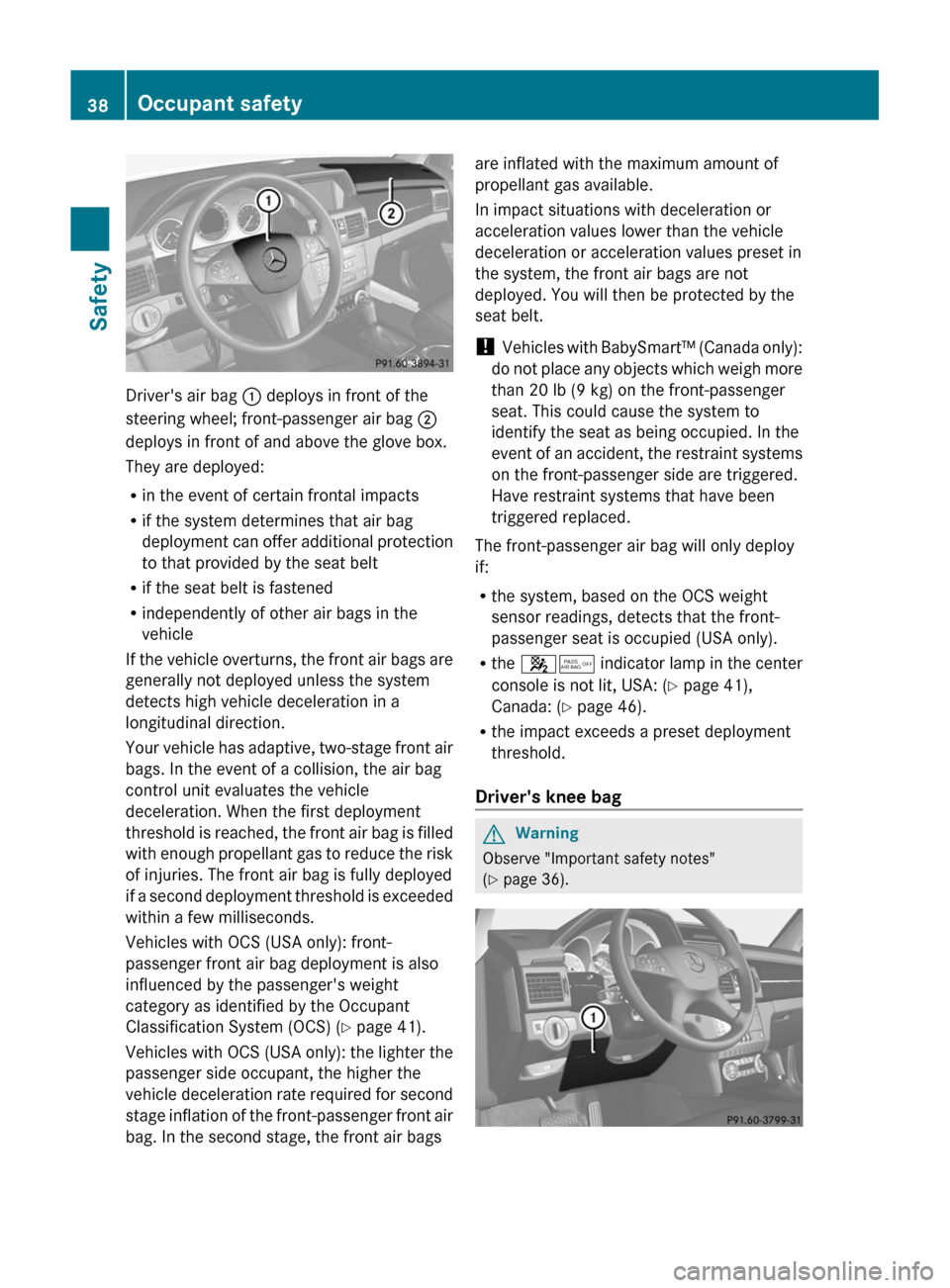
Driver's air bag : deploys in front of the
steering wheel; front-passenger air bag ;
deploys in front of and above the glove box.
They are deployed:
Rin the event of certain frontal impacts
Rif the system determines that air bag
deployment can offer additional protection
to that provided by the seat belt
Rif the seat belt is fastened
Rindependently of other air bags in the
vehicle
If the vehicle overturns, the front air bags are
generally not deployed unless the system
detects high vehicle deceleration in a
longitudinal direction.
Your vehicle has adaptive, two-stage front air
bags. In the event of a collision, the air bag
control unit evaluates the vehicle
deceleration. When the first deployment
threshold is reached, the front air bag is filled
with enough propellant gas to reduce the risk
of injuries. The front air bag is fully deployed
if a second deployment threshold is exceeded
within a few milliseconds.
Vehicles with OCS (USA only): front-
passenger front air bag deployment is also
influenced by the passenger's weight
category as identified by the Occupant
Classification System (OCS) (Y page 41).
Vehicles with OCS (USA only): the lighter the
passenger side occupant, the higher the
vehicle deceleration rate required for second
stage inflation of the front-passenger front air
bag. In the second stage, the front air bags
are inflated with the maximum amount of
propellant gas available.
In impact situations with deceleration or
acceleration values lower than the vehicle
deceleration or acceleration values preset in
the system, the front air bags are not
deployed. You will then be protected by the
seat belt.
! Vehicles with BabySmart™ (Canada only):
do not place any objects which weigh more
than 20 lb (9 kg) on the front-passenger
seat. This could cause the system to
identify the seat as being occupied. In the
event of an accident, the restraint systems
on the front-passenger side are triggered.
Have restraint systems that have been
triggered replaced.
The front-passenger air bag will only deploy
if:
Rthe system, based on the OCS weight
sensor readings, detects that the front-
passenger seat is occupied (USA only).
Rthe 45 indicator lamp in the center
console is not lit, USA: (Y page 41),
Canada: (Y page 46).
Rthe impact exceeds a preset deployment
threshold.
Driver's knee bag
GWarning
Observe "Important safety notes"
(Y page 36).
38Occupant safetySafety
BA 204.9 USA, CA Edition A 2011; 1; 6, en-USd2mwentsVersion: 3.0.3.62010-06-15T08:58:39+02:00 - Seite 38
Page 41 of 304
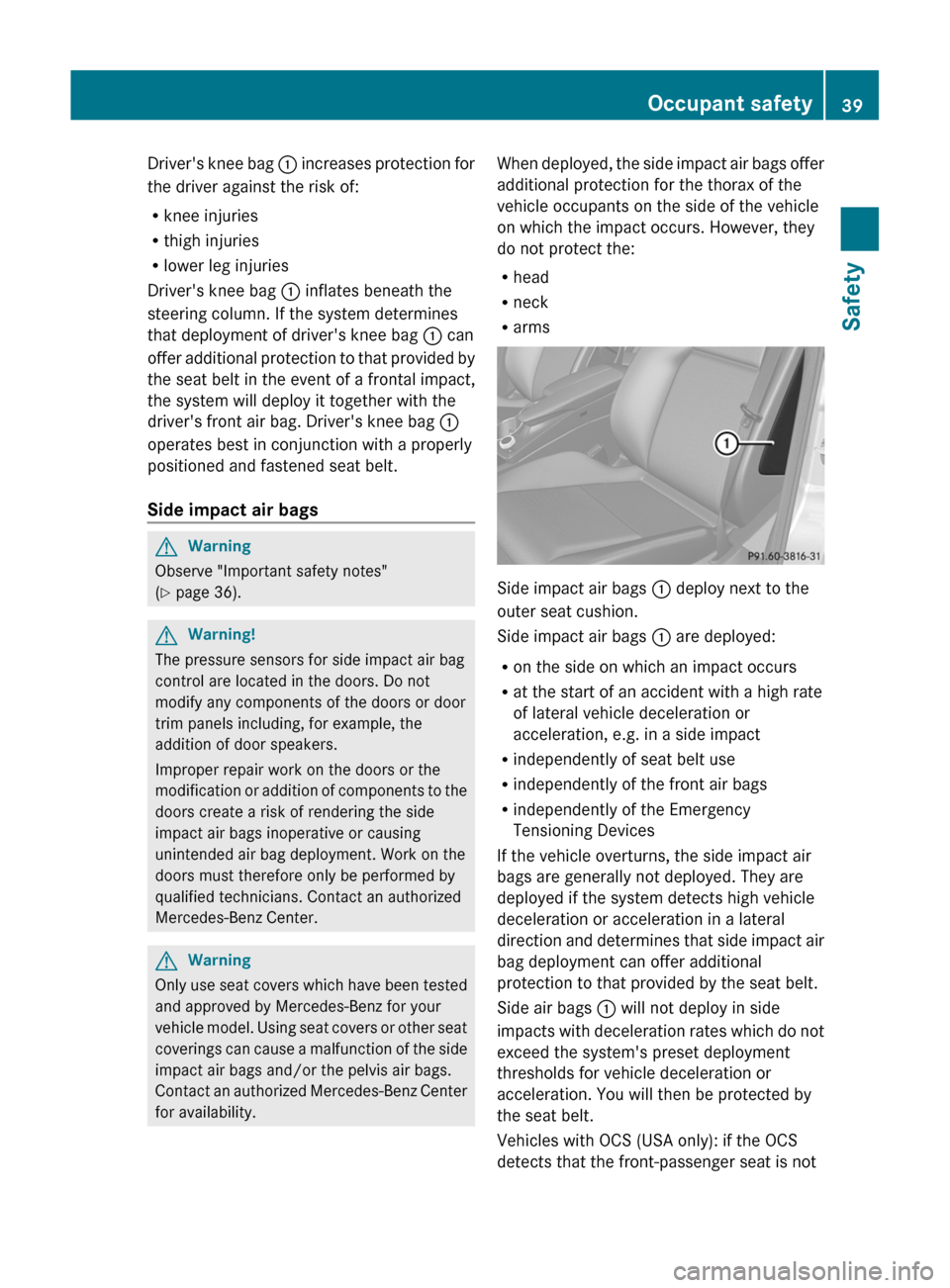
Driver's knee bag : increases protection for
the driver against the risk of:
R knee injuries
R thigh injuries
R lower leg injuries
Driver's knee bag : inflates beneath the
steering column. If the system determines
that deployment of driver's knee bag : can
offer additional protection to that provided by
the seat belt in the event of a frontal impact,
the system will deploy it together with the
driver's front air bag. Driver's knee bag :
operates best in conjunction with a properly
positioned and fastened seat belt.
Side impact air bagsGWarning
Observe "Important safety notes"
( Y page 36).
GWarning!
The pressure sensors for side impact air bag
control are located in the doors. Do not
modify any components of the doors or door
trim panels including, for example, the
addition of door speakers.
Improper repair work on the doors or the
modification or addition of components to the
doors create a risk of rendering the side
impact air bags inoperative or causing
unintended air bag deployment. Work on the
doors must therefore only be performed by
qualified technicians. Contact an authorized
Mercedes-Benz Center.
GWarning
Only use seat covers which have been tested
and approved by Mercedes-Benz for your
vehicle model. Using seat covers or other seat
coverings can cause a malfunction of the side
impact air bags and/or the pelvis air bags.
Contact an authorized Mercedes-Benz Center
for availability.
When deployed, the side impact air bags offer
additional protection for the thorax of the
vehicle occupants on the side of the vehicle
on which the impact occurs. However, they
do not protect the:
R head
R neck
R arms
Side impact air bags : deploy next to the
outer seat cushion.
Side impact air bags : are deployed:
R on the side on which an impact occurs
R at the start of an accident with a high rate
of lateral vehicle deceleration or
acceleration, e.g. in a side impact
R independently of seat belt use
R independently of the front air bags
R independently of the Emergency
Tensioning Devices
If the vehicle overturns, the side impact air
bags are generally not deployed. They are
deployed if the system detects high vehicle
deceleration or acceleration in a lateral
direction and determines that side impact air
bag deployment can offer additional
protection to that provided by the seat belt.
Side air bags : will not deploy in side
impacts with deceleration rates which do not
exceed the system's preset deployment
thresholds for vehicle deceleration or
acceleration. You will then be protected by
the seat belt.
Vehicles with OCS (USA only): if the OCS
detects that the front-passenger seat is not
Occupant safety39SafetyBA 204.9 USA, CA Edition A 2011; 1; 6, en-USd2mwentsVersion: 3.0.3.62010-06-15T08:58:39+02:00 - Seite 39Z
Page 42 of 304
occupied and the front-passenger seat belt is
not fastened (the belt tongue is not engaged
in the seat belt buckle), the side impact air
bag on the front-passenger side will not
deploy. The side impact air bag on the front-
passenger side will deploy if the front-
passenger seat belt is fastened, regardless of
whether the front-passenger seat is occupied
or not.
! Vehicles with BabySmart™ (Canada only):
do not place any objects which weigh more
than 20 lb (9 kg) on the front-passenger
seat. This could cause the system to
identify the seat as being occupied. In the
event of an accident, the restraint systems
on the front-passenger side are triggered.
Have restraint systems that have been
triggered replaced.
Pelvis air bags
GWarning
Observe "Important safety notes"
(Y page 36).
GWarning
Only use seat covers which have been tested
and approved by Mercedes-Benz for your
vehicle model. Using seat covers or other seat
coverings can cause a malfunction of the side
impact air bags and/or the pelvis air bags.
Contact an authorized Mercedes-Benz Center
for availability.
Pelvis air bag deployment enhances the level
of protection of the vehicle occupants on the
side of the vehicle on which the impact
occurs.
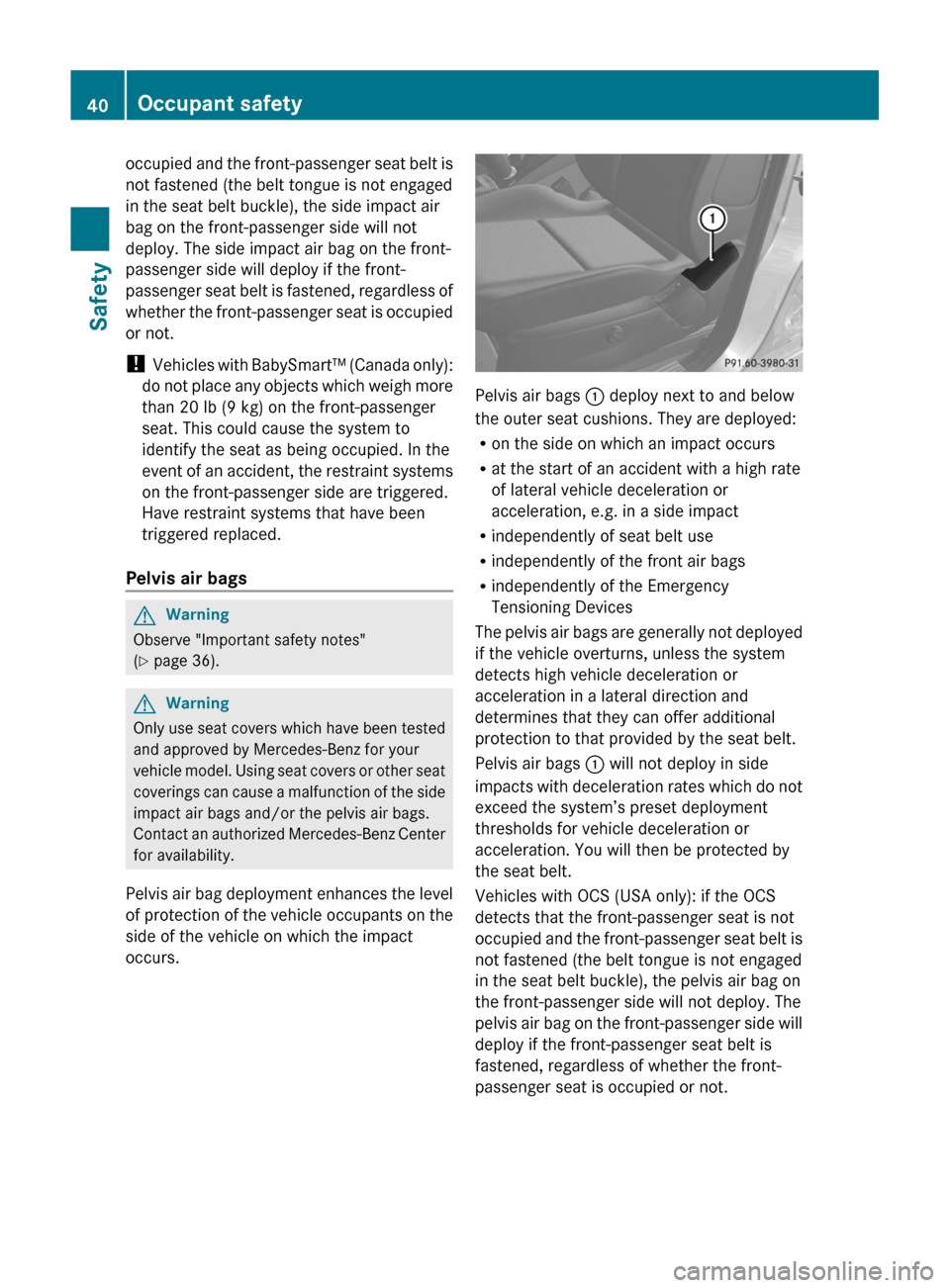
Pelvis air bags : deploy next to and below
the outer seat cushions. They are deployed:
Ron the side on which an impact occurs
Rat the start of an accident with a high rate
of lateral vehicle deceleration or
acceleration, e.g. in a side impact
Rindependently of seat belt use
Rindependently of the front air bags
Rindependently of the Emergency
Tensioning Devices
The pelvis air bags are generally not deployed
if the vehicle overturns, unless the system
detects high vehicle deceleration or
acceleration in a lateral direction and
determines that they can offer additional
protection to that provided by the seat belt.
Pelvis air bags : will not deploy in side
impacts with deceleration rates which do not
exceed the system’s preset deployment
thresholds for vehicle deceleration or
acceleration. You will then be protected by
the seat belt.
Vehicles with OCS (USA only): if the OCS
detects that the front-passenger seat is not
occupied and the front-passenger seat belt is
not fastened (the belt tongue is not engaged
in the seat belt buckle), the pelvis air bag on
the front-passenger side will not deploy. The
pelvis air bag on the front-passenger side will
deploy if the front-passenger seat belt is
fastened, regardless of whether the front-
passenger seat is occupied or not.
40Occupant safetySafety
BA 204.9 USA, CA Edition A 2011; 1; 6, en-USd2mwentsVersion: 3.0.3.62010-06-15T08:58:39+02:00 - Seite 40
Page 43 of 304
Window curtain air bagsGWarning
Observe "Important safety notes"
(Y page 36).
The window curtain air bags enhance the level
of protection for the head (but not chest or
arms) of the vehicle occupants on the side of
the vehicle on which the impact occurs.
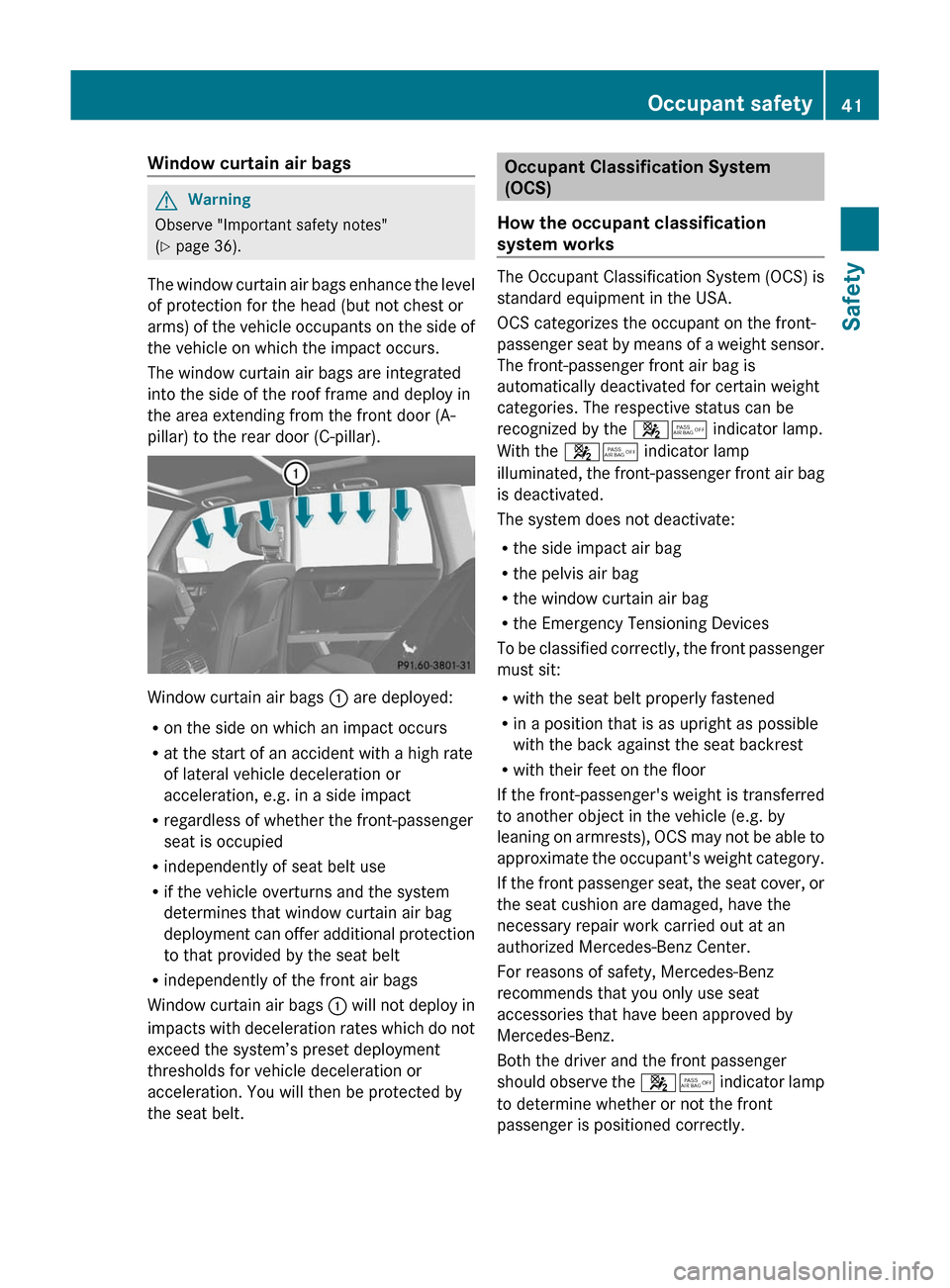
The window curtain air bags are integrated
into the side of the roof frame and deploy in
the area extending from the front door (A-
pillar) to the rear door (C-pillar).
Window curtain air bags : are deployed:
Ron the side on which an impact occurs
Rat the start of an accident with a high rate
of lateral vehicle deceleration or
acceleration, e.g. in a side impact
Rregardless of whether the front-passenger
seat is occupied
Rindependently of seat belt use
Rif the vehicle overturns and the system
determines that window curtain air bag
deployment can offer additional protection
to that provided by the seat belt
Rindependently of the front air bags
Window curtain air bags : will not deploy in
impacts with deceleration rates which do not
exceed the system’s preset deployment
thresholds for vehicle deceleration or
acceleration. You will then be protected by
the seat belt.
Occupant Classification System
(OCS)
How the occupant classification
system works
The Occupant Classification System (OCS) is
standard equipment in the USA.
OCS categorizes the occupant on the front-
passenger seat by means of a weight sensor.
The front-passenger front air bag is
automatically deactivated for certain weight
categories. The respective status can be
recognized by the 45 indicator lamp.
With the 45 indicator lamp
illuminated, the front-passenger front air bag
is deactivated.
The system does not deactivate:
Rthe side impact air bag
Rthe pelvis air bag
Rthe window curtain air bag
Rthe Emergency Tensioning Devices
To be classified correctly, the front passenger
must sit:
Rwith the seat belt properly fastened
Rin a position that is as upright as possible
with the back against the seat backrest
Rwith their feet on the floor
If the front-passenger's weight is transferred
to another object in the vehicle (e.g. by
leaning on armrests), OCS may not be able to
approximate the occupant's weight category.
If the front passenger seat, the seat cover, or
the seat cushion are damaged, have the
necessary repair work carried out at an
authorized Mercedes-Benz Center.
For reasons of safety, Mercedes-Benz
recommends that you only use seat
accessories that have been approved by
Mercedes-Benz.
Both the driver and the front passenger
should observe the 45 indicator lamp
to determine whether or not the front
passenger is positioned correctly.
Occupant safety41SafetyBA 204.9 USA, CA Edition A 2011; 1; 6, en-USd2mwentsVersion: 3.0.3.62010-06-15T08:58:39+02:00 - Seite 41Z
Page 44 of 304
GWarning
If the 45 indicator lamp illuminates
when an adult or someone larger than a small
individual is in the front-passenger seat, have
the front passenger reposition himself or
herself in the seat until the 45
indicator lamp goes out.
In the event of a collision, the air bag control
unit will not allow front-passenger front air
bag deployment when the OCS has classified
the front-passenger seat occupant as
weighing as much as or less than a typical 12-
month-old child in a standard child restraint
or if the front-passenger seat is classified as
being empty.
When the OCS senses that the front-
passenger seat occupant is classified as
being up to or less than the weight of a typical
12-month-old child in a standard child
restraint, the 45 indicator lamp will
illuminate when the engine is started and
remain illuminated, indicating that the front-
passenger front air bag is deactivated.
When the OCS senses that the front-
passenger seat is classified as being empty,
the 45 indicator lamp will illuminate
when the engine is started and remain
illuminated, indicating that the front-
passenger front air bag is deactivated.
When the OCS senses that the front-
passenger seat occupant is classified as
being heavier than the weight of a typical 12-
month-old child seated in a standard child
restraint or as being a small individual (such
as a young teenager or a small adult), the
45 indicator lamp will illuminate for
approximately 6 seconds when the engine is
started and then, depending on occupant
weight sensor readings from the front-
passenger seat, remain illuminated or go out.
With the 45 indicator lamp
illuminated, the front-passenger front air bag
is deactivated. With the 45 indicator
lamp out, the front-passenger front air bag is
activated.
When the OCS senses that the front-
passenger seat occupant is classified as an
adult or someone larger than a small
individual, the 45 indicator lamp will
illuminate for approximately 6 seconds when
the engine is started and then go out,
indicating that the front-passenger front air
bag is activated.
If the 45 indicator lamp is illuminated,
the front-passenger front air bag is
deactivated and will not be deployed.
If the 45 indicator lamp is not
illuminated, the front-passenger front air bag
is activated and will be deployed:
R in the event of certain frontal impacts
R if impact exceeds a preset deployment
threshold
R independently of the side impact air bags
If the front-passenger front air bag is
deployed, the rate of inflation will be
influenced by:
R the rate of relevant vehicle deceleration as
assessed by the air bag control unit
R the front passenger's weight category as
identified by OCS
For further information, see the section
regarding air bag display messages
( Y page 179).GWarning
According to accident statistics, children are
safer when properly restrained on the rear
seats than on the front-passenger seat. Thus,
we strongly recommend that children be
placed in the rear seats whenever possible.
Regardless of seating position, children 12
years old and under must be seated and
properly secured in an appropriate infant
restraint, toddler restraint, or booster seat
recommended for the size and weight of the
child.
The infant or child restraint must be properly
secured with the vehicle's seat belt, the seat
belt and Top Tether strap, or lower anchors
42Occupant safetySafety
BA 204.9 USA, CA Edition A 2011; 1; 6, en-USd2mwentsVersion: 3.0.3.62010-06-15T08:58:39+02:00 - Seite 42
Page 52 of 304
pelvis air bags may be prevented from
deploying.
Contact an authorized Mercedes-Benz Center
for availability.
If the NECK-PRO head restraints have been
triggered in an accident, you must reset the
NECK-PRO head restraints on the driver's and
front-passenger seat (Y page 50).
Otherwise, the additional protection will not
be available in the event of another rear-end
collision. You can recognize that NECK-PRO
head restraints have been triggered by the
fact that they have moved forwards and can
no longer be adjusted.
GWarning!
For your protection, drive only with properly
positioned head restraints.
Adjust the head restraint so that it is as close
to the head as possible and the center of the
head restraint supports the back of the head
at eye level. This will reduce the potential for
injury to the head and neck in the event of an
accident or similar situation.
Resetting triggered NECK-PRO head
restraints
GWarning
For safety reasons, have the NECK-PRO head
restraints checked at an authorized
Mercedes-Benz Center after a rear-end
collision.
GWarning
When pushing back the NECK-PRO head
restraint cushion, make sure your fingers do
not become caught between the head
restraint cushion and the cover. Failure to
observe this could result in injuries.
iResetting the NECK-PRO head restraints
requires a lot of strength. If you have
difficulty resetting the NECK-PRO head
restraints, have this work carried out at a
qualified specialist workshop, e.g. an
authorized Mercedes-Benz Center.
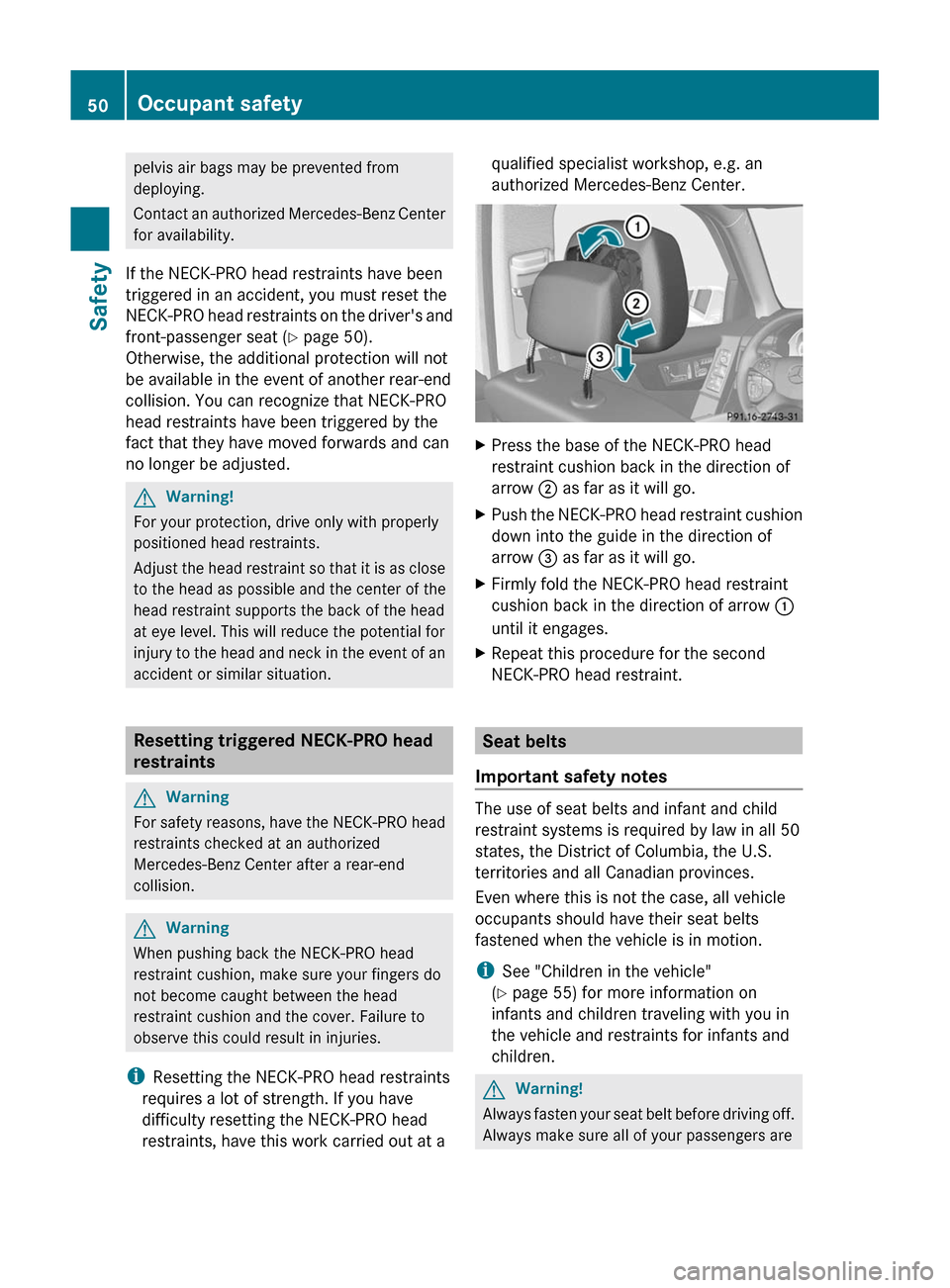
XPress the base of the NECK-PRO head
restraint cushion back in the direction of
arrow ; as far as it will go.
XPush the NECK-PRO head restraint cushion
down into the guide in the direction of
arrow = as far as it will go.
XFirmly fold the NECK-PRO head restraint
cushion back in the direction of arrow :
until it engages.
XRepeat this procedure for the second
NECK-PRO head restraint.
Seat belts
Important safety notes
The use of seat belts and infant and child
restraint systems is required by law in all 50
states, the District of Columbia, the U.S.
territories and all Canadian provinces.
Even where this is not the case, all vehicle
occupants should have their seat belts
fastened when the vehicle is in motion.
iSee "Children in the vehicle"
(Y page 55) for more information on
infants and children traveling with you in
the vehicle and restraints for infants and
children.
GWarning!
Always fasten your seat belt before driving off.
Always make sure all of your passengers are
50Occupant safetySafety
BA 204.9 USA, CA Edition A 2011; 1; 6, en-USd2mwentsVersion: 3.0.3.62010-06-15T08:58:39+02:00 - Seite 50