Back MERCEDES-BENZ GLK-Class 2015 X204 Owner's Manual
[x] Cancel search | Manufacturer: MERCEDES-BENZ, Model Year: 2015, Model line: GLK-Class, Model: MERCEDES-BENZ GLK-Class 2015 X204Pages: 386, PDF Size: 7.16 MB
Page 7 of 386
Service message ............................ 304
Special service requirements ......... 305
ATA (Anti-Theft Alarm system)
Activating/deactivating ................... 75
Function ........................................... 75
Switching off the alarm .................... 75
ATTENTION ASSIST
Activating/deactivating ................. 229
Display message ............................ 251
Function/note s............................. 202
Audio menu (on-board com-
puter) .................................................. 226
Audio system see separate operating instructions
Authorized Mercedes-Benz Center
see Qualified specialist workshop
Authorized workshop
see Qualified specialist workshop
AUTO lights
Display message ............................ 246
see Lights
Automatic car wash (care) ............... 306
Automatic engine start (ECO start/
stop function) .................................... 153
Automatic engine switch-off (ECO
start/stop function) .......................... 153
Automatic headlamp mode .............. 117
Automatic transmission Accelerator pedal position ............. 159
Automatic drive program ............... 160
Changing gear ............................... 159
DIRECT SELECT lever ..................... 156
Display message ............................ 258
Driving tips .................................... 159
Emergency running mode .............. 162
Engaging drive position .................. 158
Engaging neutral ............................ 157
Engaging park position automati-
cally ............................................... 157
Engaging reverse gear ................... 157
Engaging the park position ............ 157
Kickdown ....................................... 159
Manual drive progra m.................... 160
Overview ........................................ 156
Problem (malfunction) ................... 162
Program selector button ................ 159
Pulling away ................................... 151 Starting the engine ........................ 151
Steering wheel paddle shifters ...... 160
Trailer towing ................................. 159
Transmission position display ........ 157
Transmission positions .................. 158
Automatic transmission emer-
gency mode ....................................... 162 B
Backup lamp Changing bulb s.............................. 125
Display message ............................ 245
Bag hook ............................................ 278
Ball coupling Installing ........................................ 214
Removing ....................................... 217
Storing ........................................... 217
BAS (Brake Assist System) ................. 69
BAS PLUS (Brake Assist System
PLUS) .................................................... 69
Battery (SmartKey) Checking .......................................... 81
Important safety notes .................... 80
Replacing ......................................... 81
Battery (vehicle)
Charging ........................................ 321
Display message ............................ 249
Important safety notes .................. 319
Jump starting ................................. 323
Belt
see Seat belts
Belt force limiter
Activation ......................................... 60
Function ........................................... 60
Blind Spot Assist
Activating/deactivating ................. 229
Display message ............................ 253
Notes/function .............................. 203
Trailer towing ................................. 205
see Active Blind Spot Assist
BlueTEC (DEF) .................................... 376
BlueTEC ®
Adding DEF .................................... 166
Brake Assist
see BAS (Brake Assist System) Index
5
Page 12 of 386
Starting the engine with the
SmartKey ....................................... 151
Starting with KEYLESS-GO ............. 151
Switching off .................................. 168
Tow-starting (vehicle) ..................... 328
Engine electronics
Problem (malfunction) ................... 155
Engine jump starting
see Jump starting (engine)
Engine oil
Adding ........................................... 302
Additives ........................................ 377
Checking the oil level ..................... 301
Checking the oil level using the
dipstick .......................................... 301
Display message ............................ 249
Filling capacity ............................... 377
Notes about oil grade s................... 377
Notes on oil level/consumption .... 301
Viscosity ........................................ 377
ESP ®
(Electronic Stability Pro-
gram) Deactivating/activating ................... 71
Display message ............................ 236
ETS/4ETS ........................................ 70
Function/note s................................ 70
General notes .................................. 70
Important safety information ........... 71
Trailer stabilization ........................... 72
Warning lamp ................................. 264
ETS/4ETS (Electronic Traction Sys-
tem) ...................................................... 70
Exhaust check ................................... 170
Exhaust tail pipe (cleaning instruc-
tions) .................................................. 309
Exterior lighting Setting options .............................. 116
see Lights
Exterior mirrors
Adjusting ....................................... 109
Dipping (automatic) ....................... 110
Folding in/out (automatically )....... 110
Folding in/out (electrically) ........... 110
Folding in when locking (on-board computer) ...................................... 233
Out of position (troubleshooting) ... 110
Setting ........................................... 110 Storing settings (memory func-
tion) ............................................... 112
Storing the parking position .......... 111 F
Filler cap see Fuel filler flap
Flat tire
MOExtended tire s.......................... 315
Preparing the vehicle ..................... 314
TIREFIT kit ...................................... 316
see Emergency spare wheel
Floormats ........................................... 298
Fog lamps Switching on/of f........................... 117
Folding the rear bench seat for-
wards/back ....................................... 276
Fording On flooded roads ........................... 174
Front fog lamps
Display message ............................ 245
Switching on/of f........................... 117
Fuel
Additives ........................................ 375
Consumption statistics .................. 223
Displaying the current consump-
tion ................................................ 224
Displaying the range ...................... 224
Driving tip s.................................... 170
Fuel gauge ....................................... 33
Grade (gasoline )............................ 374
Important safety notes .................. 373
Premium-grade unleaded gaso-
line ................................................. 374
Problem (malfunction) ................... 165
Quality (diesel )............................... 375
Refueling ........................................ 162
Tank content/reserve fue l............. 374
Fuel filler flap
Opening ......................................... 164
Fuel filter (display message) ............ 250
Fuel level Calling up the range (on-board
computer) ...................................... 224
Fuel tank
Capacity ........................................ 374
Problem (malfunction) ................... 165 10
Index
Page 18 of 386
Route guidance (navigation)
............ 225S
Safety Child restraint systems .................... 61
Occupant Classification System
(OCS) ............................................... 49
Overview of occupant safety sys-
tems ................................................ 42
Safety system
see Driving safety systems
Seat belts
Adjusting the driver's and front-
passenger seat bel t......................... 59
Adjusting the height ......................... 59
Belt force limiters ............................ 60
center rear-compartment sea t......... 59
Cleaning ......................................... 312
Correct usage .................................. 57
Emergency Tensioning Devices ........ 60
Fastening ......................................... 58
Important safety guidelines ............. 56
Releasing ......................................... 59
Safety guidelines ............................. 43
Switching belt adjustment on/off
(on-board computer) ...................... 233
Warning lamp ................................. 261
Warning lamp (function) ................... 60
Seats
Adjusting (electrically) ................... 102
Adjusting lumbar support .............. 104
Adjusting the 4-way lumbar sup-
port ................................................ 105
Adjusting the head restraint .......... 102
Cleaning the cover ......................... 311
Correct driver's seat position ........ 100
Folding the backrest (rear com-
partment) forwards/back .............. 276
Folding the rear bench seat for-
wards/back ................................... 276
Important safety notes .................. 101
Seat heating problem .................... 106
Storing settings (memory func-
tion) ............................................... 112
Switching seat heating on/of f....... 105
Sensors (cleaning instructions) ....... 309Service Center
see Qualified specialist workshop
Service menu (on-board com-
puter) .................................................. 230
Service products Brake fluid ..................................... 377
Coolant (engine) ............................ 378
DEF special additives ..................... 376
Engine oil ....................................... 377
Fuel ................................................ 373
Important safety notes .................. 373
Refrigerant (air-conditioning sys-
tem) ............................................... 379
Washer fluid ................................... 379
Settings
Factory (on-board computer) ......... 234
On-board compute r....................... 230
Setting the air distribution ............... 140
Setting the airflow ............................ 141
Side impact air bag ............................. 47
Side marker lamp (display mes-
sage) ................................................... 245
Side windows Cleaning ......................................... 308
Convenience closing feature ............ 92
Convenience opening feature .......... 92
Important safety information ........... 90
Opening/closing .............................. 91
Problem (malfunction) ..................... 93
Resetting ......................................... 93
Sliding sunroof
see Panorama roof with power
tilt/sliding panel
SmartKey
Changing the battery ....................... 81
Changing the programming ............. 79
Checking the battery ....................... 81
Convenience closing feature ............ 92
Convenience opening feature .......... 92
Display message ............................ 259
Door central locking/unlocking ....... 78
Important safety notes .................... 78
Loss ................................................. 82
Mechanical key ................................ 80
Positions (ignition lock) ................. 149
Problem (malfunction) ..................... 82
Starting the engine ........................ 151 16
Index
Page 37 of 386
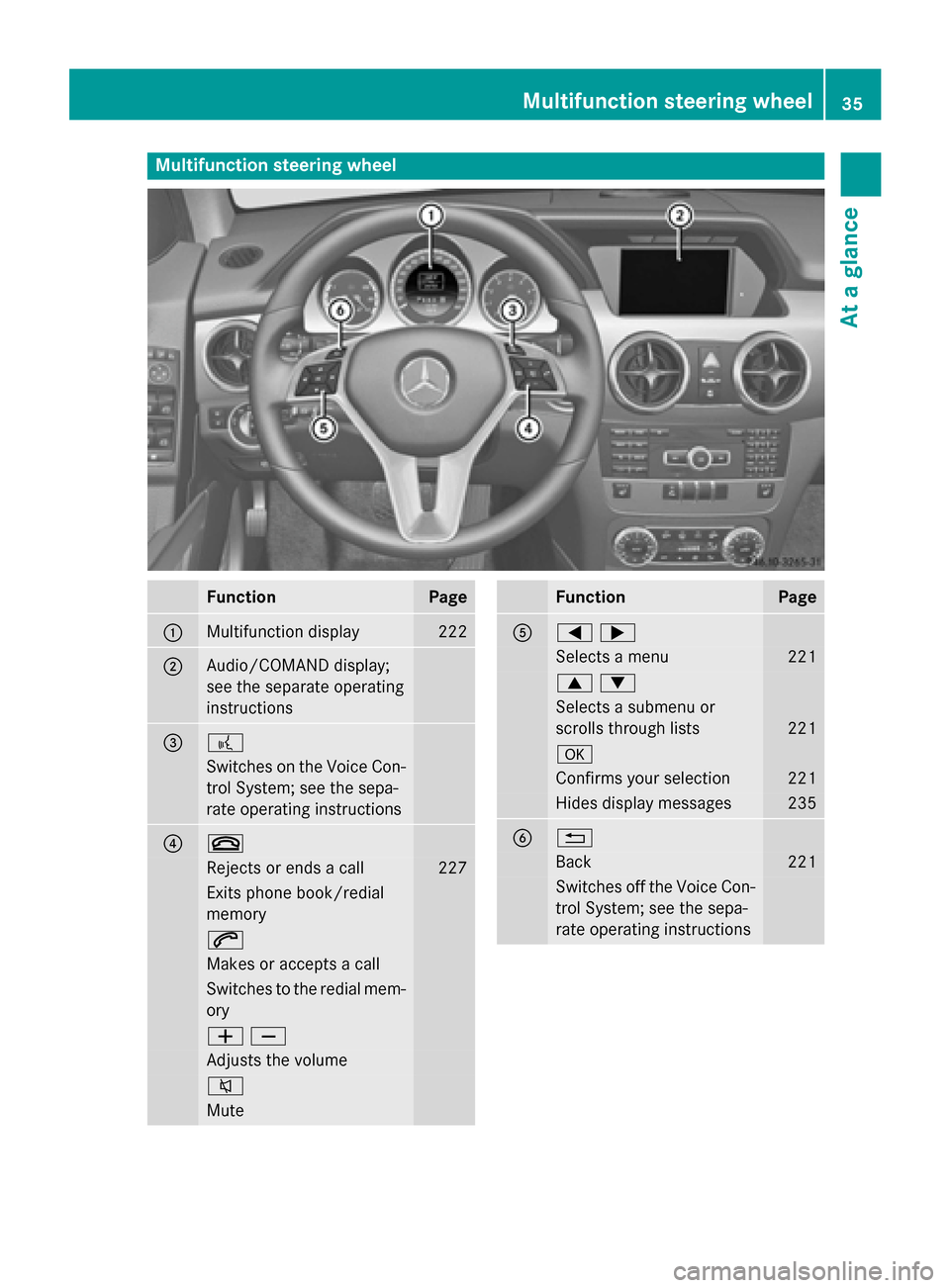
Multifunction steering wheel
Function Page
0043
Multifunction display 222
0044
Audio/COMAND display;
see the separate operating
instructions 0087 0059
Switches on the Voice Con-
trol System; see the sepa-
rate operating instructions 0085 0076
Rejects or ends a call 227
Exits phone book/redial
memory
0061
Makes or accepts a call
Switches to the redial mem-
ory 00810082
Adjusts the volume
0063
Mute Function Page
0083
00590065
Selects a menu 221
00630064
Selects a submenu or
scrolls through lists
221
0076
Confirms your selection 221
Hides display messages 235
0084 0038
Back 221
Switches off the Voice Con-
trol System; see the sepa-
rate operating instructions Multifunction steering wheel
35At a glance
Page 46 of 386
cover, outer sides of the seat backrests,
door trim panels, or door frame trims.
R Do not install additional electrical/elec-
tronic equipment on or near SRS compo-
nents and wiring.
R Keep area between air bags and occupants
free of objects (e.g. packages, purses,
umbrellas, etc.).
R Do not hang items such as coat hangers
from the coat hooks or handles over the
door. These items may be thrown around in the vehicle and cause head and other inju-
ries when the window curtain air bag is
deployed.
R Air bag system components will be hot after
an air bag has inflated. Do not touch them.
R Never place your feet on the instrument
panel, dashboard, or on the seat. Always
keep both feet on the floor in front of the
seat.
R Improper repair work on the SRS creates a
risk of rendering the SRS inoperative or
causing unintended air bag deployment.
Work on the SRS must therefore only be
performed by qualified technicians. Con-
tact an authorized Mercedes-Benz Center.
R For your protection and the protection of
others, when scrapping the air bag unit or
ETD, our safety instructions must be fol-
lowed. These instructions are available
from any authorized Mercedes-Benz Cen-
ter.
R Given the considerable deployment speed,
required inflation volume, and the material
of the air bags, there is the possibility of
abrasions or other, potentially more serious injuries resulting from air bag deployment.
If you sell your vehicle, Mercedes-Benz
strongly recommends that you inform the
subsequent owner that the vehicle is equip-
ped with SRS. Also, refer them to the appli-
cable section in the Operator's Manual. Air bags
Important safety notes The air bag installation locations are identi-
fied by the AIR BAG symbol.
G
WARNING
Using unsuitable seat covers could restrict or even prevent deployment of the air bags inte- grated into the seats. Consequently, the air
bags cannot protect vehicle occupants as
they are designed to do. In addition, the func-
tion of the air bag deactivation system could
be restricted. This poses an increased risk of
injury or even fatal injury.
You should only use seat covers that have
been approved for the respective seat by
Mercedes-Benz.
You should only use seat covers that have
been approved for your vehicle by Mercedes- Benz. The seat covers must have a special
tear seam for side impact air bags. Otherwise,
the side impact air bags cannot deploy cor-
rectly and therefore cannot provide the inten- ded protection in the event of an accident. G
WARNING
The air bag parts are hot after an air bag has
been deployed. There is a risk of injury.
Do not touch the air bag parts. Have a
deployed air bag replaced at a qualified spe-
cialist workshop as soon as possible. G
WARNING
Air bags are designed to reduce the incidence of injuries and fatalities in certain situations:
R frontal impacts (driver's and front-
passenger front air bags and driver's knee
bag)
R side impacts (side impact air bags, window
curtain air bags and pelvis air bags)
R rollover (window curtain air bags)
However, no system available today can com- pletely eliminate injuries and fatalities. 44
Occupant safetySafety
Page 47 of 386
When the air bags are deployed, a small
amount of powder is released. The powder
generally does not constitute a health hazard
and does not indicate that there is a fire in the
vehicle. In order to prevent potential breath-
ing difficulties, you should leave the vehicle as soon as it is safe to do so. If you have any
breathing difficulty but cannot get out of the
vehicle after the air bag inflates, then get fresh
air by opening a window or door. G
WARNING
In order to reduce the potential danger of
injuries caused during the deployment of the
front air bags, the driver and front passenger
must always be correctly seated and wear
their seat belts.
For maximum protection in the event of a col- lision, you must always be in the normal seat
position with your back against the backrest.
Fasten your seat belt and make sure that it is
correctly positioned on your body.
As the air bag inflates with considerable
speed and force, a proper seating position
and correct positioning of the hands on the
steering wheel will help to keep you at a safe distance from the air bag. Occupants who are
not wearing their seat belt, are not seated
properly or are too close to the air bag can be seriously injured or killed by an air bag, as it
inflates with great force instantaneously:
R sit with the seat belt fastened correctly and
in a position that is as upright as possible
with your back against the backrest.
R move the driver's seat as far back as pos-
sible, still permitting proper operation of
vehicle controls. The distance from the cen- ter of the driver's chest to the center of the
air bag cover on the steering wheel must be
at least 10 inches (25 cm). You should be
able to accomplish this by adjusting the
seat and steering wheel. If you have any
difficulties, please contact an authorized
Mercedes-Benz Center.
R do not lean your head or chest close to the
steering wheel or dashboard. R
only hold the steering wheel on the outside.
Placing hands and arms inside the rim can
increase the risk and potential severity of
hand/arm injury if the driver front air bag
inflates.
R adjust the front-passenger seat as far back
as possible from the dashboard when the
seat is occupied.
R occupants, especially children, should
never place their bodies or lean their heads
in the area of the door where the side
impact air bag inflates. This could result in
serious or fatal injuries should the side
impact air bag be deployed. Always sit as
upright as possible, wear the seat belt prop-
erly and use an appropriately sized infant
restraint, toddler restraint or booster seat
recommended for the size and weight of the child.
Failure to follow these instructions can result in severe injuries to you or other occupants.
If you sell your vehicle, it is important that you
make the buyer aware of this safety informa-
tion. Be sure to give the buyer this Operator's
Manual.
If the air bags are deployed, you will hear a
bang, and a small amount of powder may also be released. Only in rare cases will the bang
affect your hearing. The powder that is
released generally does not constitute a
health hazard and does not indicate that there is a fire in the vehicle. The dust might cause
some temporary breathing difficulty for peo-
ple with asthma or other breathing trouble. To
avoid this, you may wish to get out of the
vehicle or open the windows as soon as it is
safe to do so. The 0075SRS warning lamp
lights up.
The air bags are deployed if the air bag control
unit detects the need for deployment. Only in the event of such a situation will the air bags
provide their supplemental protection.
If the driver and front passenger do not wear their seat belts, it is not possible for the air
bags to provide their supplemental protec-
tion. Occupant safety
45Safety Z
Page 51 of 386
mines that deployment can offer additional
protection to that provided by the seat belt.
Pelvis air bags 0043will not deploy in side
impacts which do not exceed the system's
preset deployment thresholds for lateral
acceleration/deceleration. You will then be
protected by the fastened seat belt.
The pelvis air bag on the front-passenger side is not deployed in the following situations:
R OCS has detected that the front-passenger
seat is unoccupied.
R the front-passenger seat belt is not fas-
tened.
The pelvis air bag on the front-passenger side will deploy if the front-passenger seat belt is
fastened, regardless of whether the front-
passenger seat is occupied or not.
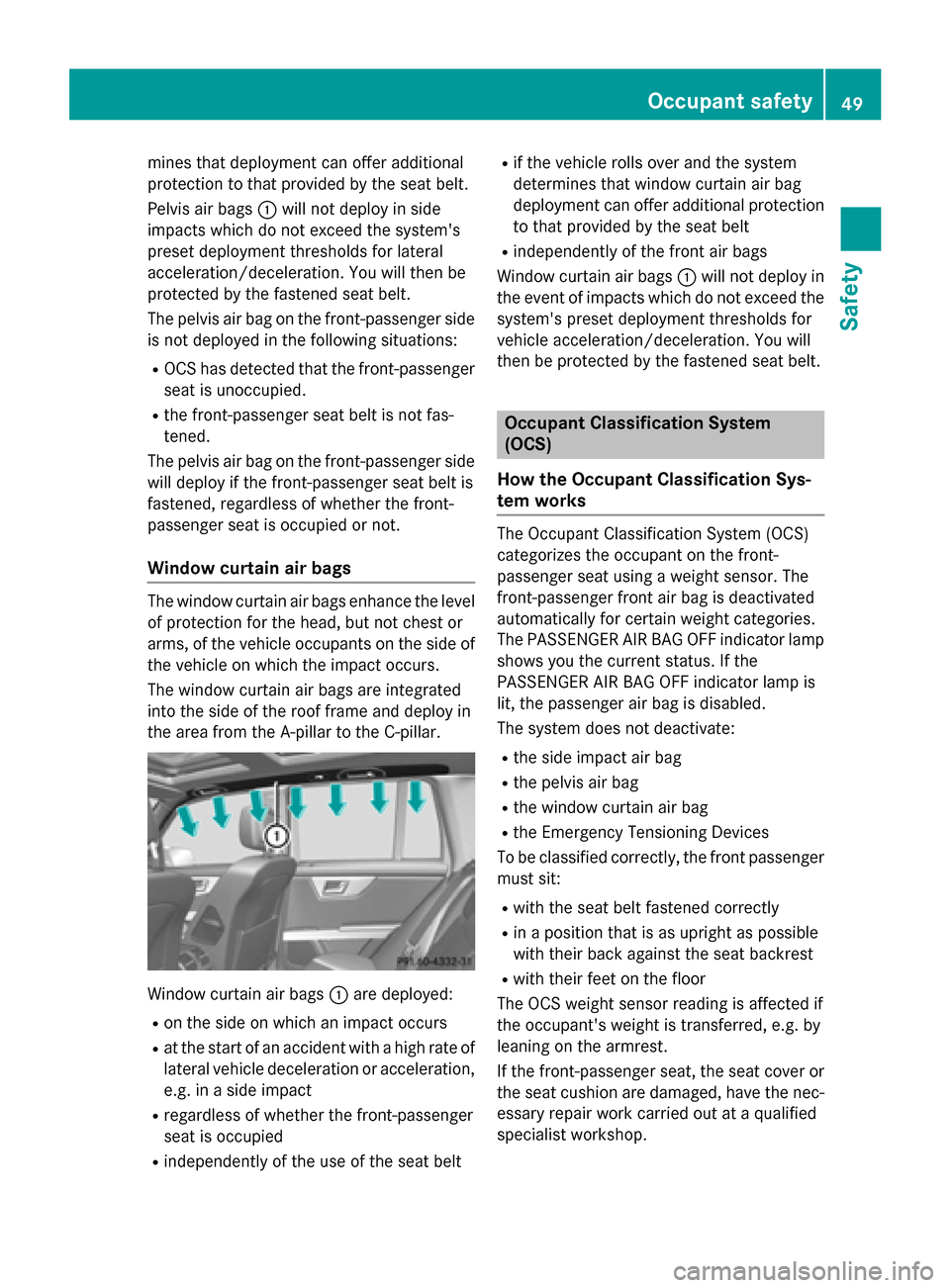
Window curtain air bags The window curtain air bags enhance the level
of protection for the head, but not chest or
arms, of the vehicle occupants on the side ofthe vehicle on which the impact occurs.
The window curtain air bags are integrated
into the side of the roof frame and deploy in
the area from the A-pillar to the C-pillar. Window curtain air bags
0043are deployed:
R on the side on which an impact occurs
R at the start of an accident with a high rate of
lateral vehicle deceleration or acceleration,
e.g. in a side impact
R regardless of whether the front-passenger
seat is occupied
R independently of the use of the seat belt R
if the vehicle rolls over and the system
determines that window curtain air bag
deployment can offer additional protection
to that provided by the seat belt
R independently of the front air bags
Window curtain air bags 0043will not deploy in
the event of impacts which do not exceed the system's preset deployment thresholds for
vehicle acceleration/deceleration. You will
then be protected by the fastened seat belt. Occupant Classification System
(OCS)
How the Occupant Classification Sys-
tem works The Occupant Classification System (OCS)
categorizes the occupant on the front-
passenger seat using a weight sensor. The
front-passenger front air bag is deactivated
automatically for certain weight categories.
The PASSENGER AIR BAG OFF indicator lamp
shows you the current status. If the
PASSENGER AIR BAG OFF indicator lamp is
lit, the passenger air bag is disabled.
The system does not deactivate:
R the side impact air bag
R the pelvis air bag
R the window curtain air bag
R the Emergency Tensioning Devices
To be classified correctly, the front passenger
must sit:
R with the seat belt fastened correctly
R in a position that is as upright as possible
with their back against the seat backrest
R with their feet on the floor
The OCS weight sensor reading is affected if
the occupant's weight is transferred, e.g. by
leaning on the armrest.
If the front-passenger seat, the seat cover or the seat cushion are damaged, have the nec- essary repair work carried out at a qualified
specialist workshop. Occupant safety
49Safety Z
Page 53 of 386
toddler restraint, or booster seat recommen-
ded for the size and weight of the child.
The infant or child restraint must be properly
secured with the vehicle's seat belt, the seat
belt and Top Tether strap, or lower anchors
and Top Tether strap, fully in accordance with the child seat manufacturer's instructions.
Occupants, especially children, should always
sit as upright as possible, wear the seat belt
properly and use an appropriately sized infant
restraint, toddler restraint, or booster seat
recommended for the size and weight of the
child.
Children can be killed or seriously injured by
an inflating air bag. Note the following impor-
tant information when circumstances require you to place a child in the front-passenger
seat:
R Your vehicle is equipped with air bag tech-
nology designed to deactivate the front-
passenger front air bag in your vehicle
when the system senses the weight of a
typical 12-month-old child or less along
with the weight of a standard appropriate
child restraint on the front-passenger seat.
R A child in a rear-facing child restraint on the
front-passenger seat will be seriously
injured or even killed if the front-passenger front air bag inflates in a collision which
could occur under some circumstances,
even with the air bag technology installed in your vehicle. The only means to eliminate
this risk completely is never to place a child
in a rear-facing child restraint in the front-
passenger seat. We therefore strongly rec- ommend that you always place a child in a
rear-facing child restraint on the rear seat.
R If you install a rear-facing child restraint on
the front-passenger seat, make sure the
00730074 indicator lamp is illuminated,
indicating that the front-passenger front air
bag is deactivated. Should the 00730074
indicator lamp not illuminate or go out while the restraint is installed, please check
installation. Periodically check the
00730074 indicator lamp while driving to make sure that the
00730074indicator
lamp is illuminated. If the 00730074indi-
cator lamp goes out or remains out, do not transport a child on the front-passenger
seat until the system has been repaired.
A child in a rear-facing child restraint on thefront-passenger seat will be seriously
injured or even killed if the front-passenger front air bag inflates.
R If you place a child in a forward-facing child
restraint on the front-passenger seat:
- move the seat as far back as possible
- use the proper child restraint recommen-
ded for the age, size and weight of the
child
- secure child restraint with the vehicle's
seat belt according to the child seat man-
ufacturer's instructions
R For children larger than the typical 12-
month-old child, the front-passenger front
air bag may or may not be activated.
If the driver's air bag deploys, this does not
mean that the front-passenger front air bag
will also deploy.
The OCS may have detected that the seat:
R is empty or occupied by the weight of a
typical child up to twelve months old,
seated in a child restraint system.
R is occupied by a small individual, such as a
young teenager or a small adult.
R is occupied by a child in a child restraint
system whose weight is greater than that of
a typical twelve month old child.
These are examples of when the OCS deacti-
vates the front-passenger front air bag. Deac- tivation takes place although the collision ful-
fills the criteria for deploying the driver's air
bag. Occupant safety
51Safety Z
Page 54 of 386
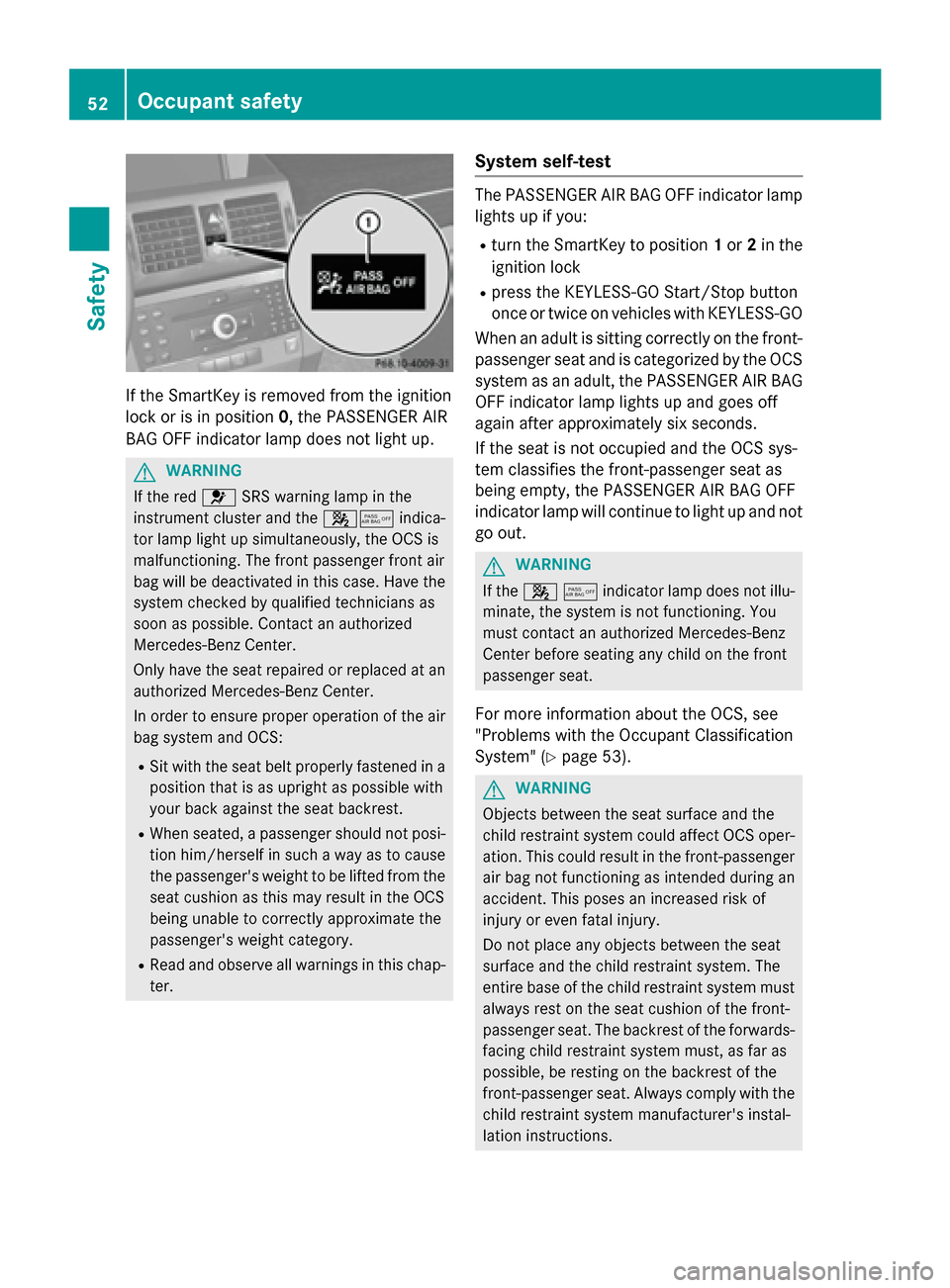
If the SmartKey is removed from the ignition
lock or is in position 0, the PASSENGER AIR
BAG OFF indicator lamp does not light up. G
WARNING
If the red 0075SRS warning lamp in the
instrument cluster and the 00730074indica-
tor lamp light up simultaneously, the OCS is
malfunctioning. The front passenger front air
bag will be deactivated in this case. Have the system checked by qualified technicians as
soon as possible. Contact an authorized
Mercedes-Benz Center.
Only have the seat repaired or replaced at an
authorized Mercedes-Benz Center.
In order to ensure proper operation of the air
bag system and OCS:
R Sit with the seat belt properly fastened in a
position that is as upright as possible with
your back against the seat backrest.
R When seated, a passenger should not posi-
tion him/herself in such a way as to cause the passenger's weight to be lifted from theseat cushion as this may result in the OCS
being unable to correctly approximate the
passenger's weight category.
R Read and observe all warnings in this chap-
ter. System self-test The PASSENGER AIR BAG OFF indicator lamp
lights up if you:
R turn the SmartKey to position 1or 2in the
ignition lock
R press the KEYLESS-GO Start/Stop button
once or twice on vehicles with KEYLESS-GO
When an adult is sitting correctly on the front-
passenger seat and is categorized by the OCS system as an adult, the PASSENGER AIR BAG
OFF indicator lamp lights up and goes off
again after approximately six seconds.
If the seat is not occupied and the OCS sys-
tem classifies the front-passenger seat as
being empty, the PASSENGER AIR BAG OFF
indicator lamp will continue to light up and not go out. G
WARNING
If the 00730074indicator lamp does not illu-
minate, the system is not functioning. You
must contact an authorized Mercedes-Benz
Center before seating any child on the front
passenger seat.
For more information about the OCS, see
"Problems with the Occupant Classification
System" (Y page 53). G
WARNING
Objects between the seat surface and the
child restraint system could affect OCS oper- ation. This could result in the front-passengerair bag not functioning as intended during an
accident. This poses an increased risk of
injury or even fatal injury.
Do not place any objects between the seat
surface and the child restraint system. The
entire base of the child restraint system must
always rest on the seat cushion of the front-
passenger seat. The backrest of the forwards- facing child restraint system must, as far as
possible, be resting on the backrest of the
front-passenger seat. Always comply with thechild restraint system manufacturer's instal-
lation instructions. 52
Occupant safetySafety
Page 55 of 386
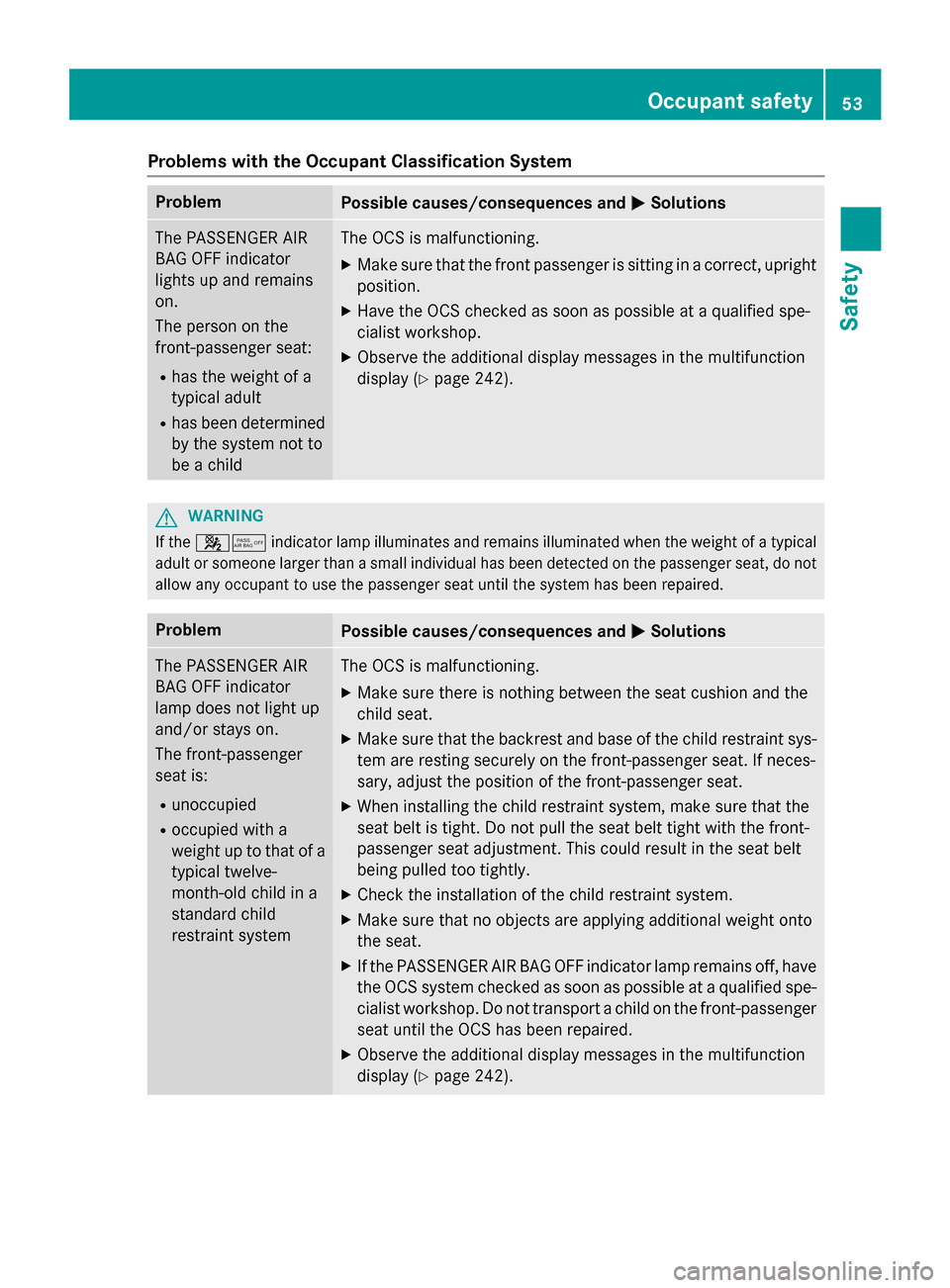
Problems with the Occupant Classification System
Problem
Possible causes/consequences and
0050
0050Solutions The PASSENGER AIR
BAG OFF indicator
lights up and remains
on.
The person on the
front-passenger seat:
R
has the weight of a
typical adult
R has been determined
by the system not to
be a child The OCS is malfunctioning.
X Make sure that the front passenger is sitting in a correct, upright
position.
X Have the OCS checked as soon as possible at a qualified spe-
cialist workshop.
X Observe the additional display messages in the multifunction
display (Y page 242). G
WARNING
If the 00730074 indicator lamp illuminates and remains illuminated when the weight of a typical
adult or someone larger than a small individual has been detected on the passenger seat, do not allow any occupant to use the passenger seat until the system has been repaired. Problem
Possible causes/consequences and
0050 0050Solutions The PASSENGER AIR
BAG OFF indicator
lamp does not light up
and/or stays on.
The front-passenger
seat is:
R unoccupied
R occupied with a
weight up to that of a typical twelve-
month-old child in a
standard child
restraint system The OCS is malfunctioning.
X Make sure there is nothing between the seat cushion and the
child seat.
X Make sure that the backrest and base of the child restraint sys-
tem are resting securely on the front-passenger seat. If neces-
sary, adjust the position of the front-passenger seat.
X When installing the child restraint system, make sure that the
seat belt is tight. Do not pull the seat belt tight with the front-
passenger seat adjustment. This could result in the seat belt
being pulled too tightly.
X Check the installation of the child restraint system.
X Make sure that no objects are applying additional weight onto
the seat.
X If the PASSENGER AIR BAG OFF indicator lamp remains off, have
the OCS system checked as soon as possible at a qualified spe-
cialist workshop. Do not transport a child on the front-passenger seat until the OCS has been repaired.
X Observe the additional display messages in the multifunction
display (Y page 242). Occupant safety
53Safety Z