ESP MERCEDES-BENZ GLS 2017 Owners Manual
[x] Cancel search | Manufacturer: MERCEDES-BENZ, Model Year: 2017, Model line: GLS, Model: MERCEDES-BENZ GLS 2017Pages: 390, PDF Size: 11.93 MB
Page 369 of 390
be required earlier. Do not change the direction
of wheel rotation.
Clean the contact surfaces of the wheel and the
brake disc thoroughly every time a wheel is rota-
ted. Check the tire pressure and, if necessary,
restart the tire pressure loss warning system or
the tire pressure monitor ( Y
page 353).
Direction of rotation Tires with a specified direction of rotation have
additional benefits, e.g. if there is a risk of hydro-
planing. These advantages can only be gained if
the tires are installed corresponding to the
direction of rotation.
An arrow on the sidewall of the tire indicates its
correct direction of rotation.
Storing wheels Store wheels that are not being used in a cool,
dry and preferably dark place. Protect the tires
from oil, grease, gasoline and diesel.
Mounting a wheel
Preparing the vehicle X
Vehicle with emergency spare wheel:
when mounting the emergency spare wheel in
the event of a flat tire, follow the additional
notes on vehicle preparation under "Flat tire"
( Y
page 331). X
Stop the vehicle on solid, non-slippery and
level ground. X
Apply the electric parking brake manually. X
Bring the front wheels into the straight-ahead
position. X
Vehicles with automatic transmission:
shift the automatic transmission to position
P . X
Vehicles with the AIRMATIC package:
make sure that the normal vehicle level is
selected ( Y
page 188).X
Vehicles with the Off-Road Engineering
package: make sure that the normal level is
selected ( Y
page 182).X
Switch off the engine. X
Vehicles without KEYLESS-GO: remove the
SmartKey from the ignition lock. X
Vehicles with KEYLESS-GO: open the driv-
er's door.
The on-board electronics now have status 0 .
This is the same as the SmartKey having been
removed. X
Vehicles with KEYLESS-GO: remove the
Start/Stop button from the ignition lock
( Y
page 138). X
If included in the vehicle equipment, remove
the tire-change tool kit from the vehicle. X
Safeguard the vehicle against rolling away.
i Apart from certain country-specific varia-
tions, vehicles are not equipped with a tire-
change tool kit. For information on which
tools are required to perform a wheel change
on your vehicle, consult an authorized
Mercedes-Benz Center.
Necessary tire-changing tools can include, for
example: R
Jack R
Wheel chock R
Lug wrench
Securing the vehicle to prevent it from
rolling away
If your vehicle is equipped with a wheel chock, it
can be found in the tire-change tool kit
( Y
page 331).
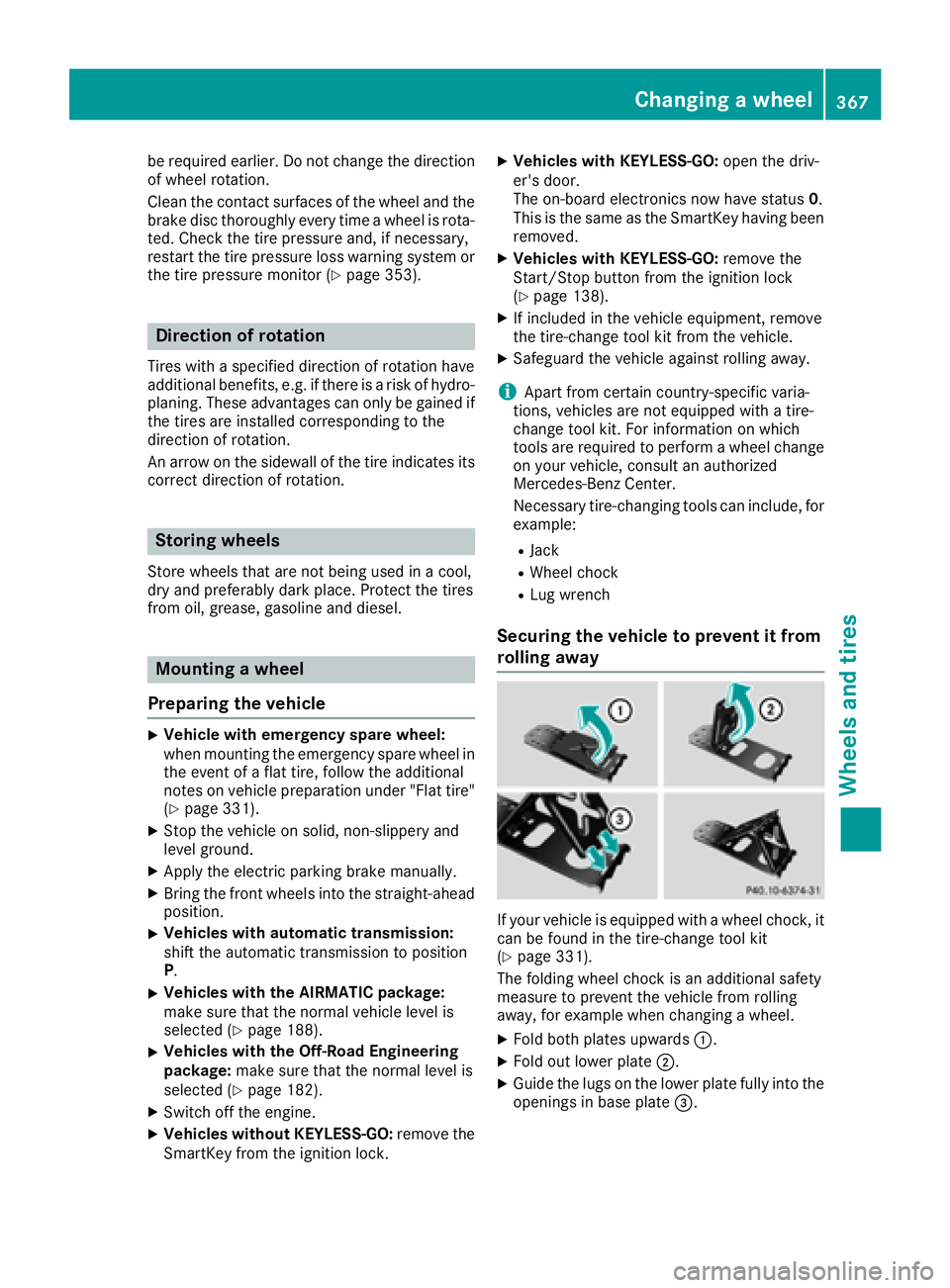
The folding wheel chock is an additional safety
measure to prevent the vehicle from rolling
away, for example when changing a wheel. X
Fold both plates upwards C .X
Fold out lower plate D .X
Guide the lugs on the lower plate fully into the
openings in base plate
Page 372 of 390
G WARNING
If you tighten the wheel bolts or wheel nuts
when the vehicle is raised, the jack could tip
over. There is a risk of injury.
Only tighten the wheel bolts or wheel nuts
when the vehicle is on the ground.
! To prevent damage to the paintwork, hold
the wheel securely against the wheel hub
while screwing in the first wheel bolt.
Always pay attention to the instructions and
safety notes in the "Changing a wheel" section
( Y
page 366).
Only use wheel bolts that have been designed
for the wheel and the vehicle. For safety rea-
sons, Mercedes-Benz recommends that you
only use wheel bolts which have been approved
for Mercedes-Benz vehicles and the respective
wheel.
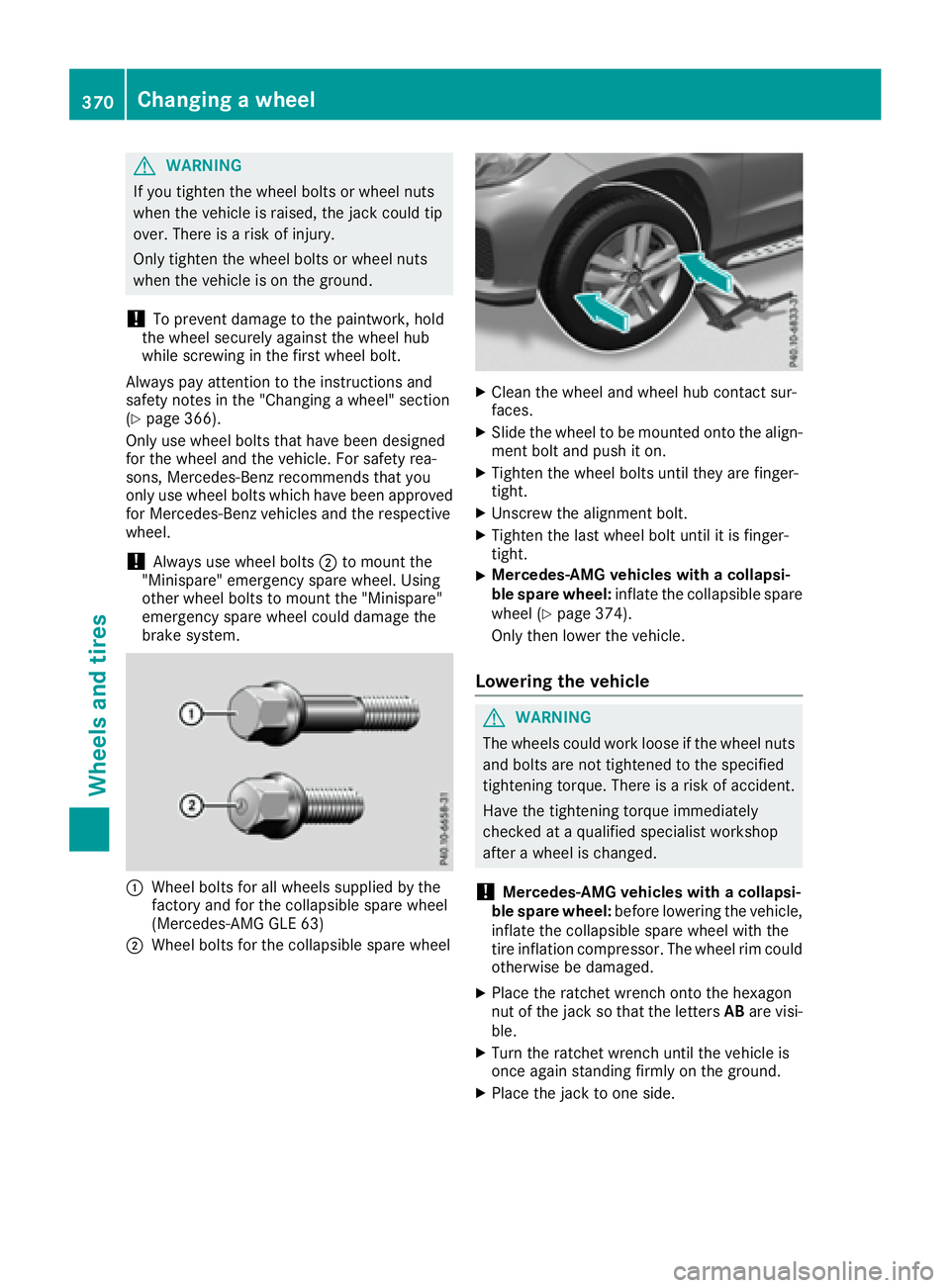
! Always use wheel bolts D to mount the
"Minispare" emergency spare wheel. Using
other wheel bolts to mount the "Minispare"
emergency spare wheel could damage the
brake system.
C
Wheel bolts for all wheels supplied by the
factory and for the collapsible spare wheel
(Mercedes-AMG GLE 63)
D
Wheel bolts for the collapsible spare wheel X
Clean the wheel and wheel hub contact sur-
faces. X
Slide the wheel to be mounted onto the align-
ment bolt and push it on. X
Tighten the wheel bolts until they are finger-
tight. X
Unscrew the alignment bolt. X
Tighten the last wheel bolt until it is finger-
tight. X
Mercedes-AMG vehicles with a collapsi-
ble spare wheel: inflate the collapsible spare
wheel ( Y
page 374).
Only then lower the vehicle.
Lowering the vehicle
G WARNING
The wheels could work loose if the wheel nuts
and bolts are not tightened to the specified
tightening torque. There is a risk of accident.
Have the tightening torque immediately
checked at a qualified specialist workshop
after a wheel is changed.
! Mercedes-AMG vehicles with a collapsi-
ble spare wheel: before lowering the vehicle,
inflate the collapsible spare wheel with the
tire inflation compressor. The wheel rim could
otherwise be damaged. X
Place the ratchet wrench onto the hexagon
nut of the jack so that the letters AB are visi-
ble. X
Turn the ratchet wrench until the vehicle is
once again standing firmly on the ground. X
Place the jack to one side.370
Changing a wheel
Wheels and tires
Page 374 of 390
Notes on the vehicle equipment – always equip
the vehicle: R
with tires of the same size on a given axle (left
and right) R
with the same type of tires at a given time
(summer tires, winter tires, MOExtended
tires)
Vehicles equipped with MOExtended tires are
not equipped with a TIREFIT kit at the factory. It
is therefore recommended that you additionally
equip your vehicle with a TIREFIT kit if you mount
tires that do not feature run-flat properties, e.g.
winter tires. A TIREFIT kit may be obtained from
a qualified specialist workshop.
Emergency spare wheel
Important safety notes
G WARNING
The wheel or tire size as well as the tire type of
the spare wheel or emergency spare wheel
and the wheel to be replaced may differ.
Mounting an emergency spare wheel may
severely impair the driving characteristics.
There is a risk of an accident.
To avoid hazardous situations: R
adapt your driving style accordingly and
drive carefully. R
never mount more than one spare wheel or
emergency spare wheel that differs in size. R
only use a spare wheel or emergency spare
wheel of a different size briefly. R
do not switch ESP ®
off.R
have a spare wheel or emergency spare
wheel of a different size replaced at the
nearest qualified specialist workshop.
Observe that the wheel and tire dimensions
as well as the tire type must be correct.
! Mercedes-AMG vehicles with
"Minispare" emergency spare wheel: only
use the "Minispare" emergency spare wheel
on the rear axle . If you mount the
"Minispare" emergency spare wheel on the
front axle, this could result in damage to the
brake system. If a tire on the front axle is defective, an intact
wheel from the rear axle must first be
replaced with the "Minispare" emergency
spare wheel. The damaged wheel on the front
axle can then be replaced by the undamaged
wheel from the rear axle.
Make sure to note the placard on the
"Minispare" emergency spare wheel.
When using an emergency spare wheel or spare
wheel of a different size, you must not exceed
the maximum speed of 50 mph (80 km/h).
Snow chains must not be mounted on emer-
gency spare wheels.
General notes You can ask for information regarding permitted
emergency spare wheels at an authorized
Mercedes-Benz Center.
Mounting the emergency spare wheel is descri-
bed under "Mounting a wheel" ( Y
page 367).
You should regularly check the pressure of the
emergency spare wheel, particularly prior to
long trips, and correct the pressure as neces-
sary ( Y
page 349). The value on the wheel is
valid.
An emergency spare wheel may also be moun-
ted against the direction of rotation. Observe
the time restriction on use as well as the speed
limitation specified on the emergency spare
wheel.
Replace the tires after six years at the latest,
regardless of wear. This also applies to the
emergency spare wheel.
When you are driving with the collapsible spare
wheel mounted, the tire pressure loss warning
system or the tire pressure monitor cannot func-
tion reliably. Only restart the tire pressure loss
warning system or tire pressure monitor when
the defective wheel has been replaced with a
new wheel.
Vehicles with tire pressure monitor: after
mounting an emergency spare wheel, the sys-
tem may still display the tire pressure of the
removed wheel for a few minutes. The value dis-
played for the mounted emergency spare wheel
is not the same as the current tire pressure of
the emergency spare wheel.372
Emergency spare wheel
Wheels and tires
Page 378 of 390
Information regarding technical data
i The dat a state d her e specifically refers to a
vehicl e wit h standard equipment. Consult an
authorize d Mercedes-Ben z Cente r for th e
dat a for all vehicl e variants and trim levels.
Vehicle electronics
Installing two-way radios and mobile
phones (RF transmitters)
G WARNIN G
The electromagneti c radiation from modifie d
or incorrectl y retrofitte d RF-transmitters can
interfere wit h th e vehicl e electronics . This can
compromise th e operational safet y of th e
vehicle. Ther e is a ris k of an accident.
You should hav e all wor k to electrical and
electronic equipmen t carried out at a qualified
specialist workshop.
G WARNIN G
The electromagneti c radiation from incor-
rectl y operate d RF transmitters can interfere
wit h th e vehicl e electronics , for example:R
if th e RF transmitte r is no t connecte d wit h
an exterio r antennaR
th e exterio r antenna has been installed
incorrectl y or is no t a low-reflection typ e
This can compromise th e operational safet y
of th e vehicle. Ther e is a ris k of an accident.
Hav e th e low-reflection exterio r antenna
mounte d at a qualified specialist workshop.
When operating RF transmitters in th e vehi-
cle , always connec t them wit h th e low-reflec -
tion exterio r antenna.
! The operating permit may be invalidated if
th e instruction s for installation and use of RF
transmitters are no t observed. In particular, th e followin g condition s must be
complied with: R
only approve d wavebands may be used. R
observ e th e maximum permissible output
in these wavebands. R
only approve d antenna position s may be
used.
Excessiv e levels of electromagneti c radiation
may caus e damag e to your healt h and th e healt h
of others. Using an exterio r antenna takes int o
accoun t curren t scientific discussion s relating
to th e possible healt h hazards that may result
from electro magneti c fi
elds.
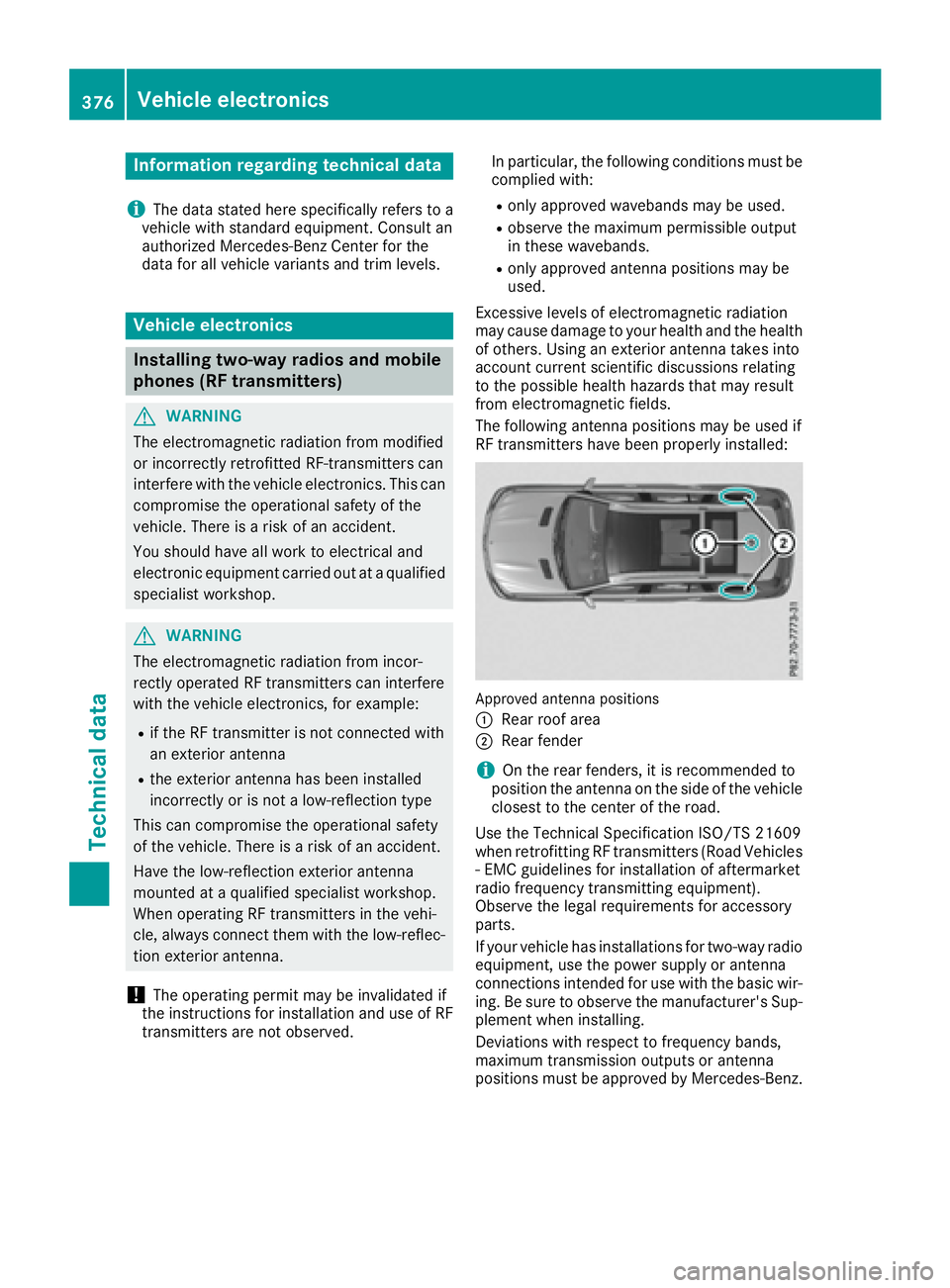
The followin g antenna position s may be used if
RF transmitters hav e been properly installed:
Approved antenna position s
C
Rear roo f areaD
Rear fender
i On th e rear fenders, it is recommended to
position th e antenna on th e side of th e vehicl e
closes t to th e center of th e road .
Use th e Technical Specification ISO/TS 2160 9
when retrofitting RF transmitters (Road Vehicles
- EM C guidelines for installation of aftermarket
radi o frequency transmitting equipment) .
Observ e th e legal requirements for accessory
parts.
If your vehicl e has installation s for two-way radi o
equipment, use th e power suppl y or antenna
connection s intended for use wit h th e basic wir-
ing . Be sur e to observ e th e manufacturer' s Sup -
plemen t when installing.
Deviation s wit h respec t to frequency bands,
maximum transmission output s or antenna
position s must be approve d by Mercedes-Benz.376
Vehicle electronics
Technical data
Page 383 of 390
DEF
Important safet y notesComply wit h th e important safet y note s fo r ser -
vic e products when handlin g DE F ( Y
page 378).
DE F is a water-soluble flui d fo r th e exhaus t gas
aftertreatmen t of diesel engines. It is:R
no t poisonousR
colorles s and odorlessR
no t flammable
Whe n you ope n th e DE F container, small
amount s of ammonia vapor may be released.
Ammoni a vapor s hav e a pungen t odo r and are
particularly irritatin g to th e skin , to mucous
membrane s and to th e eyes . You may experi-
ence a burning sensation in your eyes , nose and
throat . Coughin g and watering of th e eyes are
possible.
Do no t inhale ammonia vapors. Fil l th e DE F tank
only in well-ventilated areas.
Low outsid e temperaturesDE F freezes at a temperature of approximately
12 ‡ (-11 †). The vehicle is delivered from th e
factory equipped wit h a DE F preheatin g system.
Winte r operation can thus be guaranteed eve n
at temperature s belo w 12 ‡ (-11 †).
Additives
! Only use DE F in accordance wit h IS O
22241. Do no t use additive s wit h DE F and do
no t dilut e DE F wit h water. Thi s may destroy
th e BlueTE C exhaus t gas aftertreatmen t sys -
tem.
Purity
! Impurities in DE F (e.g. due to other servic e
products , cleanin g agents or dust ) lead to :R
increase d emission valuesR
damage to th e catalytic converterR
engin e damageR
malfunction s in th e BlueTE C exhaus t gas
aftertreatmen t syste m
Assurin g th e purit y of DE F is particularly impor -
tant wit h respec t to avoidin g malfunction s in th e
BlueTE C exhaus t gas aftertreatmen t system.
If DE F is pumped out of th e DE F tank , e.g. durin g
repair work, it mus t no t be returned to th e tank . The purit y of th e flui d can no longer be guaran-
teed.
Filling capacities Model Tota l capacity
GLS 350 d 4MATIC
10.2 US gal
(38.7 l)
Engin e oil
General notes
! Never use engin e oil or an oil filte r of a spec-
ification other than is necessary to fulfill th e
prescribed servic e intervals. Do no t chang e
th e engin e oil or oil filte r in order to achiev e
longer replacement intervals than those pre -
scribed. You could otherwise cause engin e
damage or damage to th e exhaus t gas after-
treatment.
Follow th e instruction s in th e servic e interval
display regardin g th e oil change. Otherwise ,
you may damage th e engin e and th e exhaus t
gas aftertreatment.
Whe n handlin g engin e oil, observ e th e important
safet y note s on servic e products ( Y
page 378).
The engin e oils are matched to th e performanc e
of Mercedes-Ben z engines and servic e intervals.
You should therefore only use engin e oils and oil
filters that are approved fo r vehicles wit h main -
tenance systems .
Fo r a list of approved engin e oils and oil filters ,
consult an authorized Mercedes-Ben z Center.
Or visit th e websit e
http://bevo.mercedes-benz.co m.
The table shows which engine oils have been
approved for your vehicle.Service products and filling capacities 381
Technical data Z
Page 385 of 390
Comp ly wit h the impo rtant safety notes for ser-
vice products when han dlin g coolant
( Y
page 378).
The coolant is a mixture of water and ant i-
freeze/corrosion inh ibit or. It is respon sible for
the foll owin g:R
Anti-corrosion protection R
Antifreeze protection R
Raisin g the boiling poin t
If the coolant has antifreeze protection down to
-35 ‡ (-37 †), the boilin g poin t of the coolant
during operation is appr oximately 266 ‡
(130 †).
The antifreeze concentrate /c orrosion inh ibit or
concentration in the engine co olin g system
sho uld: R
be at least 50 %. This will protect the engine
co olin g system against freezing down to
approximate ly -35 ‡ (-37 †).R
not exceed 55% (antifreeze protection down
to -49 ‡ [-45 †]). Otherwise, heat will not be
dissipat ed as effectively.
Mercedes-Benz recommen ds an antifreeze/
corrosion inh ibit or concentrate in accordance
wit h MB Spe cifications for Service Products
310.1.
i When the veh icle is first deliv ere d, it is fille d
wit h a coolant mixture that ensures adequate
antifreeze and anti-corrosion protection.
i The coolant is checked wit h every mainte-
nance interval at a qualif ied spec ialist work-
sho p.
Filling capacities Model Capacity
Mercedes ‑ AMG
vehicles Approx. 11.9 US qt
(11.3 l)
GLS 350 d 4MAT IC
Approx. 12.2 US qt
(11.5 l)
GLS 550 4MATIC
Approx. 12.0 US qt
(11.4 l)
All other mod els
Approx. 10.3 US qt
(9.7 l) Windshield washer system
Important safety notes
G WARNING
Windshield washer concentrate could ignite if
it comes into contact wit h hot engine compo-
nents or the exhaust system. There is a risk of
fire and injury.
Make sure that no windshie ld washer con-
centrate is spilled next to the filler neck.
! On ly MB SummerFit and MB WinterF it
washer fluid should be mixed together. The
spray nozzles may otherwise become
blocked.
Do not use distilled or de-ionized water. Other-
wise, the level sensor may give a false reading.
When handling washer fluid, observe the impor-
tant safety notes on service products
( Y
page 378).
At temperatures above freezing: X
Fill the washer fluid reservoir wit h a mixture of
water and windshie ld washer fluid, e.g. MB
SummerFit.
Add 1 part MB SummerFit to 100 parts water.
At temperatures below freezing: X
Fill the washer fluid reservoir wit h a mixture of
water and washer fluid, e.g. MB WinterFit.
For the correct mixing ratio refer to the infor-
mation on the antifreeze reservoir.
i Add windshie ld washer fluid, e.g. MB Sum-
merFit or MB WinterFit, to the washer fluid all
year roun d.
Climate control system refrigerant
Important safety notes The clim ate control system of your vehicle is fil-
led wit h refrigerant R ‑ 134a.
The instruction label regarding the refrigerant
type used can be found on the radiator cross
member.
! Only the refrigerant R ‑ 134a and the PAG oil
approved by Mercedes-Benz may be used.
The appr oved PAG oil may not be mixed wit h
any other PAG oil that is not appr oved forService products and filling capacities 383
Technical data Z