engine MERCEDES-BENZ GLS 2017 Owners Manual
[x] Cancel search | Manufacturer: MERCEDES-BENZ, Model Year: 2017, Model line: GLS, Model: MERCEDES-BENZ GLS 2017Pages: 390, PDF Size: 11.93 MB
Page 345 of 390
the combination switch, the hazard warning
lamp starts flashing again.
Transporting the vehicle
4MATIC vehicles/vehicles with auto-
matic transmission
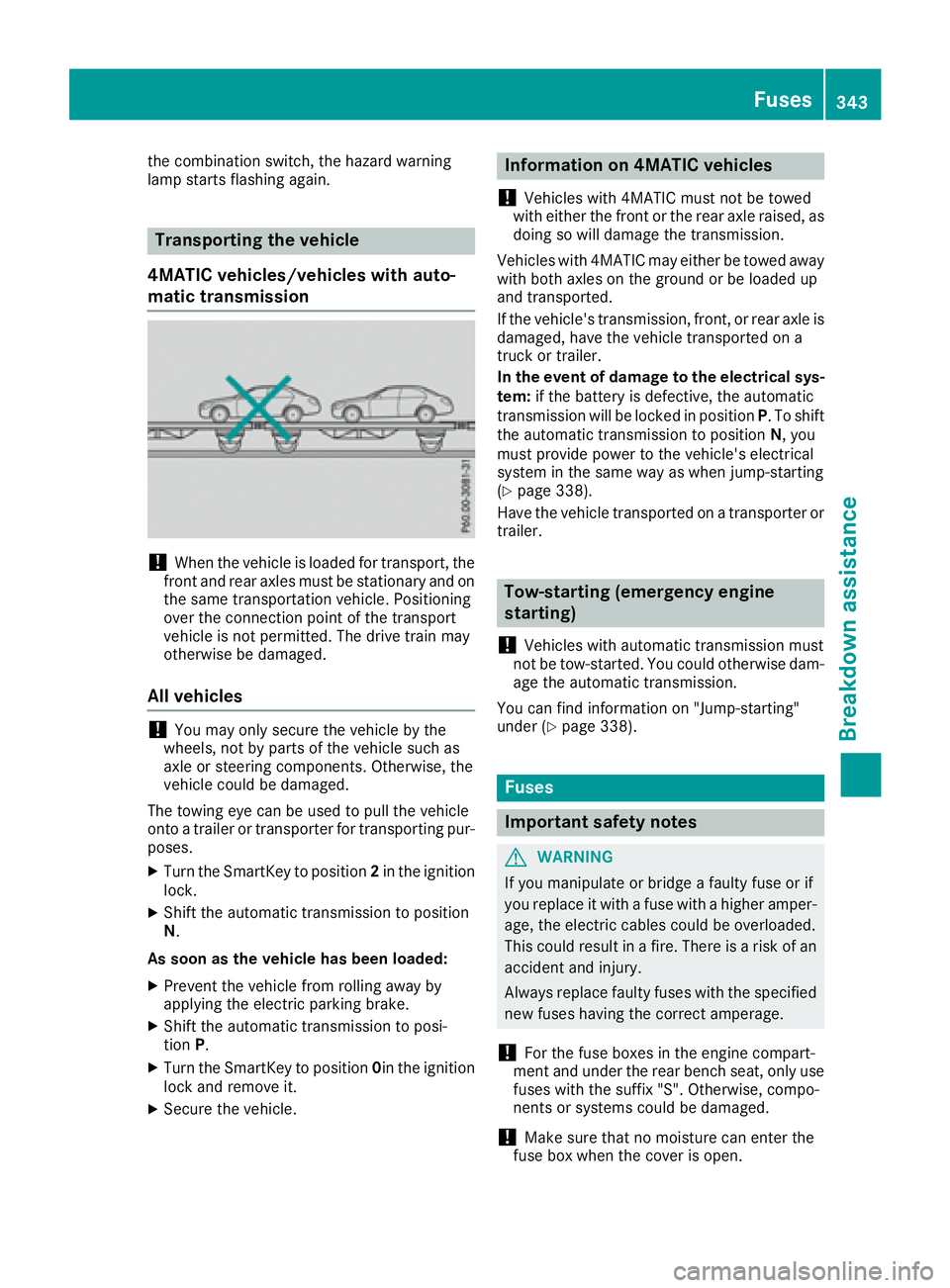
! When the vehicle is loaded for transport, the
front and rear axles must be stationary and on
the same transportation vehicle. Positioning
over the connection point of the transport
vehicle is not permitted. The drive train may
otherwise be damaged.
All vehicles
! You may only secure the vehicle by the
wheels, not by parts of the vehicle such as
axle or steering components. Otherwise, the
vehicle could be damaged.
The towing eye can be used to pull the vehicle
onto a trailer or transporter for transporting pur-
poses. X
Turn the SmartKey to position 2 in the ignition
lock. X
Shift the automatic transmission to position
N .
As soon as the vehicle has been loaded: X
Prevent the vehicle from rolling away by
applying the electric parking brake. X
Shift the automatic transmission to posi-
tion P .X
Turn the SmartKey to position 0 in the ignition
lock and remove it. X
Secure the vehicle. Information on 4MATIC vehicles
! Vehicles with 4MATIC must not be towed
with either the front or the rear axle raised, as
doing so will damage the transmission.
Vehicles with 4MATIC may either be towed away
with both axles on the ground or be loaded up
and transported.
If the vehicle's transmission, front, or rear axle is
damaged, have the vehicle transported on a
truck or trailer.
In the event of damage to the electrical sys-
tem: if the battery is defective, the automatic
transmission will be locked in position P . To shift
the automatic transmission to position N , you
must provide power to the vehicle's electrical
system in the same way as when jump-starting
( Y
page 338).
Have the vehicle transported on a transporter or
trailer.
Tow-starting (emergency engine
starting)
! Vehicles with automatic transmission must
not be tow-started. You could otherwise dam-
age the automatic transmission.
You can find information on "Jump-starting"
under ( Y
page 338).
Fuses
Important safety notes
G WARNING
If you manipulate or bridge a faulty fuse or if
you replace it with a fuse with a higher amper-
age, the electric cables could be overloaded.
This could result in a fire. There is a risk of an
accident and injury.
Always replace faulty fuses with the specified
new fuses having the correct amperage.
! For the fuse boxes in the engine compart-
ment and under the rear bench seat, only use
fuses with the suffix "S". Otherwise, compo-
nents or systems could be damaged.
! Make sure that no moisture can enter the
fuse box when the cover is open. Fuses 343
Breakdown assistance Z
Page 346 of 390
! When closing the cover, make sure that it is
lying correctly on the fuse box. Moisture seep-
ing in or dirt could otherwise impair the oper-
ation of the fuses.
The fuses in your vehicle serve to close down
faulty circuits. If a fuse blows, all the compo-
nents on the circuit and their functions stop
operating.
Blown fuses must be replaced with fuses of the
same rating, which you can recognize by the
color and value. The fuse ratings are listed in the
fuse allocation chart.
The fuse allocation chart is located in the fuse
box under the rear bench seat ( Y
page 345).
If a newly inserted fuse also blows, have the
cause traced and rectified at a qualified special-
ist workshop, e.g. an authorized Mercedes-Benz
Center.
Before changing a fuse Observe the important safety notes
( Y
page 343) X
Switch off the engine. X
Switch off all electrical consumers. X
Remove the SmartKey from the ignition lock.
or, in vehicles with KEYLESS-GO start-function
or KEYLESS ‑ GOX
Open the driver's door.
The vehicle electronics now have status 0 .
This is the same as the SmartKey having been
removed.
The driver’s door can be closed again. X
Secure the vehicle against rolling away
( Y
page 159).
All indicator lamps in the instrument cluster
must be off.
The fuses are located in various fuse boxes: R
Fuse box on the front-passenger side of the
dashboard R
Fuse box in the engine compartment on the
right-hand side of the vehicle, when viewed in
the direction of travel R
Fuse box under the rear bench seat Dashboard fuse box
! Do not use a pointed object such as a screw-
driver to open the cover in the dashboard. You
could damage the dashboard or the cover.
Mercedes-Benz recommends that you have this
work performed at a qualified specialist work-
shop, e.g. at an authorized Mercedes-Benz Cen-
ter.
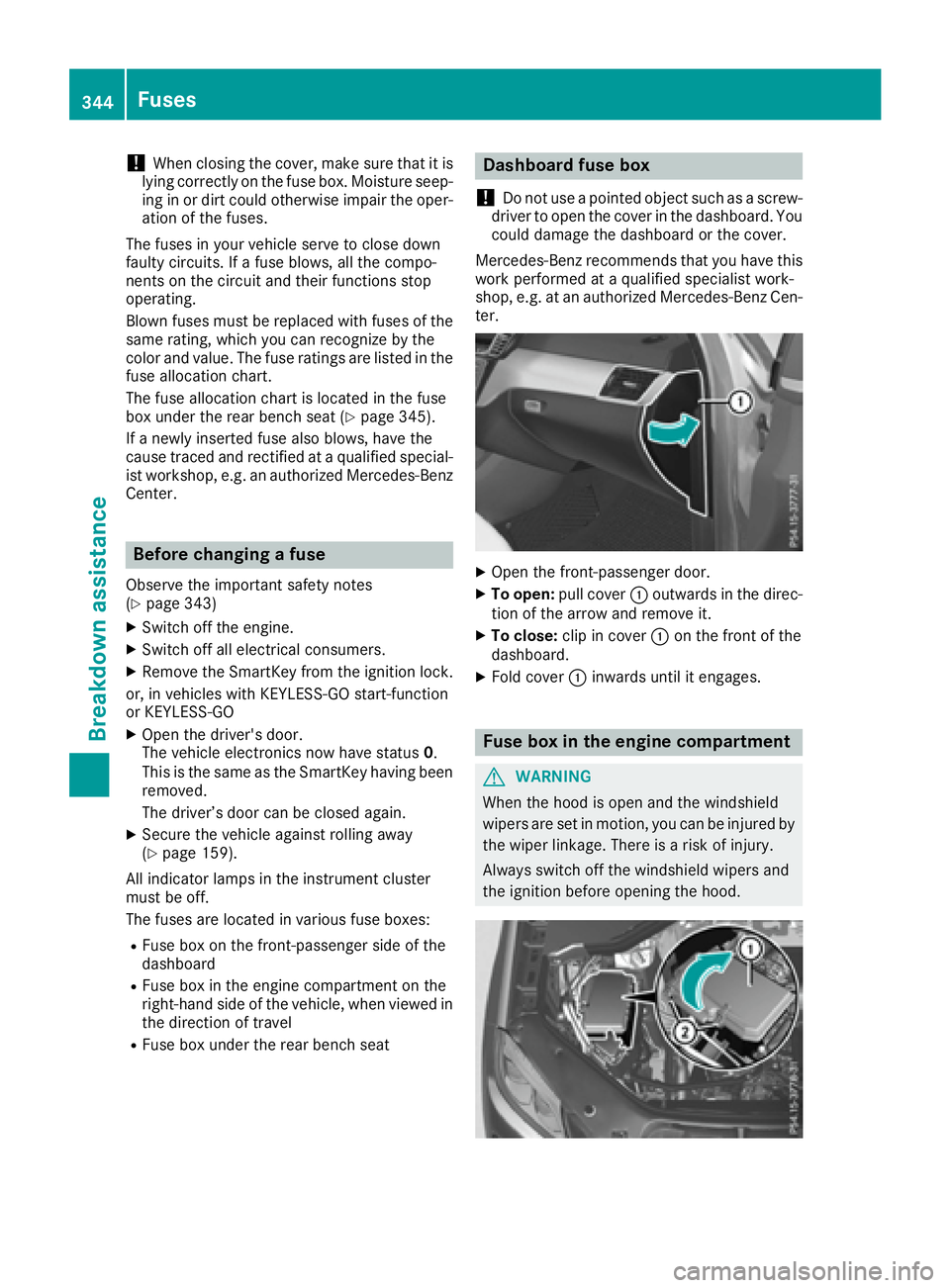
X
Open the front-passenger door. X
To open: pull cover C outwards in the direc-
tion of the arrow and remove it. X
To close: clip in cover C on the front of the
dashboard. X
Fold cover C inwards until it engages.
Fuse box in the engine compartment
G WARNING
When the hood is open and the windshield
wipers are set in motion, you can be injured by
the wiper linkage. There is a risk of injury.
Always switch off the windshield wipers and
the ignition before opening the hood.344
Fuses
Breakdown assistance
Page 369 of 390
be required earlier. Do not change the direction
of wheel rotation.
Clean the contact surfaces of the wheel and the
brake disc thoroughly every time a wheel is rota-
ted. Check the tire pressure and, if necessary,
restart the tire pressure loss warning system or
the tire pressure monitor ( Y
page 353).
Direction of rotation Tires with a specified direction of rotation have
additional benefits, e.g. if there is a risk of hydro-
planing. These advantages can only be gained if
the tires are installed corresponding to the
direction of rotation.
An arrow on the sidewall of the tire indicates its
correct direction of rotation.
Storing wheels Store wheels that are not being used in a cool,
dry and preferably dark place. Protect the tires
from oil, grease, gasoline and diesel.
Mounting a wheel
Preparing the vehicle X
Vehicle with emergency spare wheel:
when mounting the emergency spare wheel in
the event of a flat tire, follow the additional
notes on vehicle preparation under "Flat tire"
( Y
page 331). X
Stop the vehicle on solid, non-slippery and
level ground. X
Apply the electric parking brake manually. X
Bring the front wheels into the straight-ahead
position. X
Vehicles with automatic transmission:
shift the automatic transmission to position
P . X
Vehicles with the AIRMATIC package:
make sure that the normal vehicle level is
selected ( Y
page 188).X
Vehicles with the Off-Road Engineering
package: make sure that the normal level is
selected ( Y
page 182).X
Switch off the engine. X
Vehicles without KEYLESS-GO: remove the
SmartKey from the ignition lock. X
Vehicles with KEYLESS-GO: open the driv-
er's door.
The on-board electronics now have status 0 .
This is the same as the SmartKey having been
removed. X
Vehicles with KEYLESS-GO: remove the
Start/Stop button from the ignition lock
( Y
page 138). X
If included in the vehicle equipment, remove
the tire-change tool kit from the vehicle. X
Safeguard the vehicle against rolling away.
i Apart from certain country-specific varia-
tions, vehicles are not equipped with a tire-
change tool kit. For information on which
tools are required to perform a wheel change
on your vehicle, consult an authorized
Mercedes-Benz Center.
Necessary tire-changing tools can include, for
example: R
Jack R
Wheel chock R
Lug wrench
Securing the vehicle to prevent it from
rolling away
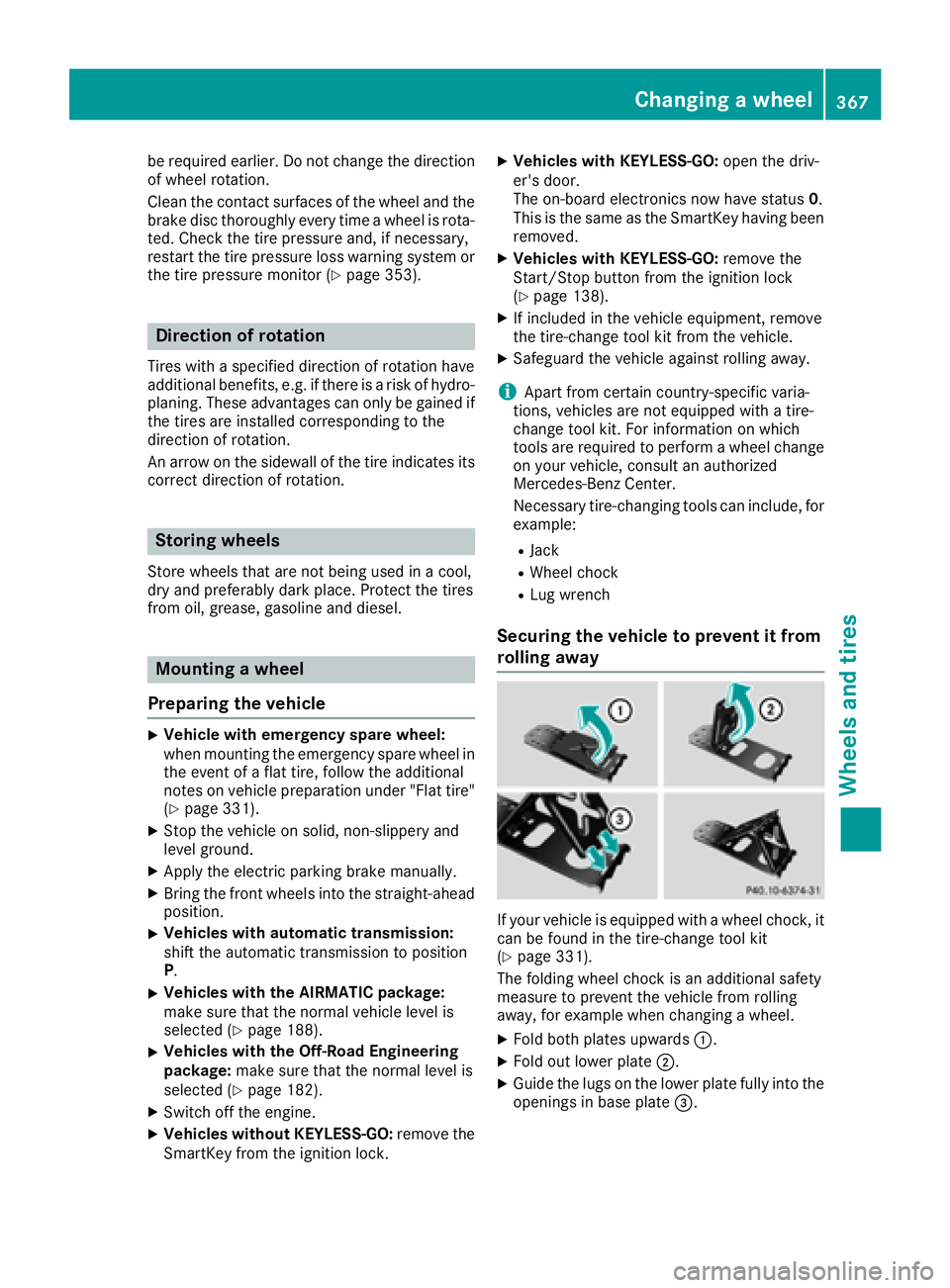
If your vehicle is equipped with a wheel chock, it
can be found in the tire-change tool kit
( Y
page 331).
The folding wheel chock is an additional safety
measure to prevent the vehicle from rolling
away, for example when changing a wheel. X
Fold both plates upwards C .X
Fold out lower plate D .X
Guide the lugs on the lower plate fully into the
openings in base plate
Page 370 of 390
X
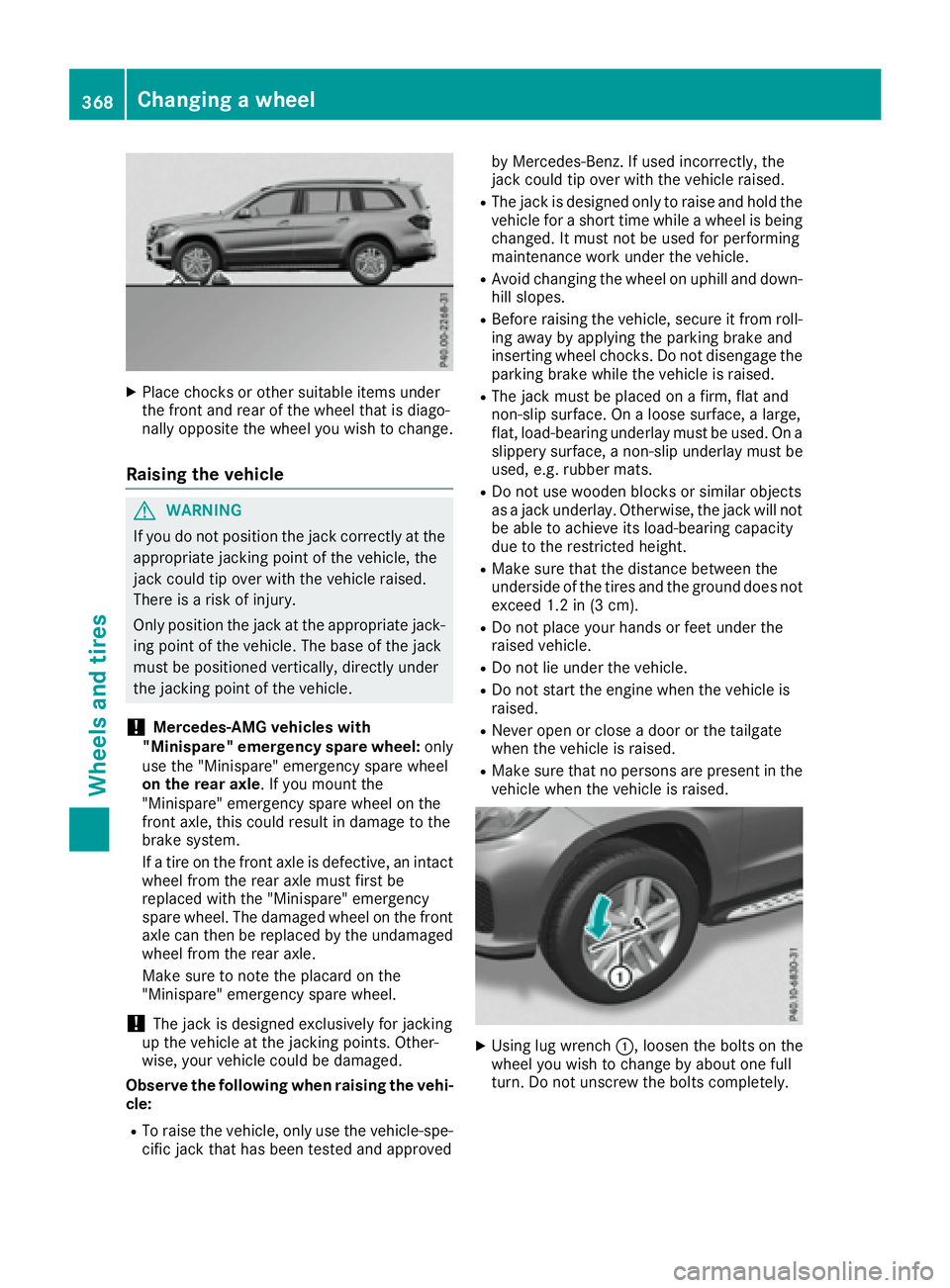
Place chocks or other suitable items under
the front and rear of the wheel that is diago-
nally opposite the wheel you wish to change.
Raising the vehicle
G WARNING
If you do not position the jack correctly at the
appropriate jacking point of the vehicle, the
jack could tip over with the vehicle raised.
There is a risk of injury.
Only position the jack at the appropriate jack-
ing point of the vehicle. The base of the jack
must be positioned vertically, directly under
the jacking point of the vehicle.
! Mercedes-AMG vehicles with
"Minispare" emergency spare wheel: only
use the "Minispare" emergency spare wheel
on the rear axle . If you mount the
"Minispare" emergency spare wheel on the
front axle, this could result in damage to the
brake system.
If a tire on the front axle is defective, an intact
wheel from the rear axle must first be
replaced with the "Minispare" emergency
spare wheel. The damaged wheel on the front
axle can then be replaced by the undamaged
wheel from the rear axle.
Make sure to note the placard on the
"Minispare" emergency spare wheel.
! The jack is designed exclusively for jacking
up the vehicle at the jacking points. Other-
wise, your vehicle could be damaged.
Observe the following when raising the vehi-
cle: R
To raise the vehicle, only use the vehicle-spe-
cific jack that has been tested and approved by Mercedes-Benz. If used incorrectly, the
jack could tip over with the vehicle raised. R
The jack is designed only to raise and hold the
vehicle for a short time while a wheel is being
changed. It must not be used for performing
maintenance work under the vehicle. R
Avoid changing the wheel on uphill and down-
hill slopes. R
Before raising the vehicle, secure it from roll-
ing away by applying the parking brake and
inserting wheel chocks. Do not disengage the
parking brake while the vehicle is raised. R
The jack must be placed on a firm, flat and
non-slip surface. On a loose surface, a large,
flat, load-bearing underlay must be used. On a
slippery surface, a non-slip underlay must be
used, e.g. rubber mats. R
Do not use wooden blocks or similar objects
as a jack underlay. Otherwise, the jack will not
be able to achieve its load-bearing capacity
due to the restricted height.R
Make sure that the distance between the
underside of the tires and the ground does not
exceed 1.2 in (3 cm). R
Do not place your hands or feet under the
raised vehicle. R
Do not lie under the vehicle. R
Do not start the engine when the vehicle is
raised. R
Never open or close a door or the tailgate
when the vehicle is raised. R
Make sure that no persons are present in the
vehicle when the vehicle is raised.
X
Using lug wrench C , loosen the bolts on the
wheel you wish to change by about one full
turn. Do not unscrew the bolts completely.368
Changing a wheel
Wheels and tires
Page 380 of 390
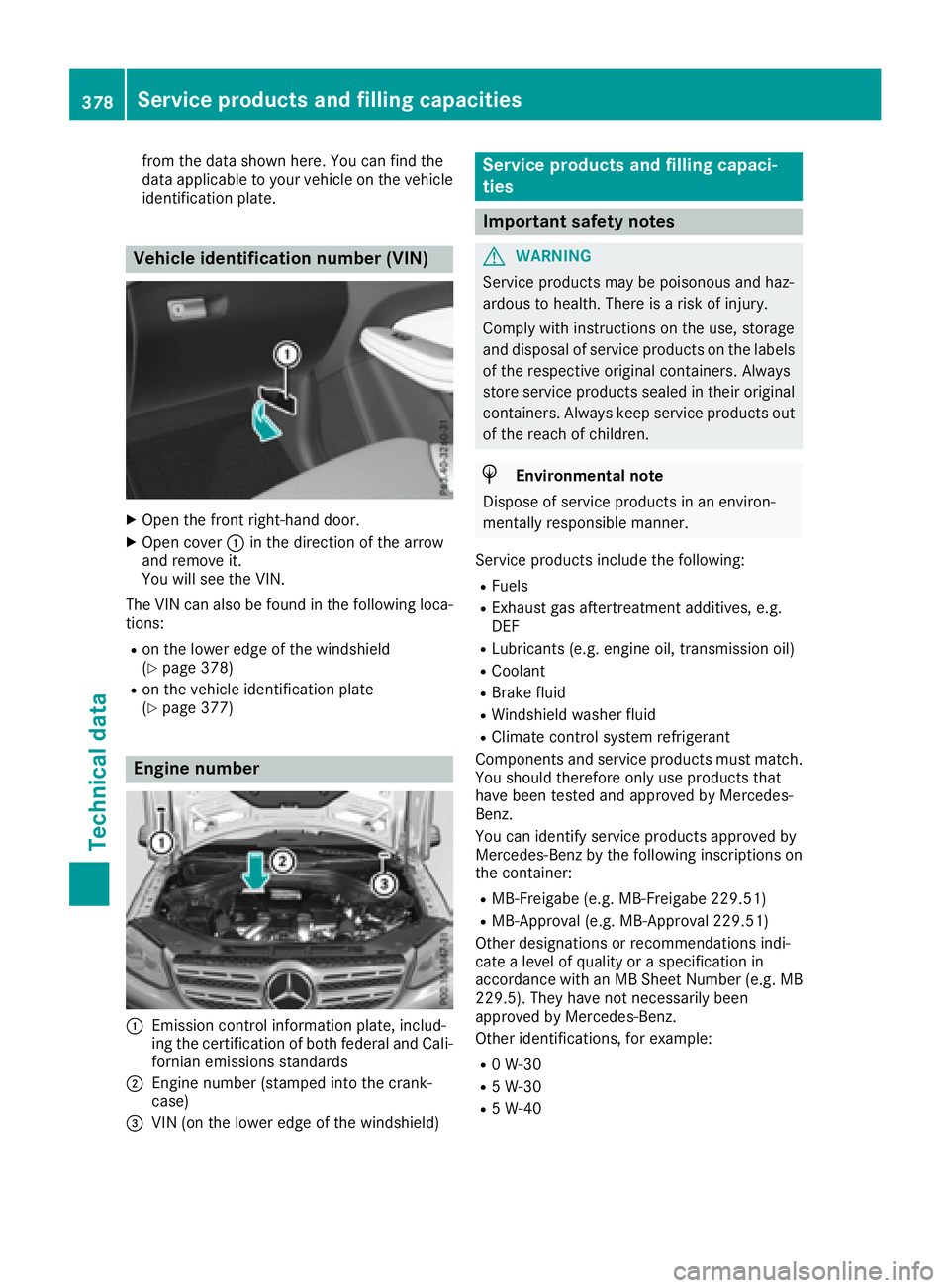
from the data shown here. You can find the
data applicable to your vehicle on the vehicle
identification plate.
Vehicle identification number (VIN) X
Open the front right-hand door. X
Open cover C in the direction of the arrow
and remove it.
You will see the VIN.
The VIN can also be found in the following loca-
tions: R
on the lower edge of the windshield
( Y
page 378)R
on the vehicle identification plate
( Y
page 377)
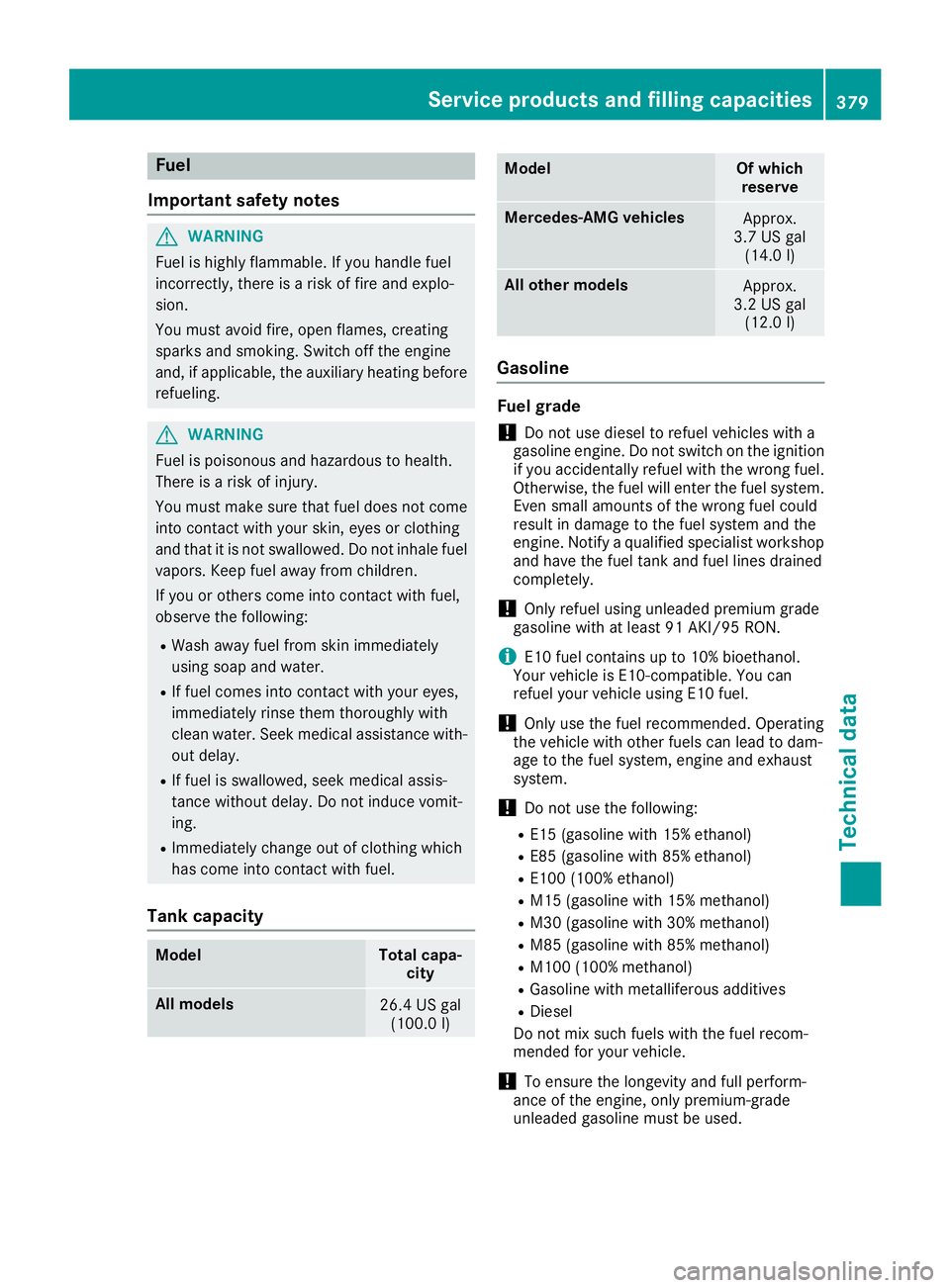
Engine number
C
Emission control information plate, includ-
ing the certification of both federal and Cali-
fornian emissions standards
D
Engine number (stamped into the crank-
case)
Page 381 of 390
Fuel
Important safety notes
G WARNIN G
Fuel is highly flammable . If you handle fuel
incorrectly, there is a ris k of fir e and explo-
sion .
You must avoi d fire, open flames, creating
sparks and smoking. Switc h off th e engin e
and , if applicable, th e auxiliary heating before
refueling.
G WARNIN G
Fuel is poisonous and hazardous to health.
Ther e is a ris k of injury.
You must mak e sure that fuel does no t come
int o contact wit h your skin, eyes or clothing
and that it is no t swallowed. Do no t inhale fuel
vapors. Kee p fuel away from children .
If you or other s come int o contact wit h fuel ,
observ e th e following:R
Wash away fuel from skin immediately
usin g soap and water.R
If fuel comes int o contact wit h your eyes,
immediately rinse them thoroughly wit h
clean water. Seek medical assistanc e with-
out delay. R
If fuel is swallowed, seek medical assis-
tance without delay. Do no t induce vomit -
ing . R
Immediately chang e out of clothing whic h
has come int o contact wit h fuel .
Tank capacity
Model Total capa-
cit y
All models
26.4 US gal
(100. 0 l) Model Of which
reserv e
Mercedes ‑ AMG vehicles
Approx.
3. 7 US gal
(14.0 l)
Al l ot her models
Approx.
3.2 US gal
(12.0 l)
Gasoline Fuel grade
! Do not use diesel to refuel vehicles with a
gasoline engine. Do not switch on the ignition
if you accidentally refuel with the wrong fuel.
Otherwise, the fuel will enter the fuel system.
Even small amounts of the wrong fuel could
result in damage to the fuel system and the
engine. Notify a qualified specialist workshop
and have the fuel tank and fuel lines drained
completely.
! Only refuel using unleaded premium grade
gasoline with at least 91 AKI/95 RON.
i E10 fuel contains up to 10% bioethanol.
Your vehicle is E10-compatible. You can
refuel your vehicle using E10 fuel.
! Only use the fuel recommended. Operating
the vehicle with other fuels can lead to dam-
age to the fuel system, engine and exhaust
system.
! Do not use the following: R
E15 (gasoline with 15% ethanol) R
E85 (gasoline with 85% ethanol) R
E100 (1 00% ethanol) R
M15 (gasoline with 15% methanol) R
M30 (gasoline with 30% methanol) R
M85 (gasoline with 85% methanol) R
M100 (1 00% methanol) R
Gasoline with metalliferous additives R
Diesel
Do not mix such fuels with the fuel recom-
mended for your vehicle.
! To ensure the longevity and full perform-
ance of the engine, only premium-grade
unleaded gasoline must be used.Service products and filling capacities 379
Technical data Z
Page 382 of 390
If standard unleaded gasoline is unavailable
and you have to refuel with unleaded gasoline
of a lower grade, observe the following pre-
cautions: R
Only fill the fuel tank to half full with regular
unleaded gasoline and fill the rest with pre-
mium-grade unleaded gasoline as soon as
possible. R
Do not drive at the maximum speed. R
Avoid sudden acceleration and engine
speeds over 3,000 rpm.
You will usually find information about the fuel
grade on the pump. If you cannot find the label
on the pump, ask the staff for assistance.
i For further information, consult a qualified
specialist workshop or visit
http://www.mbusa.com (USA only).
As a temporary measure, if the recommended
fuel is not available, you may also use regular
unleaded gasoline with an octane rating of
87 AKI/91 RON. This may reduce engine per-
formance and increase fuel consumption. Avoid
driving at full throttle and sudden acceleration.
Never refuel using gasoline with a lower AKI.
Information on refueling ( Y
page 154).
Additives
! Operating the engine with fuel additives
added later can lead to engine failure. Do not
mix fuel additives with fuel. This does not
include additives for the removal and preven-
tion of residue buildup. gasoline must only be
mixed with additives recommended by
Mercedes-Benz. Comply with the instructions
for use on the product label. More information
about recommended additives can be
obtained from any authorized Mercedes-Benz
Center.
Mercedes-Benz recommends that you use bran-
ded fuels that have additives.
The fuel quality available in some countries may
not be sufficient. Residue could build up in the
fuel injection system as a result. In such cases,
and in consultation with an authorized
Mercedes-Benz Center, the fuel may be mixed
with the cleaning additive recommended by
Mercedes-Benz. You must observe the notes
and mixing ratios specified on the container. Diesel Fuel grade
G WARNING
If you mix diesel fuel with gasoline, the flash
point is lower than that of pure diesel fuel.
When the engine is running, exhaust system
components could overheat without being
noticed. There is a risk of fire.
Never refuel with gasoline. Never mix gasoline
with diesel fuel.
! Only use Ultra Low Sulfur Diesel (ULSD),
otherwise it may lead to increased wear and
damage to the fuel system, engine and
exhaust system.
! Do not use the following: R
gasoline R
diesel with a bio-diesel content greater
than 5% (e.g. B20) R
bio-diesel R
vegetable oil R
paraffin R
kerosene R
marine diesel R
heating oil
Do not mix such fuels with diesel fuel and do
not use any special additives. Otherwise,
engine damage may occur.
! In countries outside USA and Canada, only
use sulfur-free diesel with a sulfur content
under 50 ppm. Otherwise, the emission con-
trol system could be damaged.
You will usually find information about the fuel
grade on the pump. If you cannot find the label
on the pump, ask the staff for assistance.
Information on refueling ( Y
page 154).
Low outside temperatures
i Diesel fuel with improved cold flow proper-
ties is available during the winter months.
Further information about fuel properties can
be obtained from oil companies, e.g. at gas
stations.380
Service products and filling capacities
Technical data
Page 383 of 390
DEF
Important safet y notesComply wit h th e important safet y note s fo r ser -
vic e products when handlin g DE F ( Y
page 378).
DE F is a water-soluble flui d fo r th e exhaus t gas
aftertreatmen t of diesel engines. It is:R
no t poisonousR
colorles s and odorlessR
no t flammable
Whe n you ope n th e DE F container, small
amount s of ammonia vapor may be released.
Ammoni a vapor s hav e a pungen t odo r and are
particularly irritatin g to th e skin , to mucous
membrane s and to th e eyes . You may experi-
ence a burning sensation in your eyes , nose and
throat . Coughin g and watering of th e eyes are
possible.
Do no t inhale ammonia vapors. Fil l th e DE F tank
only in well-ventilated areas.
Low outsid e temperaturesDE F freezes at a temperature of approximately
12 ‡ (-11 †). The vehicle is delivered from th e
factory equipped wit h a DE F preheatin g system.
Winte r operation can thus be guaranteed eve n
at temperature s belo w 12 ‡ (-11 †).
Additives
! Only use DE F in accordance wit h IS O
22241. Do no t use additive s wit h DE F and do
no t dilut e DE F wit h water. Thi s may destroy
th e BlueTE C exhaus t gas aftertreatmen t sys -
tem.
Purity
! Impurities in DE F (e.g. due to other servic e
products , cleanin g agents or dust ) lead to :R
increase d emission valuesR
damage to th e catalytic converterR
engin e damageR
malfunction s in th e BlueTE C exhaus t gas
aftertreatmen t syste m
Assurin g th e purit y of DE F is particularly impor -
tant wit h respec t to avoidin g malfunction s in th e
BlueTE C exhaus t gas aftertreatmen t system.
If DE F is pumped out of th e DE F tank , e.g. durin g
repair work, it mus t no t be returned to th e tank . The purit y of th e flui d can no longer be guaran-
teed.
Filling capacities Model Tota l capacity
GLS 350 d 4MATIC
10.2 US gal
(38.7 l)
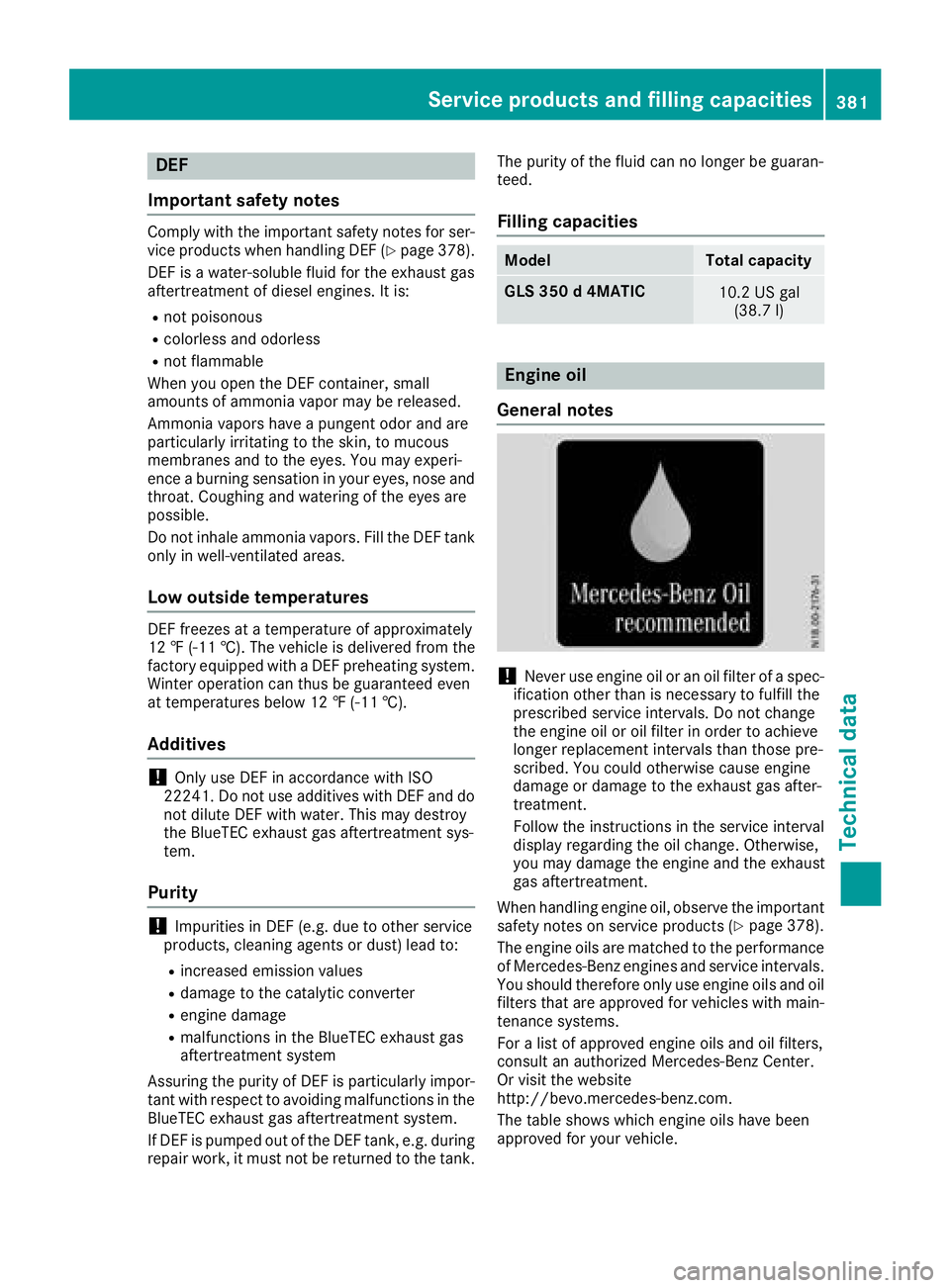
Engin e oil
General notes
! Never use engin e oil or an oil filte r of a spec-
ification other than is necessary to fulfill th e
prescribed servic e intervals. Do no t chang e
th e engin e oil or oil filte r in order to achiev e
longer replacement intervals than those pre -
scribed. You could otherwise cause engin e
damage or damage to th e exhaus t gas after-
treatment.
Follow th e instruction s in th e servic e interval
display regardin g th e oil change. Otherwise ,
you may damage th e engin e and th e exhaus t
gas aftertreatment.
Whe n handlin g engin e oil, observ e th e important
safet y note s on servic e products ( Y
page 378).
The engin e oils are matched to th e performanc e
of Mercedes-Ben z engines and servic e intervals.
You should therefore only use engin e oils and oil
filters that are approved fo r vehicles wit h main -
tenance systems .
Fo r a list of approved engin e oils and oil filters ,
consult an authorized Mercedes-Ben z Center.
Or visit th e websit e
http://bevo.mercedes-benz.co m.
The table shows which engine oils have been
approved for your vehicle.Service products and filling capacities 381
Technical data Z
Page 384 of 390
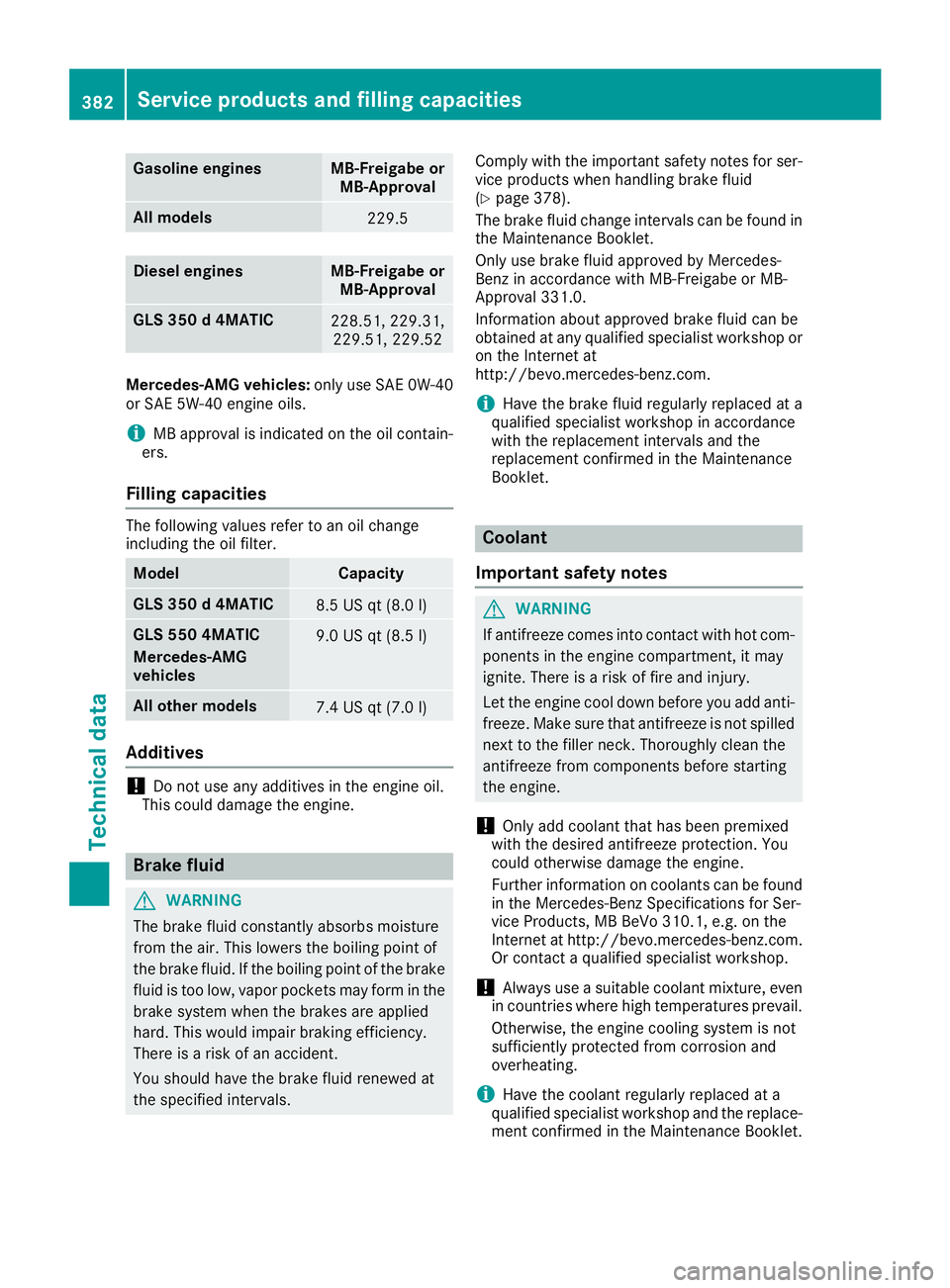
Gasoline engines MB-Freigabe or
MB-Approval
All models
229.5
Diesel engines MB-Freigabe or
MB-Approval
GLS 350 d 4MATIC
228.51, 229.31,
229.51, 229.52
Mercedes-AMG vehicles: only use SAE 0W-40
or SAE 5W-40 engine oils.
i MB approval is indicated on the oil contain-
ers.
Filling capacities The following values refer to an oil change
including the oil filter.
Model Capacity
GLS 350 d 4MATIC
8.5 US qt (8.0 l)
GLS 550 4MATIC
Mercedes ‑ AMG
vehicles 9.0 US qt (8.5 l)
Al l ot her models
7.4 US qt (7.0 l)
Ad ditives
! Do not use any additives in the engine oil.
This could damage the engine.
Brake fluid
G WARNING
The brake fluid constantly absorbs moisture
from the air. This lowers the boiling point of
the brake fluid. If the boiling point of the brake
fluid is too low, vapor pockets may form in the
brake system when the brakes are applied
hard. This would impair braking efficiency.
There is a risk of an accident.
You should have the brake fluid renewed at
the specified intervals. Comply with the important safety notes for ser-
vice products when handling brake fluid
( Y
page 378).
The brake fluid change intervals can be found in
the Maintenance Booklet.
Only use brake fluid approved by Mercedes-
Benz in accordance with MB-Freigabe or MB-
Approval 331.0.
Information about approved brake fluid can be
obtained at any qualified specialist workshop or
on the Internet at
http://bevo.mercedes-benz.co m.
i Have the brake fluid regularly replaced at a
qualified specialist workshop in accordance
with the replacement intervals and the
replacement confirmed in the Maintenance
Booklet.
Coolant
Important safety notes
G WARNING
If antifreeze comes into contact with hot com-
ponents in the engine compartment, it may
ignite. There is a risk of fire and injury.
Let the engine cool down before you add anti-
freeze. Make sure that antifreeze is not spilled
next to the filler neck. Thoroughly clean the
antifreeze from components before starting
the engine.
! Only add coolant that has been premixed
with the desired antifreeze protection. You
could otherwise damage the engine.
Further information on coolants can be found
in the Mercedes-Benz Specifications for Ser-
vice Products, MB BeVo 310.1, e.g. on the
Internet at http://bevo.mercedes-benz.com.
Or contact a qualified specialist workshop.
! Always use a suitable coolant mixture, even
in countries where high temperatures prevail.
Otherwise, the engine cooling system is not
sufficiently protected from corrosion and
overheating.
i Have the coolant regularly replaced at a
qualified specialist workshop and the replace-
ment confirmed in the Maintenance Booklet.382
Service products and filling capacities
Technical data
Page 385 of 390
Comp ly wit h the impo rtant safety notes for ser-
vice products when han dlin g coolant
( Y
page 378).
The coolant is a mixture of water and ant i-
freeze/corrosion inh ibit or. It is respon sible for
the foll owin g:R
Anti-corrosion protection R
Antifreeze protection R
Raisin g the boiling poin t
If the coolant has antifreeze protection down to
-35 ‡ (-37 †), the boilin g poin t of the coolant
during operation is appr oximately 266 ‡
(130 †).
The antifreeze concentrate /c orrosion inh ibit or
concentration in the engine co olin g system
sho uld: R
be at least 50 %. This will protect the engine
co olin g system against freezing down to
approximate ly -35 ‡ (-37 †).R
not exceed 55% (antifreeze protection down
to -49 ‡ [-45 †]). Otherwise, heat will not be
dissipat ed as effectively.
Mercedes-Benz recommen ds an antifreeze/
corrosion inh ibit or concentrate in accordance
wit h MB Spe cifications for Service Products
310.1.
i When the veh icle is first deliv ere d, it is fille d
wit h a coolant mixture that ensures adequate
antifreeze and anti-corrosion protection.
i The coolant is checked wit h every mainte-
nance interval at a qualif ied spec ialist work-
sho p.
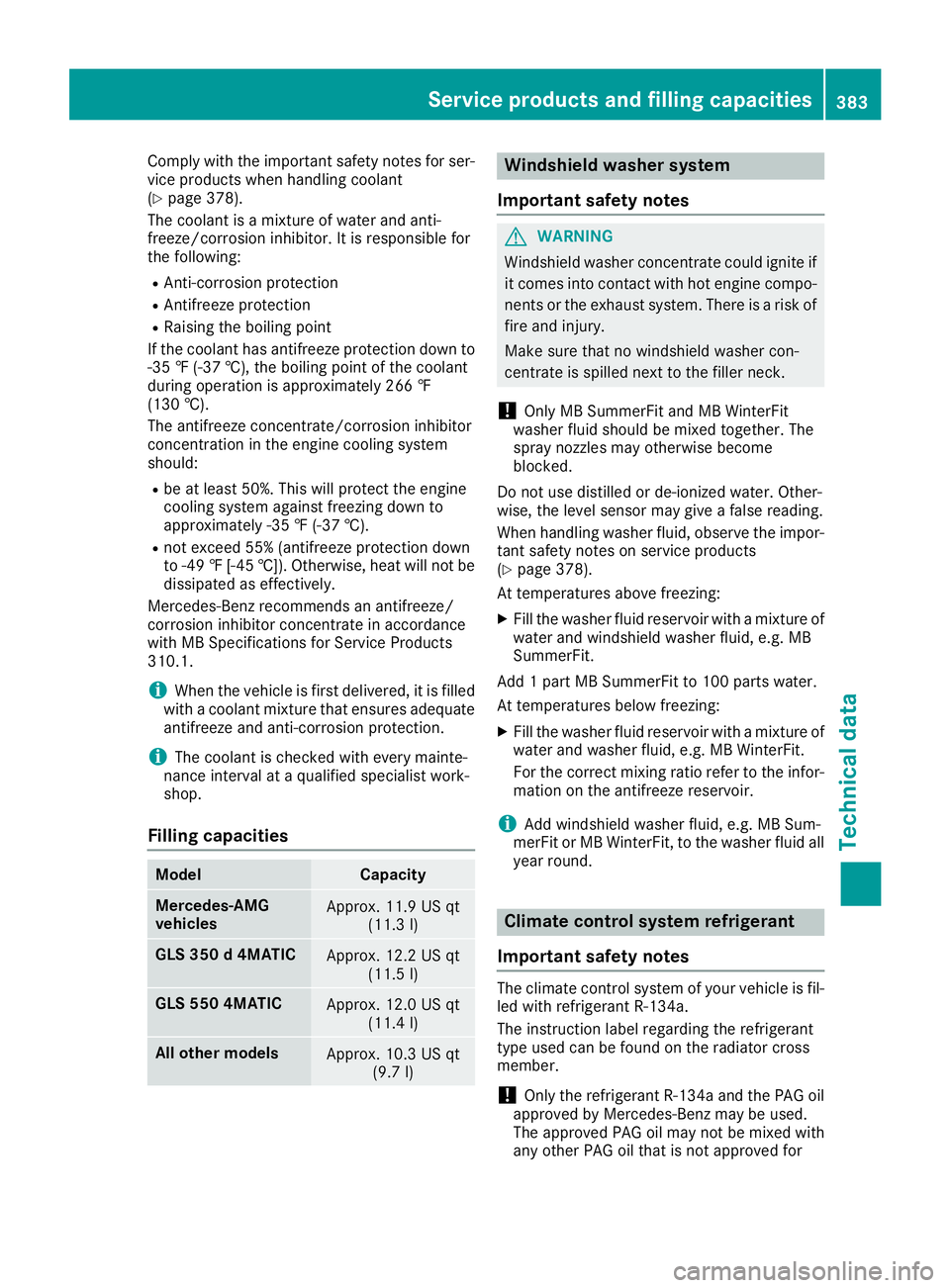
Filling capacities Model Capacity
Mercedes ‑ AMG
vehicles Approx. 11.9 US qt
(11.3 l)
GLS 350 d 4MAT IC
Approx. 12.2 US qt
(11.5 l)
GLS 550 4MATIC
Approx. 12.0 US qt
(11.4 l)
All other mod els
Approx. 10.3 US qt
(9.7 l) Windshield washer system
Important safety notes
G WARNING
Windshield washer concentrate could ignite if
it comes into contact wit h hot engine compo-
nents or the exhaust system. There is a risk of
fire and injury.
Make sure that no windshie ld washer con-
centrate is spilled next to the filler neck.
! On ly MB SummerFit and MB WinterF it
washer fluid should be mixed together. The
spray nozzles may otherwise become
blocked.
Do not use distilled or de-ionized water. Other-
wise, the level sensor may give a false reading.
When handling washer fluid, observe the impor-
tant safety notes on service products
( Y
page 378).
At temperatures above freezing: X
Fill the washer fluid reservoir wit h a mixture of
water and windshie ld washer fluid, e.g. MB
SummerFit.
Add 1 part MB SummerFit to 100 parts water.
At temperatures below freezing: X
Fill the washer fluid reservoir wit h a mixture of
water and washer fluid, e.g. MB WinterFit.
For the correct mixing ratio refer to the infor-
mation on the antifreeze reservoir.
i Add windshie ld washer fluid, e.g. MB Sum-
merFit or MB WinterFit, to the washer fluid all
year roun d.
Climate control system refrigerant
Important safety notes The clim ate control system of your vehicle is fil-
led wit h refrigerant R ‑ 134a.
The instruction label regarding the refrigerant
type used can be found on the radiator cross
member.
! Only the refrigerant R ‑ 134a and the PAG oil
approved by Mercedes-Benz may be used.
The appr oved PAG oil may not be mixed wit h
any other PAG oil that is not appr oved forService products and filling capacities 383
Technical data Z