light MERCEDES-BENZ M-Class 2011 W164 User Guide
[x] Cancel search | Manufacturer: MERCEDES-BENZ, Model Year: 2011, Model line: M-Class, Model: MERCEDES-BENZ M-Class 2011 W164Pages: 372, PDF Size: 16.23 MB
Page 29 of 372

CockpitFunctionPage:Combination switch109;Cruise control lever172=Instrument cluster28?HornASteering wheel paddle
shifters
148
BDIRECT SELECT lever144CPARKTRONIC warning
display
184
DOverhead control panel32EOperates the automatic
climate control system
122
FunctionPageFIgnition lock139Start/Stop button139GAdjusts the steering wheel
manually
99
HOn-board diagnostic socketIOpens the hood282JParking brake158KReleases the parking brake158LLight switch106MAdjusts the steering wheel
electrically
99
Steering wheel heating100Cockpit27At a glanceBA 164.1 USA, CA Edition B 2011; 1; 2, en-USd2mskotVersion: 3.0.3.52010-04-21T17:25:06+02:00 - Seite 27
Page 30 of 372

Instrument cluster
Overview
FunctionPage:Speedometer;Sets the instrument cluster
lighting: dimmer=Reset button?Sets the instrument cluster
lighting: brighterFunctionPageATachometer204BFuel gaugeCMultifunction display206DClock21528Instrument clusterAt a glance
BA 164.1 USA, CA Edition B 2011; 1; 2, en-USd2mskotVersion: 3.0.3.52010-04-21T17:25:06+02:00 - Seite 28
Page 31 of 372

Warning and indicator lampsFunctionPage:Brakes (USA only)247;ESP®250=Distance warning lamp 4253?Turn signal109ATurn signal109BDiesel engine: preglow141CSRS251DLow-beam headlamps107EEngine diagnostics (Canada
only)
252
FEngine diagnostics (USA
only)
252
FunctionPageGHigh-beam headlamps109HReserve fuel252ISeat belt248JBrakes (Canada only)247KTire pressure monitor (USA
only)
253
LABS249MThe lamp lights up briefly,
but has no function.4 On vehicles without DISTRONIC, the lamp lights up briefly but has no function.Instrument cluster29At a glanceBA 164.1 USA, CA Edition B 2011; 1; 2, en-USd2mskotVersion: 3.0.3.52010-04-21T17:25:06+02:00 - Seite 29
Page 33 of 372
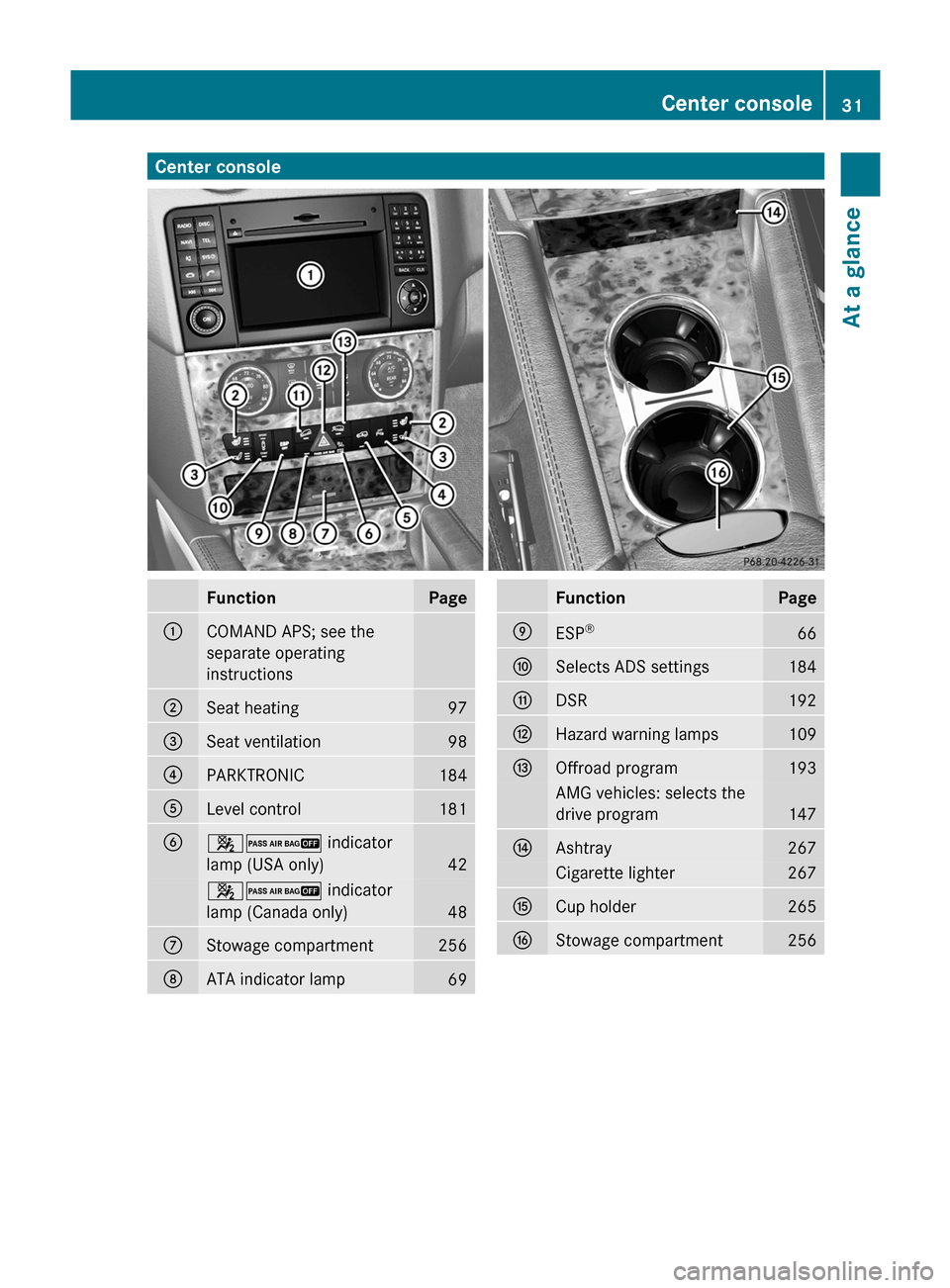
Center consoleFunctionPage:COMAND APS; see the
separate operating
instructions
;Seat heating97=Seat ventilation98?PARKTRONIC184ALevel control181B42 indicator
lamp (USA only)42
42 indicator
lamp (Canada only)48
CStowage compartment256DATA indicator lamp69FunctionPageEESP®66FSelects ADS settings184GDSR192HHazard warning lamps109IOffroad program193AMG vehicles: selects the
drive program147
JAshtray267Cigarette lighter267KCup holder265LStowage compartment256Center console31At a glanceBA 164.1 USA, CA Edition B 2011; 1; 2, en-USd2mskotVersion: 3.0.3.52010-04-21T17:25:06+02:00 - Seite 31
Page 34 of 372
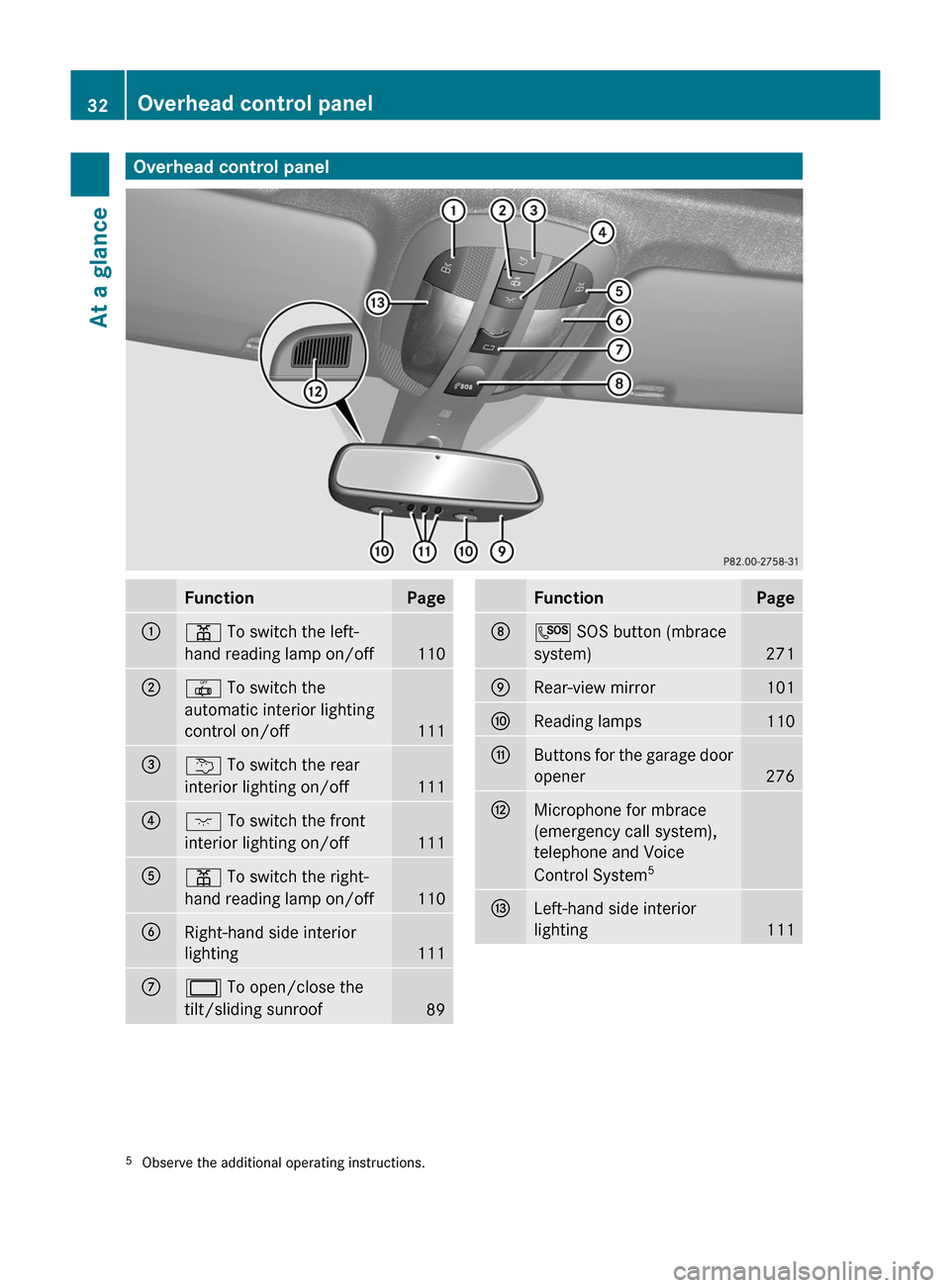
Overhead control panelFunctionPage:p To switch the left-
hand reading lamp on/off
110
;| To switch the
automatic interior lighting
control on/off
111
=u To switch the rear
interior lighting on/off
111
?c To switch the front
interior lighting on/off
111
Ap To switch the right-
hand reading lamp on/off
110
BRight-hand side interior
lighting
111
C2 To open/close the
tilt/sliding sunroof
89
FunctionPageDG SOS button (mbrace
system)
271
ERear-view mirror101FReading lamps110GButtons for the garage door
opener
276
HMicrophone for mbrace
(emergency call system),
telephone and Voice
Control System 5ILeft-hand side interior
lighting
1115 Observe the additional operating instructions.32Overhead control panelAt a glance
BA 164.1 USA, CA Edition B 2011; 1; 2, en-USd2mskotVersion: 3.0.3.52010-04-21T17:25:06+02:00 - Seite 32
Page 38 of 372
Vehicle equipment
i This manual describes all the standard
and optional equipment of your vehicle
which was available at the time of
purchase. Country-specific differences are
possible. Bear in mind that your vehicle
may not feature all functions described
here. This also refers to safety-related
systems and functions.
Occupant safety
Overview of occupant safety
In this section you will learn the most
important facts about the restraint system
components of the vehicle.
The restraint systems are:
R Seat belts
R Child restraint systems
R "LATCH" type child seat mountings
Additional protection is provided by:
R SRS (Supplemental Restraint System)
R NECK-PRO head restraints
R PRE-SAFE ®
R Air bag system components with:
- PASSENGER air bag OFF indicator lamp
- USA only: front-passenger seat with
Occupant Classification System (OCS)
- Canada only: front-passenger seat with
BabySmart™ air bag deactivation system
The protective functions of the systems work
in conjunction with each other. The systems
are, however, autonomous.
GWarning!
Modifications to or work improperly
conducted on restraint system components
or their wiring, as well as tampering with
interconnected electronic systems, can lead
to the restraint systems no longer functioning
as intended.
Air bags or Emergency Tensioning Devices/
belt buckle tensioners, for example, could
deploy inadvertently or fail to deploy.
Therefore, never modify the restraint
systems. Do not tamper with electronic
components or their software.
i More information on the subject of
children in the vehicle and child restraint
systems can be found under the "Children
in the vehicle" chapter ( Y page 58).
SRS (Supplemental Restraint System)
Introduction
SRS reduces the risk of occupants coming
into contact with the vehicle's interior in the
event of an accident. It can also reduce the
effect of the forces to which occupants are
subjected during an accident.
SRS consists of:
R + SRS warning lamp
R air bags
R air bag control unit (with crash sensors)
R ETDs/belt buckle tensioners
R belt force limiters
SRS warning lamps
SRS functions are checked regularly when
you switch on the ignition and when the
engine is running. Therefore, malfunctions
can be detected in good time.
The + SRS warning lamp in the instrument
cluster lights up when the ignition is switched
on. It goes out no later than a few seconds
after the engine is started.
The SRS components are in operational
readiness when the + indicator lamp goes
out while the engine is running.
36Occupant safetySafety
BA 164.1 USA, CA Edition B 2011; 1; 2, en-USd2mskotVersion: 3.0.3.52010-04-21T17:25:06+02:00 - Seite 36
Page 42 of 372
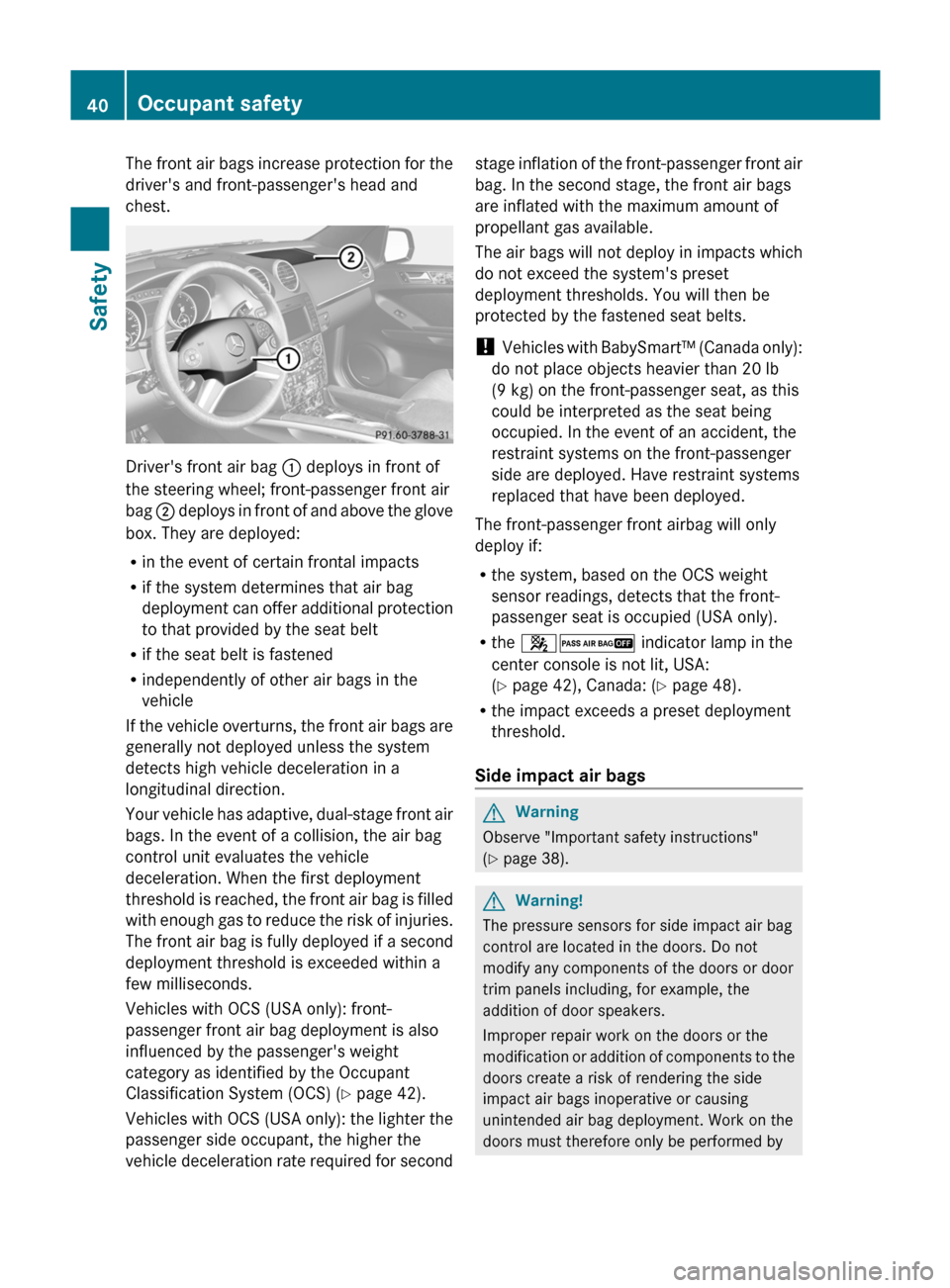
The front air bags increase protection for the
driver's and front-passenger's head and
chest.
Driver's front air bag : deploys in front of
the steering wheel; front-passenger front air
bag ; deploys in front of and above the glove
box. They are deployed:
R in the event of certain frontal impacts
R if the system determines that air bag
deployment can offer additional protection
to that provided by the seat belt
R if the seat belt is fastened
R independently of other air bags in the
vehicle
If the vehicle overturns, the front air bags are
generally not deployed unless the system
detects high vehicle deceleration in a
longitudinal direction.
Your vehicle has adaptive, dual-stage front air
bags. In the event of a collision, the air bag
control unit evaluates the vehicle
deceleration. When the first deployment
threshold is reached, the front air bag is filled
with enough gas to reduce the risk of injuries.
The front air bag is fully deployed if a second
deployment threshold is exceeded within a
few milliseconds.
Vehicles with OCS (USA only): front-
passenger front air bag deployment is also
influenced by the passenger's weight
category as identified by the Occupant
Classification System (OCS) ( Y page 42).
Vehicles with OCS (USA only): the lighter the
passenger side occupant, the higher the
vehicle deceleration rate required for second
stage inflation of the front-passenger front air
bag. In the second stage, the front air bags
are inflated with the maximum amount of
propellant gas available.
The air bags will not deploy in impacts which
do not exceed the system's preset
deployment thresholds. You will then be
protected by the fastened seat belts.
! Vehicles with BabySmart™ (Canada only):
do not place objects heavier than 20 lb
(9 kg) on the front-passenger seat, as this
could be interpreted as the seat being
occupied. In the event of an accident, the
restraint systems on the front-passenger
side are deployed. Have restraint systems
replaced that have been deployed.
The front-passenger front airbag will only
deploy if:
R the system, based on the OCS weight
sensor readings, detects that the front-
passenger seat is occupied (USA only).
R the 42 indicator lamp in the
center console is not lit, USA:
( Y page 42), Canada: ( Y page 48).
R the impact exceeds a preset deployment
threshold.
Side impact air bagsGWarning
Observe "Important safety instructions"
( Y page 38).
GWarning!
The pressure sensors for side impact air bag
control are located in the doors. Do not
modify any components of the doors or door
trim panels including, for example, the
addition of door speakers.
Improper repair work on the doors or the
modification or addition of components to the
doors create a risk of rendering the side
impact air bags inoperative or causing
unintended air bag deployment. Work on the
doors must therefore only be performed by
40Occupant safetySafety
BA 164.1 USA, CA Edition B 2011; 1; 2, en-USd2mskotVersion: 3.0.3.52010-04-21T17:25:06+02:00 - Seite 40
Page 44 of 372
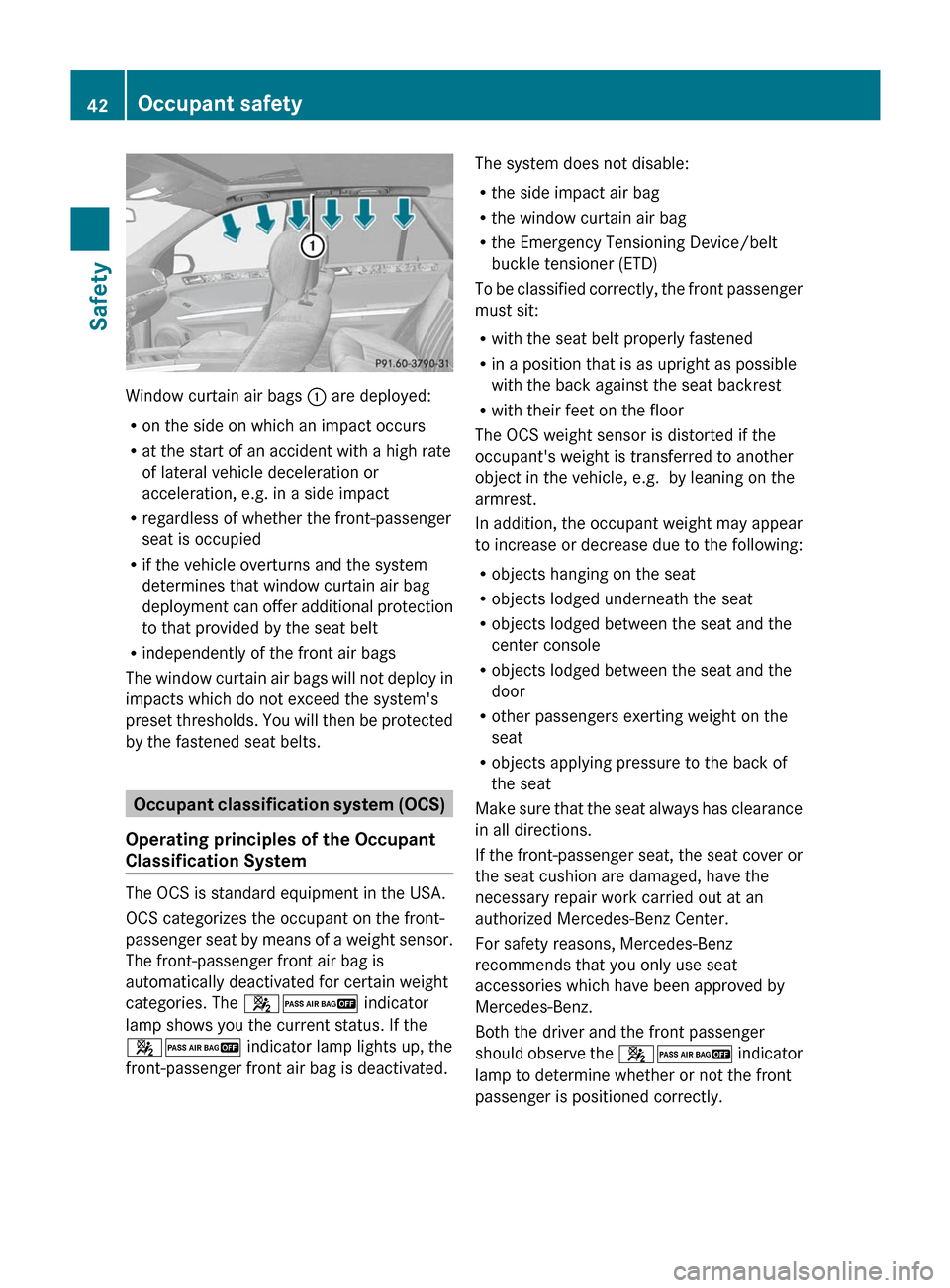
Window curtain air bags : are deployed:
R on the side on which an impact occurs
R at the start of an accident with a high rate
of lateral vehicle deceleration or
acceleration, e.g. in a side impact
R regardless of whether the front-passenger
seat is occupied
R if the vehicle overturns and the system
determines that window curtain air bag
deployment can offer additional protection
to that provided by the seat belt
R independently of the front air bags
The window curtain air bags will not deploy in
impacts which do not exceed the system's
preset thresholds. You will then be protected
by the fastened seat belts.
Occupant classification system (OCS)
Operating principles of the Occupant
Classification System
The OCS is standard equipment in the USA.
OCS categorizes the occupant on the front-
passenger seat by means of a weight sensor.
The front-passenger front air bag is
automatically deactivated for certain weight
categories. The 42 indicator
lamp shows you the current status. If the
42 indicator lamp lights up, the
front-passenger front air bag is deactivated.
The system does not disable:
R the side impact air bag
R the window curtain air bag
R the Emergency Tensioning Device/belt
buckle tensioner (ETD)
To be classified correctly, the front passenger
must sit:
R with the seat belt properly fastened
R in a position that is as upright as possible
with the back against the seat backrest
R with their feet on the floor
The OCS weight sensor is distorted if the
occupant's weight is transferred to another
object in the vehicle, e.g. by leaning on the
armrest.
In addition, the occupant weight may appear
to increase or decrease due to the following:
R objects hanging on the seat
R objects lodged underneath the seat
R objects lodged between the seat and the
center console
R objects lodged between the seat and the
door
R other passengers exerting weight on the
seat
R objects applying pressure to the back of
the seat
Make sure that the seat always has clearance
in all directions.
If the front-passenger seat, the seat cover or
the seat cushion are damaged, have the
necessary repair work carried out at an
authorized Mercedes-Benz Center.
For safety reasons, Mercedes-Benz
recommends that you only use seat
accessories which have been approved by
Mercedes-Benz.
Both the driver and the front passenger
should observe the 42 indicator
lamp to determine whether or not the front
passenger is positioned correctly.42Occupant safetySafety
BA 164.1 USA, CA Edition B 2011; 1; 2, en-USd2mskotVersion: 3.0.3.52010-04-21T17:25:06+02:00 - Seite 42
Page 46 of 372
complete accordance with the child seat
manufacturer's instructions.
Occupants, in particular children, must sit as
upright as possible, fasten the seat belt
correctly and use a suitable infant restraint
system, child restraint system or booster seat
suitable for the size and weight of the child.
Children can be killed or seriously injured by
an inflating air bag. Observe the following
important information if it is absolutely
necessary to carry a child on the front-
passenger seat:
R your vehicle is equipped with air bag
technology designed to deactivate the
passenger front air bag in your vehicle
when the system senses the weight of a
typical 12-month-old child or less along
with the weight of a standard appropriate
child restraint on the passenger seat.
R a child in a rear-facing child restraint on the
passenger seat will be seriously injured or
even killed if the passenger front air bag
inflates in a collision which could occur
under some circumstances, even with the
air bag technology installed in your vehicle.
The only way to completely rule out this risk
is by making sure you never place a child in
a rearward-facing child restraint system on
the front-passenger seat. For this reason,
we strongly advise that you always carry
children in a rearward-facing child restraint
system on a rear seat.
R if it is absolutely necessary to install a
rearward-facing child restraint system on
the front-passenger seat, make sure the
42 indicator lamp is
illuminated, indicating that the front-
passenger front air bag is disabled. If the
42 indicator lamp does not
light up or goes out when the child restraint
system is installed, check the anchorages
of the restraint system. Check the
42 indicator lamp regularly
while driving to ensure that the
42 indicator lamp is
illuminated. If the 42 indicatorlamp lights up or remains out, you may only
carry a child on the front-passenger seat
once the system has been repaired.
A child in a rear-facing child restraint on the
passenger seat will be seriously injured or
even killed if the passenger front air bag
inflates.
R when securing a child in a child restraint
system on the front-passenger seat, you
must:
- move the front-passenger seat as far
back as possible
- use a child restraint system that is
suitable for the age, size and weight of
the child
- observe the manufacturer's installation
instructions in order to install and secure
the child restraint system correctly.
R for children larger than the typical 12-
month-old child, the passenger front air bag
is activated.
Deployment of the driver front air bag does
not mean that the front-passenger front air
bag also should have deployed. The OCS may
have determined:
R that the seat was empty or occupied by a
person with a weight up to or less than that
of a typical 12 month-old child seated in a
standard child restraint
R that the seat was occupied by a small
person (e.g. a young teenager or a small
adult) or a child that weighs more than a
typical 12 month old child in a child
restraint system
These are examples of when OCS disables the
front-passenger front air bag. This occurs
even though the impact fulfills the criteria for
deployment of the driver's front air bag.44Occupant safetySafety
BA 164.1 USA, CA Edition B 2011; 1; 2, en-USd2mskotVersion: 3.0.3.52010-04-21T17:25:06+02:00 - Seite 44
Page 47 of 372
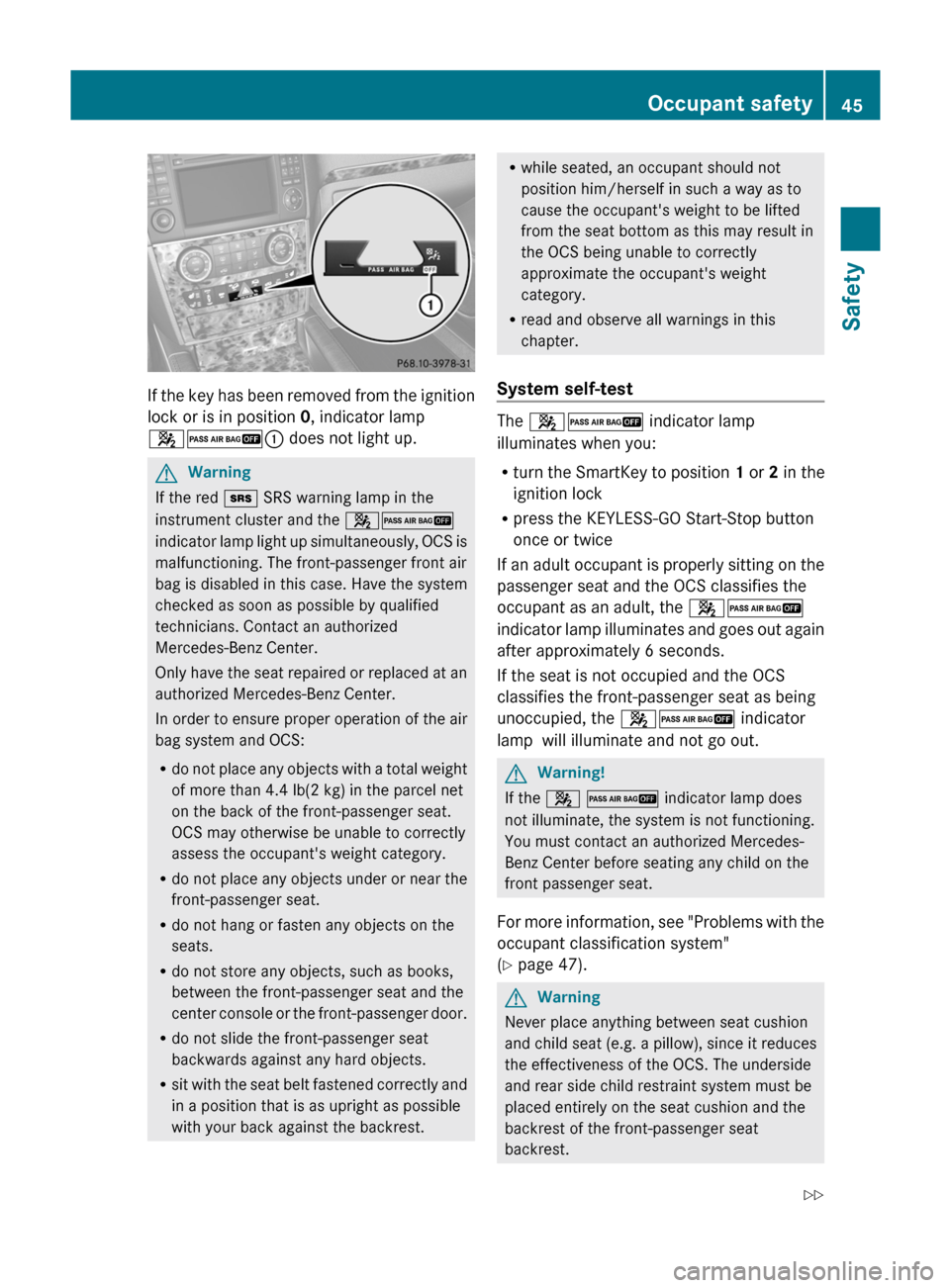
If the key has been removed from the ignition
lock or is in position 0, indicator lamp
42 : does not light up.
GWarning
If the red + SRS warning lamp in the
instrument cluster and the 42
indicator lamp light up simultaneously, OCS is
malfunctioning. The front-passenger front air
bag is disabled in this case. Have the system
checked as soon as possible by qualified
technicians. Contact an authorized
Mercedes-Benz Center.
Only have the seat repaired or replaced at an
authorized Mercedes-Benz Center.
In order to ensure proper operation of the air
bag system and OCS:
R do not place any objects with a total weight
of more than 4.4 lb(2 kg) in the parcel net
on the back of the front-passenger seat.
OCS may otherwise be unable to correctly
assess the occupant's weight category.
R do not place any objects under or near the
front-passenger seat.
R do not hang or fasten any objects on the
seats.
R do not store any objects, such as books,
between the front-passenger seat and the
center console or the front-passenger door.
R do not slide the front-passenger seat
backwards against any hard objects.
R sit with the seat belt fastened correctly and
in a position that is as upright as possible
with your back against the backrest.
R while seated, an occupant should not
position him/herself in such a way as to
cause the occupant's weight to be lifted
from the seat bottom as this may result in
the OCS being unable to correctly
approximate the occupant's weight
category.
R read and observe all warnings in this
chapter.
System self-test
The 42 indicator lamp
illuminates when you:
R turn the SmartKey to position 1 or 2 in the
ignition lock
R press the KEYLESS-GO Start-Stop button
once or twice
If an adult occupant is properly sitting on the
passenger seat and the OCS classifies the
occupant as an adult, the 42
indicator lamp illuminates and goes out again
after approximately 6 seconds.
If the seat is not occupied and the OCS
classifies the front-passenger seat as being
unoccupied, the 42 indicator
lamp will illuminate and not go out.
GWarning!
If the 4 2 indicator lamp does
not illuminate, the system is not functioning.
You must contact an authorized Mercedes-
Benz Center before seating any child on the
front passenger seat.
For more information, see "Problems with the
occupant classification system"
( Y page 47).
GWarning
Never place anything between seat cushion
and child seat (e.g. a pillow), since it reduces
the effectiveness of the OCS. The underside
and rear side child restraint system must be
placed entirely on the seat cushion and the
backrest of the front-passenger seat
backrest.
Occupant safety45SafetyBA 164.1 USA, CA Edition B 2011; 1; 2, en-USd2mskotVersion: 3.0.3.52010-04-21T17:25:06+02:00 - Seite 45Z