light MERCEDES-BENZ M-CLASS SUV 2011 User Guide
[x] Cancel search | Manufacturer: MERCEDES-BENZ, Model Year: 2011, Model line: M-CLASS SUV, Model: MERCEDES-BENZ M-CLASS SUV 2011Pages: 389, PDF Size: 9.22 MB
Page 31 of 389
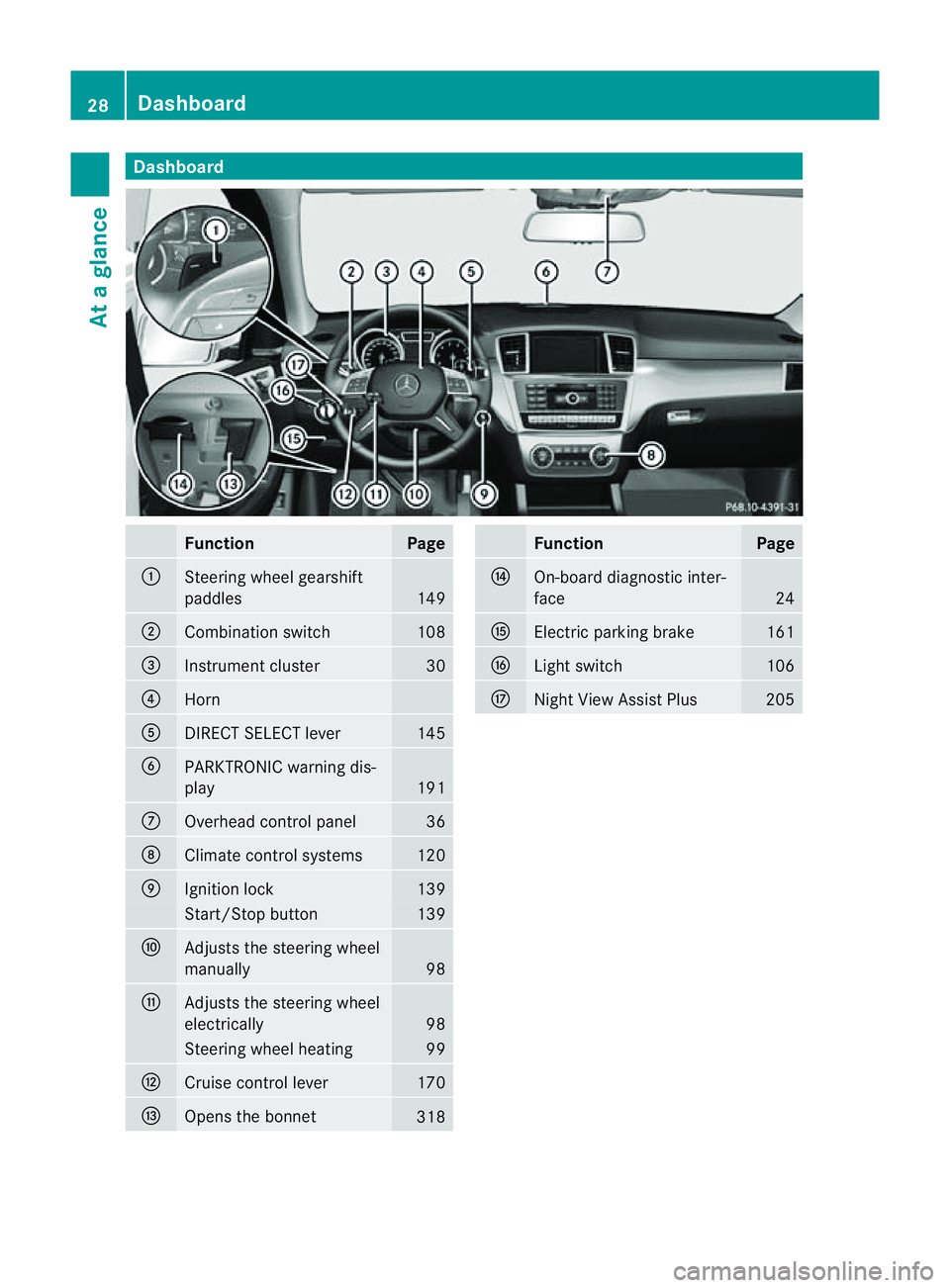
Dashboard
Function Page
:
Steerin
gwhee lgearshift
paddles 149
;
Combination switch 108
=
Instrumen
tcluster 30
?
Horn
A
DIRECT SELECT
lever 145
B
PARKTRONIC warnin
gdis-
play 191
C
Overhead contro
lpanel 36
D
Climat
econtrol systems 120
E
Ignition lock 139
Star
t/Stop button 139
F
Adjust
sthe steerin gwheel
ma nually 98
G
Adjust
sthe steerin gwheel
electrically 98
Steerin
gwhee lheating 99
H
Cruis
econtrol lever 170
I
Opens th
ebonnet 318 Fu
nction Page
J
On-boar
ddiagn ostic inter-
face 24
K
Electric parking brake 161
L
Light switch 106
M
Night Vie
wAssist Plus 20528
DashboardAt
ag lance
Page 32 of 389
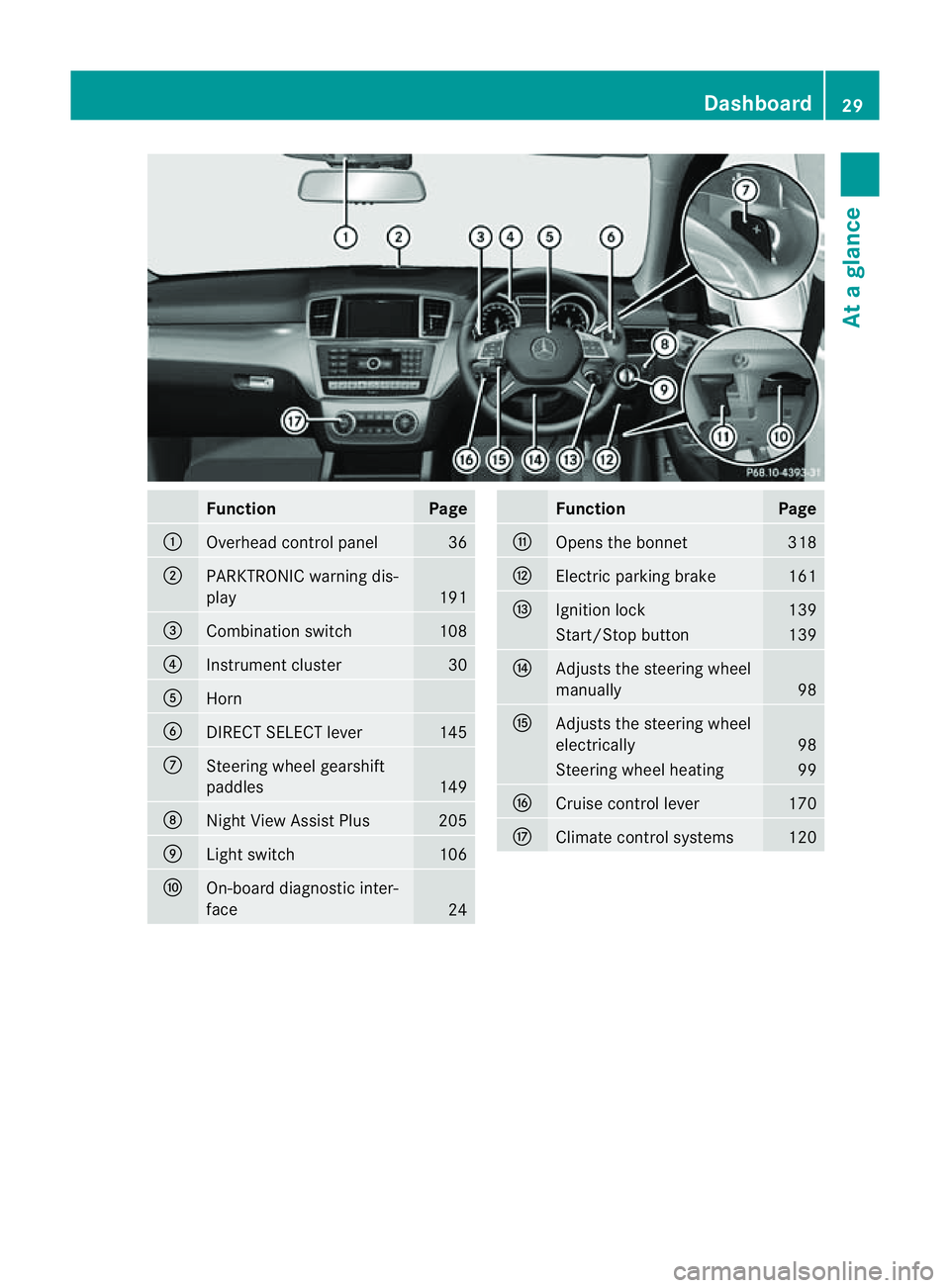
Function Page
:
Overhead con
trol panel 36
;
PARKTRONI
Cwarning dis-
play 191
=
Combination switch 108
?
Instrument cluster 30
A
Horn
B
DIRECT SELECT lever 145
C
Steerin
gwheel gearshift
paddles 149
D
Nigh
tView Assist Plus 205
E
Light switch 106
F
On-board diagnostic inter-
face 24 Function Page
G
Opens the bonnet 318
H
Electric parking brake 161
I
Ignition lock 139
Start/Stop button 139
J
Adjusts the steerin
gwheel
manually 98
K
Adjusts the steeri
ngwheel
electrically 98
Steerin
gwheel heati ng 99
L
Cruise control lever 170
M
Climate control systems 120Dashbo
ard
29Atag lance
Page 33 of 389
Instr
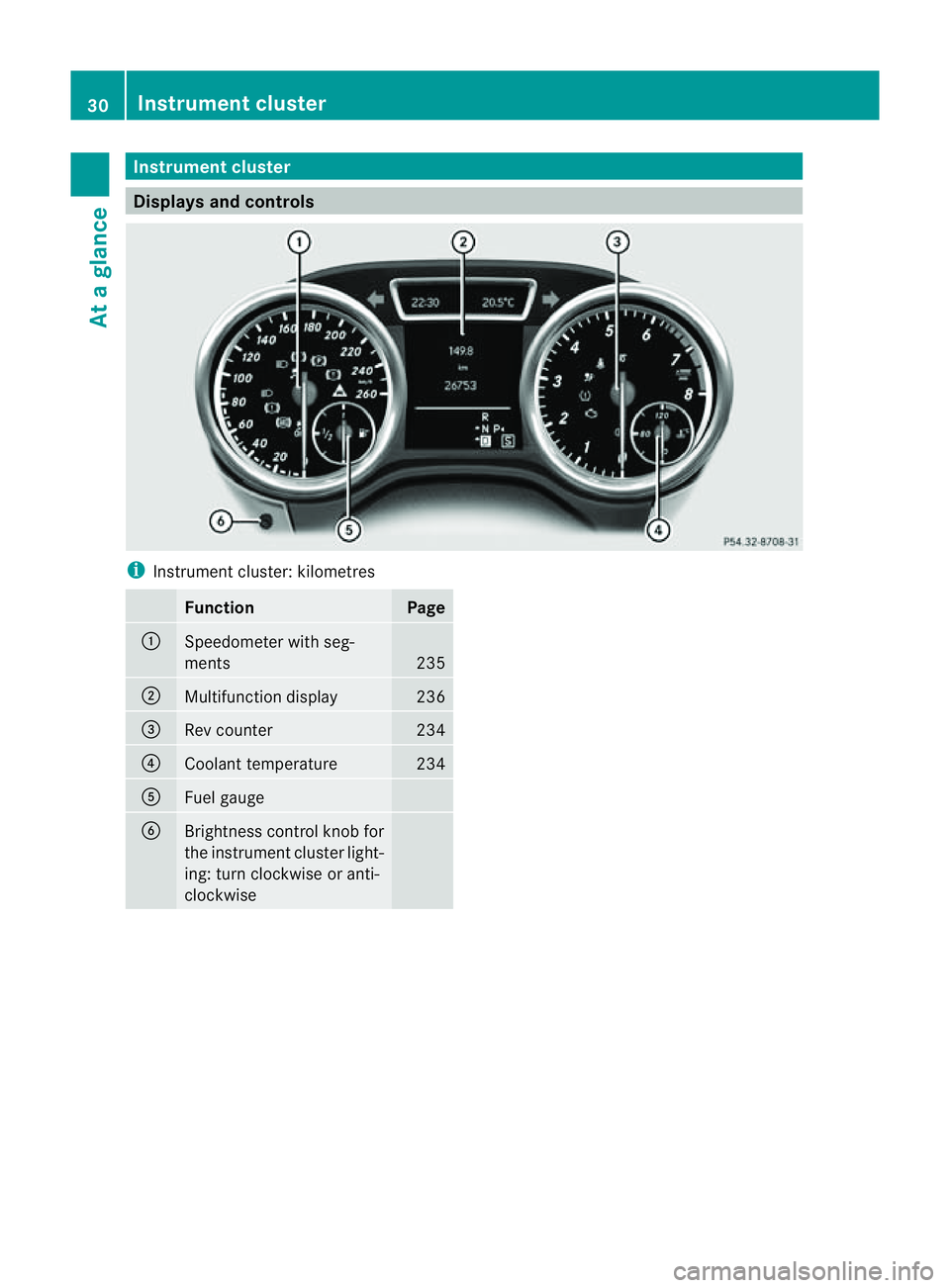
umentc luster Displa
ysand controls i
Inst rument cluster: kilometres Function Page
:
Speedometer with seg-
ments
235
;
Multi
function display 236
=
Rev counter 234
?
Coolant temperature 234
A
Fuel gauge
B
Brightness control knob for
the instrument cluster light-
ing: tur nclockwise or anti-
clockwise 30
Instrument clusterAt
ag lance
Page 34 of 389
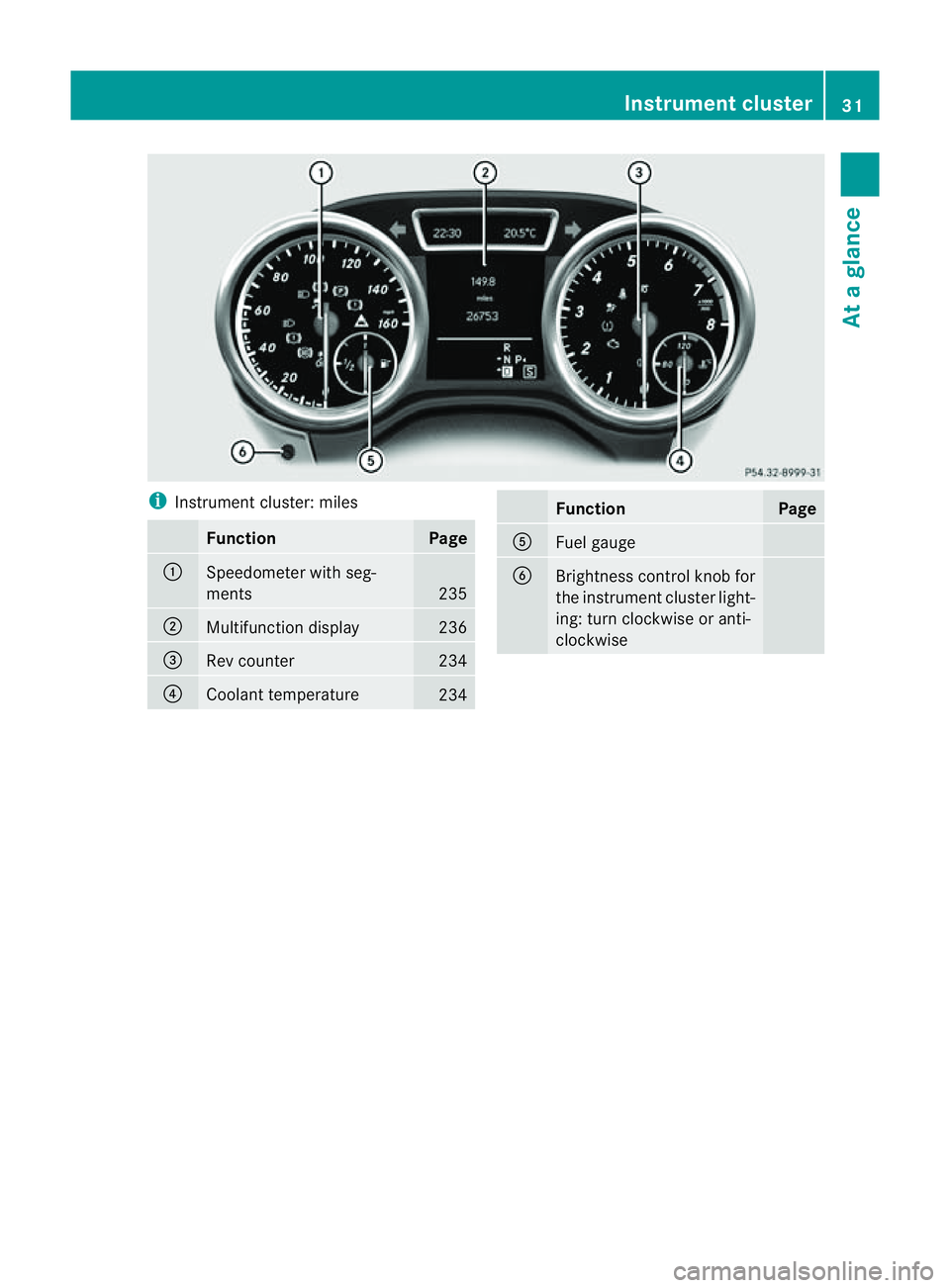
i
Instrument cluster: miles Fun
ction Page
:
Speedometer with seg-
ments
235
;
Multifunctio
ndisplay 236
=
Rev counter 234
?
Coolant temperature
234 Function Page
A
Fuel gauge
B
Brightness control knob for
the instrument cluster light-
ing: turn clockwise or anti-
clockwise Instrument cluster
31Atag lance
Page 38 of 389
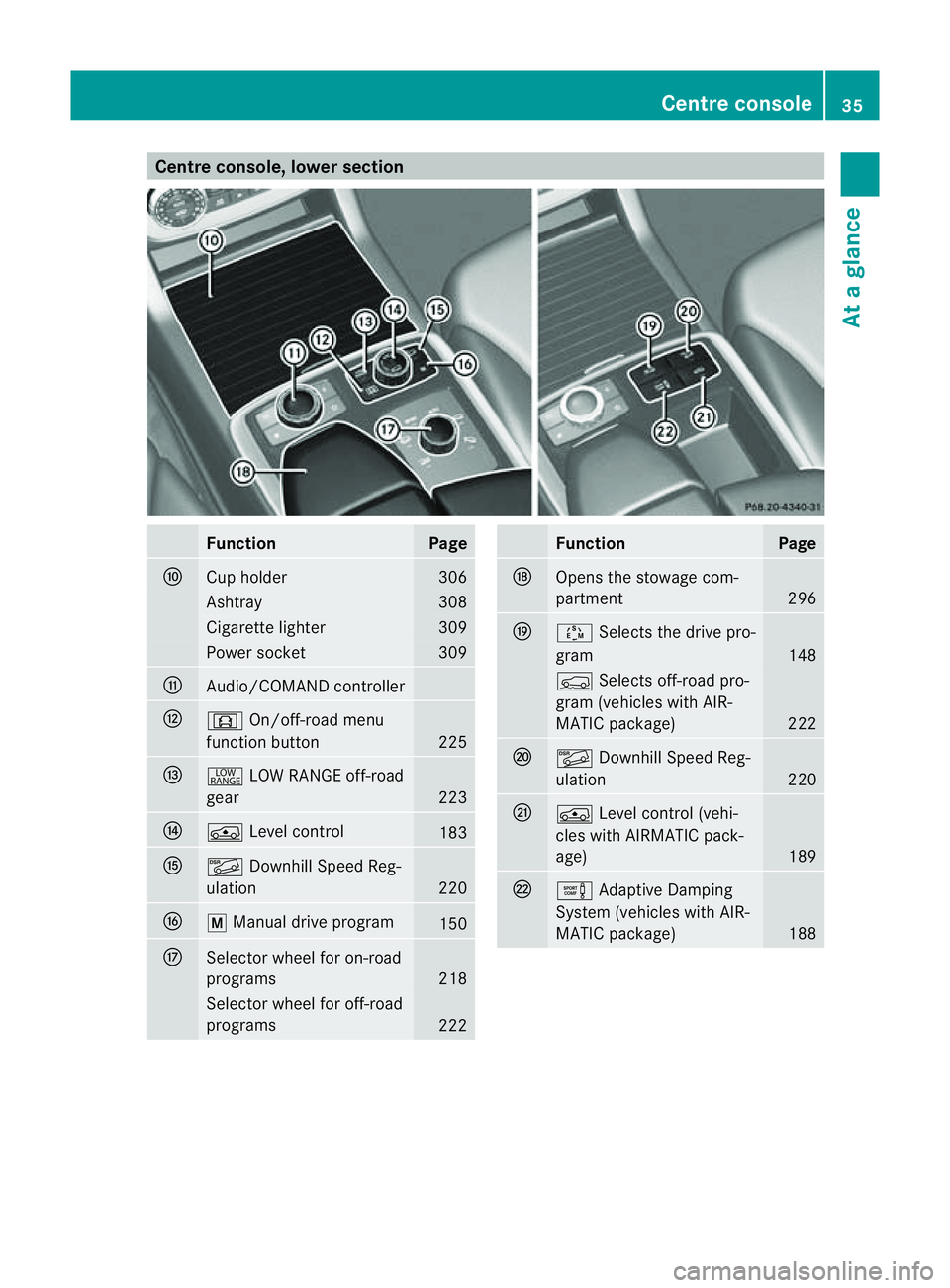
Centre console, lower section
Function Page
F
Cup holder 306
Ashtray 308
Cigarett
elighter 309
Power socket 309
G
Audio/COMAND controller
H
d
On/off-road menu
function button 225
I
+
LOW RANGE off-road
gear 223
J
Á
Level control 183
K
Ã
Downhill Speed Reg-
ulation 220
L
p
Manual driv eprogram 150
M
Selec
torw heel for on-road
progra ms 218
Selector whee
lfor off-road
progra ms 222 Func
tion Page
N
Open
sthe stowage com-
par tment 296
O
Ú
Select sthe driv epro-
gram 148
Ç
Selectsoff-road pro-
gra m( vehicles with AIR-
MATIC package) 222
P
Ã
Downhil lSpeed Reg-
ulation 220
Q
Á
Level control (vehi-
cle sw ithA IRMATIC pac k-
age) 189
R
e
Adaptive Damping
System (vehicles wit hAIR-
MATIC packa ge) 188Centre cons
ole
35Atag lance
Page 39 of 389
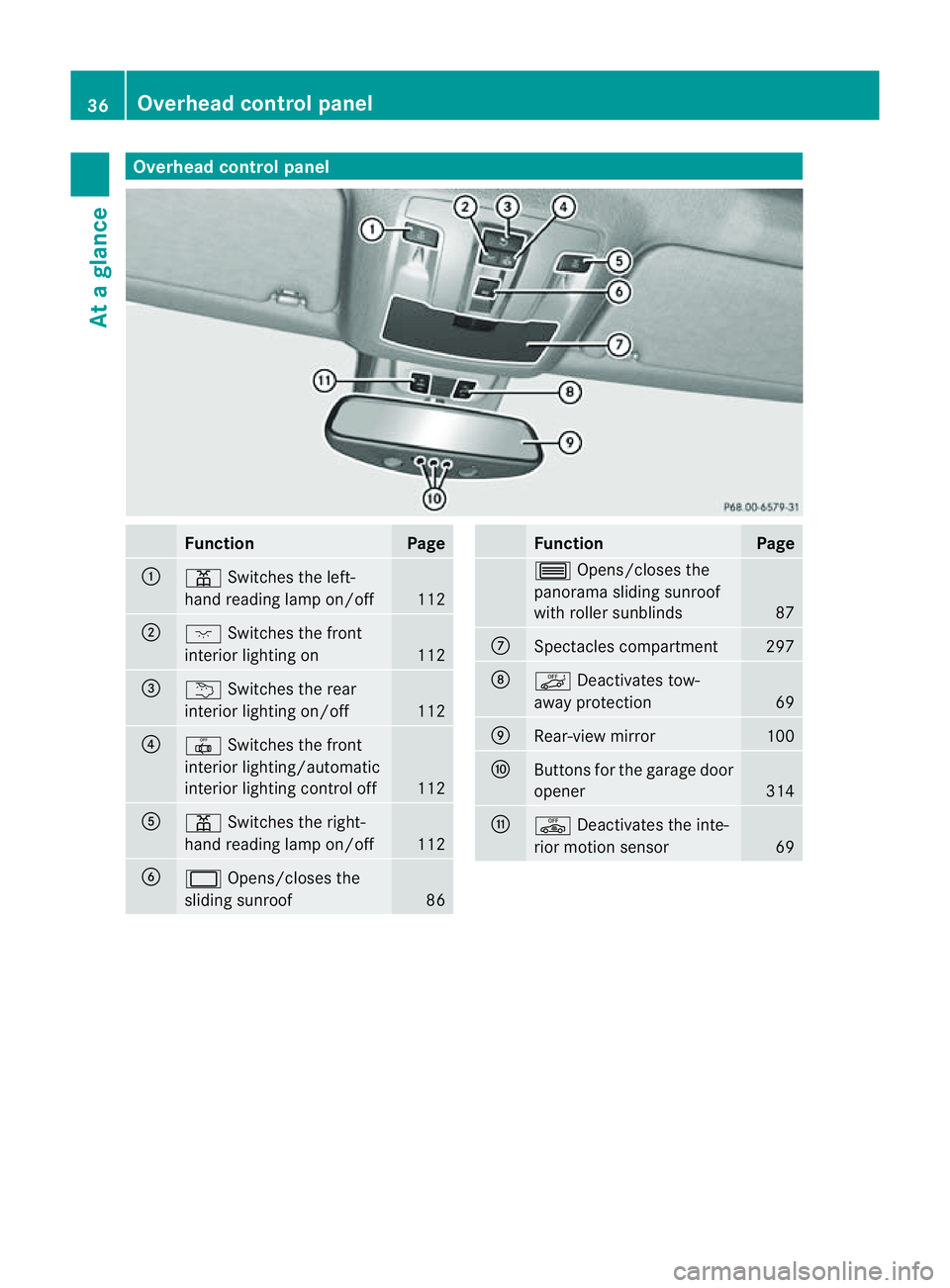
Overhea
dcontrol panel Function Page
:
p
Switche sthe left-
han dreadin glamp on/off 112
;
c
Switches the front
interior lighting on 112
=
u
Switches the rear
interior lighting on/off 112
?
|
Switches the front
interior lighting/automatic
interior lighting control off 112
A
p
Switches the right-
hand readin glamp on/off 112
B
2
Opens/close sthe
slidin gsunroof 86 Function Page
3
Opens/close sthe
pano rama sliding sunroof
with rolle rsunblinds 87
C
Spectacles compartment 297
D
ë
Deactivates tow-
away protection 69
E
Rear-view mirror 100
F
Button
sfor the garage door
opener 314
G
ê
Deactivates the inte-
rior motion sensor 6936
Overhead control panelAt
ag lance
Page 44 of 389
G
WARNING
Modifications to or work performe dincor-
rectly on the following parts can result in the
restraint systems not functioning as intended:
R the restraint system, consisting of seat
belts and thei ranchorage points, bel tten-
sioners, belt for celimiter sand airbags
R the wiring
R networked electronic systems
Airbags and belt tensioners could fail to
deploy or be trigge redinana ccident despite
the deceleration force being sufficient to trig-
ger the systems, or could be triggered unin-
tentionally. For this reason, never make any
modifications to the restrain tsystems.
Therefore, you must not tamper with elec-
tronic components or their software. SRS (Supplemen
talRestraint System)
Introduction SRS consists of:
R
the 6 SRS warning lamp
R airbags
R airba gcontrol unit (with crash sensors)
R belt tensioner sfor the front seat belts and
the outer seat belts in the rear
R belt force limiters
SRS reduces the risk of occupan ts coming
into contact with the vehicle's interio rinthe
even tofana ccident. It can als oreduce the
effect of the forces to which occupant sare
subjected during an accident.
SRS warnin glamp SRS functions are checked regularly when
you switch on the ignition and when the
engine is running. Therefore ,malfunctions
can be detected in good time.
The 6 SRS warning lamp in the instrument
cluster lights up when the ignition is switched
on. It goes out no later than afew seconds
after the engine is star ted. G
WARNING
If SRS is malfunctioning, individual systems
may be activated unintentionally or may not
be triggered in the even tofanaccident with
ah igh rate of vehicle deceleration.
Am alfunction has occurred if:
R the 6 SRS warning lamp does not light
up when the ignition is switched on.
R the engine is runnin gand the 6SRS
warning lamp doe snot go out after afew
seconds.
R the engine is runnin gand the 6SRS
warning lamp lights up again.
In this case, have SRS checked immediately
at aq ualified specialist workshop .Mercedes-
Benz recommends that you use aMercedes-
Benz Servic eCentr efor this purpose.
In particular ,work relevant to safet yoron
safety-related systems must be carried out at
aq ualified specialist workshop.
Triggering of belt tensioners, belt force
limiters and airbags During the first stage of
acollision ,the airbag
con trol unit evaluates important physical
data relatin gtovehicle deceleration or accel-
eration, such as:
R duration
R direction
R magnitude
Based on the evaluation of this data, the air-
bag control unit pre-emptively triggers the
belt tensioner sinthe first stage.
i The front belt tensioner scan only be trig-
gered if the seat belt tongues on the front
seats are correctly engaged in the seat belt
buckles.
If there is an even higher rate of vehicle decel-
eration or acceleration in alongitudinal direc-
tion ,the front airbags ar ealso deployed.
Your vehicle has adaptive, two-stage front air-
bags. The airbag control unit evaluates vehi-
cle deceleration or acceleration in the event Occupant safety
41Safety Z
Page 45 of 389
of
ac ollision .Inthe first deploymen tstage,
the front airbag is filled with enoug hpropel-
lan tgas to reduce the risk of injuries. The
front airbag is fully deployed if asecond
deployment threshold is exceeded within a
few milliseconds.
The belt tensioner and airbag triggering
thresholds are variable and are adapted to the
rat eofd eceleration or acceleration of the
vehicle. This process is pre-emptive in nature.
The triggerin gprocess mus ttake place in
good time at the start of the collision.
i Airbags are not deployed in all types of
accidents. Also, not all airbags are
deployed together in an accident .The dif-
ferent airbag system swork independently
of each other.
How the airbag system work sisdeter-
mined by the severity of the collision detec-
ted, especially the vehicle deceleration or
acceleration, and the apparent type of acci-
dent:
R head-on collision
R side impact
R overturn
The rat eofvehicle deceleration or accelera-
tion and the direction of the force are essen-
tially determined by:
R the distribution of forces during the colli-
sion
R the collision angle
R the deformation characteristics of the vehi-
cle
R the characteristics of the object with which
the vehicle has collided
Factors which can only be seen and measured
after acollision has occurred do not play a
decisive role in the deployment of an airbag,
nor do they provide an indication of airbag
deployment.
The vehicle ma ybedeformed significantly,
e.g. the bonnet or the wing, without an airbag
being deployed. This is the case if only parts
which are relatively easily deformed are affec- ted and the rat
eofdeceleration is not high.
Conversely, airbags may be deployed even
though the vehicle suffers only minor defor-
mation. This is the case if, for example, very
rigid vehicle part ssuch as longitudinal body
members are hit, and sufficient deceleration
occurs as aresult. Airbags
Important safety notes Airbag deployment slows down and restricts
the movemen
tofthe vehicle occupant.
If the airbags ar edeployed, you will hear a
bang and asmall amount of powder may also
be released. Only in rare cases will th ebang
affect your hearing. The powde rthat is
released generally does not constitute a
healt hhazard. The 6SRS warning lamp
lights up.
The airbag installation locations are identified
by the AIRBA Gsymbol. G
WARNING
Airbags provide additional protection; they
are not, however, asubstitute for seat belts.
Observe the following notes to reduce the risk
of serious or even fatal injury caused by airbag
deployment:
R all vehicle occupants –inparticular ,preg-
nant women –must wear their seat belt
correctly at all times and lean back against
the backrest, which should be positioned
as close to the vertical as possible. The
head restraint must support the back of the
head at about eye level.
R always secur echildren less than 1.50 mtall
and under 12 years of age in suitable child
restraint systems.
R all vehicle occupant smust select aseat
position that is as far away from the airbag
as possible. The driver' sseat position must
allow the vehicle to be driven safely .The
driver's chest should be as fa raway from 42
Occupant safetySafety
Page 49 of 389
PRE-
SAFE®
inte rvenes:
R in emergenc ybraking situations ,e.g. if BAS
is activated or for vehicles with DISTRONIC
PLUS, BAS PLUS intervenes powerfully
R if the radar senso rsystem detects an immi-
nent dange rofcollision in cer tain situa-
tions (on vehicles with DISTRONIC PLUS)
R in critical drivin gsituations, e.g. when phys-
ical limits are exceed and the vehicle under-
steers or oversteers severely
PRE-SAFE ®
takes the following measures
depending on the hazardous situation detec-
ted:
R the fron tseat belts are pre- tensio ned.
R vehicles with the memory fun ction :it
adjust sthe front-pas senger seat if it is in
an unfavourable position.
R if th evehicle skids, th eslidin gsunroof/
panoram aslidin gsunroof and th eside win-
dows are closed so tha tonly asmall gap
remains.
If th ehazardous situatio npasses without
resulting in an accident ,PRE-SAFE ®
slackens
the belt pretensioning. All settings made by
PRE-SAFE ®
can then be reversed.
If the seat belts are not released:
X Move the backrest or seat back sligh tly, but
only when the vehicle is stationary.
The belt pretensionin gisreduced and the
locking mechanis misreleased. G
WARNING
When adjusting the seat, mak esure that
nobody can become trapped.
! Make sure that there are no objects in the
footwell or behind the seats when moving
the seat back. There is arisk that the seats
and/or the objects could be damaged.
More information abou tseat-belt adjust-
men t,ac onvenienc efunction integrated into
PRE-SAFE ®
,c an be found in the "Seat-belt
adjustment" section (Y page 48). Seat belts
Important safety notes Seat belts are the most effective means of
restraining the movemen
tofvehicle occu-
pant sint he even tofana ccident. This
reduce sthe risk of vehicle occupan ts coming
into contact with parts of the vehicl einterior. G
WARNING
As eat belt which is not worn correctly, or
which has not been engaged in the seat belt
buckle correctly, can notp erform its intended
protectiv efunction. Under certain circum-
stances, this could cause severe or even fatal
injuries in the event of an accident.
Make sure that all occupant s–inparticular,
pregnan twome n–w ear their seat belt cor-
rectly at all times.
R The seat belt must fit snugly on your body
and must no tbetwisted. Therefore, avoid
wearing bulky clothing, e.g. awinter coat.
The shoulder belt section must be routed
across the centre of your shoulder –onno
account across your neck or under your
arm –and pulled tight against your upper
body .The lap belt must always pass across
your lap as low down as possible, i.e. over
your hip join ts–n ot across your abdomen.
If necessary ,push down the belt strap
slightly and then retighten it in the roll-up
direction.
R Do not route the belt strap across sharp
edge sorfragil eobjects, especially if these
are located on or in your clothing, e.g. spec-
tacles, pens, keys, etc. The seat belt strap
could be damaged and tear in an accident,
and you or other vehicl eoccupants could
be injured.
R Onl yone person should use each sea tbelt
at any one time. Children must never travel
sittin gont he lap of other occupan ts.It
would not be possible to restrain the child
in the event of asudden change in direc-
tion, braking or an accident .This could 46
Occupant safetySafety
Page 51 of 389
Sea
tbelt adjustment The seat-belt adjustment func
tion adjusts the
driver's and front-passenger seat belt to the
upper body of the occupants.
The belt strap is tighte neds lightly when:
R you engage the belt tongue in the belt
buckle and you then turn the key to position
2 in the ignition lock.
R the key is in position 2in the ignition lock
and you then engage the belt tongue in the
buckle.
The seat-belt adjustment will apply acertain
tightening force if any slack is detected
between the occupant and the seat belt. Do
not hold on to the seat belt tightly while it is
adjusting. You can switc hthe seat-belt
adjustment on and off in the on-boar dcom-
puter (Y page 251).
The seat-belt adjustment is an integra lpart of
the PRE-SAFE ®
convenience function. More
information about PRE-SAFE ®
can be found
in the "PRE-SAFE ®
(preventative occupant
protection)" section (Y page 45).
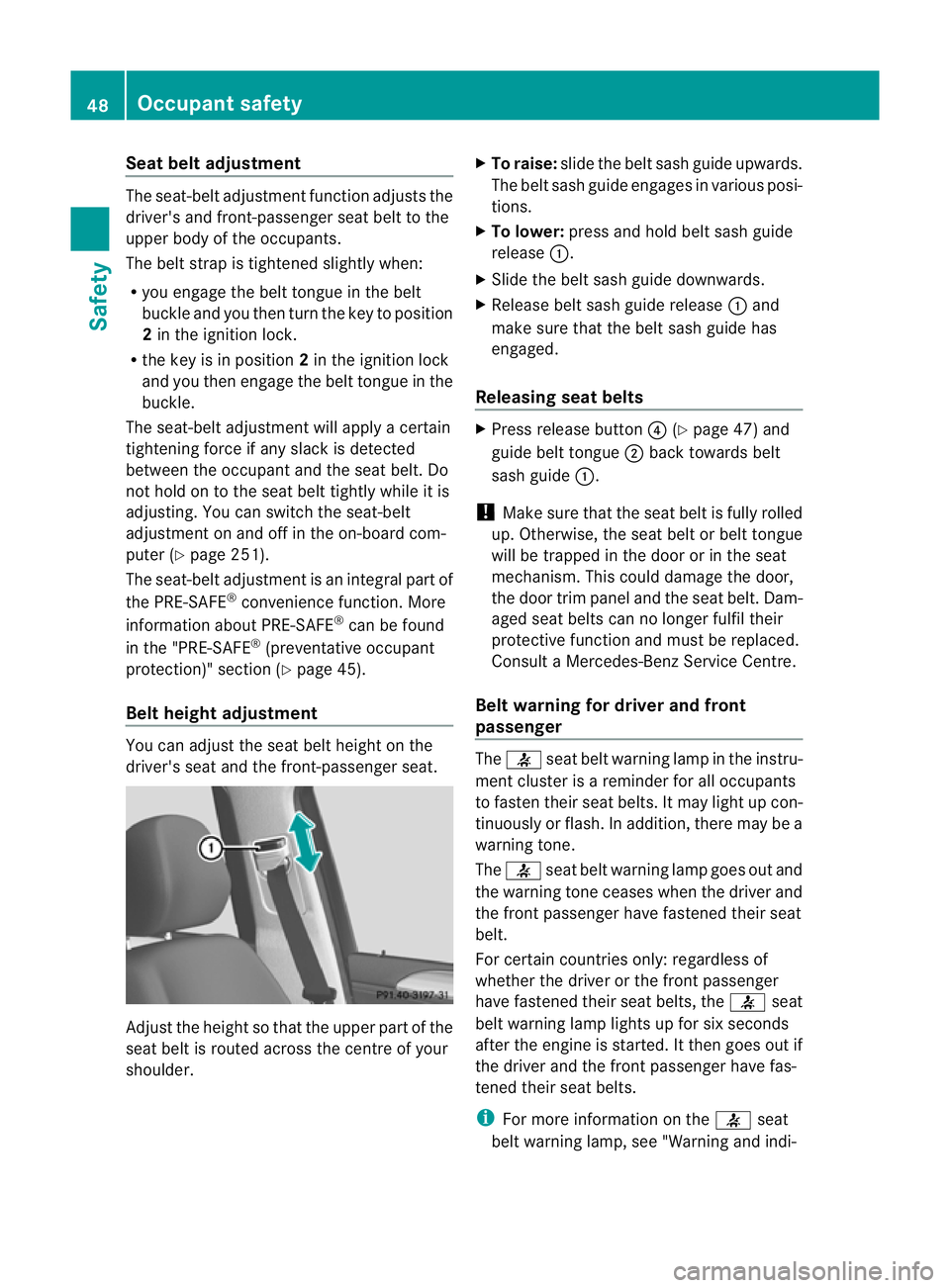
Belt height adjustment You can adjust the seat belt height on the
driver' sseat and the front-passenger seat. Adjust the height so that the upper part of the
seat belt is routed across the centre of your
shoulder. X
To raise: slide the belt sash guide upwards.
The belt sash guide engages in various posi-
tions.
X To lower: press and hold belt sash guide
release :.
X Slide the belt sash guide downwards.
X Release belt sash guide release :and
mak esure that the belt sash guide has
engaged.
Releasing seat belts X
Press release button ?(Ypage 47) and
guide belt tongue ;back towards belt
sash guide :.
! Make sure that the seat belt is fully rolled
up. Otherwise, the seat belt or belt tongue
will be trapped in the door or in the seat
mechanism. This could damage the door,
the door trim panel and the seat belt. Dam-
aged seat belts can no longer fulfil their
protective function and must be replaced.
Consult aMercedes-Benz Servic eCentre.
Belt warning for driver and front
passenger The
7 seat belt warning lam pint he instru-
men tcluster is areminder for all occupants
to fasten their seat belts. It may light up con-
tinuously or flash. In addition ,there ma ybea
warning tone.
The 7 seat belt warning lamp goes out and
the warning tone ceases when the driver and
the front passenge rhave fastened their seat
belt.
For certain countries only: regardless of
whethe rthe driver or the front passenger
hav efastened their seat belts, the 7seat
belt warning lamp lights up for six seconds
after the engine is started. It then goes out if
the driver and the front passenger have fas-
tened their seat belts.
i For more information on the 7seat
belt warning lamp, see "Warning and indi- 48
Occupant safetySafety