weight MERCEDES-BENZ M-CLASS SUV 2011 User Guide
[x] Cancel search | Manufacturer: MERCEDES-BENZ, Model Year: 2011, Model line: M-CLASS SUV, Model: MERCEDES-BENZ M-CLASS SUV 2011Pages: 389, PDF Size: 9.22 MB
Page 299 of 389
Usefu
linfor mati on
i This Owner's Manual describes all models
and all standard and optional equipment
available to your vehicle at the time of pub-
lication of the Owner's Manual. Country-
specific deviation sare possible .Please
not ethat your vehicle ma ynot be equipped
with all featur es described. This also
applies to safety-releva ntsystems and
functions.
i Please read the information on qualified
specialist workshops (Y page 24).Loading guidelines
G
WARNING
Secur eand position the load as described in
the loading guidelines.
Otherwise, vehicl eoccupan tscould
be injured by the loa dbeingthrown around in
th ee vent of sharp braking ,asudden change
in directio noranaccident.
You wil lfind further information in the "Secur-
ing aload" section.
Even if you follow all the loadin gguidelines,
the load will increase the risk of injury in the
event of an accident. G
WARNING
Keep the tailgate closed when the engine is
running. Otherwise, you could be poisoned by
exhaust fumes enterin gthe vehicle.
The handling characteristics of aladen vehi-
cle are dependent on the distribution of the
load within the vehicle. For this reason, you
should observe the following notes when
transporting aload:
R when transpor ting aload, never exceed the
maximum permissible gross vehicle weight or the permissible axle loads for the vehicle
(includin goccupants).
R position heavy loads as far forward saspos-
sible and as low down in the load compart-
men tasp ossible.
R the load must not protrude abov ethe upper
edge of the seat backrests.
R always plac ethe load against the rea ror
front seat backrests .Make sure that the
seat backrests are securely locked into
place.
R hook in the safety net when loading.
R always place the load behind unoccupied
seats if possible.
R secure the load with sufficiently stron gand
wear-resistant lashing material. Pad sharp
edges for protection.
i Load restraints are available at any quali-
fied specialis tworkshop, e.g. aMercedes-
Benz Servic eCentre. Stowage areas
Stowage compartments
Important safety notes G
WARNING
The stowage compartments must be closed
when item sare store dinthem. Luggage nets
ar en ot designed to secur eheavy item sof
luggage.
You or other vehicle occupant scould be
injure dbyo bjectsbeing thrown around if you:
R brak esharply
R change direction suddenly
R arei nvolved in an accident
Sharp-edge dand fragile object smust not be
placed in the luggag enet. 296
Stowage areasStowing and features
Page 301 of 389
Stowage compa
rtment/telephone com-
partment under the armrest
i Depending on the vehicle's equipment, a
USB port and an AUX-I Njack or aMedia
In terf ace are installed in the stowage com-
partment .AMedia In terface is auniversal
interface for portable audi oequipment, e.g.
for an iPod ®
or MP3 player (see the sepa-
rat eA udio or COMAND operating instruc-
tions).
i There is aremovable stowage tray in the
storage compartment, in which objects
such as an iPod ®
can be stored. X
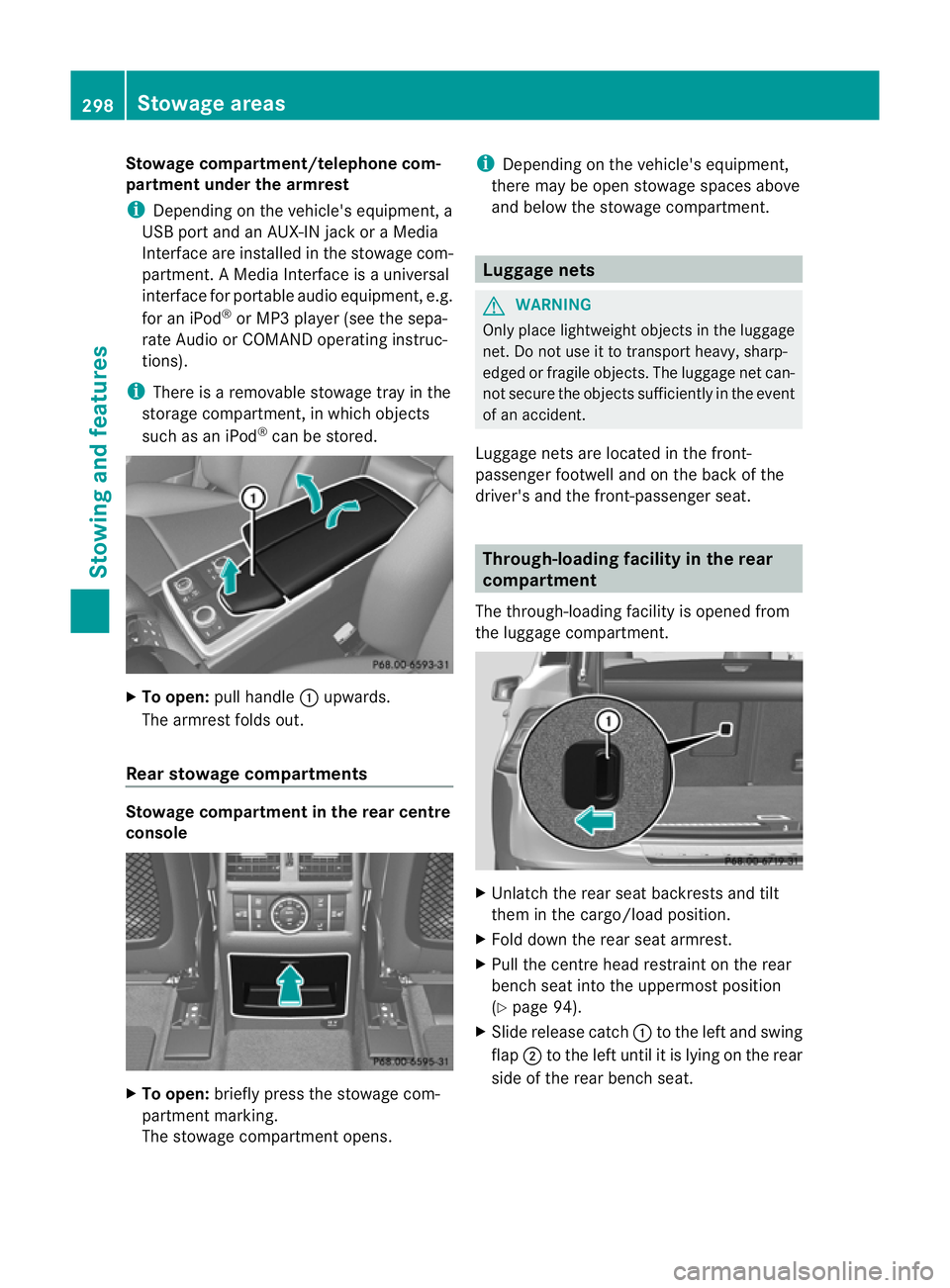
To open: pull handle :upwards.
The armrest folds out.
Rea rstowage compartments Stowage compartment in the rear centre
cons ole X
To open: briefly pres sthe stowage com-
partment marking.
The stowage compartmen topens. i
Depending on the vehicle's equipmen t,
there may be ope nstowag espaces above
and below the stowage compartment. Luggage nets
G
WAR
NING
Only place lightweight obje ctsint he luggage
net .Don ot use it to transport heavy ,sharp-
edged or fragile objects. The luggag enet can-
not secur ethe objects sufficiently in the event
of an accident.
Luggage net sare locate dinthe front-
passenger footwell and on the bac kofthe
driver 'sand the front-passenger seat. Through-loading facility in the rear
compartment
The through-loading facility is opened from
the luggag ecompartmen t. X
Unlatch th erear seat back rests and tilt
them in the cargo/load position.
X Fold down the rea rseat armrest.
X Pull the centr ehead restraint on the rear
benc hseat int othe uppermost position
(Y page 94).
X Slide release cat ch: to the left and swing
flap ;to the left until it is lying on the rear
sid eoft he rea rbenc hseat. 298
Stowage areasStowing and fea
tures
Page 304 of 389
or fragile objec
ts.W hen brakin gsharply,
changing direction quickly or in the even tof
an accident ,the bag hooks will not secur ethe
item ssufficiently. This could result in injury to
yourself or others.
! The bag hoo kcan bear amaximum load
of 3k g. Do not use it to secur eaload.
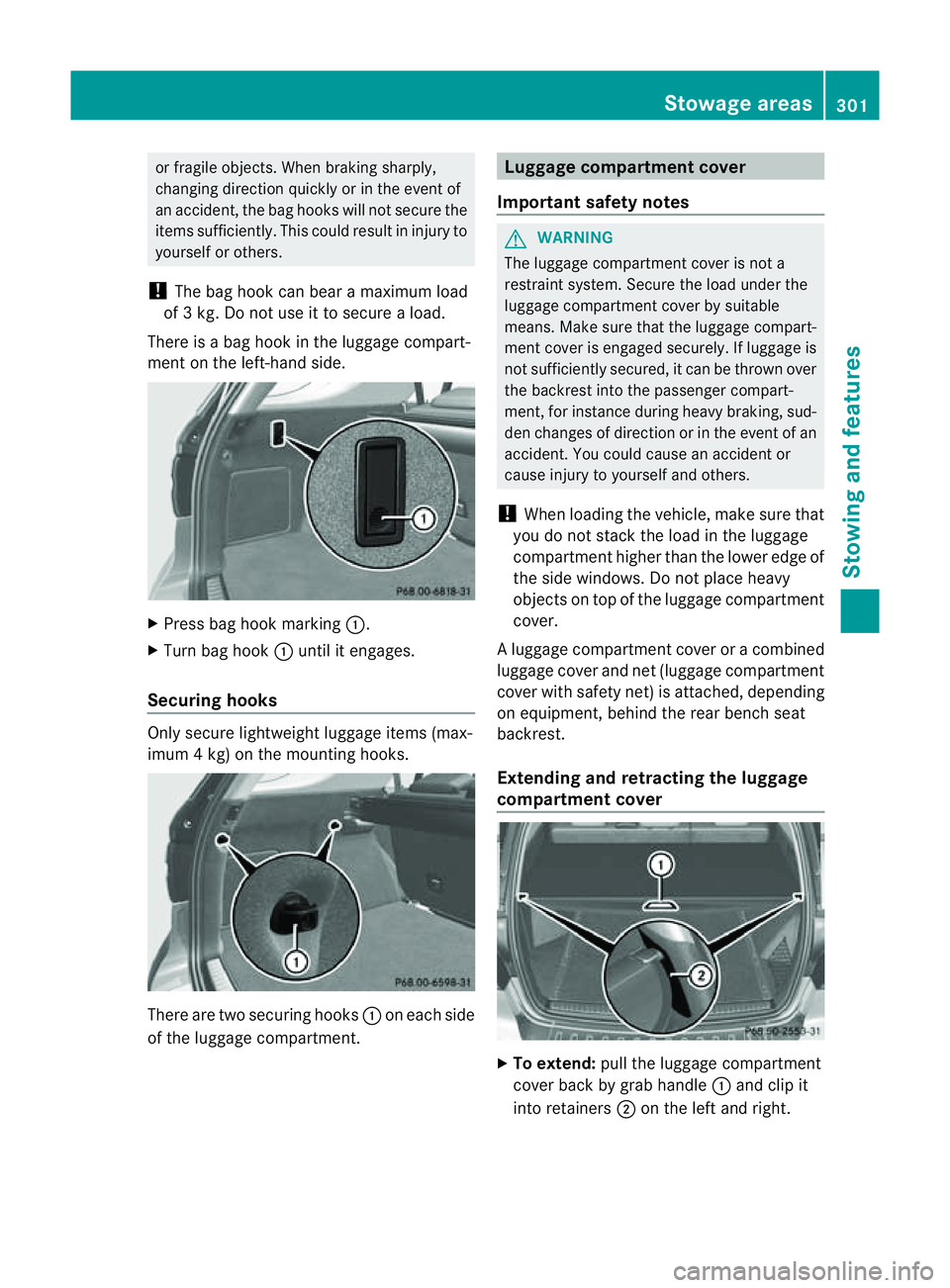
There is abag hook in the luggag ecompart-
men tont he left-hand side. X
Press bag hook marking :.
X Tur nbag hook :until it engages.
Securing hooks Only secure lightweight luggag
eitems (max-
imum 4kg) on the mounti nghooks. There ar
etwo securing hooks :on each side
of the luggage compart ment. Luggag
ecompartment cover
Important safety notes G
WARNING
The luggage compartment cover is not a
restraint system. Secur ethe load unde rthe
luggag ecompart ment cover by suitable
means. Make sure that the luggage compart-
ment cover is engaged securely. If luggage is
not sufficiently secured, it can be thrown over
the backres tinto the passenger compart-
ment, for instance during heavy braking, sud-
den change sofdirection or in the event of an
accident .You coul dcause an accident or
cause injury to yourself and others.
! When loading the vehicle, make sure that
you do not stack the load in the luggage
compartment higher than the lower edge of
the side windows .Donot plac eheavy
object sontop of the luggage compartment
cover.
Al uggage compartment cover or acombined
luggage cover and net (luggage compar tment
cove rwith safety net) is attached, depending
on equipment, behind the rear bench seat
backrest.
Extending and retracting the luggage
compa rtment cover X
To extend: pull the luggage compartment
cover back by grab handle :and clip it
int or etainers ;on the left and right. Stowage areas
301Stowingandfeatur es Z
Page 307 of 389
Inserting th
ebracket sintot he loading
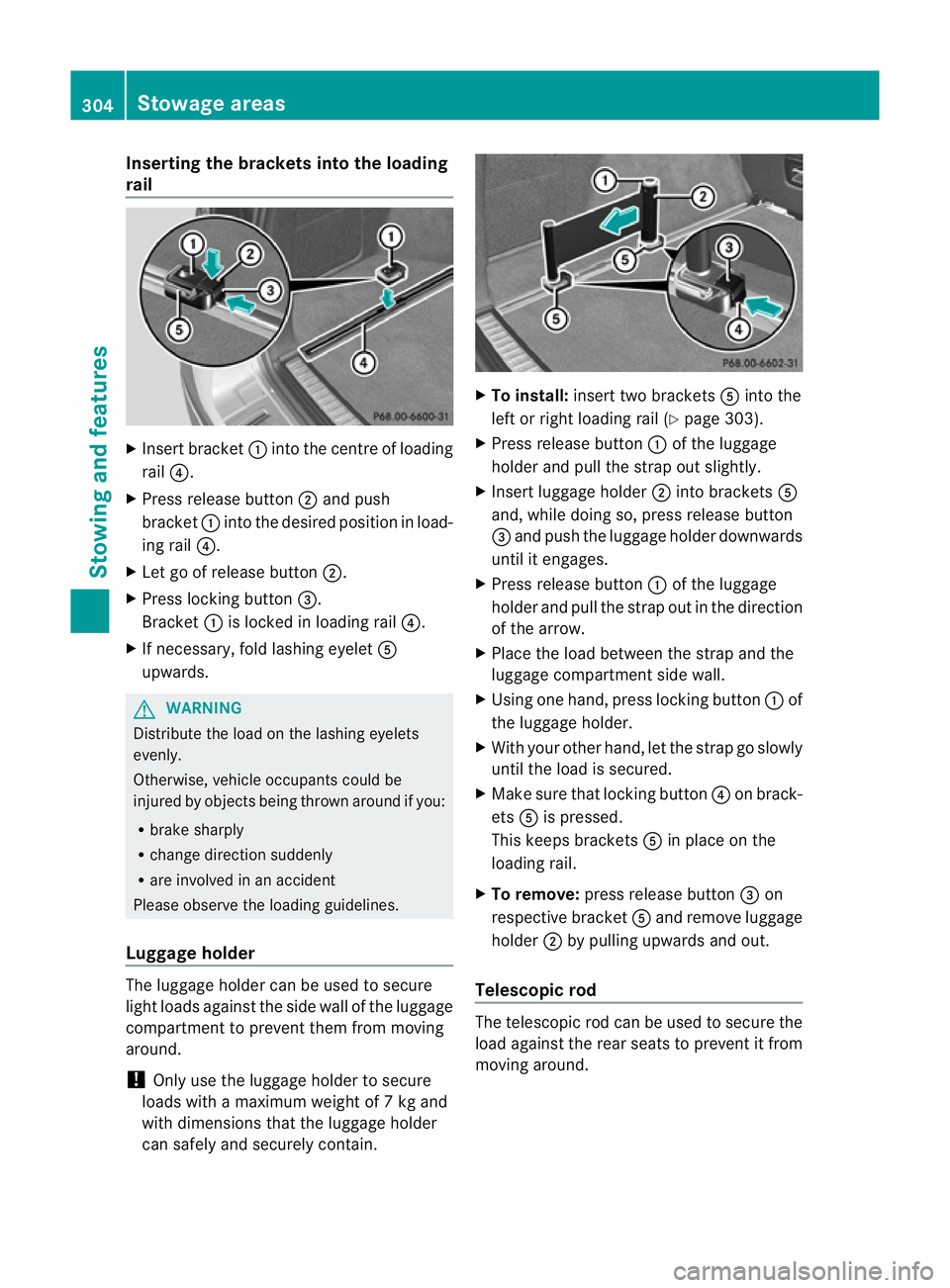
rail X
Insert bracket :into th ecentr eofl oading
rail ?.
X Press release button ;and push
bracket :intothe desired position in load-
ing rail ?.
X Let go of rel ease button ;.
X Press locking button =.
Bracket :is locked in loading rail ?.
X If necessary, fol dlashin geyelet A
upwards. G
WARNING
Distribute the loa donthe lashing eyelets
evenly.
Otherwise, vehicle occupants could be
injured by objects being thrown around if you:
R brake shar ply
R chang edirection suddenly
R are involved in an accident
Please observe the loading guidelines.
Luggage holder The luggage holder can be use
dtosecure
ligh tloads against the side wall of the luggage
compartment to prev entthem from moving
around.
! Only use the luggage holder to secure
loads with amaximum weight of 7kgand
with dimensions that the luggage holder
can safel yand securely contain. X
To install: insert two brackets Ainto the
left or right loading rail (Y page303).
X Press releas ebutton :of the luggage
holder and pull the strap out slightly.
X Insert luggag eholder ;intob rackets A
and ,while doing so, press release button
= and push the luggage holder downwards
until it engages.
X Press release button :of the luggage
holder and pull the strap out in the direction
of the arrow.
X Plac ethe load between the strap and the
luggage compartment side wall.
X Using one hand, press locking button :of
the luggage holder.
X With your other hand, let the strap go slowly
until the load is secured.
X Make sur ethat locking button ?on brack-
ets Ais pressed.
This keeps brackets Ain plac eonthe
loading rail.
X To remove: press release button =on
respective bracket Aand remove luggage
holder ;by pulling upwards and out.
Telescopic rod The telescopic rod can be used to secure the
load against the rea
rseats to prevent it from
moving around. 304
Stowage areasStowing and features
Page 310 of 389
The bottles are neither secured nor prevented
from tippin gover. Therefore ,donot plac eany
ope ndrink con tainers in the stowage com-
partments.
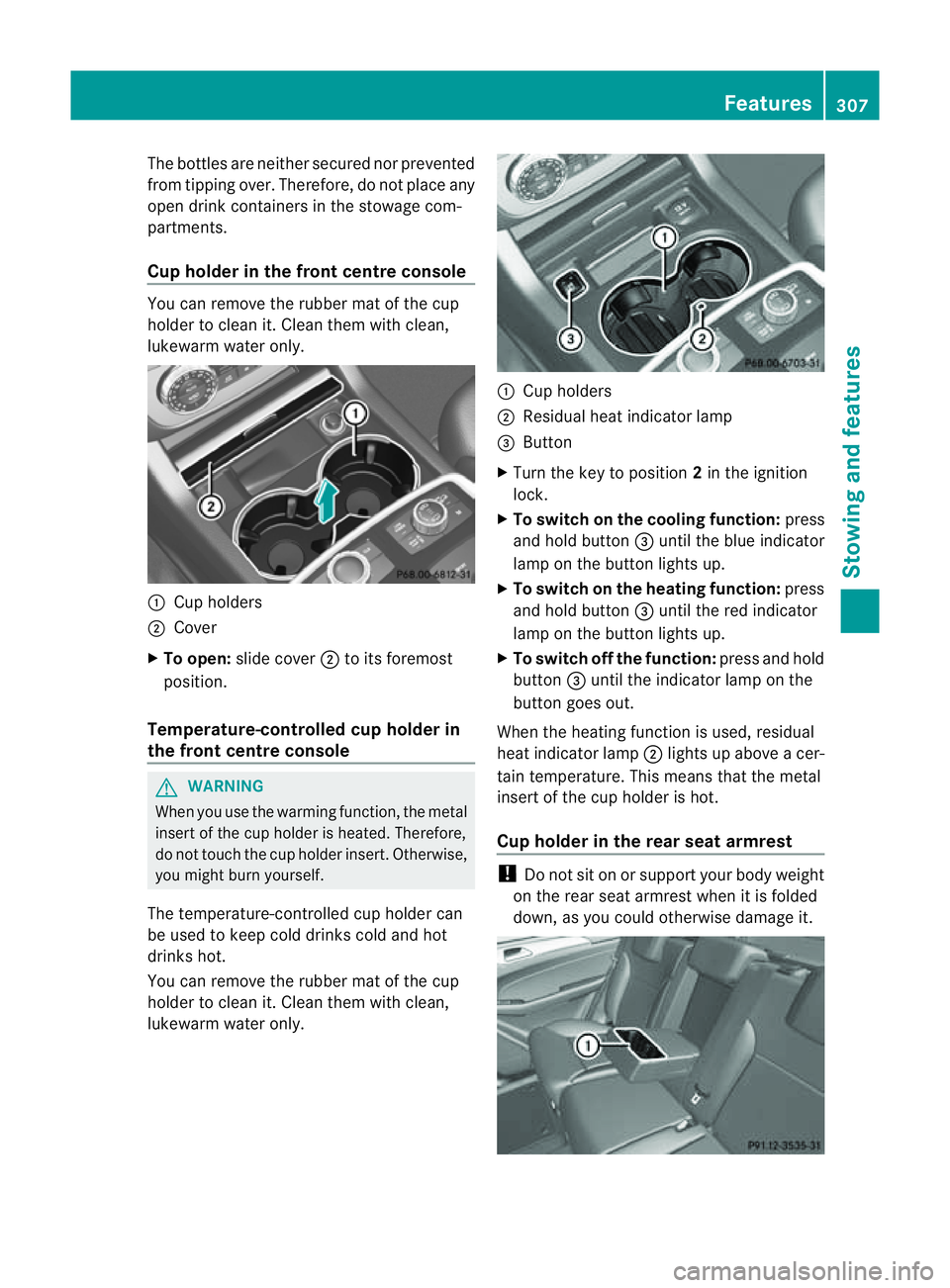
Cup holder in the front centre console You can remov
ethe rubber ma tofthe cup
holder to clea nit. Clean them with clean,
lukewarm water only. :
Cup holders
; Cover
X To open: slidecover ;to its foremost
position.
Tem perature-controlled cup holder in
the front centre console G
WARNING
When you use the warming function, the metal
insert of the cup holder is heated. Therefore,
do not touch the cup holder insert. Otherwise,
you might burn yourself.
The tem perature-c ontrolle dcup holde rcan
be used to keep cold drinks cold and hot
drinks hot.
You can remove the rubber mat of the cup
holder to clean it. Clean them with clean,
lukewar mwater only. :
Cup holders
; Residua lheat indicator lamp
= Button
X Tur nthe key to position 2in the ignition
lock.
X To switch on th ecooling function: press
and hold button =until the blue indicator
lamp on the button lights up.
X To switch on the heating function: press
and hold button =until the red indicator
lamp on the button lights up.
X To switch off the function: press and hold
button =until the indicator lamp on the
button goes out.
When the heating func tion is used, residual
heat indicator lamp ;lights up abov eacer-
tain temperature. This mean sthat the metal
inser tofthe cup holder is hot.
Cu ph older in the rear seat armrest !
Do not sit on or support your body weight
on the rear seat armrest when it is folded
down, as you could otherwise damage it. Features
307Stowingandfeatu res Z
Page 353 of 389
R
the engine is not running.
R there is abrake syst emmalfunction.
R there isam alfunction in the power supply
or the vehicle' selectrical system.
The power assistance for the steering and the
brake forc ebooster do not work when the
engin eisnot running. You will need more
force to steer and brake, you may have to
depress the brake pedal with maximu mforce.
Before towin gaway ,make sure that the steer-
ing can be moved and is not locked.
If you tow or tow-star tanothe rvehicle, its
weight must not exceed the maximu mper-
missible gross vehicle weight of your vehicle. G
WARNING
The vehicle is braked when the HOL Dfunction
or DISTRONIC PLUS is activated. Therefore,
deactivate HOLD and DISTRONIC PLUS if the
vehicle is to be towed.
It is better to have the vehicle transported
than to have it towed.
! You may tow the vehicle for amaximum
of 50 km. Atowing speed of 50 km/h must
not be exceeded.
For towin gdistances over 50 km, the entire
vehicle must be lifted up and transported.
! Make sure that the electric parkin gbrake
is released. If th eelectric parkin gbrake is
faulty, visit aqualified specialist workshop.
! Only secure the tow rope or towing bar to
the towing eyes. The vehicle may otherwise
be damaged.
! Do not use the towing eye for recovery,
as this could damage the vehicle. If in
doubt, recover the vehicle with acrane.
! When towing, pull awa yslowly and
smoothly. If the trac tivepower is too high,
the vehicles could be damaged.
! To tow vehicles with KEYLESS-GO, use
the key instead of the Star t/Stop button.
Th ea utomatic transmission may otherwise switch to position
Pwhen you open the
driver' sorfront-passenger door which
could damag ethe transmission.
! Vehicles with differential locks: make
sur ethe differential lock sare in automatic
mode. Th edifferential locks must not be
switched on by hand when towing the vehi-
cle. The transmission may otherwise be
damaged.
If the vehicle has suffered transmission dam-
age, have it transported on atransporter or
trailer.
Th ea utomatic transmission must be in posi-
tion Nwhen the vehicle is being towed.
The battery must be connected and charged.
Otherwise, you:
R cannot turn the key in the ignition lock to
position 2
R cannot shift the automatic transmission to
position N
i Before the vehicle is towed, switch off the
automatic locking feature (Y page 249).
You could otherwis ebelockedout when
pushing or towing the vehicle.
Deactivate tow-away protection
(Y page 69) before the vehicle is towed. Fitting/removing the towing eye
Fitting the towing eye Vehicles with
atrailer to whitch: if you intend
to use the vehicle for towing, fold out the ball
coupling and connect the towbar to it
(Y page 228).
X Remove the towing eye from the vehicle
tool kit (Y page 333).
The mountings for the removable towing eyes
are located in the bumpers. They are at the
front and at the rear ,under the covers. 350
Towing and tow-startingBreakdow
nassistance
Page 376 of 389
?
Vehicl eidentification number (VIN)
A Maximum permissible gross vehicle
weight
B Gross combination mass
C Maximum permissible front axle load
D Maximum permissible rear axle load
E Paint code Vehicle identification number (VIN)
In addition to being stamped on the vehicle
identification plate, the vehicle identification
number (VIN) is also stamped onto the vehicle
body. It is located in the lower part of the
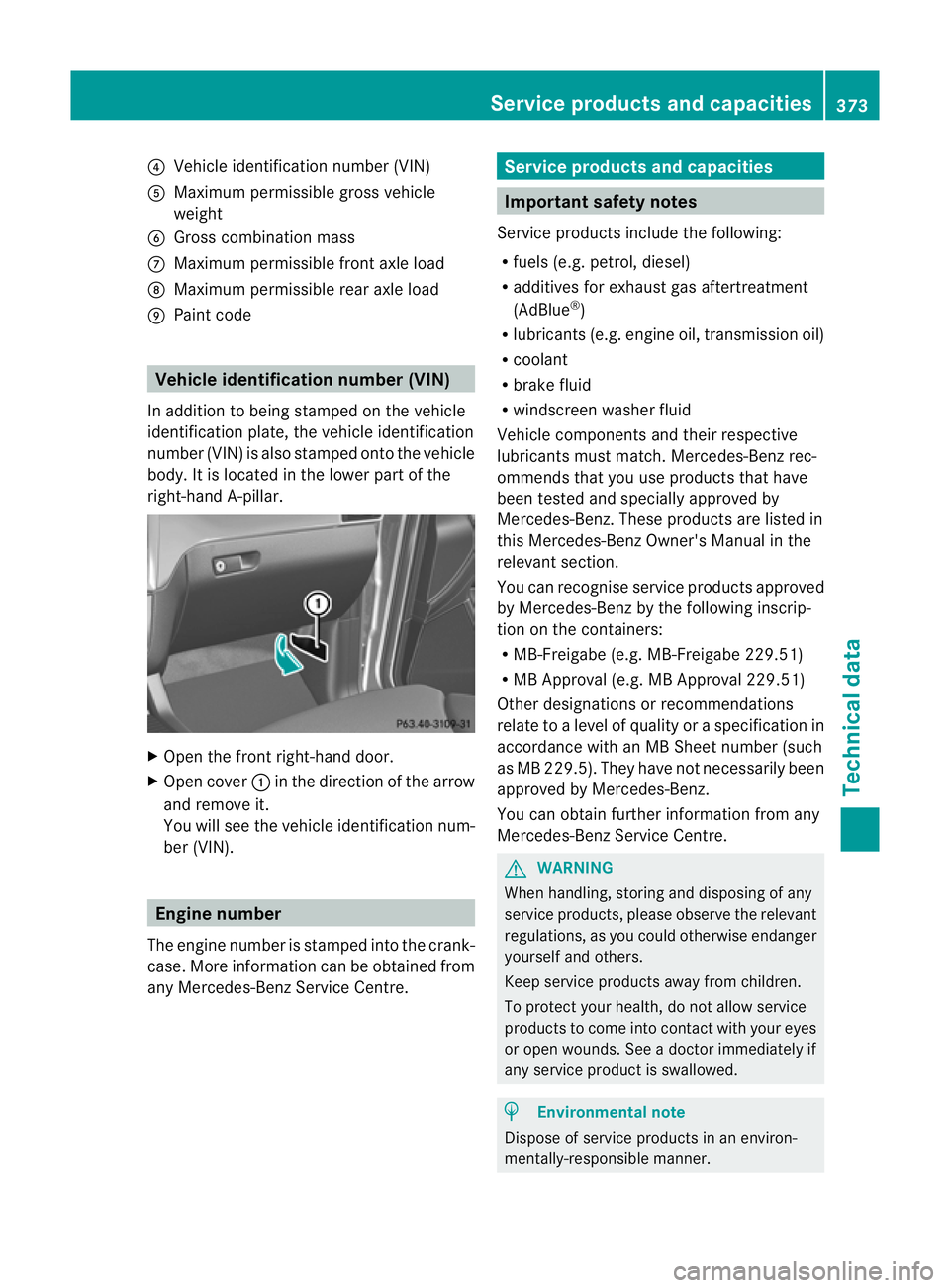
right-han dA-pillar. X
Ope nthe front right-hand door.
X Open cover :in the direction of the arrow
and remove it.
You will see the vehicle identification num-
ber (VIN). Engine number
The engin enumber is stamped into the crank-
case. More information can be obtained from
any Mercedes-Benz Service Centre. Service products and capacities
Important safety notes
Service products include the following:
R fuels (e.g. petrol, diesel)
R additives for exhaust gas aftertreatment
(AdBlue ®
)
R lubricants (e.g. engine oil, transmission oil)
R coolant
R brake fluid
R windscreen washe rfluid
Vehicle component sand thei rrespective
lubricants must match. Mercedes-Ben zrec-
ommends that you use products that have
been tested and specially approved by
Mercedes-Ben z.These product sare listed in
this Mercedes-Be nzOwner's Manual in the
relevant section.
You can recognise service product sapproved
by Mercedes-Ben zbythe fol lowinginscrip-
tion on the cont ainers:
R MB-Freigabe (e.g. MB-Freigabe 229.51)
R MB Approva l(e.g. MB Approval 229.51)
Other designation sorrecommendations
relat etoal evel of qualit yoras pecification in
accordance wit hanMBSheet number (such
as MB 229.5). They hav enot necessaril ybeen
approved by Mercedes-Benz.
You can obtain further information from any
Mercedes-Benz Ser vice Centre. G
WARNING
Whe nhandling, storing and disposing of any
servic eproducts, please observe th erelevant
regulations, as you could otherwise endanger
yourself and others.
Keep servic eproducts awa yfrom children.
To protect your health ,donot allow service
products to com einto contact with your eyes
or ope nwounds. See adoctor immediately if
any service product is swallowed. H
Environmental note
Dispose of service products in an environ-
men tally-responsible manner. Service products and capacities
373Technicaldata Z
Page 380 of 389
Coolant
Important safety notes The coolan
tisamixture of water and anti-
freeze/corrosio ninhibitor. It performs the
following tasks:
R anti-corrosio nprotection
R antifreeze protection
R raising th eboiling point
i When the vehicle is first delivered, it is fil-
led with acoolant mixtur ethat ensures
adequate antifreeze and corrosion protec-
tion.
! Only add coolant that has been premixed
with the desired antifreeze protection. The
engin ecould otherwise be damaged.
Further information on coolants and on fill-
ing can be found in the Mercedes-Benz
Specifications for Servic eProducts ,MB
Approval 310.1 ,e.g. on the Internet at
http ://bevo.mercedes-benz.com .You can
also consult aMercedes-Benz Service
Centre.
! Alway suseasuitable coolant mixture,
even in countries where high temperatures
prevail.
Otherwise, the engine cooling system is not
sufficiently protected from corrosion and
overheating.
If antifreeze/corrosio ninhibitor is present in
the correc tconcentration, the boilin gpoint of
the coolant during operation will be around
13 0†.
The antifreeze/ corrosion inhibitor con centra-
tion in the engine cooling system should:
R be at leas t50%. This wil lprotect the engine
coolin gsystem agains tfreezin gdown to
around -3 7†.
R not excee d55% (antifreeze protection
down to -45 †);otherwise, heat will not be
dissipated as effectively.
If the vehicle has los tcoolant, top it up with
equal amount sofwater and antifreeze/cor- rosion inhibitor. Mercedes-Benz recom-
mends an antifreeze/corrosion inhibitor
which has been approved for Mercedes-Benz.
! The engin ecoolin gsystem is filled with
coolant that must be renewed after 15
years, or after 250,000 km at the lates t. Vehicl
edata
Pleas enotet hat for the speci fied vehicle
data:
R the height sspecified may var yasaresult
of:
- tyres
- load
- conditio nofthe suspen sion
- optional equipment
R item sofo ptional equipmen tincrease the
unlade nweight and reduc ethe maximum
payload. The unladen weight is speci fied in
accordanc ewith EC directive and includes:
- driver (68 kg)
- luggage (7 kg)
- all fluids (fuel tan k90% full)
R veh icle-specific weigh tinformation can be
found on the vehicl eidentification plate
(Y page 37 2).
R only for cer tain countries: you can find vehi-
cle-specific vehicle data in the COC docu-
ment s(CERTIFICATE OF CONFORMITY).
Thes edocuments ar edelivered with your
vehicle.
Missing values were not available at tim eof
going to print. All models
Vehicle lengt
h(ECE) 480
4mm Vehicle width
including exterior
mirrors
214
1mm Vehicle width with-
out exterior mirrors 192
6mm Vehicl
edata
377Techni caldata Z
Page 381 of 389
All models
Wheelbase
2915 mm
Unladen weight
Maximu
mroofload 10
0kg Vehicle height
178
8mm Ground clearance
191 mm
1796 mm
Ground clearance
202 mm
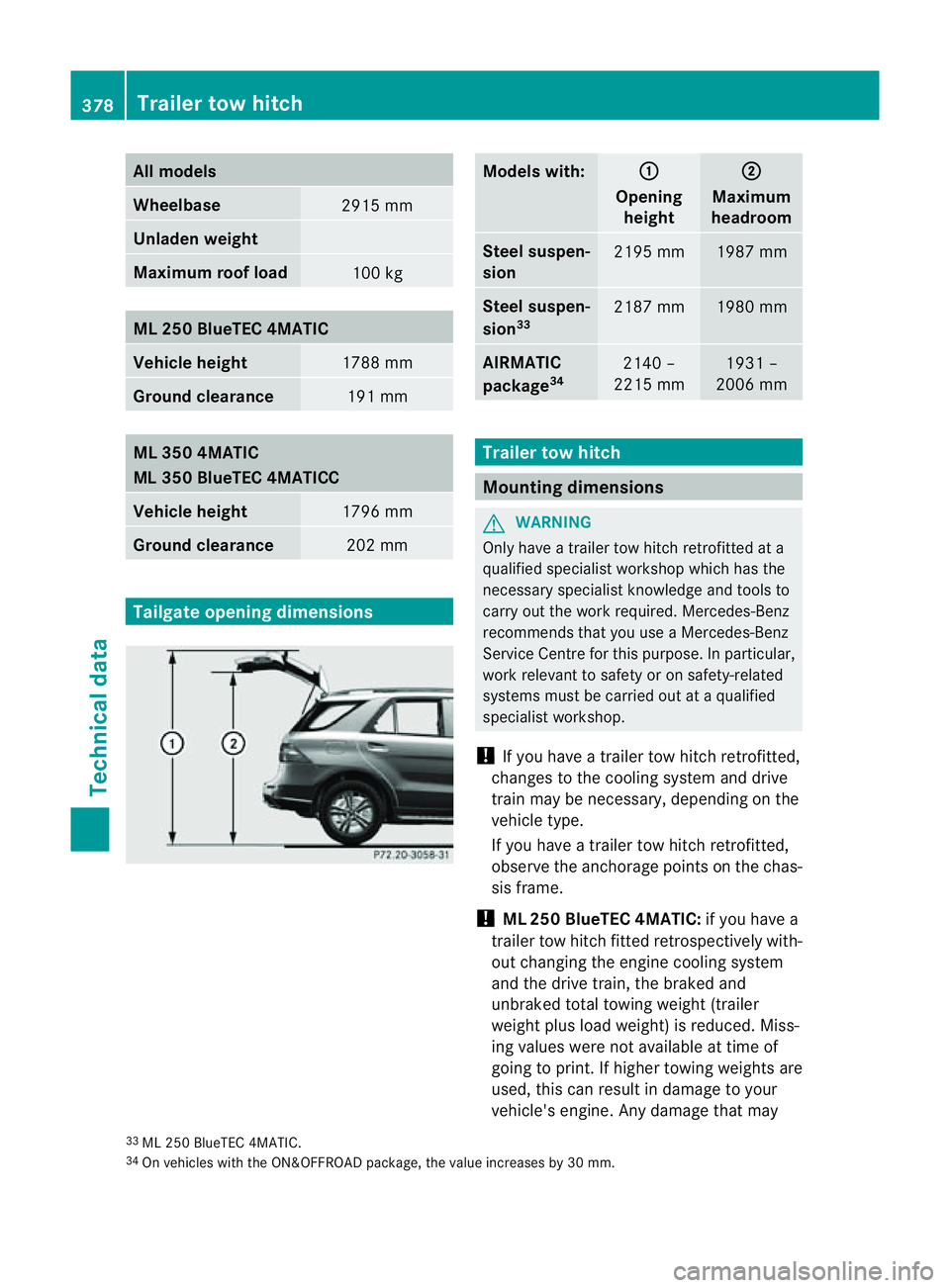
Tailg
ateo pening dimensions Models with: :
Opening
height ;
Maximum
headroom Stee
lsuspen-
sion 2195 mm 1987 mm
Steel suspen-
sion
33 2187 mm 1980 mm
AIRMATIC
package
34 2140 –
2215 mm 1931 –
2006 mm Traile
rtow hitch Mounting dimensions
G
WARNING
Only have atrailer tow hitch retrofit tedata
qualified specialist workshop which has the
necessary specialist knowledge and tools to
carry out the work required. Mercedes-Benz
recommends that you use aMercedes-Benz
Ser vice Centre for thi spurpose. In particular,
work relevant to safety or on safety-related
systems must be carried out at aqualified
specialist workshop.
! If you have atrailer to whitchr etrofit ted,
changes to the cooling system and drive
train may be necessary, depending on the
vehicle type.
observe the anchorage points on th echas-
sis frame.
! trailer tow hitc hfitted retrospectively with-
out changing the engine cooling system
and the drive train ,the braked and
unbraked tota ltowing weight (trailer
weight plus load weight) is reduced. Miss-
ing values wer enot available at tim eof
going to print. If higher towin gweight sare
used ,this can result in damage to your
vehi cle's engine. An ydamage that may
33
34 On vehicles with the ON&OFFROAD package, the value increases by 30 mm. 378
Trailer tow hitchTechnica
ldata
ML 250 BlueTEC 4MATIC
ML 350 4MATIC
Vehicle height
ML
350 BlueTEC 4MATICC
ML 250 BlueTEC 4MATIC:if you have a
If you have
atrailer to whitchr etrofit ted,
ML 25 0BlueTE C4MATIC.
Page 382 of 389
occur is not covered by the warranty or the
implied warranty .Therefore, ensur ethat
you always comply with the reduce dtotal
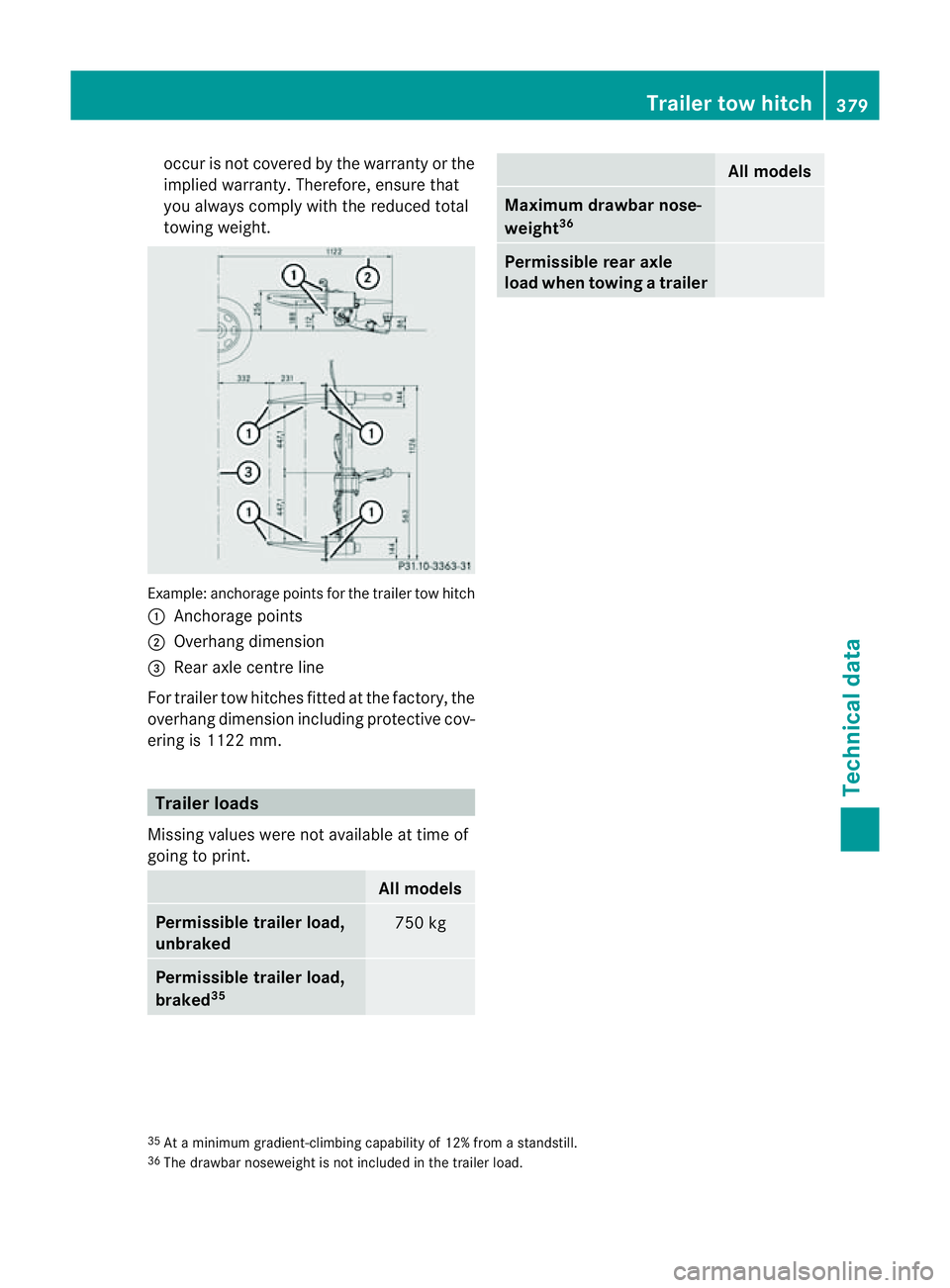
towin gweight. Example
:anchorag epoints for the trailer tow hitch
: Anchorage points
; Overhang dimension
= Rear axle centre line
For trailer tow hitches fit tedatt he factory, the
overhang dimension includin gprotective cov-
ering is 1122 mm. Traile
rloads
Missing values were not available at time of
going to print. All models
Permissible trailer load,
unbraked
750 kg
Permissible trailer load,
braked
35 All models
Maximu
mdrawbar nose-
weight 36 Permissibl
erear axle
load when towing atrailer 35
At am inimum gradient-climbing capability of 12% from astandstill.
36 The drawba rnoseweight is not included in the trailer load. Trailer tow hitch
379Technicaldata Z