wheel MERCEDES-BENZ M-CLASS SUV 2011 User Guide
[x] Cancel search | Manufacturer: MERCEDES-BENZ, Model Year: 2011, Model line: M-CLASS SUV, Model: MERCEDES-BENZ M-CLASS SUV 2011Pages: 389, PDF Size: 9.22 MB
Page 26 of 389
are listed in the original purchase agreement
of your vehicle. Should you hav eany ques-
tions concerning equipment and operation,
please consult aMercedes-Ben zService
Cent re. Oper
ating safety Safe
tynotes G
WARNING
All wor konthe vehicle and, in particular ,work
relevant to safet yoronsafety-related sys-
tems must be carried out at aqualified spe-
cialist workshop. The specialist workshop
must have the necessary specialist knowl-
edge and tools to carry out the work required.
Mercedes -Benz recommends that you use a
Mercedes-Benz Ser vice Centre for thi spur-
pose. G
WARNING
Some safety systems only function when the
engine is running. You should therefore never
switch off the engine when driving. Otherwise,
the safety systems of your vehicle may not
function correctly and as aresult will no lon-
ger protec tyou and other person sasinten-
ded .Ina ddition, there is arisk that you may
lose control of your vehicle and thus cause an
accident. G
WARNING
Work carried out incorrectly, or alterations
made to the vehicle, e.g. re-routing of cables
under coverings, could cause the safety sys-
tems of your vehicle to stop working properly.
The safety systems would thus no longer pro-
tect you and other persons as intended. In
addition, there is arisk that you may lose con-
trol of your vehicle and thus cause an acci-
dent.
All work and alteration stothe vehicle, e.g.
installation sormodifications, should there-
for ebec arried out at aqualified specialist
workshop. G
WARNING
If work on electronic equipmen tand its soft-
ware is carried out incorrectly, this equipment
could stop working. The electronic systems
are networ kedv ia interfaces. Tampering with
these electronic systems could cause mal-
func tions in system swhich hav enot been
modified. Malfunction ssuch as these can
seriously jeopardis ethe vehicle' soperating
safety and therefore your own safety.
You should therefore have all work and mod-
ifications to electronic components carried
out at aqualified specialist workshop. G
WARNING
If you drive over obstacle sathigh speed or if
the vehicle bottoms out in rough terrain, it
could cause heavy impact stothe vehicle
underbody, tyres or wheels. This coul dcause
your vehicle to be damaged, which in turn
might lead to an accident. This also applies to
vehicles which are equipped with underbody
protection.
You shoul dtherefore drive over obstacles
slowly. Prevent the vehicle from bottoming
out when driving off-road an difnecessar y,
hav eyourvehicle inspected at aqualified spe-
cialist workshop. General notes
The following information applie stoa ll radio
system component sinthe vehicle and to
COMAN D:
The radio system component sinthis vehicle
ar ec ompliant with the basic requirements
and all other relevant condition sofDirective
1999/5/EC. You can obtain further informa-
tion from any Mercedes-Ben zService Centre.
The equipment is approved by the vehicle
manufacturer in accordance with European
Automotive EMC Directive 95/54/ EC.O per-
ation accordin gtoits intende dpurpose is
thus approved for your vehicle. The equip-
ment does not require certification. Introduction
23 Z
Page 30 of 389
Dashboard
........................................... 28
Instrument cluster ..............................30
Multifunction steering wheel .............33
Centr econsole .................................... 34
Overhe adcontrol panel ...................... 36
Door control panel .............................. 37 27At
ag lance
Page 31 of 389
Dashboard
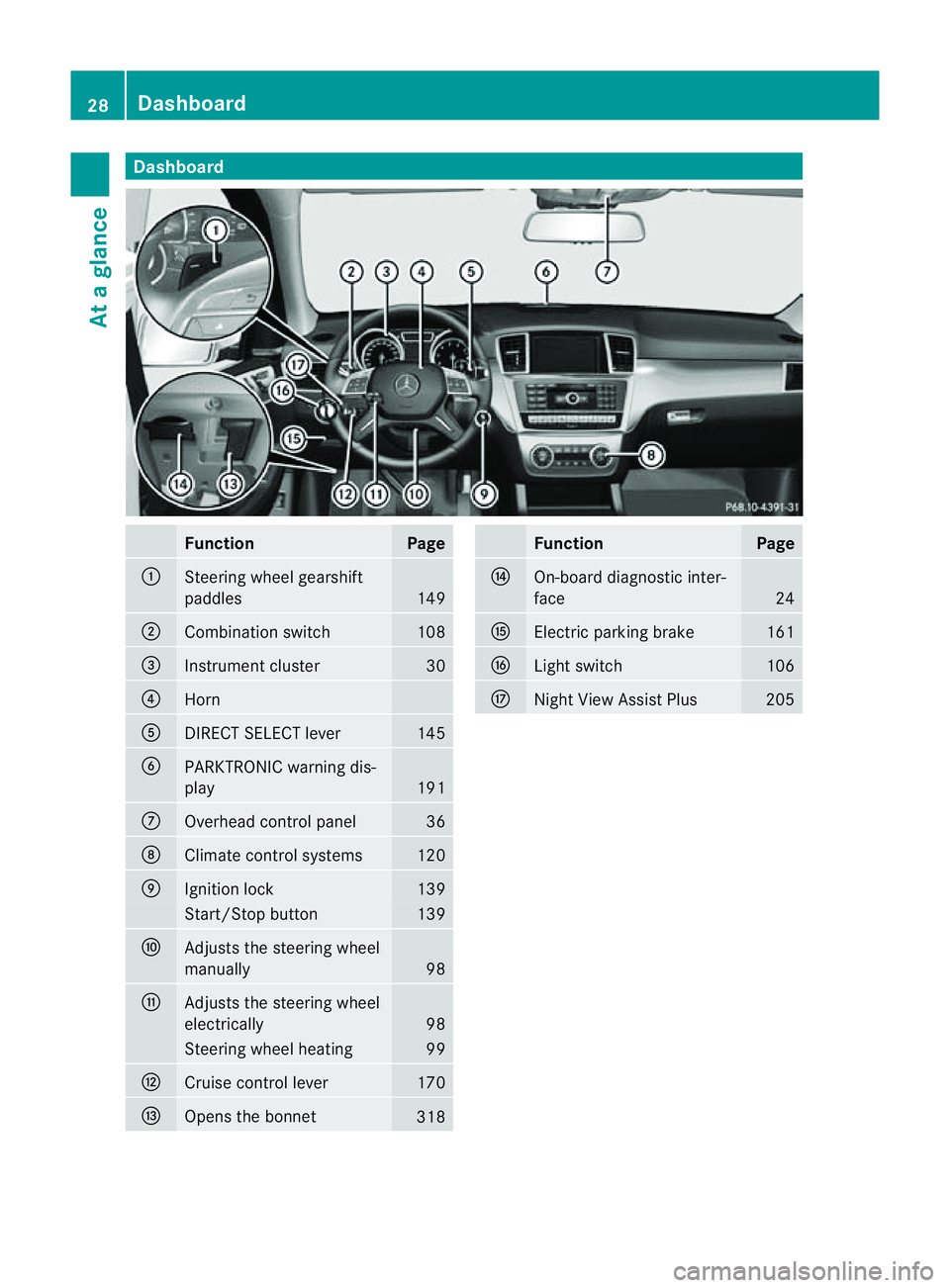
Function Page
:
Steerin
gwhee lgearshift
paddles 149
;
Combination switch 108
=
Instrumen
tcluster 30
?
Horn
A
DIRECT SELECT
lever 145
B
PARKTRONIC warnin
gdis-
play 191
C
Overhead contro
lpanel 36
D
Climat
econtrol systems 120
E
Ignition lock 139
Star
t/Stop button 139
F
Adjust
sthe steerin gwheel
ma nually 98
G
Adjust
sthe steerin gwheel
electrically 98
Steerin
gwhee lheating 99
H
Cruis
econtrol lever 170
I
Opens th
ebonnet 318 Fu
nction Page
J
On-boar
ddiagn ostic inter-
face 24
K
Electric parking brake 161
L
Light switch 106
M
Night Vie
wAssist Plus 20528
DashboardAt
ag lance
Page 32 of 389
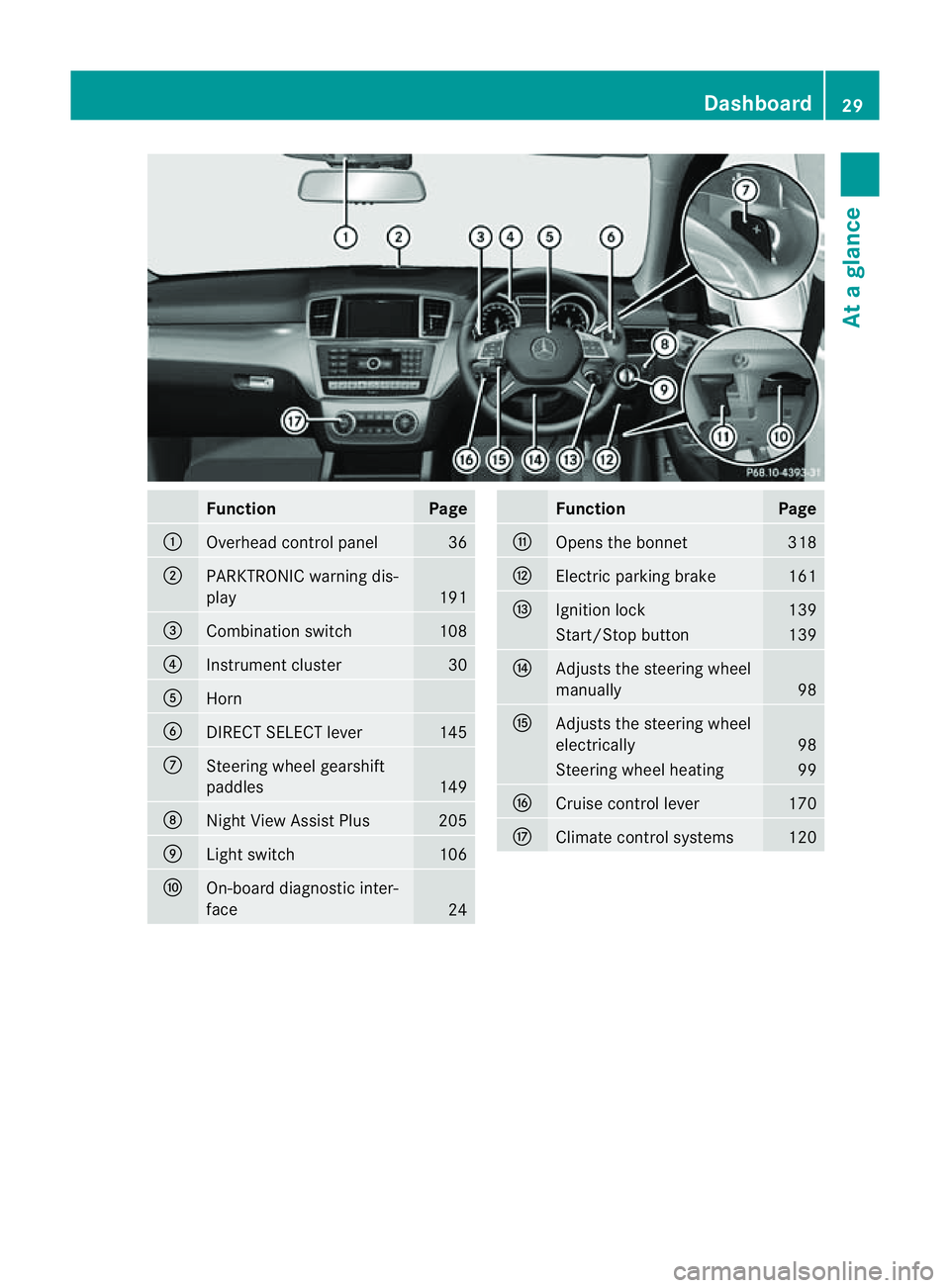
Function Page
:
Overhead con
trol panel 36
;
PARKTRONI
Cwarning dis-
play 191
=
Combination switch 108
?
Instrument cluster 30
A
Horn
B
DIRECT SELECT lever 145
C
Steerin
gwheel gearshift
paddles 149
D
Nigh
tView Assist Plus 205
E
Light switch 106
F
On-board diagnostic inter-
face 24 Function Page
G
Opens the bonnet 318
H
Electric parking brake 161
I
Ignition lock 139
Start/Stop button 139
J
Adjusts the steerin
gwheel
manually 98
K
Adjusts the steeri
ngwheel
electrically 98
Steerin
gwheel heati ng 99
L
Cruise control lever 170
M
Climate control systems 120Dashbo
ard
29Atag lance
Page 36 of 389
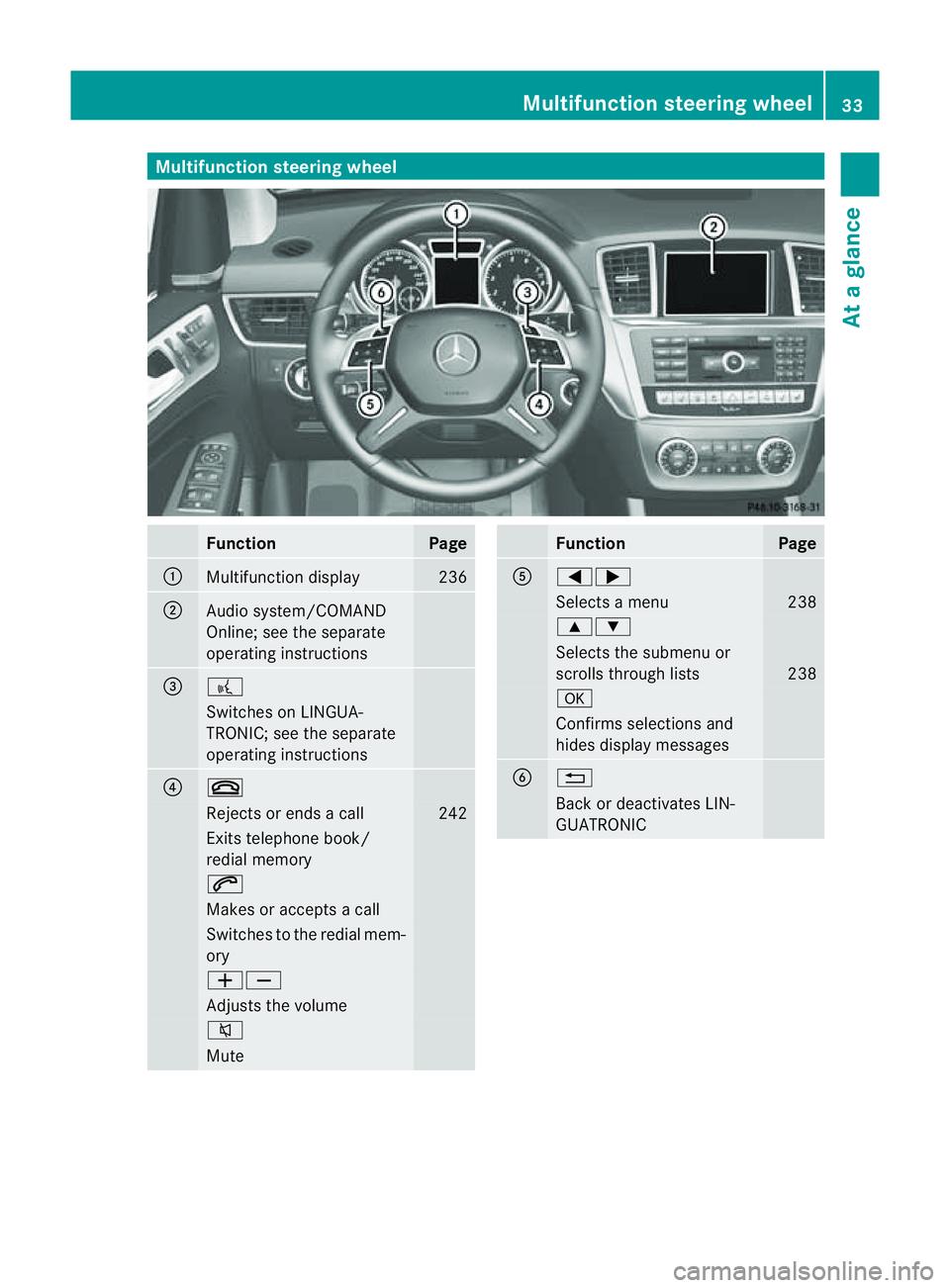
Multifunctio
nsteering wheel Function Page
:
Multifunction dis
play 236
;
Audi
osystem/COMAND
Online ;see the separate
operating instructions =
?
Switches on LINGUA-
TRONIC; see the separate
operating instructions ?
~
Rejects or ends
acall 242
Exits telephone book/
redial memory 6
Makes or accepts
acall Switches to the redial mem-
ory WX
Adjusts the volume
8
Mute Function Page
A
=;
Selects
amenu 238
9:
Selects the submenu or
scrolls through lists 238
a
Confirm
sselection sand
hid esdisplay messages B
%
Bac
kord eactivates LIN-
GUATRONIC Multifunction steering wheel
33Atag lance
Page 40 of 389
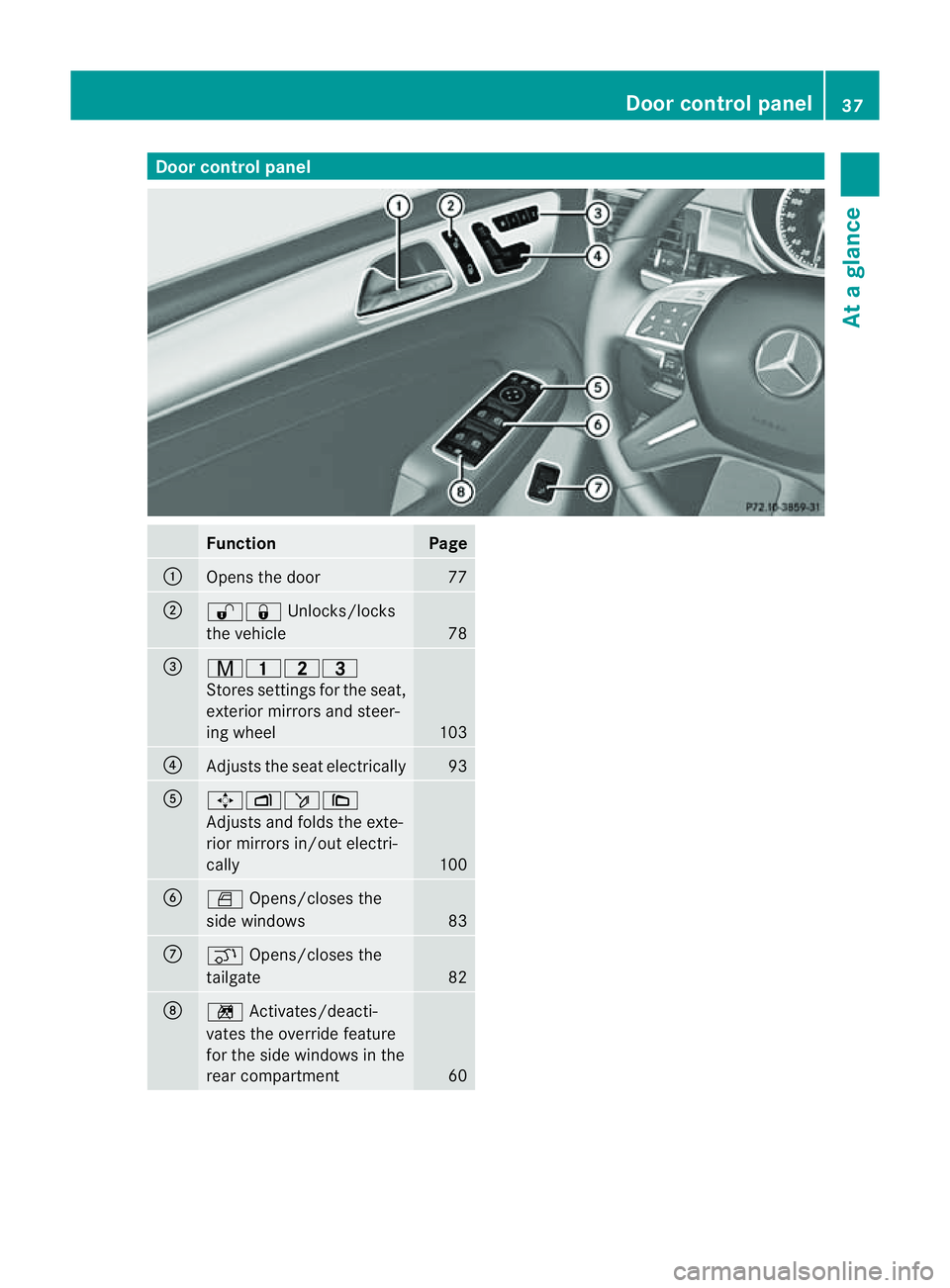
Door control panel
Function Page
:
Opens th
edoor 77
;
%&
Unlocks/locks
th ev ehicle 78
=
r4
5=
Stores se ttingsfor theseat,
exterior mirrors and steer-
ing wheel 103
?
Adjusts the seat electrically 93
A
7Zö\
Adjusts and folds the exte-
rio
rm irrors in/out electri-
cally 100
B
W
Opens/closes the
side windows 83
C
q
Opens/closes the
tailgate 82
D
n
Activates/deacti-
vates the override feature
for the side windows in the
rear compartment 60 Doo
rcontrol panel
37Atag lan ce
Page 46 of 389
the centre of the driver's airba
gcover as
possible.
R move the fr ont-passenge rseatasf ar back
as possible. Thi sisespecially important if
yo uh aves ecure dac hild in achild restraint
syste mont he front-passenger seat.
R vehicle occupants –inparticular ,children
–m ust not lean their heads into the area of
the window in which the sidebag/window-
bag is deployed.
R rearward-facing child restraint systems
must not be fit tedtot he front-passenger
seat unless the front-passenger airbag has
been disabled. On the front-passenger
seat, the front-passenger airbag is disabled
if ac hild rest raint system with atrans-
ponde rfor automatic child seat recognition
is fit tedtot he front-passenger seat in a
vehicle equipped with automatic chil dseat
recognition. The 4PASSENGE RAIRBAG
OF Findicator lamp must be continuously
lit.
If the front-passenger sea tofyour vehicle
does not have automatic child seat recog-
nition ,oryour rearward-facing child
rest raint system does not have automatic
child seat recognition, children must be
secured in achild rest raint system on a
suitable seat in the rear. If you secure a
forward-facing child restraint system to the
front-passenger seat, you must move the
front-passenger seat as far back as possi-
ble.
R make sure there are no heavy or sharp-
edged objects in the pockets of clothing.
R do not lean forwards, e.g. over the cover of
the driver's/front-passenger airbag, partic-
ularly when the vehicle is in motion.
R do not put your feet on the dashboard.
R only hold the steerin gwheel on the outside.
This allow sthe airbag to be fully deployed.
You coul dbeinjured if the airbag is
deploye dand you are holding the inside of
the steerin gwheel. R
do not lean on the doors from insid ethe
vehicle.
R make sur ethat ther eare no people ,ani-
mals or obje ctsb etween the vehicle occu-
pants and the area where the airbags are
deployed.
R do not place any objects between the seat
back rest and the door.
R do not hang any har dobjects, for example,
coat hangers, on the grab handles or coat
hooks.
R do not atta chaccessories, e.g. cup holders,
to the doors.
It is not possible to rule out arisk of injury
being caused by an airbag, due to the high
speed at which the airbag must be deployed. G
WARNING
Airbag functionality can only be assured if the
following parts are not covered and no badges
or stickers are attached to them:
R padded steerin gwheel boss
R kneebag cover below the steerin gcolumn
R front-passenger airbag cover
R outer side of seat bolsters G
WAR
NING
As mall amo untofp owder is released when
an air bagisd eployed. The powder could
cause short-term breathing difficulties in peo-
ple with asthma or other respirator yprob-
lems.
In order to prevent bre athing difficulties ,you
should leave the vehicle as soon as it is safe
to do so. You can also open the window to
allow fresh air to enter the interior .The pow-
der does not constitute ahealth hazar dand
doe snot indicat ethat ther eisaf ire in the
vehicle. G
WARNING
The airbag parts are hot after the airbag has
been deployed. Do not touch them as you
could burn yourself. Occupant safety
43Safety
Z
Page 47 of 389
Have the airbags replaced at
aqualified spe-
cialist workshop .Otherwi se,o ccupants are
not protecte dbythe airbags in the event of
anothe raccident.
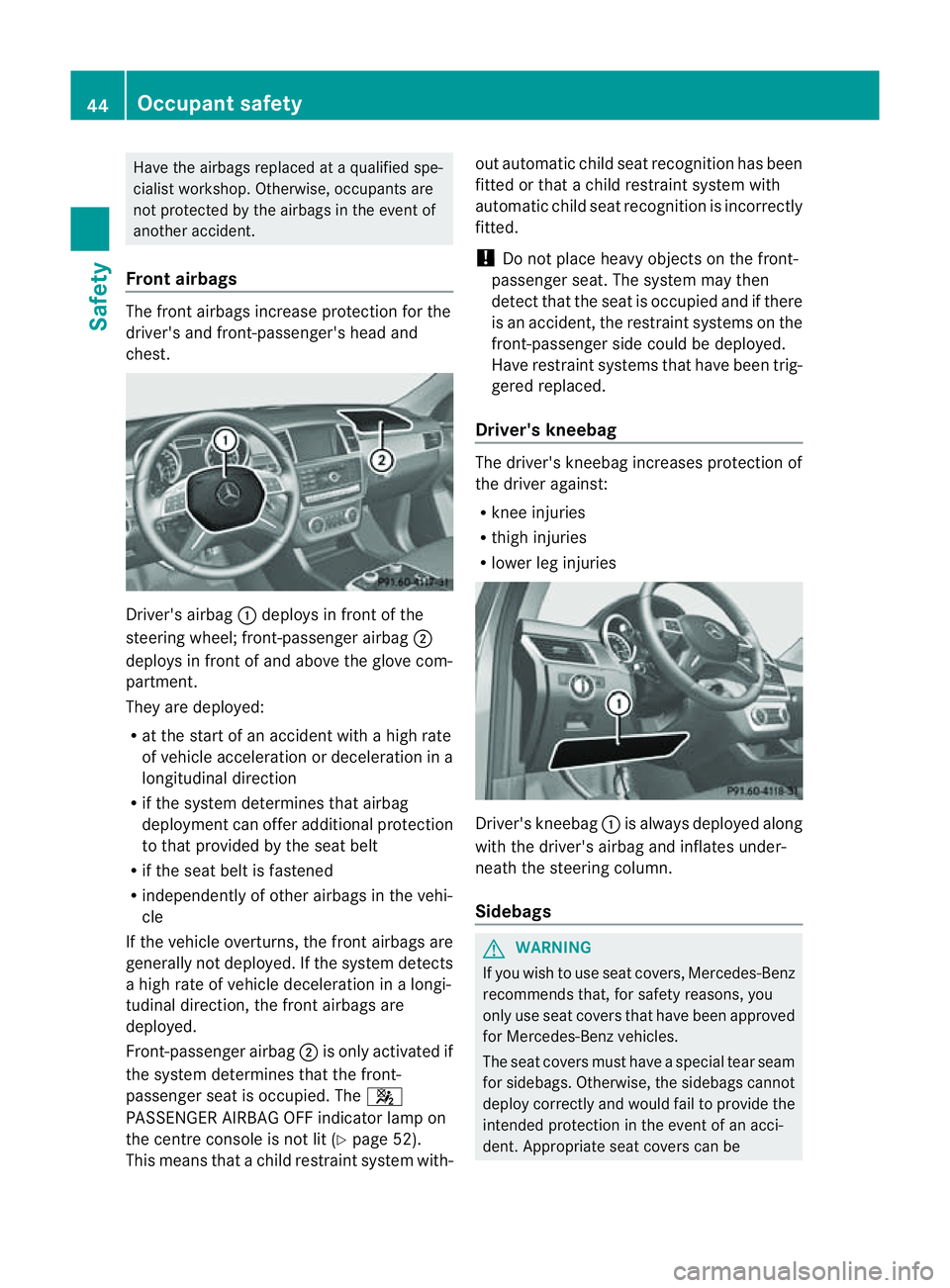
Front airbags Th
ef ront airbags increase protection for the
driver's and front-p assenger' sheada nd
chest. Driver'
sairbag :deploy sinfront of the
st ee ring wheel; front-p assenger airbag ;
deploys in front of and above the glove com-
partment.
They are deployed:
R at the start of an acciden twith ahigh rate
of vehicle acceleration or deceleration in a
longitudinal direction
R if the system determines that airbag
deploymen tcan offer additional protec tion
to that provide dbytheseat belt
R if th eseat belt is fastened
R independently of other airbag sinthe vehi-
cle
If the vehicle overturns ,the front airbags are
generally not deployed. If the system detec ts
ah igh rate of vehicle deceleration in alongi-
tudinal direction, the front airbags are
deployed.
Front-passenger airbag ;is only activated if
the system determines that the front-
passenger seat is occupied. The 4
PASSENGER AIRBA GOFF indicato rlamp on
the centre console is not lit (Y page 52).
This means that achild restraint system with- out automatic chil
dseat recognition has been
fitted or that achild restraint system with
automatic chil dseat recognition is incorrectly
fitted.
! Do not place heavy object sonthe front-
passenger seat. The system ma ythen
detec tthat the seat is occupied and if there
is an accident ,the restraint system sonthe
front-passenger side could be deployed.
Hav erestraint system sthat hav ebeen trig-
gered replaced.
Driver' skneebag The driver'
skneebag increases protection of
the driver against:
R knee injuries
R thig hinjuries
R lowe rleg injuries Driver's kneebag
:is always deployed along
with the driver' sairbag and inflates under-
neath the steering column.
Sidebags G
WARNING
If you wish to use seat covers, Mercedes-Benz
recommends that, for safety reasons, you
only use seat cover sthat hav ebeen approved
for Mercedes-Ben zvehicles.
The seat cover smust have aspecial tear seam
for sidebags. Otherwise, the sidebags cannot
deploy correctly and would fail to provide the
intended protection in the event of an acci-
dent .Appropriate seat cover scan be 44
Occupant safetySafety
Page 64 of 389
R
ABS ( Anti-lock BrakingSystem)
R BAS ( Brake Assist System)
R BAS PLU S(Brake Assist Sys tem Plus*)
R Adaptive brake lamps
R ESP ®
(Elec tronic Stability Program)
R EBD ( electronic brake force distribution)
R ADAP TIVE BRA KE
R PRE- SAFE ®
Brake
R STEER CONTROL Important safety notes
If yo ufail to adap tyou rd riving style, the driv-
ing safety systems ca nneither reduc ethe risk
of accident nor override the laws of physics.
Drivi ngsafety systems ar emerely aids
designed to assist driving. You are responsi-
ble for the distance to the vehicle in front ,for
vehicle speed and for brakin gingood time.
Always adapt your drivin gstyle to suit the
prevailing road and weather conditions, as
well as the traffic conditions and maintain a
safe distance from the vehicle in front .Drive
carefully.
i Please note that th edriving safetys ys-
tems described only work as effectively as
possibl ewhen ther eisadequate contact
between the tyres and the road surface.
Pay particula rattention to the information
regarding tyres, recommended minimum
tyre tread depth setc. in the "Wheels and
tyres" sectio n(Ypage 356).
In wintr ydriving conditions ,always use
winter tyres (M+S tyres) and if necessary,
snow chains. Only in this way will the driv-
ing safety systems described in this section
work as effec tivel yasp ossible. ABS (Anti-loc
kBrak ing System)
Impor tant safety notes i
Observ ethe "Importan tsafety notes" sec-
tion (Y page 61). ABS regulates brake pressure in such
away
that the wheels do not lock when you brake.
This allows you to continue steering the vehi-
cle when braking.
ABS works from aspeed of about 8km/h
upwards, regardless of road-surfac econdi-
tions. AB Sworksons lippery surfaces, even
when you only brake gently. G
WARNING
If ABS is faulty, the wheels could lock when
braking. This limits the steerability of the vehi-
cle when brakin gand the braking distance
may increase.
If ABS is deactivated due to amalfunction,
then BAS and ESP are also deactivated. There
is an increased risk of your vehicle skidding in
certain situations.
You shoul dalways adapt your drivin gstyle to
suit the prevailing road and weather condi-
tions.
Braking If ABS intervenes whe
nbraking, yo uwill feel
ap ulsing in the brake pedal.
X If ABS intervenes: continue to depressthe
brake pedal with force until the brakin gsit-
uation is over.
X To mak eafull brake application:
depress th ebrake peda lwith full force.
The pulsating brake pedal can be an indica-
tion of hazardous road conditions and func-
tions as areminder to take extr acare while
driving. G
WARNING
Do not depress the brake pedal several times
in quick succession (pumping). Pumping the
brake pedal reduces the braking effect .You
might otherwise not be able to stop the vehi-
cle in tim eand could cause an accident.
Depres sthe brake pedal firmly and smoothly. Driving safety systems
61Safety Z
Page 65 of 389
Off-road ABS
An AB
Ssystem specifically suited to off -road
ter rain is activated automatically once th eoff-
road program (Y page 222) is activated.
At speeds below 30 km/h, the front wheels
loc kc yclically durin gbraking .The digging-in
eff ect ac hieved in the process red ucesthe
stopping distanc eonoff-road terrain. This
limits steering capability. BAS (Brak
eAssist)
i Observ ethe "Importan tsafety notes" sec-
tion (Y page 61).
BAS operates in emergency braking situa-
tions. If you depress the brake pedal quickly,
BAS automatically boosts the braking force,
thus shortening the stopping distance.
X Keep the brake pedal firmly depressed until
the emergency braking situation is over.
ABS prevents the wheels from locking.
The brakes will function as usua lonce you
releas ethe brake pedal. BA Sisd eactivated. G
WARNING
If BAS has malfunctioned, the braking system
remains available with ful lbrake boosting
effect. However, braking force is not auto-
matically increased in emergency braking sit-
uations and th estopping distance may
increase. BAS PLU
S(Brak eAssist System Plus)
BA SP LUS is only availabl eonvehicles with
DI ST RONIC PLUS.
i Observe the "Important safety notes" sec-
tion (Y page 61).
BAS PLUS assists you in braking during haz-
ardous situations at speeds above 30 km/h
and uses the radar sensor syste mtoevaluate
the traffic situation.
With the hel pofthe radar sensor system ,BAS
PLUS can detect obstacles that are in the path of your vehicl
efor an exte nded period of
time.
At speeds up to approximately 70 km/h ,BAS
PLUS may also detect stationary obstacles,
for example ,stopped or parked vehicles.
Shoul dyou approach an obstacle and BAS
PLU Shas detected arisk of collision, BAS
PLU Scalculates the braking force necessary
to avoid arear-end collision .Should you apply
the brakes forcefully ,BAS PLUS can auto-
matically increase the braking force to alevel
suitabl efor the traffic conditions.
If BA SPLUS demand sparticularly high brak-
ing force, preventative passenger protection
measures (PRE-SAFE ®
)a re activate dsimul-
taneously.
X Keep the brake pedal depressed until the
emergenc ybraking situatio nisover.
ABS prevent sthe wheels from locking.
The brakes will wor knormally again if:
R you release the brake pedal.
R ther eisnol onger any danger of arear-end
collision.
R no obstacl eisdetected in front of your
vehicle.
BAS PLU Sisthen deactivated .Ifyou have
activated DSR (Y page 220), BASPLUS is
likewise deactivated.
Th er adar senso rsystem is switched off auto-
matically in the vicinity of radio telescope
facilities in the following vehicles:
R vehicles with COMAND Online and naviga-
tion
R vehicles with Audio 20 and Becker ®
MAP
PILOT
Becker ®
MAP PILOT must be connected;
see the separate Audio 20 operating
instructions. 62
Driving safety systemsSafety